Bio-based n-Butanol Market

Bio-based n-Butanol Market by Type (Starch-based, Sugar-based), Application (Direct Solvents, Adhesives & Sealants, Specialty Chemicals, Rubber & Plasticizers, Bio Fuels, and Others), and Region - Global Forecast to 2030




OVERVIEW
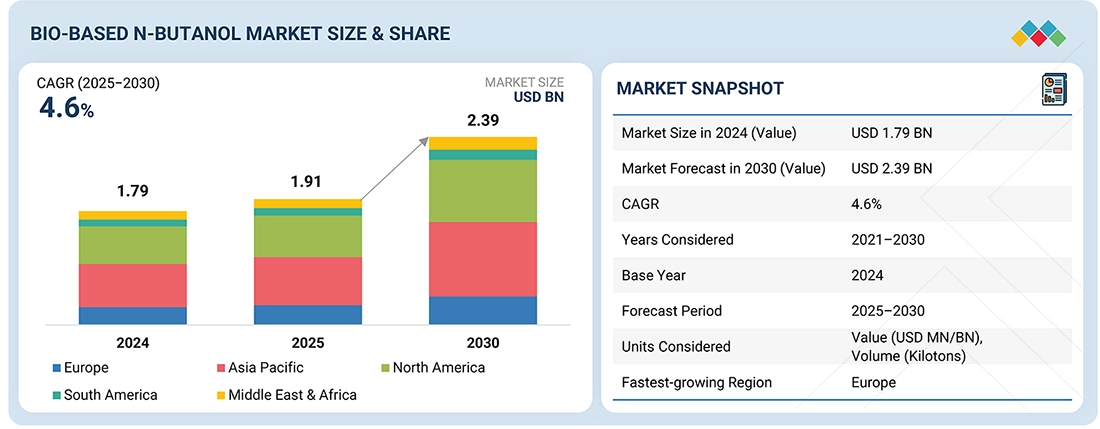
Source: Secondary Research, Interviews with Experts, MarketsandMarkets Analysis
The bio-based n-butanol market is projected to grow from USD 1.91 billion in 2025 to USD 2.39 billion in 2030 at a CAGR of 4.6% during the forecast period. The market is growing as chemical firms and their associated sectors are under increasing pressure to decrease carbon emissions and reduce their dependence on raw materials derived from fossil fuels. Bio-based n-butanol is becoming widely accepted since it provides the same quality as the traditional n-butanol while helping companies achieve their sustainability goals. Its compatibility with applications, including paints, coatings, adhesives, plastics, and chemical intermediates, presents an opportunity for manufacturers to switch to it without any major changes in the production process. The increasing demand especially from the construction, automotive, and packaging industries in Asia Pacific is also a factor that is contributing to the market growth. The costs are still higher than petrochemical alternatives; however, the continuous technological advancements, scaling up efforts, and long-term sustainability commitments increase the market attractiveness.
KEY TAKEAWAYS
-
BY APPLICATIONRubber & plasticizers segment is the fastest-growing amongst all applications, growing at a CAGR of 4.9% between 2025 and 2030.
-
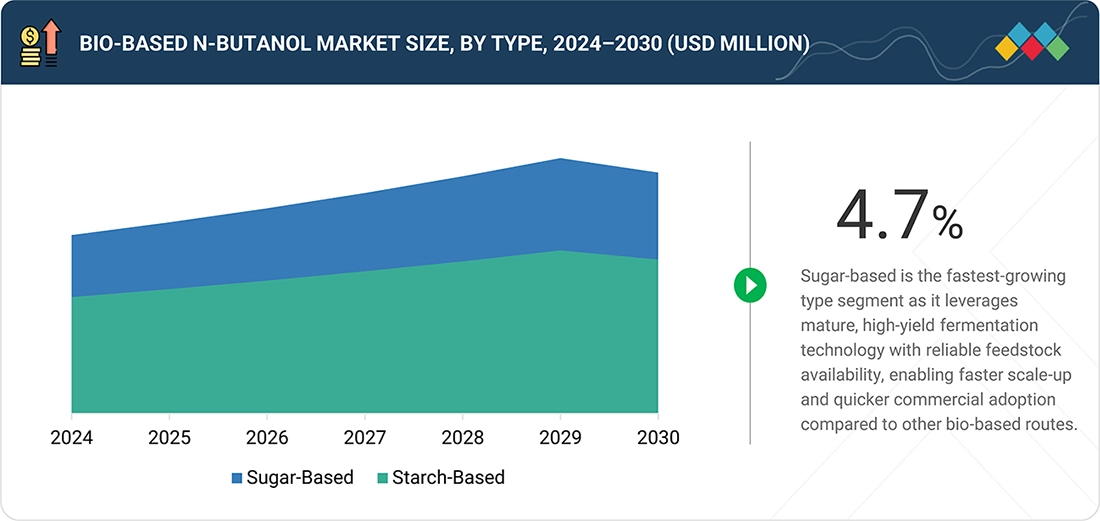
BY TYPESugar-based n-butanol is the fastest growing type segment in the bio-based n-butanol market, growing at a CAGR of 4.7% during the forecast period.
-
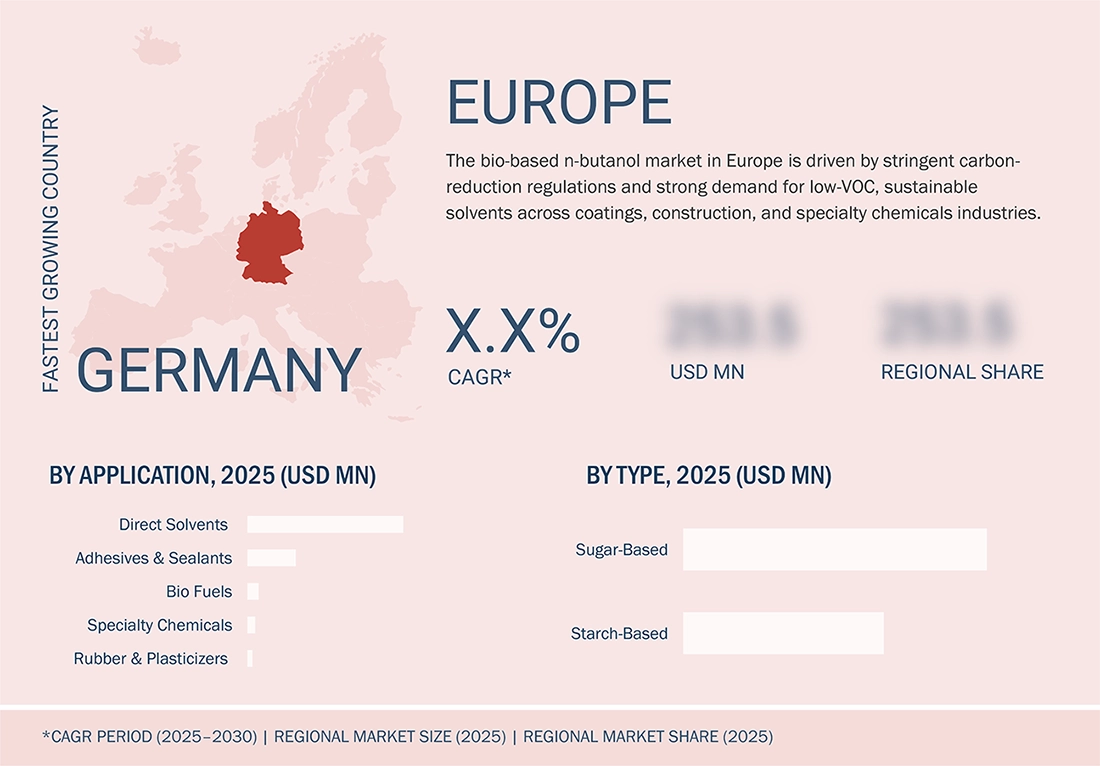
BY REGIONEurope is the fastest-growing market in the bio-based n-butanol market, growing at a CAGR of 5.0% during the forecast period.
-
COMPETITIVE LANDSCAPEThe bio-based n-butanol market is driven by product innovation, capacity expansions, and strategic collaborations among global leaders, such as BASF (Germany), Dow (US), Mitsubishi Chemical Group Corporation (Japan) and Petronas group (Berhard) (Malaysia). These companies are focusing on developing advanced bio-based n-butanol variants with enhanced efficiency, purity levels exceeding 99%, and sustainable bio-based production methods to cater to the growing demand from pharmaceuticals and personal care industries.
-
COMPETITIVE LANDSCAPENACALAI TESQUE, INC. and TOKYO CHEMICAL INDUSTRY CO., LTD. are considered under the other players of the bio-based n-butanol market.
The bio-based n-butanol market is on the rise, as chemical manufacturers are under pressure from the government and the public to cut carbon emissions and reduce their reliance on fossil fuel-based raw materials. Bio-based n-butanol has similar properties to conventional n-butanol, and it is less harmful to the environment, leading to increased acceptance. It has the same compatibility with applications such as paints, coatings, adhesives, plastics, and chemical intermediates, which means that switching over would not require any major changes in the process. Strong demand in construction, automotive, and packaging industries, mainly in Asia Pacific, is, in turn, fueling the growth further.
TRENDS & DISRUPTIONS IMPACTING CUSTOMERS' CUSTOMERS
Growing demand for bio-based solvents, sustainable coatings, low-VOC formulations, and green chemical intermediates–driven by regulatory pressures (REACH-style restrictions, China’s ecological civilization goals, India’s push for cleaner production, and ASEAN sustainability mandates–is rapidly reshaping purchasing patterns of n-butanol end users in paints & coatings, adhesives, pharmaceuticals, personal care, and plasticizers industries. This, in turn, significantly impacts the revenues of regional Bio based n-butanol producers and their upstream propylene suppliers.

Source: Secondary Research, Interviews with Experts, MarketsandMarkets Analysis
MARKET DYNAMICS

Level
-
Strong regulatory and sustainability push

-
Drop-in compatibility of bio-based n-butanol with existing petrochemical n-butanol applications


Level
-
High production cost compared with petro-based n-butanol


Level
-
Use of waste and non-food biomass feedstocks

-
Rising demand for green solvents in high-value applications


Level
-
Achieving efficient scale up of fermentation and downstream processing operations

Source: Secondary Research, Interviews with Experts, MarketsandMarkets Analysis
Driver: Strong regulatory and sustainability push
The bio-based n-butanol market is primarily driven by increasing regulatory and sustainability concerns that chemical makers and end-use industries can no longer ignore. The governments in the leading economies are gradually setting more stringent carbon reduction targets and promoting the switch from fossil fuel-derived products to renewable and bio-based chemicals. Bio-based n-butanol is a sustainable option, and its carbon footprint is lower than that of petrochemical counterparts made from renewable or waste feedstock. The biggest downstream sectors, such as paints, coatings, and adhesives, and packaging, are turning more toward making the required transition to sustainable raw materials by laying out sustainability roadmaps. For these sectors, it is challenging to handle environmental objectives, so they make a switch to bio-based n-butanol, which is an easy option to meet the targets without displacing performance. The other factors here are that corporate ESG reporting and consumer demand for eco-friendly products are making it necessary for the manufacturers
Restraints: High production cost compared with petro-based n-butanol
The principal limitation that hampers the speedier uptake of bio-based n-butanol is not its environmental impact but rather its higher production cost compared with conventional petrochemical n-butanol. The bio-based production routes, mainly fermentation-based processes, are costlier because they also involve the use of expensive feedstock, intricate fermentation control, and energy-consuming purification steps. Moreover, the majority of the bio-based n-butanol plants are still working at smaller sizes compared to the already matured petrochemical plants, thus limiting them from possible gains due to the large scale of production. The volatility of feedstock prices particularly affects sugar raw material and has a significant impact on the cost competitiveness of the bio-based n-butanol. Industries that are highly sensitive to the prices and where bio-based n-butanol is an option are coatings and construction chemicals nonetheless for them cost is still the most important factor in making a decision. Thus, the usage of bio-based n-butanol is often by the sustainability pledges and not necessarily by the economics. It will be a challenge to achieve cost parity with petro-based n-butanol as long as the production technologies do not reach full maturity, the scales do not become larger, and the feedstock optimization does not get better, thus, it will be a slow process in highly competitive markets.
Opportunity: Use of waste and non-food biomass feedstocks
One of the significant prospects for the bio based n-butanol market is the growing application of waste and non-food biomass feedstocks like corn stover, bagasse, agricultural residues, and industrial organic waste. Greatly decreasing feedstock costs and at the same time averting hassles associated with the food-versus-fuel debates can be achieved by the switch from food-based sugars. The improvement of the pretreatment technologies, enzymatic hydrolysis, and microbial fermentation has made it more viable to convert lignocellulosic biomass into fermentable sugars for n-butanol production. The use of waste biomass not only facilitates n-butanol production but also enhances its overall environmental profile by cutting down on lifecycle emissions and fostering circular economy practices. This strategy presents an opportunity to the regions that have large amounts of agricultural waste, such as Asia Pacific and Latin America. With the future one of the anticipated outcomes would be that waste-based production routes will unlock cost reductions along with supporting the wide market adoption of bio based n-butanol which at that point will be at par with petrochemical alternatives.
Challenegs: Achieving efficient scale up of fermentation and downstream processing operations
The most important factor that the bio based n-butanol market has to face is the efficient scaling up of fermentation and downstream processing. Technical difficulties are hindering the n-butanol fermentation process, these include the toxicity of products to microbes, lower yields as compared to ethanol, and complex recovery processes. Extracting n-butanol from fermentation broth after it has been produced is a very energy-demanding process and this translates into high production costs. To get the same quality and stable output as the laboratory scale at the commercial scale takes a lot of technological improvement and capital investment. Moreover, the new bioprocesses scaling up may bring in operational risks which in turn can slow down the commercialization process. According to experts, the solving of the above-mentioned issues will come with improvements in strain engineering, process optimization, and separation technologies. Right now the situation is such that large-scale and cost-effective production of bio-based n-butanol is still very much a technical challenge, and thus rapid market expansion will be limited.
BIO-BASED N-BUTANOL MARKET: COMMERCIAL USE CASES ACROSS INDUSTRIES
| COMPANY | USE CASE DESCRIPTION | BENEFITS |
|---|---|---|
 |
Development of n-butanol-based intermediates for pharmaceutical formulations in chronic disease management | Enhanced therapeutic efficacy | Reduced production costs | Potential applications in cardiovascular and neuroprotective drugs, supporting China's growing pharma sector |
 |
Use of n-butanol in skincare and personal care formulations as a solvent and carrier for active ingredients | Improved product stability and absorption | Eco-friendly alternative to synthetic solvents, enhanced brand sustainability image in Japan's cosmetics market |
 |
Incorporation of n-butanol as a solvent and preservative in functional foods & beverages | Longer shelf life | Clean-label solutions | Consumer preference for natural ingredients, aligning with Southeast Asia's rising F&B demand |
 |
Research into n-butanol-derived coatings and polymers for sustainable packaging | Development of eco-friendly materials | Reduced environmental impact, alignment with circular economy goals in Taiwan's plastics industry |
Logos and trademarks shown above are the property of their respective owners. Their use here is for informational and illustrative purposes only.
MARKET ECOSYSTEM
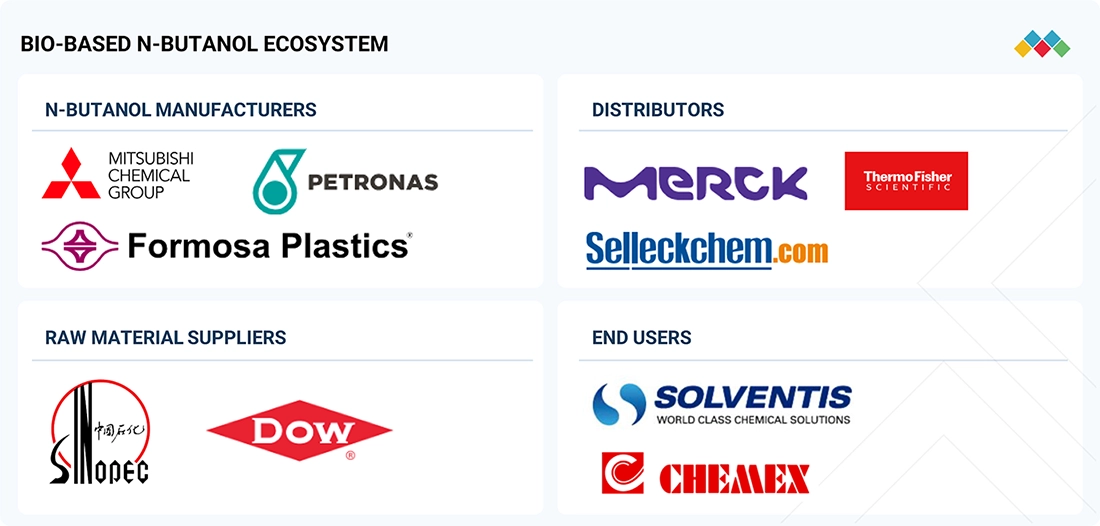
The bio-based n-butanol ecosystem analysis involves identifying and examining the interconnected relationships among key stakeholders, including raw material suppliers (primarily propylene and syngas providers), n-butanol manufacturers, distributors, and downstream end users. Propylene suppliers deliver feedstock to manufacturers, who produce n-butanol through oxo-alcohol processes. Distributors and specialized traders bridge manufacturing companies and end users in sectors such as paints & coatings, adhesives, pharmaceuticals, plasticizers, and construction chemicals, streamlining the supply chain, reducing lead times, and enhancing operational efficiency and profitability across the entire regional value chain.
Logos and trademarks shown above are the property of their respective owners. Their use here is for informational and illustrative purposes only.
MARKET SEGMENTS
Source: Secondary Research, Interviews with Experts, MarketsandMarkets Analysis
Bio-based n-Butanol Market, By Type
The bio-based n-butanol market is dominated by the sugar-based segment due to the easy and efficient conversion of sugar feedstocks, such as sugarcane, sugar beet, and molasses, into n-butanol through fermentation, in contrast to starch-based materials, sugars can be directly fermented, so there is no need for additional processing steps, such as enzymatic hydrolysis, which are required for starch-based feedstocks. This leads to higher fermentation efficiency, better yields, and lower overall production complexity. Moreover, sugar feedstocks are abundantly available in major producing regions especially in Asia Pacific and Latin America, where strong agricultural output secures a reliable and scalable supply chain. The established fermentation infrastructure in these areas further fortifies the dominance of sugar-based routes. Besides, sugar-based production has consistent quality, faster processing, and better cost control at commercial scale compared with starch-based feedstocks, which makes it the preferred choice for producers and contributes to its larger market share.
Bio-based n-Butanol Market, by Application
The direct solvents segment is holding the largest market share. The primary usage of direct solvent stills is the consumption of bio-based n-butanol, as n-butanol is consumed in large amounts as a solvent in industrial sectors, including paints & coatings, adhesive, inks, and cleaning formulations. Moreover, the direct use of bio-based n-butanol can substitute fossil-based n-butanol in these applications without the need of any performance, formulation stability, or production processes change, thus making it easier for manufacturers to adopt. The demand for such solvents that are sustainable and have low VOC content is on the rise as the regulations become stricter and the consumers' choice turns towards the environment-friendly products. Being that the solvent applications are the largest consumers of n-butanol with the minimum requirement of reformulation that is why they are considered to be the fastest and the easiest pathway for market adoption.
REGION
Europe to be fastest-growing region in global bio-based n-butanol market during forecast period
The bio-based n-butanol market in Europe is experiencing the fastest growth rate among all regions worldwide, primarily due to the strong regulatory measures implemented in favor of low-carbon and sustainable chemicals. As part of the Green Deal and other initiatives, the EU has set very high climate and emission-reduction targets that encourage the use of bio-based substances instead of fossil-based ones in chemical industries. The regulatory framework is supporting the continual utilization of bio-based solvents in the key end-use industries, such as paints and coatings, adhesives, automotive, and construction. On the other hand, Europe witnesses strict standards for VOC and environmental compliance, making bio-based n-butanol a promising solution that helps manufacturers stay in line with the regulations without cutting back on performance. Besides, the region is well-equipped with R&D skills, collaboration between chemical firms and research institutions is well-established, and there is government support for biorefinery and fermentation technology. Moreover, consumers and brand owners in Europe are becoming more and more concerned about sustainability and the use of bio-based materials, thereby forcing the downstream industries to switch to greener raw materials. These factors combined are making the bio-based n-butanol market grow faster in Europe than any other region.
BIO-BASED N-BUTANOL MARKET: COMPANY EVALUATION MATRIX
In the bio-based n-butanol market, Mitsubishi Chemical Group (Star) leads with a dominant market share and a strong regional presence. Supported by its extensive portfolio of bio-based n-butanol and derivative products used across paints & coatings, adhesives, plastics, and chemical intermediates. Dow (Emerging leader) leverages advanced production technologies and innovative formulations to strengthen its competitive positioning, particularly in high-growth markets, such as India, China, and Southeast Asia. Meanwhile, other participants are increasing visibility by offering specialty bio-based n-butanol grades and derivatives for niche applications, including high-purity solvents and sustainable chemical solutions. While Mitsubishi Chemical Group maintains leadership through scale and technological expertise, Dow and other emerging players show rising potential to capture greater market share as demand for industrial-grade and specialty n-butanol continues to grow globally.
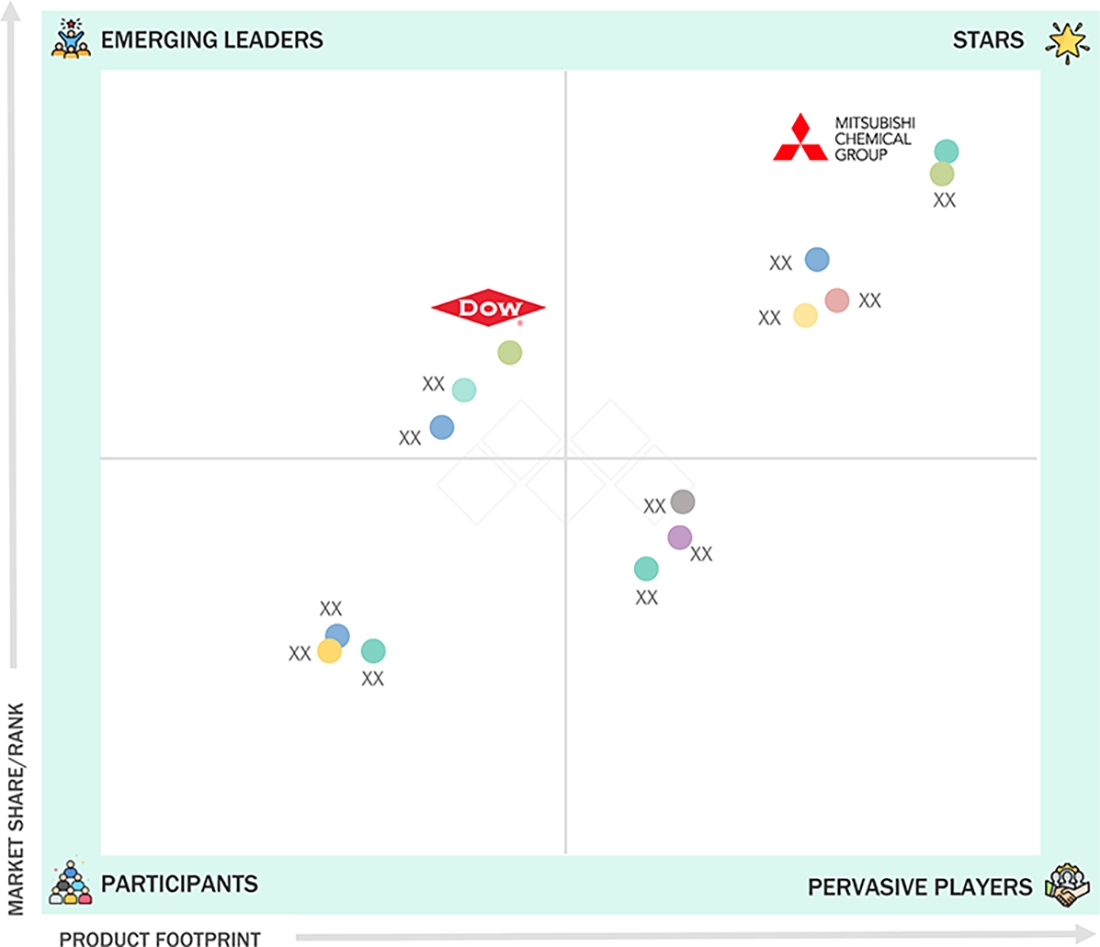
Source: Secondary Research, Interviews with Experts, MarketsandMarkets Analysis
KEY MARKET PLAYERS
- BASF (Germany)
- Dow (US)
- SABIC (Saudi Arabia)
- Mitsubishi Chemical Group Corporation (Japan)
- Eastman Chemical Company (US)
- Sasol Limited (South Africa)
- OQ Chemicals GmbH (Germany)
- PetroChina Company Limited (China)
- KH Neochem Co., Ltd. (Japan)
- Petronas Chemicals Group Berhad (Malaysia)
MARKET SCOPE
| REPORT METRIC | DETAILS |
|---|---|
| Market Size in 2024 (Value) | USD 1.79 Billion |
| Market Forecast in 2030 (Value) | USD 2.39 Billion |
| Growth Rate | CAGR of 4.6% from 2025–2030 |
| Years Considered | 2021–2030 |
| Base Year | 2024 |
| Forecast Period | 2025–2030 |
| Units Considered | Value (USD Million/Billion), Volume (Tons) |
| Report Coverage | Revenue forecast, company ranking, competitive landscape, growth factors, and trends |
| Segments Covered |
|
| Regions Covered | Asia Pacific, Europe, North America, Middle East & Africa, and South America |
WHAT IS IN IT FOR YOU: BIO-BASED N-BUTANOL MARKET REPORT CONTENT GUIDE
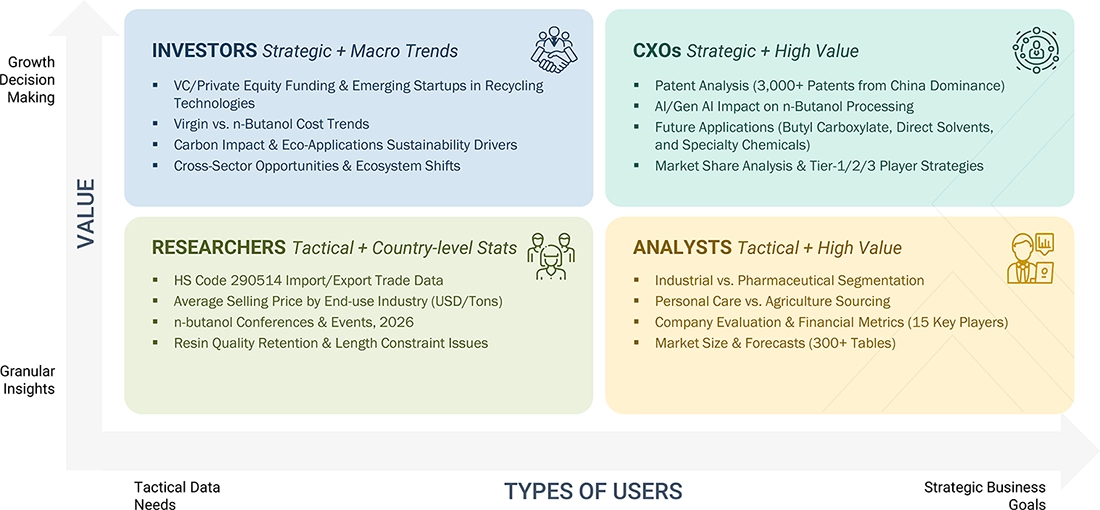
DELIVERED CUSTOMIZATIONS
We have successfully delivered the following deep-dive customizations:
| CLIENT REQUEST | CUSTOMIZATION DELIVERED | VALUE ADDS |
|---|---|---|
| Country-Level Breakdown | Instead of only regional coverage, the report provides country-specific analysis for key bio-based n-butanol markets such as China, India, Japan, South Korea, Germany, France, the Netherlands, the U.S., and Brazil. The analysis includes demand drivers, bio-based production capacity, feedstock availability, import–export trends, regulatory frameworks, and sustainability policies supporting bio-based chemicals. | Helps stakeholders identify high-growth national markets, design precise market entry or expansion strategies, assess policy-driven demand, and forecast country-level consumption with higher accuracy. |
| Application-Specific Deep Dive | Customized analysis of bio-based n-butanol applications with detailed sub-segmentation, including direct solvents (paints, coatings, inks, adhesives, cleaners), chemical intermediates (butyl acrylates, butyl acetates, glycol ethers), plastics and polymers, pharmaceuticals, and specialty chemicals. Each application is evaluated based on demand growth, sustainability adoption, and substitution potential. | Supports clients in targeting high-growth and premium applications, optimizing R&D investments, and developing application-focused product and sales strategies. |
| Feedstock / Production Route Segmentation | Comparative analysis of bio-based n-butanol by feedstock and production route, including sugar-based, starch-based, and lignocellulosic or waste-based pathways. The study assesses yield efficiency, production cost structure, scalability, technology maturity, and sustainability impact of each route. | Enables producers and investors to select optimal feedstock strategies, improve cost competitiveness, and identify long-term scalable and sustainable production opportunities. |
| Competitive Benchmarking | Extended profiling of key global and regional players involved in bio-based n-butanol production and technology development. Covers business overview, production approach, geographic presence, sustainability positioning, partnerships, and innovation strategies. Includes competitive benchmarking to highlight strengths, gaps, and strategic positioning. | Provides clients with a clear competitive landscape, helping identify positioning opportunities, potential partners, acquisition targets, and differentiation strategies in the bio-based n-butanol market. |
RECENT DEVELOPMENTS
- August 2024 : BASF signed a Memorandum of Understanding (MoU) with UPC Technology Corporation to strengthen strategic cooperation on plasticizer alcohols and catalysts. Under this agreement, BASF will supply n-butanol and 2-Ethylhexanol from its new Zhanjiang Verbund site in China (scheduled to begin operations in 2025) to meet UPC’s growing demand, especially in South China. The partnership also includes collaboration on sustainable solutions and promotion of lower-carbon products like biomass balance (BMB) grades.
- May 2022 : Mitsubishi Chemical Group Corporation established Mitsubishi Chemical Holdings Asia Pacific Pte. Ltd. in Singapore to strengthen its regional presence. The expansion supports the manufacturing and marketing of n-butanol and specialty chemicals, enhancing market development, customer engagement, and regulatory compliance across Asia Pacific.
Table of Contents
 Exclusive indicates content/data unique to MarketsandMarkets and not available with any competitors.
Methodology
The study involved four major activities in estimating the market size of the Bio-based n-Butanol Market . Exhaustive secondary research was done to collect information on the market, the peer market, and the grandparent market. The next step was to validate these findings, assumptions, and sizing with industry experts across the value chain through primary research. Both top-down and bottom-up approaches were employed to estimate the complete market size. Thereafter, the market breakdown and data triangulation procedures were used to estimate the market size of the segments and subsegments.
Secondary Research
In the secondary research process, various secondary sources have been referred to for identifying and collecting information for this study. These secondary sources include annual reports, press releases, investor presentations of companies, white papers, certified publications, trade directories, articles from recognized authors, gold standard and silver standard websites, and databases. Secondary research has been used to obtain key information about the value chain of the industry, monetary chain of the market, the total pool of key players, market classification and segmentation according to industry trends to the bottom-most level, and regional markets. It was also used to obtain information about the key developments from a market-oriented perspective.
Primary Research
The Bio-based n-Butanol Market comprises several stakeholders in the value chain, which include manufacturers, and end users. Various primary sources from the supply and demand sides of the Bio-based n-Butanol Market have been interviewed to obtain qualitative and quantitative information. The primary interviewees from the demand side include key opinion leaders in chemical sector. The primary sources from the supply side include manufacturers, associations, and institutions involved in n-butanol industry. Primary interviews were conducted to gather insights such as market statistics, data of revenue collected from the products and services, market breakdowns, market size estimations, market forecasting, and data triangulation. Primary research also helped in understanding the various trends related to type, end-use industry, and region. Stakeholders from the demand side, such as CIOs, CTOs, and CSOs were interviewed to understand the buyer’s perspective on the suppliers, products, component providers, and their current usage of n-butanol and outlook of their business, which will affect the overall market.
The breakdown of profiles of the primary interviewees is illustrated in the figure below:
To know about the assumptions considered for the study, download the pdf brochureMarket Size Estimation
The top-down and bottom-up approaches have been used to estimate and validate the size of the Bio-based n-Butanol Market .
- The key players in the industry have been identified through extensive secondary research.
- The supply chain of the industry has been determined through primary and secondary research.
- All percentage shares, splits, and breakdowns have been determined using secondary sources and verified through primary sources.
- All possible parameters that affect the markets covered in this research study have been accounted for, viewed in extensive detail, verified through primary research, and analyzed to obtain the final quantitative and qualitative data.
- The research includes the study of reports, reviews, and newsletters of the key market players, along with extensive interviews for opinions with leaders such as directors and marketing executives.
Data Triangulation
After arriving at the total market size from the estimation process, the overall market has been split into several segments and sub-segments. To complete the overall market engineering process and arrive at the exact statistics for all the segments and sub-segments, the data triangulation and market breakdown procedures have been employed, wherever applicable. The data has been triangulated by studying various factors and trends from both the demand and supply sides. Along with this, the market size has been validated by using both the top-down and bottom-up approaches and primary interviews. Hence, for every data segment, there have been three sources—top-down approach, bottom-up approach, and expert interviews. The data was assumed correct when the values arrived from the three sources matched.
Market Definition
The chemical formula for n-butanol, also known as normal butanol or n-butyl, is represented by C3H9OH. It is a transparent liquid with a strong, easily recognizable smell. From a chemical standpoint, n-butanol is distinguished by its boiling point of 117.7°C and freezing point of -89.0°C. The substance has a density of approximately 0.8109 g/cm3 at a temperature of 20 degrees Celsius. It has limited solubility in water, around 7.7% by weight at the same temperature, but can dissolve in various organic solvents like ethanol and ether. Because of its tendency to easily catch fire, n-butanol is commonly utilized. It is used in a variety of industries for its function as a solvent and as a chemical intermediary in the creation of other substances.
Stakeholders
- Senior Management
- End User
- Finance/Procurement Department
- R&D Department
- Manufacturers
- Raw Material Suppliers
Report Objectives
- To define, describe, and forecast the size of the Bio-based n-Butanol Market , in terms of value and volume.
- To provide detailed information regarding the major factors (drivers, opportunities, restraints, and challenges) influencing the growth of the market
- To estimate and forecast the market size based on grade, distribution channel, feedstock, application, end-use industry, and region.
- To forecast the size of the market with respect to major regions, namely, Europe, North America, Asia Pacific, Middle East & Africa, and South America, along with their key countries
- To strategically analyze micromarkets with respect to individual growth trends, prospects, and their contribution to the overall market
- To analyze opportunities in the market for stakeholders and provide a competitive landscape of market leaders.
- To track and analyze recent developments such as expansions, new product launches, partnerships & agreements, and acquisitions in the market.
- To strategically profile key market players and comprehensively analyze their core competencies.


Personalize This Research
- Triangulate with your Own Data
- Get Data as per your Format and Definition
- Gain a Deeper Dive on a Specific Application, Geography, Customer or Competitor
- Any level of Personalization
Let Us Help You
- What are the Known and Unknown Adjacencies Impacting the Bio-based n-Butanol Market
- What will your New Revenue Sources be?
- Who will be your Top Customer; what will make them switch?
- Defend your Market Share or Win Competitors
- Get a Scorecard for Target Partners

Custom Market Research Services
We Will Customise The Research For You, In Case The Report Listed Above Does Not Meet With Your Requirements
Get 10% Free CustomisationTESTIMONIALS
We at Nissan Chemicals Corporation have been clients of MarketsandMarkets for more than a year now. We recently consulted MarketsandMarkets for a study, the team at MarketsandMarkets was extremely professional and organized. The business insights were very detailed and aligned well with our expectations that really helped us formulate the Business Plans and device new strategies for development themes. MarketsandMarkets offers a unique combination of expertise and dedicated engagement model. Their research findings have helped us in designing our Pricing Strategy which will make it easier for us to predict the future sales and profits for the next ten years. We look forward to working with MarketsandMarkets in the future.
VP of Strategy & New Business Development
Leading Specialty Chemical Company
The MarketsandMarkets Engagement Model, composed of both the Knowledge Store and advisory custom research, has greatly helped us in understanding our markets and making strategic decisions. The Knowledge Store is a fast way to allow everyone in our organization to understand more about most any market they are interested in. The ability to then get custom research done and get answers to specific strategic questions and market insight has been spectacular. The Markets and Markets team feel more like colleagues than vendors and their services have helped us change our culture where statements of things like growth opportunities and competitive position are always backed by industry research.

Rich Gibson,
Director, Corporate Strategy
Milliken & Company,
Leading Industrial Manufacturer of specialty chemical, floor covering, performance and protective textile materials, and healthcaremilliken.com
MarketsandMarkets is a trusted resource that helps us to better understand markets that are near-adjacencies-whether its technology, value chain or geography. Their Knowledge Store platform provides a dashboard of markets and their characteristics which is easy to use and saves us time.
Adam Shaw,
Market Development and Strategy Manager
AdvanSix Inc. USA,
An American Leader in Chemicalswww.advansix.com
The Knowledge Store from MarketsandMarkets is a valuable tool which has helped my team acquire greater insight in to the end markets that our business serves. This has enabled us to help our company build stronger strategies throughout our planning process.
TOSHIO KINOSHITA
Senior Chif Consultion Research & Consulting Division
Mitsubishi Chemical Research Corporation,
Leading Manufacturer of Chemical Productswww.mitsubishichem-res.co.jp/en/

We recently engaged with MarketsandMarkets for a study, the team not only clearly understood our business objectives but was also extremely professional in the way they handled the entire project. The study was efficiently conducted in a phase-wise manner, and the engagement model furnished us with high-quality business insights that far exceeded our expectations at each phase. We were especially happy that MarketsandMarkets could provide us with both, an English as well as a Japanese version of the study. A special thanks to the Analyst Team and Client Services Team, whose fluency in Japanese enhanced our comfort level, as we could converse with them in our preferred language.
Independent entrepreneurs
Arrow Precision
We approached MarketsandMarkets for study on Proppants Market, and their work exceeded our expectations. The study conducted was comprehensive and enabled us to view the market through the various dimensions. In addition, the team was extraordinarily responsive throughout the process and resolved our queries on time. I strongly recommend MarketsandMarkets and will certainly consider them for additional market assessments we will need in the future.
Global engineering company, Japan
Deputy Manager,
Strategic Planning OfficeThe high-quality insights shared by the MarketsandMarkets team helped us understand the pharmaceutical plant designers in a specific geography. It also captured the risks that we may likely face in communicating with our potential partners. The study would enable us identify partners, which would impact our future growth.






Growth opportunities and latent adjacency in Bio-based n-Butanol Market