Bluetooth Low Energy (BLE) Indoor Location Market

Bluetooth Low Energy (BLE) Indoor Location Market by Hardware (Beacons, Tags, Sensors), Application (Indoor Navigation, Asset Tracking, Workforce Management, Inventory Management) - Global Forecast to 2030




OVERVIEW
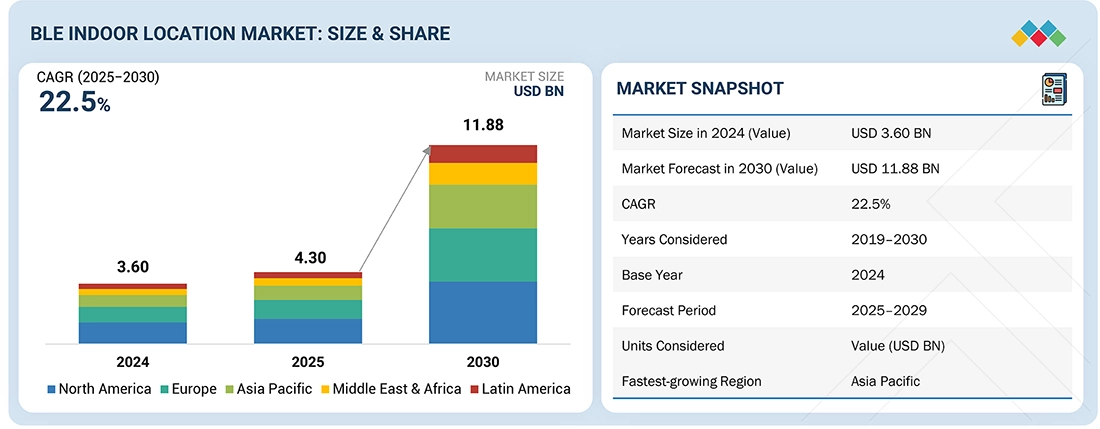
Source: Secondary Research, Interviews with Experts, MarketsandMarkets Analysis
The BLE indoor location market is projected to grow from USD 4.30 billion in 2025 to USD 11.88 billion by 2030, at a CAGR of 22.5% from 2025 to 2030. The market is accelerating due to urgent demand for affordable, real-time asset tracking to improve efficiency in logistics, healthcare, and manufacturing. It is further driven by widespread smartphone use, enabling precise indoor navigation and personalized services in public spaces such as airports and malls.
KEY TAKEAWAYS
-
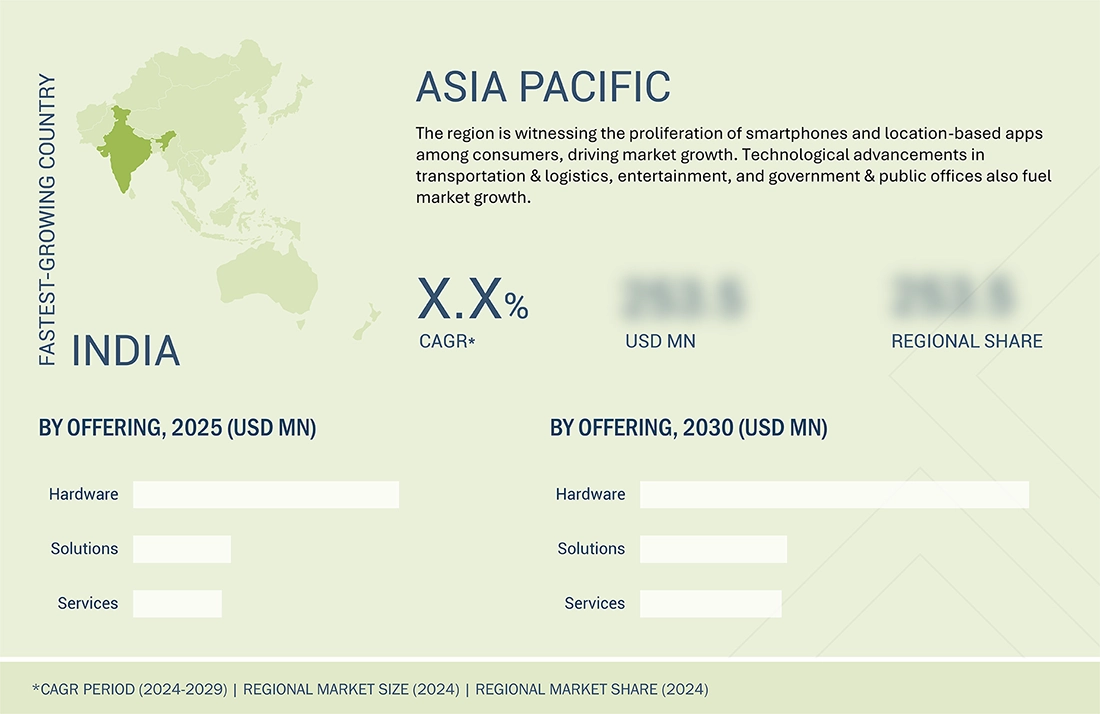
By RegionAsia Pacific is projected to be the fastest regional market, at a CAGR of 25%.
-
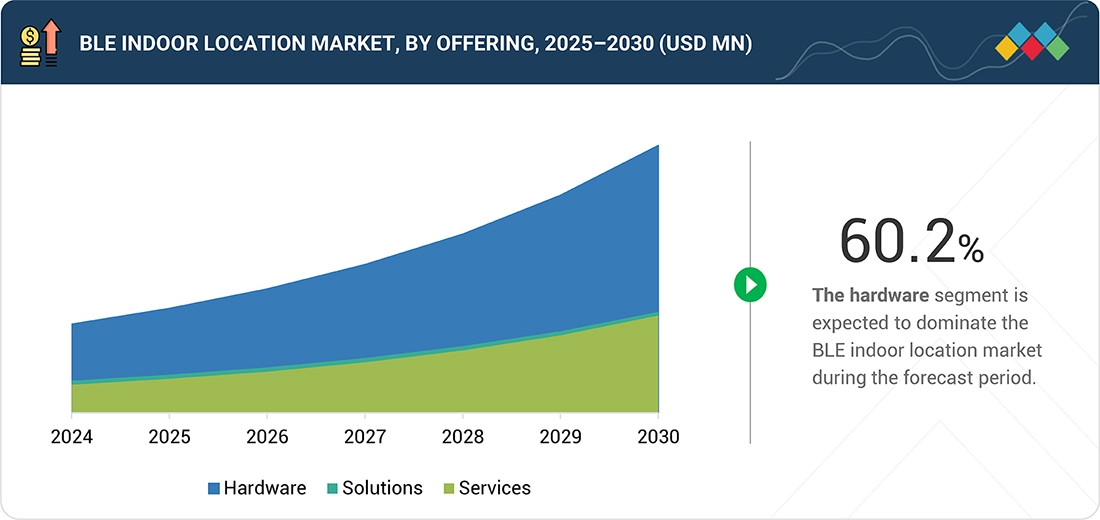
By OfferingBy offering, the services segment is expected to register the highest CAGR of 20.9%.
-
By ApplicationBy application, the workforce management segment is projected to be the fastest, at a CAGR of 19.7%.
-
By VerticalBy vertical, the retail segment is projected to hold the largest market size in 2025.
-
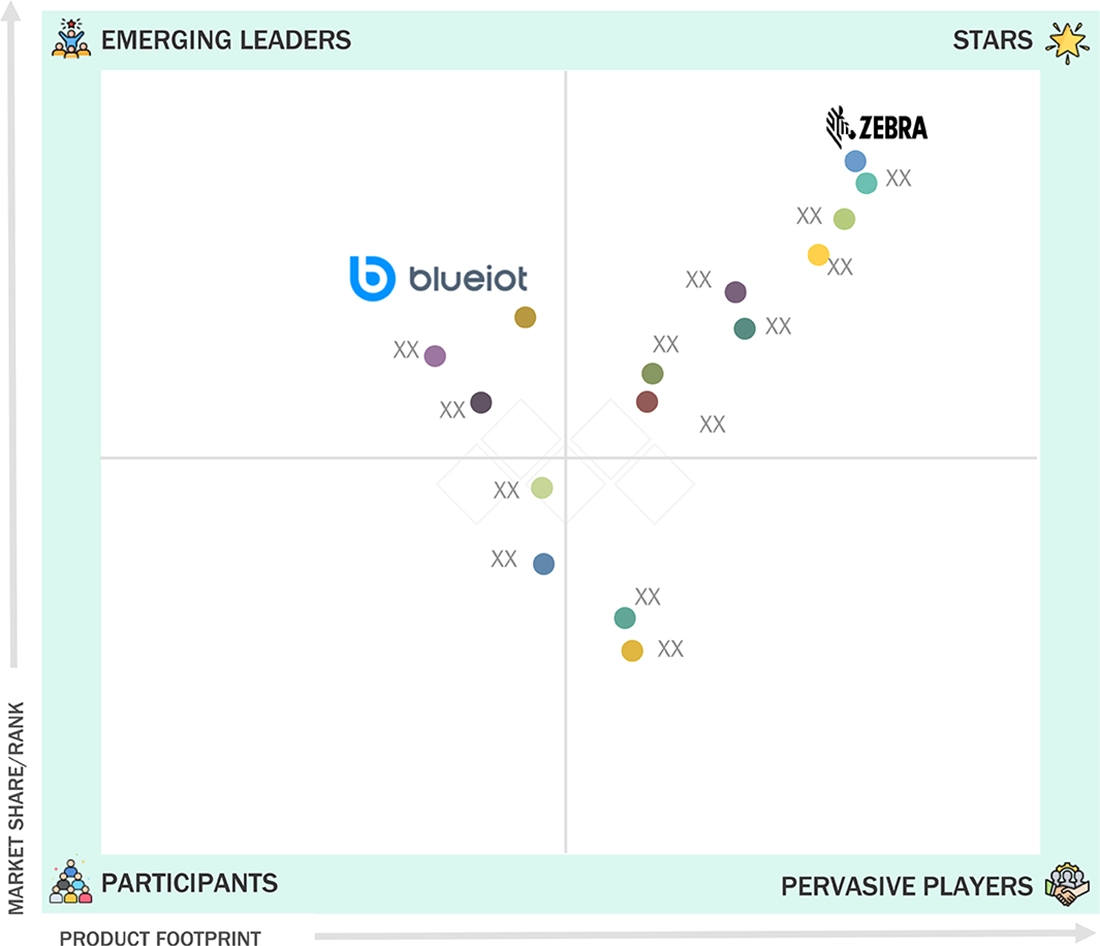
Competitive Landscape - Key PlayersZebra Technologies, Cisco, HPE, Pointr, and Mapsted were identified as some of the star players in the BLE indoor location market (global), given their strong market share and product footprint.
-
Competitive Landscape - Startups/SMEsLocatify, Kontakt.IO, and Anantics are some of the progressive companies that stand out by offering specialized, industry-tailored BLE Indoor Location solutions.
The BLE indoor location market is evolving from simple proximity marketing to high-value industrial IoT applications, further driven by BLE’s ability to deliver sub-meter accuracy at a fraction of the infrastructure cost and power consumption of UWB or Wi-Fi.
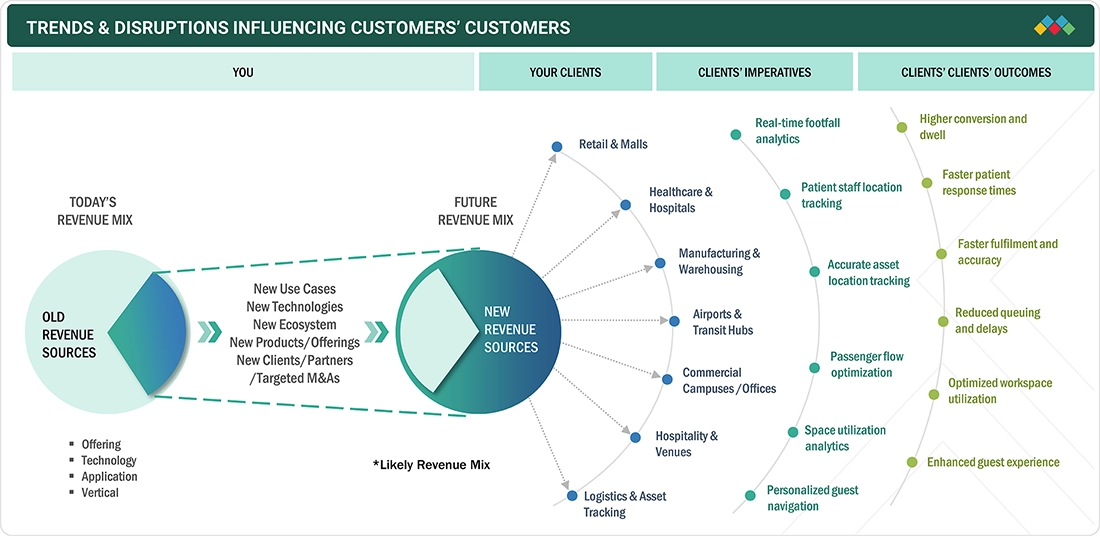
TRENDS & DISRUPTIONS IMPACTING CUSTOMERS' CUSTOMERS
The impact on consumers' business in the BLE indoor location market stems from evolving customer needs and industry disruptions. Hot bets include BLE Angle of Arrival (AoA), sensor fusion, and edge analytics, which are shifting indoor positioning from approximate tracking to centimeter-accurate, context-aware services and monetizable location platforms. Disruptions include dense sensor deployments, privacy concerns, and standards fragmentation. End users gain better asset utilization, personalized experiences, faster fulfillment, and reduced shrinkage.
Source: Secondary Research, Interviews with Experts, MarketsandMarkets Analysis
MARKET DYNAMICS

Level
-
Prevalence of Bluetooth-Enabled Devices and Bring Your Own Device (BYOD) Readiness

-
Advent of Bluetooth 5.1 and Direction Finding using Angle of Arrival (AoA) and Angle of Departure (AoD)


Level
-
Spectrum Crowding and 2.4 GHz Interference

-
Security Vulnerabilities and Spoofing Risks


Level
-
Integration with Mesh Networking for Smart Building Ecosystems

-
Expansion into Contact Tracing and Occupational Safety


Level
-
Hardware Fragmentation and Battery Maintenance

-
Achieving Stability in Complex "Multipath" Environments

Source: Secondary Research, Interviews with Experts, MarketsandMarkets Analysis
Driver: Prevalence of Bluetooth-Enabled Devices and Bring Your Own Device (BYOD) Readiness
As Bluetooth becomes more widely adopted in consumer smartphones, tablets, and wearables, the adoption of BLE indoor location is expected to accelerate. Technologies such as Ultra-Wideband (UWB) or active RFID often require users to carry proprietary tags. By contrast, BLE allows businesses to leverage the devices that visitors already use. This "client-based" architecture significantly lowers the barrier to entry, enabling venues such as airports, museums, and malls to launch wayfinding and proximity marketing apps. These apps are immediately accessible to billions of potential users without distributing additional hardware.
Restraint: Spectrum Crowding and 2.4 GHz Interference
A significant limitation of BLE technology is its operation in the crowded 2.4 GHz ISM radio band, the same frequency used by Wi-Fi, Zigbee, and microwaves. In indoor environments such as hospitals or corporate offices, hundreds of devices transmit BLE signals simultaneously, leading to collisions and noise. This results in packet loss or jittery location data. This physical limitation forces system integrators to conduct complex site surveys and channel planning to ensure reliability, further increasing deployment complexity compared with proprietary tracking solutions operating on cleaner, licensed frequencies.
Opportunity: Integration with Mesh Networking for Smart Building Ecosystems
The evolution of Bluetooth Mesh presents a major opportunity to integrate indoor location into broader smart building controls. Instead of installing a standalone network of location anchors, BLE capabilities can be embedded directly into lighting fixtures, thermostats, and smoke detectors. This creates a dense, redundant "grid" of sensor points that serves dual purposes: controlling the building environment and tracking assets. Lighting manufacturers are increasingly serving as the Trojan horse for BLE adoption, offering "location-ready" luminaires. This approach drastically reduces installation costs for building owners, opening up a vast retrofit market.
Challenge: Hardware Fragmentation and Battery Maintenance
A major operational challenge in the BLE indoor location market is managing battery-powered infrastructure. A large-scale deployment, such as a stadium or hospital, may require thousands of battery-operated beacons. Managing the lifecycle of these devices, monitoring battery levels, and physically replacing them every 2-5 years create "maintenance fatigue" for facility managers. Furthermore, the market is fragmented, with hundreds of hardware vendors producing beacons with varying firmware standards and battery profiles. This lack of standardization makes it difficult for software platforms to offer a unified view when managing a mixed fleet of hardware from different suppliers.
BLUETOOTH LOW ENERGY (BLE) INDOOR LOCATION: COMMERCIAL USE CASES ACROSS INDUSTRIES
| COMPANY | USE CASE DESCRIPTION | BENEFITS |
|---|---|---|
 |
BLE beacon and tag tracking for hospital equipment and patients | Faster asset location, improved clinical workflows, reduced search time |
 |
BLE indoor navigation and visitor analytics for large venues | Improved wayfinding, space utilization, richer visitor insights |
 |
BLE beacon-based mobile SDK for app wayfinding experiences | Precise navigation, contextual engagement, enhanced user satisfaction |
 |
BLE AoA anchors and tags delivering sub-meter asset tracking | High BLE accuracy, scalable deployments, improved safety and monitoring |
 |
BLE beacon and sensor fusion SDK for indoor wayfinding/tracking | Rapid BLE deployment, GDPR-aware positioning, strong enterprise support |
Logos and trademarks shown above are the property of their respective owners. Their use here is for informational and illustrative purposes only.
MARKET ECOSYSTEM
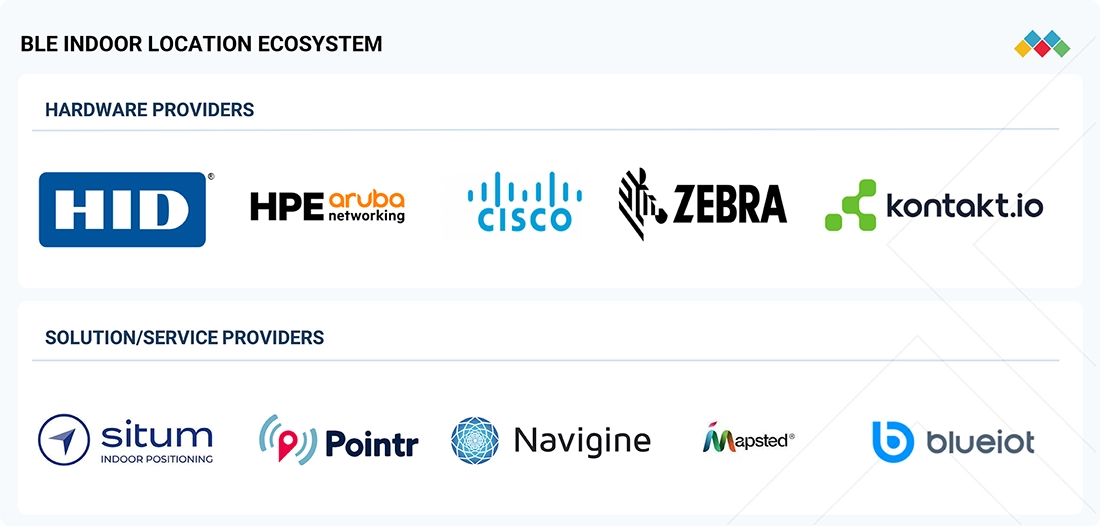
The BLE indoor location market ecosystem comprises hardware providers (HPE/Aruba, Cisco, Zebra) that supply beacons, tags, AP-integrated radios, and enterprise badges, forming the physical positioning fabric. Solution/Service providers (Pointr, Mapsted, Situm, BlueIoT) deliver SDKs, maps, wayfinding, RTLS services, and analytics.
Logos and trademarks shown above are the property of their respective owners. Their use here is for informational and illustrative purposes only.
MARKET SEGMENTS
Source: Secondary Research, Interviews with Experts, MarketsandMarkets Analysis
BLE Indoor Location Market, By Offering
The hardware segment of the BLE indoor location market is evolving from simple coin-cell beacons to gateways and system-on-chip (SoC) modules. Standard beacons are becoming commoditized and low-cost. This shift is moving value toward high-performance locator arrays designed for direction finding (AoA). These advanced hardware units feature multiple antenna arrays to detect signal phase differences, which comes at a premium. Additionally, the semiconductor market plays a critical role, as powerful processing cores are directly embedded into BLE chips. This enables edge computing on the tag itself, saving bandwidth.
BLE Indoor Location Market, By Application
Asset tracking is the fastest-growing application for BLE indoor location, primarily in the logistics and healthcare industries. BLE offers real-time visibility at a reasonable cost compared with other technologies, such as active or passive RFID. Asset tracking is used to locate mobile medical equipment, such as infusion pumps and wheelchairs, thereby reducing search times and driving demand in the healthcare industry. BLE tags are increasingly placed on pallets or high-value packages to monitor not only location but also environmental conditions during transit. This provides a comprehensive condition-monitoring solution that simple location technologies cannot match.
BLE Indoor Location Market, By Vertical
The retail vertical is the largest in the BLE indoor location market. Demand for BLE in retail is driven by "proximity marketing," which uses BLE beacons. These beacons bridge the digital and physical worlds, triggering push notifications, coupons, or loyalty rewards on a shopper's phone. Beyond marketing, retailers are leveraging BLE for operational intelligence, generating heat maps of shopper dwell times to optimize store layouts and staffing levels. The trend is moving toward frictionless experiences, enabling features such as "click and collect" automation, detecting a customer's arrival in the parking lot, and alerting staff.
REGION
Asia Pacific to be fastest-growing region in global BLE indoor location market during forecast period
The Asia Pacific BLE indoor location market is driven by the convergence of massive greenfield infrastructure projects and a mobile-first consumer ecosystem. Unlike Western markets focused on retrofitting, China, India, and Vietnam are embedding BLE infrastructure directly into the construction of new mega-airports, smart transit hubs, and vertical cities, enabling support for high-density crowd management. Additionally, the region’s dominance in electronics manufacturing has created a thriving local supply chain for low-cost BLE beacons, significantly reducing deployment costs.
BLUETOOTH LOW ENERGY (BLE) INDOOR LOCATION: COMPANY EVALUATION MATRIX
In the BLE indoor location market matrix, Zebra (Star) leads with a strong market share and extensive product footprint, driven by enterprise-grade BLE beacons/tags and the MotionWorks platform, with deep vertical integrations. BlueIoT (Emerging Leader) is gaining visibility through BLE AoA anchors and tags with sub-meter accuracy, turnkey cloud integrations, and SI partnerships focused on industrial and healthcare deployments, enabling fast, low-cost scale-ups.
Source: Secondary Research, Interviews with Experts, MarketsandMarkets Analysis
KEY MARKET PLAYERS
- Zebra Technologies (US)
- Cisco (US)
- Inpixon (US)
- HPE (US)
- Pointr (UK)
- HID Global (US)
- Mapsted (Canada)
- BlueIoT (China)
- Infsoft (Germany)
- Situm (Spain)
- Navigine (US)
- Locatify (Iceland)
- Kontakt.io (US)
- RealTrac International (Switzerland)
- Anantics (US)
MARKET SCOPE
| REPORT METRIC | DETAILS |
|---|---|
| Market Size in 2024 (Value) | USD 3.60 Billion |
| Market Forecast in 2030 (Value) | USD 11.88 Billion |
| Growth Rate | CAGR of 22.5% from 2025-2030 |
| Years Considered | 2019-2030 |
| Base Year | 2024 |
| Forecast Period | 2025-2030 |
| Units Considered | Value (USD Billion) |
| Report Coverage | Revenue forecast, company ranking, competitive landscape, growth factors, and trends |
| Segments Covered |
|
WHAT IS IN IT FOR YOU: BLUETOOTH LOW ENERGY (BLE) INDOOR LOCATION REPORT CONTENT GUIDE
DELIVERED CUSTOMIZATIONS
We have successfully delivered the following deep-dive customizations:
| CLIENT REQUEST | CUSTOMIZATION DELIVERED | VALUE ADDS |
|---|---|---|
| Leading Solution Provider (US) | Product Analysis: Product Matrix, which gives a detailed comparison of the product portfolio of each company | Enhanced understanding of competitive positioning and product offerings |
| Leading Service Provider (Europe) | Company Information: Detailed analysis and profiling of additional market players (up to 5) | Deeper insights into market dynamics and potential strategic partnerships |
RECENT DEVELOPMENTS
- April 2025 : Penguin Location Services partnered with Nordic Semiconductor to revolutionize BLE RTLS (real-time location systems) indoor positioning solutions. This collaboration integrated Nordic's advanced BLE 5.1 chipsets with Penguin's machine-learning algorithms to deliver unprecedented indoor location accuracy. The partnership achieved remarkable performance metrics without requiring costly Angle of Arrival (AoA) infrastructure.
- July 2024 : MOKO SMART partnered with Navigine to deliver comprehensive indoor navigation and real-time location system (RTLS) solutions across various industries. The collaboration integrated MOKO SMART's hardware portfolio, including Bluetooth beacons, anchors, and gateways, with Navigine's advanced software solutions.
- July 2024 : Qualcomm launched a new BLE beacon chip specifically designed to optimize real-time asset tracking and proximity marketing in indoor positioning applications. The chip features extended battery life and faster data transmission capabilities compared to previous generations.
Table of Contents
 Exclusive indicates content/data unique to MarketsandMarkets and not available with any competitors.
Methodology
The study involved four major activities in estimating the current size of the Bluetooth Low Energy (BLE) Indoor Location Market. Exhaustive secondary research was done to collect information on the market, peer, and parent markets. The next step was to validate these findings, assumptions, and sizing with industry experts across the value chain through primary research. Both top-down and bottom-up approaches were employed to estimate the total Bluetooth Low Energy (BLE) Indoor Location Market size. After that, the market breakup and data triangulation techniques were used to estimate the market size of segments and subsegments.
Secondary Research
Various secondary sources, such as Bloomberg and BusinessWeek, were referred to in the secondary research process to identify and collect information for this study. The secondary sources included company annual reports, press releases, and investor presentations; white papers; journals, such as Linux Journal and Container Journal; and articles from recognized authors, directories, and databases.
Primary Research
In the primary research process, various sources from both the supply and demand sides were interviewed to obtain qualitative and quantitative information for the report. The primary sources from the supply side included industry experts, such as Chief Executive Officers (CEOs), Chief Technology Officers (CTOs), Chief Operating Officers (COOs), Vice Presidents (VPs), marketing directors, technology and innovation directors, and related key executives from various key companies and organizations operating in the Bluetooth Low Energy (BLE) Indoor Location Market. The primary sources from the demand side included Indoor location end users, network administrators/consultants/specialists, Chief Information Officers (CIOs), and subject-matter experts from enterprises and government associations.
To know about the assumptions considered for the study, download the pdf brochure
|
Company Name |
Designation |
|
Zebra Technologies |
Senior Manager |
|
Quuppa |
VP |
|
Cisco |
Business Executive |
Market Size Estimation
The top-down and bottom-up approaches were used to make market estimates and forecast the Bluetooth Low Energy (BLE) Indoor Location Market, as well as other dependent submarkets. The bottom-up procedure was used to arrive at the overall market size of the Bluetooth Low Energy (BLE) Indoor Location Market using key companies’ revenue and their offerings in the market. The research methodology used to estimate the market size includes the following:
- The key players in the Bluetooth Low Energy (BLE) Indoor Location Market have been identified through extensive secondary research.
- In terms of value, the market size has been determined through primary and secondary research processes.
- All percentage shares, splits, and breakups have been determined using secondary sources and verified through primary sources.
To know about the assumptions considered for the study, Request for Free Sample Report
Data Triangulation
This study determined and confirmed the exact value of the overall parent market size through data triangulation and validation through primary interviews. The overall market size was then used in the top-down procedure to estimate the size of other individual markets via percentage splits of the market segmentation.
Market Definition
Indoor location or indoor positioning technology facilitates the navigation and tracking of objects and people in a building using sensory information captured by mobile devices. It includes hardware, software, and service components to provide indoor location services to various vertical organizations. Indoor location solutions may collect location data using Radio Frequency (RF), Visible Light Communication (VLC), Sound Navigation and Ranging (Sonar), Light Detection and Ranging (Lidar), or any technology or a combination of technologies.
Key Stakeholders
- Indoor location solution providers
- Independent Software Vendors (ISVs)
- Investors and Venture Capitalists (VCs)
- Support and maintenance service providers
- Value-added Resellers (VARs) and distributors
Report Objectives
- To determine and forecast the Bluetooth Low Energy (BLE) Indoor Location Market by offering (hardware, solutions, and services), application, technology, vertical, and region from 2024 to 2029, and analyze the various macroeconomic and microeconomic factors that affect the market growth.
- To forecast the size of the market segments with respect to five main regions: North America, Europe, Asia Pacific (APAC), Latin America, and the Middle East and Africa (MEA).
- To provide detailed information about the major factors (drivers, restraints, opportunities, and challenges) influencing the growth of the Bluetooth Low Energy (BLE) Indoor Location Market.
- To analyze each submarket for individual growth trends, prospects, and contributions to the overall Bluetooth Low Energy (BLE) Indoor Location Market.
- To analyze the opportunities in the market for stakeholders by identifying the high-growth segments of the Bluetooth Low Energy (BLE) Indoor Location Market.
- To profile the key market players; provide a comparative analysis based on business overviews, regional presence, product offerings, business strategies, and key financials; and illustrate the market's competitive landscape.
- Track and analyze competitive developments in the market, such as mergers and acquisitions, product developments, partnerships and collaborations, and Research and Development (R&D) activities.
Available Customizations
With the given market data, MarketsandMarkets offers customizations as per the company’s specific needs. The following customization options are available for the report:
Company Information
- Detailed analysis and profiling of two additional market players
Key Questions Addressed by the Report
What is the current size of the BLE Indoor Location Market?
The BLE indoor location market is valued at USD 4.30 billion in 2025 and is projected to reach USD 11.88 billion by 2030 at a CAGR of 22.5%.
What is driving the growth of the BLE Indoor Location Market?
Growth is driven by rising demand for cost-effective real-time asset tracking, indoor navigation, and operational efficiency across retail, healthcare, and logistics.
Why are investors focusing on the BLE Indoor Location Market?
Investors are targeting BLE indoor location due to its strong double-digit CAGR, scalable IoT applications, and growing adoption in smart buildings and industrial automation.
Which vertical holds the largest market share in BLE Indoor Location?
The retail sector dominates the market due to widespread adoption of proximity marketing, customer analytics, and store navigation solutions.
What technology trends are shaping the BLE Indoor Location Market?
Key trends include BLE AoA (Angle of Arrival), AI-powered location analytics, hybrid RTLS models, and integration with industrial IoT platforms.
Who are the leading players in the BLE Indoor Location Market?
Major players include Zebra Technologies, Cisco, HPE, Pointr, and Mapsted.


Personalize This Research
- Triangulate with your Own Data
- Get Data as per your Format and Definition
- Gain a Deeper Dive on a Specific Application, Geography, Customer or Competitor
- Any level of Personalization
Let Us Help You
- What are the Known and Unknown Adjacencies Impacting the Bluetooth Low Energy (BLE) Indoor Location Market
- What will your New Revenue Sources be?
- Who will be your Top Customer; what will make them switch?
- Defend your Market Share or Win Competitors
- Get a Scorecard for Target Partners

Custom Market Research Services
We Will Customise The Research For You, In Case The Report Listed Above Does Not Meet With Your Requirements
Get 10% Free Customisation





Growth opportunities and latent adjacency in Bluetooth Low Energy (BLE) Indoor Location Market