



Cloud Services Brokerage Market Overview And Future Outlook
Report Code
TC 3513
Published in
Nov, 2026, By MarketsandMarkets™
Cloud Services Brokerage Market by Service Type [Aggregation (Multi-Cloud, Data Integration, Automation & Orchestration), Intermediation (Security, Performance & Usage), Arbitrage (Marketplace, Service Catalog, Enablement)] - Global Forecast to 2031

USD 36.52 BN
MARKET SIZE, 2031

CAGR 18.9%
(2026-2031)

330
REPORT PAGES

150
MARKET TABLES
OVERVIEW
Source: Secondary Research, Interviews with Experts, MarketsandMarkets Analysis
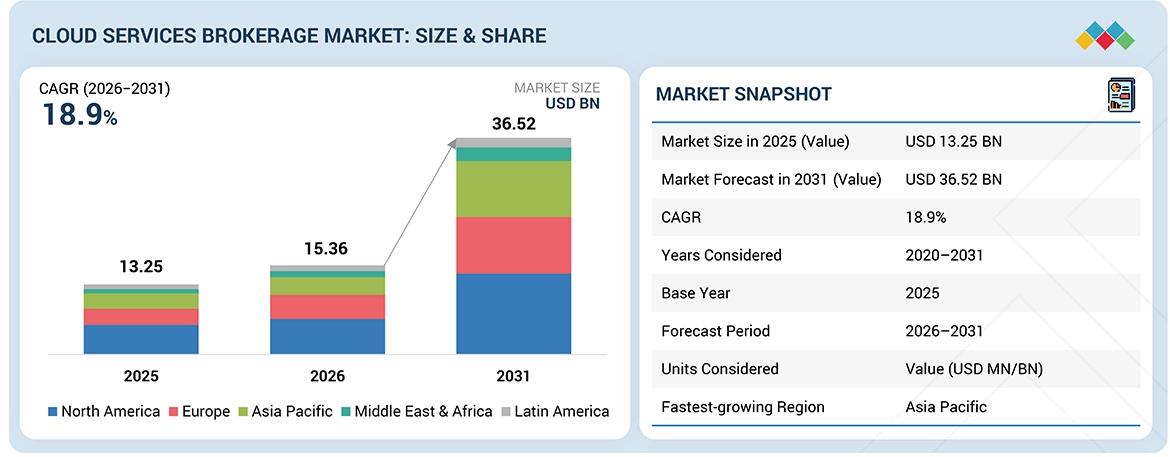
The cloud services brokerage market is expected to reach USD 36.52 billion by 2031, from USD 15.36 billion in 2026, with a CAGR of 18.9%. This growth is mainly driven by rapid multicloud adoption. Enterprises using multiple cloud providers face fragmented billing, security, and governance systems. Brokerage platforms address this complexity by enabling centralized cost optimization, workload orchestration, compliance management, and unified cross-cloud visibility.
KEY TAKEAWAYS
-
By RegionAsia Pacific is the fastest-growing region, with a CAGR of 23.8%.
-
By Service TypeService intermediation is expected to record a CAGR of 20.2% during the forecast period.
-
By Cloud Service ModelPlatform-as-a-Service is expected to grow at the highest CAGR of 22.2% from 2026 to 2031.
-
By Organization SizeSmall enterprises are the fastest-growing segment among all organization sizes.
-
By VerticalThe retail & consumer goods segment is expected to grow at the fastest rate during the forecast period.
-
Competitive Landscape – Large ProvidersIBM, Accenture, and Broadcom lead with strong multicloud integration and enterprise-scale automation capabilities.
-
Competitive Landscape – Emerging ProvidersOpenText, InContinuum, and Compunnel gain traction through flexible and cost-efficient cloud brokerage solutions.
The cloud services brokerage market is driven by increasing enterprise demand for easier workload portability, standardized cloud purchasing, and greater vendor transparency. As more organizations work with multiple vendors, there is a rising need for centralized service catalogs, consolidated billing, and performance tracking. Brokerage platforms will be vital for streamlining procurement processes, enabling cross-cloud comparisons, and enhancing operational accountability in distributed cloud setups.
TRENDS & DISRUPTIONS IMPACTING CUSTOMERS' CUSTOMERS
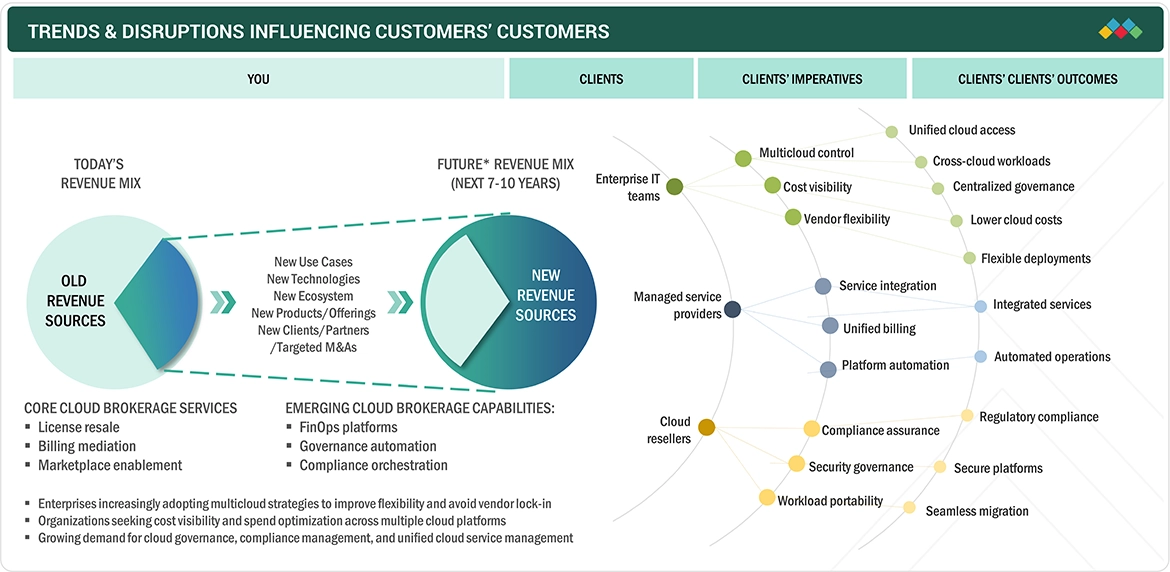
The cloud services brokerage market is expanding as enterprises adopt multicloud strategies to avoid vendor lock-in and improve resilience, which increases operational and cost complexity. To address this, organizations are deploying brokerage platforms for centralized cost monitoring, automated workload placement, SLA tracking, and unified governance across AWS, Azure, and private clouds. Providers are embedding AI for predictive cost and performance optimization. Future growth will be shaped by sovereign cloud controls, API-led integration, and tighter security-policy orchestration.
Source: Secondary Research, Interviews with Experts, MarketsandMarkets Analysis
MARKET DYNAMICS

Drivers
Impact
Level
Level
-
Accelerated enterprise shift toward multicloud strategies requiring centralized governance, cost visibility, and workload orchestration across AWS, Azure, and private environments

-
Rising enterprise focus on minimizing downtime and ensuring business continuity


RESTRAINTS
Impact
Level
Level
-
Enterprise concerns over control, accountability, and integration dependency

-
Integration complexity across diverse billing models, IAM frameworks, and legacy systems creating implementation friction


OPPORTUNITIES
Impact
Level
Level
-
Increasing regulatory scrutiny and FinOps accountability mandates

-
Growing adoption of AI-driven orchestration and predictive optimization tools embedded within brokerage platforms


CHALLENGES
Impact
Level
Level
-
Complexity of delivering consistent orchestration across heterogeneous cloud environments

-
Ensuring consistent performance, SLA enforcement, and latency optimization across global multicloud deployments

Source: Secondary Research, Interviews with Experts, MarketsandMarkets Analysis
Driver: Rising enterprise focus on minimizing downtime and ensuring business continuity
Enterprises are redesigning IT architectures around multicloud resilience, vendor diversification, and workload portability. However, fragmented billing, inconsistent policy enforcement, and limited cross-cloud visibility are driving up costs and operational risks. This structural complexity is increasing the need for brokerage platforms that centralize governance, optimize spending, and coordinate workloads across providers.
Restraint: Enterprise concerns over control, accountability, and integration dependency
Organizations are taking a cautious approach to introducing an intermediary governance layer between themselves and the hyperscalers due to concerns about data sovereignty, API dependencies, reduced contractual leverage, and the potential for architectural lock-in. These issues are creating barriers to large-scale implementation. Enterprises want transparency, validation for interoperability, and clear accountability models before deploying with brokers.
Opportunity: Increasing regulatory scrutiny and FinOps accountability mandates
The increasing regulatory scrutiny and the ongoing rise in cloud spending are pushing enterprise cloud strategies to require greater governance and financial accountability. As companies must demonstrate auditable controls, ensure transparent cost allocation, and enforce consistent policies across multicloud environments, this ecosystem will further promote the adoption of brokerage platforms. These platforms enable centralized visibility, compliance monitoring, and structured cost governance over dispersed cloud estates.
Challenge: Complexity of delivering consistent orchestration across heterogeneous cloud environments
Cloud providers have different APIs, pricing models, identity frameworks, and performance setups. Making sure security policies, SLA compliance, and latency are consistent across global deployments needs advanced automation and strong cross-platform integration. Achieving scalable interoperability remains a key challenge.
CLOUD SERVICES BROKERAGE MARKET OVERVIEW AND FUTURE OUTLOOK: COMMERCIAL USE CASES ACROSS INDUSTRIES
| COMPANY | USE CASE DESCRIPTION | BENEFITS |
|---|---|---|
 |
Implemented ArrowSphere multicloud delivery and management platform in the Nordic SME telecommunications industry to manage IaaS, PaaS, and SaaS. | Improved cloud service scalability, enabled new AI and IoT revenue streams, increased regional subscriptions, and delivered cost-effective cloud distribution to resellers and customers. |
 |
Implemented Cloudmore to automate billing processes and self-service capabilities for Microsoft´s cloud solutions provider services and improve customer relationship management. | Increased accuracy in billing and profitability tracking with improved customer self-service experiences, reduced manual work, and increased efficiency for operations and retention of customers. |
 |
Utilized NTT DATA´s cloud management services to optimize AWS spending with increased controls around financial governance and better management of hyperscale cloud complexity. | Delivered cost optimization recommendations, improved financial visibility, enhanced long-term cloud utilization strategy, and enabled scalable, flexible cloud management operations. |
Logos and trademarks shown above are the property of their respective owners. Their use here is for informational and illustrative purposes only.
MARKET ECOSYSTEM
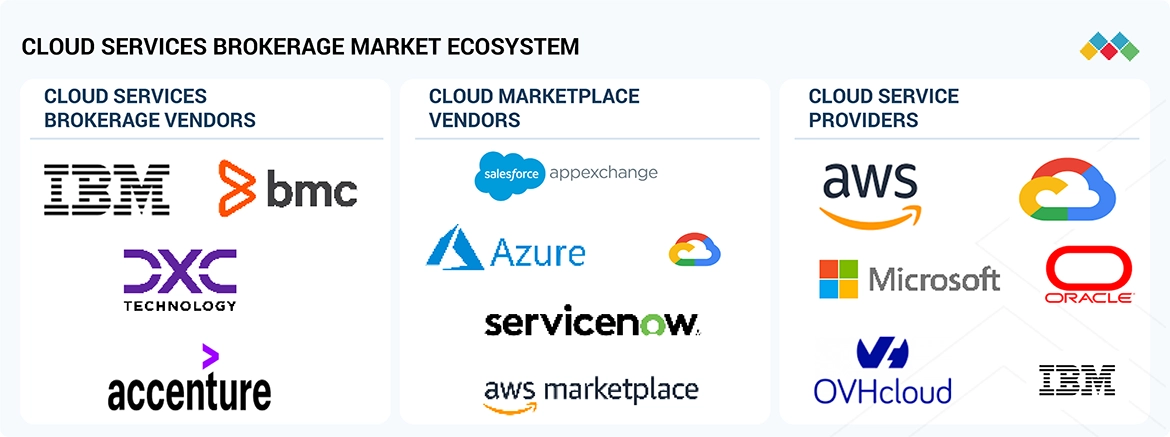
The cloud services brokerage ecosystem includes three main types of providers: cloud service brokerages (CSBs), cloud marketplaces (CMs), and cloud service providers (CSPs). As intermediaries, CSBs enable the integration, governance, and billing management across multiple clouds, offering support services for managing multicloud environments. CMs equip users with tools to discover and purchase cloud services, while CSPs deliver essential infrastructure or platform services for running businesses in the cloud.
Logos and trademarks shown above are the property of their respective owners. Their use here is for informational and illustrative purposes only.
MARKET SEGMENTS
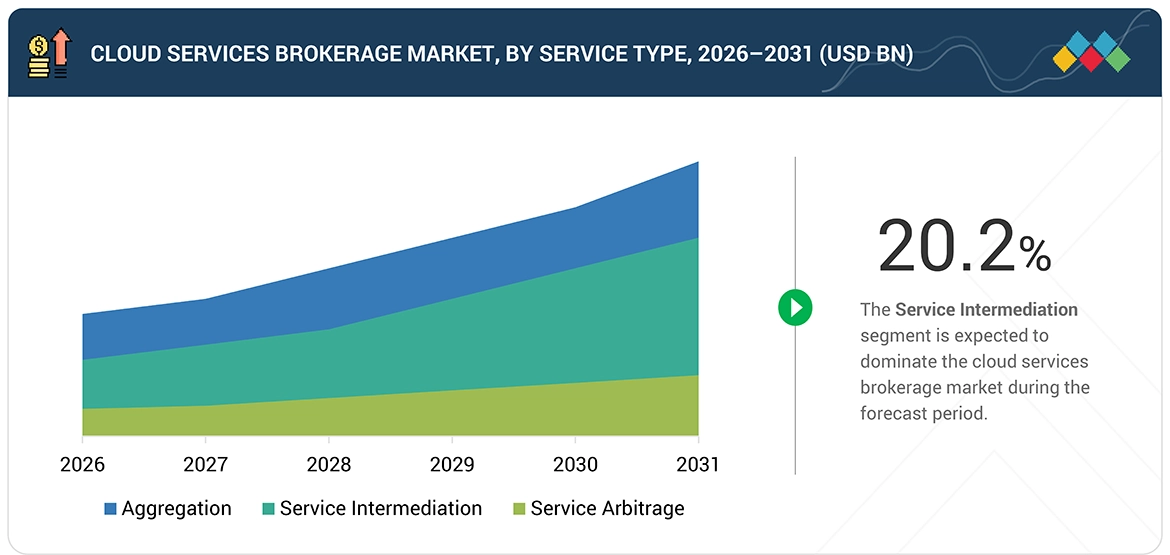
Source: Secondary Research, Interviews with Experts, MarketsandMarkets Analysis
By Service Type
Aggregation is key as enterprises increasingly operate across multiple cloud providers, leading to fragmented billing, governance, and performance visibility. The need to unify cost management, enforce standardized policies, and simplify vendor oversight makes aggregation essential. Providers should focus on integrated dashboards, FinOps tools, and API integrations to enhance value delivery.
By Cloud Service Model
SaaS leads because of quicker deployment, lower initial costs, and subscription-based scalability that fits with enterprise cloud adoption models. Organizations prefer SaaS brokerage platforms for automated updates and centralized governance without the burden of infrastructure. Vendors should improve AI-driven analytics and seamless integration to maintain a competitive edge.
By Organization Size
Large enterprises represent the largest portion as they manage complex, multi-region cloud setups with strict compliance and performance standards. Their size increases cost exposure and governance risks. Brokerage providers should focus on advanced orchestration, compliance automation, and executive-level cost reporting to meet enterprise needs.
By Vertical
BFSI continues to lead due to strict regulations, high transaction volumes, and the expectation of zero downtime. To meet compliance standards, financial institutions need centralized tracking of compliance, enforcement of SLAs, and transparency in costs across their cloud infrastructures. As a result, they focus on audit-ready reporting, robust security integration, and resilient orchestration across multicloud environments.
REGION
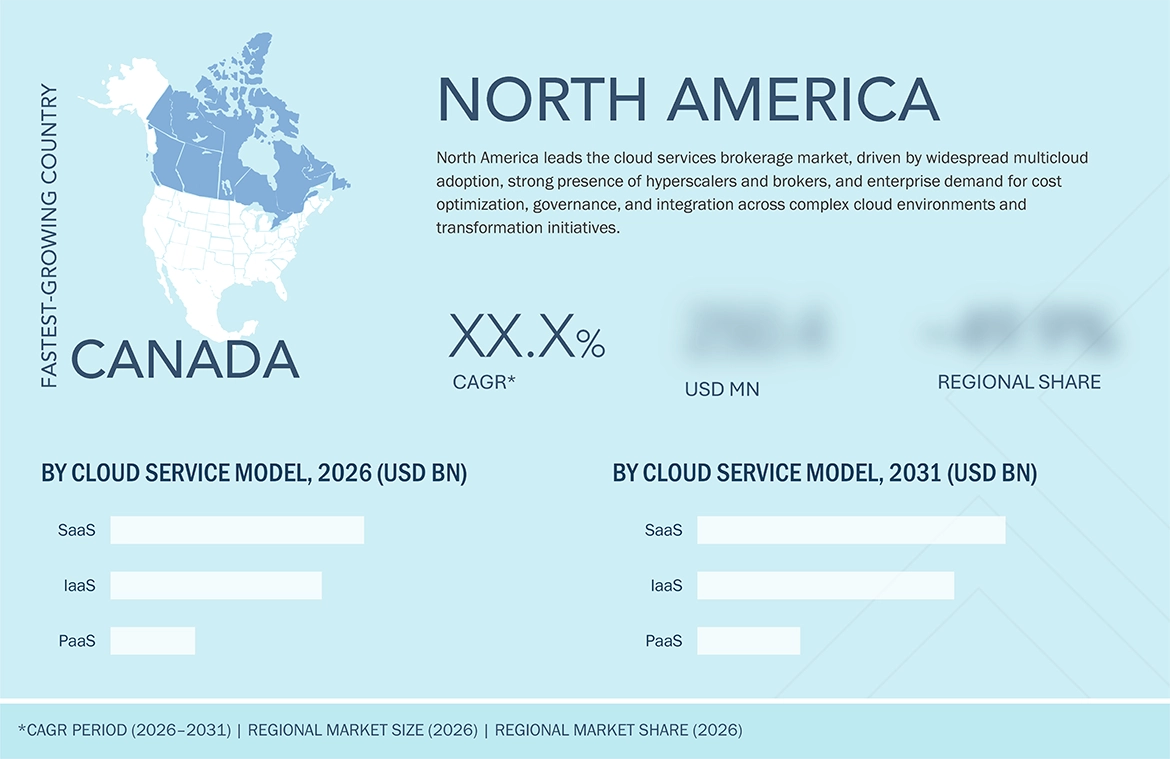
Asia Pacific to be fastest-growing region during forecast period
Asia Pacific is expected to witness the fastest growth in the cloud services brokerage market as China, India, Japan, South Korea, and Southeast Asian nations rapidly adopt cloud technology. Digital transformation initiatives are currently strong, with global cloud service providers investing heavily, and significant growth in Fintech, Telecom, and other verticals fueling demand for integrated multicloud management solutions and cost optimization platforms in the region. Recent implementation of stricter data governance regulations in these countries has also increased demand for cloud service brokerage solutions across Asia Pacific.
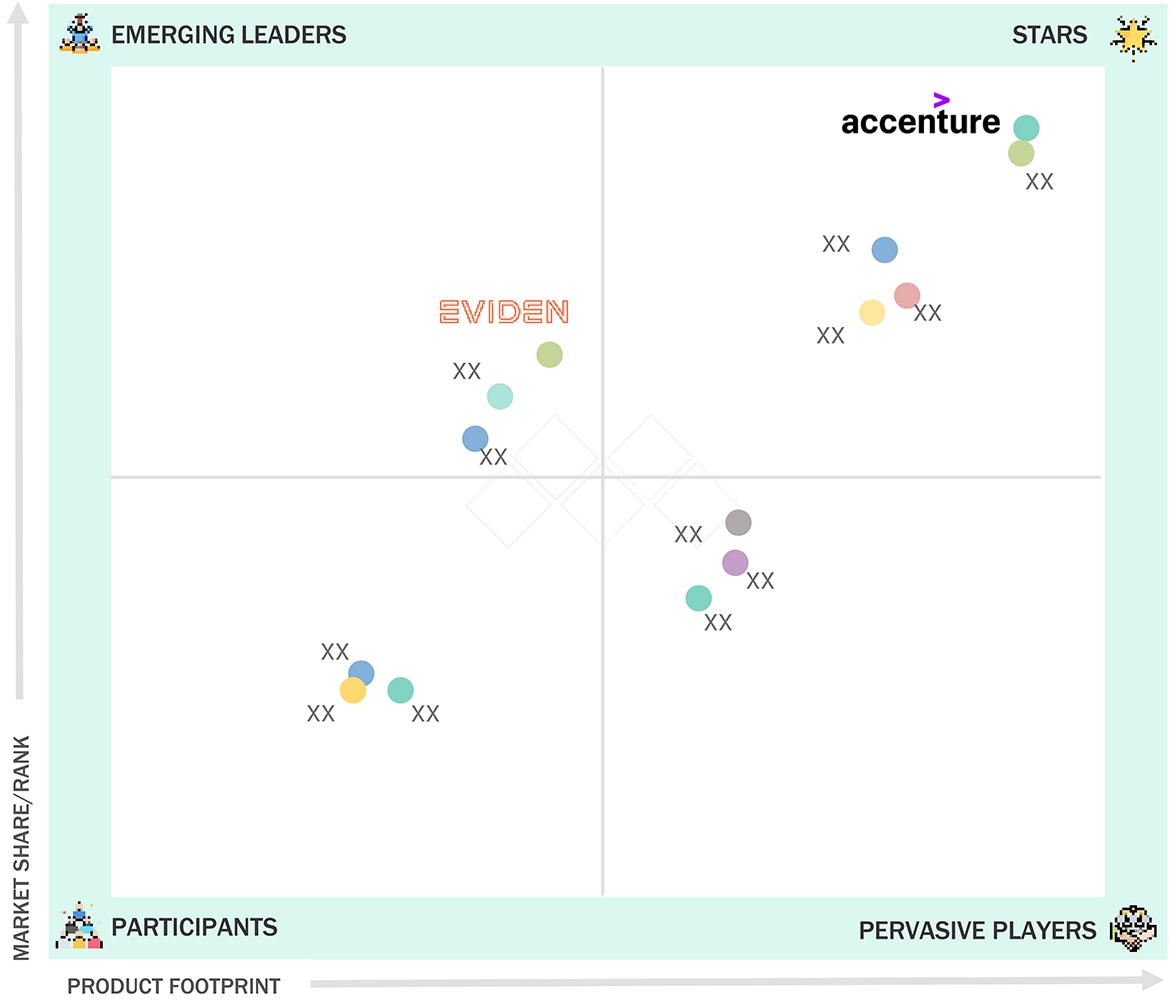
CLOUD SERVICES BROKERAGE MARKET OVERVIEW AND FUTURE OUTLOOK: COMPANY EVALUATION MATRIX
Accenture is positioned in the Stars quadrant due to its strong global service strategy and presence. It has received high scores for the capabilities of its vendor services and products. Meanwhile, Eviden is still expanding as it develops new capabilities and is therefore ranked as an Emerging Leader in the evaluation matrix.
Source: Secondary Research, Interviews with Experts, MarketsandMarkets Analysis
KEY MARKET PLAYERS
- Accenture (Ireland)
- IBM (US)
- Broadcom (US)
- Arrow Electronics (US)
- Fujitsu (Japan)
- DXC Technology (US)
- Wipro (India)
- Eviden (France)
- AWS (US)
- Infosys (India)
- NTT Data (Japan)
- TCS (India)
- Tech Mahindra (India)
- BMC Software (US)
- Flexera (US)
- Jamcracker (US)
- Cloudmore (Finland)
- ESHGro (US)
- OpenText (Canada)
- InContinuum (Netherlands)
- CompuNet (US)
- Shivami (India)
- Bittium (Finland)
- Capgemini (France)
- Oracle (US)
- CIGNEX (US)
- ActivePlatform (Belarus)
- CloudFX (US)
- CloudBolt (US)
- Cloudsme (Netherlands)
- AppDirect (US)
- Morpheus Data (US)
- Interworks Cloud (Greece)
- RackNap (US)
- Spot (US)
- CloudBroker (Switzerland)
MARKET SCOPE
| REPORT METRIC | DETAILS |
|---|---|
| Market Size in 2025 (Value) | USD 13.25 BN |
| Market Forecast in 2031 (Value) | USD 36.52 BN |
| Growth Rate | CAGR of 18.9% from 2026 to 2031 |
| Years Considered | 2020–2031 |
| Base Year | 2025 |
| Forecast Period | 2026–2031 |
| Units Considered | Value (USD MN/BN) |
| Report Coverage | Revenue forecast, company ranking, competitive landscape, growth factors, and trends |
| Segments Covered |
|
| Regions Covered | North America, Europe, Asia Pacific, Middle East & Africa, Latin America |
WHAT IS IN IT FOR YOU: CLOUD SERVICES BROKERAGE MARKET OVERVIEW AND FUTURE OUTLOOK REPORT CONTENT GUIDE
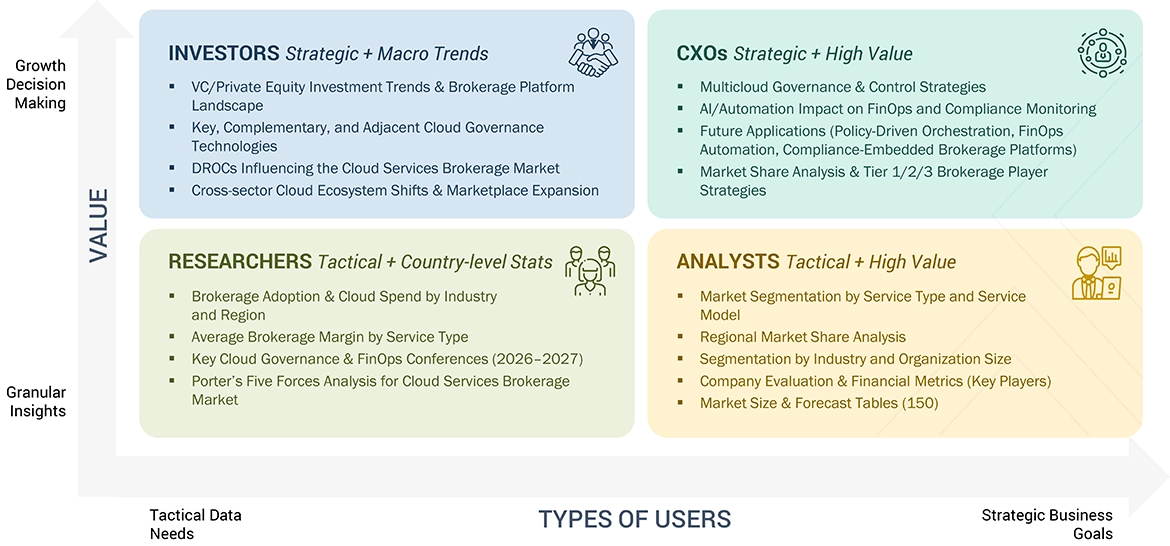
DELIVERED CUSTOMIZATIONS
We have successfully delivered the following deep-dive customizations:
| CLIENT REQUEST | CUSTOMIZATION DELIVERED | VALUE ADDS |
|---|---|---|
| Enterprise (BFSI) | Competitive benchmarking of cloud services brokerage vendors, pricing comparison, service capability analysis, and adoption trends specific to BFSI cloud environments. | Support strategic vendor selection and strengthen multicloud governance and cost optimization strategy. |
| Telecom Operator | Vendor landscape analysis focused on telecom-grade brokerage capabilities, workload orchestration, and deployment models. | Enable structured investment decisions for network cloud and edge orchestration. |
| Cloud Service Provider | Market sizing, segment analysis, and demand outlook for cloud services brokerage solutions across hybrid and multicloud environments. | Identify growth opportunities and refine platform positioning strategy. |
RECENT DEVELOPMENTS
- December 2025 : IBM agreed to acquire Confluent for USD 11 billion in order to enhance hybrid-cloud integration and real-time data streaming capabilities for enterprise AI. This will also improve data connectivity, governance, and automation across multicloud environments in support of brokerage-driven integration, orchestration, and cross-platform service delivery.
- December 2025 : AWS and Google Cloud have launched a private multicloud networking service that combines AWS Interconnect and Google Cross-Cloud Interconnect. It allows for fast, secure, and low-latency connections between different clouds, offering greater multicloud workload portability and improved data transfer between clouds, thereby assisting cloud brokers in supporting multi-provider architectures that have been developed.
- November 2025 : The acquisition of Cloud4C by Capgemini was completed to offer an expanded suite of automation-driven managed services. This acquisition will provide hyper-automation and AI-ops capabilities that enhance cloud management, migration, and continuity, as well as increase compliance services in alignment with existing core Cloud Services Brokerage functions.
Table of Contents
 Exclusive indicates content/data unique to MarketsandMarkets and not available with any competitors.
TITLE
PAGE NO
1
INTRODUCTION
15
2
EXECUTIVE SUMMARY
3
PREMIUM INSIGHTS
4
MARKET OVERVIEW
Summarizes the competitive environment, macro signals, and segment-level movements driving market outcomes.
4.1
INTRODUCTION
4.2
MARKET DYNAMICS
4.2.1
DRIVERS
4.2.2
RESTRAINTS
4.2.3
OPPORTUNITIES
4.2.4
CHALLENGES
4.3
UNMET NEEDS AND WHITE SPACES
4.4
INTERCONNECTED MARKETS AND CROSS-SECTOR OPPORTUNITIES
4.5
STRATEGIC MOVES BY TIER-1/2/3 PLAYERS
5
INDUSTRY TRENDS
Provides a snapshot of current market scenario, value chain context, and factors impacting competitive intensity.
5.1
PORTER’S FIVE FORCES ANALYSIS
5.1.1
THREAT OF NEW ENTRANTS
5.1.2
BARGAINING POWER OF BUYERS
5.1.3
BARGAINING POWER OF SUPPLIERS
5.1.4
THREAT OF SUBSTITUTES
5.1.5
INTENSITY OF COMPETITIVE RIVALRY
5.2
MACROECONOMIC OUTLOOK
5.2.1
GDP TRENDS AND FORECAST
5.2.2
TRENDS IN CLOUD COMPUTING INDUSTRY
5.2.3
TRENDS IN CLOUD MANAGED SERVICES INDUSTRY
5.3
SUPPLY CHAIN ANALYSIS
5.4
ECOSYSTEM ANALYSIS
5.5
PRICING ANALYSIS
5.5.1
AVERAGE SELLING PRICE TREND OF SERVICES OFFERED BY KEY PLAYERS, 2023–2025
5.5.2
AVERAGE SELLING PRICE TREND, BY REGION, 2023–2025
5.6
KEY CONFERENCES AND EVENTS, 2026–2027
5.7
TRENDS/DISRUPTIONS IMPACTING CUSTOMER BUSINESS
5.8
INVESTMENT AND FUNDING SCENARIO
5.9
CASE STUDY ANALYSIS
5.10
IMPACT OF 2025 US TARIFF
5.10.1
KEY TARIFF RATES
5.10.2
PRICE IMPACT ANALYSIS
5.10.3
IMPACT ON REGIONS
5.10.3.1
EUROPE
5.10.3.2
ASIA PACIFIC
5.10.3.3
LATIN AMERICA
5.10.4
IMPACT ON END-USE VERTICALS
6
TECHNOLOGICAL ADVANCEMENTS, AI-DRIVEN IMPACT, PATENTS, INNOVATIONS, AND FUTURE APPLICATIONS
6.1
KEY TECHNOLOGIES
6.2
COMPLEMENTARY TECHNOLOGIES
6.3
ADJACENT TECHNOLOGIES
6.4
TECHNOLOGY ROADMAP
6.5
PATENT ANALYSIS
6.6
IMPACT OF AI/GEN AI
6.6.1
TOP USE CASES AND MARKET POTENTIAL
6.6.2
BEST PRACTICES FOLLOWED BY SERVICE PROVIDERS
6.6.3
CASE STUDIES RELATED TO AI IMPLEMENTATION
6.6.4
INTERCONNECTED ECOSYSTEM AND IMPACT ON MARKET PLAYERS
6.6.5
CLIENTS’ READINESS TO ADOPT AI
6.7
FUTURE APPLICATIONS
7
REGULATORY LANDSCAPE
7.1
REGIONAL REGULATION AND COMPLIANCE
7.1.1
REGULATORY BODIES, GOVERNMENT AGENCIES, AND OTHER ORGANIZATIONS
7.1.2
INDUSTRY STANDARDS
8
CUSTOMER LANDSCAPE AND BUYER BEHAVIOR
8.1
DECISION-MAKING PROCESS
8.2
KEY STAKEHOLDERS IN BUYING PROCESS AND THEIR EVALUATION CRITERIA
8.2.1
KEY STAKEHOLDERS IN BUYING PROCESS
8.2.2
BUYING CRITERIA
8.3
ADOPTION BARRIERS AND INTERNAL CHALLENGES
8.4
UNMET NEEDS OF END-USE VERTICALS
9
CLOUD SERVICES BROKERAGE MARKET, BY SERVICE TYPE (MARKET SIZE & FORECAST TO 2031 - IN VALUE, USD BILLION)
9.1
INTRODUCTION
9.2
AGGREGATION
9.2.1
MULTI-CLOUD MANAGEMENT
9.2.2
DATA INTEGRATION
9.2.3
AUTOMATION & ORCHESTRATION
9.3
SERVICE INTERMEDIATION
9.3.1
SECURITY MANAGEMENT
9.3.2
PERFORMANCE & USAGE REPORTING
9.4
SERVICE ARBITRAGE
9.4.1
SERVICE CATALOG MANAGEMENT
9.4.2
MARKETPLACE INTEGRATION
9.4.3
ENABLEMENT SERVICES
10
CLOUD SERVICES BROKERAGE MARKET, BY CLOUD SERVICE MODEL (MARKET SIZE & FORECAST TO 2031 - IN VALUE, USD BILLION)
10.1
INTRODUCTION
10.2
PLATFORM-AS-A-SERVICE
10.3
INFRASTRUCTURE-AS-A-SERVICE
10.4
SOFTWARE-AS-A-SERVICE
11
CLOUD SERVICES BROKERAGE MARKET, BY ORGANIZATION SIZE (MARKET SIZE & FORECAST TO 2031 - IN VALUE, USD BILLION)
11.1
INTRODUCTION
11.2
LARGE ENTERPRISES
11.3
MEDIUM ENTERPRISES
11.4
SMALL ENTERPRISES
12
CLOUD SERVICES BROKERAGE MARKET, BY VERTICAL (MARKET SIZE & FORECAST TO 2031 - IN VALUE, USD BILLION)
12.1
INTRODUCTION
12.2
BFSI
12.3
TELECOMMUNICATIONS
12.4
IT & ITES
12.5
GOVERNMENT & PUBLIC SECTOR
12.6
RETAIL & CONSUMER GOODS
12.7
MANUFACTURING
12.8
ENERGY & UTILITIES
12.9
MEDIA & ENTERTAINMENT
12.10
HEALTHCARE & LIFE SCIENCES
12.11
OTHER VERTICALS
13
CLOUD SERVICES BROKERAGE MARKET, BY REGION (MARKET SIZE & FORECAST TO 2031 - IN VALUE, USD BILLION)
13.1
INTRODUCTION
13.2
NORTH AMERICA
13.2.1
US
13.2.2
CANADA
13.3
EUROPE
13.3.1
UK
13.3.2
GERMANY
13.3.3
FRANCE
13.3.4
ITALY
13.3.5
REST OF EUROPE
13.4
ASIA PACIFIC
13.4.1
CHINA
13.4.2
JAPAN
13.4.3
AUSTRALIA
13.4.4
REST OF ASIA PACIFIC
13.5
MIDDLE EAST & AFRICA
13.5.1
GCC COUNTRIES
13.5.1.1
UAE
13.5.1.2
SAUDI ARABIA
13.5.1.3
REST OF GCC COUNTRIES
13.5.2
SOUTH AFRICA
13.5.3
REST OF MIDDLE EAST & AFRICA
13.6
LATIN AMERICA
13.6.1
BRAZIL
13.6.2
MEXICO
13.6.3
REST OF LATIN AMERICA
14
COMPETITIVE LANDSCAPE
14.1
OVERVIEW
14.2
KEY PLAYER STRATEGIES/RIGHT TO WIN, 2023–2025
14.3
REVENUE ANALYSIS, 2021–2025
14.4
MARKET SHARE ANALYSIS,
14.5
BRAND/PRODUCT COMPARISON
14.6
COMPANY EVALUATION MATRIX: KEY PLAYERS
14.6.1
STARS
14.6.2
EMERGING LEADERS
14.6.3
PERVASIVE PLAYERS
14.6.4
PARTICIPANTS
14.6.5
COMPANY FOOTPRINT: KEY PLAYERS,
14.6.5.1
COMPANY FOOTPRINT
14.6.5.2
REGION FOOTPRINT
14.6.5.3
SERVICE TYPE FOOTPRINT
14.6.5.4
CLOUD SERVICE MODEL FOOTPRINT
14.6.5.5
ORGANIZATION SIZE FOOTPRINT
14.6.5.6
VERTICAL FOOTPRINT
14.7
COMPANY EVALUATION MATRIX: START-UPS/SMES,
14.7.1
PROGRESSIVE COMPANIES
14.7.2
RESPONSIVE COMPANIES
14.7.3
DYNAMIC COMPANIES
14.7.4
STARTING BLOCKS
14.7.5
COMPETITIVE BENCHMARKING: START-UPS/SMES,
14.7.5.1
LIST OF START-UPS/SMES
14.7.5.2
COMPETITIVE BENCHMARKING OF START-UPS/SMES
14.8
COMPANY VALUATION AND FINANCIAL METRICS
14.9
COMPETITIVE SCENARIO
14.9.1
NEW LAUNCHES
14.9.2
DEALS
14.9.3
OTHERS
15
COMPANY PROFILES
15.1
KEY PLAYERS
15.1.1
IBM
15.1.2
BROADCOM
15.1.3
ARROW ELECTRONICS
15.1.4
FUJITSU
15.1.5
DXC TECHNOLOGY
15.1.6
WIPRO
15.1.7
EVIDEN
15.1.8
AWS
15.1.9
INFOSYS
15.1.10
NTT DATA
15.1.11
TCS
15.2
OTHER PLAYERS
15.2.1
TECH MAHINDRA
15.2.2
BMC SOFTWARE
15.2.3
FLEXERA
15.2.4
JAMCRACKER
15.2.5
CLOUDMORE
15.2.6
ESHGRO
15.2.7
OPENTEXT
15.2.8
INCONTINUUM
15.2.9
COMPUNET
15.2.10
SHIVAMI
15.2.11
BITTIUM
15.2.12
CAPGEMINI
15.2.13
ORACLE
15.2.14
CIGNEX
15.2.15
ACTIVEPLATFORM
15.2.16
CLOUDFX
15.2.17
CLOUDBOLT
15.2.18
CLOUDSME
15.2.19
APPDIRECT
15.2.20
MORPHEUS DATA
15.2.21
INTERWORKS CLOUD
15.2.22
RACKNAP
15.2.23
SPOT
15.2.24
CLOUDBROKER
NOTE:
• THIS IS A TENTATIVE TOC, AND THERE MAY BE MINOR CHANGES AS THE STUDY PROGRESSES. THE LIST OF COMPANIES IS PROVISIONAL; MORE WILL BE ADDED TO THE COMPANY PROFILES DURING THE STUDY.
• FINANCIAL INFORMATION WILL ONLY BE PROVIDED FOR PUBLICLY LISTED COMPANIES.
16
RESEARCH METHODOLOGY
16.1
RESEARCH DATA
16.1.1
SECONDARY DATA
16.1.1.1
KEY DATA FROM SECONDARY SOURCES
16.1.1.2
KEY SECONDARY SOURCES
16.1.2
PRIMARY DATA
16.1.2.1
KEY DATA FROM PRIMARY SOURCES
16.1.2.2
KEY PRIMARY PARTICIPANTS
16.1.2.3
BREAKDOWN OF PRIMARY INTERVIEWS
16.1.2.4
KEY INDUSTRY INSIGHTS
16.2
MARKET SIZE ESTIMATION
16.2.1
BOTTOM-UP APPROACH
16.2.2
TOP-DOWN APPROACH
16.2.3
MARKET SIZE CALCULATION FOR BASE YEAR
16.3
MARKET FORECAST APPROACH
16.3.1
SUPPLY SIDE
16.3.2
DEMAND SIDE
16.4
DATA TRIANGULATION
16.5
FACTOR ANALYSIS
16.6
RESEARCH ASSUMPTIONS AND LIMITATIONS
16.7
RISK ASSESSMENT
17
APPENDIX
17.1
DISCUSSION GUIDE
17.2
KNOWLEDGESTORE: MARKETSANDMARKETS’ SUBSCRIPTION PORTAL
17.3
CUSTOMIZATION OPTIONS
17.4
RELATED REPORTS
17.5
AUTHOR DETAILS
Methodology
This research study used extensive secondary sources, directories, and databases, such as D&B Hoovers, Bloomberg Businessweek, and Factiva, to identify and collect information for a technical, market-oriented, and commercial study of the global cloud services brokerage market. Additionally, a few other market-related reports and analyses published by various industry associations and consortiums, such as the National Security Agency (NSA) and SC Magazine, were considered while doing the extensive secondary research. The primary sources were mainly the industry experts from the core and related industries and preferred suppliers, manufacturers, distributors, service providers, technology developers, and technologists from companies and organizations related to all segments of this industry’s value chain. In-depth interviews were conducted with primary respondents, including key industry participants, subject-matter experts, C-level executives of key market players, and industry consultants, to obtain and verify critical qualitative and quantitative information and assess prospects. The market has been estimated by analyzing various driving factors, such as improving organizational compliance requirements, enhancing operational efficiency, and requiring simplified workflows to eliminate bottlenecks.
Secondary Research
The market size of companies offering cloud services brokerage was arrived at based on the secondary data available through paid and unpaid sources, as well as by analyzing the product portfolios of major companies in the ecosystem and rating the companies based on their product capabilities and business strategies.
Various sources were used in the secondary research process to identify and collect information for the study. These sources included annual reports, press releases, investor presentations of companies, product data sheets, white papers, journals, certified publications, articles from recognized authors, government websites, directories, and databases.
Secondary research was mainly used to obtain essential information about the industry’s supply chain, the total pool of key players, market classification and segmentation according to industry trends to the bottom-most level, regional markets, and key developments from both market- and technology-oriented perspectives, all of which were further validated by primary sources.
Primary Research
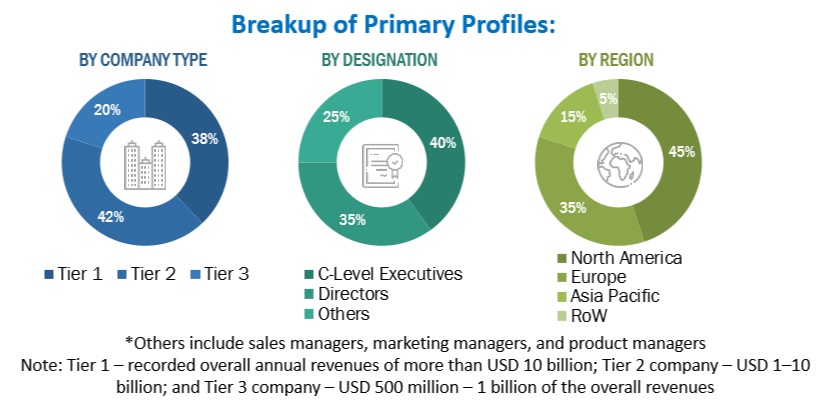
In the primary research process, various sources from the supply and demand sides were interviewed to obtain qualitative and quantitative information for this report. The primary sources from the supply side included industry experts, such as chief executive officers (CEOs), vice presidents (VPs), marketing directors, technology and innovation directors, and related key executives from various key companies and organizations operating in the cloud services brokerage market.
Primary interviews have been conducted to gather key insights on market statistics, the latest trends, disrupting the market, new use cases implemented, data regarding revenue collected from products and services, market breakups, market size estimations, market forecasts, and data triangulation. Primary research also helped understand the various technology trends, segmentation types, industry trends, and regions. Demand-side stakeholders, such as Chief Information Officers (CIOs), Chief Technology Officers (CTOs), Chief Security Officers (CSOs), and the installation teams of governments/end users using cloud services brokerage and digital initiatives project teams, were interviewed to understand the buyer’s perspective on suppliers, products, service providers, and their current use of services, which would affect the overall cloud services brokerage market.
To know about the assumptions considered for the study, download the pdf brochure
Market Size Estimation
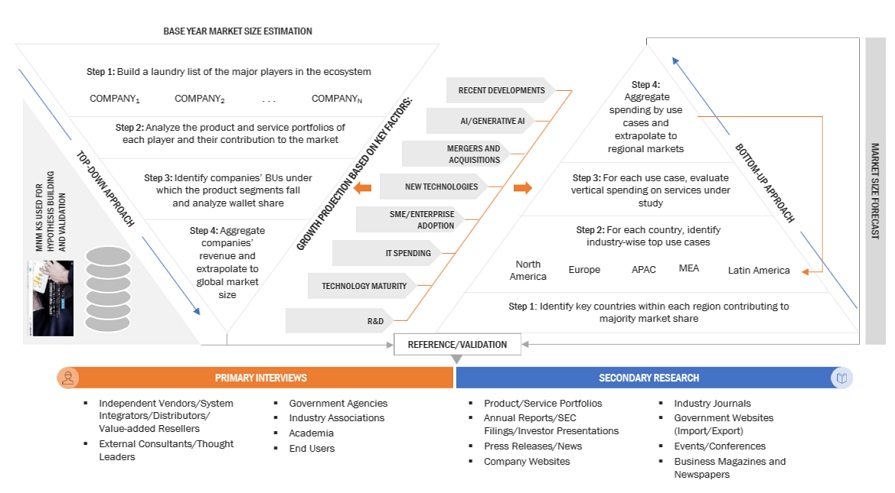
We used top-down and bottom-up approaches to estimate and forecast the cloud services brokerage and other dependent submarkets. We deployed a bottom-up procedure to arrive at the overall market size using the revenues and offerings of key companies in the market. With data triangulation methods and validation through primary interviews, this study determined and confirmed the exact value of the overall parent market size. We used the overall market size in the top-down procedure to estimate the size of other individual markets via percentage splits of the market segments.
We used top-down and bottom-up approaches to estimate and validate the cloud services brokerage market and other dependent subsegments.
The research methodology used to estimate the market size included the following details:
- We identified key players in the market through secondary research. We then determined their revenue contributions in the respective countries through primary and secondary research.
- This procedure included studying top market players' annual and financial reports and extensive interviews for key insights from industry leaders, such as Chief Executive Officers (CEOs), VPs, directors, and marketing executives.
- All percentage splits and breakups were determined using secondary sources and verified through primary sources.
All the possible parameters that affect the market covered in this research study have been accounted for, viewed in extensive detail, verified through primary research, and analyzed to get the final quantitative and qualitative data. This data is consolidated and added with detailed inputs and analysis from MarketsandMarkets.
Cloud services brokerage market: Top-down and Bottom-up approaches
To know about the assumptions considered for the study, Request for Free Sample Report
Data Triangulation
After arriving at the overall market size, the market was split into several segments and subsegments using the market size estimation processes explained above. Where applicable, data triangulation and market breakup procedures were employed to complete the overall market engineering process and determine each market segment's and subsegment's exact statistics. The data was triangulated by studying several factors and trends from the cloud services brokerage market's demand and supply sides.
Market Definition
Cloud Services Brokerage involves third-party intermediaries between service providers and organizations that help an organization discover, manage, and integrate many cloud services from different providers. A CSB decreases the challenge of approaching several clouds by providing an intermediary function to the organization concerning the management of vendors, the billing consortium, security, and compliance. CSBs integrate access, personalize, and optimize existing cloud services, allowing an organization to use cloud resources while controlling the associated costs and performance utilization.
Key Stakeholders
- Technology service providers
- CSPs
- Colocation providers
- Government organizations
- Networking companies
- Consultants/consultancies/advisory firms
- Support and maintenance service providers
- Telecom service providers
- Information Technology (IT) infrastructure providers
- System Integrators (SIs)
- Regional associations
- Independent Software Vendors (ISVs)
- Value-added resellers and distributors
Report Objectives
- To define, describe, and forecast the global Cloud Services Brokerage market based on service type, cloud service model, organization size, vertical, and region.
- To forecast the market size of the five major regional segments: North America, Europe, Asia Pacific, Middle East & Africa, and Latin America
- To strategically analyze the market subsegments concerning individual growth trends, prospects, and contributions to the total market
- To provide detailed information related to the significant factors influencing the growth of the market (drivers, restraints, opportunities, and challenges)
- To strategically analyze macro and micro markets concerning growth trends, prospects, and their contributions to the overall market
- To analyze industry trends, patents and innovations, and pricing data related to the Cloud Services Brokerage market.
- To analyze the opportunities in the market for stakeholders and provide details of the competitive landscape for major players.
- To profile key players in the market and comprehensively analyze their market share/ranking and core competencies.
- To track and analyze competitive developments, such as mergers & acquisitions, product developments, and partnerships & collaborations in the market.
Available Customizations
With the given market data, MarketsandMarkets offers customizations per the company's specific needs. The following customization options are available for the report:
Product Analysis
- The product matrix provides a detailed comparison of each company's portfolio.
Geographic Analysis
- Further breakup of the Asia Pacific market into countries contributing 75% to the regional market size
- Further breakup of the North American market into countries contributing 75% to the regional market size
- Further breakup of the Latin American market into countries contributing 75% to the regional market size
- Further breakup of the Middle Eastern & African market into countries contributing 75% to the regional market size
- Further breakup of the European market into countries contributing 75% to the regional market size
Company Information
- Detailed analysis and profiling of additional market players (up to 5)
Key Questions Addressed by the Report
What is the projected size of the Cloud Services Brokerage Market?
According to MarketsandMarkets, the Cloud Services Brokerage Market is projected to grow from USD 15.36 billion in 2026 to USD 36.52 billion by 2031 at a CAGR of 18.9%.
What is driving the growth of the Cloud Services Brokerage Market?
Market growth is driven by rapid multi-cloud adoption, demand for centralized governance, cost optimization, workload orchestration, and unified cloud management.
Which region is expected to grow the fastest in the Cloud Services Brokerage Market?
Asia Pacific is forecast to be the fastest-growing regional market with a CAGR of 23.8% during the forecast period.
Which industries are creating the highest demand for cloud services brokerage?
BFSI, telecommunications, IT & ITeS, government, retail, manufacturing, healthcare, and energy sectors are major adopters driving market demand.
Who are the leading players in the Cloud Services Brokerage Market?
Key companies include IBM, Accenture, Broadcom, OpenText, InContinuum, and Compunnel, according to MarketsandMarkets.
What are the key trends shaping the Cloud Services Brokerage Market?
Key trends include multi-cloud orchestration, FinOps integration, cloud cost optimization, workload portability, and enhanced governance capabilities.
Which organization size offers the strongest growth opportunity?
Small enterprises are expected to register the fastest growth as they increasingly adopt cloud brokerage platforms for efficient cloud management.
Fact checked
Personalize This Research
- Triangulate with your Own Data
- Get Data as per your Format and Definition
- Gain a Deeper Dive on a Specific Application, Geography, Customer or Competitor
- Any level of Personalization
Let Us Help You
- What are the Known and Unknown Adjacencies Impacting the Cloud Services Brokerage Market
- What will your New Revenue Sources be?
- Who will be your Top Customer; what will make them switch?
- Defend your Market Share or Win Competitors
- Get a Scorecard for Target Partners

Custom Market Research Services
We Will Customise The Research For You, In Case The Report Listed Above Does Not Meet With Your Requirements
Get 10% Free CustomisationTESTIMONIALS
- US Cloud Services Brokerage Market
- Canada Cloud Services Brokerage Market
- UK Cloud Services Brokerage Market
- Germany Cloud Services Brokerage Market
- France Cloud Services Brokerage Market
- Italy Cloud Services Brokerage Market
- China Cloud Services Brokerage Market
- Japan Cloud Services Brokerage Market
- India Cloud Services Brokerage Market
- Brazil Cloud Services Brokerage Market
- Mexico Cloud Services Brokerage Market
- South Africa Cloud Services Brokerage Market
- Rest Of Europe Cloud Services Brokerage Market
- Rest Of Asia Pacific Cloud Services Brokerage Market
Growth opportunities and latent adjacency in Cloud Services Brokerage Market






Ruwin
Apr, 2026
As we expand across multi-cloud environments, does this report clearly explain how cloud brokerage helps with cost control, governance, and vendor management at scale?.