Controlled Environment Agriculture Market

Controlled Environment Agriculture Market by Type (Greenhouse, Vertical Farms, Indoor Farms, Container Farm), Cultivation Method (Hydrophonics, Aquaphonics, Soil-Based, Advanced/Emerging Methods), Component, Crop Type & Region - Global Forecast To 2031




OVERVIEW

Source: Secondary Research, Interviews with Experts, MarketsandMarkets Analysis
The controlled environment agriculture (CEA) market is projected to reach USD 143.00 billion by 2031, up from USD 90.42 billion in 2026, at a CAGR of 9.6% from 2026 to 2031. The controlled environment agriculture market comprises technologies, infrastructure, and integrated cultivation systems that enable crop production under precisely controlled environmental conditions, including temperature, humidity, light, carbon dioxide (CO2), irrigation, and nutrient supply. The market is experiencing strong growth due to increasing demand for year-round production of fresh produce, rising concerns over food security, declining availability of arable land, and the adoption of precision agriculture technologies. Advances in LED grow lighting, climate control systems, hydroponics, automation, artificial intelligence (AI), and Internet of Things (IoT)-based monitoring are further accelerating market expansion by improving resource efficiency, crop quality, and productivity. Major market segments include greenhouses, vertical farms, indoor farms (non-vertical), and container farms, with key applications spanning the cultivation of vegetables, fruits, herbs & microgreens, flowers & ornamentals, and other high-value crops.
KEY TAKEAWAYS
-
BY REGIONThe Asia Pacific region in the controlled environment agriculture (CEA) market will exhibit the highest CAGR of 10.5%.
-
BY TYPEBy type, the greenhouse segment is expected to dominate the market.
-
BY CULTIVATION METHODBy cultivation method, the hydroponics segment is expected to register the highest CAGR of 11.5% during 2026-2031.
-
BY COMPONENTBy component, the hardware segment is expected to register the largest market share of nearly 60% in 2026.
-
BY CROP TYPEBy crop type, the vegetable segment is expected to dominate the market.
-
COMPETITIVE LANDSCAPE - KEY PLAYERSSignify N.V., Netafim Ltd., Grodan B.V., and Hoogendoorn Growth Management were identified as some of the star players in the controlled environment agriculture market, given their strong market share and product footprint.
-
COMPETITIVE LANDSCAPE - STARTUPS/SMEsKoidra Inc. (US), LettUs Grow Ltd., and Intelligent Growth Solutions Ltd., among others, have distinguished themselves among emerging companies by securing strong footholds in specialized niche areas, underscoring their potential as emerging market leaders.
The controlled-environment agriculture (CEA) market comprises technologies and systems that enable crop production under controlled conditions by managing temperature, humidity, lighting, irrigation, and nutrients. Market growth is driven by rising demand for year-round fresh produce, sustainable farming, and efficient resource use, supported by advances in hydroponics, automation, AI, IoT, and climate control technologies. It serves greenhouses, vertical farms, indoor farms, and container farms that produce high-value crops such as vegetables, fruits, herbs, and ornamental plants.
TRENDS & DISRUPTIONS IMPACTING CUSTOMERS' CUSTOMERS
A key trend in the controlled environment agriculture (CEA) market is the rapid adoption of intelligent, resource-efficient farming technologies, driven by advances in automation, sustainability, and digital agriculture. An increasing emphasis on water conservation, energy efficiency, and year-round crop production is accelerating the adoption of hydroponics, climate control systems, and LED grow lighting. At the same time, AI, IoT-enabled sensors, robotics, and data analytics are transforming greenhouse and indoor farming operations through real-time monitoring, predictive crop management, and automated environmental control. Growing investments in urban farming, local food production, and renewable energy integration are further supporting the transition to highly automated, sustainable, and resilient CEA systems worldwide.

Source: Secondary Research, Interviews with Experts, MarketsandMarkets Analysis
MARKET DYNAMICS

Level
-
Increasing Demand for Year-round Production of High-quality Fresh Produce

-
Growing Adoption of Precision Agriculture and Automation Technologies


Level
-
High Capital Investment and Infrastructure Costs

-
High Energy Consumption and Operating Costs


Level
-
Expansion of Urban and Localized Food Production

-
Integration of Renewable Energy and Smart Energy Management


Level
-
Limited Crop Diversity and Economic Viability for Staple Crops

-
Shortage of Skilled Workforce and Technical Expertise

Source: Secondary Research, Interviews with Experts, MarketsandMarkets Analysis
Driver: Increasing Demand for Year-round Production of High-quality Fresh Produce
Growing consumer preference for fresh, locally produced, and high-quality fruits and vegetables is accelerating the adoption of controlled environment agriculture (CEA). Greenhouses and indoor farms enable continuous production regardless of seasonal variations or adverse weather, ensuring a stable crop supply year-round. CEA also minimizes crop losses, improves food security, and enables producers to meet rising demand for premium produce with consistent quality, freshness, and traceability.
Restraint: High Capital Investment and Infrastructure Costs
Setting up controlled-environment agriculture facilities requires substantial capital investment in greenhouse structures, vertical farming systems, LED lighting, HVAC equipment, irrigation systems, automation technologies, and monitoring software. These high upfront costs can limit adoption, particularly among small and medium-sized growers. In addition, financing challenges and long payback periods often discourage investment in large-scale commercial CEA projects, especially in developing economies.
Opportunity: Expansion of Urban and Localized Food Production
Rapid urbanization and rising demand for locally grown produce are creating significant opportunities for controlled-environment agriculture. Vertical farms, rooftop greenhouses, and container farms established near urban centers shorten transportation distances, reduce food waste, and strengthen supply chain resilience. Local production also enables retailers and consumers to access fresher produce, supports sustainable urban food systems, and reduces dependence on imported agricultural products.
Challenge: Limited Crop Diversity and Economic Viability for Staple Crops
Although controlled-environment agriculture is highly effective for producing high-value crops such as leafy greens, herbs, tomatoes, and strawberries, it remains less economical for staple crops, including wheat, rice, and maize. The high infrastructure and energy requirements make large-scale production of these crops financially challenging, limiting the market primarily to premium horticultural crops with higher commercial returns.
CONTROLLED ENVIRONMENT AGRICULTURE MARKET: COMMERCIAL USE CASES ACROSS INDUSTRIES
| COMPANY | USE CASE DESCRIPTION | BENEFITS |
|---|---|---|
 |
Implements integrated climate control, irrigation, and energy management platforms that automatically regulate temperature, humidity, CO2, and fertigation in commercial greenhouses using sensor-driven automation. | Improves crop yield and quality, reduces energy and water consumption, and lowers operational costs through optimized environmental control. |
 |
Deploys programmable Philips GreenPower LED lighting systems with adjustable light spectra and intensity to optimize photosynthesis across different crop growth stages in greenhouses and vertical farms. | Accelerates plant growth, increases crop consistency, reduces electricity consumption, and enables year-round cultivation. |
 |
Provides precision drip irrigation and fertigation systems integrated with greenhouse automation to deliver water and nutrients according to crop requirements and real-time environmental conditions. | Maximizes water-use efficiency, reduces fertilizer losses, and enhances crop productivity while supporting sustainable farming practices. |
 |
Supplies stone wool growing substrates integrated with precision irrigation management to optimize root-zone oxygen, moisture, and nutrient availability in greenhouse vegetable production. | Improves root development, increases yield and crop uniformity, and reduces water and nutrient consumption. |
 |
Uses AI-enabled greenhouse management software to automate climate control, irrigation scheduling, energy optimization, and crop monitoring based on real-time sensor data. | Enhances production efficiency, lowers labor requirements, and improves resource utilization while maintaining stable growing conditions. |
Logos and trademarks shown above are the property of their respective owners. Their use here is for informational and illustrative purposes only.
MARKET ECOSYSTEM
Some of the prominent companies in this market include well-established, financially sound manufacturers of controlled environment agriculture (CEA) products. These companies have operated in the market for over a decade and have diversified portfolios, the latest technologies, and excellent global sales and marketing networks. The controlled environment agriculture (CEA) ecosystem comprises manufacturers, regulatory bodies, and end users. Key manufacturers such as Priva Holding B.V., Signify N.V., Netafim Ltd., and Grodan B.V. have a strong presence across the market.

Logos and trademarks shown above are the property of their respective owners. Their use here is for informational and illustrative purposes only.
MARKET SEGMENTS

Source: Secondary Research, Interviews with Experts, MarketsandMarkets Analysis
Controlled Environment Agriculture (CEA) Market, By Type
The controlled-environment agriculture market is segmented into four major categories: greenhouses, vertical farms, indoor farms (non-vertical), and container farms. Among these, greenhouses hold the largest market share due to their widespread commercial adoption, lower operating costs than fully indoor systems, and ability to produce high-value crops at scale. Rising investments in protected cultivation, growing demand for year-round food production, and advances in climate control, automation, and energy-efficient technologies are driving growth across all facility types. Each type addresses specific cultivation requirements based on available land, climate conditions, production scale, and crop portfolio.
Controlled Environment Agriculture (CEA) Market, By Cultivation Method
The controlled-environment agriculture market is classified into four major cultivation methods: hydroponics, aquaponics, soil-based controlled cultivation, and advanced or emerging methods. The cultivation method segment highlights the techniques used to grow crops in controlled environments. Production systems are selected based on crop requirements, water availability, operational efficiency, and desired productivity. Hydroponics dominates this segment because it enables precise nutrient management, faster plant growth, and significant water savings compared with conventional cultivation. Emerging cultivation methods continue to evolve, with innovations focused on improving sustainability, resource efficiency, and production flexibility.
Controlled Environment Agriculture (CEA) Market, By Component
The component segment comprises the technologies and services required to establish and operate controlled-environment agriculture facilities. It includes hardware, software, and services that collectively enable efficient cultivation, monitoring, and facility management. Hardware accounts for the largest share, as greenhouse structures, lighting systems, irrigation equipment, climate control solutions, and automation technologies constitute the majority of capital expenditure. The growing digital transformation across agriculture is further increasing demand for intelligent software platforms and specialized support services.
Controlled Environment Agriculture (CEA) Market, By Crop Type
The controlled environment agriculture market is classified into five major crop types: vegetables, fruits, herbs and microgreens, flowers and ornamentals, and others. This segmentation reflects the diversity of crops grown with controlled environment agriculture technologies. Crop selection is primarily influenced by market demand, production economics, cultivation cycle, and environmental suitability. Vegetables account for the largest share because of their high consumption, short growth cycles, and compatibility with greenhouse and indoor farming systems. Rising consumer demand for premium-quality produce is also supporting the cultivation of fruits, herbs, microgreens, flowers, ornamental plants, and other specialty crops, broadening the commercial applications of CEA systems.
REGION
Asia Pacific to be the fastest-growing country in the controlled environment agriculture market during the forecast period
Asia Pacific is projected to be the fastest-growing region in the controlled environment agriculture (CEA) market over the forecast period. The region's growth is driven by rapid urbanization, population growth, shrinking arable land, and rising demand for year-round production of fresh, high-quality produce. Governments in countries such as China, Japan, Singapore, South Korea, India, and Australia are actively promoting protected cultivation, smart farming, and food security through supportive policies and investments. In addition, the growing adoption of hydroponics, greenhouse technologies, vertical farming, and AI-enabled automation, coupled with rising private investment and technological advancements, is accelerating the deployment of CEA systems across the region.

CONTROLLED ENVIRONMENT AGRICULTURE MARKET: COMPANY EVALUATION MATRIX
One-star company Priva Holding B.V. has strong brand recognition, a comprehensive portfolio of greenhouse automation, climate control, irrigation, and digital horticulture solutions, and a significant global presence in the controlled environment agriculture market. Emerging leaders such as LettUs Grow Ltd. are rapidly expanding through innovative aeroponic cultivation technologies, sustainable farming solutions, and advanced indoor agriculture platforms. Participants maintain stable market positions by offering specialized products and services across the CEA value chain, while Pervasive Players have a moderate market presence, focusing on niche applications, regional markets, and technology-specific solutions.

Source: Secondary Research, Interviews with Experts, MarketsandMarkets Analysis
KEY MARKET PLAYERS
- Priva Holding B.V. (Netherlands)
- Signify N.V. (Netherlands)
- Netafim Ltd. (Israel)
- Grodan B.V. (Netherlands)
- Hoogendoorn Growth Management (Netherlands)
- Ridder Group B.V. (Netherlands)
- Argus Control Systems Ltd. (Canada)
- Heliospectra AB (Sweden)
- Fluence Bioengineering, Inc. (US)
- Freight Farms, Inc. (US)
- iFarm Corporation (Finland)
- Urban Crop Solutions NV (Belgium)
- Koidra Inc. (US)
- LettUs Grow Ltd. (UK)
- Intelligent Growth Solutions Ltd. (IGS) (UK)
MARKET SCOPE
| REPORT METRIC | DETAILS |
|---|---|
| Market Size in 2026 (Value) | USD 90.42 Billion |
| Market Forecast in 2031 (value) | USD 143.00 Billion |
| Growth Rate | CAGR of 9.6% during 2026-2031 |
| Years Considered | 2021-2031 |
| Base Year | 2026 |
| Forecast Period | 2026-2031 |
| Units Considered | Value (USD Million/Billion) |
| Report Coverage | Revenue forecast, company ranking, competitive landscape, growth factors, and trends |
| Segments Covered |
|
| Regions Covered | North America, South America, Asia Pacific, Europe, RoW |
WHAT IS IN IT FOR YOU: CONTROLLED ENVIRONMENT AGRICULTURE MARKET REPORT CONTENT GUIDE

DELIVERED CUSTOMIZATIONS
We have successfully delivered the following deep-dive customizations:
| CLIENT REQUEST | CUSTOMIZATION DELIVERED | VALUE ADDS |
|---|---|---|
| Global CEA Technology Provider |
|
|
| Commercial Greenhouse/Vertical Farm Operator |
|
|
| Greenhouse Equipment & Automation Manufacturer |
|
|
| Agricultural Distributor/System Integrator |
|
|
| Investor/Private Equity Firm |
|
|
RECENT DEVELOPMENTS
- June 2026 : Orbia Netafim expanded its manufacturing footprint in Mexico to strengthen production capacity and improve the supply of precision irrigation and greenhouse solutions across North and Latin America, supporting the growing adoption of controlled-environment agriculture. (Netafim)
- February 2026 : Orbia Netafim launched its AI-powered Dosing 5G fertigation product range, including FertiKit™ 5G and NetaFlex™ 5G, enabling automated nutrient dosing, remote monitoring, and improved water and fertilizer use efficiency for greenhouse and protected cultivation. (Netafim)
- February 2026 : Orbia Netafim collaborated with Amazon India to deploy advanced drip irrigation technologies to conserve water and promote sustainable agriculture, demonstrating the growing integration of precision irrigation technologies into protected cultivation and CEA systems. (Netafim)
- July 2025 : The Controlled Environment Agriculture Innovation Center (CEAIC) announced the return of CEA Summit East 2025, which will bring together growers, technology providers, researchers, and investors to showcase innovations in greenhouse automation, vertical farming, and controlled environment agriculture. (ceaic.org)
Table of Contents
 Exclusive indicates content/data unique to MarketsandMarkets and not available with any competitors.
Methodology
The study involved four major activities in estimating the current size of the controlled environment agriculture market. Exhaustive secondary research was done to collect information on the market, peer, and parent markets. The next step was to validate these findings, assumptions, and sizing with industry experts across the value chain through primary research. Both top-down and bottom-up approaches were employed to estimate the complete market size. After that, market breakdown and data triangulation were used to estimate the market size of segments and subsegments.
Secondary Research
This research study relied extensively on secondary sources—directories and databases such as Bloomberg Businessweek and Factiva—to identify and collect information for a technical, market-oriented, and commercial study of the controlled environment agriculture market.
In the secondary research process, various sources such as annual reports, press releases and investor presentations from companies, white papers, certified publications, articles by recognized authors, gold- and silver-standard websites, directories, and databases were consulted to identify and collect information. This research study involved extensive use of secondary sources—directories and databases such as Bloomberg Businessweek and Factiva—to identify and collect information useful for a technical, market-oriented, and commercial study of the controlled environment agriculture market.
Secondary research was primarily used to obtain key information about the industry’s supply chain, the total pool of key players, market classification and segmentation by industry trends down to the most granular level, regional markets, and key developments from both market- and technology-oriented perspectives.
Primary Research
Extensive primary research was conducted after gathering information on the controlled environment agriculture market through secondary research. Several primary interviews were conducted with market experts from both the demand and supply sides across major countries in North America, Europe, Asia Pacific, the Middle East & Africa, and South America. Primary data was collected through questionnaires, emails, and telephonic interviews. Primary sources from the supply side included industry experts such as Chief X Officers (CXOs), Vice Presidents (VPs), Directors from business development, marketing, and research and development teams, related key executives from distributors, and key opinion leaders. Primary interviews were conducted to gather insights such as market statistics, revenue data for products and services, market breakdowns, market size estimates, market forecasts, and data triangulation. Primary research also helped in understanding various trends related to mode of application, crop type, type, form, origin, and region.
Breakdown of Primary Interviews
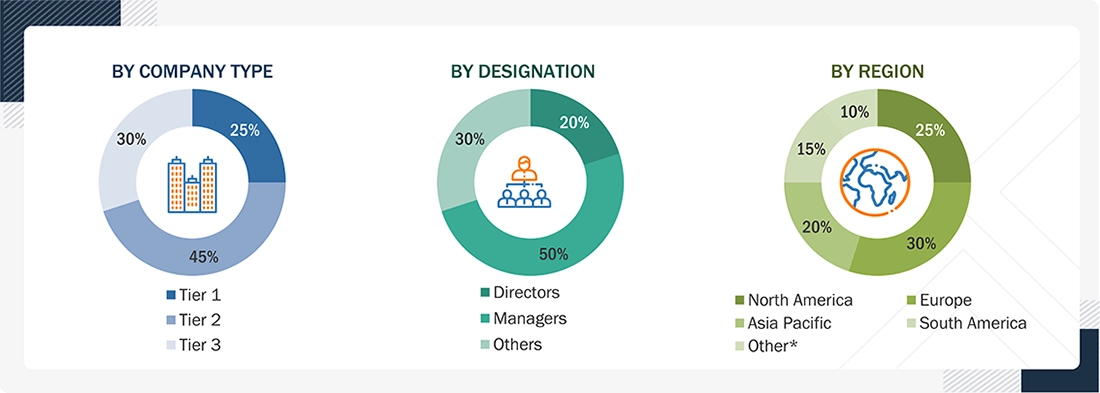
Note: The three tiers of the companies are defined based on their total revenues in 2023 or 2024, as per the availability of financial data: Tier 1: Revenue > USD 1 billion; Tier 2: USD 100 million ≤ Revenue ≤ USD 1 billion; Tier 3: Revenue < USD 100 million.
|
COMPANY NAME |
DESIGNATION |
|
Heliospectra AB (Sweden) |
R&D Expert |
|
Netafim Ltd. (Israel) |
Sales Manager |
|
Freight Farms, Inc. (US) |
Manager |
|
iFarm Corporation (Finland) |
Sales Manager |
|
Koidra Inc. (US) |
Marketing Manager |
To know about the assumptions considered for the study, download the pdf brochure
Market Size Estimation
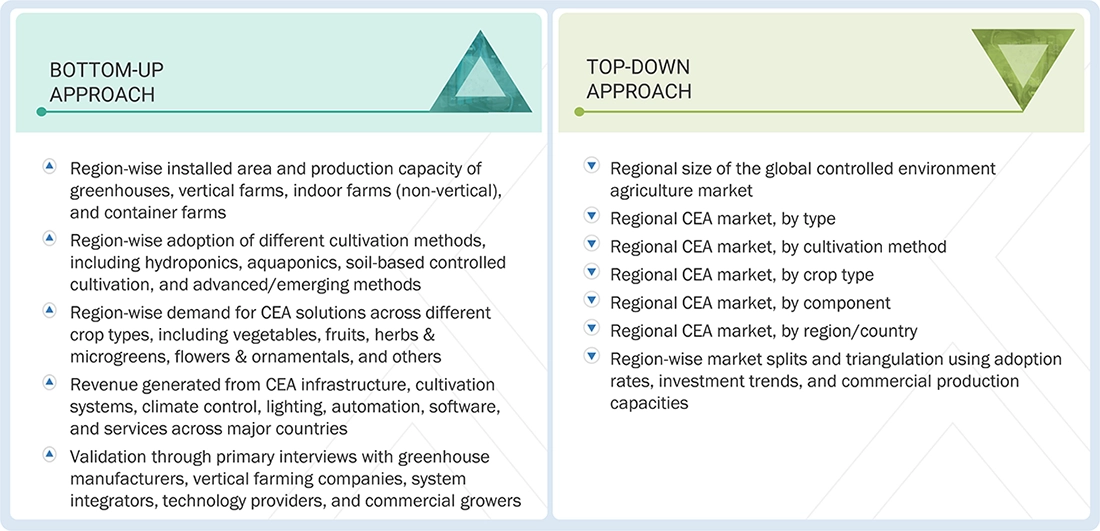
Both the top-down and bottom-up approaches were used to estimate and validate the total size of the controlled environment agriculture market. These approaches were also used extensively to estimate the size of various dependent submarkets. The research methodology used to estimate the market size includes the following:
- The key players in the industry and the overall markets were identified through extensive secondary research.
- All shares, splits, and breakdowns were determined using secondary sources and verified through primary sources.
- All possible parameters that affect the market covered in this research study were accounted for, viewed in extensive detail, verified through primary research, and analyzed to obtain final quantitative and qualitative data.
- The research included the study of reports, reviews, and newsletters of top market players, along with extensive interviews for opinions from leaders, such as CEOs, directors, and marketing executives.
Controlled Environment Agriculture Market : Top-Down and Bottom-Up Approach
Data Triangulation
After determining the overall market size through the estimation process described above, the total market was segmented into several segments and subsegments. Data triangulation and market breakdown procedures were employed, wherever applicable, to estimate the overall controlled environment agriculture market and arrive at the exact statistics for all segments and subsegments. The data was triangulated by analyzing various factors and trends from both the demand and supply sides. The market size was also validated using both the top-down and bottom-up approaches.
Market Definition
The controlled environment agriculture (CEA) market comprises technologies, infrastructure, equipment, software, and services used to cultivate crops in enclosed or semi-enclosed environments, where key growing parameters—including temperature, humidity, light intensity, carbon dioxide (CO2), irrigation, nutrient supply, and air circulation—are precisely monitored and controlled to optimize plant growth and maximize productivity. CEA systems enable year-round cultivation, reduce dependence on external climatic conditions, improve resource-use efficiency, and enhance crop quality and yield.
The market encompasses greenhouses, vertical farms, indoor farms (non-vertical), and container farms, using cultivation methods such as hydroponics, aquaponics, soil-based controlled cultivation, and advanced growing technologies. It includes revenue from greenhouse structures, LED grow lighting, climate control systems, irrigation and fertigation equipment, sensors, automation and robotics, software platforms, and related installation and maintenance services. The market serves commercial growers, indoor farming companies, research institutions, and food producers cultivating vegetables, fruits, herbs and microgreens, flowers and ornamentals, and other high-value crops.
Key Stakeholders
- Greenhouse manufacturers and turnkey greenhouse solution providers
- Vertical farming system manufacturers
- Hydroponic, aeroponic, and aquaponic system manufacturers
- Greenhouse equipment manufacturers (HVAC, fertigation, irrigation, ventilation, and climate control systems)
- Horticultural LED lighting manufacturers
- Greenhouse automation, robotics, and control system providers
- Sensor, IoT, and precision agriculture technology providers
- Growing media and substrate manufacturers (rockwool, coco coir, peat, perlite)
- Seed and plant breeding companies
- Water treatment and nutrient solution manufacturers
- Controlled environment agriculture software developers (AI, farm management, digital twin, and analytics platforms)
- Container farming and modular farming solution providers
- Greenhouse project developers, EPC contractors, and system integrators
- Fresh produce growers and commercial greenhouse operators
- Vertical farming companies and indoor farm operators
- Agricultural equipment distributors, dealers, and solution integrators
- Food retailers, supermarkets, and foodservice companies
- Food processing companies
- Research institutes and universities
- Government bodies, venture capitalists, private equity firms, and institutional investors
- Regulatory bodies
Report Objectives
- Determining and projecting the size of the controlled environment agriculture market with respect to type, cultivation method, component, crop type, and region.
- Identifying the attractive opportunities in the market by determining the largest and fastest-growing segments
- Providing detailed information about the key factors influencing the market growth (drivers, restraints, opportunities, and industry-specific challenges)
- Providing the regulatory framework and market entry process related to the controlled environment agriculture market
- Analyzing the micro markets with respect to individual growth trends, prospects, and their contribution to the total market
Available customizations:
With the given market data, MarketsandMarkets offers customizations according to company-specific scientific needs.
The following customization options are available for the report:
Product Analysis
-
Products Matrix, which gives a detailed comparison of the service portfolio of each company.
Company Information
With the given market data, MarketsandMarkets offers customizations according to company-specific scientific needs.
- Further breakdown of the Rest of Europe controlled environment agriculture market into key countries.
- Further breakdown of the Rest of Asia Pacific controlled environment agriculture market into key countries.
- Further breakdown of the Rest of South America controlled environment agriculture market into key countries.


Personalize This Research
- Triangulate with your Own Data
- Get Data as per your Format and Definition
- Gain a Deeper Dive on a Specific Application, Geography, Customer or Competitor
- Any level of Personalization
Let Us Help You
- What are the Known and Unknown Adjacencies Impacting the Controlled Environment Agriculture Market
- What will your New Revenue Sources be?
- Who will be your Top Customer; what will make them switch?
- Defend your Market Share or Win Competitors
- Get a Scorecard for Target Partners

Custom Market Research Services
We Will Customise The Research For You, In Case The Report Listed Above Does Not Meet With Your Requirements
Get 10% Free CustomisationTESTIMONIALS

Business Innovation Director
US Based Leading Agribusiness,
Food and Ingredients ManufacturerI highly appreciate the team's efficiency for a well conducted study that helped us clarify some blind spots in food and agricultural niche markets. Although compiling information for B2B markets is very difficult, the MnM team pulled out the task successfully. The quality of research, level of insights, and responsiveness of team were commendable.






Growth opportunities and latent adjacency in Controlled Environment Agriculture Market