Data Center Battery (UPS & BESS) Market Size, Share, Trends

Data Center Battery (UPS & BESS) Market Size, Share & Trends by UPS (<100 kWh, 100-500 kWh, 500 kWh-1 MWh, >1 MWh), BESS (<1 MWh, 1-30 MWh, >30 MWh), Battery Type (Li-ion, Lead-acid, Sodium-ion, Flow Battery), Data Center (Enterprise, Hyperscale, Colocation) - Global Forecast to 2032




Data Center Battery Market OVERVIEW
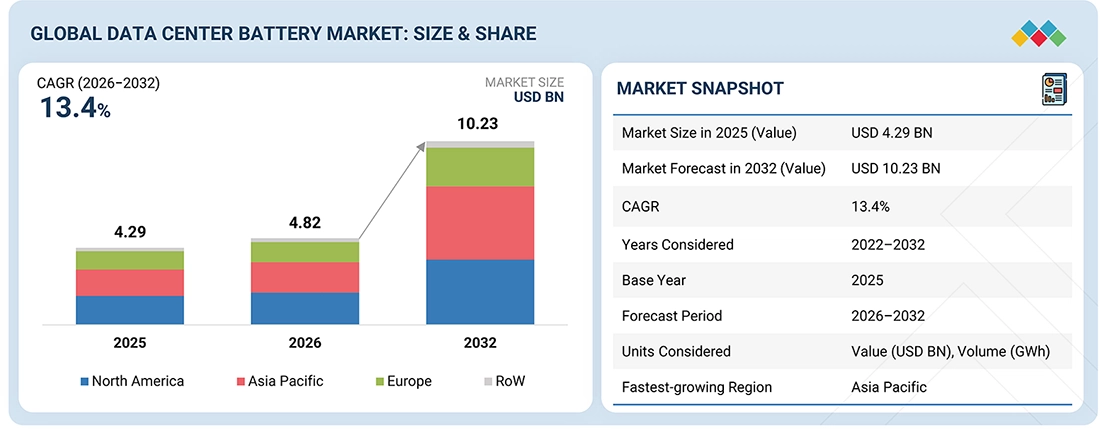
The data center battery market size is projected to grow from USD 4.82 billion in 2026 to USD 10.23 billion by 2032, registering a CAGR of 13.4% during the forecast period 2026–2032. Growth is driven by increasing investments in hyperscale, colocation, and enterprise data centers as operators prioritize power reliability, energy resilience, and uninterrupted operations. Rising deployment of artificial intelligence workloads, cloud infrastructure, and battery energy storage systems is accelerating demand for advanced battery solutions. Advancements in lithium ion battery technologies, battery management systems, and renewable energy integration are enhancing operational efficiency and supporting sustainable data center development across major regions.
REPORT SCOPE
| REPORT METRIC | DETAILS |
|---|---|
| Market Size in 2025 (Value) | USD 4.29 Billion |
| Market Size in 2026 (Value) | USD 4.82 Billion |
| Market Forecast in 2032 (Value) | USD 10.23 Billion |
| CAGR | 13.4% |
| Years Considered | 2022–2032 |
| Base Year | 2025 |
| Forecast Period | 2026–2032 |
| Units Considered | Value (USD Billion), Volume (GWh) |
| Report Coverage | Revenue Forecast, Company Ranking, Competitive Landscape, Growth Factors, and Trends |
| Top Companies |
|
| Growth Driver |
|
| Segments Covered |
|
| Regions Covered | North America, Europe, Asia Pacific, and RoW |
KEY TAKEAWAYS
-
BY REGIONNorth America is expected to account for a significant share of 45%–50% of the data center battery market by 2032.
-
BY SYSTEM TYPEBattery Energy Storage Systems (BESS) are expected to register the highest CAGR of 18%–22% in the data center battery market during the forecast period.
-
BY BATTERY TYPELithium ion batteries are expected to account for a significant share of the data center battery (UPS & BESS) market by 2032.
-
BY DATA CENTER TYPECloud & Hyperscale Data Centers are expected to register the highest CAGR of 16%–18% in the data center battery market during the forecast period.
-
BY ENTERPRISE VERTICALSIT & Telecommunication vertical is expected to account for a significant share of the data center battery (UPS & BESS) market by 2032.
-
COMPETITIVE LANDSCAPE (KEY PLAYERS)Contemporary Amperex Technology Co., Limited (China) and LG Energy Solution (South Korea), among others, are identified as key players in the data center battery market.
-
COMPETITIVE LANDSCAPE (STARTUPS/SMES)ZincFive (US) and C&D Technologies, Inc. (US), among others, have established strong positions in specialized data center backup power and battery solutions, highlighting their role as emerging players and SMEs in the data center battery market.
The data center battery market share is witnessing strong growth as operators increasingly invest in resilient power infrastructure to support expanding digital workloads. Demand is driven by the rapid growth of hyperscale, colocation, and enterprise data centers, along with rising deployment of artificial intelligence and cloud computing applications. Increasing emphasis on uninterrupted operations, energy efficiency, and renewable energy integration is accelerating adoption of advanced battery technologies. Continuous advancements in lithium ion batteries, battery management systems, and battery energy storage systems are improving performance, lifecycle, and operational reliability. Growing power density requirements and the need for flexible energy management solutions are further strengthening the role of batteries in modern data center power architectures.
Source: Secondary Research, Interviews with Experts, MarketsandMarkets Analysis
TRENDS & DISRUPTIONS IMPACTING CUSTOMERS' CUSTOMERS
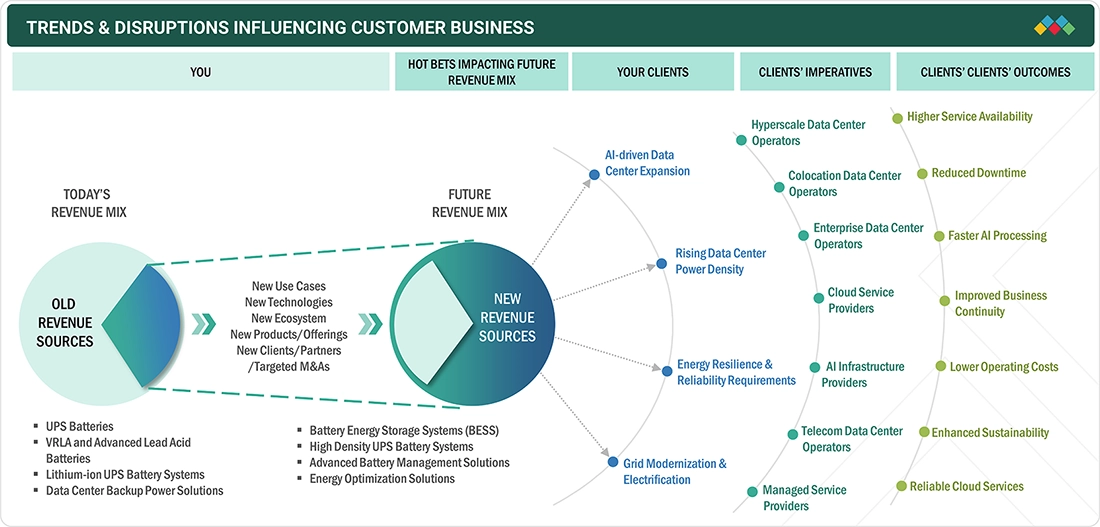
The figure highlights the increasing shift in the data center battery market trends from traditional backup power systems toward advanced energy storage and intelligent power management solutions. Data center operators are deploying lithium ion batteries, battery energy storage systems, and advanced battery management technologies to support rising power demands from cloud computing and artificial intelligence workloads. Growing emphasis on energy resilience, renewable energy integration, and operational continuity is accelerating adoption across enterprise, colocation, and hyperscale facilities. This transition supports improved power reliability, enhanced energy efficiency, reduced downtime, and greater flexibility in energy management, positioning data center batteries as critical components of modern digital infrastructure.
Source: Secondary Research, Interviews with Experts, MarketsandMarkets Analysis
MARKET DYNAMICS

Level
-
Expansion of Hyperscale, Colocation, and AI Focused Data Centers

-
Increasing Demand for Uninterrupted Power Supply and Energy Resilience


Level
-
High Upfront Deployment and Battery Replacement Costs

-
Thermal Management and Safety Requirements for Large Scale Battery Installations


Level
-
Growing Adoption of Battery Energy Storage Systems (BESS) in Data Centers

-
Increasing Integration of Renewable Energy and Grid Interactive Power Infrastructure


Level
-
Supply Chain Volatility for Critical Battery Materials

-
Integration of Advanced Battery Systems with Existing Power Infrastructure

Source: Secondary Research, Interviews with Experts, MarketsandMarkets Analysis
Driver: Expansion of Hyperscale, Colocation, and AI Focused Data Centers
Increasing investments in hyperscale, colocation, and AI focused data centers are driving demand for advanced battery solutions. Growing power requirements and higher rack densities are accelerating deployment of UPS batteries and battery energy storage systems to ensure uninterrupted operations.
Restraint: Thermal Management and Safety Requirements for Large Scale Battery Installations
Large scale battery deployments require effective thermal management and safety systems to maintain performance and reliability. Compliance with safety standards and operational requirements can increase implementation complexity.
Opportunity: Growing Adoption of Battery Energy Storage Systems (BESS) in Data Centers
Increasing focus on energy resilience, peak shaving, and backup power optimization is creating opportunities for BESS deployment. Data center operators are leveraging energy storage systems to improve energy management and operational efficiency.
Challenge: Supply Chain Volatility for Critical Battery Materials
Fluctuations in the availability and pricing of lithium, nickel, cobalt, and other critical materials can impact battery manufacturing costs and supply stability. Managing procurement risks remains a key challenge for market participants.
DATA CENTER BATTERY MARKET SIZE, SHARE, TRENDS: COMMERCIAL USE CASES ACROSS INDUSTRIES
| COMPANY | USE CASE DESCRIPTION | BENEFITS |
|---|---|---|
 |
Provides lithium ion batteries and battery energy storage systems for hyperscale, colocation, and enterprise data centers to support backup power, energy storage, and renewable energy integration. | Improves power reliability, supports energy resilience, enables peak load management, and enhances operational continuity. |
 |
Delivers lithium ion UPS batteries and energy storage solutions for data centers requiring high energy density, long lifecycle performance, and reliable backup power. | Reduces maintenance requirements, optimizes space utilization, improves energy efficiency, and supports uninterrupted operations. |
 |
Supplies advanced lithium ion battery systems for UPS and energy storage applications across mission critical data center environments. | Enhances system reliability, increases backup power efficiency, supports high density deployments, and improves battery lifecycle performance. |
 |
Offers large scale battery energy storage solutions that support data center energy management, renewable energy integration, and grid stabilization initiatives. | Enables peak shaving, improves energy flexibility, supports renewable energy utilization, and lowers operating costs. |
 |
Provides lithium ion battery technologies for data center backup power infrastructure and energy storage applications supporting critical digital operations. | Ensures continuous power availability, improves power quality, increases energy resilience, and supports sustainable data center operations. |
Logos and trademarks shown above are the property of their respective owners. Their use here is for informational and illustrative purposes only.
MARKET ECOSYSTEM
The data center battery market ecosystem is structured across raw material and component suppliers, battery manufacturers, system integrators, and data center operators, collectively enabling reliable backup power, energy storage, and power resilience. Raw material and component providers supply critical battery materials and technologies that form the foundation of battery performance and safety. Battery manufacturers develop UPS batteries and battery energy storage systems designed to support uninterrupted operations in enterprise, colocation, and hyperscale data centers. System integrators incorporate these solutions into broader power infrastructure, ensuring seamless deployment and operational reliability. Data center operators deploy battery systems to maintain uptime, improve energy efficiency, support renewable energy integration, and enhance operational resilience, making them essential components of modern digital infrastructure.
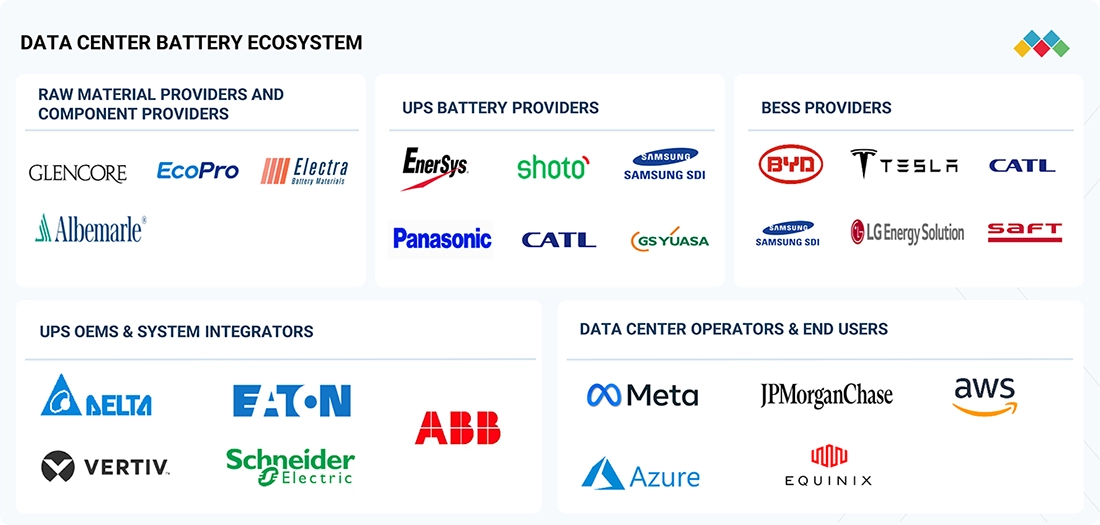
Logos and trademarks shown above are the property of their respective owners. Their use here is for informational and illustrative purposes only.
MARKET SEGMENTS
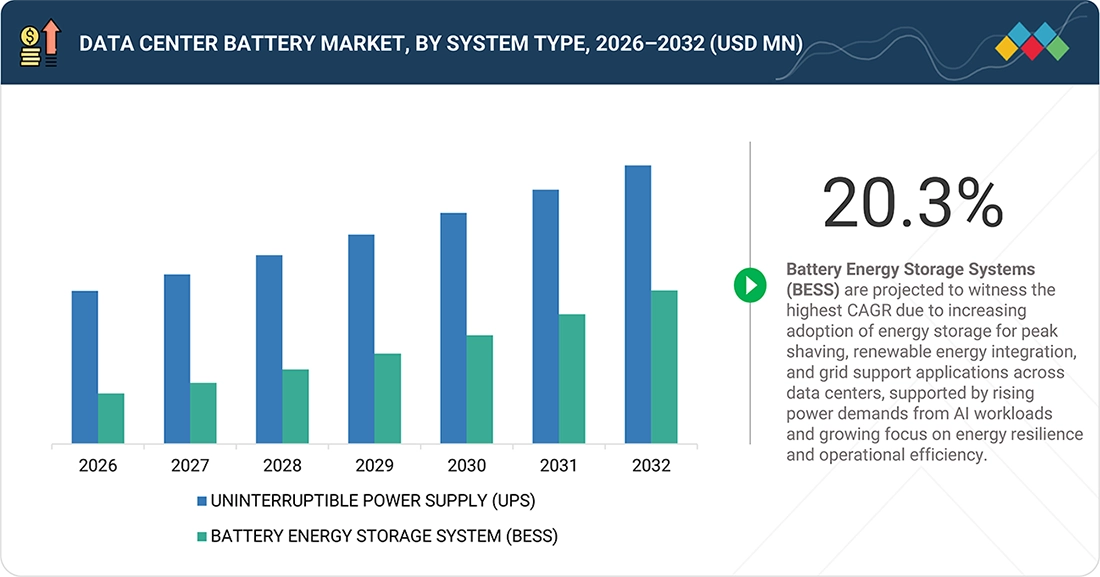
Source: Secondary Research, Interviews with Experts, MarketsandMarkets Analysis
Data Center Battery Market, By System Type
Battery Energy Storage Systems (BESS) are expected to register the highest CAGR of 20.3% during the forecast period due to increasing adoption for peak shaving, renewable energy integration, energy resilience, and grid support applications. Rising power demands from artificial intelligence and high density computing environments are accelerating deployment of BESS solutions across modern data centers.
Data Center Battery Market, By Battery Type
Advanced lead acid batteries are expected to account for a significant share of the data center battery market in 2025 due to their established presence in UPS applications, proven reliability, lower upfront costs, and widespread deployment across enterprise, colocation, and hyperscale facilities. Continued use in mission critical backup power systems supports their considerable market presence.
Data Center Battery Market, By Data Center Type
Cloud & Hyperscale Data Centers are expected to account for a significant share of the data center battery market throughout the forecast period, driven by growing investments in artificial intelligence infrastructure, cloud computing services, and large scale digital transformation initiatives. Increasing power requirements continue to drive deployment of advanced battery systems across hyperscale facilities.
Data Center Battery Market, By Enterprise Verticals
The Manufacturing vertical is expected to register a significant CAGR during the forecast period due to increasing adoption of Industry 4.0 technologies, industrial automation, connected manufacturing systems, and data intensive production environments. Growing demand for reliable data processing and storage infrastructure is supporting investments in data center battery solutions across the manufacturing sector.
Data Center Battery Market, By Region
Asia Pacific is expected to register the highest CAGR in the data center battery market during the forecast period, driven by rapid expansion of hyperscale and colocation data centers across China, India, Japan, Southeast Asia, and Australia. Rising investments in artificial intelligence infrastructure, cloud computing capacity, and battery energy storage systems are accelerating demand for advanced battery solutions. Growing digitalization, increasing data traffic, and ongoing development of large scale data center facilities continue to support strong regional growth.
REGION
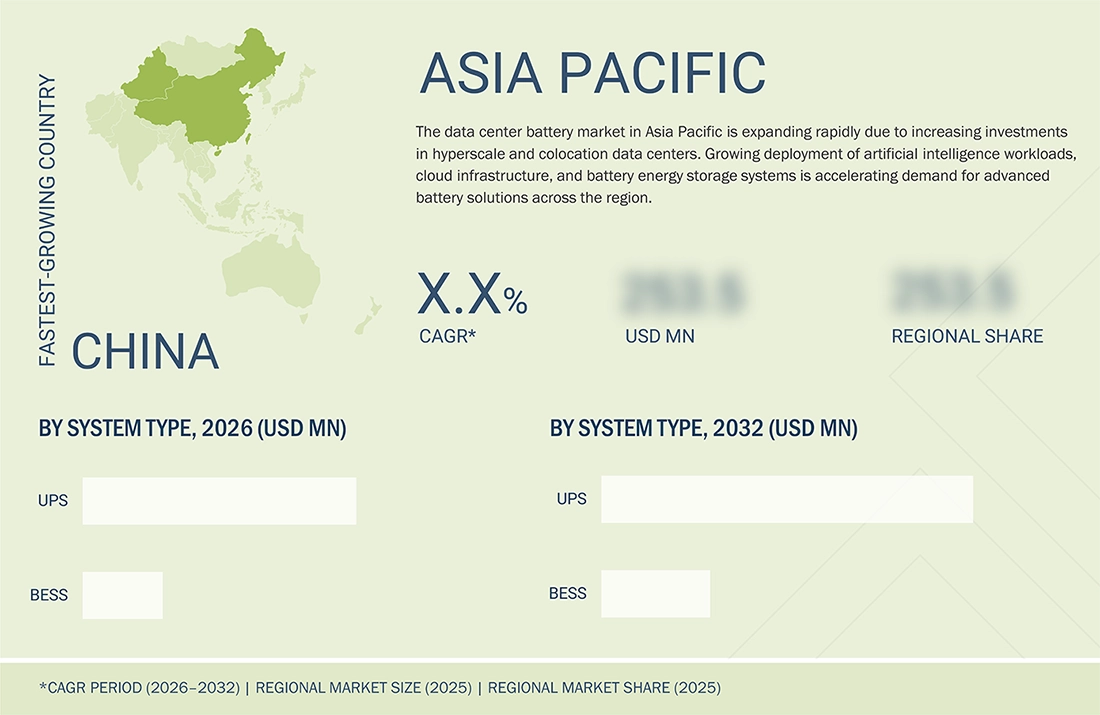
Asia Pacific to be fastest-growing region in Data Center Battery Market during forecast period
Asia Pacific is expected to be the fastest growing region in the data center battery market, driven by rapid expansion of hyperscale and colocation data centers across China, India, Japan, South Korea, and Southeast Asia. Strong growth in cloud computing, artificial intelligence workloads, and digital infrastructure investments is accelerating deployment of advanced battery solutions across the region. Rising demand for reliable backup power, energy resilience, and battery energy storage systems is further supporting market growth. Increasing investments by hyperscale operators and colocation providers, along with growing integration of renewable energy and energy storage technologies, are contributing to sustained regional expansion and increasing adoption of data center battery solutions across Asia Pacific.
DATA CENTER BATTERY MARKET SIZE, SHARE, TRENDS: COMPANY EVALUATION MATRIX
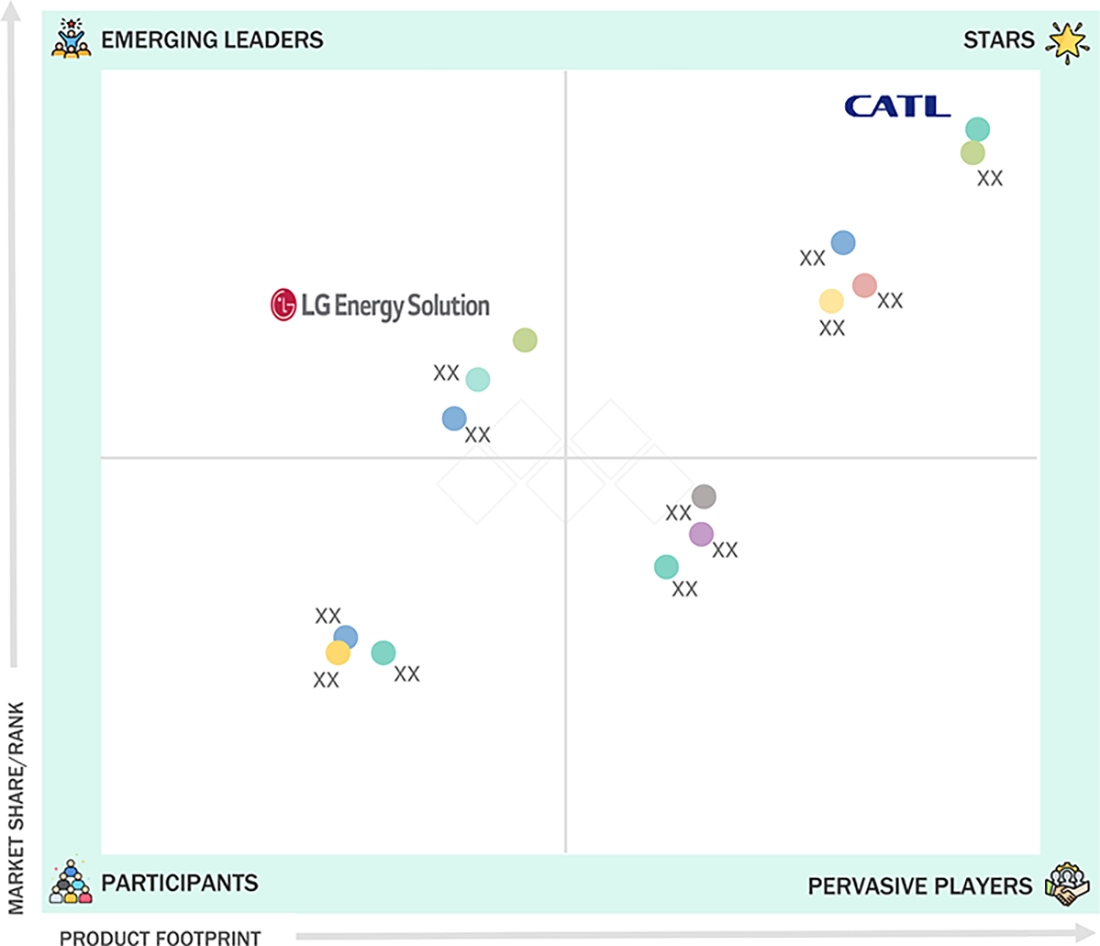
In the data center battery market matrix, Contemporary Amperex Technology Co., Limited is positioned as a Star, supported by its strong portfolio of lithium ion batteries and battery energy storage solutions, extensive manufacturing capabilities, and widespread deployment across energy storage and data center applications. The company demonstrates strength in battery innovation, production scale, and integrated energy storage technologies. LG Energy Solution is positioned as a Star, driven by its expertise in advanced battery technologies, energy storage systems, and strong presence across mission critical power applications. Continued investments in battery innovation, manufacturing expansion, and next generation energy storage solutions are strengthening its market presence and reinforcing its position within the evolving data center battery ecosystem
Source: Secondary Research, Interviews with Experts, MarketsandMarkets Analysis
KEY MARKET PLAYERS
- Contemporary Amperex Technology Co., Limited. (China)
- LG Energy Solution (South Korea)
- SAMSUNG SDI (South Korea)
- Tesla (US)
- Panasonic Holdings Corporation (Japan)
- BYD Company Ltd. (China)
- GS YUASA CORPORATION (Japan)
- EnerSys (US)
- EVE ENERGY CO., LTD. (China)
- TOSHIBA CORPORATION (Japan)
- Sunwoda Electronics Co., Ltd. (China)
WHAT IS IN IT FOR YOU: DATA CENTER BATTERY MARKET SIZE, SHARE, TRENDS REPORT CONTENT GUIDE
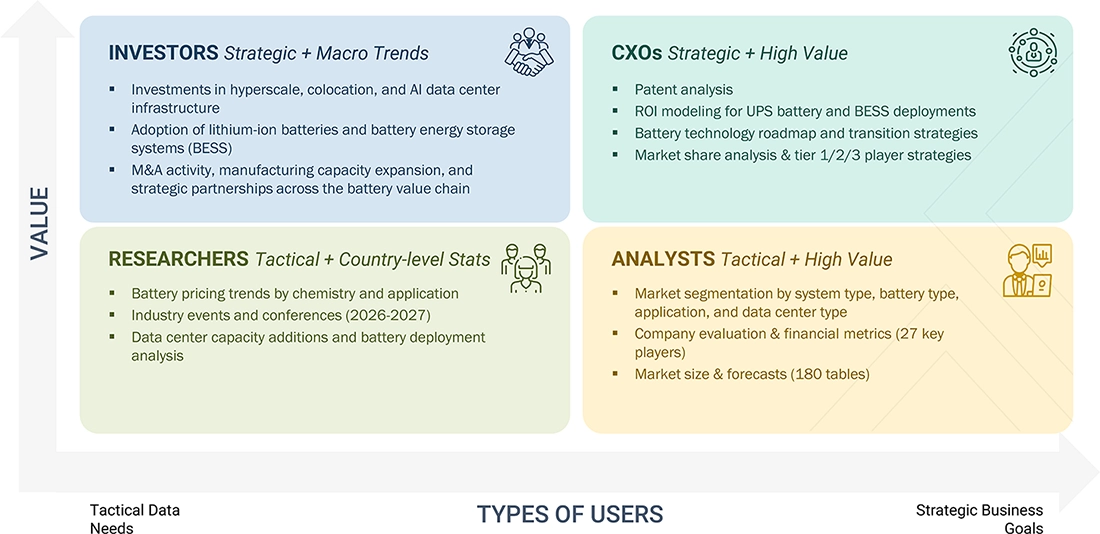
DELIVERED CUSTOMIZATIONS
We have successfully delivered the following deep-dive customizations:
| CLIENT REQUEST | CUSTOMIZATION DELIVERED | VALUE ADDS |
|---|---|---|
| Data Center Operator / Colocation Provider | Mapping data center battery adoption across enterprise, colocation, and cloud & hyperscale facilities, with analysis of UPS and BESS deployment trends by application and facility type | Benchmarking power resilience and uptime strategies |
| Battery Manufacturer | Competitive benchmarking of battery technologies including lithium ion, advanced lead acid, nickel zinc, nickel cadmium, and sodium ion batteries across data center applications and end uses | Technology benchmarking based on energy density, lifecycle, safety, and cost |
RECENT DEVELOPMENTS
- August 2026: Tesla disclosed, via SpaceX's SEC filing for the quarter ended June 30, 2026, that SpaceX spent $295 million on Tesla Megapack battery systems during the April–June period, primarily to help power its Colossus AI data centers in the Greater Memphis area. The purchase builds on SpaceXAI's prior deployment of 168 Megapacks at the site, with Tesla executives noting the units are used mainly to smooth power fluctuations during AI training runs. The disclosure underscores continuing customer demand for Tesla's batteries specifically for AI data center backup and power-smoothing applications.
- August 2026: SAMSUNG SDI raised roughly $3.2 billion from selling its display-business stake to fund its AI-era battery ambitions, days after acquiring General Motors' stake in the paused StarPlus Energy joint-venture campus in Kokomo, Indiana, which it plans to convert to lithium iron phosphate battery production for energy storage systems. Samsung SDI, positioning itself as the only non-Chinese prismatic LFP manufacturer with a US production base, is targeting the converted plant to supply FEOC-compliant cells for utility-scale ESS buyers tied to AI data center and grid-stability demand, with cell production targeted for October 2026.
- July 2026: LG Energy Solution disclosed it is accelerating development of battery solutions optimized for Nvidia's proposed 800VDC power architecture for next-generation AI data centers, outlining a sequential cell roadmap from its current NCM-based JP5 to an LFP-based JP6 in 2028 and a sodium-ion-based JP7 in 2029. The company said 800VDC cuts current for the same power delivered versus today's 415V AC data center setups, reducing cable use, heat, and transmission losses, and noted it has already passed large-scale fire tests under the tightened UL9540A sixth-edition standard. The roadmap directly targets next-generation data center battery requirements as LG Energy builds out its ESS/UPS offerings for AI facilities.
- June 2026: EnerSys introduced the DataSafe Noir™ lithium-based energy storage system, a new data-center-focused battery platform engineered to manage power behavior under real-world, high-density, AI-driven load conditions rather than relying on chemistry, runtime, and cost alone. The system, available immediately, expands EnerSys' data center battery portfolio beyond its established DataSafe TPPL lead-acid line, giving operators a higher-performance lithium option for handling variable, real-time power demand from AI workloads. The launch directly targets the data-center battery segment, positioning EnerSys to defend its established lead-acid share while capturing new lithium-based demand tied to AI data center growth.
- June 2026: Panasonic Holdings Corporation unveiled a JPY 350 billion (~$2.18 billion) investment plan at its Investor Day to build dedicated data center battery manufacturing capacity, including converting its Kansas EV battery cell plant in De Soto for data center applications, adding module sites in Mexico, and repurposing an Osaka vehicle line for lithium battery and supercapacitor output. The plan targets tripling Panasonic's data center energy-storage sales to roughly JPY 1 trillion by fiscal year 2029, alongside new capacitor backup units and battery backup units suited to high-voltage DC data center architectures. It is among the largest single manufacturing commitments announced to date tied specifically to data center battery supply.
Table of Contents
 Exclusive indicates content/data unique to MarketsandMarkets and not available with any competitors.
Methodology
The study involved four major activities to estimate the current size of the data center battery market. Exhaustive secondary research was conducted to collect information on the market, peer market, and parent market. To validate these findings, assumptions, and sizing, primary research with industry experts across the value chain was the next step. Both top-down and bottom-up approaches were employed to estimate the total market size. After that, market breakdown and data triangulation methods were used to estimate the market size of segments and subsegments. Two sources of information, secondary and primary, were used to identify and collect information for an extensive technical and commercial study of the data center battery market.
Secondary Research
Various secondary sources have been used in the secondary research process to identify and collect information relevant to this study. The secondary sources include annual reports, press releases, and investor presentations from companies; white papers; journals and other certified publications; articles by recognized authors; and websites, directories, and databases. Secondary research has been conducted to obtain key information on the industry’s supply chain, the market’s value chain, the total pool of key players, market segmentation by industry trends (to the most granular level), regional markets, and key developments from market- and technology-oriented perspectives. Secondary data have been collected and analyzed to determine the overall market size, and the results have been further validated through primary research.
Primary Research
Extensive primary research has been conducted after gaining an understanding of the current state of the data center battery market through secondary research. Several primary interviews have been conducted with experts from the demand and supply sides across four major regions, North America, Europe, Asia-Pacific, and RoW. This primary data has been collected through questionnaires, emails, and telephone interviews.
Breakdown of Primary Interviews
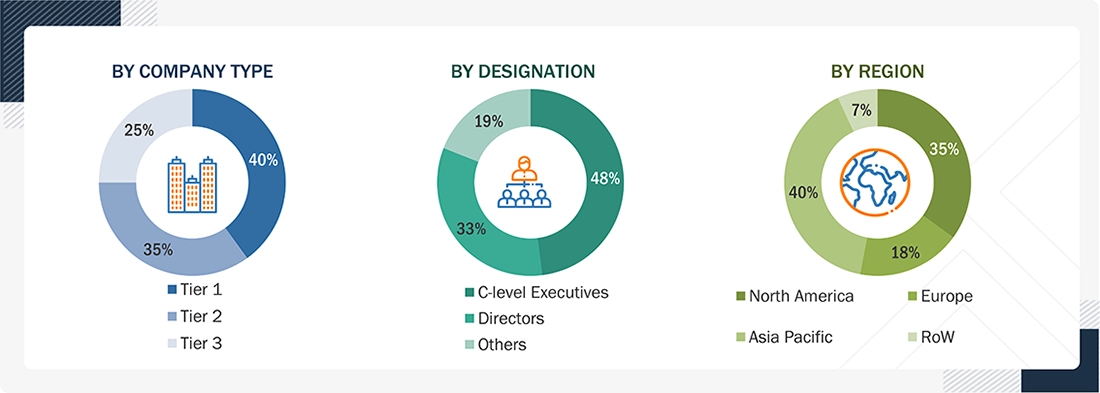
Note: Other designations include product, sales, and marketing managers.
Three tiers of companies have been defined based on their total revenue as of 2025: tier 3: revenue less than USD 500 million; tier 2: revenue between USD 500 million and USD 5 billion; and tier 1: revenue more than USD 5 billion.
RoW mainly includes South America, Africa, and the Middle East.
To know about the assumptions considered for the study, download the pdf brochure
Market Size Estimation
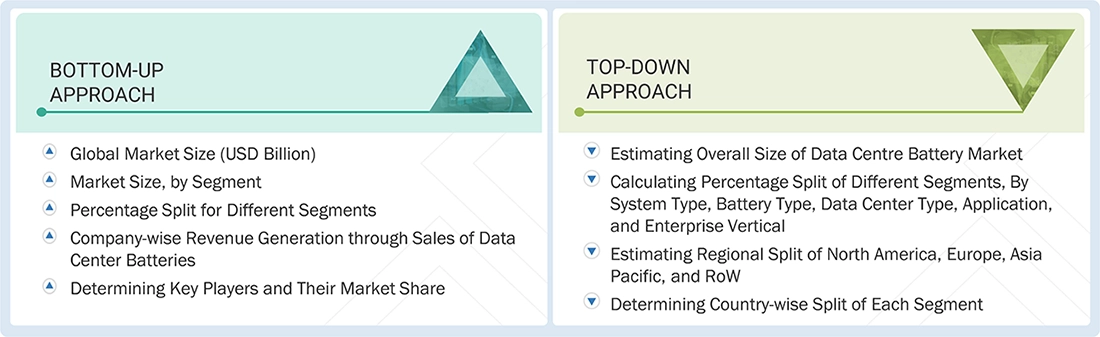
Both top-down and bottom-up approaches have been used to estimate and validate the total size of the data center battery market. These methods have also been used extensively to estimate the size of various market subsegments. The following research methodology has been used to estimate the market size:
- Major players in the industry and markets have been identified through extensive secondary research.
- The industry’s value chain and market size (in terms of value) have been determined through primary and secondary research processes.
- All percentage shares, splits, and breakdowns have been determined using secondary sources and verified through primary sources.
Data Center Battery Market : Top-Down and Bottom-Up Approach
Data Triangulation
After determining the overall size of the data center battery market through the market size estimation process described above, the total market has been segmented into several segments and subsegments. Data triangulation and market breakdown procedures have been employed, where applicable, to complete the overall market engineering process and derive exact statistics for all market segments and subsegments. The data has been triangulated by analyzing various factors and trends from both the demand and supply sides. Additionally, the market size has been validated using both top-down and bottom-up approaches.
Market Definition
The data center battery market comprises battery technologies and energy storage solutions that provide backup power, energy resilience, and power management across data center facilities. These systems ensure uninterrupted operations during grid disturbances, power outages, and voltage fluctuations, supporting the continuous availability of critical digital infrastructure. The market includes batteries used in uninterruptible power supply (UPS) systems and battery energy storage systems (BESS), serving enterprise, hyperscale, and colocation data centers. Data center batteries play a vital role in maintaining uptime, improving power reliability, supporting renewable energy integration, and optimizing energy utilization. As data centers continue to expand in scale and power density, battery systems have become essential components of modern power architectures, enabling operational continuity, energy efficiency, and long-term infrastructure resilience.
Key Stakeholders
- Data center operators
- Cloud service providers and hyperscale operators
- Colocation service providers
- Enterprise organizations and end users
- Battery manufacturers
- Battery energy storage system (BESS) providers
- UPS manufacturers and solution providers
- Power infrastructure and electrical equipment providers
- Data center developers and construction companies
- Engineering, procurement, and construction (EPC) contractors
- System integrators
- Energy management and power quality solution providers
- Utilities and grid operators
- Government bodies, venture capitalists, and private equity firms
- Industry associations related to data centers, energy storage, and digital infrastructure
- Research institutions and technology organizations
- Standards organizations and regulatory authorities
- Professional services and consulting firms
- Distributors and channel partners
- Technology consultants and infrastructure advisors
Report Objectives
- To define, describe, and forecast the data center battery market based on system type, battery type, data center type, application, and enterprise vertical, in terms of value
- To describe and forecast the size of the data center battery market by four regions: North America, Europe, Asia Pacific, and the Rest of the World (RoW), along with their respective countries, in terms of value
- To provide detailed information regarding drivers, restraints, opportunities, and challenges influencing market growth
- To strategically analyze micromarkets1 with respect to individual growth trends, prospects, and contributions to the overall market size
- To study the complete value chain of the data center battery market
- To analyze opportunities for stakeholders by identifying high-growth segments of the data center battery market
- To strategically profile the key players and comprehensively analyze their market position in terms of their ranking and core competencies2
- To analyze competitive developments, such as product launches, acquisitions, collaborations, and partnerships, in the data center battery market
- To provide ecosystem analysis, case study analysis, patent analysis, technology analysis, impact of AI/Gen AI, impact of 2025 US tariffs, key conferences and events, Porter’s Five Forces analysis, and regulations pertaining to the market under study
- To provide a macroeconomic outlook for all the regions
Available customizations:
With the given market data, MarketsandMarkets offers customizations according to the company’s specific needs. The following customization options are available for the report:
Company Information
-
Detailed analysis and profiling of additional market players (up to 5)
Key Questions Addressed by the Report
What is the current size of the Data Center Battery Market?
The global Data Center Battery Market is valued at USD 4.82 billion in 2026 and is projected to reach USD 10.23 billion by 2032, growing at a CAGR of 13.4%.
What are the major growth drivers of the Data Center Battery Market?
Growth is driven by rising AI workloads, hyperscale data center expansion, cloud computing, and increasing demand for reliable backup power systems.
Which battery type is expected to dominate the market?
Lithium-ion batteries lead the market due to their high energy density, longer lifespan, faster charging, and lower maintenance requirements.
Which region holds the largest market share?
North America leads the market owing to strong investments in hyperscale data centers, AI infrastructure, and cloud services.
Who are the leading companies in the Data Center Battery Market?
Key players include CATL, LG Energy Solution, ZincFive, C&D Technologies, Tesla, and Panasonic Energy.
What are the key trends in the Data Center Battery industry?
Major trends include lithium-ion adoption, Battery Energy Storage Systems (BESS), AI-ready infrastructure, and renewable energy integration.
Which data center segment is growing the fastest?
Hyperscale and cloud data centers are expected to witness the fastest growth due to increasing AI and digital transformation investments.
How does AI impact the Data Center Battery Market?
AI applications increase power demand, encouraging investments in advanced battery technologies and resilient backup power solutions.
What opportunities exist in the Data Center Battery Market?
Opportunities include renewable-powered data centers, smart battery management systems, and next-generation battery technologies such as sodium-ion batteries.
What does the report analyze?
The report covers market size, forecasts, trends, battery types, UPS and BESS capacities, regional analysis, competitive landscape, and growth opportunities through 2032.


Personalize This Research
- Triangulate with your Own Data
- Get Data as per your Format and Definition
- Gain a Deeper Dive on a Specific Application, Geography, Customer or Competitor
- Any level of Personalization
Let Us Help You
- What are the Known and Unknown Adjacencies Impacting the Data Center Battery (UPS & BESS) Market
- What will your New Revenue Sources be?
- Who will be your Top Customer; what will make them switch?
- Defend your Market Share or Win Competitors
- Get a Scorecard for Target Partners

Custom Market Research Services
We Will Customise The Research For You, In Case The Report Listed Above Does Not Meet With Your Requirements
Get 10% Free CustomisationTESTIMONIALS

Tetsuya Ohhira
Business Development Manager-Technology Business
Nikon Corporation,
Leading Japanese MNC specializing in optics and imaging productswww.nikon.com
MarketsandMarkets™ response
is quick. Their attitude is flexible and positive. Analyst Insights are globally considered and
significant. Client Services quickly respond to our inquiry and demand. Their wide range of global
surveys help us make our strategic plan.
We hope Knowledge Store will be easier to search
for a report.
VP - Marketing & Business Development
Leading Provider of Process Control Solutions
We engaged with MarketsandMarkets on a study to perform an analysis and recommend a Go-To-Market strategy for metrology and process control in the semiconductor market. The study was tailored to our targets and needs with well-defined milestones. Our overall experience with the MarketsandMarkets team was very good throughout the project in all aspects including the analysis methodologies used, the quality and depth of primary and secondary data sets, the professionalism and flexibility of the team and the ability to meet the target schedule and milestones. We want to thank MarketsandMarkets team for a job well done.






Growth opportunities and latent adjacency in Data Center Battery (UPS & BESS) Market