Data Center Direct-to-Chip Coolants Market

Data Center Direct-to-Chip Coolants Market by Coolant Type (Water-Glycol Mixture, Dielectric Fluids, Refrigerants), Cooling Technology (Single-phase, Two-phase), Data Center Type (Hyperscale, Colocation, Enterprises), and Region - Global Forecast to 2032




OVERVIEW
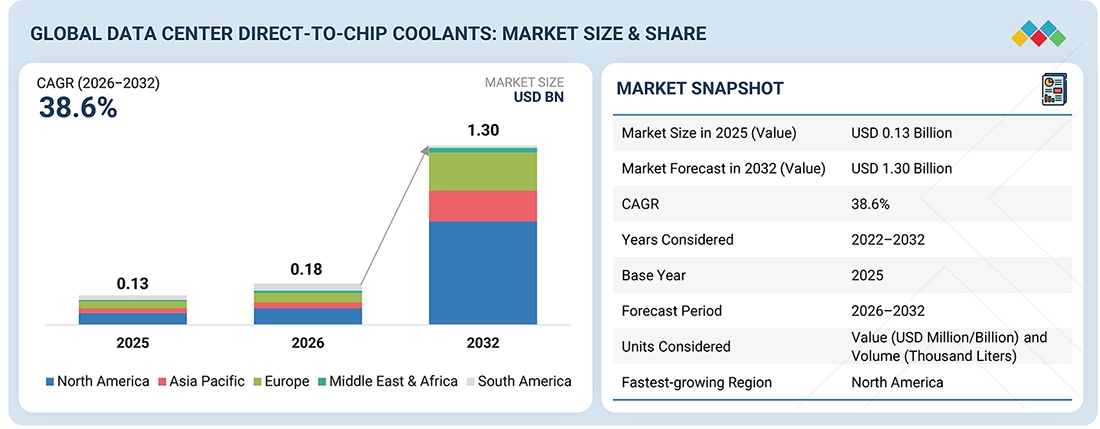
Source: Secondary Research, Interviews with Experts, MarketsandMarkets Analysis
The global data center direct-to-chip coolants market is projected to grow from USD 0.18 billion in 2026 to USD 1.30 billion by 2032, at a CAGR of 38.6% during the forecast period. The market for direct-to-chip coolants in data centers is experiencing steady growth, primarily driven by the rapid advancement of artificial intelligence (AI), high-performance computing (HPC), cloud services, and the substantial construction of hyperscale data centers. As next-generation AI processors and GPU clusters continue to generate increased thermal loads, traditional air-cooling systems are becoming increasingly inadequate for maintaining efficiency and thermal stability. This situation is accelerating the transition to direct-to-chip liquid cooling technologies and innovative coolant solutions that can transfer and dissipate heat from high-density computing environments more effectively than previously available methods.
Market Size and Forecast:
- Market Size Value in 2026: USD 0.18 Billion
- Revenue Forecast in 2032: USD 1.30 Billion
- Growth Rate: CAGR of 38.6% from 2026 to 2032
- Data available from 2022 to 2032
Key Market Trends and Insights
- Segment Acceleration: The dielectric fluids segment is expected to register the highest growth with a 40.3% CAGR, while single-phase cooling technology and hyperscale data centers are accelerating rapidly at 36.8% and 37.5% CAGR, respectively, driven by demand for efficient high-density cooling.
-
Growth Opportunities: The market is projected to grow at 38.6% CAGR, creating significant opportunities in next-gen AI, HPC, and hyperscale infrastructure, especially in North America which is expected to grow at 41.8%+ CAGR.
- Growth Drivers: Growth is primarily driven by rising heat density from AI processors and GPU clusters, increasing need for higher rack power density, and the shift from traditional air cooling to direct-to-chip liquid cooling for improved thermal efficiency and performance stability.
- Market Share Analysis: The market is led by established players such as Shell plc, The Chemours Company, and Castrol Limited, while emerging players like InnoChill and Savita Oil are gaining niche share, indicating a competitive landscape with strong participation across both global leaders and specialized innovators.
KEY TAKEAWAYS
-
BY REGIONBy region, North America is projected to register the highest CAGR of 41.8% during the forecast period.
-
BY COOLING TECHNOLOGYBy cooling technology, the single-phase segment is projected to grow at the highest CAGR of 36.8% during the forecast period.
-
BY DATA CENTER TYPEBy data center type, the hyperscale data centers segment is projected to register the highest CAGR of 37.5% during the forecast period.
-
BY COOLANT TYPEBy coolant type, the dielectric fluids is projected to register the highest CAGR of 40.3% during the forecast period.
-
Competitive Landscape - Key PlayersShell plc, The Chemours Company, and Castrol Limited were identified as some of the leading players in the data center direct-to-chip coolants market, given their strong market share and product footprint.
-
Competitive Landscape - StartupsInnoChill, Savita Oil Technologies, and Old World Industries, among others, have become leading startups or SMEs by identifying niche gaps early and delivering solutions that precisely match unmet customer needs. Their agility, faster decision-making, and ability to innovate continuously allow them to outperform larger, less flexible competitors.
The global data center direct-to-chip coolants market is also being driven by the increasing pressure to enhance rack-level power density without expanding physical infrastructure. Data center operators need to achieve higher computing output from their existing facilities because they are using high-wattage processors and server setups that create intense heat production. The current cooling methods have lost their effectiveness because they cannot support additional system capacity, while direct-to-chip coolant methods, which control heat at its origin, have become more popular. Operators need to maintain optimal thermal conditions because real-time applications like AI inference, financial transactions, and streaming services require them to reduce latency while increasing processing speed. Direct to chip cooling provides temperature control, which prevents thermal throttling and helps maintain processing efficiency throughout the entire process. The increasing need for scalable infrastructure solutions has led to investments in cooling technologies, which will enable future hardware development, making direct-to-chip cooling the preferred solution for developing next-generation data centers.
TRENDS & DISRUPTIONS IMPACTING CUSTOMERS' CUSTOMERS
The data center direct-to-chip coolants market is undergoing a significant shift in revenue mix, moving from traditional cooling solutions toward advanced liquid cooling technologies driven by AI and high-performance computing demands. Future revenue growth is expected to be fueled by new use cases, single-phase direct-to-chip cooling systems, and eco-friendly cooling technologies designed to improve energy efficiency and reduce carbon emissions. Key market drivers include the rapid expansion of AI and generative AI infrastructure, increasing deployment of high-density computing systems, and the transition from conventional air cooling to liquid cooling architectures. Emerging opportunities are also arising from edge AI deployments and modular data center designs. The evolving ecosystem is creating strong demand for direct-to-chip coolant manufacturers, customized coolant formulators, retrofit cooling solution providers, coolant recycling companies, and AI-based cooling monitoring system providers. On the demand side, hyperscale cloud operators, HPC facilities, enterprise data centers, and colocation providers are becoming the primary adopters of advanced direct-to-chip cooling technologies to support next-generation computing workloads efficiently and sustainably.

Source: Secondary Research, Interviews with Experts, MarketsandMarkets Analysis
MARKET DYNAMICS

Level
-
Rising adoption of AI and high-performance computing (HPC)

-
Increasing rack power density


Level
-
High initial infrastructure and deployment costs

-
Complexity of retrofitting existing facilities


Level
-
Growth of edge computing and 5G infrastructure

-
Emergence of next-generation coolant chemistries


Level
-
Managing extremely high heat fluxes

-
Material compatibility issues

Source: Secondary Research, Interviews with Experts, MarketsandMarkets Analysis
Driver: Rising adoption of AI and high-performance computing (HPC)
The increasing adoption of artificial intelligence (AI) in conjunction with high-performance computing (HPC) is significantly driving the growth of the data center direct-to-chip coolants market. Applications such as AI model training, generative AI, and machine learning workloads require powerful processors and GPU clusters that generate considerably more heat than traditional computing systems. As rack power densities continue to rise, conventional air cooling methods have proven inadequate, often failing to maintain optimal operating temperatures, which negatively impacts system reliability. This has accelerated the transition to direct-to-chip liquid cooling solutions and advanced coolant technologies capable of handling greater thermal loads efficiently. In numerous AI and HPC environments, rack densities can exceed 40–100 kW, creating substantial thermal management challenges, particularly for hyperscale and enterprise data centers. Direct-to-chip cooling systems address this issue by delivering coolant directly to CPUs, GPUs, and other accelerators through cold plates, thereby facilitating efficient heat transfer. This method enhances processor performance, mitigates the risk of thermal throttling, improves energy efficiency, and ensures stability during extended high-compute tasks associated with AI training and inference.
Restraint: High initial infrastructure and deployment costs
The substantial initial infrastructure and deployment costs remain a significant constraint on the growth of the data center direct-to-chip cooling market. Implementing direct-to-chip liquid cooling systems necessitates considerable capital investment in specialized infrastructure components, including cold plates, cooling distribution units (CDUs), liquid piping networks, pumps, heat exchangers, leak detection systems, and advanced coolant management technologies. In comparison to traditional air cooling systems, these liquid cooling architectures typically incur a considerably higher upfront installation cost, along with additional integration expenses, particularly within hyperscale and high-density computing facilities. This challenge is exacerbated for existing data centers that require retrofitting to accommodate direct-to-chip cooling solutions. Many legacy facilities were initially designed for air-cooled systems and may necessitate major structural modifications, enhancements to plumbing, reinforced floor layouts, and a revised airflow management strategy to effectively implement liquid cooling. These complexities associated with retrofitting can prolong implementation timelines, cause operational disruptions, and increase overall project costs, thereby limiting adoption among small and medium-sized data center operators.
Opportunity: Growth of edge computing and 5G infrastructure
The rapid expansion of edge computing and the development of 5G infrastructure are significantly driving growth in the market for direct-to-chip coolants utilized within data centers. As an increasing number of latency-sensitive applications—such as autonomous vehicles, smart cities, industrial IoT, augmented reality (AR), virtual reality (VR), and real-time AI analytics—gain mainstream acceptance, the deployment of edge data centers continues to shift away from traditional centralized models. These facilities require compact, high-density computing environments to effectively manage substantial data volumes, leading to elevated thermal loads that conventional air-cooling systems often cannot adequately address. In this context, direct-to-chip liquid cooling emerges as an optimal thermal management solution, providing superior heat dissipation while occupying less physical space. Additionally, the advanced coolants in these systems help maintain stable operating temperatures for high-performance processors, GPUs, and AI accelerators in edge locations, which is essential for ensuring consistent performance and may contribute to lower energy consumption—an increasingly critical factor for the operational success of remote or modular edge facilities.
Challenge: Managing extremely high heat fluxes
Managing the extremely high heat flux levels is a significant challenge for the data center direct-to-chip cooling market. The rapid development of artificial intelligence (AI), high-performance computing (HPC), and demanding GPU-based workloads has markedly increased processor power densities, resulting in contemporary servers and entire data center racks generating heat at an exceptionally intense rate and often in highly concentrated areas. Modern AI accelerators and next-generation chips can produce localized heat flux that surpasses the capabilities of traditional air cooling systems, making efficient thermal management a critical concern for operators. While direct-to-chip cooling methodologies aim to extract heat directly from CPUs, GPUs, and accelerators via liquid-cooled cold plates, managing ultra-high and concentrated thermal loads remains technically complex. As chip power consumption continues to rise, maintaining consistent coolant flow, preventing hotspot formation, and ensuring uniform heat dissipation across densely packed computing components become increasingly challenging. Inadequate thermal management can result in thermal throttling, diminished processor performance, accelerated equipment aging, and broader reliability concerns.
DATA CENTER DIRECT-TO-CHIP COOLANTS MARKET: COMMERCIAL USE CASES ACROSS INDUSTRIES
| COMPANY | USE CASE DESCRIPTION | BENEFITS |
|---|---|---|
 |
Deployment of direct-to-chip cooling systems for hyperscale AI clusters, generative AI training, and GPU-intensive cloud environments | Supports ultra-high rack densities, lowers energy consumption, improves thermal stability, and reduces operational costs |
 |
Two-phase direct-to-chip cooling for HPC clusters, financial modeling systems, and scientific simulations | Eliminates thermal throttling, improves compute performance, minimizes water usage, and supports scalable HPC infrastructure |
 |
Liquid-cooled colocation environments supporting AI factories, GPU cloud tenants, and high-density enterprise workloads | Higher compute density, lower PUE, improved sustainability, and future-ready infrastructure |
 |
Precision liquid cooling for AI servers, edge data centers, and enterprise GPU systems operating in constrained environments | Reduces hardware failures, lowers power consumption, improves component lifespan, and enables quieter operations |
 |
Development of AI-designed microfluidic cooling channels directly etched into semiconductor dies for next-generation AI processors | Up to 3× higher cooling efficiency, lower silicon temperatures, and support for advanced chip packaging architectures |
Logos and trademarks shown above are the property of their respective owners. Their use here is for informational and illustrative purposes only.
MARKET ECOSYSTEM
The ecosystem surrounding direct-to-chip coolants in data centers comprises multiple interrelated stakeholders that contribute to the advancement, distribution, and implementation of sophisticated liquid cooling solutions. Manufacturers of direct-to-chip coolants, including Castrol, Valvoline, Recochem, and Dynalene, play a pivotal role in the creation of high-performance coolants specifically designed for effective thermal management in artificial intelligence (AI), hyperscale, and high-performance computing (HPC) data centers. Distributors such as Gulf Oil and Renkert Oil facilitate market penetration by providing coolant solutions across various regional and industrial markets. Furthermore, raw material suppliers including Chemours, Shell, and Dow supply specialty chemicals, dielectric fluids, glycols, additives, and engineered materials essential for the formulation and performance optimization of coolants. On the demand side, end users such as Supermicro, Vertiv, and Lenovo are increasingly adopting direct-to-chip cooling technologies to enhance the performance of high-density AI servers, cloud infrastructure, and energy-efficient data center operations. This ecosystem is rapidly evolving, driven by the growing need for liquid cooling solutions in tandem with the expansion of AI and HPC deployments.

Logos and trademarks shown above are the property of their respective owners. Their use here is for informational and illustrative purposes only.
MARKET SEGMENTS

Source: Secondary Research, Interviews with Experts, MarketsandMarkets Analysis
Data Center direct-to-chip coolants Market, By Cooling Technology
The single-phase segment is anticipated to dominate the data center direct-to-chip (D2C) coolants market in value during the forecast period due to its simpler architecture, lower deployment costs, and compatibility with existing infrastructures compared to two-phase systems. Maintaining the coolant in liquid form throughout the thermal management cycle allows for consistent heat transfer, reduced operational challenges, and enhanced reliability for both hyperscale and enterprise data centers. The rising demand from artificial intelligence, machine learning, and high-performance computing workloads is increasing rack power densities, leading to broader adoption of liquid cooling solutions that can manage 60 to 120 kW per rack or more. Moreover, single-phase cooling systems strike a practical balance in thermal performance, scalability, and cost-efficiency while minimizing maintenance requirements, and their compatibility with water-glycol mixtures and engineered fluids facilitates adoption in both new and retrofit projects.
Data Center direct-to-chip coolants Market, By Coolant Type
The market currently presents three primary types of coolants: water-glycol-based coolants, dielectric fluids, and refrigerants. These coolant types offer distinct performance characteristics and safety features tailored to various applications. Water-glycol mixtures are prevalent due to their excellent thermal conductivity and cost-effectiveness, functioning effectively across a broad range of temperatures. However, their electrical conductivity necessitates specialized handling protocols. Dielectric fluids have emerged as the preferred option for advanced applications, owing to their non-conductive properties, which facilitate direct interaction between operators and electronic components while enhancing overall system performance and design capabilities. Refrigerants primarily operate within two-phase systems, utilizing their phase-change attributes to accomplish efficient heat transfer. This makes them particularly suitable for high-density data centers and hyperscale data center environments, notwithstanding the additional operational challenges and environmental considerations they entail.
Data Center direct-to-chip coolants Market, By Data Center Type
The market is categorized into three segments based on end users: hyperscale data centers, colocation providers, and enterprises. Each segment exhibits distinct adoption behaviors. Hyperscale data centers are at the forefront of the market due to their substantial computing power, necessitating advanced solutions for managing the significant heat generated by artificial intelligence and cloud computing workloads. This has led to an increased demand for sophisticated direct-to-chip coolant technologies. Colocation providers are experiencing considerable business growth through the implementation of technology that addresses diverse customer needs while simultaneously reducing energy consumption and accommodating higher equipment utilization. Additionally, enterprises are increasingly adopting direct-to-chip coolant systems as they modernize their infrastructure to meet escalating computational requirements.
REGION
North America to be fastest-growing region in the global data center direct-to-chip coolants market during the forecast period
The global data center direct-to-chip coolants market, North America as fastest-growing region because hyperscale data centers keep expanding, and advanced computing technologies drive demand, which includes artificial intelligence, machine learning, and cloud services. The region hosts a high concentration of leading cloud service providers and technology companies, which are continuously investing in next-generation data center infrastructure to support growing digital workloads. The increasing rack densities together with rising power consumption levels have rendered conventional air-cooling systems ineffective, thus leading to the adoption of direct-to-chip systems as more efficient liquid cooling solutions. The region experiences rapid growth because organizations focus on sustainability and energy efficiency while developing new cooling technologies. North America will emerge as a major direct-to-chip coolants solution growth center during the upcoming years because of these combined factors.

DATA CENTER DIRECT-TO-CHIP COOLANTS MARKET: COMPANY EVALUATION MATRIX
In the data center direct-to-chip coolants market matrix, Shell plc (Star) established itself as a top industry competitor through its innovative liquid cooling technologies and its ongoing dedication to research and development activities. The company provides efficient direct-to-chip technologies, including coolants for data centers, designed to support high-density workloads such as AI and high-performance computing. The company protects its market leadership position by creating energy-efficient cooling systems that customers can implement in both new data centers and their existing facilities. Arteco (Emerging Player) has established itself as a significant competitor in the data center direct-to-chip coolants market because of its direct-to-chip coolants products and its strong manufacturing capabilities.

Source: Secondary Research, Interviews with Experts, MarketsandMarkets Analysis
KEY MARKET PLAYERS
- Shell plc (UK)
- The Chemours Company (US)
- Castrol Limited (UK)
- Dow (US)
- Valvoline Global Operations (US)
- Dynalene, Inc. (US)
- Arteco (Belgium)
- Liquitherm Technologies Group Ltd (US)
- Perstorp (PETRONAS Chemicals Group Berhad) (Sweden)
- Dober (US)
- Clariant (Switzerland)
- GS Caltex (South Korea)
- Enviro Tech International (US)
- Old World Industries (US)
- Solstice Advanced Materials (US)
- Recochem Corporation (Canada)
- Arkema (France)
- InnoChill (China)
- Savita Oil Technologies Limited (India)
- Inventec Performance Chemicals (France)
MARKET SCOPE
| REPORT METRIC | DETAILS |
|---|---|
| Market Size in 2025 (Value) | USD 0.13 Billion |
| Market Forecast in 2032 (Value) | USD 1.30 Billion |
| CAGR (2026–2032) | 38.6% |
| Years Considered | 2022–2032 |
| Base Year | 2025 |
| Forecast Period | 2026–2032 |
| Units Considered | Value (USD Million/Billion), Volume (Thousand Liters) |
| Report Coverage | Revenue forecast, competitive landscape, growth factors, and trends |
| Segments Covered |
|
| Regions Covered | North America, Europe, Asia Pacific, Middle East & Africa, South America |
WHAT IS IN IT FOR YOU: DATA CENTER DIRECT-TO-CHIP COOLANTS MARKET REPORT CONTENT GUIDE

DELIVERED CUSTOMIZATIONS
We have successfully delivered the following deep-dive customizations:
| CLIENT REQUEST | CUSTOMIZATION DELIVERED | VALUE ADDS |
|---|---|---|
| Demand for region-specific market insights |
|
Helps clients identify high-growth regional markets, evaluate infrastructure readiness for liquid cooling deployment, and align expansion strategies with AI-driven data center investments and regional sustainability initiatives |
| Request for competitor benchmarking | Benchmarked leading direct-to-chip coolant manufacturers, liquid cooling solution providers, and thermal management companies by assessing their coolant portfolios, single-phase and two-phase cooling capabilities, partnerships with hyperscale operators, innovation pipelines, pricing strategies, and integration capabilities for AI-ready data centers | Enables competitive positioning analysis, identification of technology leadership gaps, evaluation of strategic partnerships, and discovery of collaboration or acquisition opportunities within the liquid cooling ecosystem |
| Application-specific insights | Provided detailed insights into direct-to-chip coolant applications across AI and machine learning clusters, GPU-intensive computing, cloud computing facilities, enterprise data centers, colocation facilities, and HPC environments requiring advanced chip-level thermal management | Supports application-focused product development, workload-specific cooling optimization, and alignment of coolant technologies with evolving high-density computing requirements |
| Custom material & product specification support | Evaluated the suitability of various coolant chemistries including water-glycol mixtures, dielectric fluids, and engineered coolants based on thermal conductivity, corrosion resistance, material compatibility, fluid stability, and performance requirements in direct-to-chip cooling architectures | Improves cooling efficiency, enhances equipment reliability, reduces maintenance challenges, and supports long-term operational stability in AI-intensive and hyperscale data center environments |
| Technical feasibility & system integration guidance | Delivered guidance on the deployment and integration of direct-to-chip cooling systems within existing and new data center infrastructure, including cold plate integration, coolant distribution unit (CDU) deployment, pump circulation design, rack retrofitting, and hybrid air-liquid cooling transition strategies | Enhances deployment efficiency, minimizes implementation risks, improves thermal management performance, and supports seamless transition from conventional air cooling to advanced liquid cooling systems |
| Regulatory & compliance support | The analysis examined the impact of energy efficiency standards, environmental regulations, coolant safety requirements, and sustainability policies on the adoption of direct-to-chip coolants across global data center markets | Ensures regulatory compliance, supports ESG and carbon reduction initiatives, reduces operational compliance risks, and enables sustainable infrastructure planning for next-generation data centers |
RECENT DEVELOPMENTS
- June 2025 : Shell has launched a propylene glycol-based direct liquid cooling solution designed to meet the thermal demands of high-performance computing and ai by efficiently removing heat from data center components.
- May 2025 : Chemours announced a strategic partnership with Navin Fluorine to manufacture Opteon, its two-phase immersion-cooling fluid. This collaboration, part of Chemours' expanded Liquid Cooling Venture, aimed to meet the rising thermal, energy, and water demands of advanced data centers and AI hardware. Production was set to begin in 2026, marking a key step toward the commercial adoption of two-phase liquid cooling technology.
- December 2024 : Castrol has launched a propylene glycol-based cooling fluid engineered specifically for direct-to-chip cooling applications in high-performance data centers, addressing rising thermal demands from ai and high-density computing workloads.
- March 2023 : Aramco acquired Valvoline Global Operations, expanding its footprint in the premium branded lubricants market. The acquisition gives Aramco ownership of the Valvoline brand for its global products business, while Valvoline Inc. retained the brand for retail services. Valvoline Global Operations brings expertise in automotive and industrial solutions. By leveraging Aramco’s extensive base oils production, advanced R&D capabilities, and worldwide distribution network, the deal aimed to accelerate Valvoline’s global growth, strengthen relationships with OEMs, and enhance Aramco’s integrated downstream portfolio.
Table of Contents
 Exclusive indicates content/data unique to MarketsandMarkets and not available with any competitors.
Methodology
The research methodology used to estimate the size of the data center direct-to-chip coolants market consisted of four major activities. Extensive secondary research was conducted to gather detailed information on the market, peer markets, and parent markets. These findings, assumptions, and metrics were verified through primary interviews with experts from both the demand and supply sides of the data center direct-to-chip coolants value chain. Both top-down and bottom-up approaches were used to estimate the total market size. Market sizes for various segments and subsegments were finalized through comprehensive market segmentation and data triangulation.
Secondary Research
The research methodology for estimating and forecasting the data center direct-to-chip coolants market begins with gathering data on key vendors' revenues through secondary research. This process draws on a range of secondary sources, including Hoover's, Bloomberg Businessweek, Factiva, the World Bank, and industry-specific journals. These sources encompass annual reports, press releases, investor presentations, white papers, certified publications, articles by recognized authors, regulatory notifications, trade directories, and databases. Vendor offerings are also considered to inform market segmentation.
Primary Research
The data center direct-to-chip coolants market comprises several stakeholders throughout the supply chain, including raw material suppliers, processors, end-product manufacturers, and regulatory organizations. The demand side of this market is characterized by industry segments, coolant types, and end users. The supply side is characterized by technological advancements and a wide range of applications. Primary sources from both the supply and demand sides of the market were interviewed to obtain qualitative and quantitative information. The following is the breakdown of the primary respondents:
The Breakup of Primary Research:

To know about the assumptions considered for the study, download the pdf brochure
Market Size Estimation
The top-down and bottom-up approaches have been used to estimate and validate the total size of the data center direct-to-chip coolants market. These approaches have also been widely used to calculate the sizes of various dependent market subsegments. The research methodology used to estimate the market size included the following:
The following segments provide details about the overall market size estimation process employed in this study:
- Extensive primary and secondary research was done to identify the key players.
- The value chain and market size in terms of value of the data center direct-to-chip coolants market were determined through primary and secondary research.
- All percentage shares, splits, and breakdowns were collected through secondary sources and verified through primary sources.
- All possible parameters that affect the market were covered in this research study and are viewed in extensive detail, verified through primary research, and analyzed to obtain the final quantitative and qualitative data.
- The study of reports, reviews, and newsletters of top market players, along with extensive interviews for opinions from key leaders, such as CEOs, directors, and marketing executives, is included in this research.
Data Center Direct-to-Chip Coolants Market : Top-Down and Bottom-Up Approach

Data Triangulation
After estimating the overall market size using the above estimation process, the market was segmented into various segments and subsegments. Data triangulation and market segmentation techniques, along with the market engineering process, were employed to obtain precise market analysis data for each segment and its subsegments.
Research Methodology: The research methodology used to estimate and forecast the global market size began by aggregating data and information from various levels, including country-level data.
Market Definition
Data center direct-to-chip coolants are specialized thermal management fluids engineered to transfer heat directly from high-performance computing components such as CPUs, GPUs, AI accelerators, and memory modules through liquid cooling systems. These coolants circulate within cold plates or microchannel heat exchangers mounted directly onto electronic chips, enabling efficient dissipation of high thermal loads generated in hyperscale, enterprise, edge, and AI-driven data centers.
Direct-to-chip coolants are typically formulated using water-based glycols, dielectric fluids, refrigerants, or other coolants (nanofluids and bio-based fluids) that provide high thermal conductivity, low electrical conductivity, corrosion protection, material compatibility, biological stability, and long operational life. Their primary function is to maintain optimal chip operating temperatures while supporting higher rack power densities, reducing energy consumption, improving Power Usage Effectiveness (PUE), and enabling next-generation high-density server architectures.
Key Stakeholders
- Data center direct-to-chip coolants manufacturers
- Data Center direct-to-chip coolants formulators, custom coolant providers
- Manufacturers of small and mid-sized data centers
- Operators of hyperscale, colocation, and enterprise data centers
- Traders, distributors, and suppliers of data center direct-to-chip coolants
- ASHRAE (American Society of Heating, Refrigerating and Air Conditioning Engineers), Open Compute Project (OCP), Uptime Institute, The Green Grid, Data Center Dynamics, Bitcoin Mining Council, Blockchain Infrastructure Alliance, Liquid Cooling Coalition, European Data Centre Association (EUDCA), Asia Pacific Data Centre Association (APDCA)
- Contract manufacturing organizations (CMOs)
- NGOs, governments, investment banks, venture capitalists, and private equity firms
Report Objectives
- To define, describe, and forecast the size of the data center direct-to-chip coolants market, in terms of value, based on cooling technology, coolant type, data center type, and region
- To provide detailed information regarding the key factors, such as drivers, restraints, opportunities, and industry-specific challenges, influencing the growth of the data center direct-to-chip coolants market
- To strategically analyze micromarkets with respect to individual growth trends, prospects, and their contribution to the total market
- To analyze opportunities in the market for stakeholders and provide a competitive landscape of the market leaders
- To project the size of the market and its submarkets, in terms of value and volume, with respect to five regions (along with their respective key countries), namely, North America, Asia Pacific, Europe, South America, and the Middle East & Africa
- To provide ecosystem analysis, case study analysis, value chain, patent analysis, technology analysis, pricing analysis, Porter's five forces analysis, key stakeholders and buying criteria, investment and funding scenario, trade analysis, impact of AI/Gen AI and 2025 US tariff, key conferences and events, regulatory bodies, government agencies, and regulations about the market under study
- To strategically profile the key players and comprehensively analyze their core competencies
- To analyze competitive developments such as product launches, deals, expansions, and research & development in the data center direct-to-chip coolants market
- To provide the macroeconomic outlook for all regions considered under the study
Available customizations:
Based on the given market data, MarketsandMarkets offers customizations tailored to client-specific needs.
The following customization options are available for the report:
- Additional country-level analysis of the data center direct-to-chip coolants market
- Profiling of additional market players (up to five)
Product Analysis
- Product matrix, which provides a detailed comparison of each company's product portfolio.


Personalize This Research
- Triangulate with your Own Data
- Get Data as per your Format and Definition
- Gain a Deeper Dive on a Specific Application, Geography, Customer or Competitor
- Any level of Personalization
Let Us Help You
- What are the Known and Unknown Adjacencies Impacting the Data Center Direct-to-Chip Coolants Market
- What will your New Revenue Sources be?
- Who will be your Top Customer; what will make them switch?
- Defend your Market Share or Win Competitors
- Get a Scorecard for Target Partners

Custom Market Research Services
We Will Customise The Research For You, In Case The Report Listed Above Does Not Meet With Your Requirements
Get 10% Free CustomisationTESTIMONIALS
We at Nissan Chemicals Corporation have been clients of MarketsandMarkets for more than a year now. We recently consulted MarketsandMarkets for a study, the team at MarketsandMarkets was extremely professional and organized. The business insights were very detailed and aligned well with our expectations that really helped us formulate the Business Plans and device new strategies for development themes. MarketsandMarkets offers a unique combination of expertise and dedicated engagement model. Their research findings have helped us in designing our Pricing Strategy which will make it easier for us to predict the future sales and profits for the next ten years. We look forward to working with MarketsandMarkets in the future.
VP of Strategy & New Business Development
Leading Specialty Chemical Company
The MarketsandMarkets Engagement Model, composed of both the Knowledge Store and advisory custom research, has greatly helped us in understanding our markets and making strategic decisions. The Knowledge Store is a fast way to allow everyone in our organization to understand more about most any market they are interested in. The ability to then get custom research done and get answers to specific strategic questions and market insight has been spectacular. The Markets and Markets team feel more like colleagues than vendors and their services have helped us change our culture where statements of things like growth opportunities and competitive position are always backed by industry research.

Rich Gibson,
Director, Corporate Strategy
Milliken & Company,
Leading Industrial Manufacturer of specialty chemical, floor covering, performance and protective textile materials, and healthcaremilliken.com
MarketsandMarkets is a trusted resource that helps us to better understand markets that are near-adjacencies-whether its technology, value chain or geography. Their Knowledge Store platform provides a dashboard of markets and their characteristics which is easy to use and saves us time.
Adam Shaw,
Market Development and Strategy Manager
AdvanSix Inc. USA,
An American Leader in Chemicalswww.advansix.com
The Knowledge Store from MarketsandMarkets is a valuable tool which has helped my team acquire greater insight in to the end markets that our business serves. This has enabled us to help our company build stronger strategies throughout our planning process.
TOSHIO KINOSHITA
Senior Chif Consultion Research & Consulting Division
Mitsubishi Chemical Research Corporation,
Leading Manufacturer of Chemical Productswww.mitsubishichem-res.co.jp/en/

We recently engaged with MarketsandMarkets for a study, the team not only clearly understood our business objectives but was also extremely professional in the way they handled the entire project. The study was efficiently conducted in a phase-wise manner, and the engagement model furnished us with high-quality business insights that far exceeded our expectations at each phase. We were especially happy that MarketsandMarkets could provide us with both, an English as well as a Japanese version of the study. A special thanks to the Analyst Team and Client Services Team, whose fluency in Japanese enhanced our comfort level, as we could converse with them in our preferred language.
Independent entrepreneurs
Arrow Precision
We approached MarketsandMarkets for study on Proppants Market, and their work exceeded our expectations. The study conducted was comprehensive and enabled us to view the market through the various dimensions. In addition, the team was extraordinarily responsive throughout the process and resolved our queries on time. I strongly recommend MarketsandMarkets and will certainly consider them for additional market assessments we will need in the future.
Global engineering company, Japan
Deputy Manager,
Strategic Planning OfficeThe high-quality insights shared by the MarketsandMarkets team helped us understand the pharmaceutical plant designers in a specific geography. It also captured the risks that we may likely face in communicating with our potential partners. The study would enable us identify partners, which would impact our future growth.
- US Data Center Direct-to-Chip Coolants Market
- Canada Data Center Direct-to-Chip Coolants Market
- Mexico Data Center Direct-to-Chip Coolants Market
- Germany Data Center Direct-to-Chip Coolants Market
- UK Data Center Direct-to-Chip Coolants Market
- France Data Center Direct-to-Chip Coolants Market
- China Data Center Direct-to-Chip Coolants Market
- Japan Data Center Direct-to-Chip Coolants Market
- India Data Center Direct-to-Chip Coolants Market
- South Korea Data Center Direct-to-Chip Coolants Market
- Malaysia Data Center Direct-to-Chip Coolants Market
- Singapore Data Center Direct-to-Chip Coolants Market
- Australia Data Center Direct-to-Chip Coolants Market
- Saudi Arabia Data Center Direct-to-Chip Coolants Market
- UAE Data Center Direct-to-Chip Coolants Market
- South Africa Data Center Direct-to-Chip Coolants Market
- Brazil Data Center Direct-to-Chip Coolants Market
- Argentina Data Center Direct-to-Chip Coolants Market
- Rest Of Europe Data Center Direct-to-Chip Coolants Market
- Rest Of Asia Pacific Data Center Direct-to-Chip Coolants Market
- Rest Of GCC Data Center Direct-to-Chip Coolants Market
- Rest Of South America Data Center Direct-to-Chip Coolants Market






Growth opportunities and latent adjacency in Data Center Direct-to-Chip Coolants Market