Data Center Infrastructure Management Market

Data Center Infrastructure Management Market by DCIM Software (Monitoring, Operations & Management) and Functionality (Asset Management, Operational Monitoring, Performance Optimization, Configuration, Reporting & Dashboards) - Global Forecast to 2031




OVERVIEW
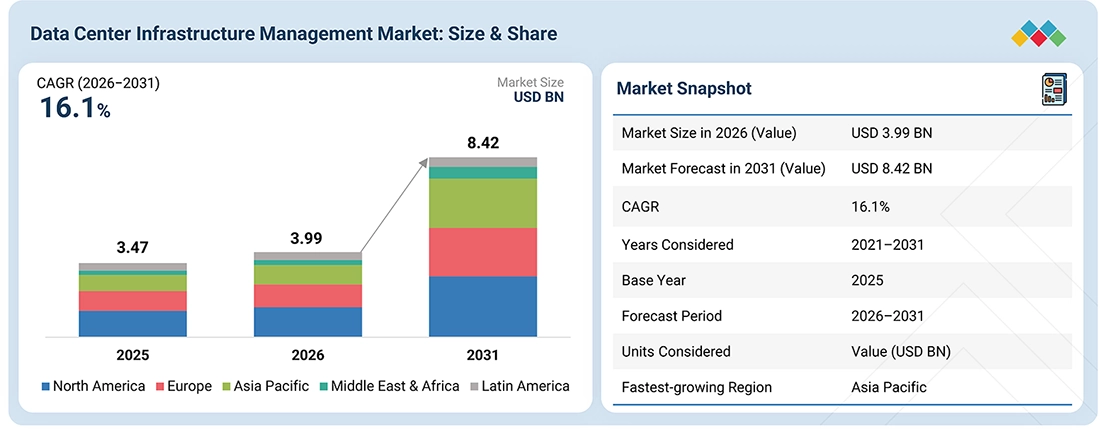
Source: Secondary Research, Interviews with Experts, MarketsandMarkets Analysis
The global data center infrastructure management (DCIM) market is projected to grow from USD 3.99 billion in 2026 to USD 8.42 billion by 2031, reflecting a 16.1% CAGR over the forecast period. Growth is driven by rising data center complexity, AI and high-density workloads, higher power and cooling requirements, and the need for centralized infrastructure visibility. Organizations are increasingly adopting DCIM to monitor assets, capacity, power, cooling, environmental conditions, and infrastructure performance through integrated platforms. The expansion of hyperscale, colocation, enterprise, and edge data centers is further increasing demand for real-time monitoring, predictive analytics, automation, and energy optimization. A growing emphasis on operational efficiency and sustainability is also encouraging operators to adopt DCIM solutions that improve resource utilization, support predictive maintenance, and optimize infrastructure performance across distributed data center environments.
KEY TAKEAWAYS
-
BY REGIONNorth America is expected to account for the largest market value of USD 1.4 billion in 2026.
-
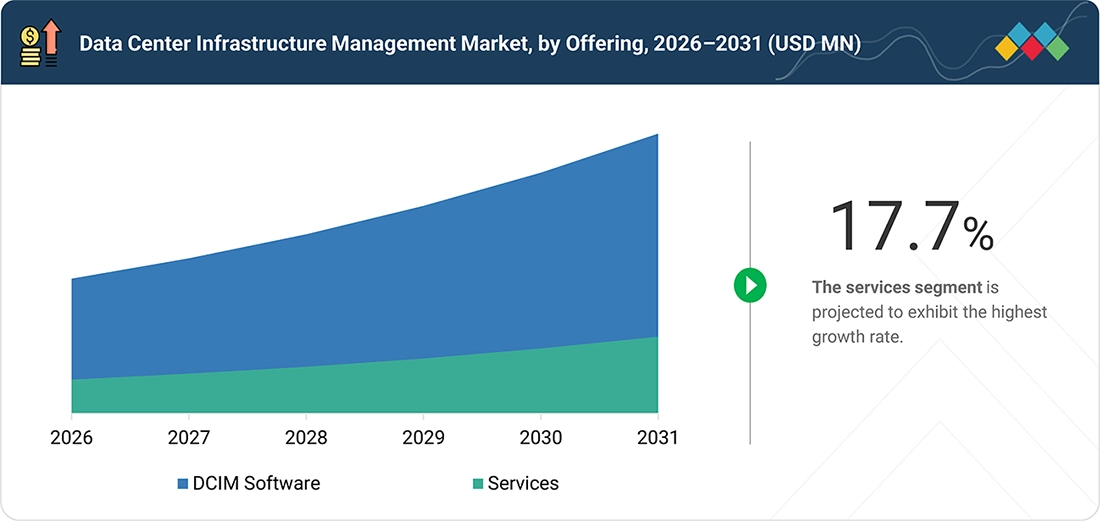
BY OFFERINGThe services segment is expected to grow at the highest CAGR of 17.7% during the forecast period.
-
BY FUNCTIONALITYThe asset management segment is expected to hold the largest market value of USD 1.2 billion in 2026.
-
BY DEPLOYMENT TYPEThe cloud segment is expected to register the highest CAGR during the forecast period.
-
BY TIER TYPETier 4 is expected to dominate the market.
-
BY DATA CENTER SIZEThe small data centers segment is expected grow at the highest CAGR.
-
BY END USERThe enterprises segment is expected to lead with the largest market value.
-
COMPETITIVE LANDSCAPE - KEY PLAYERSKey players such as Schneider Electric, Vertiv, Johnson Controls, Eaton, and Delta Electronics stand out as Stars in the DCIM market due to their strong portfolios in power, cooling, automation, and real-time monitoring.
-
COMPETITIVE LANDSCAPE - STARTUPSSMEs and startups such as Cormant, RF Code, Rackwise, and Paessler act as agile innovators in the DCIM landscape, offering highly specialized and cost-effective solutions tailored for mid-sized and distributed data centers.
The DCIM market is growing steadily as data centers expand in size and complexity, increasing the need for centralized monitoring, capacity planning, and energy optimization. Rising investments in digital infrastructure, AI workloads, and sustainability initiatives are accelerating adoption, especially as operators seek real-time visibility and efficiency gains. This growth is further supported by modernization efforts in both hyperscale and enterprise facilities.
TRENDS & DISRUPTIONS IMPACTING CUSTOMERS' CUSTOMERS
Key trends and disruptions in the DCIM market include the growing integration of AI-driven analytics, predictive maintenance, automation, and performance optimization into infrastructure management platforms. The expansion of high-density AI workloads is increasing the need for real-time monitoring of power, cooling, capacity, and equipment performance. The growth of edge and distributed data centers is also creating demand for remote monitoring and centralized management across geographically dispersed facilities. Rising energy consumption and sustainability requirements are encouraging operators to adopt DCIM tools that support power monitoring, energy optimization, cooling management, and infrastructure efficiency. Meanwhile, cybersecurity and compliance requirements are increasing the need for secure integration between DCIM platforms and IT, BMS, and EPMS environments. The shift toward cloud-based and multi-site DCIM is further changing infrastructure management by enabling centralized visibility, remote operations, analytics, and scalable management across diverse data center environments.
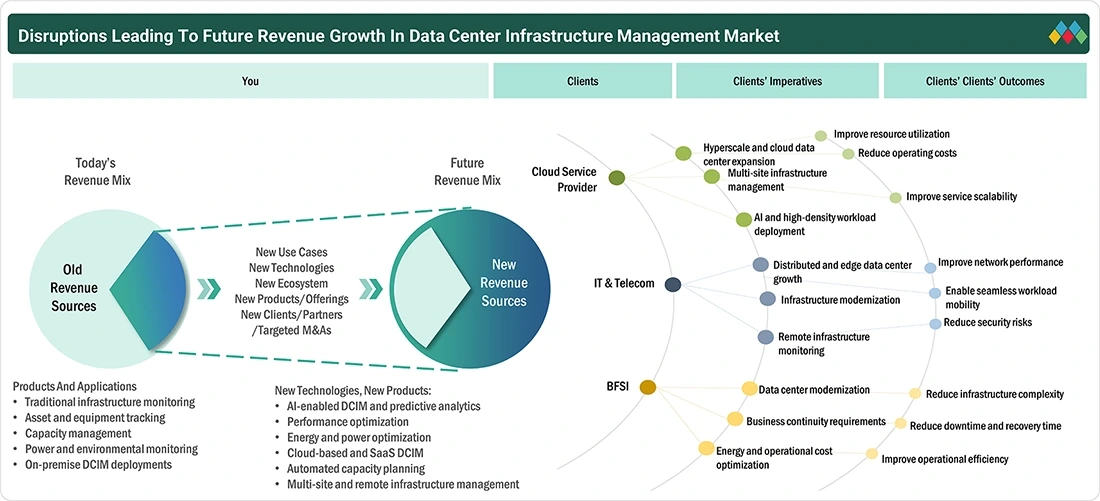
Source: Secondary Research, Interviews with Experts, MarketsandMarkets Analysis
MARKET DYNAMICS

Level
-
Growing adoption of AI and high-density data centers

-
Growing demand for energy-efficient solutions


Level
-
High implementation costs of DCIM solutions

-
Complexity and cost of deploying DCIM across heterogeneous infrastructure


Level
-
Growing investments in data center technologies

-
Rising adoption of edge data centers


Level
-
Concerns over data privacy and security

-
Lack of skilled professionals

Source: Secondary Research, Interviews with Experts, MarketsandMarkets Analysis
Driver: Growing adoption of AI and high-density data centers
AI and accelerated computing are increasing power and thermal densities in data centers, driving demand for DCIM solutions that provide real-time visibility into power, cooling, capacity, and equipment performance. DCIM platforms are increasingly integrating power, cooling, and IT systems to support capacity planning and infrastructure optimization. In June 2025, Schneider Electric introduced EcoStruxure solutions for high-density AI clusters, and in March 2025, Vertiv launched Environet for real-time power and thermal infrastructure management. These developments highlight the shift toward integrated monitoring, analytics, and optimization for AI and hyperscale data center environments.
Restraint: High implementation costs of DCIM solutions
High implementation costs are expected to remain a key restraint on DCIM adoption, as organizations must invest in software licenses, environmental sensors, dedicated servers, and ongoing maintenance and training. These expenses can be challenging for small and medium-sized enterprises with limited budgets, often leading to delayed or scaled-back deployments. However, the long-term benefits—such as improved efficiency, accurate reporting, lower energy consumption, and reduced downtime—typically outweigh the initial investment. Avoiding DCIM can lead to higher operational risks and missed optimization opportunities. With proper planning and budgeting, organizations can justify the cost and achieve meaningful long-term performance gains.
Opportunity: Growing investments in data center technologies
Growing investments in data center infrastructure are creating strong opportunities for the DCIM market. With global investments exceeding USD 22 billion in the first five months of 2024, organizations are expanding capacity and upgrading facilities, increasing the need for advanced tools to manage complex environments and improve efficiency. As data centers scale to support high-performance, energy-intensive workloads, DCIM becomes essential for resource optimization and operational visibility. Sustainability initiatives further accelerate adoption, as DCIM solutions provide critical insights into energy usage and support carbon-reduction goals. Recent investments and strategic moves by major players such as Microsoft, CoreWeave, DataNovaX, and Cologix highlight the growing emphasis on modern, efficient, and well-managed data center operations.
Challenge: Concerns over data privacy and security
Managing data center infrastructure has become increasingly challenging amid growing concerns about data privacy and security. Modern data centers process large volumes of sensitive information, making them prime targets for cyberattacks and sophisticated intrusions. Operators must implement robust security measures, including encryption, firewalls, and intrusion detection systems, while continuously monitoring evolving threats. Regulations such as GDPR and CCPA further increase compliance obligations, with significant penalties for violations. The main challenge is balancing robust security with operational efficiency, as excessive controls can degrade performance or raise costs. As a result, data centers need a comprehensive management approach that ensures strong protection and smooth, compliant operations.
DATA CENTER INFRASTRUCTURE MANAGEMENT MARKET: COMMERCIAL USE CASES ACROSS INDUSTRIES
| COMPANY | USE CASE DESCRIPTION | BENEFITS |
|---|---|---|
 |
Leading Edge Data Centres (LEDC), aiming to bridge the “digital divide” in regional Australia, partnered with Schneider Electric to deploy a network of prefabricated Tier-III edge data centers. LEDC uses EcoStruxure IT and other Schneider Electric infrastructure to monitor and manage its geographically dispersed sites in real time. | LEDC significantly enhanced service reliability and uptime for regional customers by leveraging remote monitoring and proactive analytics. The company also reduced deployment complexity and costs by using Schneider’s prefabricated data center modules, enabling faster and more scalable network roll-out. |
 |
Computacenter, a leading UK-based IT infrastructure services provider, used Nlyte’s DCIM suite to centralize visibility across its data centers (including newly acquired ones) and to model, predict, and optimize capacity. | Computacenter achieved more accurate, usage-based billing and improved SLA alignment through real-time power and capacity visibility. Audit time was reduced from three weeks to under one week, improving data accuracy and compliance. The company also boosted operational efficiency by enabling proactive maintenance and optimizing space, power, and cooling across its facilities. |
 |
Vodafone deployed Sunbird’s DCIM solution to gain real-time insight into its global data centers, leveraging environmental sensors at different rack heights and unified dashboards. With this platform, Vodafone consolidated its asset inventory, capacity management, and power monitoring across all sites. | Using temperature data from the racks, Vodafone identified overcooling and safely raised set-points, resulting in significant energy savings. Vodafone also improved operational agility by having a centralized, real-time view of rack capacity and device relationships, enabling faster deployment decisions. |
 |
FNT Software helped DataVita, a rapidly growing colocation and cloud provider, to document and manage its data center infrastructure using the FNT Command DCIM platform. The system captures all physical, logical, and network assets including cabling, power, cooling, and IT devices in a unified, dynamically updating repository. | DataVita gained full visibility into its infrastructure, significantly improving capacity planning and resource utilization across its two buildings. The platform’s multi-tenancy features ensured data separation and compliance, reducing risk and supporting GDPR requirements. Meanwhile, integrated workflows and real-time asset tracking helped streamline operations, lower operating costs, and accelerate decision-making. |
Logos and trademarks shown above are the property of their respective owners. Their use here is for informational and illustrative purposes only.
MARKET ECOSYSTEM
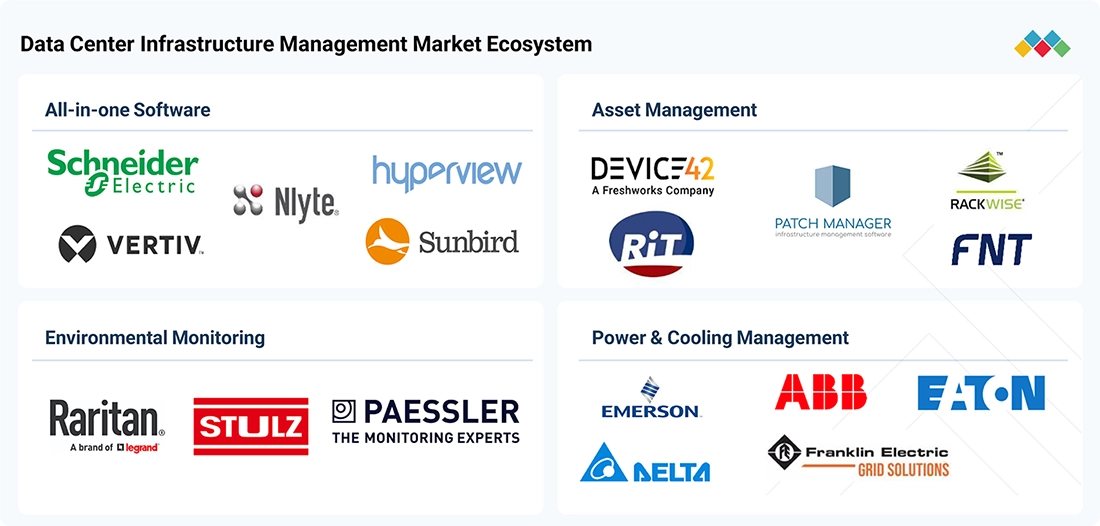
The DCIM ecosystem includes a mix of comprehensive platforms and specialized tools that address key functions such as asset tracking, power and cooling optimization, capacity planning, and environmental monitoring. All-in-one DCIM suites offer centralized oversight of data center operations, while focused solutions support specific needs like energy management and resource forecasting. These tools help enterprises, colocation providers, and edge facilities manage growing infrastructure complexity, improve efficiency, and maintain optimal performance. Understanding how these solutions complement each other is essential for selecting the right DCIM capabilities.
Logos and trademarks shown above are the property of their respective owners. Their use here is for informational and illustrative purposes only.
MARKET SEGMENTS
Source: Secondary Research, Interviews with Experts, MarketsandMarkets Analysis
Data Center Infrastructure Management Market, By Offering
DCIM software is expected to hold the largest market share over the forecast period, supported by the growing adoption of integrated platforms for monitoring and managing complex data center infrastructure. DCIM software provides centralized visibility into assets, capacity, power, cooling, environmental conditions, and infrastructure performance. The growing deployment of hyperscale, colocation, enterprise, and edge facilities is driving demand for scalable software that supports distributed environments. Services are expected to grow fastest, driven by rising demand for design and consulting, integration and deployment, and support and maintenance as organizations implement and optimize DCIM platforms across increasingly complex infrastructure.
Data Center Infrastructure Management Market, By Functionality
Asset management is expected to hold the largest market share during the forecast period, as operators require accurate visibility into IT and facility assets across increasingly complex data center environments. Asset management supports asset tracking, lifecycle management, utilization monitoring, and capacity planning, helping operators improve resource allocation and infrastructure visibility. Performance optimization is expected to grow fastest, driven by rising rack densities, AI workloads, and the need to optimize power, cooling, equipment performance, and infrastructure utilization. The integration of real-time analytics, automation, and predictive capabilities is further increasing demand for performance optimization functionality.
Data Center Infrastructure Management Market, By Deployment Type
Cloud-based DCIM is expected to post the highest CAGR over the forecast period as organizations increasingly seek scalable, flexible platforms to manage distributed data center infrastructure. Cloud deployment enables remote monitoring, centralized management, faster updates, and integration across geographically dispersed facilities. Its scalability also makes it well suited for organizations managing multiple enterprise, colocation, edge, and hybrid environments. The growing adoption of AI, cloud infrastructure, and distributed computing is expected to further drive demand for cloud-based DCIM platforms.
Data Center Infrastructure Management Market, By Tier Type
Tier 3 data centers are expected to achieve the highest CAGR over the forecast period, driven by rising demand for highly available, maintainable infrastructure across enterprise, colocation, cloud, and digital service environments. Tier 3 facilities require continuous visibility into power, cooling, IT equipment, and supporting infrastructure to ensure operational continuity. DCIM solutions enable operators to monitor infrastructure conditions, manage capacity, track assets, and identify potential issues via automated alerts and analytics. Modernization and expansion of Tier 3 facilities are expected to further drive DCIM adoption.
Data Center Infrastructure Management Market, By Data Center Size
Small data centers are expected to post the highest CAGR over the forecast period, driven by the expansion of edge computing, distributed IT infrastructure, localized digital services, and smaller enterprise and cloud facilities. These environments increasingly require remote monitoring and centralized infrastructure visibility, yet operate with limited on-site resources. DCIM solutions can support asset tracking, capacity planning, power and environmental monitoring, and remote infrastructure management. Cloud-based, scalable DCIM platforms are particularly relevant for smaller facilities seeking to improve operational efficiency without deploying complex management environments.
Data Center Infrastructure Management Market, By End User
Cloud service providers are expected to post the highest CAGR over the forecast period, supported by the continued expansion of cloud infrastructure, hyperscale facilities, AI workloads, and distributed computing. Their large, geographically dispersed data center environments require centralized monitoring, capacity planning, asset management, energy optimization, and infrastructure performance management. Rising rack densities and dynamic workloads are further strengthening the need for automated and predictive infrastructure management. DCIM platforms enable cloud service providers to improve infrastructure utilization, coordinate power and cooling resources, and maintain operational visibility across multiple facilities.
REGION
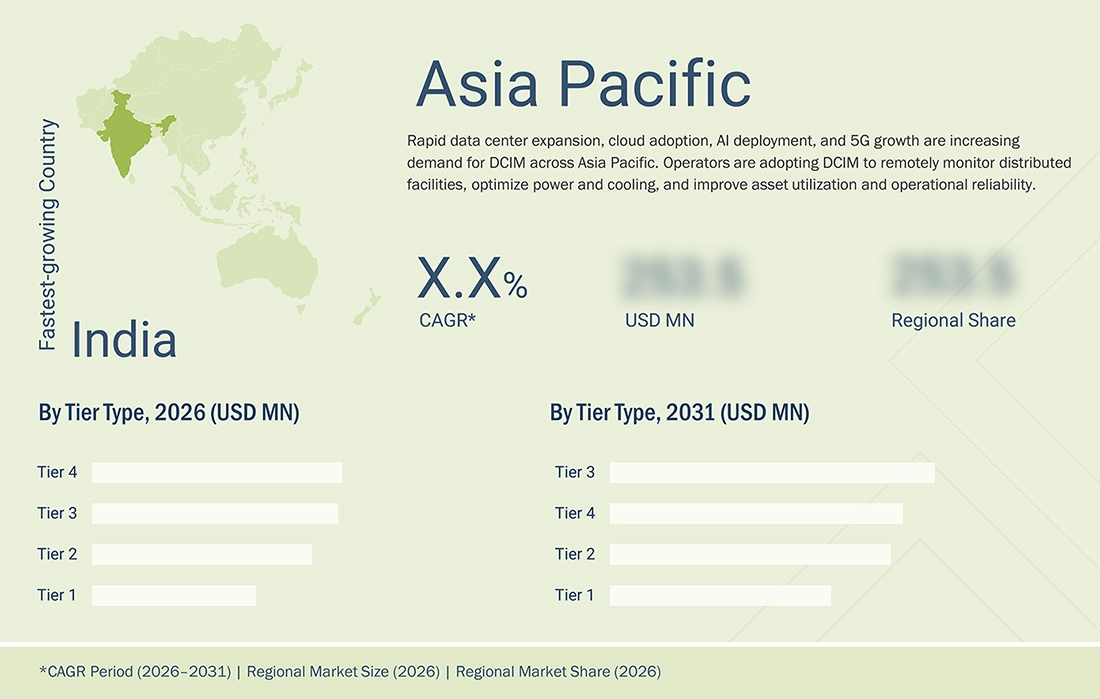
Asia Pacific is expected to register the fastest growth in the data center infrastructure management market during the forecast period
Asia Pacific is expected to lead the DCIM market's growth during the forecast period, supported by rapid data center capacity expansion, cloud adoption, digital transformation, and rising investment in AI infrastructure. Countries such as China, India, Japan, Singapore, Australia, and South Korea are expanding data center facilities to support cloud services, digital applications, enterprise workloads, and high-performance computing. The growth of hyperscale, colocation, and edge facilities is increasing demand for centralized monitoring, capacity planning, energy optimization, and infrastructure automation. Rising power consumption and sustainability requirements are also prompting operators to improve visibility into energy and cooling performance. At the same time, modernizing existing facilities is creating opportunities for DCIM providers to deploy cloud-based monitoring, predictive analytics, remote management, and integrated infrastructure management platforms. These factors are expected to drive strong DCIM adoption across the region.
DATA CENTER INFRASTRUCTURE MANAGEMENT MARKET: COMPANY EVALUATION MATRIX
In the DCIM market, Schneider Electric is positioned as a Star, supported by its strong DCIM portfolio, broad data center infrastructure capabilities, and the established EcoStruxure IT platform. The company offers integrated capabilities spanning infrastructure monitoring, asset management, capacity planning, power and cooling management, analytics, and operational optimization. Rittal is positioned as an Emerging Leader, supported by its established data center infrastructure portfolio, modular data center solutions, cooling systems, and a growing focus on integrated monitoring and infrastructure management. Rittal's capabilities in physical infrastructure and thermal management strengthen its ability to address evolving data center requirements. The competitive positioning of these companies is influenced by product breadth, DCIM functionality, infrastructure integration, monitoring capabilities, automation, energy efficiency, and the ability to support increasingly complex data center environments.
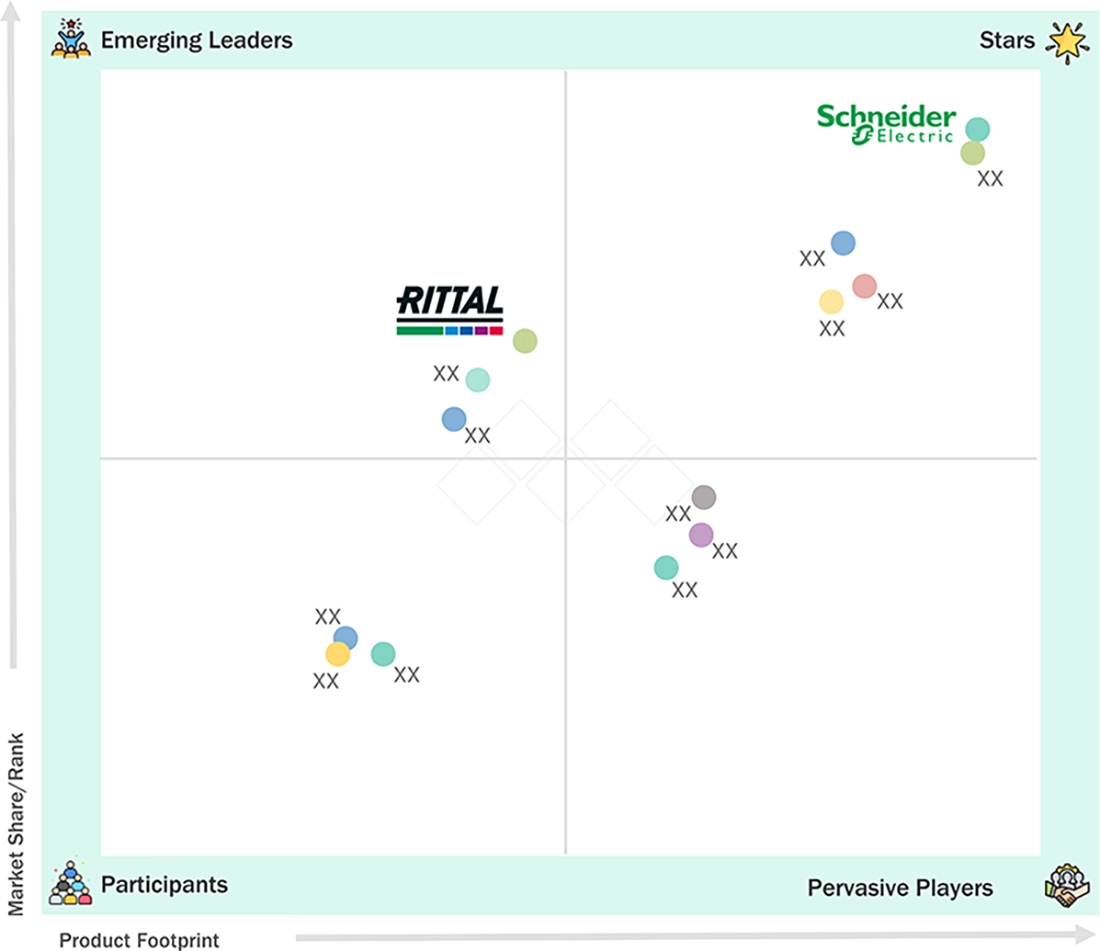
Source: Secondary Research, Interviews with Experts, MarketsandMarkets Analysis
KEY MARKET PLAYERS
- Schneider Electric (France)
- Vertiv (US)
- Eaton (US)
- Johnson Controls (US)
- Siemens (Germany)
- Nlyte Software (US)
- Huawei (China)
- ABB (Switzerland)
- Sunbird Software (US)
- FNT Software (Germany)
- Cormant (Philippines)
- RF Code (US)
- RACKWISE (US)
- Paessler (Germany)
- iTRACS (US)
- STULZ (Germany)
- Device42 (US)
- Hyperview (Canada)
- Rittal (Germany)
- Patch Manager (Netherlands)
- ManageEngine (US)
- GreenField Software (India)
- ISPsystem (Cyprus)
- Delta Electronics (Taiwan)
- ZPE Systems (US)
- Modius (US)
- NetZoom (US)
- EkkoSense (UK)
- CenterOS (New Zealand)
- TeeCube Solutions (India)
- UnitedLayer (US)
- RiT Tech (Israel)
MARKET SCOPE
| REPORT METRIC | DETAILS |
|---|---|
| Market Size in 2025 (Value) | USD 3.47 Billion |
| Market Size in 2026 (Value) | USD 3.99 Billion |
| Market Forecast in 2031 (Value) | USD 8.42 Billion |
| Growth Rate | CAGR of 16.1% from 2026 to 2031 |
| Years Considered | 2021–2031 |
| Base Year | 2025 |
| Forecast Period | 2026–2031 |
| Units Considered | Value (USD Billion) |
| Report Coverage | Revenue Forecast, Company Ranking, Competitive Landscape, Growth Factors, and Trends |
| Segments Covered |
|
| Regional Scope | North America, Asia Pacific, Europe, Middle East & Africa, Latin America |
WHAT IS IN IT FOR YOU: DATA CENTER INFRASTRUCTURE MANAGEMENT MARKET REPORT CONTENT GUIDE
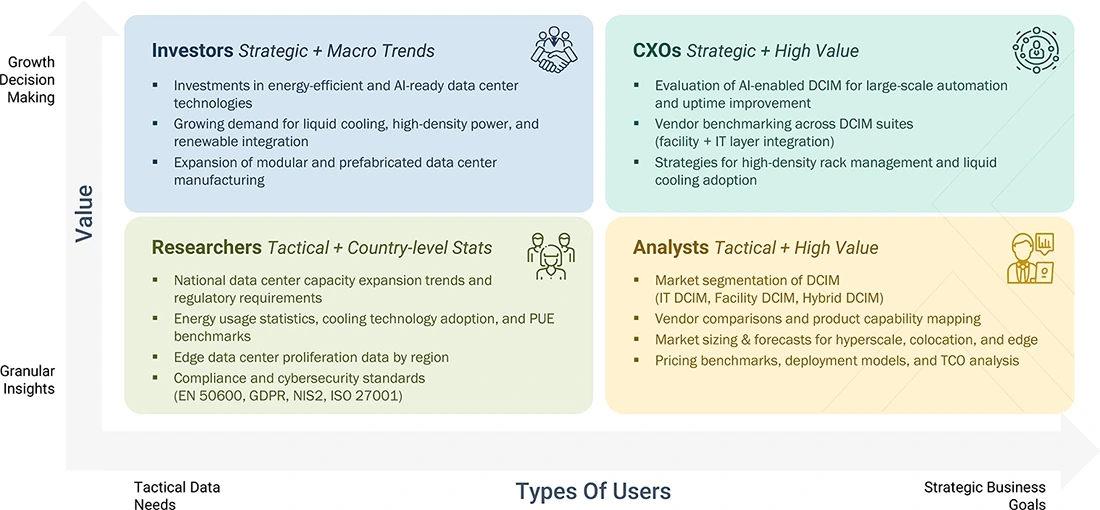
DELIVERED CUSTOMIZATIONS
We have successfully delivered the following deep-dive customizations:
| CLIENT REQUEST | CUSTOMIZATION DELIVERED | VALUE ADDS |
|---|---|---|
| Leading Solution Provider (US) | In-depth segmentation of the North American DCIM Market Extended regional breakdowns for: Europe Asia Pacific Middle East & Africa Latin America |
|
| Leading Solution Provider (EU) | Detailed profiling of additional market players (up to 5 vendors), including product portfolios, strategic initiatives, and regional presence |
|
RECENT DEVELOPMENTS
- August 2026 : Cisco expanded its Secure AI Factory with NVIDIA, leveraging rack-scale AI computing solutions developed with Supermicro. The architecture combines high-density compute, AI networking, and security, with an NVIDIA Cloud Partner-compliant design for neocloud, sovereign cloud, enterprise, and large-scale AI workloads, extending Cisco's SDDC-relevant capabilities across the full infrastructure stack.
- August 2026 : Nutanix introduced an open-source Model Context Protocol server for the Nutanix Cloud Platform, enabling AI agents and developer tools to interact with the platform via its Prism API. The development brings natural-language and agentic automation to hybrid cloud operations while preserving enterprise visibility and control across infrastructure environments.
- July 2026 : Microsoft partnered with 3M to deploy Expanded Beam Optical technology across Azure infrastructure, targeting the physical networking needs of rapidly expanding AI and cloud workloads. The collaboration is expected to improve optical connectivity within hyperscale infrastructure as Microsoft continues to expand its AI data center footprint.
- June 2026 : Arista Networks launched its 7060XE7 portfolio of 1.6T networking platforms for rack-scale AI infrastructure. The platforms support scale-up and scale-out AI fabrics and are designed for high-density, power-efficient networking across air-, liquid-, and hybrid-cooled environments, addressing the rapidly increasing connectivity requirements of AI clusters.
- June 2026 : HPE expanded its self-driving network strategy across data centers and AI factories by integrating its Juniper networking portfolio with AI data center solutions. New agentic AIOps, networking, and zero-trust capabilities are designed to simplify operations across increasingly distributed infrastructure and to strengthen automated management of AI-driven environments.
Table of Contents
 Exclusive indicates content/data unique to MarketsandMarkets and not available with any competitors.
Methodology
The study involved four major activities to estimate the data center infrastructure management market. We conducted secondary research to gather information on the market, competitors, and the parent market. The next stage was to validate these findings and assumptions and size them with industry professionals across the value chain through primary research. Top-down and bottom-up methodologies were used to determine the total market size. We used market breakup and data triangulation techniques to estimate the market size of the data center infrastructure management market segments.
Secondary Research
Multiple sources were used to collect data for this research project during the secondary research phase. These included annual reports, press releases, investor presentations, white papers, journals, publications, and articles from reputable sources, as well as directories and databases. Information was also collected from additional secondary sources such as academic journals, official government sites, blogs, and vendor websites.
Primary Research
Primary sources included industry experts from the core and associated industries, preferred software suppliers, hardware manufacturers, distributors, service providers, technology developers, alliances, and organizations representing all parts of the industry's value chain. In-depth interviews were conducted with primary respondents, including major industry participants, subject-matter experts, C-level executives at key market companies, and industry consultants, to collect and verify critical qualitative and quantitative data and to analyze the market's potential.
Primary interviews were conducted to gain insights such as market statistics, current disruptive industry trends, new use cases, revenue data from products and services, market breakdowns, size projections, predictions, and data triangulation. This research also helped to understand various technology trends, segmentation types, industry movements, and geographic factors. Demand-side stakeholders—including Chief Information Officers (CIOs), Chief Technology Officers (CTOs), Chief Security Officers (CSOs), installation teams of governments and end users utilizing data center infrastructure management solutions and services, as well as digital initiatives project teams—were interviewed to understand the buyer's perspective on suppliers, products, service providers, and current service usage, which influence the overall data center infrastructure management market.
Breakup of Primary Profiles:
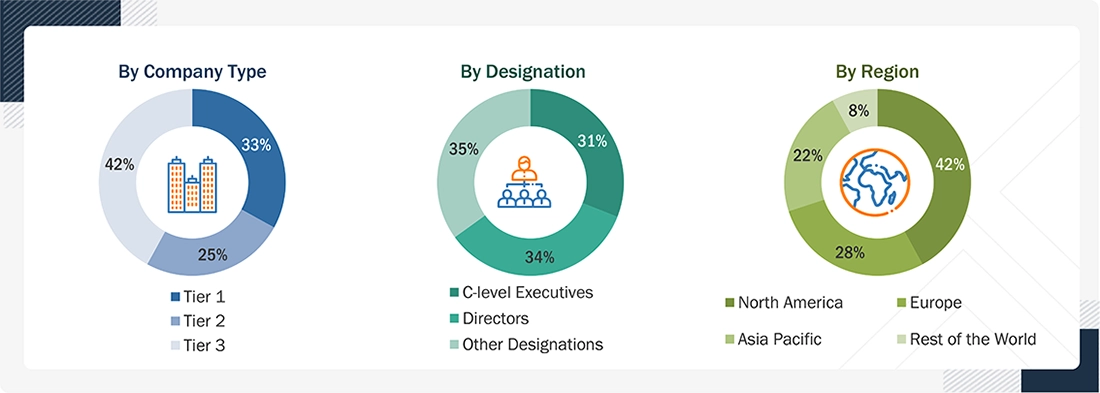
*Others include sales managers, marketing managers, and product managers
Note: Tier 1 – recorded overall annual revenues of more than USD 10 billion; Tier 2 company – USD 1–10 billion; and Tier 3 company – USD 500 million – 1 billion of the overall revenues
To know about the assumptions considered for the study, download the pdf brochure
Market Size Estimation
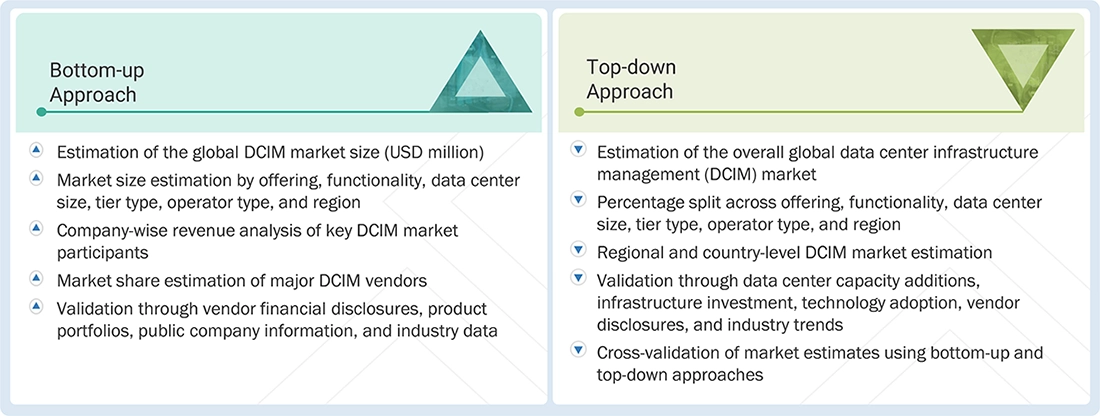
The data center infrastructure management market and related submarkets were estimated and forecasted using top-down and bottom-up methodologies. A bottom-up approach was employed to determine the overall market size by analyzing the revenues and offerings of significant market players. Data triangulation and validation through primary interviews were utilized to establish and confirm the precise value of the parent market. The overall market size was used in the top-down process to estimate the size of other specific markets through percentage splits of market segments.
Top-down and bottom-up approaches were used to estimate and validate the data center infrastructure management market and its dependent subsegments.
The research methodology used to estimate the market size included the following details:
- Key players in the market were identified through secondary research. Their revenue contributions in the respective countries were then determined using primary and secondary research..
- This procedure included studying top market players’ annual and financial reports and extensive interviews for key insights from industry leaders, such as Chief Executive Officers (CEOs), VPs, directors, and marketing executives.
- All percentage splits and breakups were determined using secondary sources and verified through primary sources.
Using top-down and bottom-up methodologies, the data center infrastructure management market and related submarkets were estimated and forecasted. a bottom-up approach was used to calculate the overall market size by analyzing the revenues and offerings of significant market players. data triangulation methods and validation through primary interviews were employed to determine and confirm the precise worth of the entire parent market. the overall market size in the top-down process was used to estimate the size of other specific markets using percentage splits of market segments.
Data Center Infrastructure Management Market : Top-Down and Bottom-Up Approach
Data Triangulation
After determining the overall market size, the market was segmented and subsegmented using the previously described market size estimation techniques. Where applicable, data triangulation and market breakdown methods were used to complete the market engineering process and determine the exact numbers for each market segment and subsegment. The data was triangulated by evaluating multiple elements and trends on the demand and supply sides of the data center infrastructure management (DCIM) market.
Market Definition
Based on input from various sources and associations, data center infrastructure management (DCIM) is defined as “a suite of tools and platforms that a data center can use to control and monitor the IT, facility, and environmental settings across all departments. Flexible integration with IT and facility management enables DCIM systems to provide real-time operating information necessary for more efficient resource utilization, energy conservation, and operational enhancements in a data center.”
Key Stakeholders
- Cloud Service Providers (CSPs)
- Original Equipment Manufacturers (OEMs)
- Data Center Equipment Suppliers
- Colocation Providers
- Technology Services Providers
- Data Center Managed Service Providers
- Government Organizations
- Networking Companies
- Consultants/Consultancies/Advisory Firms
- Support and Maintenance Service Providers
- Telecom Service Providers
- Information Technology (IT) Infrastructure Providers
- System Integrators (SIs)
- Regional Associations
- Independent Software Vendors
- Value-added Resellers and Distributors
Report Objectives
- To define, describe, and forecast the data center infrastructure management (DCIM) market based on offering, functionality, deployment mode, tier type, data center size, end user, and region
- To forecast the market size of the five major regional segments: North America, Europe, Asia Pacific, Middle East & Africa, and Latin America
- To strategically analyze the market subsegments concerning individual growth trends, prospects, and contributions to the total market
- To provide detailed information related to the significant factors influencing the growth of the market (drivers, restraints, opportunities, and challenges)
- To strategically analyze macro and micromarkets concerning growth trends, prospects, and their contribution to the overall market
- To analyze industry trends, patents and innovations, and pricing data related to the market
- To analyze the opportunities in the market for stakeholders and provide details of the competitive landscape for major players
- To profile key players in the market and comprehensively analyze their market share/ranking and core competencies
- To track and analyze competitive developments, such as mergers & acquisitions, product developments, and partnerships & collaborations in the market
Available customizations:
With the given market data, MarketsandMarkets offers customizations per the company's specific needs. The following customization options are available for the report:
Product Analysis
- The product matrix provides a detailed comparison of each company's product portfolio.
Geographic Analysis
- Further breakup of the Asia Pacific market into countries contributing 75% to the regional market size
- Further breakup of the North American market into countries contributing 75% to the regional market size
- Further breakup of the Latin American market into countries contributing 75% to the regional market size
- Further breakup of the Middle Eastern & African market into countries contributing 75% to the regional market size
- Further breakup of the European market into countries contributing 75% to the regional market size
Company Information
-
Detailed analysis and profiling of additional market players (up to 5)


Personalize This Research
- Triangulate with your Own Data
- Get Data as per your Format and Definition
- Gain a Deeper Dive on a Specific Application, Geography, Customer or Competitor
- Any level of Personalization
Let Us Help You
- What are the Known and Unknown Adjacencies Impacting the Data Center Infrastructure Management Market
- What will your New Revenue Sources be?
- Who will be your Top Customer; what will make them switch?
- Defend your Market Share or Win Competitors
- Get a Scorecard for Target Partners

Custom Market Research Services
We Will Customise The Research For You, In Case The Report Listed Above Does Not Meet With Your Requirements
Get 10% Free CustomisationTESTIMONIALS
- Canada Data Center Infrastructure Management Market
- US Data Center Infrastructure Management Market
- UK Data Center Infrastructure Management Market
- Germany Data Center Infrastructure Management Market
- France Data Center Infrastructure Management Market
- Italy Data Center Infrastructure Management Market
- China Data Center Infrastructure Management Market
- Japan Data Center Infrastructure Management Market
- India Data Center Infrastructure Management Market
- South Africa Data Center Infrastructure Management Market
- Brazil Data Center Infrastructure Management Market
- Mexico Data Center Infrastructure Management Market
- Rest Of Europe Data Center Infrastructure Management Market
- Rest Of Asia Pacific Data Center Infrastructure Management Market
- Rest Of Latin America Data Center Infrastructure Management Market
- GCC Data Center Infrastructure Management Market
- Rest Of GCC Data Center Infrastructure Management Market
- Saudi Arabia Data Center Infrastructure Management Market
- UAE Data Center Infrastructure Management Market






Growth opportunities and latent adjacency in Data Center Infrastructure Management Market