Data Center Liquid Cooling Valves Market

Data Center Liquid Cooling Valves Market by Valve Type (Ball Valves, Control Valves, Butterfly Valves, Check Valves, Pressure-Relief Valves), Cooling Type (Immersion, Direct to Chip), Data Center Type (Hyperscale, Colocation, Enterprise), and Region - Global Forecast to 2032




OVERVIEW
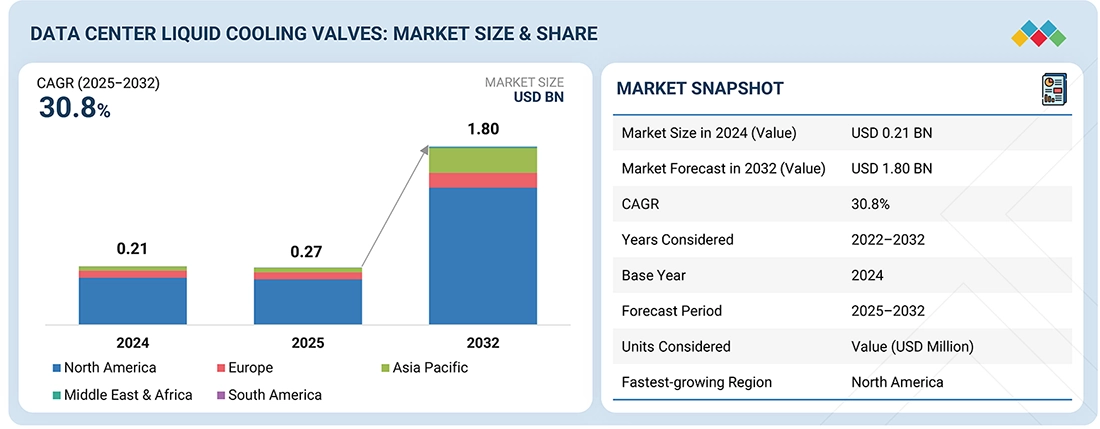
Source: Secondary Research, Interviews with Experts, MarketsandMarkets Analysis
The data center liquid cooling valves market is projected to grow from USD 0.27 billion in 2025 to USD 1.80 billion by 2032, at a CAGR of 30.8% during the forecast period. The global data center liquid cooling valves market is expanding due to the increasing shift toward liquid-based thermal management systems that require accurate and dependable control of coolant movement throughout the cooling network. The rising demand for precise flow control systems enables uniform cooling across multiple equipment zones while maintaining stable operating conditions that prevent temperature-related performance losses. Valves function as essential components in cooling systems because they enable plants to manage flow direction while maintaining pressure control and establishing connections between their cooling distribution units and server cooling systems. The growing need to decrease operational hazards while enhancing maintenance procedures drives organizations to implement valves that enable safe section isolation within cooling systems without disrupting overall system operation. As digital infrastructure continues to expand and organizations increasingly adopt liquid cooling technologies, there is a steady demand for advanced liquid cooling valves that provide dependable thermal management solutions.
KEY TAKEAWAYS
-
BY REGIONThe North America region is expected to register the highest CAGR of 33.1% during forecast period.
-
BY VALVE TYPEBy valve type, the butterfly valves segment is projected to grow at the highest CAGR of 33.3% during the forecast period.
-
BY COOLING TYPEBy cooling type, the direct-to-chip segment is projected to register the highest CAGR of 32.8% during the forecast period.
-
BY DATA CENTER TYPEBy data center type, the hyperscale data center segment is projected to register the highest CAGR of 33.8% during the forecast period.
-
Competitive Landscape - Key PlayersBelimo, Danfoss, Siemens, Schneider Electric, and Emerson Electric Co. were identified as some of the leading players in the data center liquid cooling valves market, given their strong market share and product footprint.
-
Competitive Landscape - StartupsAVK Holding A/S and FlowCon International, among others, have become leading startups or SMEs by identifying niche gaps early and delivering solutions that precisely match unmet customer needs. Their agility, faster decision-making, and ability to innovate continuously allow them to outperform larger, less flexible competitors.
The global data center liquid cooling valves market is experiencing growth because operators need exact thermal management systems that enable them to sustain the continuous operation of essential IT resources. A major driver is the need to maintain consistent coolant distribution across complex liquid cooling circuits, where valves help manage varying flow requirements based on changing computational loads. Valves become critical components for data centers because they enable operators to smoothly initiate and terminate their cooling systems while safeguarding equipment from pressure fluctuations and overheating. The increasing use of automated cooling systems has created a greater need for valves that can quickly react to control signals while sustaining proper cooling performance. The global liquid cooling valves market is experiencing growth because cooling systems undergo modernization and facilities require reliable flow management solutions.
TRENDS & DISRUPTIONS IMPACTING CUSTOMERS' CUSTOMERS
The data center liquid cooling market is experiencing the adoption of advanced liquid cooling systems, including direct-to-chip and immersion cooling solutions, which are replacing traditional cooling systems. The valve market for cooling systems will expand as manufacturers develop specialized liquid cooling systems that require valves to deliver stable coolant distribution with accurate pressure control and safe system protection through closed-loop operations. Advanced cooling systems are being implemented at hyperscale data centers, colocation facilities, enterprise data centers, HPC facilities, and crypto mining facilities because these operations need reliable valve systems to protect their equipment from backflow and leakage. The current transition is driving the adoption of valves that enable system maintenance while operating during high-density working hours. The development of liquid cooling technologies together with the construction of next-generation data centers creates a demand for liquid cooling valve systems, which drives research and development activities.

Source: Secondary Research, Interviews with Experts, MarketsandMarkets Analysis
MARKET DYNAMICS

Level
-
Growth in data center market

-
Increase in server rack density


Level
-
High upfront capital costs and infrastructure complexity

-
Lack of standardization and interoperability


Level
-
Emerging cooling technologies and coolants

-
Smart and programmable valve solutions


Level
-
Reliability and leak sensitivity in mission critical environments

-
Regulatory and environmental hurdles

Source: Secondary Research, Interviews with Experts, MarketsandMarkets Analysis
Driver: Growth in data center market
The data center liquid cooling valves market is experiencing significant growth as data center construction activity has increased, including hyperscale data centers, colocation facilities, and enterprise facilities. The construction of new data centers, together with the expansion of current facilities, leads operators to implement liquid cooling systems because they need to handle increasing thermal loads. This fuels the demand for multiple valves to control coolant flow and maintain pressure levels while ensuring system performance. The expansion of rack systems, together with cooling distribution systems, requires facilities to implement accurate flow control methods, making valves necessary for both facility and rack cooling systems. The ongoing spending on data center infrastructure upgrades and operational efficiency initiatives drives the implementation of advanced liquid cooling systems, which creates a rising need for liquid cooling valves in data centers around the world.
Restraint: Lack of standardization and interoperability
A major restraint to the growth of the data center liquid cooling valves market is the lack of proper standards and interoperability among different liquid cooling systems and infrastructure designs. Data centers often implement custom cooling systems that use valves with different connection sizes, pressure ratings, control interfaces, and material compatibility, depending on the manufacturer and cooling solution provider. The existing system needs to undergo modifications before users can operate cooling network components. The cooling distribution units, rack-level cooling systems, and facility cooling loops currently lack design and performance standards recognized by most organizations. The liquid cooling valves adoption suffers because data center operators encounter difficulties when they try to implement scalable and flexible cooling solutions which create operational problems during large-scale rollout.
Opportunity: Emerging cooling technologies and coolants
The adoption of advanced cooling technologies and new coolant types requires more accurate and dependable flow management systems. This is a major opportunity for players in the data center liquid cooling valves market. Data centers that implement next-generation cooling systems need valves that can operate across a range of fluid characteristics, temperature ranges, and pressure levels. The development of new dielectric fluids and specialized coolants requires valve manufacturers to create materials that can work safely and effectively with their products. The current trend drives manufacturers to create valves that will have better strength and resistance to corrosion and will control fluid movement with better precision. The rising use of advanced cooling technologies in both newly constructed and existing facilities creates opportunities for valve manufacturers to assist with developing thermal management systems.
Challenge: Reliability and leak sensitivity in mission critical environments
The major challenge in the data center liquid cooling valves market is the need for operators to maintain dependable systems that must operate without interruption in their most critical facilities. Liquid cooling systems use coolant to flow through areas that contain delicate electronic components, and any valve failure, seal breakdown, or connection issue can cause fluid to leak, disrupting operations, damaging equipment, and resulting in costly operational halts. Data center operators need valves that maintain sealing throughout extended periods of high pressure, temperature changes, and continuous liquid flow. The valves need to function correctly throughout their entire operational lifespan because even small problems with their performance will result in improper distribution of coolant and unstable thermal conditions. The manufacturing sector and data center operators both face difficulties because they need to maintain valve performance while handling advanced cooling solutions, which require higher operational capacity.
DATA CENTER LIQUID COOLING VALVES MARKET: COMMERCIAL USE CASES ACROSS INDUSTRIES
| COMPANY | USE CASE DESCRIPTION | BENEFITS |
|---|---|---|
 |
The company creates specially engineered valve systems that control the flow of chilled water and liquid cooling systems used in high-density data center environments. The systems operate through their primary and secondary cooling loops, which create controlled fluid movement across their complete system. The solutions become part of both modular data center projects and large-scale data center construction initiatives. The systems enable proper thermal management for essential computing operations in vital mission-critical facilities. | The system increases cooling efficiency by maintaining continuous fluid motion across all network components. The system delivers increased protection against both corrosion and scaling throughout its entire operational lifetime. The system reduces maintenance requirements while essential infrastructure functions continue to operate. The system increases the operational lifespan of its cooling distribution systems. |
 |
The company provides valve systems for closed-loop cooling and fluid transport in modern data centers. The solutions work in temperature-controlled cooling systems, which maintain high-performance computing facilities. The valve systems work with both prefabricated and modular facility designs. The systems enable organizations to develop energy-efficient cooling systems. | The system provides two thermal benefits through its cooling distribution system. The system design allows for installation process with fewer resources to install and it decreases total system weight. The material provides improved chemical defense because it remains intact through extended use. The system enables data center cooling systems to operate at lower energy consumption. |
 |
The company produces valve systems for data center cooling systems that transport fluids and remove heat. The valve system enables the movement of chilled water and the operation of secondary cooling systems. The systems are used in both new data centers and in existing facilities undergoing modernization. The systems provide support for maintaining a steady distribution of cooling fluids throughout the computing centers. | The system enhances valve flow performance by maintaining continuous cooling system operations. The system enables easy installation in advanced structural systems through its lightweight installation features. The system provides better defense against environmental elements and chemical substances. The system decreases maintenance needs while increasing system availability for operations. |
 |
The company designs particular valve networks that enable precise movement of fluids throughout temperature-controlled data center cooling systems. The solutions operate in facilities that require dependable thermal distribution systems for their intense computing operations. The valve networks enable integrated cooling systems to function throughout different facility design areas. The systems maintain operational stability across all data center environments. | The system provides reliable thermal management across its entire cooling system. The system permits designers to implement their required solutions through free design execution. The solution extends product lifespan while maintaining operational reliability during extended time periods. The system enhances cooling network performance while enhancing system capacity to handle unforeseen difficulties. |
 |
The company delivers engineered valve systems, which it manufactures and supplies to support liquid cooling and fluid transport systems used in data center operations. The solutions are used in customized cooling distribution frameworks and retrofit facility upgrades. The valve systems enable multiple cooling loops to operate throughout high-density computing environments. The systems help maintain organized fluid management systems, which modern data centers require to operate effectively. | The system enables both large-scale infrastructure deployment and special requirements that need custom design. The system protects against leaks while maintaining system integrity during its cooling network operations. The system achieves better performance by distributing cooling fluid to multiple sections of complex facilities. The system maintains consistent operation despite its various liquid-cooling system design modifications. |
Logos and trademarks shown above are the property of their respective owners. Their use here is for informational and illustrative purposes only.
MARKET ECOSYSTEM
The data center liquid cooling valves ecosystem comprises raw material suppliers (e.g., ArcelorMittal, Nippon Steel), producers (e.g., Belimo, Danfoss), and end users (e.g., Google, Intel).

Logos and trademarks shown above are the property of their respective owners. Their use here is for informational and illustrative purposes only.
MARKET SEGMENTS
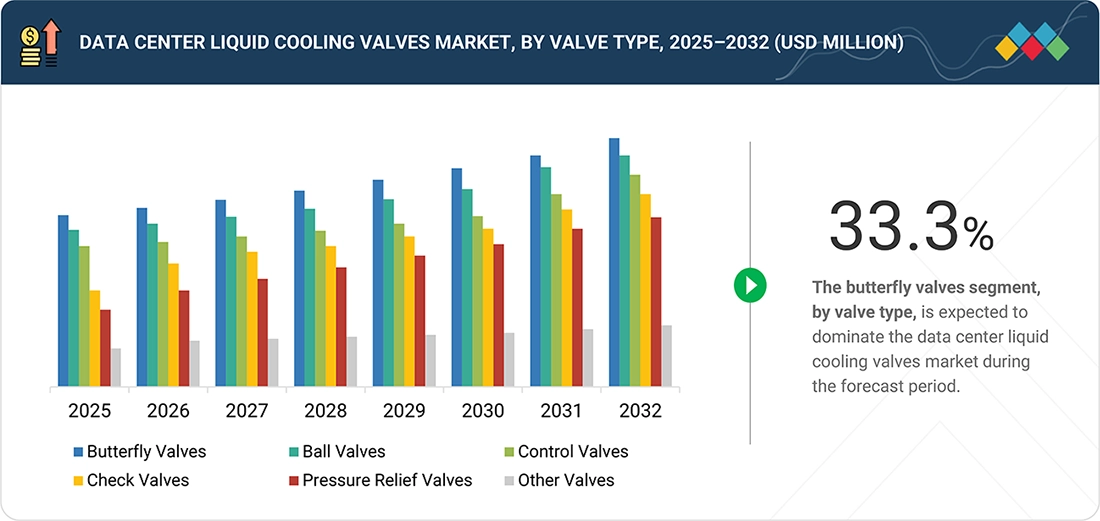
Source: Secondary Research, Interviews with Experts, MarketsandMarkets Analysis
Data Center Liquid Cooling Valves Market, By Valve Type
The data center liquid cooling valves market is segmented based on valve type into ball valves, butterfly valves, check valves, pressure-relief valves, and control valves. Ball valves serve as the preferred solution for rapid coolant loop shutdowns, while butterfly valves enable efficient flow control in large piping systems through their compact design. Check valves block coolant from flowing backward, which protects cooling systems and preserves system operational capacity, while pressure-relief valves control excessive pressure to protect system safety. The need for control valves increases as liquid cooling systems advance because these systems require proper flow control to achieve stable cooling efficiency and dependable operation in contemporary data center facilities.
Data Center Liquid Cooling Valves Market, By Cooling Type
The data center liquid cooling valves market is segmented based on cooling type into immersion cooling and direct-to-chip cooling. A direct-to-chip cooling system uses cold plates and closed-loop piping to deliver coolant to processors and high-heat components. Precise valve control is necessary to maintain flow rate and pressure and achieve thermal performance. Direct-to-chip cooling is growing as modern servers handle multiple computing tasks, requiring effective heat removal. The current trend in data centers requires valves that deliver precise coolant distribution while maintaining system reliability and enabling flexible liquid cooling operations.
Data Center Liquid Cooling Valves Market, By Data Center Type
The data center liquid cooling valves market is segmented based on data center type into hyperscale data centers, enterprise, and colocation. The hyperscale data center segment is projected to account for the largest market share during the forecast period, driven by the growing demand for cloud services, artificial intelligence, and large-scale data processing. Leading technology companies continue to invest heavily in hyperscale facilities to support expanding digital infrastructure and rising global data traffic. These facilities operate at extremely high computing capacities and rack densities, creating a strong requirement for efficient cooling solutions. As a result, hyperscale data centers are increasingly adopting advanced liquid cooling technologies to maintain optimal operating conditions. In addition, hyperscale operators often develop large data center campuses across multiple regions, which further increases infrastructure deployment. Consequently, the continued expansion of hyperscale data centers is expected to contribute significantly to the overall growth of the market.
REGION
North America to be fastest-growing region in global data center liquid cooling valves market during forecast period
The North American region will post the highest growth rate in the global data center liquid cooling valves market over the forecast period, as hyperscale and colocation data centers require cutting-edge cooling and fluid control systems to support their rapid expansion. Operators of data centers now use liquid cooling systems to handle increased rack density, which creates a greater need for valves that control coolant flow, maintain pressure stability, and ensure dependable system performance. The ongoing construction of new data center facilities, combined with existing cooling systems upgrades, will lead to more precise valve components being installed throughout cooling distribution networks. The region's commitment to enhancing cooling efficiency and operational reliability, together with its automated thermal management systems, has led to increased use of specialized valves, which are essential for contemporary liquid cooling systems.

DATA CENTER LIQUID COOLING VALVES MARKET: COMPANY EVALUATION MATRIX
In the data center liquid cooling valves market matrix, Belimo (Star) maintains its expertise in advanced cooling infrastructure through active development of flow-control technologies. The company provides valve solutions that enable precise coolant regulation, system balance, and reliable operation in liquid cooling systems. The company designs energy-efficient flow management systems that work together with automated control systems to meet the growing demand for liquid cooling systems in contemporary data centers. Belimo's valve engineering expertise helps data centers maintain operational stability and meet thermal requirements in their liquid cooling systems as they move to high-density computing environments. Steel & O'Brien Manufacturing (Emerging Leader) is a significant competitor in the data center liquid-cooling valves industry, providing precision-engineered valve solutions that perform effectively in environments requiring controlled liquid-handling operations. The company uses its expertise in creating durable leak-proof valves to ensure the safe operation of liquid cooling systems through reliable coolant distribution and system containment functions. The company develops valve technologies that use high-quality materials and create tight seals to support the safe and efficient thermal management requirements of contemporary data center systems.

Source: Secondary Research, Interviews with Experts, MarketsandMarkets Analysis
KEY MARKET PLAYERS
- BELIMO
- Danfoss
- Siemens
- Schneider Electric
- Emerson Electric Co.
- Equilibar, LLC
- Valex
- Bray International
- Crane Fluid Systems
- TLX Technologies
- Steel & O’Brien Manufacturing
- Gems Sensors & Controls
- IMI
- Parker Hannifin Corp.
- Watts
- WarrenValve
- Georg Fischer Ltd.
MARKET SCOPE
| REPORT METRIC | DETAILS |
|---|---|
| Market Size in 2024 (Value) | USD 0.21 BN |
| Market Forecast in 2032 (Value) | USD 1.80 BN |
| CAGR (2025–2032) | 30.8% |
| Years Considered | 2022–2032 |
| Base Year | 2024 |
| Forecast Period | 2025–2032 |
| Units Considered | Value (USD Billion) |
| Report Coverage | Revenue forecast, competitive landscape, growth factors, and trends |
| Segments Covered | By Valve Type: Ball Valves, Control Valves, Butterfly Valves, Check Valves, and Pressure-Relief Valves |
| Regions Covered | North America, Europe, Asia Pacific, Middle East & Africa, and South America |
WHAT IS IN IT FOR YOU: DATA CENTER LIQUID COOLING VALVES MARKET REPORT CONTENT GUIDE

DELIVERED CUSTOMIZATIONS
We have successfully delivered the following deep-dive customizations:
| CLIENT REQUEST | CUSTOMIZATION DELIVERED | VALUE ADDS |
|---|---|---|
| Demand for region-specific market insights | Provided detailed analysis of liquid cooling valve demand across key regions (North America, Europe, Asia Pacific, Middle East & Africa, South America), including adoption of direct-to-chip and immersion cooling, regulatory frameworks, and investment trends in hyperscale and AI-driven data centers | Helps clients identify high-growth regions, understand regional liquid cooling adoption, and align expansion strategies with evolving AI infrastructure and sustainability regulations |
| Request for competitor benchmarking | Delivered a comparative assessment of leading valve manufacturers (e.g., smart control valve providers, HVAC valve leaders), including product portfolios, technological capabilities (IoT-enabled valves, PICVs), and strategic partnerships with hyperscalers and colocation providers | Enables competitive positioning, highlights innovation gaps, and supports differentiation strategies in high-performance and intelligent valve solutions |
| Application-specific insights | Provided insights across key applications such as direct-to-chip cooling, immersion cooling, rear-door heat exchangers, and chilled water systems, including valve requirements for flow control, pressure regulation, and leak prevention | Supports targeted product development and market entry strategies by aligning valve design with high-density rack and AI workload requirements |
| Custom material & product grade support | Evaluated and recommended valve materials (stainless steel, copper alloys, corrosion-resistant coatings) and configurations suitable for high-pressure, high-temperature, and liquid proximity environments in data centers | Enhances product reliability, reduces leakage risks, and ensures compatibility with advanced cooling fluids and next-generation thermal architectures |
| Technical feasibility & process guidance | Delivered guidance on valve integration within liquid cooling loops, CDU systems, and facility-level cooling infrastructure, including automation, actuator integration, and real-time monitoring technologies | Improves system efficiency, enables predictive maintenance, and supports smart data center operations through IoT-enabled flow control |
| Regulatory & compliance support | Provided analysis of global standards and regulations (energy efficiency norms, ASHRAE guidelines, environmental and safety standards) impacting liquid cooling valve deployment and manufacturing | Ensures compliance, reduces operational risk, and supports sustainable and energy-efficient cooling system implementation |
RECENT DEVELOPMENTS
- October 2025 : Eguilibar introduced the IC Series, an industrial line of valves designed for back-pressure, vacuum, and flow-control applications with high-throughput requirements. The IC Series uses its dome-loaded, multi-orifice technology to provide users with advanced control capabilities through its small, efficient design. The valves are customizable for diverse applications and are particularly suited for demanding gas, liquid, and mixed-phase processes requiring high flow coefficient.
- July 2025 : The Siemens and Microsoft collaboration integrates Building X with Azure IoT Operations to enable seamless, interoperable IoT data across buildings and data centers. It connects HVAC, valves, actuators, and sensors, reducing integration effort by up to 80% while improving operational efficiency and sustainability. In data centers, enhanced IoT-based monitoring optimizes cooling systems, including precise control of liquid cooling valves for high-density AI workloads. This accelerates adoption of advanced liquid cooling solutions, driving growth in the data center liquid cooling valves market through smarter, energy-efficient operations.
- April 2025 : Schneider Electric South Africa offers a comprehensive range of Spacel ogic and Easyl ogic ball valves and actuators to support digital energy management and automation. Designed to enhance HVAC performance, these solutions improve comfort and energy efficiency in both commercial and residential buildings, providing a reliable and efficient option for diverse applications.
Table of Contents
 Exclusive indicates content/data unique to MarketsandMarkets and not available with any competitors.
Methodology
The research methodology used to estimate the current size of the data center liquid cooling valves market consisted of four major activities. Extensive secondary research was conducted to obtain detailed information on the market, peer markets, and parent markets. These findings, assumptions, and metrics were verified through primary research with experts from both the demand and supply sides of the data center liquid cooling valves value chain. Both top-down and bottom-up approaches were used to estimate the total market size. The market sizes for various segments and subsegments were finalized using complete market segmentation and data triangulation.
Secondary Research
The research methodology for estimating and forecasting the Data center liquid cooling valves market begins with gathering secondary data on key vendors' revenues. The secondary research process involves consulting a range of secondary sources, including Hoover's, Bloomberg Businessweek, Factiva, the World Bank, and industry-specific journals. These secondary sources encompass press releases, investor presentations, white papers, certified publications, articles from recognized authors, regulatory notifications, trade directories, and databases. Also, vendor offerings are considered to inform market segmentation.
Primary Research
The data center liquid cooling valves market comprises several stakeholders throughout the supply chain, including raw material suppliers, processors, end-product manufacturers, and regulatory organizations. The demand side of this market is characterized by the development of various industries, including cloud computing and artificial intelligence (AI), among others. The supply side is characterized by advancements in technology and a wide range of diverse applications. Various primary sources from both the supply and demand sides of the market were interviewed to obtain qualitative and quantitative information.
The following is the breakdown of the primary respondents:

To know about the assumptions considered for the study, download the pdf brochure
Market Size Estimation
The top-down and bottom-up approaches have been used to estimate and validate the total size of the data center liquid cooling valves market. These approaches have also been used extensively to estimate the size of various dependent market subsegments. The research methodology used to estimate the market size included the following. The following segments provide details about the overall market size estimation process employed in this study:
- Extensive primary and secondary research was done to identify the key players.
- The value chain and market size in terms of value of the data center liquid cooling valves market were determined through primary and secondary research.
- All percentage shares, splits, and breakdowns were collected through secondary sources and verified through primary sources.
- All possible parameters that affect the market were covered in this research study and are viewed in extensive detail, verified through primary research, and analyzed to obtain the final quantitative and qualitative data.
- The study of reports, reviews, and newsletters of top market players, along with extensive interviews for opinions from key leaders, such as CEOs, directors, and marketing executives, is included in this research.
Data Center Liquid Cooling Valves Market Size: Bottom-Up & Top-Down Approach

Data Triangulation
After estimating the overall market size using the above estimation process, the market was split into various segments and subsegments. Data triangulation and market segmentation techniques, along with the market engineering process, were employed to obtain precise market analysis data for each segment and its subsegments.
Research Methodology: The research methodology used to estimate and forecast the global market size began by aggregating data and information from various levels, including country-level data.
Market Definition
Data center liquid cooling valves function as specialized mechanical components that control and direct cooling liquid flow within liquid-based thermal management systems that data centers use. The valves enable proper coolant circulation through cooling loops, which remove heat from servers, processors, and other high-density electronic equipment. The system maintains control over three essential factors: monitors flow rate, pressure, and temperature stability, to ensure efficient coolant delivery to heat-generating components while returning coolant through heat exchange without any leaks or flow problems. Liquid cooling valves operate in various cooling systems, which include direct-to-chip cooling, immersion cooling, and facility-level chilled liquid distribution systems. The system enables maintenance personnel to isolate specific cooling network sections while safely starting up and shutting down operations, and the system maintains balanced coolant distribution to multiple racks and cooling units. The valves perform their functions under extreme conditions, which include nonstop operation and fluctuating thermal loads.
Stakeholders
- Data center liquid cooling valve manufacturers
- Data center liquid cooling valves suppliers
- Data center liquid cooling valve traders, distributors, and suppliers
- Investment banks and private equity firms
- Raw material suppliers
- Government and research organizations
- Consulting companies/consultants in the chemicals and materials sectors
- Industry associations
Report Objectives
- To define, describe, and forecast the size of the data center liquid cooling valves market, in terms of value, based on cooling type, valve type, and region
- To provide detailed information regarding the key factors, such as drivers, restraints, opportunities, and challenges, influencing the growth of the data center liquid cooling valves market
- To strategically analyze micromarkets1 with respect to individual growth trends, prospects, and their contribution to the total market
- To analyze opportunities in the market for stakeholders and provide a competitive landscape of the market leaders
- To project the size of the market and its submarkets, in terms of value, with respect to five main regions (along with their respective key countries), namely, North America, Asia Pacific, Europe, South America, and the Middle East & Africa
- To provide ecosystem analysis, case study analysis, value chain, patent analysis, technology analysis, pricing analysis, Porter's five forces analysis, key stakeholders and buying criteria, investment and funding scenario, trade analysis, impact of AI/Gen AI and 2025 US tariff, key conferences and events, regulatory bodies, government agencies, and regulations pertaining to the market under study
- To strategically profile the key players and comprehensively analyze their core competencies
- To analyze competitive developments such as mergers & acquisitions, product launches, and research & development in the data center liquid cooling valves market
- To provide the macroeconomic outlook for all regions considered under the study


Personalize This Research
- Triangulate with your Own Data
- Get Data as per your Format and Definition
- Gain a Deeper Dive on a Specific Application, Geography, Customer or Competitor
- Any level of Personalization
Let Us Help You
- What are the Known and Unknown Adjacencies Impacting the Data Center Liquid Cooling Valves Market
- What will your New Revenue Sources be?
- Who will be your Top Customer; what will make them switch?
- Defend your Market Share or Win Competitors
- Get a Scorecard for Target Partners

Custom Market Research Services
We Will Customise The Research For You, In Case The Report Listed Above Does Not Meet With Your Requirements
Get 10% Free CustomisationTESTIMONIALS
We at Nissan Chemicals Corporation have been clients of MarketsandMarkets for more than a year now. We recently consulted MarketsandMarkets for a study, the team at MarketsandMarkets was extremely professional and organized. The business insights were very detailed and aligned well with our expectations that really helped us formulate the Business Plans and device new strategies for development themes. MarketsandMarkets offers a unique combination of expertise and dedicated engagement model. Their research findings have helped us in designing our Pricing Strategy which will make it easier for us to predict the future sales and profits for the next ten years. We look forward to working with MarketsandMarkets in the future.
VP of Strategy & New Business Development
Leading Specialty Chemical Company
The MarketsandMarkets Engagement Model, composed of both the Knowledge Store and advisory custom research, has greatly helped us in understanding our markets and making strategic decisions. The Knowledge Store is a fast way to allow everyone in our organization to understand more about most any market they are interested in. The ability to then get custom research done and get answers to specific strategic questions and market insight has been spectacular. The Markets and Markets team feel more like colleagues than vendors and their services have helped us change our culture where statements of things like growth opportunities and competitive position are always backed by industry research.

Rich Gibson,
Director, Corporate Strategy
Milliken & Company,
Leading Industrial Manufacturer of specialty chemical, floor covering, performance and protective textile materials, and healthcaremilliken.com
MarketsandMarkets is a trusted resource that helps us to better understand markets that are near-adjacencies-whether its technology, value chain or geography. Their Knowledge Store platform provides a dashboard of markets and their characteristics which is easy to use and saves us time.
Adam Shaw,
Market Development and Strategy Manager
AdvanSix Inc. USA,
An American Leader in Chemicalswww.advansix.com
The Knowledge Store from MarketsandMarkets is a valuable tool which has helped my team acquire greater insight in to the end markets that our business serves. This has enabled us to help our company build stronger strategies throughout our planning process.
TOSHIO KINOSHITA
Senior Chif Consultion Research & Consulting Division
Mitsubishi Chemical Research Corporation,
Leading Manufacturer of Chemical Productswww.mitsubishichem-res.co.jp/en/

We recently engaged with MarketsandMarkets for a study, the team not only clearly understood our business objectives but was also extremely professional in the way they handled the entire project. The study was efficiently conducted in a phase-wise manner, and the engagement model furnished us with high-quality business insights that far exceeded our expectations at each phase. We were especially happy that MarketsandMarkets could provide us with both, an English as well as a Japanese version of the study. A special thanks to the Analyst Team and Client Services Team, whose fluency in Japanese enhanced our comfort level, as we could converse with them in our preferred language.
Independent entrepreneurs
Arrow Precision
We approached MarketsandMarkets for study on Proppants Market, and their work exceeded our expectations. The study conducted was comprehensive and enabled us to view the market through the various dimensions. In addition, the team was extraordinarily responsive throughout the process and resolved our queries on time. I strongly recommend MarketsandMarkets and will certainly consider them for additional market assessments we will need in the future.
Global engineering company, Japan
Deputy Manager,
Strategic Planning OfficeThe high-quality insights shared by the MarketsandMarkets team helped us understand the pharmaceutical plant designers in a specific geography. It also captured the risks that we may likely face in communicating with our potential partners. The study would enable us identify partners, which would impact our future growth.
- US Data Center Liquid Cooling Valves Market
- Canada Data Center Liquid Cooling Valves Market
- Mexico Data Center Liquid Cooling Valves Market
- UK Data Center Liquid Cooling Valves Market
- Germany Data Center Liquid Cooling Valves Market
- France Data Center Liquid Cooling Valves Market
- China Data Center Liquid Cooling Valves Market
- Japan Data Center Liquid Cooling Valves Market
- India Data Center Liquid Cooling Valves Market
- South Korea Data Center Liquid Cooling Valves Market
- Australia Data Center Liquid Cooling Valves Market
- Singapore Data Center Liquid Cooling Valves Market
- Malaysia Data Center Liquid Cooling Valves Market
- Saudi Arabia Data Center Liquid Cooling Valves Market
- South Africa Data Center Liquid Cooling Valves Market
- Brazil Data Center Liquid Cooling Valves Market
- Rest Of Europe Data Center Liquid Cooling Valves Market
- Rest Of Asia Pacific Data Center Liquid Cooling Valves Market






Growth opportunities and latent adjacency in Data Center Liquid Cooling Valves Market