DC Charging Market Size, Share & Analysis

DC Charging Market by Charging Type (Slow DC, Fast DC, Ultrafast 1, Ultrafast 2), Charging Speed (Ultrafast, Megawatt), Charging Application (Public, Commercial), Infrastructure Type (CHAdeMO, CCS, NACS/Tesla SC, GB/T Fast), and Region - Forecast to 2032




OVERVIEW
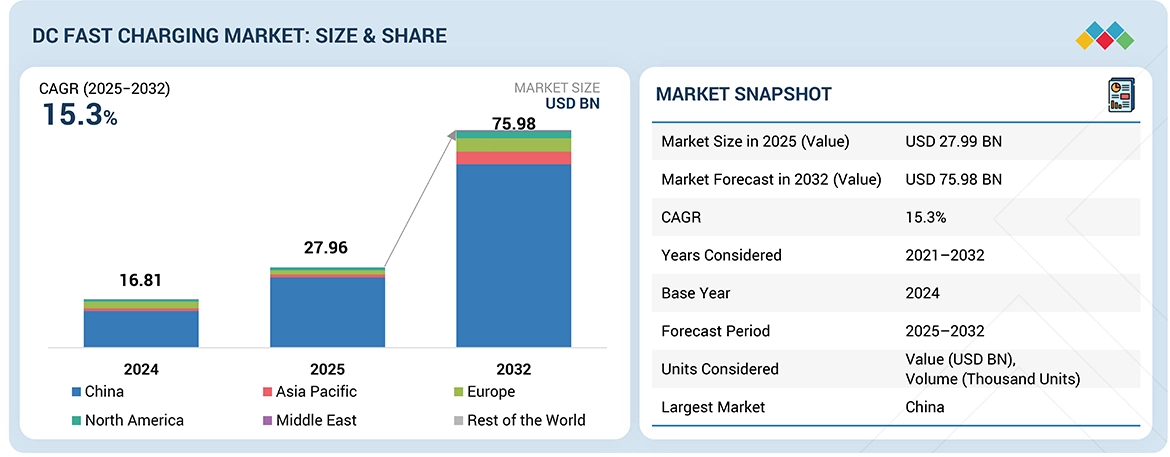
Source: Secondary Research, Interviews with Experts, MarketsandMarkets Analysis
The global DC charging market is projected to grow from USD 27.99 billion in 2025 to USD 75.98 billion in 2032 at a CAGR of 15.3%. The expansion of DC charging networks is driven by the need to support faster energy replenishment, higher vehicle duty cycles, and scalable electrification across passenger and commercial segments. DC chargers offer high-power external conversion and direct battery charging, enabling significant range increases in a short period. Advances in vehicle electrical architecture, charging standards, and power electronics efficiency are facilitating the deployment of higher-capacity charging stations that meet the evolving demands of electric mobility.
KEY TAKEAWAYS
-
By CountryIn 2025, China is estimated to hold the largest share of 87.3% in the DC charging market.
-
By Charging InfrastructureGB/T Fast is expected to be the fastest-growing segment with a CAGR of 25.8% during the forecast period.
-
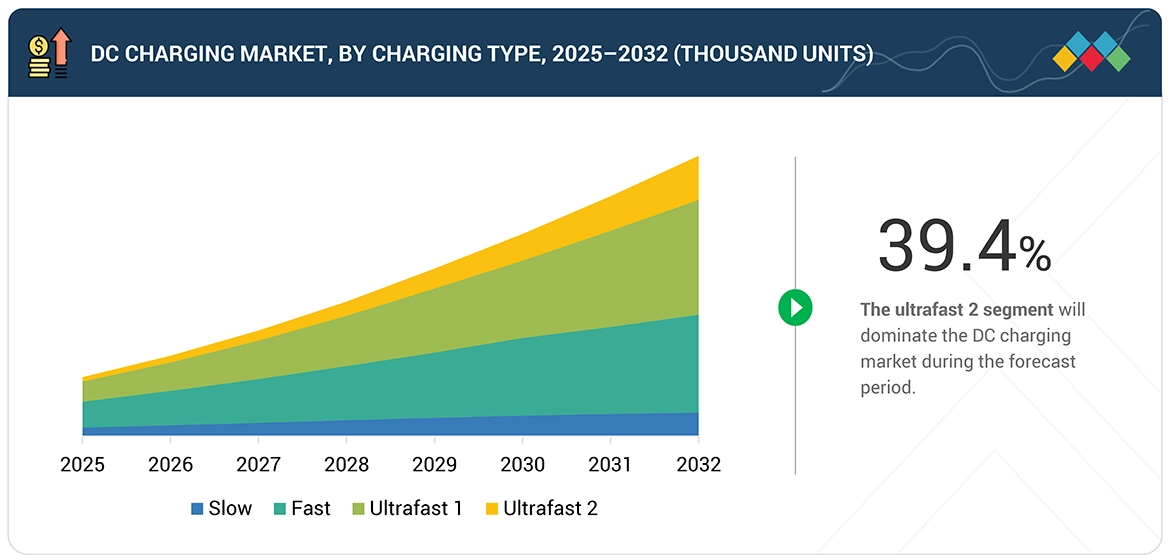
By Charging TypeThe Ultrafast 2 segment is expected to record a CAGR of 39.4% between 2025 and 2032.
-
By Charging SpeedThe megawatt segment is expected to grow at a CAGR of 52.6% between 2025 and 2032.
-
By Application TypeCommercial charging stations is expected to be the largest segment during the forecast period.
-
Competitive Landscape - Key PlayersTesla Supercharger (USA), ABB Ltd.(Switzerland), Siemens AG(Germany), BYD Company Ltd.(China), and Delta Electronics (Taiwan) were identified as key players in the DC charging market, given their strong market share and product footprint.
-
Competitive Landscape - Startups/SMEsAllego B.V., State Grid Corporation of China, SparkCharge, Instavolt, and Powerdot are startups in this market.
Deployment of DC fast charging infrastructure is speeding up due to rising energy demand from electric vehicles and the operational limits of AC charging systems. As battery capacities grow and vehicle use increases, especially in commercial and highway scenarios, higher power transfer capability becomes essential to cut charging times and keep vehicles available. DC chargers allow direct high voltage power delivery to the battery, bypassing onboard charger restrictions, which enables much faster charging rates and supports continuous vehicle operation. This trend is driven by advances in high voltage vehicle platforms, improved efficiency of power semiconductors, and increasing needs for high-throughput charging infrastructure.
TRENDS & DISRUPTIONS IMPACTING CUSTOMERS' CUSTOMERS
The DC charging market is evolving as EV adoption accelerates, grid constraints become more intense, and fleet electrification changes infrastructure needs. The growing deployment of ultrafast DC chargers and megawatt charging systems is increasing demand for higher power density architectures, better thermal management, and modular power stack designs. Standardizing charging protocols and interoperability requirements simplifies network integration while increasing competition among hardware and software providers. Optimizing utilization, integrating energy management, and adopting Charging as a Service models are shifting revenue toward recurring, software-enabled streams. Meanwhile, bidirectional charging and vehicle-to-grid capabilities are starting to influence system design, procurement strategies, and long-term infrastructure planning.
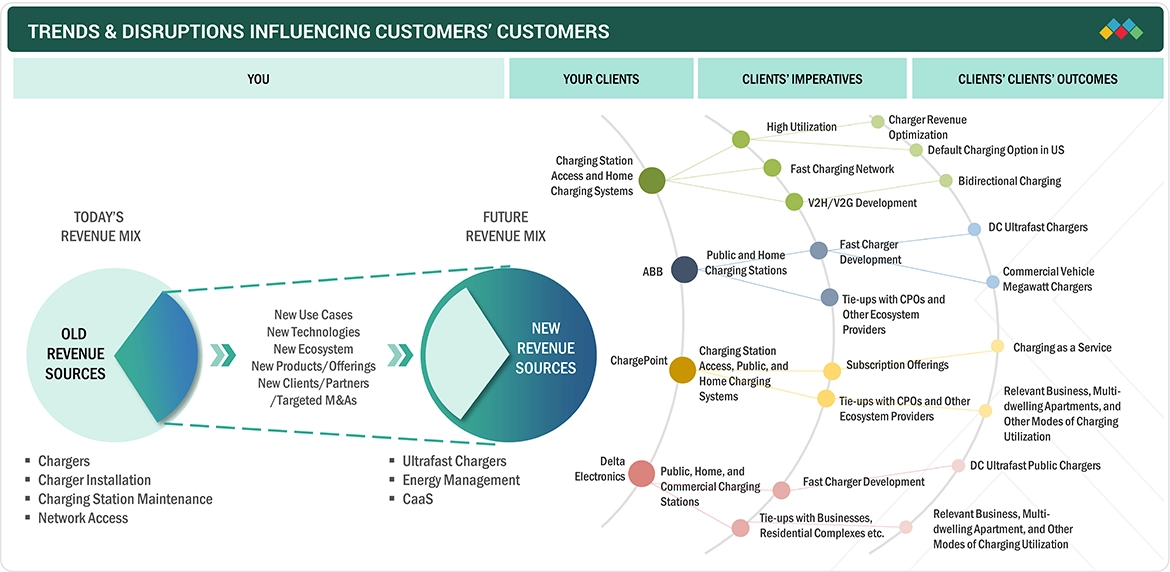
Source: Secondary Research, Interviews with Experts, MarketsandMarkets Analysis
MARKET DYNAMICS

Level
-
Shifting EV Architecture for higher charging capability

-
Reducing battery Costs


Level
-
High capital investment

-
Limited standardization in megawatt charging


Level
-
Vehicle-to-grid integration

-
Expansion of green and sustainable DC charging stations


Level
-
Long payback time

-
Localized grid stress from high-density fast-charging hubs

Source: Secondary Research, Interviews with Experts, MarketsandMarkets Analysis
Driver: Shifting EV architecture for higher charging capacity
Automakers are moving toward 800V and higher voltage vehicle architectures to enable faster charging, improved efficiency, and reduced energy losses. These platforms support higher power intake, often exceeding 250 kW, which directly increases demand for advanced DC fast and ultrafast charging infrastructure. As battery capacities grow and thermal management systems improve, vehicles can sustain higher charging rates for longer periods. This architectural shift is fueling the deployment of high-power DC chargers, megawatt charging systems, and grid-ready infrastructure across public and commercial sectors.
Restraint: High Capital Investments
Deploying DC fast charging infrastructure demands substantial upfront investments in high-power equipment, grid upgrades, land acquisition, and civil works. Utilities frequently impose demand charges and interconnection costs, increasing project complexity. For operators, reaching breakeven largely depends on utilization rates, which tend to be volatile in early-stage markets. These challenges slow large-scale deployment and limit opportunities for smaller players.
Opportunity: Vehicle to Grid Integration
Vehicle-to-grid (V2G) capability offers a significant growth opportunity by turning DC chargers into grid-interactive resources. Bidirectional charging allows for energy arbitrage, peak load management, and ancillary grid services. Integrating with energy management systems improves site-level economics and generates additional revenue beyond charging fees. As grid constraints grow tighter, V2G-enabled DC infrastructure becomes increasingly strategic.
Challenge: Long Payback Time
DC charging stations usually face long payback periods because of high startup costs and slow growth in usage. Revenue depends on EV adoption, traffic levels, and pricing strategies, which vary widely by region. Demand charges and maintenance expenses also impact profits. Operators need to use smarter site selection, flexible pricing, and partnership strategies to reduce long payback times.
DC CHARGING MARKET: COMMERCIAL USE CASES ACROSS INDUSTRIES
| COMPANY | USE CASE DESCRIPTION | BENEFITS |
|---|---|---|
 |
On-site charging at workplaces and tenant parking (Commercial Wall Connector) | Improves tenant satisfaction, supports ESG goals |
 |
Charging for fleets and commercial properties, chargers at retail locations to attract EV customers | Lowers TCO, increases station utilization, increases foot traffic, adds revenue stream |
 |
Fleet depot and public fast charging (e.g. modular high-power) | Scalability, reliability, and modular upgrade support |
 |
Integrated charging and energy management | Enhances energy efficiency, supports smart grid integration |
Logos and trademarks shown above are the property of their respective owners. Their use here is for informational and illustrative purposes only.
MARKET ECOSYSTEM
The DC charging market ecosystem comprises several interconnected stakeholders that work together to enable the deployment of high-power EV infrastructure. OEMs such as Tesla, BMW, Mercedes-Benz, and BYD incorporate DC charging into their vehicles and increasingly participate in network development to ensure customers have smooth access. Charging point manufacturers such as ABB, Siemens, Tritium, ChargePoint, and Delta Electronics design and supply high-power DC chargers, power modules, and supporting hardware for public, commercial, and fleet use. Charging point operators such as Electrify America, Shell, BP, Blink, ENGIE, and Enel X deploy, own, and manage charging networks, focusing on maximizing utilization, uptime, and revenue. Payment, navigation, and mapping providers, including PayPal, Fortumo, PayByPhone, ChargeHub, Chargemap, and Google Maps handle transactions, station discovery, and interoperability, improving user convenience and network accessibility. This integrated ecosystem supports infrastructure growth, recurring revenue streams, and the transition toward software-enabled, energy-integrated DC charging networks.
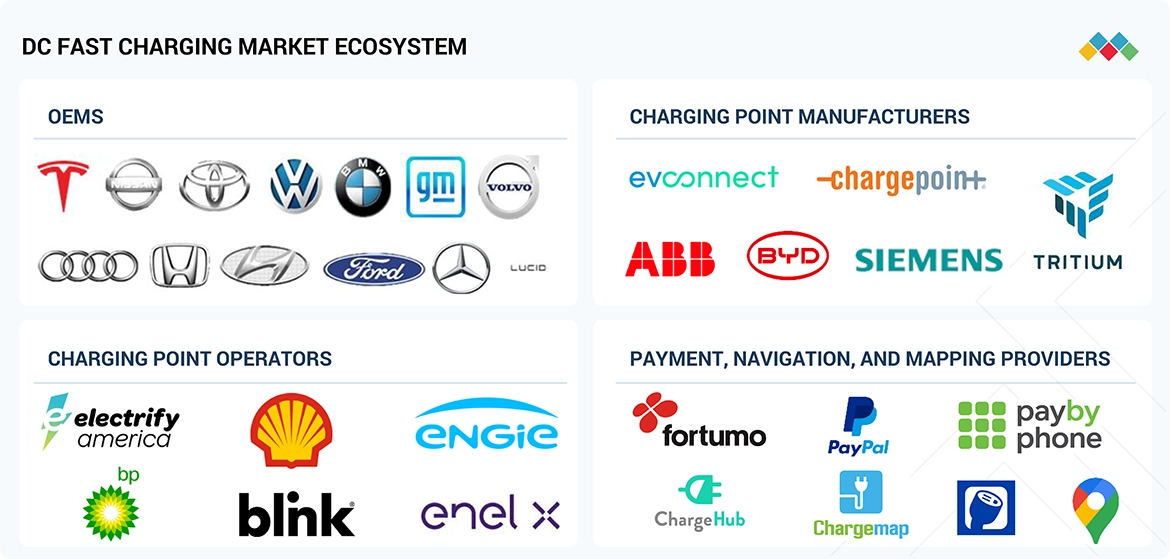
Logos and trademarks shown above are the property of their respective owners. Their use here is for informational and illustrative purposes only.
MARKET SEGMENTS
Source: Secondary Research, Interviews with Experts, MarketsandMarkets Analysis
DC Charging Market, Charging Speed
Megawatt charging is the fastest-growing segment due to the rapid electrification of heavy-duty trucks, intercity buses, and long-haul commercial fleets that need extremely high energy throughput within limited dwell times. These vehicles operate on large battery packs, often exceeding 500 kWh, making megawatt-level charging essential to maintain fleet productivity and route efficiency. Government support for zero-emission freight corridors and depot electrification further accelerates the deployment of Megawatt Charging Systems. Additionally, OEM development of MCS-compatible platforms is strengthening the ecosystem, positioning megawatt charging as the leading high-speed infrastructure segment.
DC Charging Market, By Charging Type
Ultrafast 2 charging will be the fastest segment due to rising battery capacities and the demand for sub-30-minute charging sessions. Passenger EVs with 400V and 800V architectures can use higher power outputs, boosting station throughput and utilization rates. Commercial fleets and premium EV segments prefer ultrafast charging to enhance operational efficiency. Network operators are investing in higher power systems to future-proof infrastructure and maximize long-term returns.
DC Charging Market, By Charging Infrastructure
The GB/T fast charging infrastructure will be the fastest-growing market mainly because of China’s leadership in global EV adoption and public charging expansion. China holds the largest installed base of DC fast chargers worldwide, and GB/T remains the required national standard. Strong domestic manufacturing capacity and government-driven infrastructure deployment reinforce its leadership. The scale of deployment in China far surpasses other regional standards in volume.
DC Charging Market, By Application
The commercial segment will be the fastest due to the rapid electrification of public transport, logistics fleets, ride-hailing vehicles, and corporate mobility programs. Fleet operators require high-power charging to minimize downtime and maintain asset utilization, which drives strong demand for DC fast and ultrafast infrastructure. Government incentives for bus depots and commercial fleets further accelerate deployment. High daily vehicle utilization in commercial applications supports faster payback compared to residential use cases.
REGION
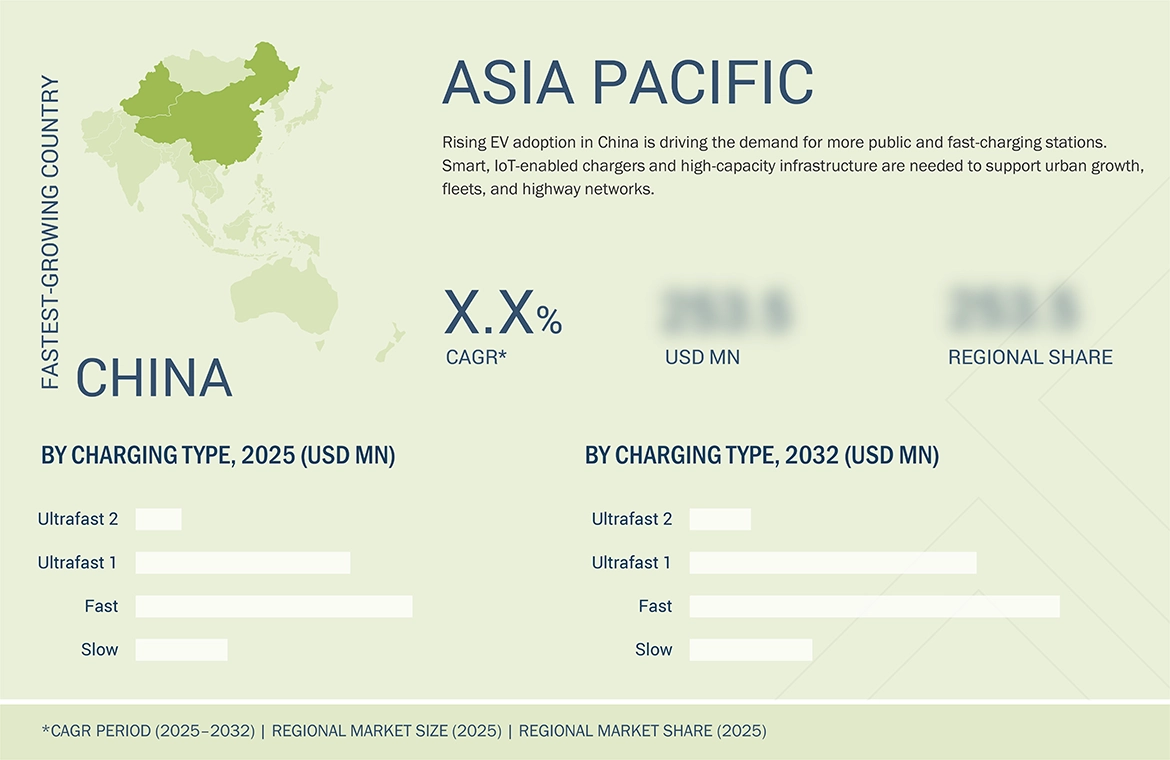
China to be fastest-growing country
China’s DC charging market continues to grow swiftly, supported by strong backing from domestic EV manufacturers that are accelerating the deployment of high-capacity charging infrastructure. The country remains the largest global provider of public DC fast chargers, aided by policy-driven expansion and urban corridor development. Increasing competition among charger producers is fueling rapid technological improvements, such as higher power outputs, better efficiency, and quicker deployment speed. Ongoing innovations in power electronics, megawatt charging capabilities, and smart network integration are enhancing system performance while lowering costs. Collectively, these developments position China as the most advanced and technologically competitive DC charging market worldwide.
DC CHARGING MARKET: COMPANY EVALUATION MATRIX
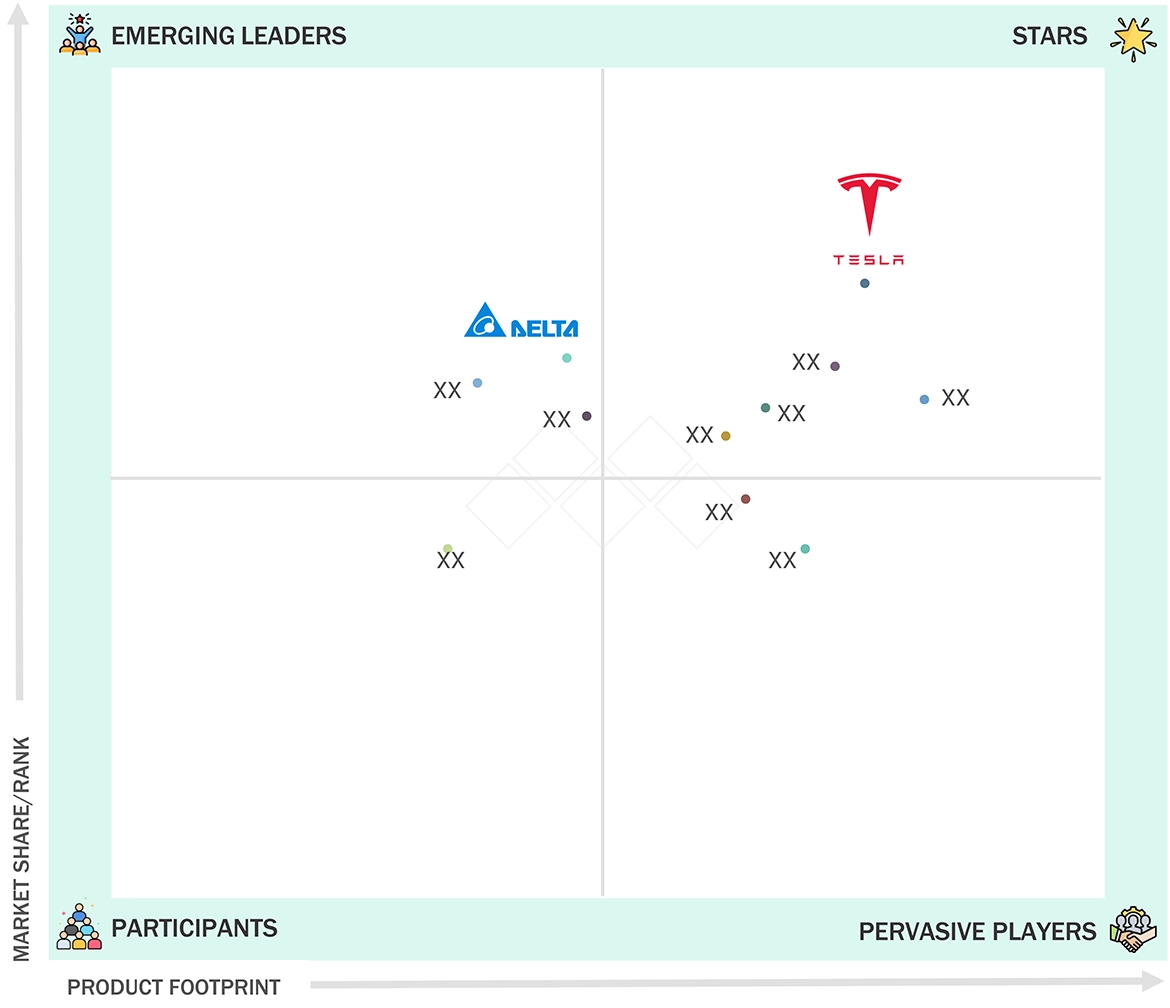
In the DC charging market, Tesla Supercharger (Star) leads, as the company offers Supercharger networks, ultrafast DC chargers, and Energy Integration Systems (ESS). It has expanded its global presence by forming alliances and partnerships with automakers such as GVM, Volvo, Ford Motor Company, and Mercedes-Benz. Delta Electronics (Emerging Leader) is rapidly growing. The company's product portfolio includes critical DC fast charging systems, ultrafast and high-power solutions, and power electronics and conversion systems. It also maintains relationships with global OEMs and supports charging infrastructure aligned with vehicle platform requirements, including CCS-based high-power standards.
Source: Secondary Research, Interviews with Experts, MarketsandMarkets Analysis
KEY MARKET PLAYERS
- Tesla Supercharger (US)
- ABB Limited (Switzerland)
- Siemens AG (Germany)
- BYD Company Ltd. (China)
- Delta Electronics (Taiwan)
- Tritium DCFC Limited (Australia)
- Schneider Electric SE (France)
- Kempower Oyj (Finland)
- Alpitronic Srl (Italy)
- Wallbox N.V.(Spain)
- Star Charge (China)
- EFACEC Power Solutions (Portugal)
MARKET SCOPE
| REPORT METRIC | DETAILS |
|---|---|
| Market Size in 2024 (Value) | USD 16.81 BN |
| Market Forecast in 2032 (Value) | USD 75.98 BN |
| Growth Rate | CAGR of 15.3% from 2025–2032 |
| Years Considered | 2021–2032 |
| Base Year | 2024 |
| Forecast Period | 2025–2032 |
| Units Considered | Value (USD MN/BN), Volume (Thousand Units) |
| Report Coverage | Revenue Forecast, Competitive Landscape, Company Share, Growth Factors, and Trends |
| Segments Covered |
|
| Regional Scope | China, Asia Pacific, Europe, North America, Middle East, Rest of the World |
WHAT IS IN IT FOR YOU: DC CHARGING MARKET REPORT CONTENT GUIDE
DELIVERED CUSTOMIZATIONS
We have successfully delivered the following deep-dive customizations:
| CLIENT REQUEST | CUSTOMIZATION DELIVERED | VALUE ADDS |
|---|---|---|
| Liquid-cooled cable demand for HPC charging stations |
|
Enabled client to align product development with next-generation ultrafast infrastructure needs and identify high-margin component opportunities in HPC deployment |
| Megawatt charger potential in coming forecast period | Developed forward looking assessment of megawatt charging adoption across heavy duty trucks, logistics fleets, and zero emission freight corridors. Incorporated regulatory push, OEM MCS readiness, and depot electrification trends | Helped client prioritize early entry into megawatt systems and align capital allocation with high growth commercial vehicle electrification segments |
| Hyperfast charger demand in US, with company's plan for expansion |
|
Supported strategic positioning in high utilization highway and urban hub markets, enabling targeted partnership and deployment decisions |
| LATAM market size check and potential for DC chargers, considering macro and micro trends, EV sales |
|
Enabled phased regional expansion strategy by identifying early mover markets with favorable macro stability and rising EV penetration |
| NACS shift trend in US market, with shift in charging standards | Assessed transition toward NACS in the US, mapping OEM adoption timelines | Provided clarity on standard convergence impact, reducing technology risk and supporting connector strategy alignment for long term market relevance |
RECENT DEVELOPMENTS
- February 2026 : Kempower has collaborated with Swedish mobility enterprise Aimo to introduce public fast charging infrastructure at SkiStar‘s Lindvallen ski resort in Sälen for the first time. The new facility is outfitted with Kempower’s rapid charging system for electric vehicles and is managed by Aimo Charge, which has experience in installing and managing electric vehicle charging stations across Sweden, Norway, and Finland.
- December 2025 : Tritium launched its GRID-FLEX 800VDC bi-directional inverter platform, expanding its technology into essential power sectors along with EV charging, enabling grid services and demand response support at scale.
- October 2025 : Siemens introduced its next-generation EV charging solution, SICHARGE FLEX, at Busworld 2025. The modular system supports dynamic power distribution of up to 1.68 MW, works with CCS and MCS standards, and is designed for passenger, heavy-duty bus, and truck charging. It will be available for purchase in 2026.
Table of Contents
 Exclusive indicates content/data unique to MarketsandMarkets and not available with any competitors.
Methodology
The study involved four major activities in estimating the current size of the DC Charging Market . Exhaustive secondary research was done to collect information on the market, the peer market, and the child markets. The next step was to validate these findings and assumptions and size them with industry experts across value chains through primary research. The top-down and bottom-up approaches were employed to estimate the complete market size. Thereafter, market breakdown and data triangulation processes were used to estimate the market size of segments and subsegments.
Secondary Research
In the secondary research process, various secondary sources such as company annual reports/presentations, press releases, industry association publications [for example, European Alternative Fuels Observatory (EAFO), European Automobile Manufacturers' Association (ACEA), China Association of Automobile Manufacturers (CAAM), International Organization of Motor Vehicle Manufacturers (OICA), Electrical Vehicle Charging Association (EVCA), National Highway Traffic Safety Administration (NHTSA), International Energy Association (IEA)], articles, directories, technical handbooks, trade websites, technical articles, and databases (for example, Marklines, and Factiva) have been used to identify and collect information useful for an extensive commercial study of the global DC Charging Market .
Primary Research
Extensive primary research was conducted after acquiring an understanding of the DC Charging Market scenario through secondary research. Several primary interviews were conducted with market experts from both the demand (OEMs) and supply sides (EV charging station manufacturers, service providers, and component manufacturers) across major regions: North America, Europe, the Middle East, Asia Pacific, and the Rest of the World. Approximately 24% and 76% of primary interviews were conducted from the demand and supply sides, respectively. Primary data was collected through questionnaires, emails, and telephonic interviews.
In the canvassing of primaries, various departments within organizations, such as sales, operations, and marketing, were covered to provide a holistic viewpoint in the report. After interacting with industry experts, brief sessions were conducted with highly experienced independent consultants to reinforce the findings from primaries. This, along with in-house subject matter experts’ opinions, led to the findings described in the remainder of this report.
To know about the assumptions considered for the study, download the pdf brochure
Market Size Estimation
Both top-down and bottom-up approaches were used to estimate and validate the total size of the market. These methods were also used extensively to estimate the size of various subsegments in the market. The research methodology used to estimate the market size includes the following:
Data Triangulation
After arriving at the overall market size—using the market size estimation processes as explained above—the market was split into several segments and subsegments. To complete the overall market engineering process and arrive at the exact statistics of each market segment and subsegment, data triangulation and market breakdown procedures were employed, wherever applicable. The data was triangulated by studying various factors and trends from both the demand and supply sides.
Market Definition
EV charging station is electrical equipment used to charge plug-in electric vehicles. This equipment can charge an electric vehicle in 6-20 hours for normal charging (Level 1 & Level 2 charging) and approximately 15-60 minutes for fast/supercharging (Level 3 charging). EVs have different charging requirements and can be used with the required chargers. They allow the conversion of current for the vehicle to be easily charged and set up at homes, semi-public places, public charging stations, and a portable charging system.
Stakeholders
- Associations, Forums, and Alliances related to EV Charging Stations
- Utility Companies
- Oil & Gas Companies
- Automobile Manufacturers
- Battery Distributors
- Battery Manufacturers
- Charging Infrastructure Providers
- Charging Service Providers
- Energy Storage Companies
- Environmental Groups
- EV Charging Pole Manufacturers
- EV Charging Network Operators
- EV Charging Station Service Providers
- EV Component Manufacturers
- EV Distributors and Retailers
- EV Manufacturers
- Electric Utilities and Grid Operators
- Electrical Contractors
- Government Agencies and Policymakers
- Property Owners
Report Objectives
To define, describe, and forecast the DC Charging Market based on level of charging, charging service type, charge point operator, charging infrastructure type, charging point type, installation type, connection phase, application, DC fast charging type, operation, and region
- To segment and forecast the market size by volume (thousand units) and value (USD million) based on the level of charging (Level 1, Level 2, Level 3)
- To segment and forecast the market size by volume (thousand units) based on application (private, semi-public, public)
- To segment and forecast the market size by volume (thousand units) based on charging point type (AC charging, DC charging)
- To segment and forecast the market size by volume (thousand units) based on charging infrastructure type (CCS, CHAdeMO, Type 1, NACS, GB/T Fast, Type 2)
- To provide qualitative insights on electric bus charging type (off-board top-down pantographs, onboard bottom-up pantographs, charging via connectors)
- To provide qualitative insights on charging service type (EV charging services, battery swapping services)
- To segment and forecast the market size by volume (thousand units) based on charge point operator (Asia Pacific, Europe, North America)
- To segment and forecast the market size by volume (thousand units) based on installation type (portable chargers, fixed chargers)
- To segment and forecast the market size by volume (thousand units) based on DC fast charging type (slow DC, fast DC, DC ultrafast 1, DC ultrafast 2)
- To segment and forecast the market size by volume (thousand units) based on operation (Mode 1, Mode 2, Mode 3, Mode 4)
- To segment and forecast the market size by volume (thousand units) based on connection phase (single phase, three phase)
-
To forecast the market size with respect to key regions, namely, China, Asia Pacific, Europe, North America, Middle East, and Rest of the World
- To provide detailed information regarding the major factors influencing the market growth (drivers, challenges, restraints, and opportunities)
- To strategically analyze the market with respect to individual growth trends, prospects, and contributions to the total market
- To study the following with respect to the market
- Value Chain Analysis
- Ecosystem Analysis
- Technology Analysis
- Case Study Analysis
- Patent Analysis
- Tariff & Regulatory Landscape
- Average Selling Price Analysis
- Buying Criteria
- Impact of AI
- Investment and Funding Scenario
- Trends and Disruptions Impacting Customer Business
- Bill of Materials
- Evolution of EV Charging
- Opportunities in EV Charging
- Future of Charging
- Key Stakeholders and Buying Criteria
- Performance Indicators for EV Charging
-
Power Booster in Charging Systems
- To strategically profile key players and comprehensively analyze their market shares and core competencies
- To track and analyze competitive developments such as deals, product developments, and other activities carried out by key industry participants
Available Customizations
With the given market data, MarketsandMarkets offers customizations in line with company-specific needs.
- Further breakdown for the DC Charging Market , by charging level, at the country level (for countries covered in the report)
- Further breakdown of the DC Charging Market , by DC charging type, at the country level (for countries covered in the report)
Company Information
- Profiles of additional market players (up to five)


Personalize This Research
- Triangulate with your Own Data
- Get Data as per your Format and Definition
- Gain a Deeper Dive on a Specific Application, Geography, Customer or Competitor
- Any level of Personalization
Let Us Help You
- What are the Known and Unknown Adjacencies Impacting the DC Charging Market
- What will your New Revenue Sources be?
- Who will be your Top Customer; what will make them switch?
- Defend your Market Share or Win Competitors
- Get a Scorecard for Target Partners

Custom Market Research Services
We Will Customise The Research For You, In Case The Report Listed Above Does Not Meet With Your Requirements
Get 10% Free CustomisationTESTIMONIALS

JIM NAAS
PRODUCT DIRECTOR, WEASLER
Weasler Engineering, a CentroMotion organization
Global Provider of Industrial Actuation & Control Solutionswww.weasler.com
Our organization was interested in learning more about the attractiveness of a particular market space. We contacted MarketsandMarkets to help us based on previous positive experiences we had with them. The results did not disappoint! We discussed our objectives with them, and the team at MarketsandMarkets developed and executed a proposal that met our needs precisely. We were very impressed by their level of expertise, the quality of the analysis and their insightful recommendations. We would not hesitate in working with them again in the future.

Matt Kardel,
Vice President
Aptiv,
A global technology company that develops safer, greener and more connected solutions.www.aptiv.com
We contracted with
MarketsandMarkets to evaluate the value chain and potential go-to-market partners related to our
interest in the Fleet Management space. The team successfully completed the work on time and at the
pricing agreed. MarketsandMarkets listened and understood our objectives and collaborated well with
us to help us get the visibility we needed to make an investment.
We have subsequently used
MarketsandMarkets again related to Smart Cities to good results.






Growth opportunities and latent adjacency in DC Charging Market