Defense Cybersecurity Market Size, Share, and Trends

Defense Cybersecurity Market Size, Share, and Trends by Platform (C2, Weapon Systems & Munitions, Combat, ISR & Sensor, Defense Industrial Base), Offering (Solutions, Services), End User (Military, Homeland Security), Deployment, Technology, and Region - Global Forecast to 2031




DEFENSE CYBERSECURITY MARKET SIZE, SHARE, AND TRENDS OVERVIEW
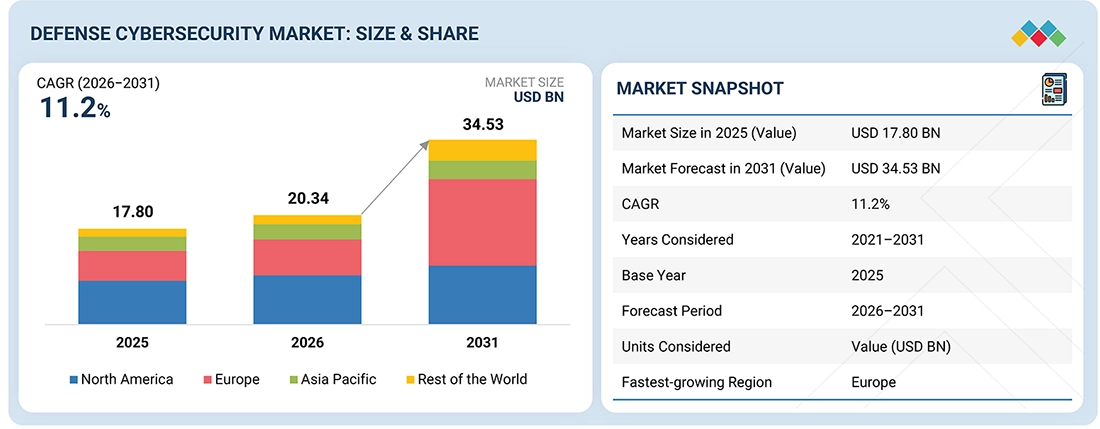
According to Marketsandmarkets, the Global Defense Cybersecurity Market Size was valued at USD 20.34 billion in 2026 and is projected to reach USD 34.53 billion in 2031, growing at a CAGR of 11.2% from 2026-2031. The market is driven by rising cyberattacks on military networks, defense platforms, command systems, and defense industrial suppliers. Growth is also supported by wider use of cloud, C4ISR, connected weapons, space systems, and zero-trust programs, which require stronger security, monitoring, encryption, and cyber testing.
MARKET SNAPSHOT TABLE
| REPORT METRIC | DETAILS |
|---|---|
| Market Size in 2025 | USD 17.80 Billion |
| Market Size in 2026 | USD 20.34 Billion |
| Market Forecast in 2031 | USD 34.53 Billion |
| CAGR | 11.2% |
| Years Considered | 2021–2031 |
| Base Year | 2025 |
| Forecast Period | 2026–2031 |
| Units Considered | USD Billion |
| Report Coverage | Revenue Forecast, Company Ranking, Competitive Landscape, Growth Factors, and Trends |
| Top Companies |
|
| Growth Drivers |
|
| Segments Covered |
|
| Regions Covered | North America, Asia Pacific, Europe, and Rest of the World |
KEY TAKEAWAYS
-
By RegionEurope is expected to have the largest market share during the forecast period.
-
By OfferingBy offering, the services segment is projected to register the highest CAGR of 12.0% during the forecast period.
-
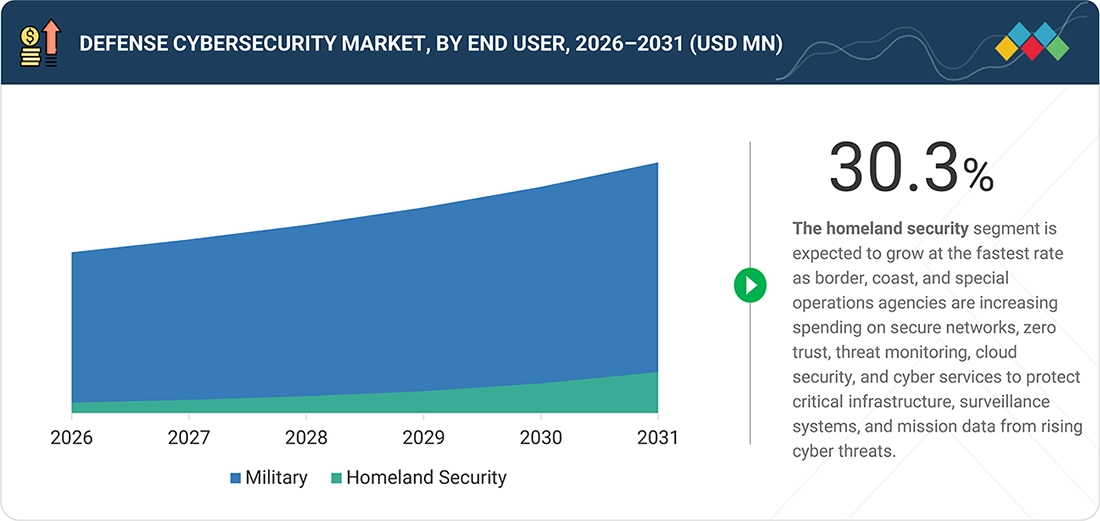
By End UserBy end user, the military segment is estimated to account for 93.6% market share in 2026.
-
Competitive Landscape - Key CompaniesBooz Allen Hamilton Inc , General Dynamics Corporation, and Leidos were identified as some of the star players in the defense cybersecurity market, given their strong market share and product footprint.
-
Competitive Landscape - Startups/SMEsCybereason and Darktrace Holdings Limited have distinguished themselves among startups and SMEs by securing strong footholds in specialized niche areas, underscoring their potential as emerging market leaders.
The defense cybersecurity market is driven by the growing need to protect military IT networks, mission systems, C2 platforms, and defense data from cyber threats. More defense programs now depend on cloud, connected sensors, software-defined systems, and digital supply chains, which increases exposure to attacks. Governments are also investing in zero trust, encryption, threat monitoring, and cyber validation to secure both existing and new defense platforms. Demand is further supported by rising focus on protecting defense contractors and critical national security infrastructure.
Source: Secondary Research, Interviews with Experts, MarketsandMarkets Analysis
TRENDS & DISRUPTIONS IMPACTING CUSTOMERS' CUSTOMERS
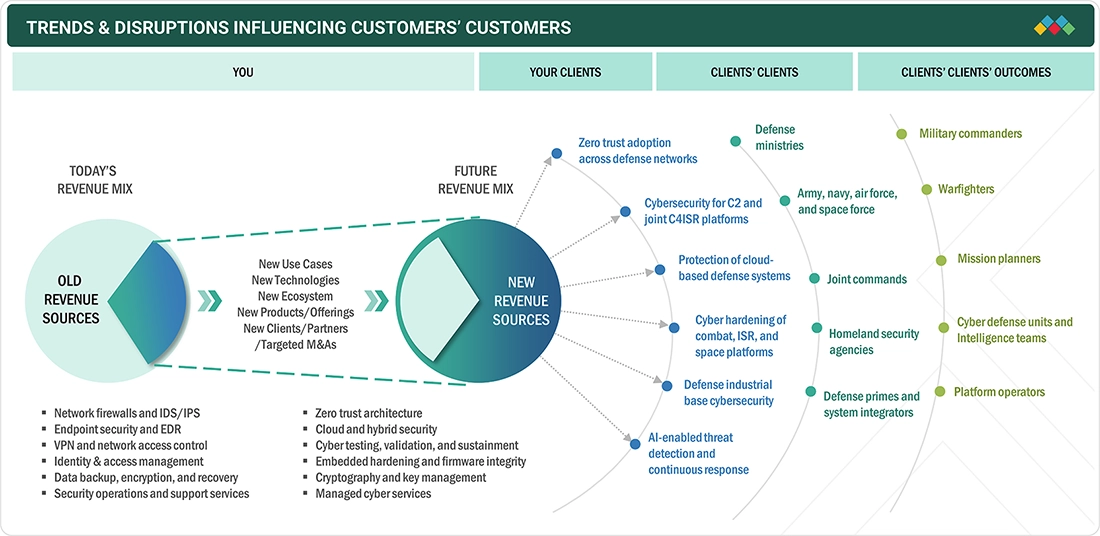
The defense cybersecurity market is shaped by the need to protect military networks, C2 and C4ISR systems, cloud-based defense systems, combat platforms, ISR assets, and defense data centers. The market has mainly included firewalls, IDS/IPS, endpoint security, VPN, network access control, identity management, data backup, encryption, security operations, and support services. It is now moving toward zero trust, cloud and hybrid security, cyber testing, embedded hardening, firmware integrity, cryptography, key management, and managed cyber services. These changes are driven by rising cyber threats, connected defense platforms, software-based systems, and defense industrial base security needs. This affects defense ministries, armed forces, joint commands, homeland security agencies, defense primes, and system integrators as they need to protect military commanders, warfighters, mission planners, cyber defense units, intelligence teams and platform operators.
Source: Secondary Research, Interviews with Experts, MarketsandMarkets Analysis
MARKET DYNAMICS

Level
-
Expansion of Connected Defense Networks and Multi-Domain Operations

-
Rising State-Sponsored Cyberattacks on Military and Defense Industrial Systems


Level
-
Legacy System Fragmentation Across Defense Networks and Platforms

-
Budget Competition with Weapons, Platforms, and Other Defense Priorities


Level
-
Zero Trust, IAM, Encryption, and Sovereign Cloud Security Programs

-
Managed Security, SOC, MDR, and Cyber Support for Defense Agencies and Suppliers


Level
-
Shortage of Cleared Cybersecurity Talent with Defense Domain Knowledge

-
AI Model Security Risks, Data Poisoning, and Cyber Validation Gaps

Source: Secondary Research, Interviews with Experts, MarketsandMarkets Analysis
Driver: Expansion of Connected Defense Networks and Multi-Domain Operations
Defense forces are using more connected systems across land, air, naval, space, and cyber domains. C2, C4ISR, ISR, sensors, combat platforms, and data centers now exchange large volumes of mission data. This increases the need for network security, IAM, encryption, monitoring, and cyber testing to protect mission systems from disruption.
Restraint: Legacy System Fragmentation Across Defense Networks and Platforms
Many defense networks and platforms still depend on older hardware, software and isolated systems. These systems are difficult to connect with modern cybersecurity tools such as zero trust, cloud security and continuous monitoring. This slows upgrades, increases integration costs and creates gaps in visibility across defense environments.
Opportunity:Zero Trust, IAM, Encryption, and Sovereign Cloud Security Programs
Defense agencies are moving toward stricter access control, stronger identity management, secure cloud use and better protection of sensitive data. Zero trust, IAM, encryption and sovereign cloud security programs create demand for cybersecurity solutions that can protect users, devices, applications and data across hybrid defense environments.
Challenge:Shortage of Cleared Cybersecurity Talent with Defense Domain Knowledge
Defense cybersecurity requires people who understand cyber tools, military systems, classified environments, and compliance needs. The supply of cleared cyber professionals is limited, especially for roles linked to SOC operations, threat response, cloud security, and platform security. This can delay implementation, increase service costs, and make long-term cyber operations harder to sustain.
DEFENSE CYBERSECURITY MARKET: COMMERCIAL USE CASES ACROSS INDUSTRIES
| COMPANY | USE CASE DESCRIPTION | BENEFITS |
|---|---|---|
 |
Cyber defense support for US Army C5ISR systems: The work includes securing tactical and enterprise systems, improving information security, and supporting cryptographic modernization. | Protects Army C5ISR systems | Improves tactical network security | Supports secure information sharing | Reduces cyber risk across Army systems |
 |
Use of a DoD IL6 cloud environment for Secret-level defense workloads: The environment supports classified data, dedicated cloud infrastructure, SIPRNet connectivity, and access controls for sensitive defense operations. | Supports classified cloud workloads | Protects sensitive mission data | Improves secure access | Supports backup and continuity |
 |
Enterprise IT and cybersecurity support for the US Army Reserve Command across many users and locations: The work covers cybersecurity, network support, system reliability, and secure day-to-day IT operations. | Improves cybersecurity for Army Reserve users | Supports secure network operations | Improves system availability | Helps protect military IT infrastructure |
Logos and trademarks shown above are the property of their respective owners. Their use here is for informational and illustrative purposes only.
MARKET ECOSYSTEM
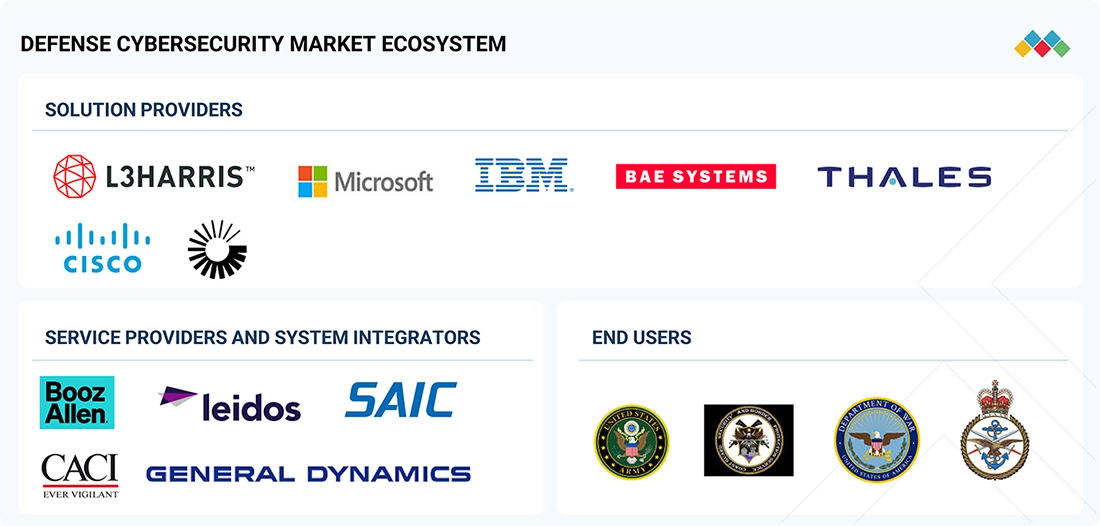
The defense cybersecurity market ecosystem includes solution providers, service providers, system integrators, and end users. Solution providers such as Cisco, Microsoft, IBM, Thales, BAE Systems, L3Harris, and RTX provide tools for network security, endpoint security, cloud security, IAM, data security, encryption, security operations, and cyber testing. Service providers and system integrators such as Booz Allen Hamilton, Leidos, CACI International, SAIC, and General Dynamics help defense agencies design, deploy, manage, and maintain cybersecurity systems for military networks, C2/C4ISR platforms, data centers, and defense platforms. End users include defense ministries, the Army, the Navy, the Air Force, the Space Force, joint commands, and homeland security agencies. The ecosystem also includes cloud providers, hardware suppliers, telecom providers, defense primes, and managed security service providers that support secure defense systems and operations.
Logos and trademarks shown above are the property of their respective owners. Their use here is for informational and illustrative purposes only.
MARKET SEGMENTS
Source: Secondary Research, Interviews with Experts, MarketsandMarkets Analysis
Defense Cybersecurity Market, By Offering
The solutions segment is expected to dominate during the forecast period because defense agencies need tools that directly secure networks, users, devices, data, applications, and cloud systems. Zero trust programs depend on IAM, endpoint security, encryption, monitoring, network security, and cloud security, so these solutions remain central to defense cybersecurity spending.
Defense Cybersecurity Market, By Platform
The Defense Industrial Base & Data Centers segment is expected to grow at the fastest rate because defense suppliers store and share sensitive program data, while data centers support more defense cloud, mission, and security workloads. Stronger supplier security rules and rising use of secure cloud systems are increasing demand for IAM, encryption, monitoring, backup, cloud security, and managed services.
Defense Cybersecurity Market, By End User
The homeland security segment is expected to grow at the fastest rate as border, coast, and special operations agencies are moving more surveillance, access control, and response systems onto connected networks. This increases demand for network security, endpoint security, IAM, data security, security monitoring, and managed cyber services within the defense cybersecurity scope.
Defense Cybersecurity Market, By Deployment
Hybrid deployment is expected to dominate because defense users need to keep sensitive C2, platform, ISR, and mission data on-premises while using cloud tools for monitoring, updates, analytics, and managed cyber services. This setup supports security control, compliance, and faster response across mixed defense networks.
REGION
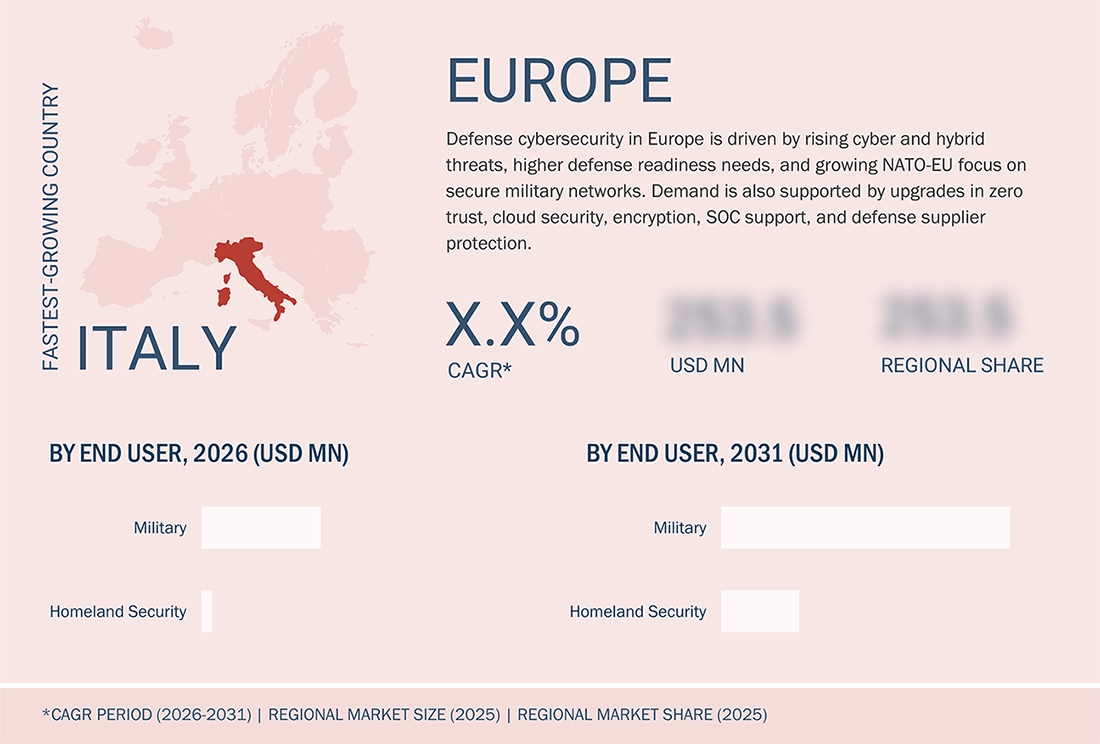
Europe to be fastest-growing region in defense cybersecurity market during forecast period
Many countries in Europe are improving defense networks, secure cloud use, cyber commands, and military security operations after repeated cyber and hybrid threats. Cooperation between NATO and the EU is also increasing the need for common cyber standards, safer data sharing, stronger access control, encryption, and protection of defense suppliers.
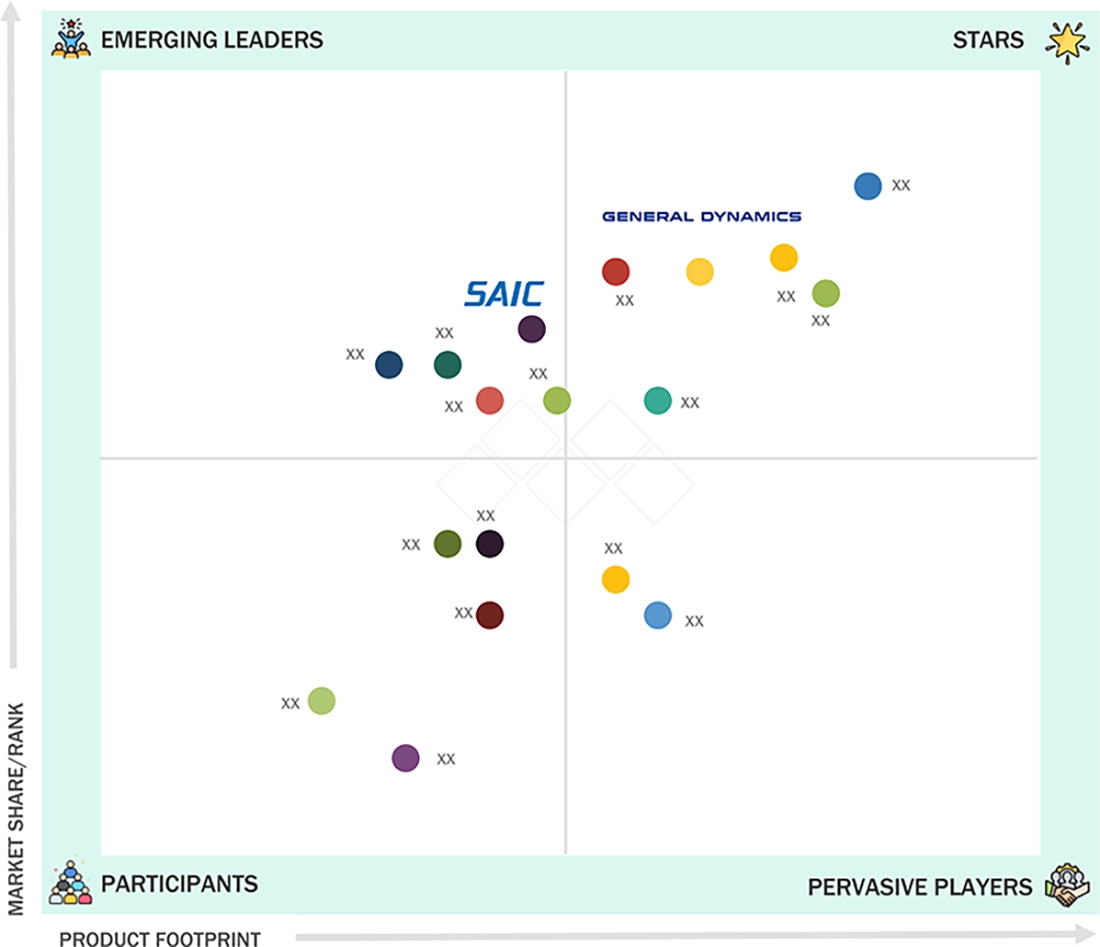
DEFENSE CYBERSECURITY MARKET: COMPANY EVALUATION MATRIX
In the defense cybersecurity market matrix, General Dynamics Corporation (Star) is placed strongly because it has a large defense customer base and a broad cybersecurity role across secure networks, cloud security, identity management, data protection, cyber operations, and managed services. Its position is supported by work across military networks, C2/C4ISR systems, defense data centers, and mission IT programs. SAIC (Emerging Leader) also has a strong position because of its defense IT, cyber support, cloud, network operations, and mission systems. However, its cybersecurity presence appears more service-based and less broad across standalone cybersecurity products than General Dynamics. This supports its placement as an emerging leader rather than a star. Overall, companies with strong defense access and wider cybersecurity coverage are placed higher in the matrix, while companies with narrower coverage or lower defense cyber scale are placed lower.
Source: Secondary Research, Interviews with Experts, MarketsandMarkets Analysis
KEY MARKET PLAYERS
- Booz Allen Hamilton Inc (US)
- General Dynamics Corporation (US)
- CACI International Inc (US)
- BAE Systems (UK)
- Leidos (US)
- Lockheed Martin Corporation (US)
- IBM (US)
- Northrop Grumman (US)
- Thales (France)
- Microsoft (US)
- RTX (US)
- L3Harris Technologies, Inc. (US)
- Leonardo S.p.A. (Italy)
- Cisco Systems, Inc. (US)
- Elbit Systems Ltd (Israel)
- SAIC (US)
- Everforth, Inc (US)
- AT&T (US)
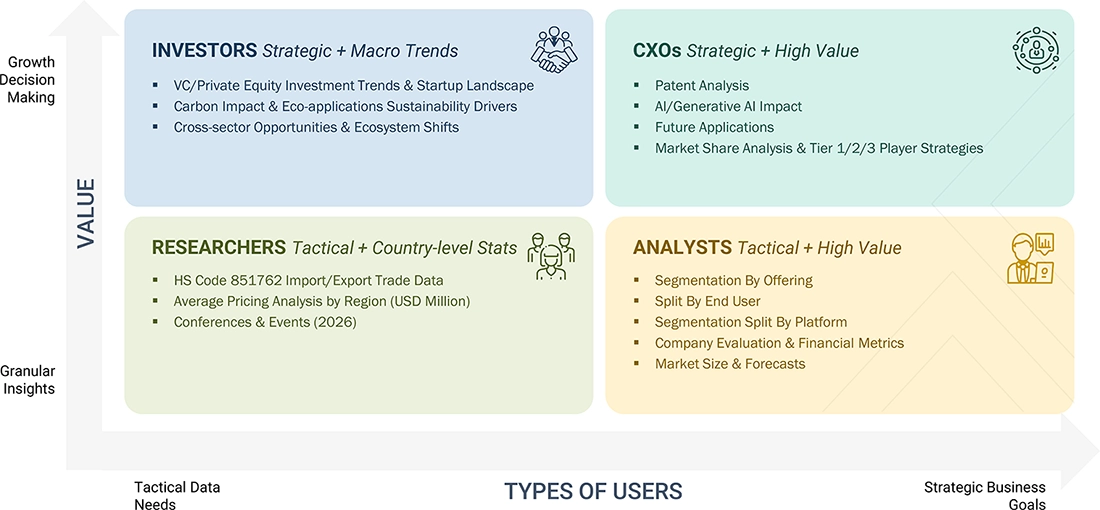
WHAT IS IN IT FOR YOU: DEFENSE CYBERSECURITY MARKET REPORT CONTENT GUIDE
DELIVERED CUSTOMIZATIONS
We have successfully delivered the following deep-dive customizations:
| CLIENT REQUEST | CUSTOMIZATION DELIVERED | VALUE ADDS |
|---|---|---|
| Leading Manufacturer | Additional segment breakdown for countries | Additional country-level market sizing tables for segments/subsegments covered at the regional/global level to gain an understanding of market potential by each country |
| Emerging Leader | Additional company profiles | Competitive information on targeted players to gain granular insights into direct competition |
| Regional Market Leader | Additional country market estimates | Additional country-level deep dive for a more targeted understanding of the total addressable market |
RECENT DEVELOPMENTS
- January 2026 : Booz Allen received a USD 460,098 OTA order under the Thunderdome Production Other Transaction Agreement to support Army Cyber Command’s 1st Signal Brigade. The order is part of the DoD Thunderdome / Zero Trust Portfolio and supports rapid fielding of zero trust-related application development services.
- January 2026 : General Dynamics Information Technology received a USD 120 million task order under the US Air Force’s Next Generation Gateway program to deploy zero-trust cybersecurity across global Air Force operations.
- May 2025 : Leidos acquired Kudu Dynamics to expand its AI-enabled cyber capabilities for defense, intelligence, and homeland security customers. Kudu Dynamics adds expertise in offensive cyber, vulnerability research, automated targeting, hardware reverse engineering, electromagnetic spectrum operations, and non-kinetic effects for military-relevant systems.
Table of Contents
 Exclusive indicates content/data unique to MarketsandMarkets and not available with any competitors.
Methodology
The study involved four major activities to estimate the current size of the defense cybersecurity market. Exhaustive secondary research was conducted to gather information on the defense cybersecurity market, its adjacent markets, and its parent market. The next step was to validate these findings, assumptions, and sizing with industry experts across the value chain through primary research. Demand-side analysis was conducted to estimate the overall market size. Thereafter, data triangulation procedures were employed to estimate the sizes of various segments and subsegments within the defense Cybersecurity Market.
Secondary Research
During the secondary research process, various sources were consulted to identify and collect information for this study. The secondary sources included government sources, such as SIPRI; corporate filings, including annual reports, press releases, and investor presentations; white papers, journals, and certified publications; and articles from recognized authors, directories, and databases.
Primary Research
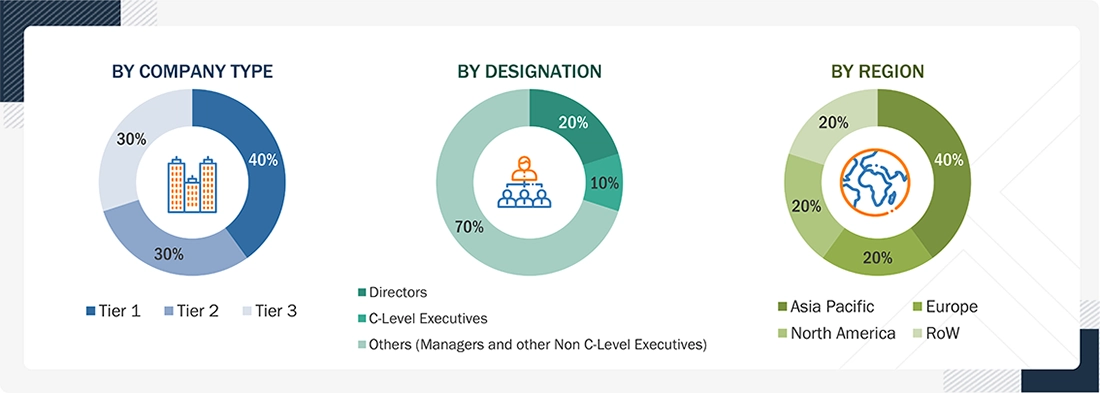
Extensive primary research was conducted after acquiring information on the defense cybersecurity market through secondary research. Several primary interviews were conducted with market experts from the demand and supply sides across major countries of North America, Europe, the Asia Pacific, and the Rest of the World (RoW). Primary data was collected through questionnaires, emails, and telephonic interviews.
To know about the assumptions considered for the study, download the pdf brochure
Market Size Estimation
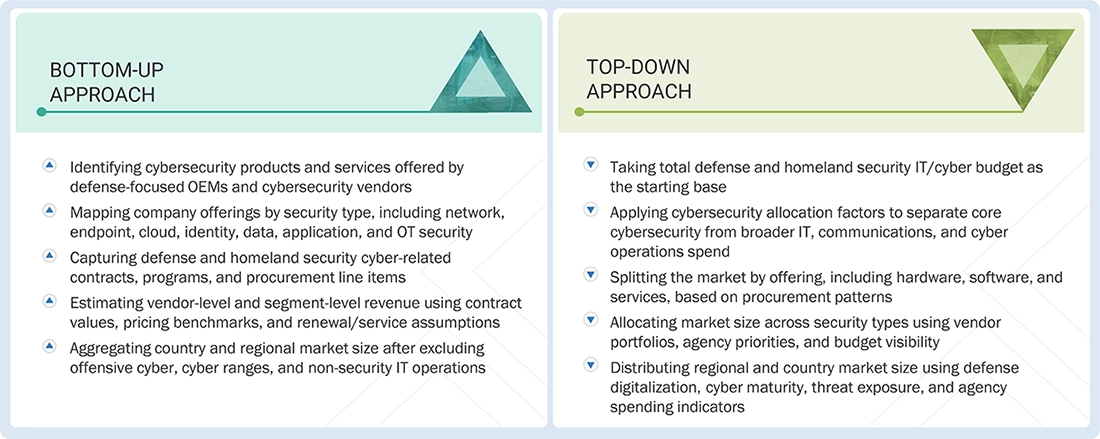
Top-down and bottom-up approaches were used to estimate and validate the size of the defense cybersecurity market. The research methodology used to estimate the size of the market included the following details:
- Key players in the defense cybersecurity market were identified through secondary research, and their market shares were determined through a combination of primary and secondary research. This included a study of the annual and financial reports of the top market players, as well as extensive interviews with leaders, including directors, engineers, marketing executives, and other key stakeholders of leading companies operating in the market.
- All percentage shares, splits, and breakdowns were determined using secondary sources and verified through primary sources.
- All possible parameters that affect the markets covered in this research study were accounted for, viewed in extensive detail, verified through primary research, and analyzed to obtain the final quantitative and qualitative data on the defense cybersecurity market. This data was consolidated, enhanced with detailed input, analyzed by MarketsandMarkets, and presented in this report.
Data Triangulation
After determining the overall market size, the total market was classified into several segments and subsegments. The data triangulation and market breakdown procedures explained below were implemented, wherever applicable, to complete the overall market engineering process and arrive at the estimated market numbers for the market segments and subsegments. The data was triangulated by examining various factors and trends on both the demand and supply sides. Additionally, the market size was validated using top-down and bottom-up approaches.
Market Definition
The defense cybersecurity market covers hardware, software, and services used to protect military information systems, defense networks, cloud environments, applications, endpoints, data, identities, and digital infrastructure from unauthorized access, disruption, malware, data loss, and system compromise.
Key Stakeholders
- Defense ministries and departments
- Army, Navy, Air Force, Space Force, and joint commands
- Homeland security, border protection, and coast protection agencies
- Defense cybersecurity solution providers
- Defense IT service providers and system integrators
- Managed security service providers and SOC service providers
- Defense primes, defense industrial base suppliers, and data center operators
Report Objectives
- To define, describe, and forecast the defense cybersecurity market based on offering, platform, end user, deployment, technology, and region in terms of value
- To forecast the size of various segments of the market across North America, Europe, the Asia Pacific, and the Rest of the World (RoW), in terms of value
- To identify and analyze the drivers, restraints, opportunities, and challenges influencing the growth of the market
- To identify industry trends, market trends, and technology trends currently prevailing in the market
- To provide an overview of the regulatory landscape with respect to defense cybersecurity across regions
- To analyze micromarkets with respect to individual growth trends, prospects, and their contribution to the overall market
- To analyze opportunities in the market for stakeholders by identifying key market trends
- To profile key market players and comprehensively analyze their market share and core competencies
- To evaluate the degree of competition in the market by analyzing recent developments, such as contracts, agreements, and acquisitions adopted by leading market players
- To identify detailed financial positions, key products, and unique selling points of leading companies in the market
- To provide a detailed competitive landscape of the market, along with market share analysis and revenue analysis of key players
Available customizations:
MarketsandMarkets offers the following customizations for this market report:
- Additional country-level analysis of the defense cybersecurity market
- Profiling of other market players (up to 5)
Product Analysis
- Product matrix, which provides a detailed comparison of the product portfolios of each company in the defense cybersecurity market
Key Questions Addressed by the Report
How is the defense cybersecurity market expected to grow by 2031?
The global defense cybersecurity market is projected to grow from USD 20.34 billion in 2026 to USD 34.53 billion by 2031, registering a CAGR of 11.2% during the forecast period.
What factors are driving the growth of the defense cybersecurity market?
Growth is being driven by increasing cyberattacks targeting military networks, command systems, defense platforms, defense contractors, and critical national security infrastructure, along with expanding adoption of cloud computing, C4ISR systems, connected weapons, and zero trust security programs.
Which region is expected to lead the defense cybersecurity market during the forecast period?
Europe is expected to hold the largest market share during the forecast period due to rising investments in military cyber defense, secure cloud adoption, cyber command development, and enhanced cooperation between NATO and European defense organizations.
Why is the military segment expected to dominate defense cybersecurity spending?
The military segment is estimated to account for 93.6% of the market in 2026 because armed forces rely heavily on secure networks, command systems, intelligence platforms, cloud environments, and mission critical data that require continuous cybersecurity protection.
Why are zero trust, identity management, and encryption programs creating major market opportunities?
Defense agencies are implementing zero trust architectures, identity and access management systems, encryption technologies, and sovereign cloud security programs to strengthen protection of users, devices, applications, and classified data across hybrid defense environments.
How are connected defense networks increasing cybersecurity requirements?
Modern defense operations rely on interconnected C2, C4ISR, ISR, sensor, combat, space, and cyber systems that continuously exchange mission data, increasing the need for advanced monitoring, encryption, access control, and threat detection capabilities.
What challenge is affecting the implementation of defense cybersecurity programs?
A shortage of cleared cybersecurity professionals with expertise in military systems, classified environments, cloud security, threat response, and cyber operations is making implementation and long term management of cybersecurity programs more difficult.
Why is hybrid deployment expected to become the dominant deployment model?
Hybrid deployment allows defense organizations to keep sensitive mission and command data on secure on premises systems while leveraging cloud technologies for analytics, monitoring, updates, and managed cybersecurity services.
Why is the defense industrial base and data center segment expected to grow rapidly?
Defense suppliers and data centers manage large volumes of sensitive program information and mission critical workloads, increasing demand for identity management, encryption, cloud security, monitoring, backup solutions, and managed cybersecurity services.
Which companies are recognized as leading participants in the defense cybersecurity market?
Booz Allen Hamilton Inc., General Dynamics Corporation, CACI International Inc., BAE Systems, Leidos, Lockheed Martin Corporation, IBM, and Northrop Grumman are among the leading market participants, with General Dynamics recognized for its broad cybersecurity capabilities across military networks, C2 and C4ISR systems, cloud security, and defense data centers.


Personalize This Research
- Triangulate with your Own Data
- Get Data as per your Format and Definition
- Gain a Deeper Dive on a Specific Application, Geography, Customer or Competitor
- Any level of Personalization
Let Us Help You
- What are the Known and Unknown Adjacencies Impacting the Defense Cybersecurity Market
- What will your New Revenue Sources be?
- Who will be your Top Customer; what will make them switch?
- Defend your Market Share or Win Competitors
- Get a Scorecard for Target Partners

Custom Market Research Services
We Will Customise The Research For You, In Case The Report Listed Above Does Not Meet With Your Requirements
Get 10% Free CustomisationTESTIMONIALS
- Canada Defense Cybersecurity Market
- US Defense Cybersecurity Market
- UK Defense Cybersecurity Market
- France Defense Cybersecurity Market
- Germany Defense Cybersecurity Market
- Italy Defense Cybersecurity Market
- Spain Defense Cybersecurity Market
- Poland Defense Cybersecurity Market
- India Defense Cybersecurity Market
- Japan Defense Cybersecurity Market
- Australia Defense Cybersecurity Market
- South Korea Defense Cybersecurity Market
- Rest Of Europe Defense Cybersecurity Market
- Rest Of Asia Pacific Defense Cybersecurity Market






Growth opportunities and latent adjacency in Defense Cybersecurity Market