Desiccant Dehumidifier Market Size Share & Trends

Desiccant Dehumidifier Market by Method (Rotary, Solid Bed, Hybrid, Compact and Liquid), Product (Fixed/Mounted, Portable), Use Case (Corrosion Prevention, Condensation Prevention, Mold/Fungus Prevention, Dry Cooling) - Global Forecast to 2029




OVERVIEW
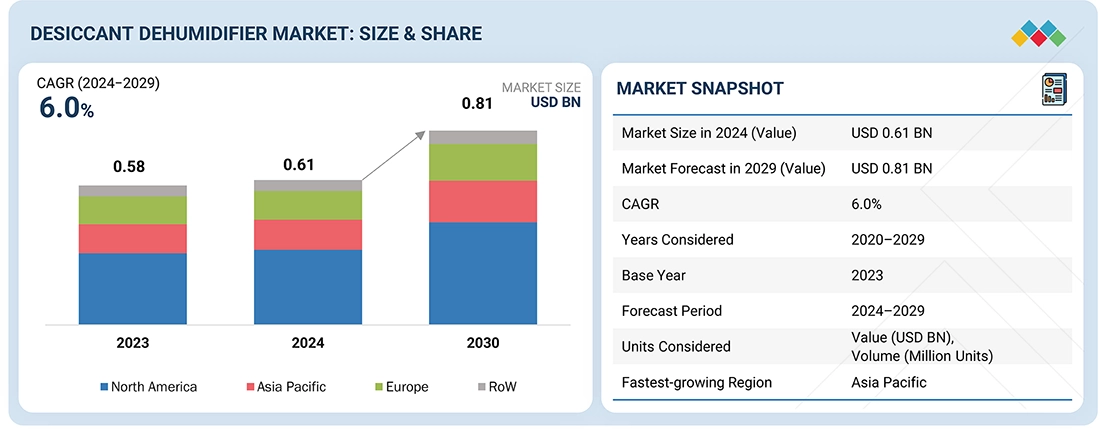
Source: Secondary Research, Interviews with Experts, MarketsandMarkets Analysis
The desiccant dehumidifier market is projected to reach USD 0.81 billion by 2029 from USD 0.61 billion in 2024, at a CAGR of 6.0% from 2024 to 2029. A desiccant dehumidifier operates using the adsorption properties of a rotating desiccant wheel, similar to a sponge soaking up moisture directly from the air. Air is drawn into the dehumidifier and passes through the slowly revolving desiccant wheel. The desiccant absorbs moisture, and the dried air is returned to the room. To allow the desiccant wheel to absorb moisture indefinitely, it passes through a regeneration area, where a secondary hot airstream heats it. An electric heater heats this secondary airstream to around 120°C before passing it through the wheel. The hot air absorbs the moisture from the desiccant and is then vented externally.
KEY TAKEAWAYS
-
By RegionThe North America desiccant dehumidifier market accounted for a 51.8% revenue share in 2024.
-
By Product TypeBy Product type, the portable segment is expected to register the highest CAGR of 6.7%.
-
By End UserBy end user, the industrial segment is expected to dominate the market, with a market share of 77.6% in 2024.
-
By ApplicationBy application, the electronics segment will grow the fastest during the forecast period.
-
Competitive LandscapeMunters (Sweden), and Condair Group (Switzerland) were identified as some of the star players in the desiccant dehumidifiers market, given their strong market share and product footprint.
-
Competitive LandscapeEcor Pro (Netherlands) is distinguished among startups and SMEs by securing strong footholds in specialized niche areas, underscoring their potential as emerging market leaders
The increasing adoption of desiccant dehumidifiers in various industries, the increasing government regulatory policies and incentives for clean energy, and the rise in construction activities drive the desiccant dehumidifier market. The growing adoption of desiccant dehumidifiers in clean room environments is likely to provide growth opportunities to market players during the forecast period.
TRENDS & DISRUPTIONS IMPACTING CUSTOMERS' CUSTOMERS
Various emerging technologies are reshaping the desiccant dehumidifier manufacturing ecosystem by shifting revenue from traditional products to advanced solutions. Growing demand from electronics, construction, energy, and food & pharmaceutical sectors is driving adoption of liquid, ventless, and climate-control-focused desiccant systems. Clients are prioritizing solar-powered, hybrid, membrane-based, and regenerative desiccant dehumidifiers to improve efficiency and sustainability. Overall, the future revenue mix reflects innovation-led growth aligned with evolving client and end-user imperatives.
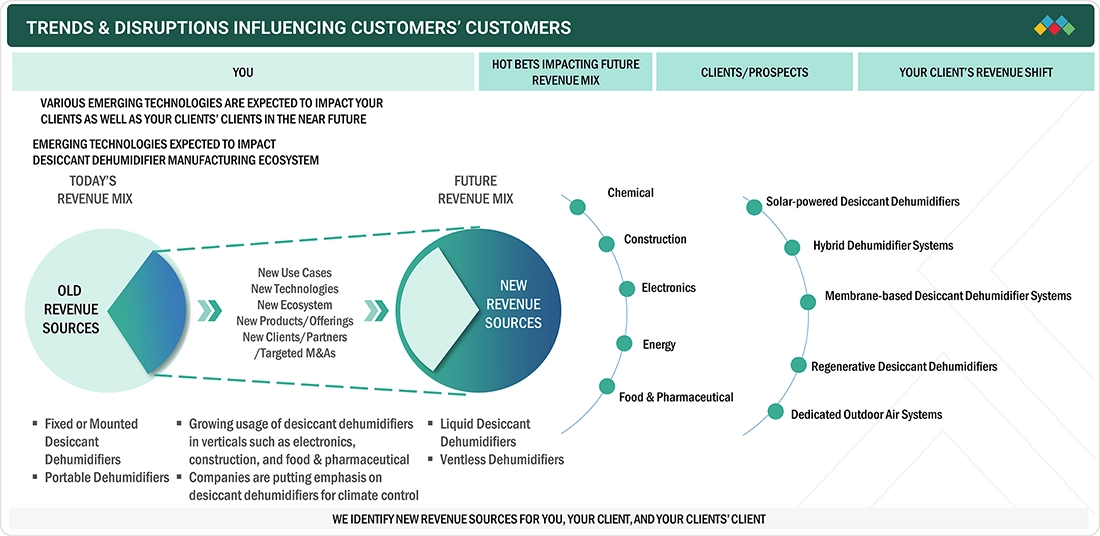
Source: Secondary Research, Interviews with Experts, MarketsandMarkets Analysis
MARKET DYNAMICS

Level
-
Rising adoption of desiccant dehumidifiers in various industries


Level
-
High initial cost of desiccant dehumidifiers


Level
-
Growing adoption of desiccant dehumidifiers in clean room environments


Level
-
Limitations in applications of desiccant dehumidifiers

Source: Secondary Research, Interviews with Experts, MarketsandMarkets Analysis
Driver:Rising adoption of desiccant dehumidifiers in various industries
Desiccant dehumidifiers are finding rising adoption in industrial applications requiring optimal humidity and temperature levels. Climate control plays a vital role in the production, storage, and transportation of numerous products in industries
Restraint: High initial cost of desiccant dehumidifiers
Desiccant dehumidifiers are often more expensive than traditional refrigerant-based dehumidifiers, making them less attractive to price-sensitive consumers. This is because they use a more complex and advanced technology that requires more expensive components and materials.
Opportunity: Growing adoption of desiccant dehumidifiers in clean room environments
To maintain a very low humidity level in a cleanroom, a desiccant dehumidifier is required. Dehumidification ensures that the climate in the cleanroom is always uniform with constant low humidity.
Challenge:Limitations in applications of desiccant dehumidifiers
Desiccant dehumidifiers are best suited for low-temperature and low-humidity environments, such as industrial or commercial settings. They may not be as effective in residential or high-humidity environments
DESICCANT DEHUMIDIFIER MARKET SIZE SHARE & TRENDS: COMMERCIAL USE CASES ACROSS INDUSTRIES
| COMPANY | USE CASE DESCRIPTION | BENEFITS |
|---|---|---|
 |
Integrates desiccant dehumidifier systems in pharmaceutical manufacturing, battery production, and food processing facilities to maintain low-humidity and controlled environments. | Ensures product quality, minimizes moisture-related defects, and supports regulatory compliance. |
 |
Deploys desiccant dehumidifiers in cold storage, packaging, and electronics assembly plants to control humidity in low-temperature and high-humidity conditions. | Prevents condensation and corrosion, improves energy efficiency, and extends equipment life. |
 |
Uses desiccant-based dehumidification solutions in industrial drying, HVAC systems, and cleanrooms for precise climate control. | Provides stable humidity control, reduces downtime, and enhances operational efficiency. |
 |
Implements desiccant dehumidifier systems in commercial buildings, museums, and data centers to manage indoor air quality and moisture. | Improves air quality, protects sensitive assets, and lowers HVAC energy consumption. |
Logos and trademarks shown above are the property of their respective owners. Their use here is for informational and illustrative purposes only.
MARKET ECOSYSTEM
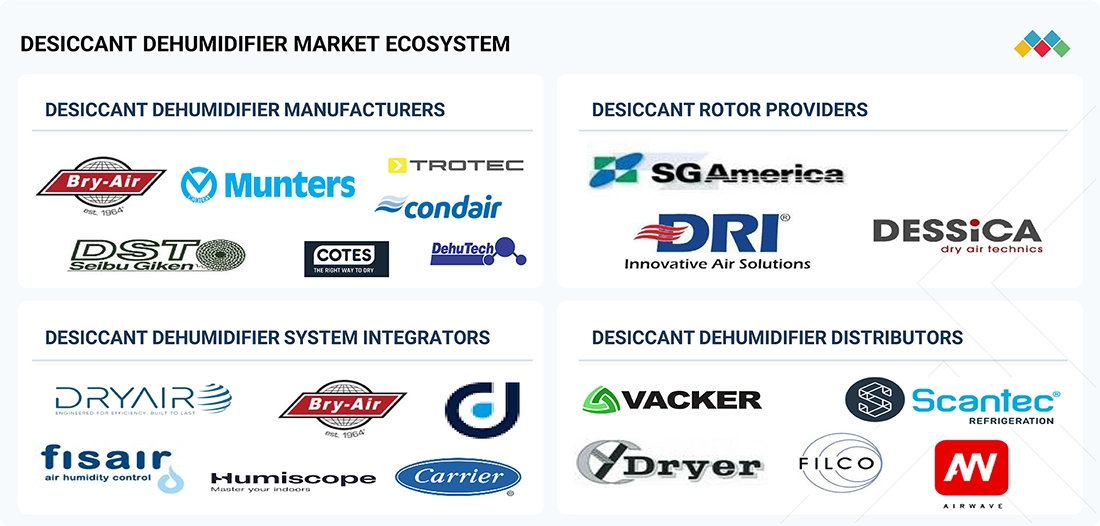
The desiccant dehumidifier value chain, spanning component suppliers to end users across multiple industries. It highlights key players involved in manufacturing desiccant dehumidifiers, supplying desiccant rotors, system integration, and product distribution. This ecosystem enables the development of customized, application-specific dehumidification solutions. End users across industrial, commercial, energy, and infrastructure sectors benefit from reliable moisture control and improved operational efficiency.
Logos and trademarks shown above are the property of their respective owners. Their use here is for informational and illustrative purposes only.
MARKET SEGMENTS
Source: Secondary Research, Interviews with Experts, MarketsandMarkets Analysis
Desiccant Dehumidifier Market, By Product Type
By product type, the fixed/mounted segment held the larger market share in 2023. The portable segment is expected to exhibit faster growth during the forecast period. Portable dehumidifiers are typically lightweight and compact. Some models are equipped with wheels for easy mobility. These portable desiccant dehumidifiers are increasingly adopted in gyms, basements, sports arenas, and commercial spaces where low-capacity desiccant dehumidifiers are required. Additionally, the rising investment in product innovation for portable desiccant dehumidifiers boosts segmental growth.
Desiccant Dehumidifier Market,By Application
The desiccant dehumidifier market for energy is expected to exhibit a considerable CAGR during the forecast period. This can be attributed to the growing adoption in power plants as desiccant dehumidifiers can provide the ideal low humidity environment for preservation and deactivation of power plants, as they can maintain RH as low as 1% or even lower at a constant level, regardless of ambient conditions. These dehumidifiers are increasingly adopted in lithium-ion battery production. Li-ion battery manufacturing is not feasible in the absence of dehumidification technology. As Li-ion batteries are vital for driving the energy storage industry, the sector needs to invest in desiccant dehumidification products and solutions to revolutionize how batteries are manufactured. It will help in the production of highly durable and consistent batteries.
Desiccant Dehumidifier Market, By End User
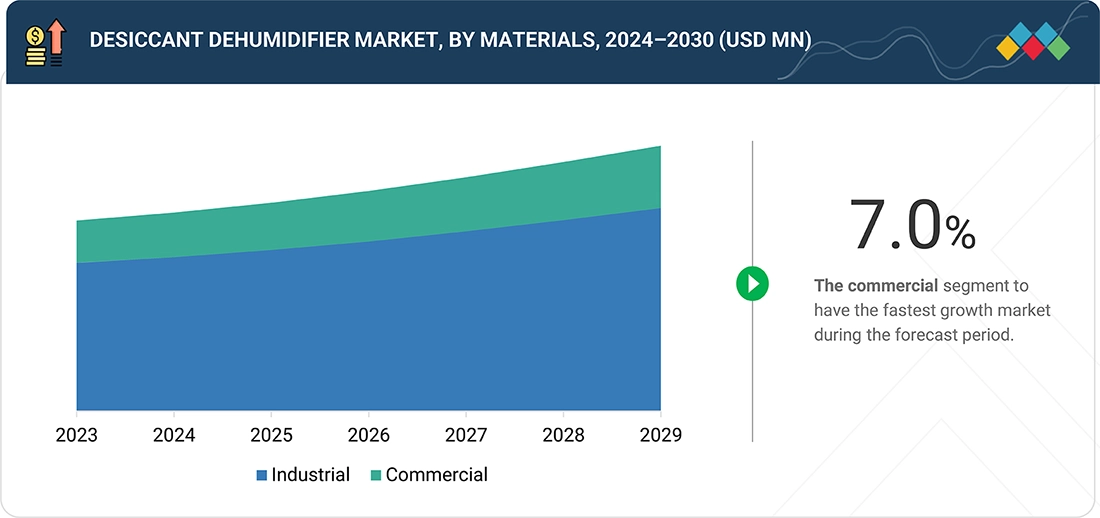
In 2023, the industrial segment held the largest share of the desiccant dehumidifier market. It is expected to retain its dominant position owing to the application scope in industries, such as pharmaceuticals, manufacturing, food & beverage, energy & utility, and electronics. Additionally, desiccant dehumidifiers can provide effective humidity control in a cost-effective and energy-efficient manner while offering greater flexibility and reduced maintenance requirements compared with other techniques, such as refrigerant dehumidifiers. This enables companies to choose desiccant dehumidifiers for their facilities. These factors are boosting the market growth.
REGION
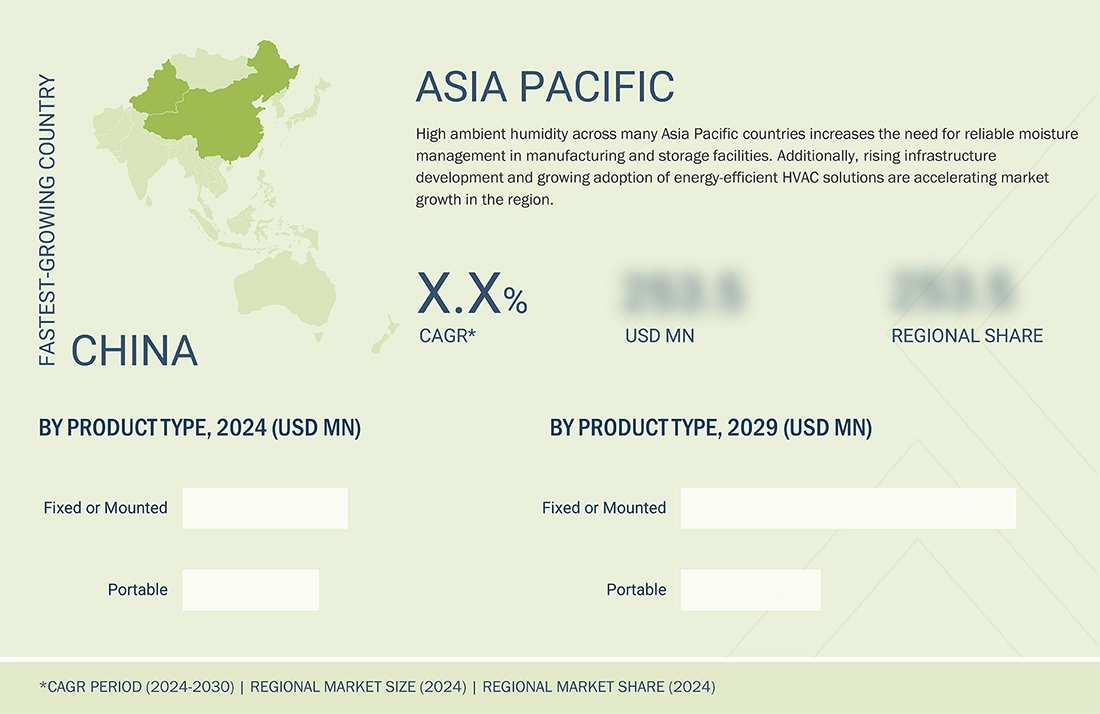
Asia Pacific to be fastest-growing region in Desiccant Dehumidifier market during forecast period
Desiccant dehumidifiers are growing fastest in Asia Pacific due to rapid industrialization, expanding electronics and pharmaceutical sectors, and increasing demand for climate-controlled environments. Strong infrastructure investments and stringent quality standards are driving adoption in manufacturing and storage applications. Additionally, supportive government policies on energy efficiency and humidity management further accelerate market growth in the region.
DESICCANT DEHUMIDIFIER MARKET SIZE SHARE & TRENDS: COMPANY EVALUATION MATRIX
In the desiccant dehumidifier market matrix, Munters (Sweden) leads with a strong market share and extensive product footprint. Trotec Laser GmbH (Austria) (Emerging Leader) is gaining visibility with its specialised alloys and tailored solutions for industrial end users, strengthening its position through innovation and niche product offerings.
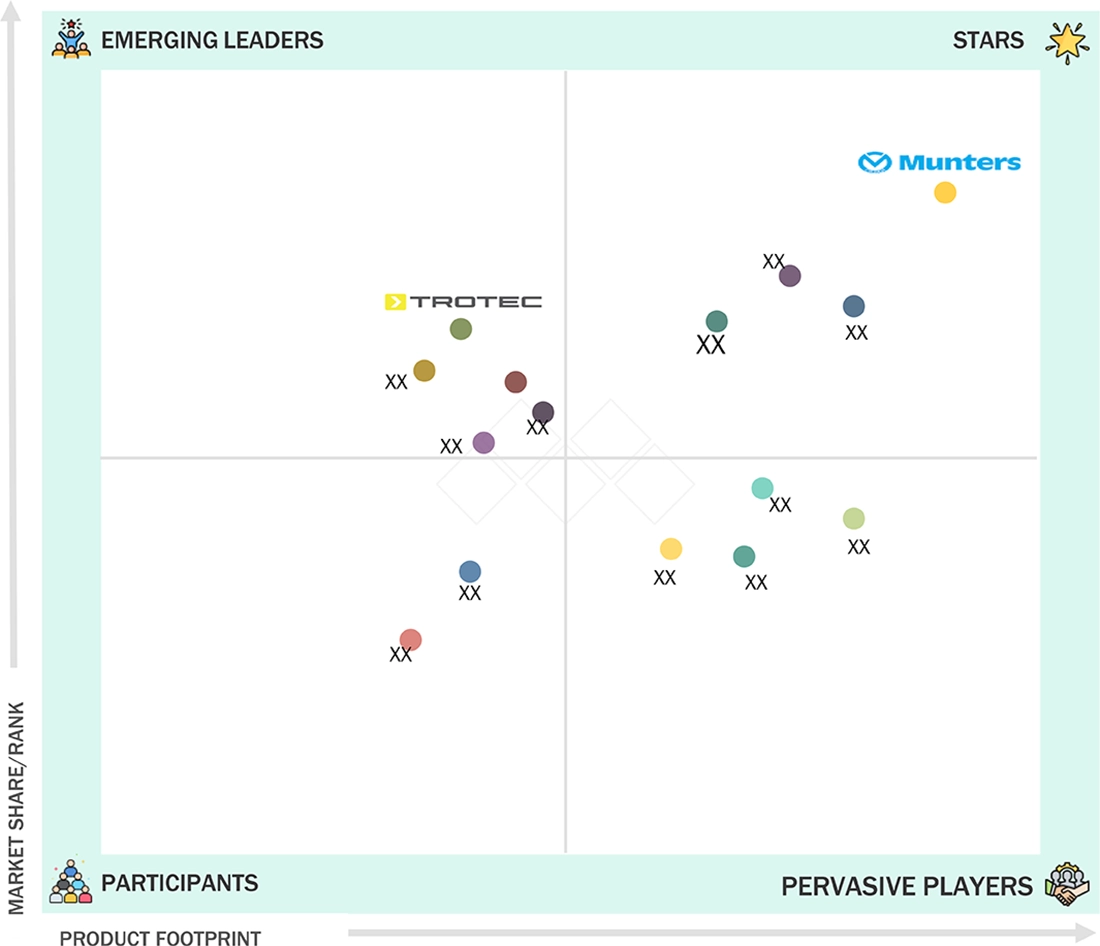
Source: Secondary Research, Interviews with Experts, MarketsandMarkets Analysis
KEY MARKET PLAYERS
- Bry-Air (India)
- Munters (Sweden)
- Condair Group (Switzerland)
- Cotes (Denmark)
- Seibu Giken DST (Sweden)
- Trotec Laser GmbH (Austria)
- DehuTech AB (China)
- Fisen Corporation (US)
- Kaeser Kompressoren (Germany)
- Atlas Copco AB (Sweden)
MARKET SCOPE
| REPORT METRIC | DETAILS |
|---|---|
| Market Size in 2024 (Value) | USD 0.61 Billion |
| Market Forecast in 2029 (Value) | USD 0.81 Billion |
| Growth Rate | CAGR of 6.0% from 2024-2029 |
| Years Considered | 2020-2029 |
| Base Year | 2023 |
| Forecast Period | 2024-2029 |
| Units Considered | Value (USD Million/Billion), Volume (Kiloton) |
| Report Coverage | Revenue forecast, company ranking, competitive landscape, growth factors, and trends |
| Segments Covered |
|
| Regions Covered | North America, Asia Pacific, Europe, RoW |
WHAT IS IN IT FOR YOU: DESICCANT DEHUMIDIFIER MARKET SIZE SHARE & TRENDS REPORT CONTENT GUIDE
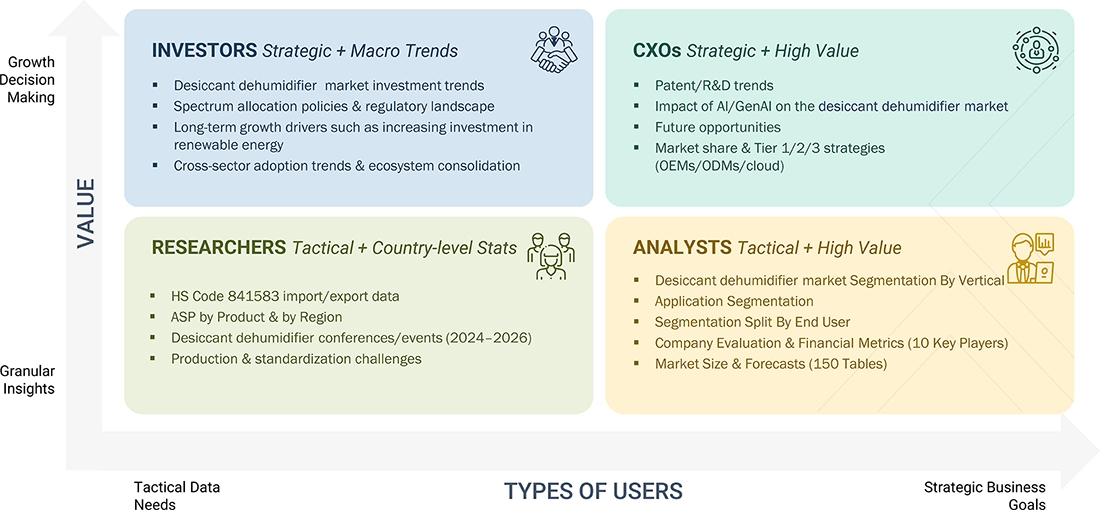
DELIVERED CUSTOMIZATIONS
We have successfully delivered the following deep-dive customizations:
| CLIENT REQUEST | CUSTOMIZATION DELIVERED | VALUE ADDS |
|---|---|---|
| Leading Desiccant Dehumidifier Manufacturer / HVAC OEM |
|
|
RECENT DEVELOPMENTS
- July 2024 : CONDAIR GROUP announced its acquisition of KUUL. Kuul manufactures glass fiber and cellulose media in evaporative cooling systems and adiabatic pre-cooling for chillers and turbines. This acquisition favors the company as KUUL has the media expertise, which complements the evaporative technology expertise of Condair together, which will help Condair provide reliable and sustainable solutions.
- May 2024 : Condair Group launched the new Condair PureHum 1000 Pro, a mobile humidifier ideal for areas up to 1,000 m³. Advanced features include phone-based app control, UV-water sterilization, multiple air filtration options, and an 8-speed auto-adjusting fan.
- March 2024 : Munters signed an agreement to acquire AIRPROTECH, an Italian manufacturer of Volatile Organic Compounds (VOC) abatement systems. This acquisition will enhance Munters Clean Technology portfolio and supports cleaner production for European industries
- September 2022 : Bry-Air launched the "BryShield" to prevent electronic corrosion in small server rooms by removing gaseous contaminants. The innovative air filtration system has been aesthetically designed to fit easily into a false ceiling and be compactly ceiling mounted
- COLUMN 'A' SHOULD BE IN TEXT FORMAT AND NOT DATE FORMAT :
Table of Contents
 Exclusive indicates content/data unique to MarketsandMarkets and not available with any competitors.
Methodology
The research process for this study included systematic gathering, recording, and analysis of data about customers and companies operating in the desiccant dehumidifier market. This process involved the extensive use of secondary sources, directories, and databases (Factiva, Oanda, and OneSource) for identifying and collecting valuable information for the comprehensive, technical, market-oriented, and commercial study of the desiccant dehumidifier market. In-depth interviews were conducted with primary respondents, including experts from core and related industries and preferred manufacturers, to obtain and verify critical qualitative and quantitative information as well as to assess growth prospects. Key players in the desiccant dehumidifier market were identified through secondary research, and their market rankings were determined through primary and secondary research. This research included studying annual reports of top players and interviewing key industry experts such as CEOs, directors, and marketing executives.
Secondary Research
In the secondary research process, various sources were used to identify and collect information important for this study. These include annual reports, press releases & investor presentations of companies, white papers, technology journals, certified publications, articles by recognized authors, directories, and databases.
Secondary research was mainly used to obtain key information about the industry's supply chain, the total pool of market players, the classification of the market according to industry trends to the bottom-most level, regional markets, and key developments from the market and technology-oriented perspectives.
Primary Research
Primary research was also conducted to identify the segmentation types, key players, competitive landscape, and key market dynamics, such as drivers, restraints, opportunities, challenges, and industry trends, along with key strategies adopted by players operating in the desiccant dehumidifier market. Extensive qualitative and quantitative analyses were performed on the complete market engineering process to list key information and insights throughout the report.
Extensive primary research has been conducted after acquiring knowledge about the desiccant dehumidifier market scenarios through secondary research. Several primary interviews have been conducted with experts from both demand (end users) and supply side (desiccant dehumidifier manufacturers/providers) across four major geographic regions: North America, Europe, Asia Pacific, and RoW. Approximately 80% and 20% of the primary interviews were conducted from the supply and demand side, respectively. These primary data have been collected through questionnaires, emails, and telephonic interviews.

To know about the assumptions considered for the study, download the pdf brochure
Market Size Estimation
In the complete market engineering process, both top-down and bottom-up approaches were implemented, along with several data triangulation methods, to estimate and validate the size of the desiccant dehumidifier market and various other dependent submarkets. Key players in the market were identified through secondary research, and their market share in the respective regions was determined through primary and secondary research. This entire research methodology included the study of annual and financial reports of the top players, as well as interviews with experts (such as CEOs, VPs, directors, and marketing executives) for key insights (quantitative and qualitative).
All percentage shares, splits, and breakdowns were determined using secondary sources and verified through primary sources. All the possible parameters that affect the markets covered in this research study were accounted for, viewed in detail, verified through primary research, and analyzed to obtain the final quantitative and qualitative data. This data was consolidated and supplemented with detailed inputs and analysis from MarketsandMarkets and presented in this report.
Desiccant Dehumidifier Market: Bottom-Up Approach and Top-Down Approach

Data Triangulation
After arriving at the overall market size from the market size estimation process, as explained above, the total market has been split into several segments and subsegments. To complete the overall market engineering process and arrive at the exact statistics for all segments and subsegments, market breakdown and data triangulation procedures have been employed, wherever applicable. The data have been triangulated by studying various factors and trends from both the demand and supply sides. Along with this, the market has been validated using top-down and bottom-up approaches.
Market Definition
A desiccant dehumidifier operates using the adsorption properties of a rotating desiccant wheel, similar to a sponge soaking up moisture directly from the air. Air is drawn into the dehumidifier and passes through the slowly revolving desiccant wheel. The desiccant absorbs moisture, and the dried air is returned to the room. To allow the desiccant wheel to absorb moisture indefinitely, it passes through a regeneration area, where a secondary hot airstream heats it. An electric heater heats this secondary airstream to over 120°C before passing it through the wheel. The hot air absorbs the moisture from the desiccant and is then vented externally.
Therefore, a desiccant dehumidifier has two airstreams—a process airstream and a regeneration airstream, which exhaust the moisture collected from the process airstream. As the freshly regenerated part of the wheel is hot, it carries some residual heat when it rotates into the process airstream. Along with drying the process airstream, the desiccant wheel provides some heat.
Key Stakeholders
- Dehumidifier Companies
- Raw Material Suppliers and Distributors
- Associations and Industrial Bodies
- Environmental Support Agencies
- System Integrators
- Government Councils
- Standardization Bodies
- Analysts and Strategic Business Planners
Report Objectives
- To define, describe, and estimate the desiccant dehumidifier market, by product type, application, end user, and region, in terms of value
- To forecast the size of the market, by region—North America, Europe, Asia Pacific, and the Rest of the World (RoW)—in terms of value
- To forecast the desiccant dehumidifier market size, by product type, in terms of volume
- To provide detailed information regarding drivers, restraints, opportunities, and challenges influencing the growth of the desiccant dehumidifier market
- To strategically analyze the micromarkets with respect to the individual growth trends, prospects, and their contribution to the desiccant dehumidifier market
- To map the competitive landscape based on company profiles, key player strategies, and key developments
- To provide a detailed overview of the desiccant dehumidifier value chain and ecosystem
- To provide information about key technology trends, impact of AI/Gen AI, macroeconomic outlook analysis, and patents related to the desiccant dehumidifier market
- To provide information regarding trade data related to the desiccant dehumidifier market
- To identify the key players operating in the desiccant dehumidifier market and comprehensively analyze their market shares and core competencies
- To analyze opportunities in the market for stakeholders by identifying high-growth segments of the desiccant dehumidifier market
- To benchmark the market players using the proprietary company evaluation matrix framework, which analyzes them on various parameters within the broad categories of market ranking/share and product portfolio
- To analyze competitive developments, such as contracts, acquisitions, product launches, collaborations, expansions, and research & development (R&D), in the desiccant dehumidifier market.
Available Customizations
With the given market data, MarketsandMarkets offers customizations according to the company’s specific needs. The following customization options are available for the report:
Company Information
- Detailed analysis and profiling of additional market players (up to 5)
Key Questions Addressed by the Report


Personalize This Research
- Triangulate with your Own Data
- Get Data as per your Format and Definition
- Gain a Deeper Dive on a Specific Application, Geography, Customer or Competitor
- Any level of Personalization
Let Us Help You
- What are the Known and Unknown Adjacencies Impacting the Desiccant Dehumidifier Market
- What will your New Revenue Sources be?
- Who will be your Top Customer; what will make them switch?
- Defend your Market Share or Win Competitors
- Get a Scorecard for Target Partners

Custom Market Research Services
We Will Customise The Research For You, In Case The Report Listed Above Does Not Meet With Your Requirements
Get 10% Free CustomisationTESTIMONIALS

Tetsuya Ohhira
Business Development Manager-Technology Business
Nikon Corporation,
Leading Japanese MNC specializing in optics and imaging productswww.nikon.com
MarketsandMarkets™ response
is quick. Their attitude is flexible and positive. Analyst Insights are globally considered and
significant. Client Services quickly respond to our inquiry and demand. Their wide range of global
surveys help us make our strategic plan.
We hope Knowledge Store will be easier to search
for a report.
VP - Marketing & Business Development
Leading Provider of Process Control Solutions
We engaged with MarketsandMarkets on a study to perform an analysis and recommend a Go-To-Market strategy for metrology and process control in the semiconductor market. The study was tailored to our targets and needs with well-defined milestones. Our overall experience with the MarketsandMarkets team was very good throughout the project in all aspects including the analysis methodologies used, the quality and depth of primary and secondary data sets, the professionalism and flexibility of the team and the ability to meet the target schedule and milestones. We want to thank MarketsandMarkets team for a job well done.
- US Desiccant Dehumidifier Market
- Canada Desiccant Dehumidifier Market
- Mexico Desiccant Dehumidifier Market
- UK Desiccant Dehumidifier Market
- Germany Desiccant Dehumidifier Market
- France Desiccant Dehumidifier Market
- Italy Desiccant Dehumidifier Market
- Spain Desiccant Dehumidifier Market
- China Desiccant Dehumidifier Market
- Japan Desiccant Dehumidifier Market
- India Desiccant Dehumidifier Market
- South Korea Desiccant Dehumidifier Market
- Rest Of Europe Desiccant Dehumidifier Market
- Rest Of Asia Pacific Desiccant Dehumidifier Market
- GCC Countries Desiccant Dehumidifier Market






Growth opportunities and latent adjacency in Desiccant Dehumidifier Market