Digital Twin in Entertainment Market Size, Share & Trends

Digital Twin in Entertainment Market Size, Share & Trends by Offering (Software, Services), Application (Film & TV Production, Gaming & Esports, Live Events & Concerts, Theme Parks & Attractions, Virtual Influencers & Digital Humans), and Region - Global Forecast to 2032




DIGITAL TWIN IN ENTERTAINMENT MARKET OVERVIEW
According to Marketsandmarkets, the digital twin in entertainment market size is projected to reach USD 2,533.2 million by 2032 from an estimated USD 492.4 million in 2026, growing at a CAGR of 31.4% from 2026 to 2032. The market is expected to witness robust growth, driven by increasing adoption of virtual production technologies, rising investments in immersive entertainment experiences, and expanding deployment of AI-powered digital twin platforms across film, television, gaming, live events, and theme parks. Growing demand for real-time content creation, remote collaboration, predictive asset management, and personalized audience experiences is further accelerating digital twin adoption across the entertainment ecosystem. Additionally, advancements in real-time 3D engines, generative AI, spatial computing, OpenUSD-based workflows, and cloud-based simulation platforms are enabling scalable, collaborative, and highly realistic digital environments, supporting the continued expansion of the digital twin in entertainment market share.
REPORT SCOPE
| REPORT METRIC | DETAILS |
|---|---|
| Market Size in 2025 (Value) | USD 381.0 Million |
| Market Size in 2026 (Value) | USD 492.4 Million |
| Market Forecast in 2032 (Value) | USD 2,533.2 Million |
| Growth Rate | at a CAGR of 31.4% between 2026-2032 |
| Years Considered | 2022-2032 |
| Base Year | 2025 |
| Forecast Period | 2026-2032 |
| Units Considered | Value (USD Million/Billion), Volume (EB) |
| Top Companies |
|
| Growth Driver |
|
| Report Coverage | Revenue Forecast, Company Ranking, Competitive Landscape, Growth Factors, and Trends |
| Segments Covered |
|
| Regions Covered | North America, Europe, Asia Pacific, Rest of the World |
KEY TAKEAWAYS
-
By RegionNorth America is expected to account for the largest market share during the forecast period, supported by strong adoption of virtual production technologies, increasing investments in digital twin platforms, widespread deployment of AI and real-time 3D engines, and the presence of leading entertainment, gaming, and technology companies across the US and Canada.
-
By OfferingThe software segment is expected to register the highest CAGR of 33.0% during the forecast period, driven by increasing adoption of AI-powered digital twin platforms, real-time 3D visualization, simulation, and virtual production software
-
By ApplicationThe film & TV production segment is expected to account for the largest market share during the forecast period, driven by the rapid adoption of virtual production, LED volume stages, real-time rendering, and digital twin-enabled pre-production workflows.
-
Competitive LandscapeKey players in the digital twin in entertainment market include Epic Games, Unity Technologies, NVIDIA Corporation, Sony Group Corporation, Siemens, Hitachi Vantara LLC, and Accenture, supported by strong investments in virtual production, AI-powered digital twins, real-time 3D engines, cloud technologies, and immersive entertainment solutions.
The digital twin in entertainment industry is witnessing robust growth driven by increasing adoption of virtual production, expanding investments in immersive entertainment, and the growing convergence of AI, real-time 3D technologies, and cloud computing. Rising demand for digital twins across film & television production, gaming, theme parks, live events, and broadcasting is accelerating the deployment of simulation-driven content creation, operational optimization, and audience engagement solutions. Additionally, advancements in spatial computing, digital humans, OpenUSD, real-time rendering engines, and AI-powered digital twin platforms are further strengthening market expansion globally.

Source: Secondary Research, Interviews with Experts, MarketsandMarkets Analysis
TRENDS & DISRUPTIONS IMPACTING CUSTOMERS' CUSTOMERS
Trends in virtual production, AI-powered content creation, immersive entertainment, and real-time 3D technologies are reshaping the adoption of digital twin solutions across the global entertainment industry. Film studios, gaming companies, broadcasters, theme park operators, and live event organizers are increasingly deploying digital twins to optimize production workflows, enhance audience engagement, and improve operational efficiency. These trends are accelerating demand for AI-powered digital twin platforms, digital humans, persistent entertainment ecosystems, spatial computing, and connected interactive experiences, enabling faster content creation, real-time collaboration, predictive decision-making, reduced production costs, and higher revenue generation across modern entertainment ecosystems

Source: Secondary Research, Interviews with Experts, MarketsandMarkets Analysis
MARKET DYNAMICS

Level
-
Explosive growth of virtual production & LED volume ecosystems

-
Convergence of gaming, metaverse, & persistent digital twin world-building


Level
-
Data security, privacy, and intellectual property risks

-
Lack of standardization and cross-platform interoperability


Level
-
Monetization of immersive digital entertainment ecosystems

-
Virtual production & digital content creation at scale


Level
-
High complexity of integrating multi-source entertainment data

-
High computational and infrastructure requirements

Source: Secondary Research, Interviews with Experts, MarketsandMarkets Analysis
Driver: Explosive growth of virtual production & LED volume ecosystems
The rapid adoption of virtual production technologies and LED volume stages is significantly driving the digital twin in entertainment market. Film studios, streaming platforms, and broadcasters are increasingly replacing physical sets with photorealistic digital twin environments that enable real-time rendering, remote collaboration, and in-camera visual effects. These solutions reduce production costs, shorten content development timelines, improve creative flexibility, and enable high-quality content creation, accelerating the adoption of digital twin technologies across global entertainment production workflows.
Restraint: Data security, privacy, and intellectual property risks
Protecting sensitive production assets, digital content, and intellectual property remains a major restraint for the digital twin in entertainment market. Digital twin platforms integrate large volumes of proprietary 3D assets, scripts, motion capture data, and real-time production information, making them attractive targets for cyber threats. Concerns regarding unauthorized access, data breaches, piracy, and ownership of digital assets increase deployment complexity and require robust cybersecurity, encryption, and access control mechanisms across collaborative entertainment ecosystems.
Opportunity:Monetization of immersive digital entertainment ecosystems
The growing adoption of immersive entertainment platforms is creating significant revenue opportunities for digital twin solution providers. Persistent digital experiences, interactive live events, virtual influencers, and AI-powered digital environments enable entertainment companies to generate recurring revenues through virtual ticketing, digital merchandise, premium subscriptions, branded experiences, and personalized content. As physical and digital entertainment continue to converge, digital twins are becoming the foundation for scalable, interactive, and continuously monetizable entertainment ecosystems.
Challenge: High complexity of integrating multi-source entertainment data
Integrating diverse data sources into a unified digital twin remains a significant challenge for the entertainment industry. Digital twin platforms must combine information from production pipelines, gaming engines, IoT devices, LiDAR scans, motion capture systems, audience analytics, and cloud-based collaboration platforms while maintaining real-time synchronization. Ensuring interoperability across multiple software environments, content formats, and technology ecosystems increases implementation complexity, development costs, and the technical expertise required for successful digital twin deployment.
DIGITAL TWIN IN ENTERTAINMENT MARKET: COMMERCIAL USE CASES ACROSS INDUSTRIES
| COMPANY | USE CASE DESCRIPTION | BENEFITS |
|---|---|---|
 |
Developed digital twins to simulate immersive entertainment environments, virtual prototyping, and deployment of multimedia experiences across live events, and location-based entertainment. | Accelerated content development | Real-time multidisciplinary collaboration | Reduced prototyping costs | Improved design accuracy | Faster deployment of immersive experiences |
 |
Uses digital twin technology to optimize stadium mobility through real-time traffic simulation, intelligent routing, parking management, and stakeholder collaboration during live events. | Reduced congestion | Lower carbon emissions | Improved mobility planning | Enhanced fan experience |
 |
Developed the "Sound of Science" digital twin of Bavaria's National Theater using Simcenter to simulate realistic acoustics, venue configurations, and orchestral setups for virtual rehearsal and performance planning. | Reduced rehearsal costs | Optimized acoustic planning | Improved production efficiency | Enhanced collaboration | Accelerated venue configuration |
 |
Developed digital twins of theatres and event venues for production visualization, enabling virtual site visits, design validation, sightline analysis, and collaborative planning using real-time 3D visualization and CAD models. | Reduced onsite planning time | Lower production costs | Improved design accuracy | Enhanced stakeholder collaboration | Faster decision-making |
 |
Uses digital twin simulation to optimize stadium operations by modeling fan movement, security screening, staffing, and venue workflows, enabling scenario-based planning and real-time operational optimization. | Reduced entry wait times | Optimized staffing | Improved crowd flow | Enhanced security operations | Higher operational efficiency |
Logos and trademarks shown above are the property of their respective owners. Their use here is for informational and illustrative purposes only.
MARKET ECOSYSTEM
The digital twin in entertainment market trends ecosystem comprises digital twin platform and software providers, virtual production, AI and immersive technology providers, system integrators, digital experience providers, and end users across the entertainment industry. Digital twin platform providers develop real-time simulation, visualization, AI-enabled analytics, and collaborative technologies that enable the creation and management of virtual replicas of entertainment assets, venues, and production environments. Virtual production and immersive technology providers leverage AI, real-time 3D engines, digital humans, spatial computing, and visualization tools to support virtual production, interactive experiences, and immersive storytelling. System integrators and digital experience providers facilitate the deployment, customization, and integration of digital twin solutions across entertainment workflows, ensuring interoperability between production systems, cloud platforms, and operational technologies. End users, including film and television studios, theme park operators, gaming companies, broadcasters, and location-based entertainment providers, are accelerating the adoption of digital twin technologies to optimize content production, enhance operational efficiency, improve audience engagement, and deliver immersive digital experiences across the global entertainment ecosystem.
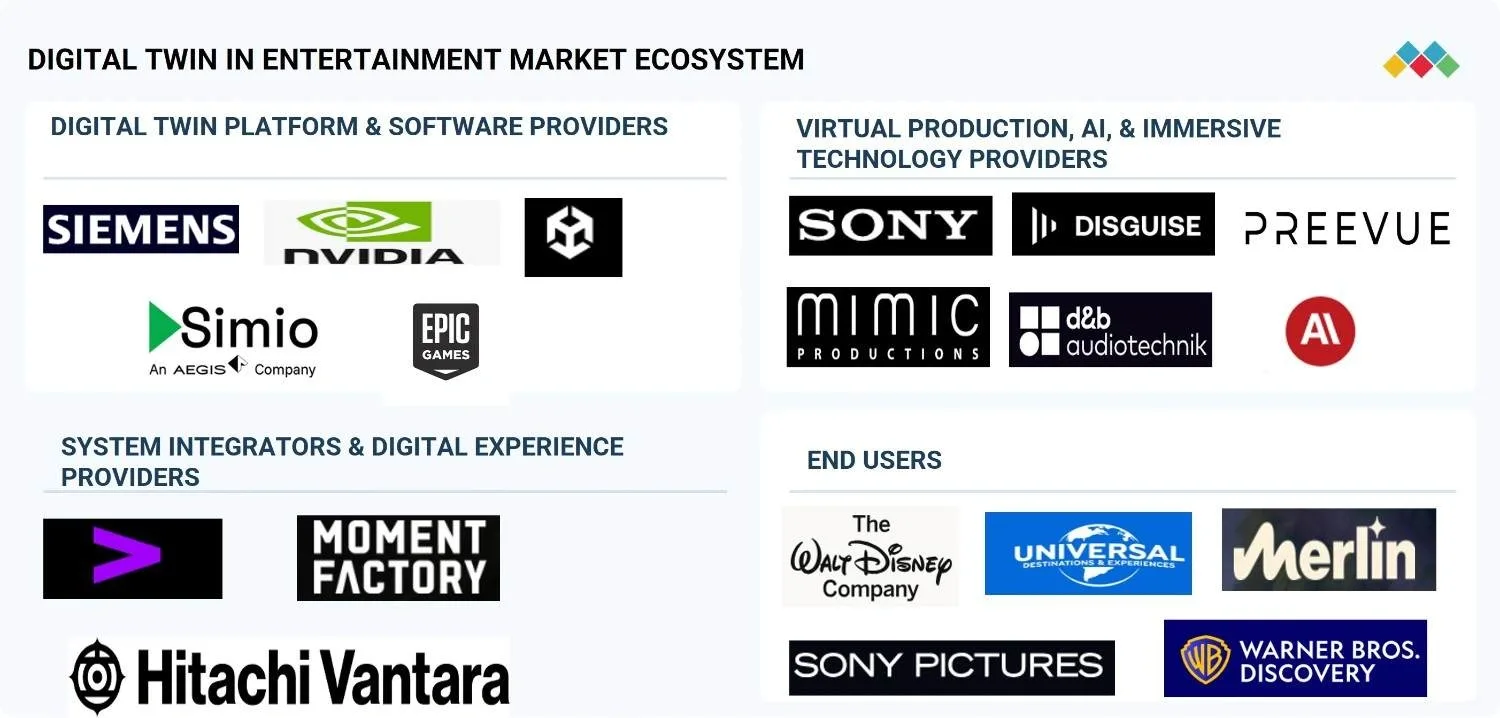
Logos and trademarks shown above are the property of their respective owners. Their use here is for informational and illustrative purposes only.
MARKET SEGMENTS

Source: Secondary Research, Interviews with Experts, MarketsandMarkets Analysis
Digital Twin in Entertainment Market, by Offering
Software is projected to register the highest CAGR during the forecast period, driven by increasing adoption of AI-powered digital twin platforms, real-time simulation, virtual production, and cloud-based collaboration solutions. Growing demand for immersive content creation, digital asset management, predictive analytics, and interactive 3D visualization is accelerating software deployment across the entertainment industry.
Digital Twin in Entertainment Market, by Application
Film & TV production is expected to account for the largest market share during the forecast period due to the rapid adoption of virtual production, LED volume stages, and real-time digital twin environments. Increasing investments in high-quality content creation, in-camera visual effects, and collaborative production workflows are driving widespread adoption of digital twin technologies across film and television production.
REGION
Asia Pacific to exhibit fastest growth in global digital twin in entertainment market during forecast period
Asia Pacific is expected to register the highest CAGR in the digital twin in entertainment market growth during the forecast period, supported by the rapid expansion of virtual production studios, increasing adoption of immersive entertainment technologies, and rising investments in AI-powered digital twin platforms across China, India, Japan, South Korea, Australia, and Southeast Asia. Growing digitalization of the media and entertainment industry, expanding gaming ecosystems, and increasing demand for real-time content creation are accelerating the adoption of digital twin solutions across the region. Additionally, strong investments by film studios, gaming companies, theme park operators, and technology providers are further driving the deployment of digital twin platforms for virtual production, interactive entertainment, and smart venue management.

DIGITAL TWIN IN ENTERTAINMENT MARKET: COMPANY EVALUATION MATRIX
Unity Technologies and Epic Games are positioned as Stars, supported by their industry-leading real-time 3D engines, extensive adoption across virtual production, gaming, and immersive entertainment, and continuous investments in AI, digital twin platforms, and real-time simulation technologies. NVIDIA Corporation is one of the Emerging Leaders due to its rapidly expanding Omniverse platform, OpenUSD ecosystem, and increasing adoption of AI-powered digital twin workflows for virtual production and immersive content creation. Other technology providers, including Siemens, Disguise, Preevue, Simio, Moment Factory, Sony Group Corporation, and Hitachi Vantara LLC, are primarily positioned as Pervasive Players and Participants, driven by their specialized digital twin software, virtual production capabilities, immersive visualization technologies, and domain-specific solutions for film production, live events, theme parks, stadiums, and location-based entertainment.

Source: Secondary Research, Interviews with Experts, MarketsandMarkets Analysis
KEY MARKET PLAYERS
- Unity Technologies (US)
- Epic Games (US)
- NVIDIA Corporation (US)
- Siemens (Germany)
- Disguise Group (England)
- Sony Group Corporation (Japan)
- Hitachi Vantara LLC (US)
- MP Mimic Productions GmbH (Germany)
- Simio (US)
- Preevue (UK)
WHAT IS IN IT FOR YOU: DIGITAL TWIN IN ENTERTAINMENT MARKET REPORT CONTENT GUIDE

DELIVERED CUSTOMIZATIONS
We have successfully delivered the following deep-dive customizations:
| CLIENT REQUEST | CUSTOMIZATION DELIVERED | VALUE ADDS |
|---|---|---|
| Film & Television Studio |
|
|
| Gaming & Interactive Entertainment Company |
|
|
| Theme Park & Location-Based Entertainment (LBE) Operator |
|
|
| Digital Twin Platform / Software Vendor |
|
|
| System Integrator / Digital Transformation Provider |
|
|
RECENT DEVELOPMENTS
- June 2026 : NVIDIA Corporation launched the ACE Game Agent SDK in beta, a lightweight C/C++ agentic framework that lets developers build in-game AI companions and autonomous non-player characters running on RTX GPUs, building on NVIDIA's digital-human technology stack (speech, animation, and reasoning). The SDK ships with a ready-to-use small language model for low-latency, on-device inference, extending NVIDIA's ACE digital-human platform from cloud microservices into a developer-accessible toolkit for games. The release reinforces NVIDIA's push to embed persistent, AI-driven digital characters into mainstream entertainment titles.
- June 2026 : Disguise Group unveiled the integration of its Mapping Matter projection-mapping tool into Disguise Cloud, letting live-event, attraction, and brand-experience teams plan and previsualize entire installations within a 3D digital twin of the actual venue before setup day. Announced ahead of InfoComm 2026, the update lets designers iterate on projector placement, luminance, and pixel density collaboratively from a web browser, extending to live entertainment the same previsualization workflow that transformed film and TV virtual production. Disguise says its tools already underpin large-scale shows for Cirque du Soleil and Moment Factory.
- April 2026 : Sony Group Corporation launched its XYN Spatial Capture Solution, a suite of software and hardware that converts real-world spaces into production-quality 3DCG assets for virtual production in film, drama, and commercial shoots. The system includes an AR-guided capture app, a cloud-based rendering engine, and a Spatial Renderer Plugin compatible with Unreal Engine and media servers including Disguise, letting productions swap real locations onto LED volumes with realistic reflections and HDR fidelity. General availability for US professional customers is set for summer 2026, with Sony flagging future expansion into gaming, animation, and digital-twin applications.
- February 2026 : Epic Games acquired Meshcapade, a German AI company spun out of the Max Planck Institute, that converts ordinary video footage into high-fidelity 3D motion and body-shape data for building digital humans. The Meshcapade team is joining Epic's AI Research group to strengthen MetaHuman and Unreal Engine, giving creators in gaming, film, and virtual production faster, more accessible tools for generating realistic digital-human doubles without traditional motion-capture rigs. The deal deepens Epic's digital-twin-of-a-human capability at the core of its entertainment tooling stack.
- February 2026 : Siemens introduced Digital Twin Composer, an AI-enabled platform built on NVIDIA Omniverse for creating photorealistic digital twins and immersive 3D environments, strengthening simulation capabilities for media, entertainment, and virtual production workflows.
Table of Contents
 Exclusive indicates content/data unique to MarketsandMarkets and not available with any competitors.
Methodology
This research study involved four major activities in estimating the size of the digital twin in entertainment market. Exhaustive secondary research was conducted to collect critical information regarding the market and its related segments. The findings, assumptions, and market estimates were validated through extensive primary research with industry experts across the entertainment, media, gaming, virtual production, digital content creation, software, cloud computing, AI, and digital twin technology value chain. Both top-down and bottom-up approaches were employed to estimate the overall market size. Subsequently, market breakdown and data triangulation techniques were applied to estimate the market size of various segments and sub-segments, ensuring accurate and reliable market forecasts.
Secondary Research
In the secondary research process, various secondary sources were referred to for identifying and collecting information required for this study. The secondary sources included annual reports, investor presentations, press releases, company websites, white papers, industry journals, technical publications, conference proceedings, and articles from recognized authors and industry associations. Secondary research was primarily conducted to obtain key information on the market's value chain, competitive landscape, digital twin platform providers, virtual production technology vendors, gaming engine developers, AI and cloud solution providers, system integrators, immersive entertainment companies, and location-based entertainment operators. It also helped identify market segmentation, technology adoption trends, regional developments, investment activities, strategic partnerships, product innovations, and regulatory developments from both market and technology perspectives.
In the digital twin in entertainment market report, the global market size has been estimated using both the top-down and bottom-up approaches, along with several other dependent submarkets. The major players in the market were identified using extensive secondary research, and their presence in the market was determined using secondary and primary research. All the percentage shares, splits, and breakdowns were determined using secondary sources and verified through primary sources.
Primary Research
Extensive primary research was conducted after understanding the digital twin in entertainment market scenario through secondary research. Several primary interviews were conducted with key opinion leaders from both demand- and supply-side vendors across four major regions—Asia Pacific, North America, Europe, and the Rest of the World. Approximately 25% of the primary interviews were conducted with the demand-side vendors and 70% with the supply-side vendors.
After successful interaction with industry experts, brief sessions were conducted with highly experienced independent consultants to reinforce the findings of our primary research. This, along with the in-house subject matter experts’ opinions, led to the findings as described in the report. The breakdown of primary respondents is as follows:

To know about the assumptions considered for the study, download the pdf brochure
Market Size Estimation
In the market engineering process, both top-down and bottom-up approaches, along with data triangulation methods, were used to estimate and validate the size of the digital twin in entertainment market and its dependent submarkets. The research methodology used to estimate the market sizes includes the following:
- Identifying top-line investments and spending across virtual production, gaming, film & television, live entertainment, theme parks, and immersive entertainment ecosystems, while considering segment-level splits and major market developments
- Identifying different stakeholders in the digital twin in entertainment market, including technology providers, software vendors, game engine developers, system integrators, content creators, entertainment studios, venue operators, and cloud service providers across the value chain
- Analyzing major companies in the entertainment digital twin ecosystem by studying their product portfolios, digital twin platforms, virtual production capabilities, AI integration, strategic partnerships, and R&D investments
- Assessing the adoption and deployment of digital twin technologies across film & TV production, gaming, theme parks, live events, broadcasting, virtual influencers, and location-based entertainment globally
- Evaluating the adoption of core technologies, including real-time 3D engines, AI, cloud computing, IoT, spatial computing, digital humans, and simulation platforms, across entertainment applications
- Estimating the market share and value contribution of software, hardware, and services, along with major application segments and deployment models
- Assessing technology spending and revenue contribution across content creation, virtual production, venue operations, immersive experiences, and interactive entertainment
- Aggregating revenues generated by digital twin software platforms, professional services, implementation services, and supporting technologies to estimate the overall global market size
- Segmenting the overall market into various categories, including component, application, and region
- Analyzing regional- and country-level market trends and validating adoption patterns across major entertainment markets worldwide
- Tracking recent and upcoming market developments, including product launches, partnerships, acquisitions, investments, technological advancements, and strategic collaborations, and incorporating their impact into market forecasts
- Conducting multiple discussions with industry executives, technology providers, entertainment studios, gaming companies, virtual production experts, and digital twin solution vendors to understand technology adoption trends and future market developments
- Validating the market estimates at every level through discussions with CXOs, directors, product managers, technology specialists, production executives, system integrators, and domain experts, followed by final validation by the MarketsandMarkets research team

Data Triangulation
After arriving at the overall market size using the market size estimation processes as explained above, the digital twin in entertainment market was split into several segments and subsegments. To complete the entire market engineering process and arrive at accurate market statistics for each segment and subsegment, data triangulation and market breakdown procedures were employed wherever applicable. The data was triangulated by analyzing various demand- and supply-side factors influencing the digital twin in entertainment market, including technology adoption across entertainment applications, immersive experiences, product innovations, strategic partnerships, deployment trends, and regional adoption patterns. This approach ensures consistent and reliable market estimates across all segments and regions.
Market Definition
The digital twin in entertainment market comprises software, hardware, and services that enable the creation, simulation, visualization, and management of dynamic digital replicas of physical assets, environments, productions, and experiences across the entertainment industry. These digital twin solutions support applications including film and television production, gaming & esports, live events & concerts, theme parks & attractions, virtual influencers, and digital humans by enabling real-time collaboration, predictive analytics, operational optimization, and immersive audience engagement. The market encompasses digital twin platforms based on various components, deployment models, technologies, applications, and end-user segments. Growing adoption of virtual production, AI, real-time 3D engines, cloud computing, spatial computing, IoT, and extended reality (XR) is driving demand for scalable, intelligent, and interactive digital twin solutions across the global entertainment ecosystem.
Key Stakeholders
- Digital Twin Platform Providers
- Real-time 3D Engine & Game Engine Developers
- AI, Cloud Computing, & Spatial Computing Solution Providers
- Virtual Production Technology Providers
- Digital Content Creation & VFX Studios
- System Integrators & Digital Transformation Service Providers
- Film & Television Production Studios
- Gaming & Interactive Entertainment Companies
- Theme Park & Location-based Entertainment (LBE) Operators
- Live Event, Broadcast, & Venue Management Companies
- Digital Human & Virtual Influencer Technology Providers
- XR (AR/VR/MR) Hardware & Software Providers
- IoT, Sensor, & Reality Capture Solution Providers
- Distributors, Technology Partners, & Channel Partners
- Government & Regulatory Organizations
Report Objectives
- To describe, segment, and forecast the size of the digital twin in entertainment market, by offering, application, and region, in terms of value (USD million/billion).
- To forecast the market by offering, in terms of value.
- To forecast the size of various market segments across North America, Europe, Asia Pacific, and the Rest of the World (RoW) in terms of value.
- To provide detailed information on the drivers, restraints, opportunities, and challenges influencing the growth of the market.
- To provide a comprehensive overview of the market value chain and ecosystem.
- To strategically analyze the micro-markets with respect to individual growth trends, prospects, and their contribution to the overall market.
- To study industry trends, technological advancements, AI integration, spatial computing, regulatory landscape, investment activities, and evolving customer preferences, along with the macroeconomic outlook.
- To identify and analyze high-growth opportunities for stakeholders across different market segments and regional markets.
- To benchmark the key market participants and analyze their market position based on product portfolio, business strategy, digital twin capabilities, partnerships, and competitive strengths.
- To analyze competitive developments, including product launches, partnerships, mergers & acquisitions, collaborations, investments, technology innovations, and expansion strategies undertaken by companies operating in the digital twin in entertainment market.
Available customizations:
With the given market data, MarketsandMarkets offers customizations according to the specific requirements of companies. The following customization options are available for the report:
- Detailed analysis and profiling of additional market players (up to 5)
Key Questions Addressed by the Report
What is the projected size of the Digital Twin in Entertainment Market by 2032?
The Digital Twin in Entertainment Market is projected to grow from USD 492.4 million in 2026 to USD 2,533.2 million by 2032.
What is the expected CAGR of the Digital Twin in Entertainment Market?
The market is expected to register a CAGR of 31.4% during the forecast period (2026–2032).
What is driving the growth of the Digital Twin in Entertainment Market?
Growth is driven by the adoption of virtual production, AI-powered digital twins, real-time 3D engines, LED volume stages, cloud collaboration, and immersive content creation.
Which application segment holds the largest market share?
Film & TV Production is expected to account for the largest share due to increasing adoption of virtual production technologies.
Which offering segment is expected to grow the fastest?
The Software segment is projected to register the highest CAGR of 33.0% during the forecast period.
Which region is expected to dominate the Digital Twin in Entertainment Market?
North America is expected to hold the largest market share due to strong investments in AI, virtual production, and advanced entertainment technologies.
Who are the major companies operating in the Digital Twin in Entertainment Market?
Key companies include Epic Games, Unity Technologies, NVIDIA, Sony Group Corporation, Siemens, Hitachi Vantara, Accenture, Preevue, Disguise Group, Moment Factory, Simio.
Which industries are adopting digital twin technology in entertainment?
Major adopting industries include film & TV production, gaming & esports, live events, theme parks, and virtual entertainment platforms.
What are the major technology trends shaping the market?
Key trends include AI integration, real-time rendering, cloud-based collaboration, immersive 3D visualization, digital humans, and virtual production ecosystems.
What does the MarketsandMarkets report cover?
The report provides detailed analysis by offering, application, region, market size, forecast (2026–2032), competitive landscape, growth drivers, opportunities, challenges, and company profiles.


Personalize This Research
- Triangulate with your Own Data
- Get Data as per your Format and Definition
- Gain a Deeper Dive on a Specific Application, Geography, Customer or Competitor
- Any level of Personalization
Let Us Help You
- What are the Known and Unknown Adjacencies Impacting the Digital Twin in Entertainment Market
- What will your New Revenue Sources be?
- Who will be your Top Customer; what will make them switch?
- Defend your Market Share or Win Competitors
- Get a Scorecard for Target Partners

Custom Market Research Services
We Will Customise The Research For You, In Case The Report Listed Above Does Not Meet With Your Requirements
Get 10% Free CustomisationTESTIMONIALS

Tetsuya Ohhira
Business Development Manager-Technology Business
Nikon Corporation,
Leading Japanese MNC specializing in optics and imaging productswww.nikon.com
MarketsandMarkets™ response
is quick. Their attitude is flexible and positive. Analyst Insights are globally considered and
significant. Client Services quickly respond to our inquiry and demand. Their wide range of global
surveys help us make our strategic plan.
We hope Knowledge Store will be easier to search
for a report.
VP - Marketing & Business Development
Leading Provider of Process Control Solutions
We engaged with MarketsandMarkets on a study to perform an analysis and recommend a Go-To-Market strategy for metrology and process control in the semiconductor market. The study was tailored to our targets and needs with well-defined milestones. Our overall experience with the MarketsandMarkets team was very good throughout the project in all aspects including the analysis methodologies used, the quality and depth of primary and secondary data sets, the professionalism and flexibility of the team and the ability to meet the target schedule and milestones. We want to thank MarketsandMarkets team for a job well done.






Growth opportunities and latent adjacency in Digital Twin in Entertainment Market