Electrical & Electronics Composites Market

Electrical & Electronics Composites Market by Fiber Type (Glass Fiber Composites, Carbon Fiber Composites, Natural Fiber Composites), Resin Type (Thermoset Composites, Thermoplastic Composites), Manufacturing Process (Lay-up, Compression Molding, Injection Molding, RTM, Filament Winding, Pultrusion), and Region- Global Forecast to 2030




OVERVIEW
Source: Secondary Research, Interviews with Experts, MarketsandMarkets Analysis
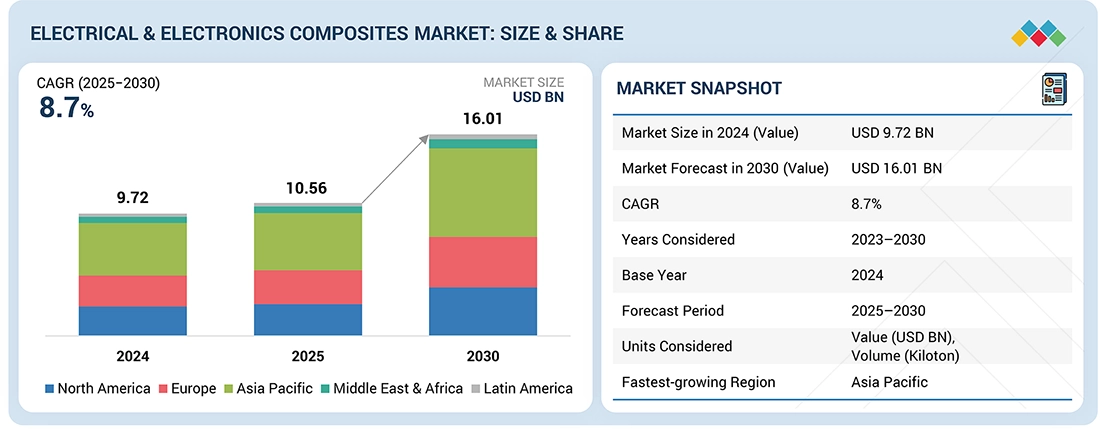
The electrical & electronics composites market is projected to reach USD 16.01 billion by 2030 from USD 10.56 billion in 2025, at a CAGR of 8.7%. The market is expected to show steady growth attributed to growing demand for electrification and grid expansion for high-performance insulation and durable, lightweight components. The rise of electric vehicles, the increase in renewable energy transmission and distribution, including composite insulators and HVDC/extra-high-voltage equipment, and the rapid development of data centers and smart grid infrastructure are the main factors driving volume and innovation.
KEY TAKEAWAYS
-
By RegionThe Asia Pacific region accounted for 42.9% share of the global electrical & electronics market, in terms of value, in 2024.
-
By Fiber TypeBy fiber type, the glass fiber segment dominated the market bu accounting 68.7% market share, in terms of value.
-
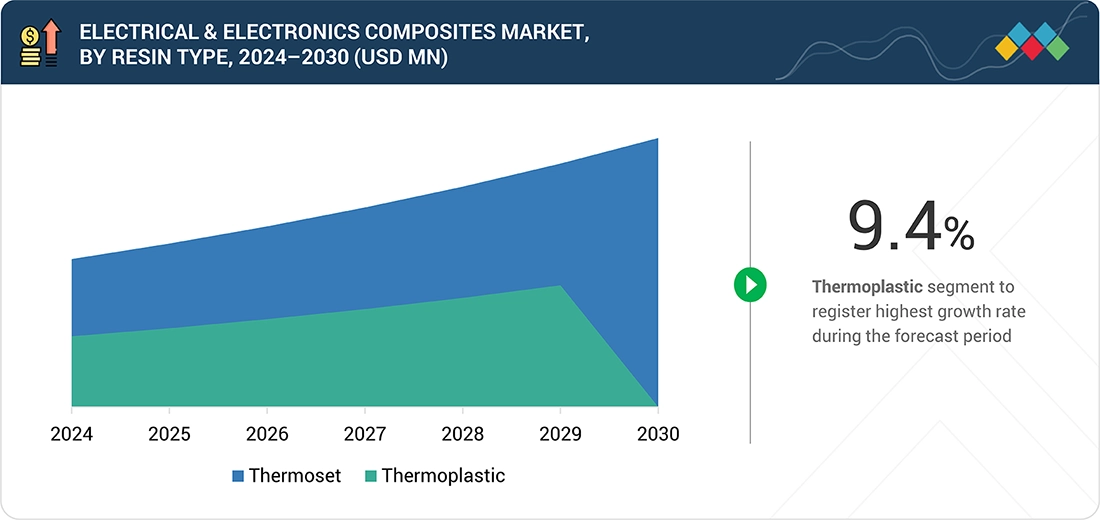
By Resin TypeBy resin Type, the thermoplastic segment is expected to register the highest CAGR during forecast period.
-
By Manufacturing ProcessBy manufacturing process, the layup process is expected to dominate the overall market.
-
Competitive Landscape - Key PlayersToray Industries, Inc., Teijin Limited, Mitsubishi Chemical Carbon Fiber & Composites, Hexcel Corporation, and SGL Carbon SE are identified as some of the star players in the electrical & electronics composites market, given their strong market share and product footprint.
-
Competitive Landscape - StartupsCompaniesAtomic-6, Antefil Composite Tech AG, RRTC, Inc., and Nove Carbon, among others, have distinguished themselves among startups and SMEs by securing strong footholds in specialized niche areas, underscoring their potential as market leaders.
The electrical & electronics composites market is becoming essential in the global move toward electrification. These materials combine high mechanical strength with excellent electrical insulation, heat resistance, and lightweight features. These composites are used in transformers, switchgear, motors, generators, busbars, insulators, and EV components. They allow for safer, more efficient, and compact electrical systems. As industries shift to higher voltages, smarter grids, renewable energy integration, and electric mobility, the need for reliable, high-performance composite materials keeps increasing.
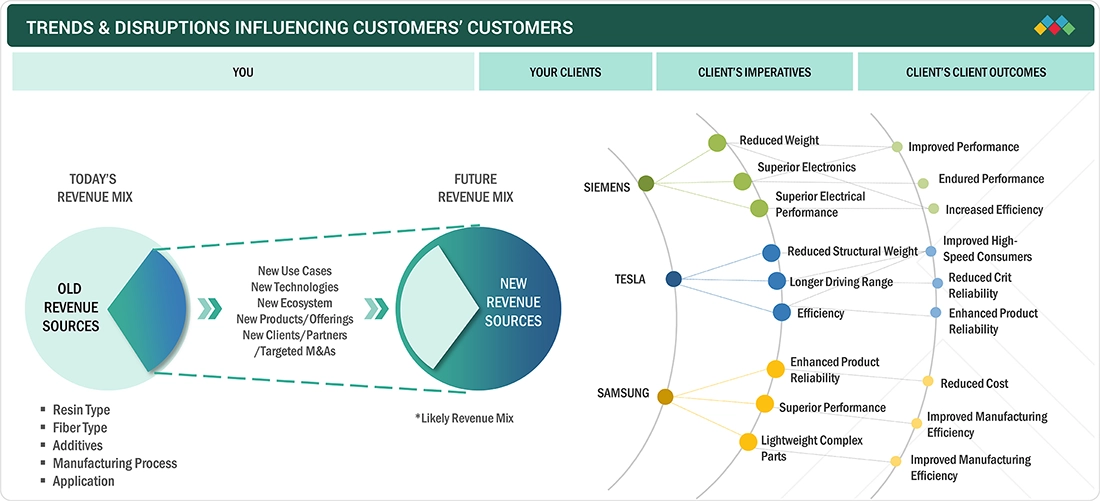
TRENDS & DISRUPTIONS IMPACTING CUSTOMERS' CUSTOMERS
Changes in customer trends or disruptions impact consumers’ businesses. These shifts impact the revenues of end users. Consequently, the revenue impact on end users is expected to affect the revenues of composite suppliers, which in turn, impacts the revenues of electrical & electronics composites manufacturers.
Source: Secondary Research, Interviews with Experts, MarketsandMarkets Analysis
MARKET DYNAMICS

Level
-
Rising electrification & grid modernization

-
Growth of EVs and electrical equipment


Level
-
High material & processing cost

-
Limited standardization


Level
-
Shift toward polymer-based insulators

-
Sustainability & recyclable composites


Level
-
Supply chain volatility

-
Technical and skilled workforce gap

Source: Secondary Research, Interviews with Experts, MarketsandMarkets Analysis
Driver: Rising electrification & grid modernization
One of the major growth contributors for electrical & electronics composites is the global trend towards extensive electrification and transmission network modernization. The growing requirement for various components with high mechanical strength, superior electrical insulation, and resilience to environmental stressors is growing as utilities upgrade ageing grids, extend HV/EHV lines, and add renewable energy sources like solar and wind. Therefore, they are a preferable choice for the future smart grid grids. The significant spending on grid reliability and energy efficiency is becoming the main factors leading to market growth.
Restraint: High material & processing cost
Despite the growing demand, the use of electrical composites is limited by the relatively high cost of resins, fibers, and production technologies. These materials often need precise manufacturing methods like pultrusion, resin infusion, or high-temperature molding. These methods increase the total production cost compared to metal or ceramic options. In many developing areas and cost-sensitive applications, this price difference slows down large-scale replacement. As a result, manufacturers and end users must balance performance benefits with budget limits, making cost a major barrier to wider market entry.
Opportunity: Shift toward polymer-based insulators
The gradual substitution of porcelain and metal parts with polymer-based composite insulators and busbars is a major opportunity for players in the market. These composites are lighter and resist moisture, pollution, and corrosion better, and are easier to install. Utilities and industrial companies are progressively realizing the advantages these materials in terms of operation and lifecycle in difficult environment or in a remote area where the cost of maintenance is high. This transition is opening up a tremendous amount of long-term growth potential for the suppliers of composite materials in the different segments of power distribution and the industrial sectors.
Challenge: Supply chain volatility
The availability of materials needed for electrical composites, particularly epoxy resins, polyester resins, and high-performance fibers, has been the most significant challenge for the electrical composites market. The situation of the petrochemical market and geopolitical events can have a significant impact on the production costs and delivery times. Moreover, a few specialty resins and reinforcements have significant lead times and require particular sourcing plans, which makes supply chain management indispensable for manufacturers. Due to this unforeseen situation, production scheduling becomes a challenge.
ELECTRICAL & ELECTRONICS COMPOSITES MARKET: COMMERCIAL USE CASES ACROSS INDUSTRIES
| COMPANY | USE CASE DESCRIPTION | BENEFITS |
|---|---|---|
 |
Uses electrical composites in switchgear, transformers, and high-voltage insulation systems for enhanced safety and performance | Superior electrical insulation, reduced equipment weight, improved thermal resistance, extended operational reliability |
 |
Integrates composite materials in high-voltage bushings, HVDC components, and grid modernization equipment | Better dielectric properties, corrosion resistance, longer service life, improved efficiency in power transmission |
 |
Applies composite components in circuit breakers, control panels, and smart-grid protection devices | Higher durability, compact design enabling space savings, enhanced arc-resistance, improved operational safety |
 |
Employs composite structures in generators, motors, and high-temperature electrical housings | High heat tolerance, vibration resistance, improved mechanical stability, reduced maintenance cost |
 |
Utilizes polymeric composite insulators and composite bushings in transmission and distribution networks | Lightweight for easier installation, greater pollution resistance, higher reliability in harsh climates |
Logos and trademarks shown above are the property of their respective owners. Their use here is for informational and illustrative purposes only.
MARKET ECOSYSTEM
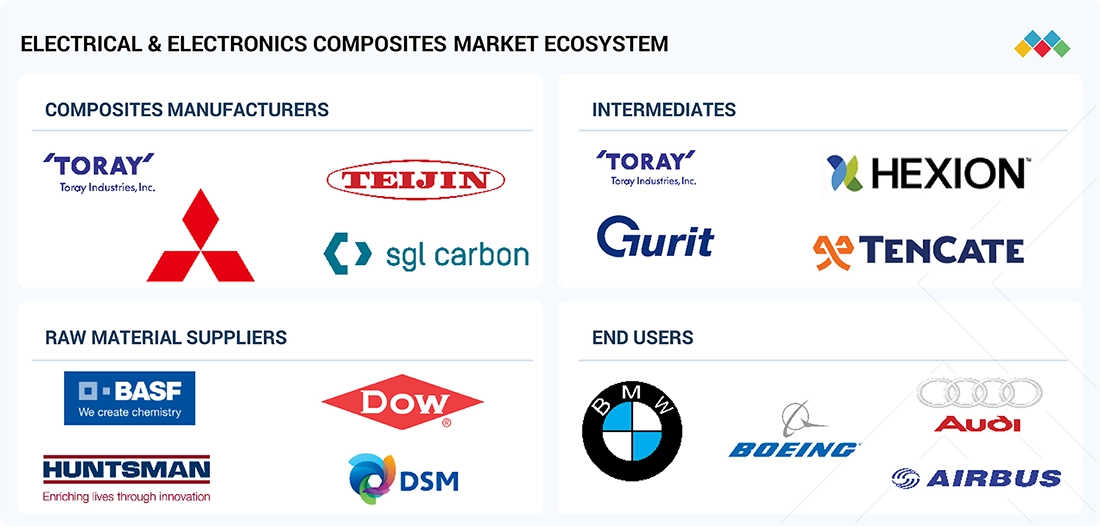
The electrical & electronics composites ecosystem analysis involves identifying and analyzing interconnected relationships among various stakeholders, including raw material suppliers, manufacturers, distributors, and end users. The raw material suppliers provide polymers, such as polyacrylonitrile, to electrical composites manufacturers. The distributors and suppliers establish contact between the manufacturing companies and end users to streamline the supply chain, increasing operational efficiency and profitability.
Logos and trademarks shown above are the property of their respective owners. Their use here is for informational and illustrative purposes only.
MARKET SEGMENTS
Source: Secondary Research, Interviews with Experts, MarketsandMarkets Analysis
Electrical & Electronics Composites Market, By Fiber Type
Glass?????? fiber dominates the electrical & electronics composites market as it is a good performance-cost versatile product for a wide range of electrical applications. Its outstanding electrical insulation properties, high dielectric strength, and resistance to heat and chemicals make it the most attractive reinforcement material. A comparative study with carbon and aramid fibers reveals that glass fiber is much cheaper and at the same time, it can still provide high mechanical strength and thermal stability. Therefore, it is ideal for large-scale production of power distribution and industrial electrical ??????systems.
Electrical & Electronics Composites Market, By Resin Type
At?????? present, thermoset resins are the main contributors to the growth of the electrical & electronics composites market. They provide the most favorable combination of electrical insulation, thermal stability, and mechanical strength to electrically conductive components. Among the thermosets, epoxy, polyester, and phenolic are preferred mainly due to their outstanding dielectric properties, high-temperature resistance, dimensional stability and the ability to endure both electrical and mechanical stresses for a prolonged period without decomposing. As a result, these characteristics have made thermoset-based composites the norm in the industry for transformers, switchgear, insulators, bushings, motor parts, printed circuit boards, and structural electrical ??????housings.
Electrical & Electronics Composites Market, By Manufacturing Process
The?????? layup manufacturing process accounts for a major share to the electrical & electronics composites market. This process offers a cheap and adaptable solution with the capability of producing all kinds of electrical components with complex shapes as well as accurate insulation requirements. Manufacturers can produce large, customized parts such as transformer housings, electrical enclosures, insulation panels, cable trays, and switchgear structures without the need for expensive tooling by using either hand lay-up or spray lay-up methods. The method is capable of using a wide range of reinforcement materials, with glass fiber being the most preferred. It is compatible with thermoset resins.
Electrical & Electronics Composites Market, By Region
The?????? Asia Pacific region is the major contributor to the electrical & electronics composites market. This is due to the rapid industrial growth of the region, the large-scale power infrastructure expansion, and the strong manufacturing base for electrical equipment. Grid modernization, renewable energy integration, electric vehicle production, and high-voltage transmission systems are the areas where countries like China, India, Japan, and South Korea are investing heavily. Asia Pacific has major composite material producers and cost-effective manufacturing facilities that allow high-volume production at competitive prices.
REGION
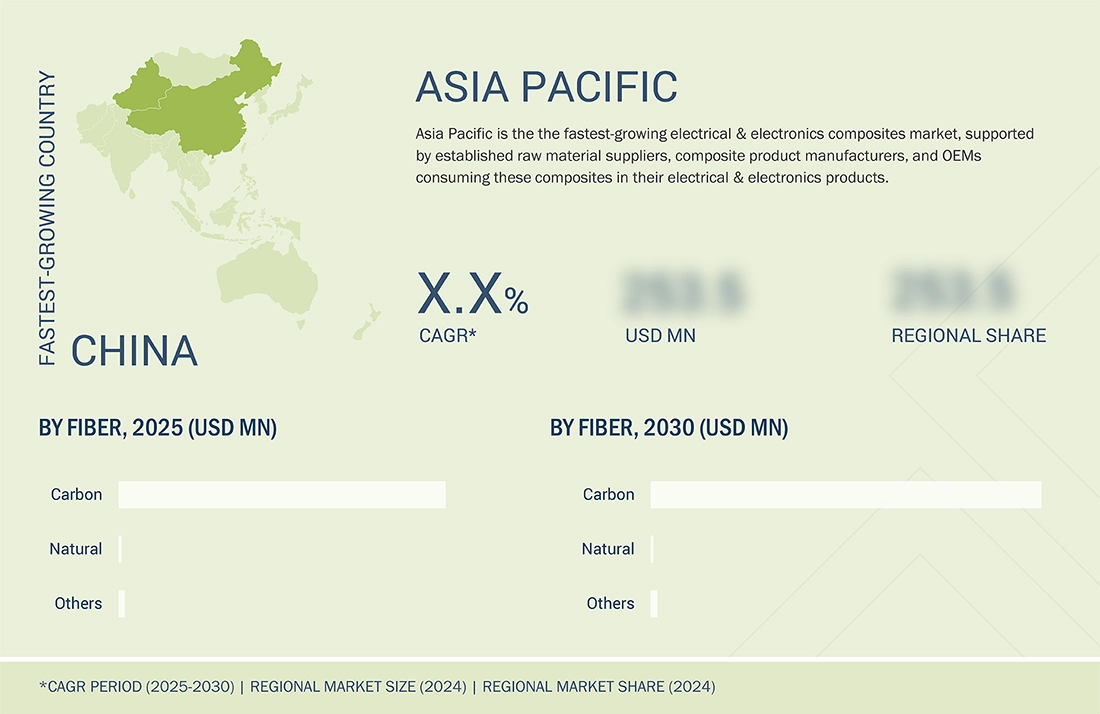
Asia Pacific to be fastest-growing region in global electrical & electronics composites market during forecast period
Asia?????? Pacific is projected to witness a substantial increase in the electrical & electronics composites market by value. The growth in this region is due to the factors such as a significant rise in investment for power infrastructure, fast urbanization, and the strong commitment of the region to electrification and renewable energy. China and India are undertaking comprehensive grid modernization programs, extending high-voltage transmission, and setting up renewable energy systems. These steps necessitate the use of advanced composites in electrical components for insulators, bushings, switchgear, and transformers. Moreover, the rapidly growing electric vehicle (EV) production industry in China, Japan, and South Korea is pushing up the need for lightweight and thermally stable composite materials that can be used in motors, battery housings, and power ??????electronics.
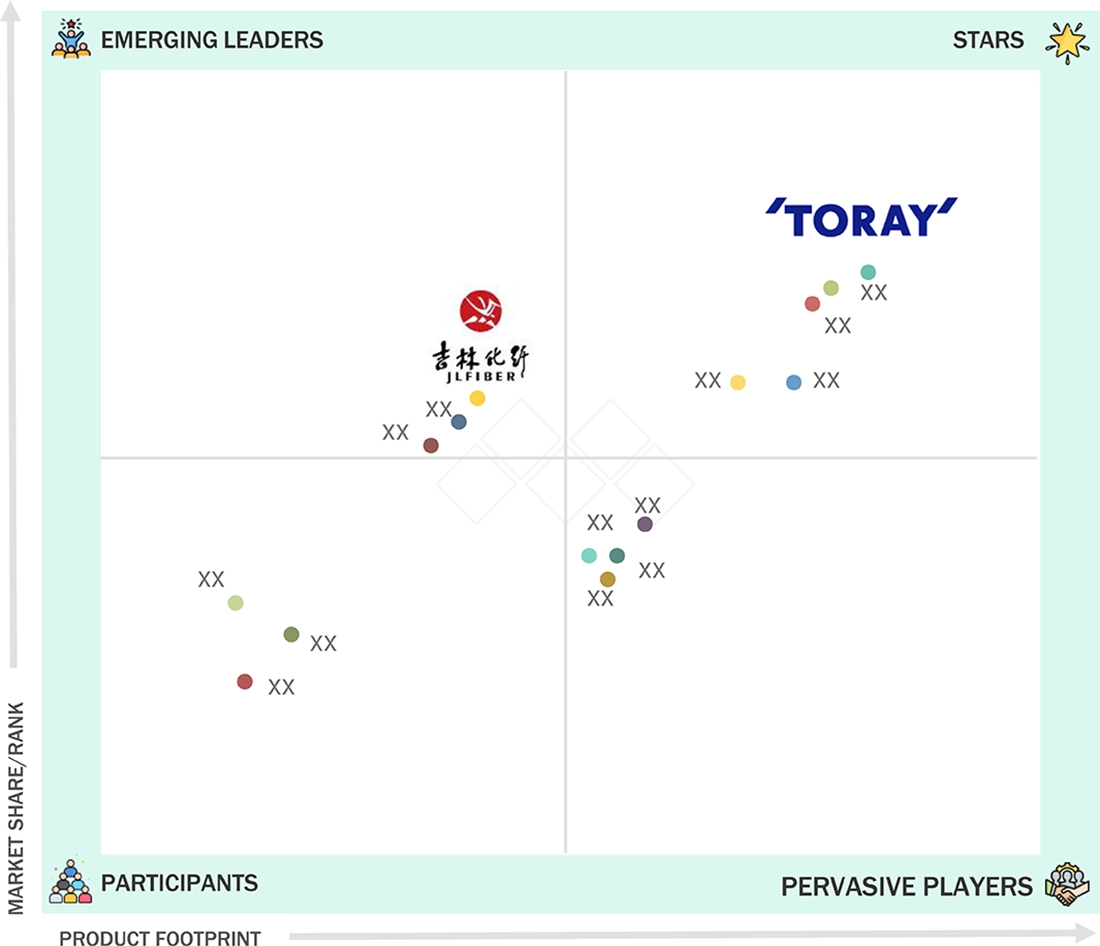
ELECTRICAL & ELECTRONICS COMPOSITES MARKET: COMPANY EVALUATION MATRIX
In the electrical & electronics composites market matrix, Toray Industries, Inc. (Japan) leads due to its robust market share and expansive product range, leveraging its established global presence and consistently strong record in delivering advanced materials across multiple applications. Jilin Chemical Fiber Group Co., Ltd. (Emerging Leader) is increasingly gaining market momentum through strategic regional initiatives and innovative product developments.
Source: Secondary Research, Interviews with Experts, MarketsandMarkets Analysis
KEY MARKET PLAYERS
- Toray Industries, Inc. (Japan)
- Mitsubishi Chemical Holdings Corporation (Japan)
- Teijin Limited (Japan)
- Nippon Electric Glass Co., Ltd. (Japan)
- SGL Carbon (Germany)
- Gurit Holding AG (Switzerland)
- China Jushi Co., Ltd. (China)
- Taishan Fiberglass Inc. (China)
- Chongqing Polycomp International Corp. (China)
- Owens Corning (US)
- Solvay S.A. (Belgium)
- Huntsman International LLC (US)
- Weyerhaeuser (US)
MARKET SCOPE
| REPORT METRIC | DETAILS |
|---|---|
| Market Size in 2024 (Value) | USD 9.72 Billion |
| Market Forecast in 2030 (value) | USD 16.01 Billion |
| Growth Rate | CAGR of 8.7 from 2025-2030 |
| Years Considered | 2022-2030 |
| Base Year | 2024 |
| Forecast Period | 2025-2030 |
| Units Considered | Value (USD Billion), Volume (Kiloton) |
| Report Coverage | Revenue forecast, company ranking, competitive landscape, growth factors, and trends |
| Segments Covered | By Fiber Type: Glass Fiber Composites, Carbon Fiber Composites, Natural Fiber Composites I By Resin Type: Thermoset Composites, Thermoplastic Composites I By Manufacturing Process: Layup, Filament Winding, Injection Molding, Pultrusion, Compression Molding, RTM |
| Regions Covered | North America, Asia Pacific, Europe, Latin America, Middle East & Africa |
WHAT IS IN IT FOR YOU: ELECTRICAL & ELECTRONICS COMPOSITES MARKET REPORT CONTENT GUIDE
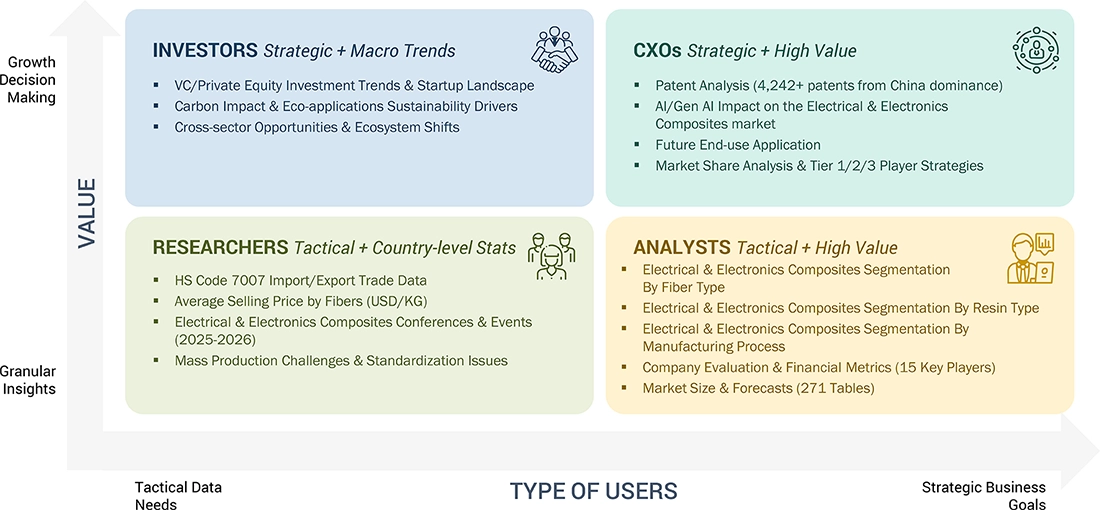
DELIVERED CUSTOMIZATIONS
We have successfully delivered the following deep-dive customizations:
| CLIENT REQUEST | CUSTOMIZATION DELIVERED | VALUE ADDS |
|---|---|---|
| Raw Material Suppliers (Epoxy resins, polyimides, ceramic-filled composites, glass fiber, carbon fiber, conductive fillers, prepregs) |
|
|
| Electronic Component Manufacturers (PCBs, semiconductor packages, connectors, sensors, power electronics housings) |
|
|
| OEMs in Consumer Electronics, Telecom, Automotive Electronics, Industrial Electronics |
|
|
| Distributors & Converters (PCB laminates, thermal substrates, insulating films, composite sheets, prepregs) |
|
|
RECENT DEVELOPMENTS
- October 2022 : Toray Advanced Composites strengthened its commercial partnership with Specialty Materials. This partnership enables engineers to easily control and manage key variables for unique solution innovations using high-quality domestically produced products in the US supply chain.
- September 2022 : Solvay S. A. partnered with 3Trees, a Chinese building materials manufacturer, to develop building-integrated photovoltaic (BIPV) thermoplastic polyolefin roofing membranes.
- January 2022 : Toray Industries, Inc. developed a new analysis technology for multi-material structures that include both UD tape (unidirectional continuous fiber-reinforced tape) and injection molding materials. Toray will likely use the technology to expand the use of its materials in urban air mobility, electric vehicles, other advanced mobility fields, and traditional industrial sectors.
Table of Contents
 Exclusive indicates content/data unique to MarketsandMarkets and not available with any competitors.
Methodology
The study involved two major activities in estimating the current size of the Electrical & Electronics Composites market. Exhaustive secondary research was done to collect information on the market, the peer market, and the parent market. The next step was to validate these findings, assumptions, and sizing with industry experts across the value chain through primary research. Both the top-down and bottom-up approaches were employed to estimate the total market size. After that, market breakdown and data triangulation procedures were used to determine the extent of market segments and sub-segments.
Secondary Research
Secondary sources referred to for this research study include financial statements of companies offering Electrical & Electronics Composites and information from various trade, business, and professional associations. Secondary research has been used to obtain critical information about the industry’s value chain, the total pool of key players, market classification, and segmentation according to industry trends to the bottom-most level and regional markets. The secondary data was collected and analyzed to arrive at the overall size of the Electrical & Electronics Composites market, which was validated by primary respondents.
Primary Research
Extensive primary research was conducted after obtaining information regarding the Electrical & Electronics Composites market scenario through secondary research. Several primary interviews were conducted with market experts from both the demand and supply sides across major countries of North America, Europe, Asia Pacific, the Middle East & Africa, and Latin America. Primary data was collected through questionnaires, emails, and telephonic interviews. The primary sources from the supply side included various industry experts, such as Chief X Officers (CXOs), Vice Presidents (VPs), Directors from business development, marketing, product development/innovation teams, and related key executives from Electrical & Electronics Composites industry vendors; system integrators; component providers; distributors; and key opinion leaders. Primary interviews were conducted to gather insights such as market statistics, data on revenue collected from the products and services, market breakdowns, market size estimations, market forecasting, and data triangulation. Primary research also helped in understanding the various trends related to technology, application, vertical, and region. Stakeholders from the demand side, such as CIOs, CTOs, CSOs, and installation teams of the customer/end users who are using the Electrical & Electronics Composites, were interviewed to understand the buyer’s perspective on the suppliers, products, component providers, and their current usage of Electrical & Electronics Composites and future outlook of their business which will affect the overall market.
To know about the assumptions considered for the study, download the pdf brochure
Market Size Estimation:
The research methodology used to estimate the size of the Electrical & Electronics Composites market includes the following details. The market sizing of the market was undertaken from the demand side. The market was upsized based on procurements and modernizations of Electrical & Electronics Composites in different applications at a regional level. Such procurements provide information on the demand aspects of the Electrical & Electronics Composites industry for each application. For each application, all possible segments of the Electrical & Electronics Composites market were integrated and mapped.
Data Triangulation
After arriving at the overall Electrical & Electronics Composites market size using the market size estimation processes as explained above, the market was split into several segments and sub-segments. To complete the whole market engineering process and arrive at the exact statistics of each market segment and subsegment, the data triangulation, and market breakdown procedures were employed, wherever applicable. The data was triangulated by studying various factors and trends from both the demand and supply sides, mainly from the automotive & transportation, wind energy, aerospace & defense, construction & infrastructure end-use industries. Along with this, the market size was validated using both the top-down and bottom-up approaches.
Market Definition
Electrical & Electronics Composites are materials that are created by combining two or more different constituents with different physical or chemical qualities to produce a new material with improved properties. These components usually consist of a matrix material (such as a polymer, metal, or ceramic) embedded with a reinforcement material (such as fibers or particles). The matrix material keeps the reinforcement in place and shields it from the elements, while the reinforcement material gives strength, stiffness, and other mechanical qualities. Electrical & Electronics Composites have many benefits, such as a high strength-to-weight ratio, resistance to corrosion, durability, and flexibility in design, which makes them ideal for a variety of uses in a wide range of industries, including renewable energy, aerospace, automotive, and construction.
Key Stakeholders
- Electrical & Electronics Composites manufacturers and distributors
- Key application segments for Electrical & Electronics Composites
- Research and consulting firms
- R&D institutions
- Associations and government institutions
- Environmental support agencies
Report Objectives
- To analyze and forecast the size of the Electrical & Electronics Composites market, in terms of value and volume
- To provide detailed information about the key factors (drivers, restraints, opportunities, and challenges) influencing the growth of the market
- To analyze and forecast the market based on resin type, fiber type, manufacturing process, and end-use industry
- To analyze and project the market based on five regions, namely, Europe, North America, Asia Pacific (APAC), the Middle East & Africa (MEA), and Latin America
- To strategically analyze the micro markets concerning individual growth trends, prospects, and their contribution to the overall market
- To analyze the opportunities in the market for stakeholders and provide a competitive landscape for market leaders
- To strategically profile the key players and comprehensively analyze their market shares and core competencies
Available Customizations
With the given market data, MarketsandMarkets offers customizations according to the specific needs of the companies with the given market data.
The following customization options are available for the report:
Product Analysis
- Product matrix, which gives a detailed comparison of the product portfolio of each company
Regional Analysis
- Further breakdown of Rest of Asia Pacific Electrical & Electronics Composites market
- Further breakdown of Rest of Europe Electrical & Electronics Composites market
- Further breakdown of Rest of Middle East & Africa Electrical & Electronics Composites market
- Further breakdown of Rest of Latin American composites market
Company Information
- Detailed analysis and profiling of additional market players (up to 10)


Personalize This Research
- Triangulate with your Own Data
- Get Data as per your Format and Definition
- Gain a Deeper Dive on a Specific Application, Geography, Customer or Competitor
- Any level of Personalization
Let Us Help You
- What are the Known and Unknown Adjacencies Impacting the Electrical & Electronics Composites Market
- What will your New Revenue Sources be?
- Who will be your Top Customer; what will make them switch?
- Defend your Market Share or Win Competitors
- Get a Scorecard for Target Partners

Custom Market Research Services
We Will Customise The Research For You, In Case The Report Listed Above Does Not Meet With Your Requirements
Get 10% Free CustomisationTESTIMONIALS

We at Nissan Chemicals Corporation have been clients of MarketsandMarkets for more than a year now. We recently consulted MarketsandMarkets for a study, the team at MarketsandMarkets was extremely professional and organized. The business insights were very detailed and aligned well with our expectations that really helped us formulate the Business Plans and device new strategies for development themes. MarketsandMarkets offers a unique combination of expertise and dedicated engagement model. Their research findings have helped us in designing our Pricing Strategy which will make it easier for us to predict the future sales and profits for the next ten years. We look forward to working with MarketsandMarkets in the future.
VP of Strategy & New Business Development
Leading Specialty Chemical Company
The MarketsandMarkets Engagement Model, composed of both the Knowledge Store and advisory custom research, has greatly helped us in understanding our markets and making strategic decisions. The Knowledge Store is a fast way to allow everyone in our organization to understand more about most any market they are interested in. The ability to then get custom research done and get answers to specific strategic questions and market insight has been spectacular. The Markets and Markets team feel more like colleagues than vendors and their services have helped us change our culture where statements of things like growth opportunities and competitive position are always backed by industry research.

Rich Gibson,
Director, Corporate Strategy
Milliken & Company,
Leading Industrial Manufacturer of specialty chemical, floor covering, performance and protective textile materials, and healthcaremilliken.com
MarketsandMarkets is a trusted resource that helps us to better understand markets that are near-adjacencies-whether its technology, value chain or geography. Their Knowledge Store platform provides a dashboard of markets and their characteristics which is easy to use and saves us time.
Adam Shaw,
Market Development and Strategy Manager
AdvanSix Inc. USA,
An American Leader in Chemicalswww.advansix.com
The Knowledge Store from MarketsandMarkets is a valuable tool which has helped my team acquire greater insight in to the end markets that our business serves. This has enabled us to help our company build stronger strategies throughout our planning process.
TOSHIO KINOSHITA
Senior Chif Consultion Research & Consulting Division
Mitsubishi Chemical Research Corporation,
Leading Manufacturer of Chemical Productswww.mitsubishichem-res.co.jp/en/

We recently engaged with MarketsandMarkets for a study, the team not only clearly understood our business objectives but was also extremely professional in the way they handled the entire project. The study was efficiently conducted in a phase-wise manner, and the engagement model furnished us with high-quality business insights that far exceeded our expectations at each phase. We were especially happy that MarketsandMarkets could provide us with both, an English as well as a Japanese version of the study. A special thanks to the Analyst Team and Client Services Team, whose fluency in Japanese enhanced our comfort level, as we could converse with them in our preferred language.
Independent entrepreneurs
Arrow Precision
We approached MarketsandMarkets for study on Proppants Market, and their work exceeded our expectations. The study conducted was comprehensive and enabled us to view the market through the various dimensions. In addition, the team was extraordinarily responsive throughout the process and resolved our queries on time. I strongly recommend MarketsandMarkets and will certainly consider them for additional market assessments we will need in the future.
Global engineering company, Japan
Deputy Manager,
Strategic Planning OfficeThe high-quality insights shared by the MarketsandMarkets team helped us understand the pharmaceutical plant designers in a specific geography. It also captured the risks that we may likely face in communicating with our potential partners. The study would enable us identify partners, which would impact our future growth.






Growth opportunities and latent adjacency in Electrical & Electronics Composites Market