Electro-Oxidation Market

Report Code CH 9449
Published in Jul, 2025, By MarketsandMarkets™
Download PDF

Choose License Type

Buy Report Now Inquire Before Buying

Electro-Oxidation Market by Type (Direct Electro-Oxidation, Indirect Electro-Oxidation), Electrode Material (Boron-Doped Diamond (BBD), Lead Dioxide (pbo2), Stannic Oxide (sno2), Titanium Suboxides (tino2n-1), Graphite, and Platinum), Application (Organic & Micropollutant Treatment, Inorganic Treatment, Disinfection & Specialized Treatment), End-Use Industry (Municipal Water & Wastewater, Industrial Manufacturing, Textile, Food & Beverage, Mining, Other End-Use Industries) & Region - Forecast to 2030

Overview

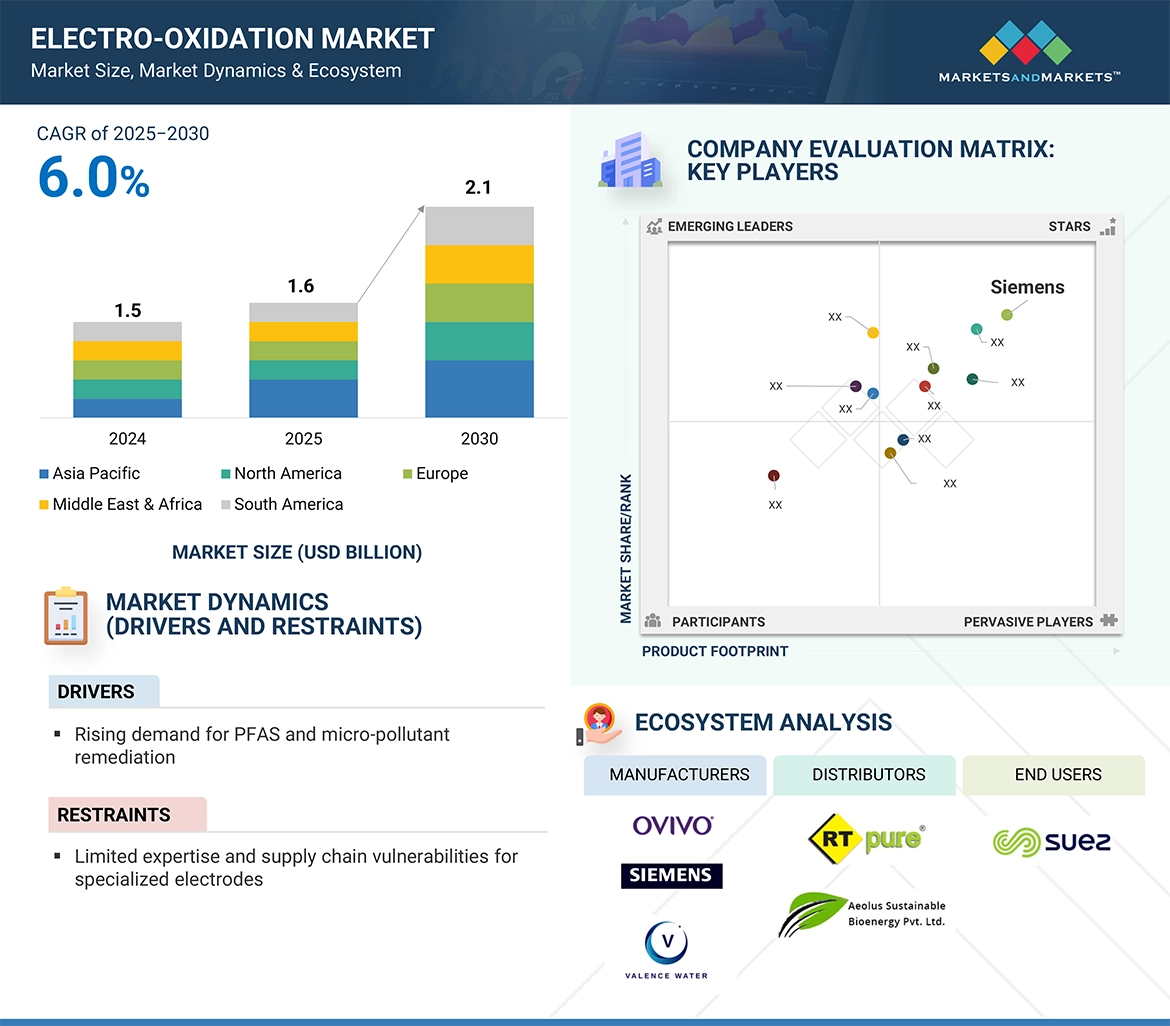
The electro-oxidation market size is projected to grow from USD 1.6 billion in 2025 to USD 2.1 billion by 2030, registering a CAGR of 6.0% during the forecast period. The demand for electro-oxidations is increasing in the region as solar energy projects expand rapidly, fueled by abundant sunlight, supportive government policies, and the need for energy diversification. Countries in the region are backing large-scale solar farms and urban solar solutions to meet electricity needs and sustainability targets. The harsh climate conditions also create a need for durable encapsulation materials, ensuring long-lasting performance in construction. Films are commonly used for ground-mounted applications and building-integrated photovoltaics, helping to expand solar infrastructure across new environments.

Electro-Oxidation Market

Attractive Opportunities in the Electro-Oxidation Market

Asia Pacific

The Asia Pacific market is experiencing growth due to rapid electro-oxidation adoption in chemicals, pharmaceuticals, and mining industries.

Governments worldwide are enforcing stricter wastewater discharge standards. Electro-oxidation provides compliance through non-selective oxidation and complete mineralization.

The Asia Pacific electro-oxidation market is set to grow as countries increasingly focus on strengthening water security and addressing long-term environmental sustainability through advanced wastewater treatment solutions.

The electro-oxidation market is expected to be USD 2.1 billion by 2030, at a CAGR of 6.0%, during the forecast period.

Performance concerns of electro-oxidation in regions with climate variability can pose challenges.

Global Electro-Oxidation Market Dynamics

DRIVER: Rising Demand for PFAs and Micro-Pollutant Remediation

A key driver of the growth in the electro-oxidation market is the rising global demand for effective treatment of PFAS (per- and polyfluoroalkyl substances) and trace organic contaminants. These chemicals, used in firefighting foam, waterproof fabrics, food packaging, and manufacturing processes, are chemically stable—particularly due to the strength of their carbon-fluorine bonds—and are difficult to treat with conventional degradation methods. Likewise, trace pollutants such as pharmaceutical and personal care product residues and pesticide runoff have become serious threats to aquatic life and human health. Traditional treatment technologies like sand filtration, activated sludge, or even granular activated carbon generally do not fully remove these persistent contaminants. Electro-oxidation technology provides a new approach by generating highly reactive oxidative species, such as hydroxyl radicals, which can oxidize these complex pollutants into environmentally harmless end products. Municipal utilities and industrial facilities are rapidly upgrading and modifying their treatment infrastructure in response to tightening regulations on water quality from governments across North America, Europe, and Asia. Public concern over drinking water safety is increasing, alongside growing awareness of "forever chemicals," leading to a higher demand.

RESTRAINT: Limited Expertise and Supply Chain Vulnerabilities for specialized Electrodes.

Key restraints in expanding the electro-oxidation market are the limited technical expertise and fragile supply chains for materials used in manufacturing advanced electrodes. The performance of electro-oxidation systems relies on high-performance electrodes, such as boron-doped diamonds (BDD) or titanium-based oxides, which are designed to withstand harsh and corrosive wastewater conditions while handling high electrical loads. Only a few manufacturers possess the specialized knowledge in electrode manufacturing, surface chemistry, and understanding of electrode durability. Low to moderate technical expertise can complicate manufacturing, installation, integration, and maintenance processes. Incorrect handling or improper installation of electrodes can reduce performance, cause inefficiencies, and lead to downtime. Furthermore, global supply chains for electrode materials—like synthetic diamonds, platinum group metals or compounds, and rare oxides—are weakly distributed, often limited to specific countries or regions. Disruptions caused by political or economic instability, export restrictions, or natural and climate events can lead to delays, higher costs, and access issues, especially for companies in developing areas without local manufacturing capabilities.


OPPORTUNITY: Integration of Renewable Energy Sources to Reduce Operational Costs

Clean energy technologies, including solar and wind power, can significantly enhance the economic and environmental performance of electro-oxidation (EO) systems. It's important to recognize that EO processes depend heavily on electrical input to start oxidation reactions, meaning high electricity consumption is a major operational cost, especially when energy prices fluctuate or are high. By using clean energy sources like solar photovoltaic (PV) panels, EO installations can operate independently of the conventional grid and substantially lower their electricity-related costs. The increased use of renewable energy is especially relevant in regions with abundant sunlight and poor grid connectivity, where standalone solar arrays with battery storage can support decentralized EO units. In such cases, the ability to treat wastewater at an affordable total system cost in remote or rural areas becomes practical, supporting advances in modern off-grid wastewater management. Additionally, using renewable power enables EO systems to align with global climate goals and regulatory standards, helping improve greenhouse gas emissions profiles and supporting broader sustainability and carbon neutrality objectives set by governments and regulators bodies.

CHALLENGES: Partial Oxidation of Ammonia and Lons Requiring Additional Processes.

The inability to fully convert ammonia and various inorganic ions to environmentally safe end-products during treatment often requires downstream remediation. In many instances, electro-oxidation processes are partial oxidation methods that do not completely transform ammonia into nitrogen gas but instead produce intermediates such as nitrites and nitrates. These compounds can remain in the treated effluent and pose greater environmental and human health risks; for example, nitrites are highly toxic to aquatic organisms and may threaten potable water supplies. Similarly, ions like chlorides, sulfates, and phosphates can form unwanted secondary compounds or may not precipitate out of solution. The presence of limiting constituents means that electro-oxidation alone often cannot serve as an effective treatment for certain wastewater profiles, necessitating the integration of additional systems (such as biological denitrification units, ion-exchange systems, or advanced precipitation). Moreover, variability in treatment performance—due to factors like location, treatment pace, chemistries involved, fluctuating ammonia levels, or changing ionic strength—adds uncertainty to predictability and diminishes the overall reliability of the treatment system.

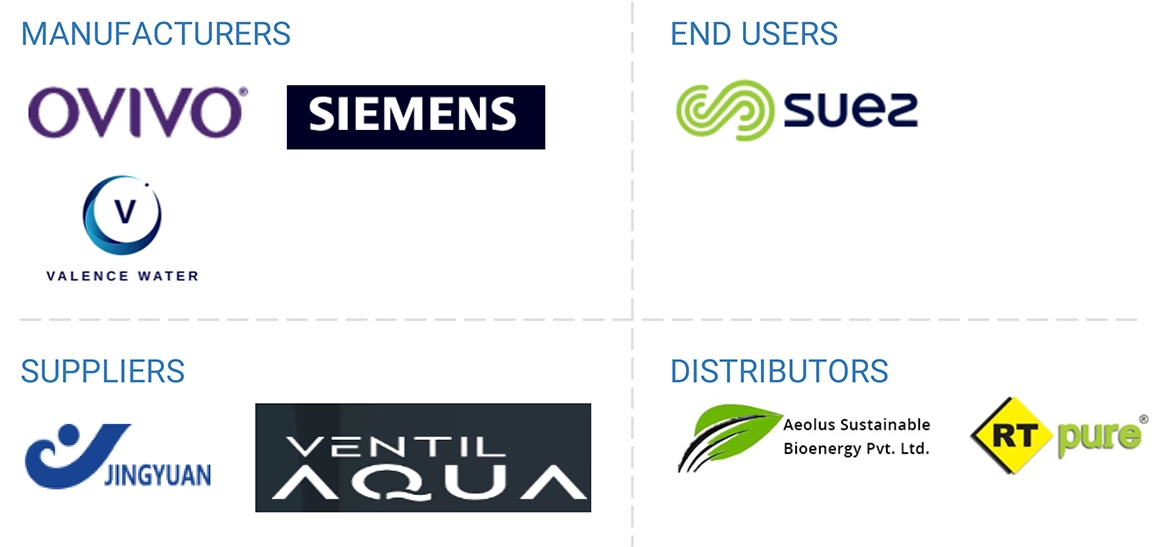
Global Electro-Oxidation Market Ecosystem Analysis

Prominent companies in this market include well-established, financially stable manufacturers of the electro-oxidation sector. The profiled companies have been operating for several years, offering diversified product portfolios and strong global sales and marketing networks. The value of ecosystem analysis in the Electro-Oxidation market lies in its ability to reveal crucial relationships among key stakeholders. It identifies the factors driving technological innovation, regulatory pressures, and market demand. By understanding these relationships, businesses can discover opportunities for innovation, optimize supply chains, and align with market trends to gain a competitive edge advantage.

Electro-Oxidation Market
 

Indirect electro-oxidation is expected to account for the largest market share in the type segment of the electro-oxidation market in terms of value, during the forecast period

The indirect electro-oxidation type is the undisputed leader of the electro-oxidation market, largely because of its superior pollutant degradation efficiencies, adaptability to different industrial wastewater characteristics, and versatility in electro-oxidative reactor configurations and operating parameters. While direct electro-oxidation depends solely on electron transfer at the electrode interface, indirect methods generate strong oxidizing agents such as free chlorine, hypochlorite ions, and peroxodisulfates in the electrolyte solution. These oxidants diffuse throughout the electric flow cell and attack a wide range of resistant organic compounds and pathogens. This technology is especially effective at treating high-COD effluents containing resistant organic compounds, which are common in wastewater from textile dyeing, pharmaceuticals, agrochemicals, petrochemicals, and tanning industries, among others. The advantages of indirect electro-oxidation include its reduced sensitivity to variations in wastewater characteristics, its ability to withstand changes in wastewater content while minimizing electrode passivation and operational downtime, thereby extending system lifespan and lowering overall lifecycle costs. Additionally, the oxidants generated can penetrate the organic pollutant matrix, ultimately oxidizing more organic compounds compared to other oxidation methods, including direct oxidation and even electro-oxidation.

Boron-doped diamond is expected to hold the largest market share in the electrode material segment of the electro-oxidation market in terms of value during the forecast period.

Boron-Doped Diamond (BDD) electrodes are preferred for both industrial and academic electro-oxidation applications because of their exceptional electrochemical properties, which enable the treatment of highly polluted and non-biodegradable wastewater. For example, BDD electrodes feature an ultra-wide anodic potential window, allowing the generation of highly oxidative species (especially hydroxyl radicals) at sufficiently high potentials without causing unwanted side reactions such as oxygen or chlorine evolution. This beneficial property makes BDD effective for oxidizing complex organic contaminants like pharmaceuticals, industrial solvents, phenols, and synthetic dyes. As global demand for treatment technologies with stricter discharge regulations rises—particularly in Europe, Japan, and emerging economies in Asia—the need for BDD electrodes increases for applications such as hospital wastewater, landfill leachate, and high-COD, complex industrial discharges. Results from BDD oxidation are favored because they enable complete mineralization rather than partial oxidation, which is essential in reuse strategies within regulatory-sensitive, sustainability-focused industries and countries. Alongside achieving total mineralization of organic contaminants, BDD electrodes continue to hold a leading position in the field of global electro-oxidation industry.

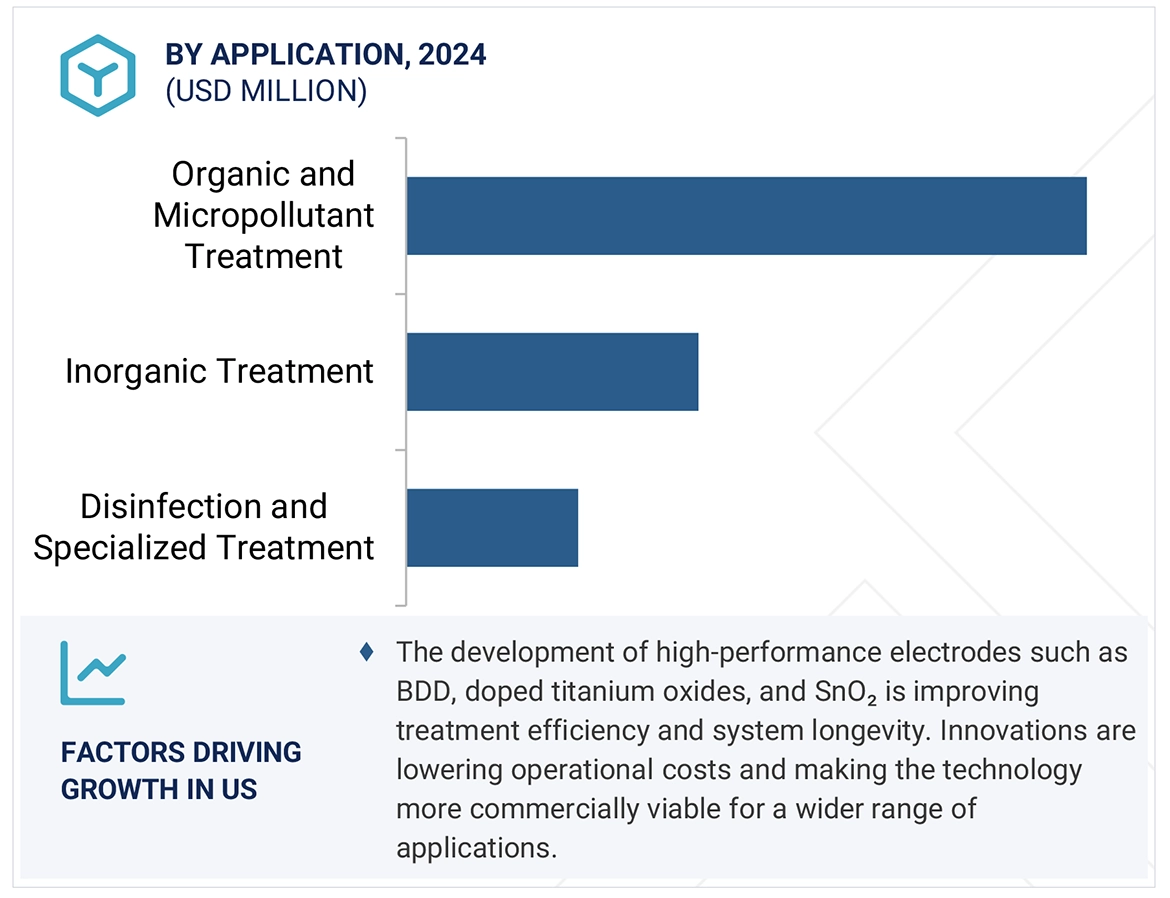
Organic and micropollutant treatment is expected to hold the largest market share in the application segment of the electro-oxidation market by value during the forecast period.

The organic and micropollutants treatment segment dominates the electro-oxidation industry by application because it plays a crucial role in degrading trace-level and highly persistent contaminants found in wastewater streams. Major contaminants include pharmaceutical residues, phenols, pesticides, dyes, and endocrine-disrupting chemicals. These pollutants are more commonly found in industrial and municipal effluents and lack effective treatment methods in traditional biological or chemical processes. Electro-oxidation creates advanced oxidizing species, such as hydroxyl radicals and other reactive oxygen species, which break down stable molecular structures, transforming them into non-toxic substances. As a result, electro-oxidation is especially effective at reducing parameters like COD, TOC, and color—parameters often used as the sole indicators of compliance in industrial discharges. These benefits have proven to be commercially valuable and environmentally significant for treating organic and micropollutants using electro-oxidation.

Municipal water & wastewater to be the largest end-use industry segment during the forecast period.

The electro-oxidation segment within the municipal water and wastewater treatment market holds the largest share, and its growth is driven by rising regulatory and operational demands to better manage micropollutants and contaminants that standard treatments cannot break down. Secondary treatment often fails to remove trace pollutants like pharmaceuticals, organic synthetic compounds, and industrial by-products. Electro-oxidation addresses these issues by producing highly oxidized reactive solutions, or hydroxyl radicals, which break down complex molecules into inert end-products, significantly improving effluent quality. Municipalities are increasingly adopting this technology to meet evolving discharge standards, including those set by the EU Urban Wastewater Treatment Directive and other water safety frameworks in China and India. It is beneficial because discharged water does not require chemical dosing and generates less sludge, easing operational burdens and offering a more sustainable solution. Electro-oxidation systems are also space-efficient and easily retrofitted into existing treatment plants, making them suitable for upgrading aging infrastructure in densely populated areas density.

Asia Pacific to be the largest region during the forecast period

Asia Pacific dominates the electro-oxidation market due to a combination of strict environmental regulations, rapid industrialization, and the rising demand for advanced wastewater treatment technologies. Home to some of the most industrialized countries such as China, India, Japan, and South Korea, Asia Pacific generates large quantities of wastewater from key industries including textiles, pharmaceuticals, petrochemicals, and food processing. Much of the wastewater from these industries is rich in chemical oxygen demand (COD), ammonia, and non-biodegradable organic pollutants, making electro-oxidation an ideal wastewater treatment method because it can remove contaminants that conventional biological treatments cannot handle. Countries in Asia Pacific face severe water stress and contamination issues that have prompted governments to develop and enforce stricter discharge regulations norms.

HIGHEST CAGR MARKET IN 2024
US FASTEST GROWING MARKET IN THE REGION
Electro-Oxidation Market

Recent Developments of Electro-Oxidation Market

  • In May 2023, Lummus acquired Siemens Energy’s Zimpro wet air oxidation, electro-oxidation technology and PACT system, plus the associated intellectual property, lab equipment and associated assets. The technologies will expand Lummus’ portfolio of sustainable and integrated offerings into the treatment of water and wastewater produced in petrochemical and refining facilities.
  • In July 2023, Hydroleap secured USD 4.4 million in Series A funding to expand its electrochemical wastewater treatment solutions across the Asia-Pacific region, with a focus on industrial and palm oil effluent treatment.
  • In February 2024, Ovivo’s strategic acquisition of E2metrix in February 2024, including its innovative and clean electrochemical oxidation technology for onsite PFAS destruction.
  • In November 2024, Veralto Corporation invested approximately USD 15 million to establish a minority interest in Axine, supporting the expansion of Axine’s electrochemical oxidation solutions for industrial wastewater and PFAS destruction.

Key Market Players

KEY PLAYERS IN THE ELECTRO-OXIDATION MARKET INCLUDE

Scope of the Report

Report Metric Details
Market size available for years 2021-2030
Base Year Considered 2024
Forecast period 2025-2030
Forecast units Value (USD Million/Billion)
Segments covered Type, Electrode Material, Application, End-Use Industry, and Region
Geographies covered North America, Europe,  Middle East & Africa, South America

Key Questions Addressed by the Report

Which factors influence the growth of the electro-oxidation market?

With more emphasis on regulatory pressure for zero liquid discharge (ZLD) systems, the electro-oxidation market is growing globally. Stricter effluent discharge norms set by governments and agencies aim to reduce pollutant levels, often near zero. Electro-oxidation supports ZLD by effectively degrading concentrated non-biodegradable compounds and significantly reducing chemical oxygen demand (COD) in treated water.

Which country is expected to have the largest share in the electro-oxidation market?

China controls the largest share of the Asia Pacific electro-oxidation market due to its strict regulations, large industrial output, and significant investments in wastewater treatment. Its textile, chemical, pharmaceutical, and electronics sectors produce complex, non-biodegradable effluents, driving demand for advanced treatment technologies.

Who are the major manufacturers?

Major manufacturers include Aqua Pulsar (USA), Hydroleap (Singapore), Yasa ET (Shanghai) Co., Ltd. (China), OVIVO USA LLC (USA), E-FLOC (USA), Siemens (Germany), Valence Water Inc. (Columbia), PPU Umwelttechnik (Germany), Ground Effects Environmental Services Inc. (Canada), and Jiangsu Jingyuan Environmental Protection Co., Ltd. (China).

What are the opportunities in the electro-oxidation market?

There is a major opportunity in treating non-biodegradable organic compounds and nitrogen-based pollutants. Electro-oxidation is effective where biological systems fail, such as in the removal of persistent pharmaceuticals, pesticides, dyes, ammonia, and nitrates.

Which application has the largest share in the electro-oxidation market?

Organic & micropollutant treatment applications account for the largest market share.

Personalize This Research

  • Triangulate with your Own Data
  • Get Data as per your Format and Definition
  • Gain a Deeper Dive on a Specific Application, Geography, Customer or Competitor
  • Any level of Personalization
Request A Free Customisation

Let Us Help You

  • What are the Known and Unknown Adjacencies Impacting the Electro-Oxidation Market
  • What will your New Revenue Sources be?
  • Who will be your Top Customer; what will make them switch?
  • Defend your Market Share or Win Competitors
  • Get a Scorecard for Target Partners
Customized Workshop Request

Table of Contents

Exclusive indicates content/data unique to MarketsandMarkets and not available with any competitors.

TITLE
PAGE NO
INTRODUCTION
22
RESEARCH METHODOLOGY
26
EXECUTIVE SUMMARY
37
PREMIUM INSIGHTS
41
MARKET OVERVIEW
45
  • 5.1 INTRODUCTION
  • 5.2 MARKET DYNAMICS
    DRIVERS
    - Rising demand for PFAS and micro-pollutant remediation
    - Adoption in decentralized and modular wastewater treatment
    RESTRAINTS
    - Limited expertise and supply chain vulnerabilities for specialized electrodes
    OPPORTUNITIES
    - Integration of renewable energy sources to reduce operational costs
    - Treatment of non-biodegradable organic compounds and nitrogen organisms
    CHALLENGES
    - Partial oxidation of ammonia and ions requiring additional processes
  • 5.3 IMPACT OF GENERATIVE AI ON ELECTRO-OXIDATION MARKET
    INTRODUCTION
    IMPACT ON ELECTRO-OXIDATION MARKET
INDUSTRY TRENDS
52
  • 6.1 INTRODUCTION
  • 6.2 TRENDS/DISRUPTIONS IMPACTING CUSTOMER BUSINESS
  • 6.3 VALUE CHAIN ANALYSIS
    RAW MATERIAL PROCUREMENT
    TECHNOLOGY DEVELOPMENT & R&D
    COMPONENT MANUFACTURING & ASSEMBLY
    SYSTEM INTEGRATION & END-USE CUSTOMIZATION
    DISTRIBUTION, INSTALLATION & AFTER-SALES SERVICE
  • 6.4 IMPACT OF 2025 US TARIFFS–ELECTRO-OXIDATION MARKET
    INTRODUCTION
    KEY TARIFF RATES
    PRICE IMPACT ANALYSIS
    KEY IMPACT ON VARIOUS REGIONS
    - US
    - Europe
    - Asia Pacific
    END-USE INDUSTRY IMPACT
  • 6.5 INDICATIVE PRICING ANALYSIS
    INTRODUCTION
    INDICATIVE PRICING OF ELECTRO-OXIDATION AMONG KEY PLAYERS, BY TYPE, 2021–2024
    INDICATIVE PRICE, BY TYPE, 2021–2024
  • 6.6 INVESTMENT AND FUNDING SCENARIO
  • 6.7 ECOSYSTEM ANALYSIS
  • 6.8 TECHNOLOGY ANALYSIS
    KEY TECHNOLOGIES
    COMPLEMENTARY TECHNOLOGIES
  • 6.9 PATENT ANALYSIS
    METHODOLOGY
    PATENTS GRANTED, 2015−2024
    PATENT PUBLICATION TRENDS
    INSIGHTS
    LEGAL STATUS OF PATENTS
    JURISDICTION ANALYSIS
    TOP APPLICANTS
    LIST OF MAJOR PATENTS
  • 6.10 TRADE ANALYSIS
    EXPORT SCENARIO (HS CODE 842121)
    IMPORT SCENARIO (HS CODE 842121)
  • 6.11 KEY CONFERENCES AND EVENTS, 2025–2026
  • 6.12 TARIFF AND REGULATORY LANDSCAPE
    TARIFF, 2024
    REGULATORY BODIES, GOVERNMENT AGENCIES, AND OTHER ORGANIZATIONS
    REGULATIONS RELATED TO ELECTRO-OXIDATION MARKET
  • 6.13 PORTER’S FIVE FORCES ANALYSIS
    THREAT OF NEW ENTRANTS
    THREAT OF SUBSTITUTES
    BARGAINING POWER OF SUPPLIERS
    BARGAINING POWER OF BUYERS
    INTENSITY OF COMPETITIVE RIVALRY
  • 6.14 KEY STAKEHOLDERS AND BUYING CRITERIA
    KEY STAKEHOLDERS IN BUYING PROCESS
    BUYING CRITERIA
  • 6.15 MACROECONOMIC OUTLOOK
    GDP TRENDS AND FORECASTS, BY COUNTRY
  • 6.16 CASE STUDY ANALYSIS
    APPLICATION OF ELECTRO-OXIDATION TECHNOLOGY FOR EFFECTIVE TREATMENT OF MUNICIPAL LANDFILL LEACHATE
    OX TREATMENT OF MUNICIPAL WASTEWATER FOR DISCHARGE TO WATERSHED
ELECTRO-OXIDATION MARKET, BY ELECTRODE MATERIAL
85
  • 7.1 INTRODUCTION
  • 7.2 BORON-DOPED DIAMOND
    ENABLING HIGH-EFFICIENCY POLLUTANT MINERALIZATION
  • 7.3 LEAD DIOXIDE
    PROVIDING COST-EFFECTIVE OXIDATION OF CONTAMINANTS
  • 7.4 STANNIC OXIDE
    FACILITATING EFFICIENT DEGRADATION WITH STABLE PERFORMANCE
  • 7.5 TITANIUM SUBOXIDE
    DELIVERING CORROSION-RESISTANT OXIDATION SOLUTIONS
  • 7.6 GRAPHITE
    SUPPORTING ECONOMIC ELECTROCHEMICAL TREATMENT
  • 7.7 PLATINUM
    ENHANCING CATALYTIC OXIDATION WITH NOBLE METAL PRECISION
ELECTRO-OXIDATION MARKET, BY TYPE
91
  • 8.1 INTRODUCTION
  • 8.2 DIRECT ELECTRO-OXIDATION
    OXIDIZING POLLUTANTS DIRECTLY AT ANODE
  • 8.3 INDIRECT ELECTRO-OXIDATION
    GENERATING INTERMEDIATE OXIDANTS FOR POLLUTANT DEGRADATION
ELECTRO-OXIDATION MARKET, BY END-USE INDUSTRY
95
  • 9.1 INTRODUCTION
  • 9.2 MUNICIPAL WATER & WASTEWATER
    ENSURING PUBLIC WATER SAFETY AND COMPLIANCE
  • 9.3 INDUSTRIAL MANUFACTURING
    TREATING ORGANIC POLLUTANTS IN INDUSTRIAL WASTEWATER
  • 9.4 TEXTILES
    REMOVING DYES FROM WASTEWATER FOR COMPLIANCE
  • 9.5 FOOD & BEVERAGE
    BALANCING ORGANIC WASTE TREATMENT AND HYGIENE STANDARDS
  • 9.6 MINING
    MITIGATING ENVIRONMENTAL IMPACT OF INORGANIC POLLUTANTS
  • 9.7 OTHERS
    ELECTRONIC & SEMICONDUCTOR
    AQUACULTURE
ELECTRO-OXIDATION MARKET, BY APPLICATION
101
  • 10.1 INTRODUCTION
  • 10.2 ORGANIC & MICROPOLLUTANT TREATMENT SEGMENT
    DEGRADING ORGANIC POLLUTANTS AND EMERGING CONTAMINANTS
  • 10.3 INORGANIC TREATMENT
    REMOVING HEAVY METALS AND INORGANIC CONTAMINANTS
  • 10.4 DISINFECTION & SPECIALIZED TREATMENT
    ENSURING MICROBIAL SAFETY AND ENHANCING WATER QUALITY
ELECTRO-OXIDATION MARKET, BY REGION
105
  • 11.1 INTRODUCTION
  • 11.2 ASIA PACIFIC
    CHINA
    - Stricter industrial effluent control driving electro-oxidation adoption in textile and chemical sectors
    JAPAN
    - Focus on emerging contaminants in electronics and pharmaceutical industries
    INDIA
    - Urban wastewater management driving electro-oxidation adoption in municipal and agricultural sectors
    SOUTH KOREA
    - Water reuse mandates boosting electro-oxidation in semiconductor and municipal sectors
    REST OF ASIA PACIFIC
  • 11.3 NORTH AMERICA
    US
    - PFAS remediation to drive electro-oxidation adoption in municipal and chemical sectors
    CANADA
    - Mining effluent management boosting electro-oxidation in mining and forestry sectors
    MEXICO
    - Industrial water reuse to drive electro-oxidation in manufacturing and textile sectors
  • 11.4 EUROPE
    GERMANY
    - Industrial Compliance Driving Electro-Oxidation adoption in Chemical Sector
    ITALY
    - Water Scarcity Mitigation Driving Electro-oxidation in Agricultural and Aquaculture Sectors
    FRANCE
    - Pharmaceutical Residue Control Boosting Electro-oxidation in Healthcare and Biotech Sectors
    UK
    - Decentralized Demand and Regulatory Shift Fueling Electro-oxidation Uptake
    SPAIN
    - Drought and Industrial Agriculture Demanding Advanced Wastewater Solutions
    REST OF EUROPE
  • 11.5 MIDDLE EAST & AFRICA
    GCC COUNTRIES
    - Saudi Arabia
    - UAE
    - Rest of GCC countries
    SOUTH AFRICA
    - Industrial contamination and urban infrastructure gaps propelling electro-oxidation adoption
    REST OF MIDDLE EAST & AFRICA
  • 11.6 SOUTH AMERICA
    ARGENTINA
    - Aging infrastructure and food processing demand prompt electro-oxidation integration
    BRAZIL
    - Industrial hubs and water scarcity driving electro-oxidation expansion in urban and semi-urban zones
    REST OF SOUTH AMERICA
COMPETITIVE LANDSCAPE
157
  • 12.1 INTRODUCTION
  • 12.2 KEY PLAYER STRATEGIES/RIGHT TO WIN
  • 12.3 MARKET SHARE ANALYSIS, 2024
  • 12.4 REVENUE ANALYSIS
  • 12.5 BRAND/PRODUCT COMPARISON
  • 12.6 COMPANY EVALUATION MATRIX: KEY PLAYERS, 2024
    STARS
    EMERGING LEADERS
    PERVASIVE PLAYERS
    PARTICIPANTS
    COMPANY FOOTPRINT: KEY PLAYERS, 2024
    - Company footprint
    - Region footprint
    - Product type footprint
    - Application footprint
    - End-use industry footprint
  • 12.7 COMPANY EVALUATION MATRIX: STARTUPS/SMES, 2024
    PROGRESSIVE COMPANIES
    RESPONSIVE COMPANIES
    DYNAMIC COMPANIES
    STARTING BLOCKS
    COMPETITIVE BENCHMARKING: STARTUPS/SMES, 2024
    - Detailed list of key startups/SMEs
    - Competitive benchmarking of key startups/SMEs
  • 12.8 COMPANY VALUATION AND FINANCIAL METRICS, 2024
  • 12.9 COMPETITIVE SCENARIO
    DEALS
    OTHER DEVELOPMENTS
COMPANY PROFILES
177
  • 13.1 KEY PLAYERS
    LUMMUS TECHNOLOGY
    - Business overview
    - Products/Solutions/Services offered
    - Recent developments
    - MnM view
    OVIVO USA LLC
    - Business overview
    - Products/Solutions/Services offered
    - Recent developments
    - MnM view
    VALENCE WATER INC
    - Business overview
    - Products/Solutions/Services offered
    - Recent developments
    - MnM view
    HYDROLEAP
    - Business overview
    - Products/Solutions/Services offered
    - Recent developments
    - MnM view
    JIANGSU JINGYUAN ENVIRONMENTAL PROTECTION CO., LTD
    - Business overview
    - Products/Solutions/Services offered
    - MnM view
    GROUND EFFECTS ENVIRONMENTAL SERVICES INC
    - Business overview
    - Products/Solutions/Services offered
    E-FLOC WASTEWATER SOLUTIONS
    - Business overview
    - Products/Solutions/Services offered
    YASA ET (SHANGHAI) CO., LTD.
    - Business overview
    - Products/Solutions/Services offered
    AQUA PULSAR
    - Business overview
    - Products/Solutions/Services offered
    AXINE WATER TECHNOLOGIES
    - Business overview
    - Products/Solutions/Services offered
    - Recent developments
  • 13.2 OTHER PLAYERS
    AEOLUS SUSTAINABLE BIOENERGY PVT. LTD
    MAGNELI MATERIALS
    HUNAN BOROMOND EPT CO. LTD.
    VENTILAQUA
    RT SAFEBALLAST PVT LTD.
    MAGNETO SPECIAL ANODES (SUZHOU) CO., LTD.
    AQUACARE SOLUTION ENVIRO ENGINEERS
    GREEN ECOWATER SYSTEMS
    BLUE EDEN CLEAN TECHNOLOGY
    PPU UMWELTTECHNIK
APPENDIX
209
  • 14.1 DISCUSSION GUIDE
  • 14.2 KNOWLEDGESTORE: MARKETSANDMARKETS’ SUBSCRIPTION PORTAL
  • 14.3 CUSTOMIZATION OPTIONS
  • 14.4 RELATED REPORTS
  • 14.5 AUTHOR DETAILS
LIST OF TABLES
 
  • TABLE 1 INDICATIVE PRICING OF ELECTRO-OXIDATION, BY TYPE, BY KEY PLAYER, 2021–2024 (USD/M³)
  • TABLE 2 INDICATIVE PRICING, BY TYPE, 2021–2024 (USD/M³)
  • TABLE 3 ELECTRO-OXIDATION MARKET: ROLE OF PLAYERS IN ECOSYSTEM
  • TABLE 4 KEY TECHNOLOGIES IN ELECTRO-OXIDATION
  • TABLE 5 COMPLEMENTARY TECHNOLOGIES IN ELECTRO-OXIDATION
  • TABLE 6 ELECTRO-OXIDATION MARKET: TOTAL NUMBER OF PATENTS
  • TABLE 7 ELECTRO-OXIDATION: LIST OF MAJOR PATENT OWNERS, 2015−2024
  • TABLE 8 ELECTRO-OXIDATION: LIST OF MAJOR PATENTS, 2015–2024
  • TABLE 9 EXPORT DATA OF HS CODE 842121–COMPLIANT PRODUCTS, BY COUNTRY, 2021–2024 (USD THOUSAND)
  • TABLE 10 IMPORT DATA OF HS CODE 842121–COMPLIANT PRODUCTS, BY COUNTRY, 2021–2024 (USD THOUSAND)
  • TABLE 11 ELECTRO-OXIDATION MARKET: KEY CONFERENCES AND EVENTS, 2025–2026
  • TABLE 12 TARIFFS RELATED TO ELECTRO-OXIDATION MARKET, 2024
  • TABLE 13 NORTH AMERICA: REGULATORY BODIES, GOVERNMENT AGENCIES, AND OTHER ORGANIZATIONS
  • TABLE 14 EUROPE: REGULATORY BODIES, GOVERNMENT AGENCIES, AND OTHER ORGANIZATIONS
  • TABLE 15 ASIA PACIFIC: REGULATORY BODIES, GOVERNMENT AGENCIES, AND OTHER ORGANIZATIONS
  • TABLE 16 MIDDLE EAST & AFRICA: REGULATORY BODIES, GOVERNMENT AGENCIES, AND OTHER ORGANIZATIONS
  • TABLE 17 SOUTH AMERICA: REGULATORY BODIES, GOVERNMENT AGENCIES, AND OTHER ORGANIZATIONS
  • TABLE 18 REGULATIONS FOR PLAYERS IN ELECTRO-OXIDATION
  • TABLE 19 ELECTRO-OXIDATION MARKET: IMPACT OF FIVE PORTER FORCES
  • TABLE 20 INFLUENCE OF STAKEHOLDERS ON BUYING PROCESS FOR TOP THREE END-USE INDUSTRIES
  • TABLE 21 KEY BUYING CRITERIA FOR TOP THREE END-USE INDUSTRIES
  • TABLE 22 GDP TRENDS AND FORECASTS, BY COUNTRY, 2023–2025 (USD MILLION)
  • TABLE 23 ELECTRO-OXIDATION MARKET, BY ELECTRODE MATERIAL, 2021–2024 (USD MILLION)
  • TABLE 24 ELECTRO OXIDATION MARKET, BY ELECTRODE MATERIAL, 2025–2030 (USD MILLION)
  • TABLE 25 ELECTRO-OXIDATION MARKET, BY TYPE, 2021–2024 (USD MILLION)
  • TABLE 26 ELECTRO OXIDATION MARKET, BY TYPE, 2025–2030 (USD MILLION)
  • TABLE 27 ELECTRO-OXIDATION MARKET, BY END-USE INDUSTRY, 2021–2024 (USD MILLION)
  • TABLE 28 ELECTRO OXIDATION MARKET, BY END-USE INDUSTRY, 2025–2030 (USD MILLION)
  • TABLE 29 ELECTRO-OXIDATION MARKET, BY APPLICATION, 2021–2024 (USD MILLION)
  • TABLE 30 ELECTRO OXIDATION MARKET, BY APPLICATION, 2025–2030 (USD MILLION)
  • TABLE 31 ELECTRO-OXIDATION MARKET, BY REGION, 2021–2024 (USD MILLION)
  • TABLE 32 ELECTRO OXIDATION MARKET, BY REGION, 2025–2030 (USD MILLION)
  • TABLE 33 ASIA PACIFIC: ELECTRO-OXIDATION MARKET, BY COUNTRY, 2021–2024 (USD MILLION)
  • TABLE 34 ASIA PACIFIC: ELECTRO OXIDATION MARKET, BY COUNTRY, 2025–2030 (USD MILLION)
  • TABLE 35 ASIA PACIFIC: MARKET, BY TYPE, 2021–2024 (USD MILLION)
  • TABLE 36 ASIA PACIFIC: MARKET, BY TYPE, 2025–2030 (USD MILLION)
  • TABLE 37 ASIA PACIFIC: MARKET, ELECTRODE MATERIAL, 2021–2024 (USD MILLION)
  • TABLE 38 ASIA PACIFIC: MARKET, BY ELECTRODE MATERIAL, 2025–2030 (USD MILLION)
  • TABLE 39 ASIA PACIFIC: MARKET, BY APPLICATION, 2021–2024 (USD MILLION)
  • TABLE 40 ASIA PACIFIC: MARKET, BY APPLICATION, 2025–2030 (USD MILLION)
  • TABLE 41 ASIA PACIFIC: MARKET, BY END-USE INDUSTRY, 2021–2024 (USD MILLION)
  • TABLE 42 ASIA PACIFIC: MARKET, BY END-USE INDUSTRY, 2025–2030 (USD MILLION)
  • TABLE 43 CHINA: ELECTRO-OXIDATION MARKET, BY END-USE INDUSTRY, 2021–2024 (USD MILLION)
  • TABLE 44 CHINA: ELECTRO OXIDATION MARKET, BY END-USE INDUSTRY, 2025–2030 (USD MILLION)
  • TABLE 45 JAPAN: MARKET, BY END-USE INDUSTRY, 2021–2024 (USD MILLION)
  • TABLE 46 JAPAN: MARKET, BY END-USE INDUSTRY, 2025–2030 (USD MILLION)
  • TABLE 47 INDIA: ELECTRO-OXIDATION MARKET, BY END-USE INDUSTRY, 2021–2024 (USD MILLION)
  • TABLE 48 INDIA: ELECTRO OXIDATION MARKET, BY END-USE INDUSTRY, 2025–2030 (USD MILLION)
  • TABLE 49 SOUTH KOREA: ELECTRO-OXIDATION MARKET, BY END-USE INDUSTRY, 2021–2024 (USD MILLION)
  • TABLE 50 SOUTH KOREA: ELECTRO OXIDATION MARKET, BY END-USE INDUSTRY, 2025–2030 (USD MILLION)
  • TABLE 51 REST OF ASIA PACIFIC: ELECTRO-OXIDATION MARKET, BY END-USE INDUSTRY, 2021–2024 (USD MILLION)
  • TABLE 52 REST OF ASIA PACIFIC: ELECTRO OXIDATION MARKET, BY END-USE INDUSTRY, 2025–2030 (USD MILLION)
  • TABLE 53 NORTH AMERICA: ELECTRO-OXIDATION MARKET, BY COUNTRY, 2021–2024 (USD MILLION)
  • TABLE 54 NORTH AMERICA: MARKET, BY COUNTRY, 2025–2030 (USD MILLION)
  • TABLE 55 NORTH AMERICA: MARKET, BY TYPE, 2021–2024 (USD MILLION)
  • TABLE 56 NORTH AMERICA: ELECTRO OXIDATION MARKET, BY TYPE, 2025–2030 (USD MILLION)
  • TABLE 57 NORTH AMERICA: MARKET, ELECTRODE MATERIAL, 2021–2024 (USD MILLION)
  • TABLE 58 NORTH AMERICA: MARKET, BY ELECTRODE MATERIAL, 2025–2030 (USD MILLION)
  • TABLE 59 NORTH AMERICA: MARKET, BY APPLICATION, 2021–2024 (USD MILLION)
  • TABLE 60 NORTH AMERICA: MARKET, BY APPLICATION, 2025–2030 (USD MILLION)
  • TABLE 61 NORTH AMERICA: MARKET, BY END-USE INDUSTRY, 2021–2024 (USD MILLION)
  • TABLE 62 NORTH AMERICA: MARKET, BY END-USE INDUSTRY, 2025–2030 (USD MILLION)
  • TABLE 63 US: ELECTRO-OXIDATION MARKET, BY END-USE INDUSTRY, 2021–2024 (USD MILLION)
  • TABLE 64 US: ELECTRO OXIDATION MARKET, BY END-USE INDUSTRY, 2025–2030 (USD MILLION)
  • TABLE 65 CANADA: ELECTRO-OXIDATION MARKET, BY END-USE INDUSTRY, 2021–2024 (USD MILLION)
  • TABLE 66 CANADA: ELECTRO OXIDATION MARKET, BY END-USE INDUSTRY, 2025–2030 (USD MILLION)
  • TABLE 67 MEXICO: ELECTRO-OXIDATION MARKET, BY END-USE INDUSTRY, 2021–2024 (USD MILLION)
  • TABLE 68 MEXICO: ELECTRO OXIDATION MARKET, BY END-USE INDUSTRY, 2025–2030 (USD MILLION)
  • TABLE 69 EUROPE: ELECTRO-OXIDATION MARKET, BY COUNTRY, 2021–2024 (USD MILLION)
  • TABLE 70 EUROPE: ELECTRO OXIDATION MARKET, BY COUNTRY, 2025–2030 (USD MILLION)
  • TABLE 71 EUROPE: MARKET, BY TYPE, 2021–2024 (USD MILLION)
  • TABLE 72 EUROPE: MARKET, BY TYPE, 2025–2030 (USD MILLION)
  • TABLE 73 EUROPE: MARKET, ELECTRODE MATERIAL, 2021–2024 (USD MILLION)
  • TABLE 74 EUROPE: MARKET, BY APPLICATION, 2025–2030 (USD MILLION)
  • TABLE 75 EUROPE: MARKET, BY APPLICATION, 2021–2024 (USD MILLION)
  • TABLE 76 EUROPE: MARKET, BY APPLICATION, 2025–2030 (USD MILLION)
  • TABLE 77 EUROPE: MARKET, BY END-USE INDUSTRY, 2021–2024 (USD MILLION)
  • TABLE 78 EUROPE: MARKET, BY END-USE INDUSTRY, 2025–2030 (USD MILLION)
  • TABLE 79 GERMANY: ELECTRO-OXIDATION MARKET, BY END-USE INDUSTRY, 2021–2024 (USD MILLION)
  • TABLE 80 GERMANY: ELECTRO OXIDATION MARKET, BY END-USE INDUSTRY, 2025–2030 (USD MILLION)
  • TABLE 81 ITALY: ELECTRO-OXIDATION MARKET, BY END-USE INDUSTRY, 2021–2024 (USD MILLION)
  • TABLE 82 ITALY: ELECTRO OXIDATION MARKET, BY END-USE INDUSTRY, 2025–2030 (USD MILLION)
  • TABLE 83 FRANCE: ELECTRO-OXIDATION MARKET, BY END-USE INDUSTRY, 2021–2024 (USD MILLION)
  • TABLE 84 FRANCE: ELECTRO OXIDATION MARKET, BY END-USE INDUSTRY, 2025–2030 (USD MILLION)
  • TABLE 85 UK: ELECTRO-OXIDATION MARKET, BY END-USE INDUSTRY, 2021–2024 (USD MILLION)
  • TABLE 86 UK: ELECTRO OXIDATION MARKET, BY END-USE INDUSTRY, 2025–2030 (USD MILLION)
  • TABLE 87 SPAIN: ELECTRO-OXIDATION MARKET, BY END-USE INDUSTRY, 2021–2024 (USD MILLION)
  • TABLE 88 SPAIN: ELECTRO OXIDATION MARKET, BY END-USE INDUSTRY, 2025–2030 (USD MILLION)
  • TABLE 89 REST OF EUROPE: ELECTRO-OXIDATION MARKET, BY END-USE INDUSTRY, 2021–2024 (USD MILLION)
  • TABLE 90 REST OF EUROPE: ELECTRO OXIDATION MARKET, BY END-USE INDUSTRY, 2025–2030 (USD MILLION)
  • TABLE 91 MIDDLE EAST & AFRICA: ELECTRO-OXIDATION MARKET, BY COUNTRY, 2021–2024 (USD MILLION)
  • TABLE 92 MIDDLE EAST & AFRICA: ELECTRO OXIDATION MARKET, BY COUNTRY, 2025–2030 (USD MILLION)
  • TABLE 93 MIDDLE EAST & AFRICA: MARKET, BY TYPE, 2021–2024 (USD MILLION)
  • TABLE 94 MIDDLE EAST & AFRICA: MARKET, BY TYPE, 2025–2030 (USD MILLION)
  • TABLE 95 MIDDLE EAST & AFRICA: MARKET, ELECTRODE MATERIAL, 2021–2024 (USD MILLION)
  • TABLE 96 MIDDLE EAST & AFRICA: MARKET, BY ELECTRODE MATERIAL, 2025–2030 (USD MILLION)
  • TABLE 97 MIDDLE EAST & AFRICA: MARKET, BY APPLICATION, 2021–2024 (USD MILLION)
  • TABLE 98 MIDDLE EAST & AFRICA: MARKET, BY APPLICATION, 2025–2030 (USD MILLION)
  • TABLE 99 MIDDLE EAST & AFRICA: MARKET, BY END-USE INDUSTRY, 2021–2024 (USD MILLION)
  • TABLE 100 MIDDLE EAST & AFRICA: ELECTRO-OXIDATION MARKET, BY END-USE INDUSTRY, 2025–2030 (USD MILLION)
  • TABLE 101 SAUDI ARABIA: ELECTRO-OXIDATION MARKET, BY END-USE INDUSTRY, 2021–2024 (USD MILLION)
  • TABLE 102 SAUDI ARABIA: ELECTRO OXIDATION MARKET, BY END-USE INDUSTRY, 2025–2030 (USD MILLION)
  • TABLE 103 UAE: ELECTRO-OXIDATION MARKET, BY END-USE INDUSTRY, 2021–2024 (USD MILLION)
  • TABLE 104 UAE: ELECTRO OXIDATION MARKET, BY END-USE INDUSTRY, 2025–2030 (USD MILLION)
  • TABLE 105 REST OF GCC COUNTRIES: ELECTRO-OXIDATION MARKET, BY END-USE INDUSTRY, 2021–2024 (USD MILLION)
  • TABLE 106 REST OF GCC COUNTRIES: ELECTRO OXIDATION MARKET, BY END-USE INDUSTRY, 2025–2030 (USD MILLION)
  • TABLE 107 SOUTH AFRICA: ELECTRO-OXIDATION MARKET, BY END-USE INDUSTRY, 2021–2024 (USD MILLION)
  • TABLE 108 SOUTH AFRICA: ELECTRO OXIDATION MARKET, BY END-USE INDUSTRY, 2025–2030 (USD MILLION)
  • TABLE 109 REST OF MIDDLE EAST & AFRICA: ELECTRO-OXIDATION MARKET, BY END-USE INDUSTRY, 2021–2024 (USD MILLION)
  • TABLE 110 REST OF MIDDLE EAST & AFRICA: ELECTRO OXIDATION MARKET, BY END-USE INDUSTRY, 2025–2030 (USD MILLION)
  • TABLE 111 SOUTH AMERICA: ELECTRO-OXIDATION MARKET, BY COUNTRY, 2021–2024 (USD MILLION)
  • TABLE 112 SOUTH AMERICA: ELECTRO OXIDATION MARKET, BY COUNTRY, 2025–2030(USD MILLION)
  • TABLE 113 SOUTH AMERICA: MARKET, BY TYPE, 2021–2024 (USD MILLION)
  • TABLE 114 SOUTH AMERICA: MARKET, BY TYPE, 2025–2030 (USD MILLION)
  • TABLE 115 SOUTH AMERICA: MARKET, ELECTRODE MATERIAL, 2021–2024 (USD MILLION)
  • TABLE 116 SOUTH AMERICA: MARKET, BY ELECTRODE MATERIAL, 2025–2030 (USD MILLION)
  • TABLE 117 SOUTH AMERICA: MARKET, BY APPLICATION, 2021–2024 (USD MILLION)
  • TABLE 118 SOUTH AMERICA: MARKET, BY APPLICATION, 2025–2030 (USD MILLION)
  • TABLE 119 SOUTH AMERICA: MARKET, BY END-USE INDUSTRY, 2021–2024 (USD MILLION)
  • TABLE 120 SOUTH AMERICA: MARKET, BY END-USE INDUSTRY, 2025–2030 (USD MILLION)
  • TABLE 121 ARGENTINA: ELECTRO-OXIDATION MARKET, BY END-USE INDUSTRY, 2021–2024 (USD MILLION)
  • TABLE 122 ARGENTINA: ELECTRO OXIDATION MARKET, BY END-USE INDUSTRY, 2025–2030 (USD MILLION)
  • TABLE 123 BRAZIL: ELECTRO-OXIDATION MARKET, BY END-USE INDUSTRY, 2021–2024 (USD MILLION)
  • TABLE 124 BRAZIL: ELECTRO OXIDATION MARKET, BY END-USE INDUSTRY, 2025–2030 (USD MILLION)
  • TABLE 125 REST OF SOUTH AMERICA: ELECTRO-OXIDATION MARKET, BY END-USE INDUSTRY, 2021–2024 (USD MILLION)
  • TABLE 126 REST OF SOUTH AMERICA: ELECTRO OXIDATION MARKET, BY END-USE INDUSTRY, 2025–2030 (USD MILLION)
  • TABLE 127 ELECTRO-OXIDATION MARKET: OVERVIEW OF STRATEGIES ADOPTED BY KEY PLAYERS, JANUARY 2021–MAY 2025
  • TABLE 128 ELECTRO OXIDATION MARKET: DEGREE OF COMPETITION, 2024
  • TABLE 129 ELECTRO-OXIDATION MARKET: REGION FOOTPRINT
  • TABLE 130 ELECTRO OXIDATION MARKET: TYPE FOOTPRINT
  • TABLE 131 ELECTRO-OXIDATION MARKET: APPLICATION FOOTPRINT
  • TABLE 132 ELECTRO OXIDATION MARKET: END-USE INDUSTRY FOOTPRINT
  • TABLE 133 ELECTRO-OXIDATION MARKET: LIST OF KEY STARTUPS/SMES
  • TABLE 134 ELECTRO OXIDATION MARKET: COMPETITIVE BENCHMARKING OF KEY STARTUPS/SMES (1/2)
  • TABLE 135 ELECTRO-OXIDATION MARKET: COMPETITIVE BENCHMARKING OF KEY STARTUPS/SMES (2/2)
  • TABLE 136 ELECTRO OXIDATION MARKET: DEALS, JANUARY 2021–MAY 2025
  • TABLE 137 ELECTRO-OXIDATION MARKET: OTHERS, JANUARY 2021–MAY 2025
  • TABLE 138 LUMMUS TECHNOLOGY : COMPANY OVERVIEW
  • TABLE 139 LUMMUS TECHNOLOGY: PRODUCTS/SOLUTIONS/SERVICES OFFERED
  • TABLE 140 LUMMUS TECHNOLOGY: DEALS, JANUARY 2020–MARCH 2025
  • TABLE 141 OVIVO USA LLC: COMPANY OVERVIEW
  • TABLE 142 OVIVO USA LLC: PRODUCTS/SOLUTIONS/SERVICES OFFERED
  • TABLE 143 OVIVO USA LLC: DEALS, JANUARY 2020–MARCH 2025
  • TABLE 144 OVIVO USA LLC: OTHER DEVELOPMENTS, JANUARY 2020–MARCH 2025
  • TABLE 145 VALENCE WATER INC: COMPANY OVERVIEW
  • TABLE 146 VALENCE WATER INC: PRODUCTS/SOLUTIONS/SERVICES OFFERED
  • TABLE 147 VALENCE WATER INC: OTHER DEVELOPMENTS, JANUARY 2020–MARCH 2025
  • TABLE 148 HYDROLEAP: COMPANY OVERVIEW
  • TABLE 149 HYDROLEAP: PRODUCTS/SOLUTIONS/SERVICES OFFERED
  • TABLE 150 HYDROLEAP: OTHER DEVELOPMENTS, JANUARY 2020–MARCH 2025
  • TABLE 151 JIANGSU JINGYUAN ENVIRONMENTAL PROTECTION CO., LTD: COMPANY OVERVIEW
  • TABLE 152 JIANGSU JINGYUAN ENVIRONMENTAL PROTECTION CO., LTD: PRODUCT/SOLUTIONS/SERVICES OFFERED
  • TABLE 153 GROUND EFFECTS ENVIRONMENTAL SERVICES INC: COMPANY OVERVIEW
  • TABLE 154 GROUND EFFECTS ENVIRONMENTAL SERVICES INC: PRODUCTS/SOLUTIONS/ SERVICES OFFERED
  • TABLE 155 E-FLOC WASTEWATER SOLUTIONS: COMPANY OVERVIEW
  • TABLE 156 E-FLOC WASTEWATER SOLUTIONS: PRODUCTS/SOLUTIONS/SERVICES OFFERED
  • TABLE 157 YASA ET (SHANGHAI) CO., LTD: COMPANY OVERVIEW
  • TABLE 158 YASA ET (SHANGHAI) CO., LTD: PRODUCTS/SOLUTIONS/SERVICES OFFERED
  • TABLE 159 AQUA PULSAR: COMPANY OVERVIEW
  • TABLE 160 AQUA PULSAR: PRODUCTS/SOLUTIONS/SERVICES OFFERED
  • TABLE 161 AXINE WATER TECHNOLOGIES: COMPANY OVERVIEW
  • TABLE 162 AXINE WATER TECHNOLOGIES: PRODUCTS/SOLUTIONS/SERVICES OFFERED
  • TABLE 163 AXINE WATER TECHNOLOGIES: DEALS, JANUARY 2020–MARCH 2025
  • TABLE 164 AXINE WATER TECHNOLOGIES: OTHER DEVELOPMENTS, JANUARY 2020–MARCH 2025
  • TABLE 165 AEOLUS SUSTAINABLE BIOENERGY PVT. LTD: COMPANY OVERVIEW
  • TABLE 166 MAGNELI MATERIALS: COMPANY OVERVIEW
  • TABLE 167 HUNAN BOROMOND EPT CO. LTD.: COMPANY OVERVIEW
  • TABLE 168 VENTILAQUA: COMPANY OVERVIEW
  • TABLE 169 RT SAFEBALLAST PVT LTD.: COMPANY OVERVIEW
  • TABLE 170 MAGNETO SPECIAL ANODES (SUZHOU) CO., LTD.: COMPANY OVERVIEW
  • TABLE 171 AQUACARE SOLUTION ENVIRO ENGINEERS: COMPANY OVERVIEW
  • TABLE 172 GREEN ECOWATER SYSTEMS: COMPANY OVERVIEW
  • TABLE 173 BLUE EDEN CLEAN TECHNOLOGY: COMPANY OVERVIEW
  • TABLE 174 PPU UMWELTTECHNIK: COMPANY OVERVIEW
LIST OF FIGURES
 
  • FIGURE 1 ELECTRO-OXIDATION MARKET SEGMENTATION AND REGIONAL SNAPSHOT
  • FIGURE 2 ELECTRO OXIDATION MARKET: RESEARCH DESIGN
  • FIGURE 3 MARKET SIZE ESTIMATION METHODOLOGY: SUPPLY-SIDE APPROACH
  • FIGURE 4 MARKET SIZE ESTIMATION METHODOLOGY: DEMAND-SIDE APPROACH
  • FIGURE 5 MARKET SIZE ESTIMATION METHODOLOGY: REVENUE OF MARKET PLAYERS, 2024
  • FIGURE 6 MARKET SIZE ESTIMATION METHODOLOGY: BOTTOM-UP APPROACH
  • FIGURE 7 MARKET SIZE ESTIMATION METHODOLOGY: TOP-DOWN APPROACH
  • FIGURE 8 ELECTRO-OXIDATION MARKET: DATA TRIANGULATION
  • FIGURE 9 INDIRECT ELECTRO-OXIDATION SEGMENT TO LEAD MARKET IN 2025
  • FIGURE 10 BORON-DOPED DIAMOND BASED SEGMENT TO REGISTER HIGHEST CAGR FORECAST PERIOD
  • FIGURE 11 ORGANIC & MICROPOLLUTANT TREATMENT SEGMENT TO REGISTER HIGHEST GROWTH BETWEEN 2025 AND 2030
  • FIGURE 12 MUNICIPAL WATER & WASTEWATER SEGMENT TO REMAIN LARGEST SEGMENT THROUGH 2030
  • FIGURE 13 ASIA PACIFIC TO REGISTER HIGHEST GROWTH DURING FORECAST PERIOD
  • FIGURE 14 GROWING USE OF ELECTRO-OXIDATION IN SEMICONDUCTOR & ELECTRONICS INDUSTRY TO CREATE LUCRATIVE OPPORTUNITIES
  • FIGURE 15 DIRECT ELECTRO-OXIDATION SEGMENT TO REGISTER FASTER GROWTH DURING FORECAST PERIOD
  • FIGURE 16 STANNIC OXIDE BASED SEGMENT TO REGISTER HIGHEST CAGR DURING FORECAST PERIOD
  • FIGURE 17 INORGANIC TREATMENT SEGMENT TO REGISTER FASTEST GROWTH DURING 2025–2030
  • FIGURE 18 INDUSTRIAL MANUFACTURING SEGMENT TO REGISTER HIGHEST CAGR DURING 2025–2030
  • FIGURE 19 CHINA TO REGISTER HIGHEST GROWTH DURING FORECAST PERIOD
  • FIGURE 20 ELECTRO-OXIDATION MARKET: DRIVERS, RESTRAINTS, OPPORTUNITIES, AND CHALLENGES
  • FIGURE 21 USE OF GENERATIVE AI IN ELECTRO-OXIDATION MARKET
  • FIGURE 22 ELECTRO-OXIDATION MARKET: TRENDS/DISRUPTIONS IMPACTING CUSTOMER BUSINESS
  • FIGURE 23 ELECTRO-OXIDATION MARKET: SUPPLY CHAIN ANALYSIS
  • FIGURE 24 ELECTRO-OXIDATION: INVESTMENT AND FUNDING SCENARIO
  • FIGURE 25 ELECTRO-OXIDATION: ECOSYSTEM ANALYSIS
  • FIGURE 26 NUMBER OF PATENTS GRANTED (2015−2024)
  • FIGURE 27 ELECTRO-OXIDATION: LEGAL STATUS OF PATENTS
  • FIGURE 28 PATENT ANALYSIS FOR ELECTRO-OXIDATION, BY JURISDICTION, 2015−2024
  • FIGURE 29 TOP 7 COMPANIES WITH HIGHEST NUMBER OF PATENTS IN LAST 10 YEARS
  • FIGURE 30 EXPORT DATA OF HS CODE 842121–COMPLIANT PRODUCTS, BY COUNTRY, 2021–2024 (USD THOUSAND)
  • FIGURE 31 IMPORT DATA OF HS CODE 842121–COMPLIANT PRODUCTS, BY COUNTRY, 2021–2024 (USD THOUSAND)
  • FIGURE 32 ELECTRO-OXIDATION MARKET: PORTER’S FIVE FORCES ANALYSIS
  • FIGURE 33 INFLUENCE OF STAKEHOLDERS ON BUYING PROCESS FOR TOP THREE END-USE INDUSTRIES
  • FIGURE 34 KEY BUYING CRITERIA FOR TOP THREE APPLICATIONS
  • FIGURE 35 BORON-DOPED DIAMOND SEGMENT TO LEAD ELECTRO-OXIDATION MARKET IN 2025
  • FIGURE 36 INDIRECT ELECTRO-OXIDATION TO BE LARGEST SEGMENT OF ELECTRO-OXIDATION MARKET IN 2025
  • FIGURE 37 MUNICIPAL WATER & WASTEWATER SEGMENT TO LEAD ELECTRO-OXIDATION MARKET IN 2025
  • FIGURE 38 ORGANIC & MICROPOLLUTANT TREATMENT TO LEAD ELECTRO-OXIDATION MARKET IN 2025
  • FIGURE 39 ASIA PACIFIC TO BE FASTEST-GROWING MARKET DURING FORECAST PERIOD
  • FIGURE 40 ASIA PACIFIC: ELECTRO-OXIDATION MARKET SNAPSHOT
  • FIGURE 41 NORTH AMERICA: ELECTRO-OXIDATION MARKET SNAPSHOT
  • FIGURE 42 EUROPE: ELECTRO-OXIDATION MARKET SNAPSHOT
  • FIGURE 43 ELECTRO-OXIDATION MARKET SHARE ANALYSIS, 2024
  • FIGURE 44 ELECTRO OXIDATION MARKET: REVENUE ANALYSIS OF KEY PLAYERS, 2020–2024 (USD BILLION)
  • FIGURE 45 ELECTRO-OXIDATION MARKET: BRAND/PRODUCT COMPARATIVE ANALYSIS
  • FIGURE 46 ELECTRO OXIDATION MARKET: COMPANY EVALUATION MATRIX (KEY PLAYERS), 2024
  • FIGURE 47 ELECTRO-OXIDATION MARKET: COMPANY FOOTPRINT
  • FIGURE 48 ELECTRO OXIDATION MARKET: COMPANY EVALUATION MATRIX (STARTUPS/SMES), 2024
  • FIGURE 49 ELECTRO-OXIDATION MARKET: EV/EBITDA OF KEY VENDORS
  • FIGURE 50 ELECTRO OXIDATION MARKET: YEAR-TO-DATE (YTD) PRICE TOTAL RETURN, 2020–2024


The study involved four major activities to estimate the size of the electro-oxidation market. Extensive secondary research was conducted to gather information on the market, peer markets, and parent markets. The next step was to validate these findings, assumptions, and sizing with industry experts across the value chain through primary research. Both top-down and bottom-up approaches were used to estimate the total market size. Then, the market breakdown and data triangulation methods were applied to estimate the market size of segments and subsegments.

Secondary Research

In the secondary research process, various secondary sources have been referred to for identifying and collecting information for this study. These secondary sources include annual reports, press releases, investor presentations of companies, white papers, certified publications, trade directories, certified publications, articles from recognized authors, gold standard and silver standard websites, and databases.

Secondary research has been used to obtain key information about the value chain of the industry, monetary chain of the market, the total pool of key electro-oxidation market classification and segmentation according to industry trends to the bottom-most level, and regional markets. It was also used to obtain information about the key developments from a market-oriented perspective.

Primary Research

The electro-oxidation market involves various stakeholders in the value chain, including raw material suppliers, manufacturers, and end users. Both supply and demand sides of the market have been interviewed to gather qualitative and quantitative data. Demand-side interviewees mainly include key opinion leaders in end-use sectors, while supply-side sources include manufacturers, associations, and institutions involved in the industry. Primary interviews aimed to collect insights such as market statistics, revenue data from products and services, market breakdowns, size estimations, forecasts, and data triangulation. This research also helped identify trends related to chemistry, applications, and regions. Stakeholders from the demand side, such as CIOs, CTOs, and CSOs, were interviewed to gain insights into the buyers’ perspectives on suppliers, products, component providers, current usage of the electro-oxidation market, and the future outlook affecting their business market.

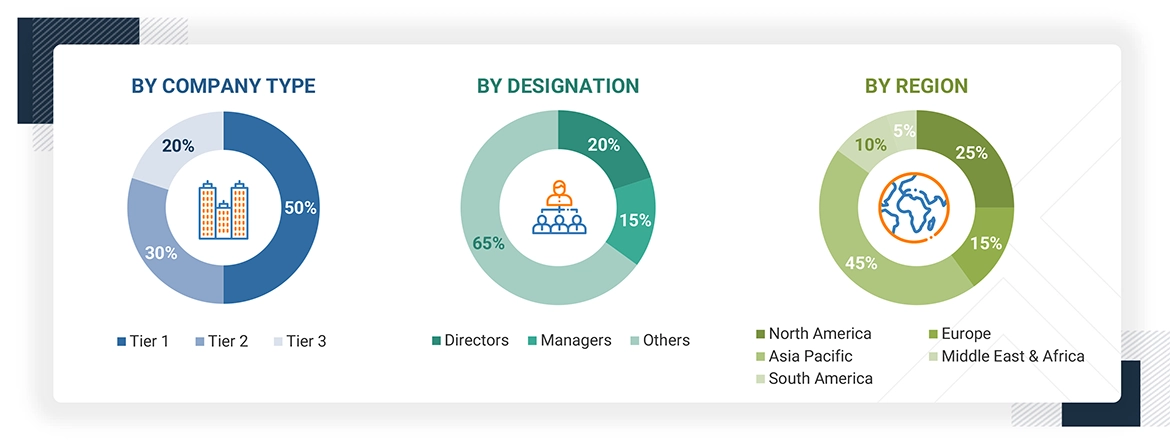
The breakdown of profiles of the primary interviewees is illustrated in the figure below:
Electro-Oxidation Market

Note: Tier 1, Tier 2, and Tier 3 companies are classified based on their market revenue in 2024 available in the public domain, product portfolios, and geographical presence.

Other designations include sales representatives, production heads, and technicians.

To know about the assumptions considered for the study, download the pdf brochure

Market Size Estimation

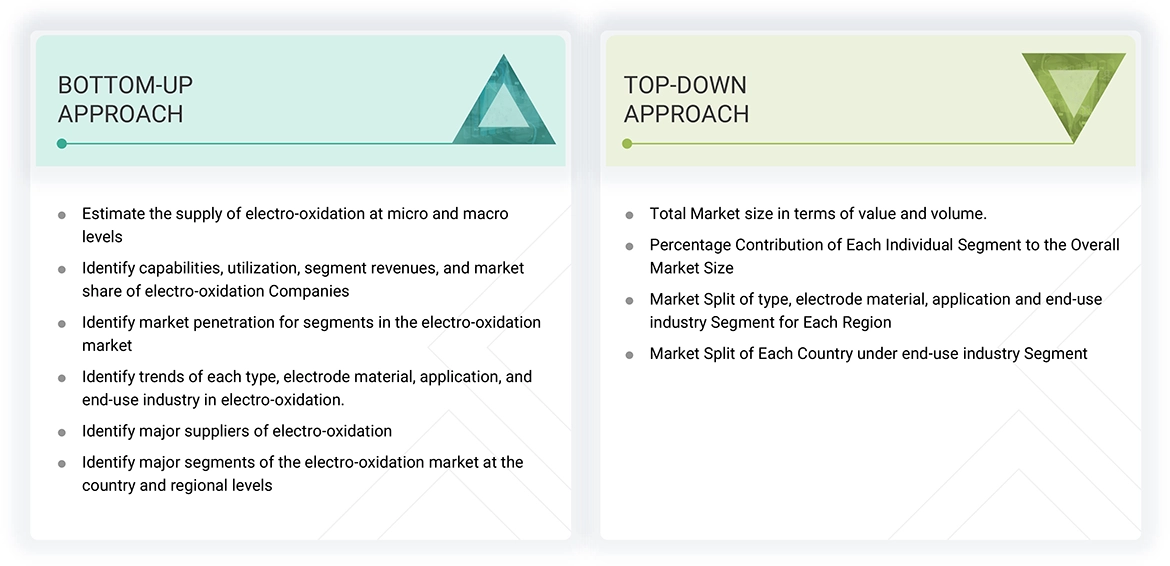
The top-down approach was used to estimate and validate the size of various submarkets for the electro-oxidation market for the region. The research methodology used to estimate the market size included the following steps:

  • The key players in the industry have been identified through extensive secondary research.
  • The supply chain of the industry has been determined through primary and secondary research.
  • All percentage shares, splits, and breakdowns based on type, electrode material,  application, end-use industry, and region were determined using secondary sources and verified through primary sources.
  • All possible parameters that affect the markets covered in this research study were accounted for, viewed in extensive detail, verified through primary research, and analyzed to get the final quantitative and qualitative data. This data was consolidated and added with detailed inputs and analysis, and presented in this report.
Electro-Oxidation Market

Data Triangulation

After arriving at the total market size from the estimation process electro-oxidation market above, the overall market has been split into several segments and sub-segments. To complete the overall market engineering process and arrive at the exact statistics for all the segments and sub-segments, the data triangulation and market breakdown procedures have been employed, wherever applicable. The data has been triangulated by studying various factors and trends from both the demand and supply sides. Along with this, the market size has been validated by using both the top-down and bottom-up approaches and primary interviews. Hence, for every data segment, there have been three sources: the top-down approach, the bottom-up approach, and expert interviews. The data was assumed correct when the values arrived from the three sources matched.

Market Definition

Electro-oxidation of water and wastewater depends on electrochemistry and other processes to eliminate contaminants through direct and indirect oxidation at an anode. When an electric potential is applied, electro-oxidation performs anodic oxidation, where pollutants lose electrons by reacting directly at the electrode surface (direct electro-oxidation), or generate reactive electrochemical species such as hydroxyl radicals during oxidation in the bulk solution (indirect electro-oxidation). This method can replace stubborn organic pollutants like dyes, pharmaceuticals, and PFAS; micropollutants; or inorganic pollutants such as heavy metals, phosphates, and nitrates. The effectiveness of high-performance electrodes such as boron-doped diamond (BDD) and lead dioxide (PbO2) in facilitating electron transfer and generating radicals is increased by their wide potential windows and catalytic activity. Direct electro-oxidation can effectively mineralize more resistant organics, while indirect electro-oxidation treats a broader range of wastewater, including water with regulatory limits on contaminants like chlorine or persulfate used in surface water or for direct reuse. Electro-oxidation is performed using a commercial electrochemical cell with an anode that oxidizes waste pollutants and a cathode that supports reduction reactions without producing additional pollution or secondary waste. Its versatility and adaptability make electro-oxidation beneficial for industrial applications (such as textiles and pharmaceuticals) and municipal use with strict discharge regulations, including zero-liquid discharge. The main advantages of electro-oxidation include its robust degradation efficiency, suitability for complex effluents, and ability to process wastewater for reuse in other applications. Although energy efficiency and electrode costs for both small- and large-scale applications remain areas for improvement, limitations.

Stakeholders

  • Electro-Oxidation Market Manufacturers
  • Electro-Oxidation Market Traders, Distributors, and Suppliers
  • Raw Type Suppliers
  • Government and Private Research Organizations
  • Associations and Industrial Bodies
  • R&D Institutions
  • Environmental Support Agencies

Report Objectives

  • To define, describe, and forecast the size of the Electro-Oxidation, in terms of value and volume
  • To provide detailed information regarding the major drivers, opportunities, restraints, and challenges, influencing the growth of the market
  • To estimate and forecast the market size based on type, electrode material,  application, end-use industry, and region
  • To forecast the size of the market with respect to major regions: North America, Europe, the Middle East & Africa, and South America, along with their key countries
  • To strategically analyze micromarkets with respect to individual growth trends, prospects, and their contribution to the overall market
  • To analyze opportunities in the market for stakeholders and provide a competitive landscape of market leaders
  • To track and analyze recent developments, such as partnerships, agreements, joint ventures, collaborations, announcements, awards, and market expansion
  • To strategically profile key market players and comprehensively analyze their core competencies

 

Previous Versions of this Report

"Our USP is "providing game-changing business opportunities reports with free customization" - so please feel free to provide us with your specific areas of interest / business challenges in much greater detail !!"

We appreciate your interest in this report. Once you fill out the form, you'll be immediately directed to an exclusive solution tailored to your needs. This high-value offering can help boost your revenue by 30% - a must-see opportunity for anyone looking to maximize growth.


By clicking the "Submit" button, you are agreeing to the Terms of Use and Privacy Policy.

Custom Market Research Services

We Will Customise The Research For You, In Case The Report Listed Above Does Not Meet With Your Requirements

Get 10% Free Customisation

Growth opportunities and latent adjacency in Electro-Oxidation Market

DMCA.com Protection Status