Epoxy Diluents Market

Epoxy Diluents Market by Product Type (Diglycidyl Ether, C12-C14 Alkyl, Butyl Glycidyl Ether), Application (Protective Coatings, Adhesives & Sealants), End-use Industry (Building & Construction, Automotive, Electrical), Region - Global Forecast to 2031


OVERVIEW
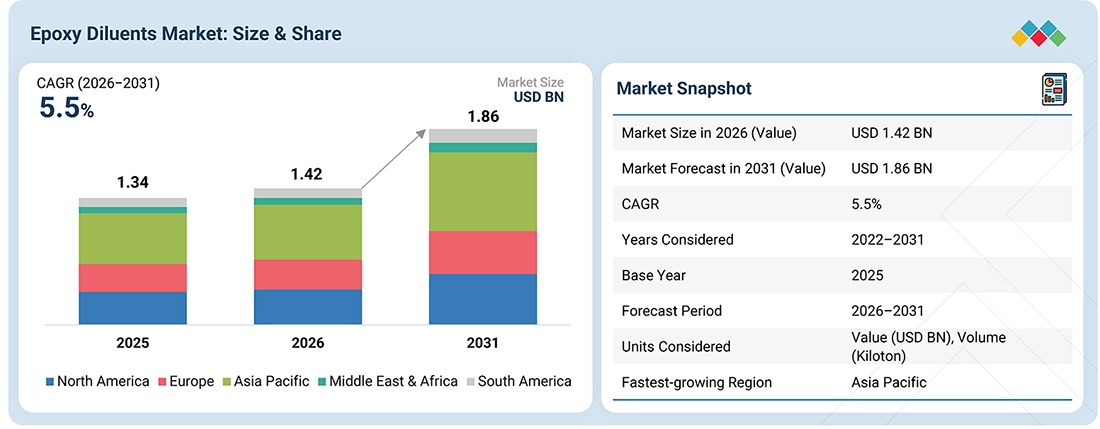
Source: Secondary Research, Interviews with Experts, MarketsandMarkets Analysis
The epoxy diluents market is projected to reach USD 1.86 billion by 2031 up from USD 1.42 billion in 2026, at a CAGR of 5.5%. Rising demand for high-performance coatings, adhesives, composites, and electrical insulation materials in the construction, automotive, energy, and industrial sectors is a driving factor behind the growth of the epoxy diluents market. Increased investments in renewable energy projects, such as the construction and development of wind energy, are boosting demand for electrostatic protective coatings and composites that are durable and corrosion resistant. Rising needs for low-emission resin formulas and better mechanical properties of epoxy resins is forcing the producers of epoxy diluents focus on the development of innovative reactive diluents that could be used in different industries.
KEY TAKEAWAYS
-
By RegionAsia Pacific accounted for a share of 48.5% of the epoxy diluents market in 2025.
-
By Product TypeDiglycidyl ether held the largest share of 31.1% of the epoxy diluents market, by product type, in 2025.
-
By ApplicationComposites is the fastest-growing application with a CAGR of 6.7% during a forecast period.
-
By End-use IndustryBuilding & construction dominate the epoxy diluents market by end-use industry.
-
Competitive Landscape - Key PlayersWestlake Corporation, Huntsman, Evonik Industries AG, were identified as some of the star players in the epoxy diluents market (global), given their strong market share and product footprint.
-
Competitive Landscape - StartupsLEUNA-Harze GmbH, Miwon Specialty Chemical Co., Ltd., and Royce Global have distinguished themselves among startups and SMEs by securing strong footholds in specialized niche areas.
Demand for epoxy diluents is being fueled by the increasing use of epoxy products such as coatings, adhesives, composites, and electrical insulation materials in various sectors of construction, automotive, energy, and manufacturing. Also, the growth of infrastructure development programs and investments in wind energy triggers the demand for products that are durable, corrosion-resistant, and capable of providing excellent mechanical properties.
TRENDS & DISRUPTIONS IMPACTING CUSTOMERS' CUSTOMERS
The changing market of epoxy diluents is influencing the strategies of Sherwin-Williams, PPG Industries, and Sika by enhancing the significance of product performance, formulation efficiency, and durability of products. The growing demand for low-VOC products is forcing Sherwin-Williams to invent the technologies which comply with environmental regulations and help to maintain consistent protection of the assets. PPG Industries gains from the better formulations which enhance the production and product longevity in industrial customers’ applications. For Sika, the innovations in epoxy formulations provide the improvement of adhesive performance and application efficiency for contractors. Such changes encourage companies to focus on selecting the right diluents, innovative development of products, and performance-oriented solutions.
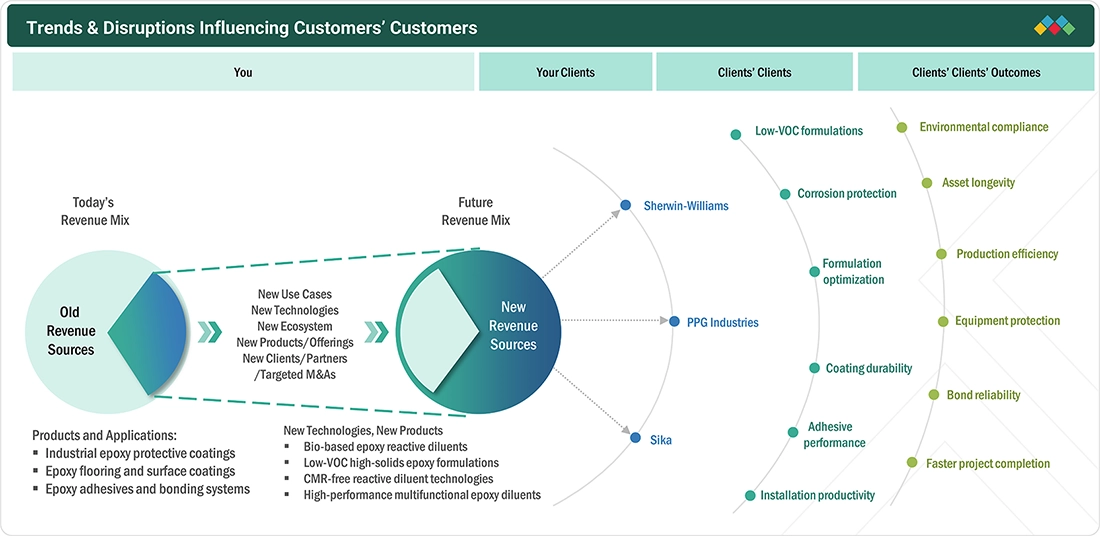
Source: Secondary Research, Interviews with Experts, MarketsandMarkets Analysis
MARKET DYNAMICS

Level
-
Growing shift toward high-solids and solvent-free epoxy formulations

-
Need for Improved Epoxy Resin Processability


Level
-
Adverse Effects on Cured Resin Performance

-
Health & Environmental Concerns Associated with Conventional Diluents


Level
-
Development of Bio-Based Epoxy Diluents

-
Expansion into Emerging Regional Markets


Level
-
Maintaining Consistent Product Quality at Commercial Scale

-
Supply Chain Disruptions and Raw Material Availability

Source: Secondary Research, Interviews with Experts, MarketsandMarkets Analysis
Driver: Growing shift toward high-solids and solvent-free epoxy formulations
The growing pressure from regulatory authorities for companies to reduce their VOC emissions is leading to faster adoption of high-solids and solvent-free epoxy formulations. Manufacturers of coatings are reformulating their products to comply with emissions regulations. This is particularly important in the case of industrial floors, marine coatings, protective coatings, and infrastructure maintenance services, where the purchase decision is heavily influenced by both durability and regulatory compliance. Therefore, in order to meet the demand for low-emission coating products, producers are expanding their list of reactive diluents and developing formulations for different curing systems.
Restraint: Adverse Effects on Cured Resin Performance
The possibility of the degradation of cured resin attributes limits the use of epoxy diluents in applications where high performance is needed. Depending on the chemical characteristics and amount of certain diluents, the properties of cured resin can be lowered such as the crosslink density, glass transition temperature, strength, resistance to chemical reactions, and elevated temperatures. Such changes have an effect on the life cycle of coatings, electrical devices, and structural composites that work in extreme conditions. Thus, requirements concerning mechanical strength, temperature stability, and thermal resistance are the reasons to impose strict limitations on formulations.
Opportunity: Development of Bio-Based Epoxy Diluents
The growing interest in renewable chemical feedstocks makes it possible to produce epoxy diluents from the vegetable oils, lignin-derived compounds, and other sources of biomass. Chemical producers can take advantage of these raw materials in order to diversify feedstock and lessen their dependence on petroleum-based inputs. The advances in molecular modifications and functionalization also provide an opportunity to produce biobased goods with specific features for certain applications. There is a chance in case the coating, adhesive, and composite producers will start using the renewable materials as consumers start specifying their use during procurement processes.
Challenge: Maintaining Consistent Product Quality at Commercial Scale
An efficient production process needs to balance appropriate chemical composition and qualities in batches while reducing variations in raw materials and conditions. The variations in reaction rates, conversion percentages, catalyst concentrations, temperatures, and purification rates impact end-product specifications. Manufacturers need to set up effective process control mechanisms, analytical testing methods, and tracing procedures that will allow them to satisfy customers’ needs in various applications. Production scaling may also bring about the equipment-related limitations and complexity of process optimization. While striving to improve economies of production and control manufacturing costs, it is also important for producers to ensure uniformity of production in order to receive long-term supply contracts from industrial customers.
EPOXY DILUENTS MARKET: COMMERCIAL USE CASES ACROSS INDUSTRIES
| COMPANY | USE CASE DESCRIPTION | BENEFITS |
|---|---|---|
 |
Use of epoxy diluents in industrial coatings and adhesives for improved application across metal surfaces and composite materials. | Reduced formulation viscosity | Improved substrate wetting | Easier application | Better resin flow |
 |
Application of epoxy diluents in protective coatings, industrial flooring, and adhesive formulations for manufacturing and infrastructure applications. | Improved workability | Enhanced processing efficiency | Better formulation flexibility | Easier application |
 |
Incorporation of epoxy diluents into high-solids coatings, concrete coatings, and industrial adhesives to support efficient formulation and application. | Improved handling | Better pigment and filler wetting | Easier processing | Support for lower-emission formulations |
 |
Use of epoxy-based formulations in protective coatings, industrial flooring, adhesives, and electrical encapsulation applications. | Chemical resistance | Corrosion protection | Strong adhesion | Mechanical durability |
Logos and trademarks shown above are the property of their respective owners. Their use here is for informational and illustrative purposes only.
MARKET ECOSYSTEM
In the ecosystem of the epoxy diluents market, there are raw materials suppliers, manufacturers, distributors, and end-users. Raw materials suppliers such as INEOS Phenol, BASF, and Perstorp are responsible for supplying chemical feedstocks. Manufacturers including Huntsman Corporation, Evonik Industries AG, and Aditya Birla Chemicals are responsible for producing reactive epoxy diluents. Distributors such as Brenntag, IMCD Group, and Univar Solutions are responsible for facilitating the availability through distribution networks. End-users such as Sherwin-Williams, PPG Industries, and Sika utilize the products in protective applications, coatings, adhesives, floorings, as well as construction materials. All these respective interconnected players are engaged in procurement, product development, distribution, and application practices in the eco-friendly epoxy diluents value-chain.
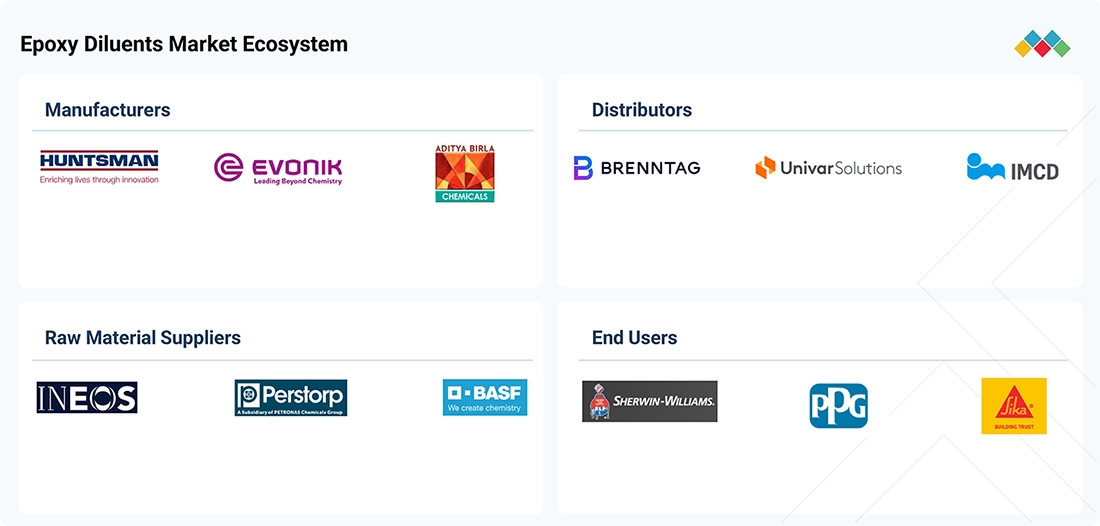
Logos and trademarks shown above are the property of their respective owners. Their use here is for informational and illustrative purposes only.
MARKET SEGMENTS
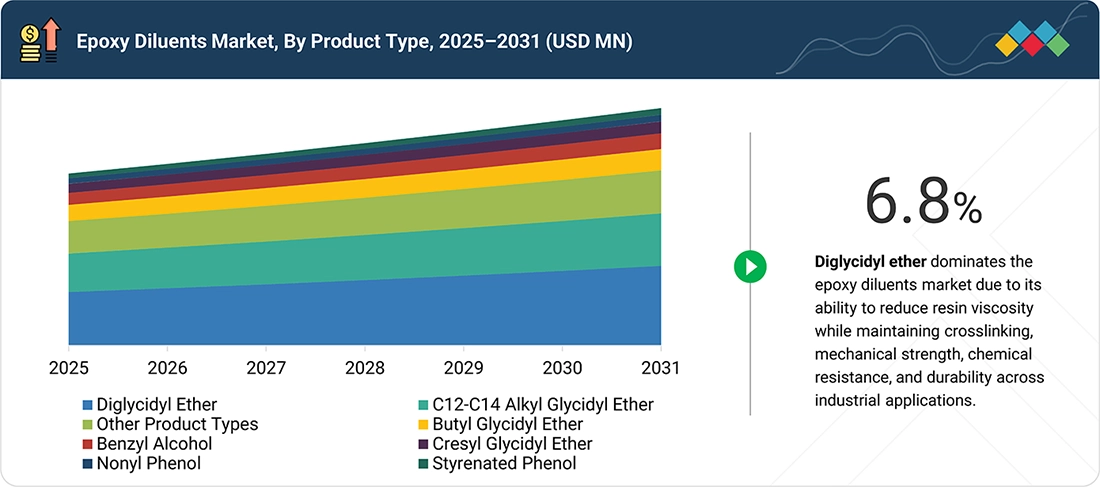
Source: Secondary Research, Interviews with Experts, MarketsandMarkets Analysis
Epoxy Diluents Market, By Product Type
Diglycidyl ether commands the highest portion of the epoxy diluents segment owing to its capacity for lowing the viscosity of the epoxy resin while preserving its preferred cured characteristics. Its two epoxy functional groups make it a participant in crosslinking reactions, which add strength and resistance to chemicals and heat compared to many monofunctional equivalents. Diglycidyl ether-based diluents can, therefore, be used in industrial coatings, adhesives, flooring, electrical encasement, and composite applications. Furthermore, their availability in a number of chemical structures makes it possible for formulators to modify the flexibility, reactivity and processing characteristics to comply with the requirements of the end-user.
Epoxy Diluents Market, by Application
The composites segment is growing rapidly in the epoxy diluents market as demand for lightweight and high-strength materials is increasing across sectors like wind energy, automotive, aerospace, and industrial. The rising wind turbine installations are causing more epoxy-based composites to be used in the manufacturing of turbines during the pressing where the low-viscosity mixes enable better resin flow and fiber saturation. The adoption of composites in the automotive and aerospace fields is also increasing in the quest to bring down the weight of components. The use of epoxy diluents results in increased efficacy during manufacturing and compliance with performance demands.
Epoxy Diluents Market, by End-use Industry
The building & construction industry is the largest end-use sector for epoxy diluents due to the potential applications of epoxy resins, for instance, in making protective coatings, industrial flooring, repair materials, adhesives, grouts and reinforcements of structures. The upsurge in construction activities requires such materials which possess good bonding properties and have resistance to chemicals, moisture and corrosion. Epoxy diluents improve formulations allowing easier application of substances or technology on concrete or metal surface. In addition, the need for smooth industrial floors, protective coatings, and durable systems increases the application of epoxy diluents in the building sector.
REGION
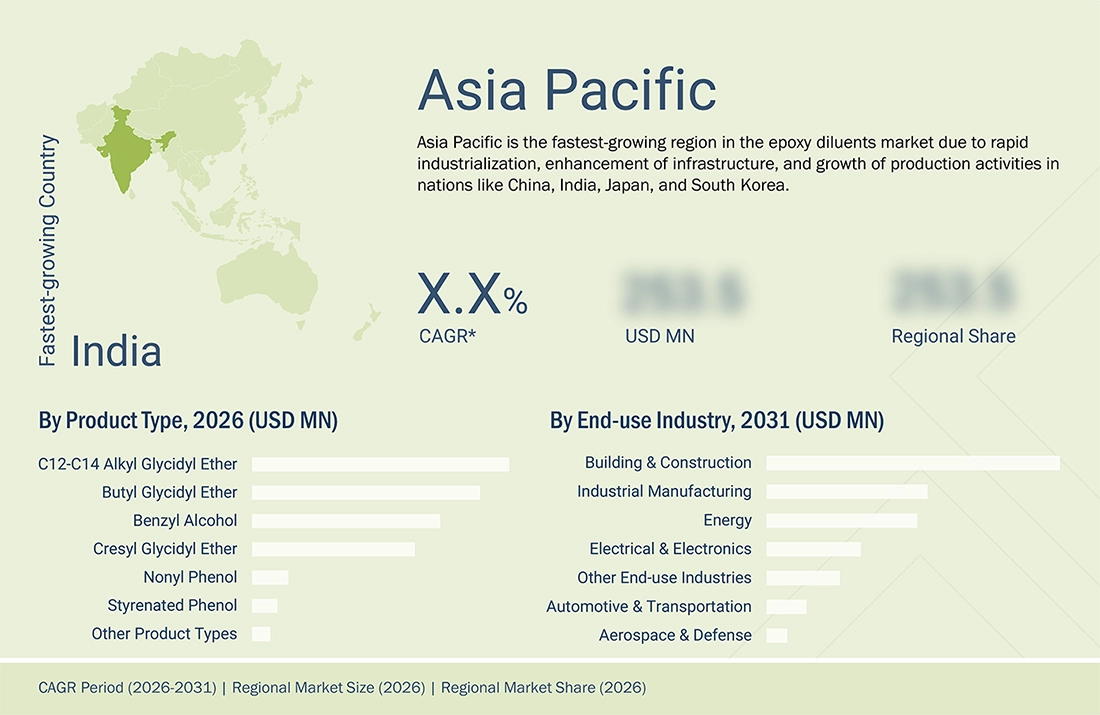
Asia Pacific to be fastest-growing region in global epoxy diluents market during forecast period
The Asia Pacific region is expanding at the fastest rate among the epoxy diluents industry due to quick industrialization, enhancement of infrastructure, and growth of production activities in nations like China, India, Japan, and South Korea. Along with strong requirements for protective coatings, industrial flooring, adhesives, and construction materials, the consumption in the area is growing. Changes in energy sources are creating opportunities in the utilization of epoxy composites and bonding products. Moreover, a big number of major chemical producers, growing electronics industry, and improvement of the availability of raw materials influence the development of the regional market. Adoption of high-solids formulations is one more contributory factor to the development of reactive epoxy diluents in a variety of industries.
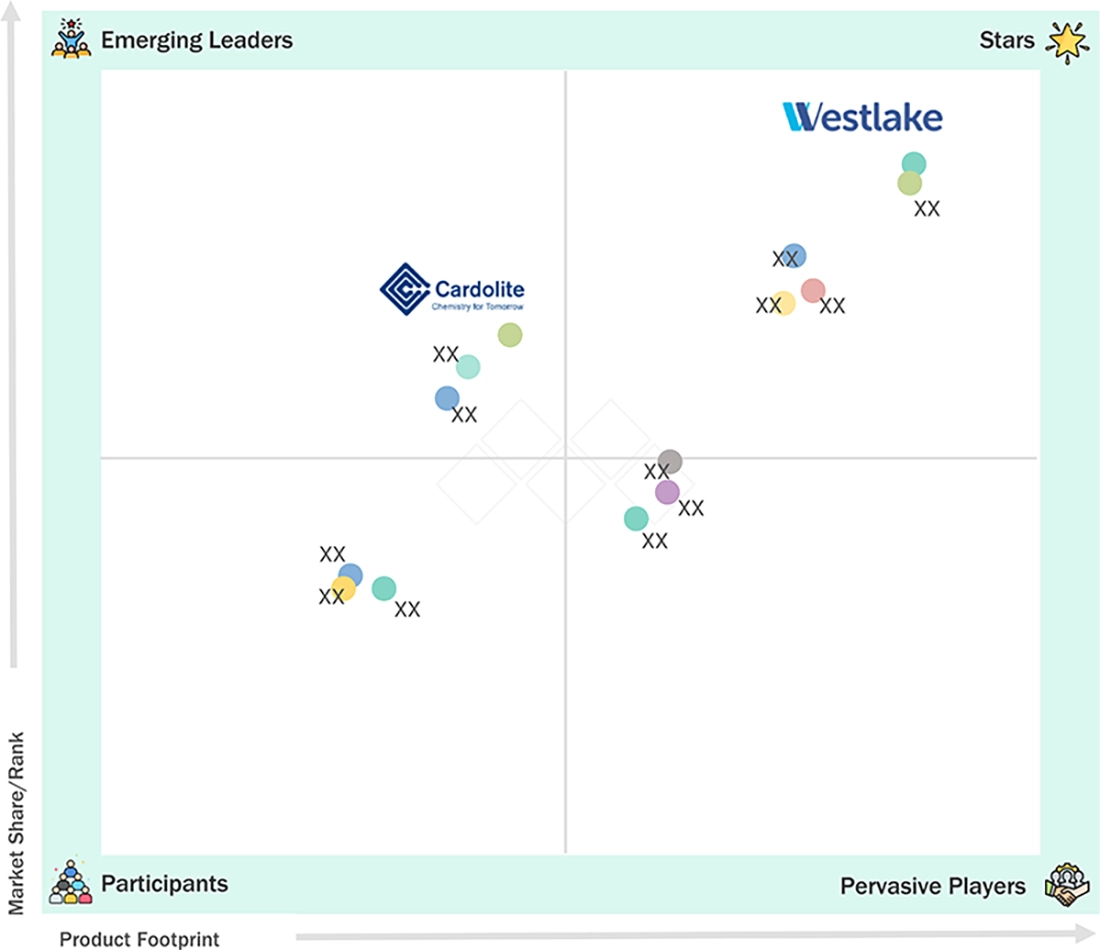
EPOXY DILUENTS MARKET: COMPANY EVALUATION MATRIX
The epoxy diluents market positions Westlake Corporation as star player in the sector due to its established position in the sector, vast product portfolio in terms of epoxy products, manufacturing competency, and being a strong player in coatings, construction, wind energy, and composites. On the other hand, Cardolite Corporation has been characterized as a developing leader due to its specialized offerings of reactive diluents from cashew nutshell liquid, which is a bio-based material as compared to regular petroleum-based products. The company’s concentration on renewable chemistry enables it to offer the much-needed solution to the demand for eco-friendly epoxy solutions.
Source: Secondary Research, Interviews with Experts, MarketsandMarkets Analysis
KEY MARKET PLAYERS
- Westlake Corporation (US)
- Huntsman (US)
- Evonik Industries AG (Germany)
- Olin Corporation (US)
- Aditya Birla Chemicals (India)
- Mitsubishi Chemical Corporation (Japan)
- KUKDO CHEMICAL CO., LTD. (South Korea)
- ITOCHU CHEMICAL FRONTIER Corporation (Japan)
- SACHEM Inc (US)
- PCC Group (Germany)
- EMS-CHEMIE HOLDING AG (Switzerland)
- KUMHO PETROCHEMICAL (South Korea)
- Atul Ltd (India)
- Cardolite Corporation (US)
MARKET SCOPE
| REPORT METRIC | DETAILS |
|---|---|
| Market Size in 2025 (Value) | USD 1.34 Billion |
| Market Size in 2026 (Value) | USD 1.42 Billion |
| Market Forecast in 2031 (Value) | USD 1.86 Billion |
| Growth Rate | CAGR of 5.5% from 2026–2031 |
| Years Considered | 2022–2031 |
| Base Year | 2025 |
| Forecast Period | 2026–2031 |
| Units Considered | Value (USD Billion), Volume (Kiloton) |
| Report Coverage | Revenue Forecast, Company Ranking, Competitive Landscape, Growth Factors, and Trends |
| Segments Covered |
|
| Regions Covered | North America, Asia Pacific, Europe, South America, and Middle East & Africa |
WHAT IS IN IT FOR YOU: EPOXY DILUENTS MARKET REPORT CONTENT GUIDE
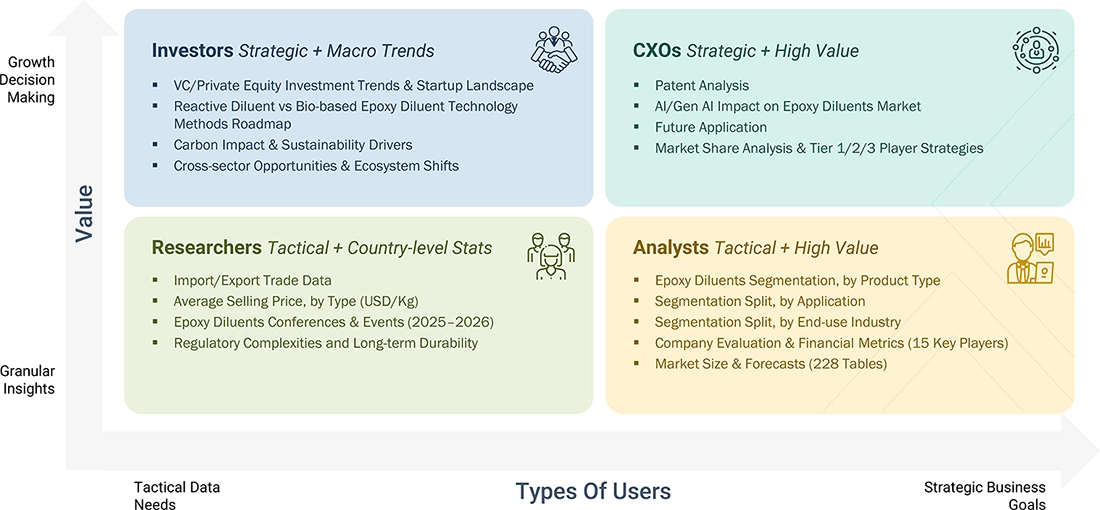
DELIVERED CUSTOMIZATIONS
We have successfully delivered the following deep-dive customizations:
| CLIENT REQUEST | CUSTOMIZATION DELIVERED | VALUE ADDS |
|---|---|---|
| Epoxy Diluents Manufacturers | Competitive benchmarking of epoxy diluent grades, product portfolios, production capacities, pricing trends, technologies, and regional demand across applications | Optimize product portfolios, identify growth opportunities, strengthen competitive positioning, and support strategic planning |
| Distributors & Channel Partners | Regional demand analysis, supplier comparison, distribution opportunities, inventory planning, and purchasing trends by product type and end-use industry | Optimize sourcing, improve inventory management, expand customer reach, and increase sales opportunities |
| Raw Material Suppliers | Assessment of feedstock demand, raw material requirements, procurement trends, supply availability, and regional consumption patterns | Identify growth segments, strengthen manufacturer relationships, and optimize supply planning |
| Formulators & Coatings Manufacturers | Analysis of epoxy diluent compatibility, formulation requirements, viscosity reduction, curing characteristics, and performance across coating applications | Improve formulation efficiency, meet application requirements, and develop differentiated coating solutions |
RECENT DEVELOPMENTS
- June 2025 : The Aditya Birla Group, through its subsidiary Aditya Birla Chemicals (USA) Inc., acquired Cargill's 17-acre facility in Dalton, Georgia, for the manufacturing of specialty chemicals. The acquisition enabled the company to increase its footprint in the Advanced Materials space. Reactive diluents, epoxy resins, formulated resins, curing agents, and polyaspartic resins for marine, industrial coatings, and flooring applications were produced at the plant. Aditya Birla Chemicals intends to ramp up production at the facility to over 40,000 tonnes annually from 16,000 tonnes a year in a couple of years. The acquisition allows Aditya Birla Chemicals to enhance the regional supply chain and extend customer and product reach in the North American market.
- June 2024 : The Aditya Birla Group has announced to invest USD 50 million in a new materials production facility and research and development infrastructure in Beaumont, Texas. The investment is made by Aditya Birla Chemicals (USA) Inc., a fully owned subsidiary of Aditya Birla Chemicals (Thailand) Ltd. The plant will occupy 35 acres and will produce special products and epoxy goods to cater to the needs of the US market. The whole center will house around 350 employees, operating both the R&D facilities and production sites. To a large extent, the project aims at expanding the sphere of influence of the group in the US markets.
- December 2023 : Grasim Industries Limited announced the expansion of its manufacturing capacity for epoxy materials with a new capacity of 123,000 tons of epoxy resins and formulations at its Vilayat plant in Gujarat. With this expansion, its Advanced Materials manufacturing capacity now stands at 246,000 tons.
Table of Contents
 Exclusive indicates content/data unique to MarketsandMarkets and not available with any competitors.
Methodology
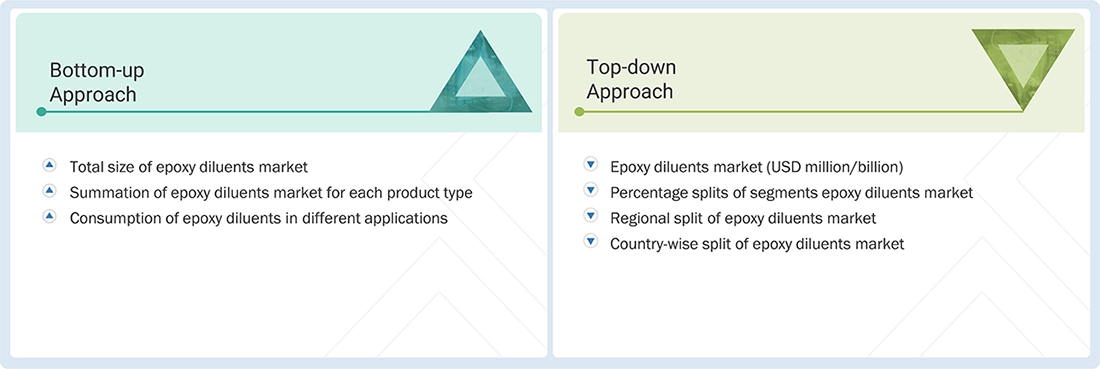
The study involved four major activities to estimate the current size of the global epoxy diluents market. Exhaustive secondary research was conducted to collect information on the epoxy diluents market, the peer product market, and the parent product group market. The next step was to validate these findings, assumptions, and sizes with industry experts across the epoxy diluents value chain through primary research. Both the top-down and bottom-up approaches were employed to estimate the overall size of the epoxy diluents market. After that, market breakdown and data triangulation were used to determine the sizes of different market segments and subsegments.
Secondary Research
For the secondary research, sources such as D&B Hoovers, Factiva, Bloomberg BusinessWeek, and Dun & Bradstreet were used to identify and collect information for this study of the epoxy diluents market. These sources included annual reports, press releases, and investor presentations from companies; white papers; certified publications; databases; articles by recognized authors; regulatory bodies; and trade directories.
Primary Research
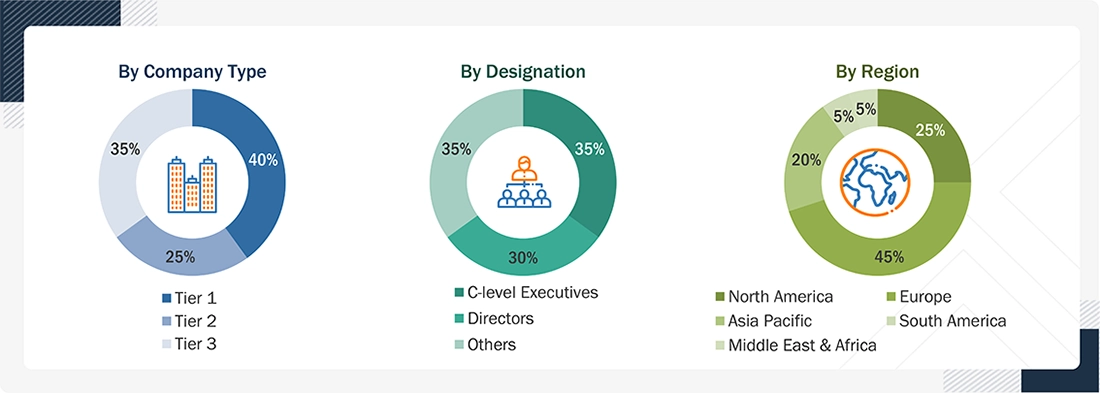
The epoxy diluents market involves various stakeholders along the supply chain, such as raw material suppliers, distributors, end-product manufacturers, buyers, and regulatory bodies. Both qualitative and quantitative data have been collected through interviews with primary sources from both the supply and demand sides. On the demand side, key participants include opinion leaders, company executives, vice presidents, and CEOs in the market. On the supply side, primary sources consist of associations, institutions, influential opinion leaders, and processing companies involved in the market.
To know about the assumptions considered for the study, download the pdf brochure
Market Size Estimation
The bottom-up and top-down approaches were used to estimate the epoxy diluents market by product type, application, end-use industry, and region. The research methodology used to calculate the market size includes the following steps:
- The key players in the industry and markets were identified through extensive secondary research.
- In terms of value, the industry’s supply chain and market size were determined through primary and secondary research processes.
- All percentage shares, splits, and breakdowns were determined using secondary sources and verified through primary sources.
- All parameters that affect the markets covered in this research study were accounted for, examined in detail, verified through primary research, and analyzed to obtain the final quantitative and qualitative data.
- The research included reviewing reports, reviews, and newsletters from top market players, as well as extensive interviews with leaders, such as directors and marketing executives, to gather opinions.
Data Triangulation
After estimating the total size of the epoxy diluents market, the market was divided into multiple segments and subsegments. Data triangulation and breakdown methods were used, where relevant, to refine the overall market analysis and determine precise statistics for all segments. The data was cross-checked by examining factors and trends from both demand and supply perspectives. Additionally, market size validation was performed using top-down and bottom-up approaches.
Market Definition
Epoxy diluents are additives used in the epoxy resin formulation to lower the viscosity, improve the flow, and aid in mixing, processing, and handling. These products are also subdivided into reactive and non-reactive diluents depending on the role played in the curing process. Reactive diluents participate in the curing process, allowing them to retain the properties of the cured material, while non-reactive diluents are used mainly for changing the processing properties. Common varieties include glycidyl ethers, aromatic diluents, and other compounds with viscosity-changing properties.
Key Stakeholders
- Epoxy diluents manufacturers
- Raw material suppliers
- Regulatory bodies and government agencies
- Distributors and suppliers
- End-use industries
- Associations and industrial bodies
- Market research and consulting firms
Report Objectives
- To define, describe, and forecast the size of the epoxy diluents market in terms of value and volume
- To provide detailed information regarding the key factors influencing the growth of the market (drivers, restraints, opportunities, and challenges)
- To forecast the market size based on product type, application, end-use industry, and region
- To study the market qualitatively based on manufacturing process
- To forecast the market size for the five main regions—North America, Europe, Asia Pacific, South America, and Middle East & Africa—along with their key countries
- To strategically analyze micromarkets with respect to individual growth trends, prospects, and contributions to the total market
- To analyze opportunities in the market for stakeholders and provide details of the competitive landscape for market leaders
- To strategically profile leading players and comprehensively analyze their key developments, such as product launches, expansions, and deals in the epoxy diluents market
- To comprehensively analyze the market share and core competencies of key players
- To study the impact of AI/gen AI on the market under study, along with the macroeconomic outlook
Available customizations:
With the given market data, MarketsandMarkets offers customizations per the specific needs of companies.
The following customization options are available for the report:
PRODUCT ANALYSIS
- Product matrix, which provides a detailed comparison of the market for different sources of epoxy diluents
REGIONAL ANALYSIS
- Further breakdown of a country with respect to the epoxy diluents market
COMPANY INFORMATION
- Detailed analysis and profiling of additional market players


Personalize This Research
- Triangulate with your Own Data
- Get Data as per your Format and Definition
- Gain a Deeper Dive on a Specific Application, Geography, Customer or Competitor
- Any level of Personalization
Let Us Help You
- What are the Known and Unknown Adjacencies Impacting the Epoxy Diluents Market
- What will your New Revenue Sources be?
- Who will be your Top Customer; what will make them switch?
- Defend your Market Share or Win Competitors
- Get a Scorecard for Target Partners

Custom Market Research Services
We Will Customise The Research For You, In Case The Report Listed Above Does Not Meet With Your Requirements
Get 10% Free CustomisationTESTIMONIALS
We at Nissan Chemicals Corporation have been clients of MarketsandMarkets for more than a year now. We recently consulted MarketsandMarkets for a study, the team at MarketsandMarkets was extremely professional and organized. The business insights were very detailed and aligned well with our expectations that really helped us formulate the Business Plans and device new strategies for development themes. MarketsandMarkets offers a unique combination of expertise and dedicated engagement model. Their research findings have helped us in designing our Pricing Strategy which will make it easier for us to predict the future sales and profits for the next ten years. We look forward to working with MarketsandMarkets in the future.
VP of Strategy & New Business Development
Leading Specialty Chemical Company
The MarketsandMarkets Engagement Model, composed of both the Knowledge Store and advisory custom research, has greatly helped us in understanding our markets and making strategic decisions. The Knowledge Store is a fast way to allow everyone in our organization to understand more about most any market they are interested in. The ability to then get custom research done and get answers to specific strategic questions and market insight has been spectacular. The Markets and Markets team feel more like colleagues than vendors and their services have helped us change our culture where statements of things like growth opportunities and competitive position are always backed by industry research.

Rich Gibson,
Director, Corporate Strategy
Milliken & Company,
Leading Industrial Manufacturer of specialty chemical, floor covering, performance and protective textile materials, and healthcaremilliken.com
MarketsandMarkets is a trusted resource that helps us to better understand markets that are near-adjacencies-whether its technology, value chain or geography. Their Knowledge Store platform provides a dashboard of markets and their characteristics which is easy to use and saves us time.
Adam Shaw,
Market Development and Strategy Manager
AdvanSix Inc. USA,
An American Leader in Chemicalswww.advansix.com
The Knowledge Store from MarketsandMarkets is a valuable tool which has helped my team acquire greater insight in to the end markets that our business serves. This has enabled us to help our company build stronger strategies throughout our planning process.
TOSHIO KINOSHITA
Senior Chif Consultion Research & Consulting Division
Mitsubishi Chemical Research Corporation,
Leading Manufacturer of Chemical Productswww.mitsubishichem-res.co.jp/en/

We recently engaged with MarketsandMarkets for a study, the team not only clearly understood our business objectives but was also extremely professional in the way they handled the entire project. The study was efficiently conducted in a phase-wise manner, and the engagement model furnished us with high-quality business insights that far exceeded our expectations at each phase. We were especially happy that MarketsandMarkets could provide us with both, an English as well as a Japanese version of the study. A special thanks to the Analyst Team and Client Services Team, whose fluency in Japanese enhanced our comfort level, as we could converse with them in our preferred language.
Independent entrepreneurs
Arrow Precision
We approached MarketsandMarkets for study on Proppants Market, and their work exceeded our expectations. The study conducted was comprehensive and enabled us to view the market through the various dimensions. In addition, the team was extraordinarily responsive throughout the process and resolved our queries on time. I strongly recommend MarketsandMarkets and will certainly consider them for additional market assessments we will need in the future.
Global engineering company, Japan
Deputy Manager,
Strategic Planning OfficeThe high-quality insights shared by the MarketsandMarkets team helped us understand the pharmaceutical plant designers in a specific geography. It also captured the risks that we may likely face in communicating with our potential partners. The study would enable us identify partners, which would impact our future growth.



Growth opportunities and latent adjacency in Epoxy Diluents Market