Europe 3D Printing Market

Europe 3D Printing Market by Offering (Printers, Materials, Software, Services), Technology [Fused Deposition Modelling (FDM), Stereolithography (SLA), Selective Laser Sintering (SLS)], Process, Application, Vertical - Forecast to 2030




OVERVIEW
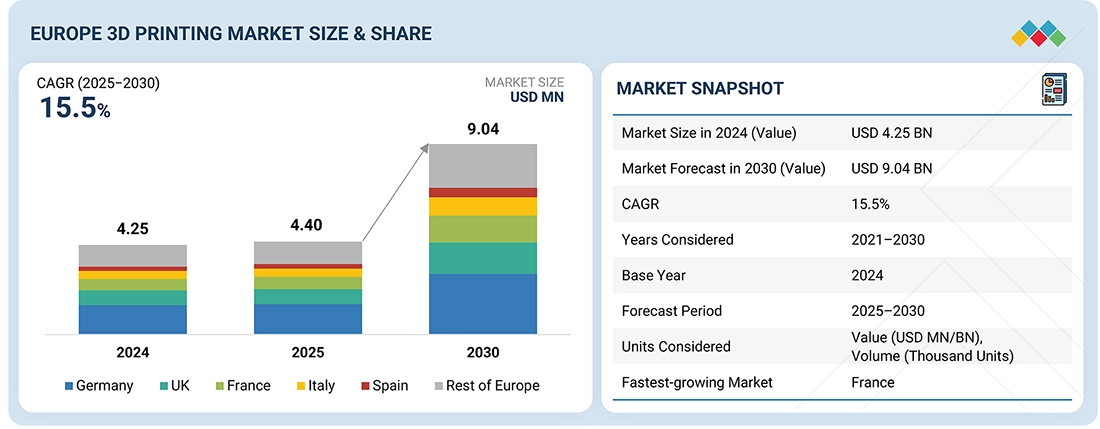
Source: Secondary Research, Interviews with Experts, MarketsandMarkets Analysis
The 3D printing market in Europe is expected to reach USD 9.04 billion by 2030, up from USD 4.40 billion in 2025, at a CAGR of 15.5% from 2025 to 2030. Market expansion is fueled by increasing adoption of additive manufacturing in the aerospace, automotive, and healthcare sectors, along with rising demand for customized, lightweight parts. Moreover, advancements in metal 3D printing, the growing industrial digitization under Industry 4.0, and significant government funding for manufacturing innovation and sustainability are boosting the adoption of 3D printing technologies across Europe.
Market Size & Forecast
KEY TAKEAWAYS
-
BY COUNTRYBy country, Germany is expected to dominate the market, at a CAGR of 14.9% during the forecast period.
-
BY OFFERINGBy offering, the service segment is likely to account for the major share of the 3D printing market in Europe in 2030.
-
BY APPLICATIONBy application, the functional parts segment is expected to register the highest CAGR.
-
BY VERTICALBy vertical, the automotive segment is projected to grow at the fastest rate from 2025 to 2030.
-
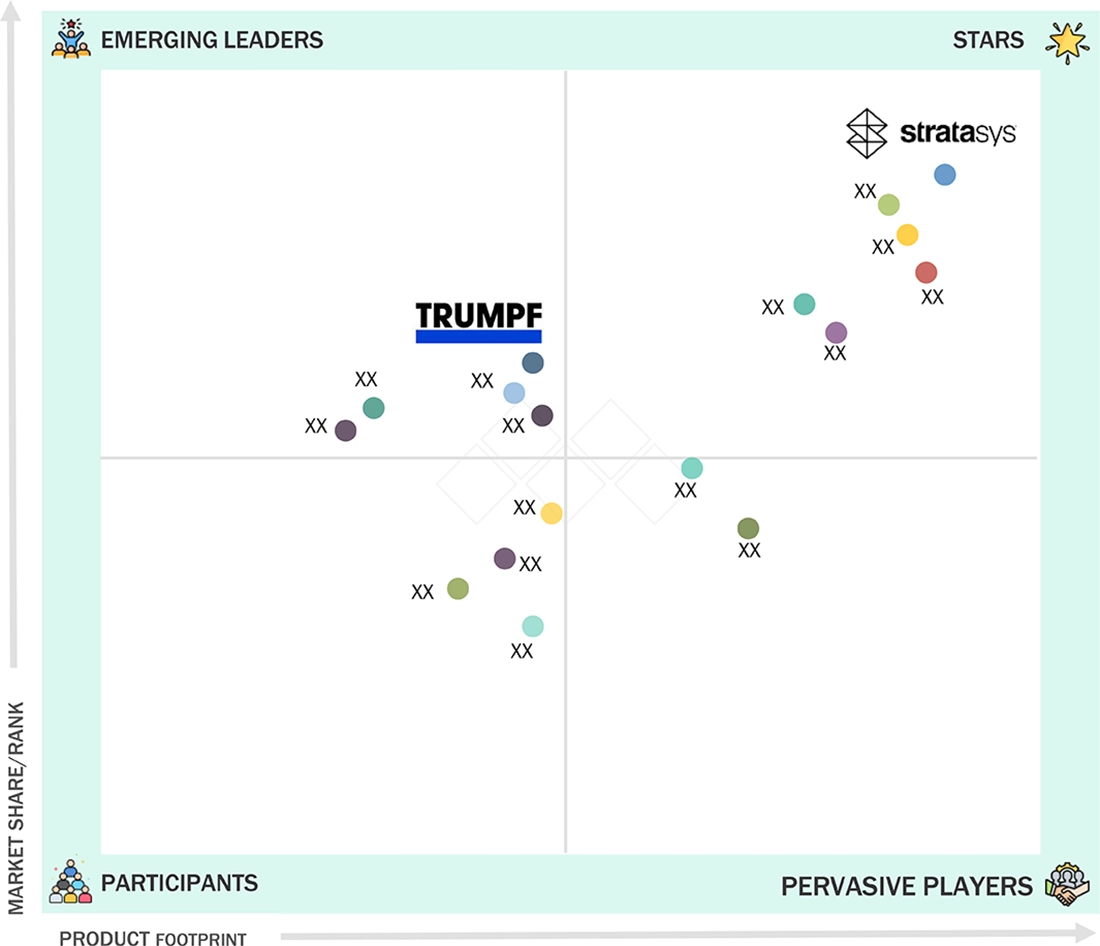
COMPETITIVE LANDSCAPE - KEY PLAYERSStratasys (US), EOS GmbH (Germany), and HP Development Company, L.P. (US) were identified as some of the star players in the 3D printing market in Europe, given their strong market share and product footprint.
-
COMPETITIVE LANDSCAPE - STARTUPS/SMESProdways Group (France) and UltiMaker (Netherlands), among others, have distinguished themselves among startups and SMEs by securing strong footholds in specialized niche areas, underscoring their potential as emerging market leaders
Germany, the UK, and France are key contributors to European market growth. Increased global government investments in 3D printing initiatives, along with the availability of a wide range of industrial-grade materials such as metals, polymers, and ceramics, have further accelerated adoption. Major industries, including healthcare, automotive, aerospace, and consumer goods, are using 3D printing for rapid prototyping, personalized production, and mass customization.
TRENDS & DISRUPTIONS IMPACTING CUSTOMERS' CUSTOMERS
The expansion of disruptive additive technologies, which enable faster prototyping, functional part manufacturing, and highly customized production, is significantly impacting customers' businesses in the 3D printing market in Europe. Automation, AI integration, and new material innovations, such as composites and biocompatible substrates, are reshaping the ecosystem, directly enhancing cost efficiency, design flexibility, and sustainability.
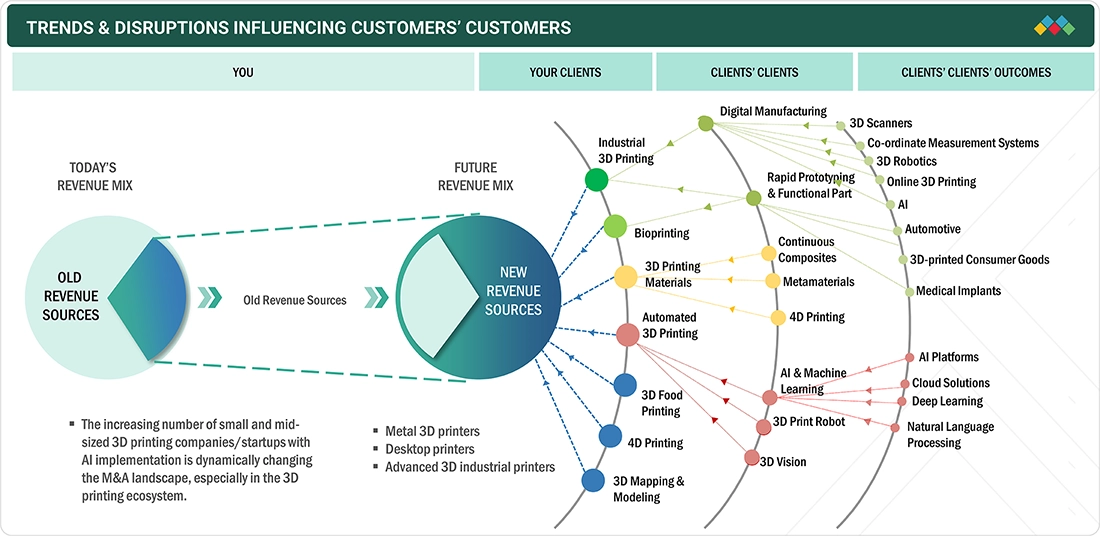
Source: Secondary Research, Interviews with Experts, MarketsandMarkets Analysis
MARKET DYNAMICS

Level
-
Ease in manufacturing of customized products

-
Reduction in manufacturing costs and process downtime


Level
-
Lack of standardized testing methods to verify mechanical properties of 3D printing materials and high raw material costs

-
Inadequate design and process control data due to lack of printing material specifications


Level
-
Increasing demand for medical products and supplies in post-pandemic scenario

-
Rapid advancements in printing technologies and materials and development of knowledge and skill progression frameworks


Level
-
Ensuring consistent quality of final 3D-printed product with repeatable and stable production processes

-
Threat of copyright infringement

Source: Secondary Research, Interviews with Experts, MarketsandMarkets Analysis
Driver: Ease in manufacturing of customized products
3D printing allows the creation of highly customized products tailored to individual needs across Europe, especially in aerospace, automotive, dental, and medical fields. European manufacturers increasingly depend on additive technologies for quick prototyping and design flexibility, supported by strong R&D infrastructure, lower printing costs, and access to advanced materials, which collectively drive the adoption of customized production.
Restraint: Lack of standardized testing methods to verify mechanical properties of 3D printing materials and high raw material costs
The 3D printing market in Europe encounters barriers due to the lack of consistent certification standards across EU member states. Limited access to high-purity materials increases production costs, while inadequate mechanical testing standards reduce consistency, accuracy, and repeatability, which hampers large-scale industrial deployment in regulated sectors such as aerospace and healthcare.
Opportunity: Increasing demand for medical products and supplies in post-pandemic scenario
The increasing demand for personalized medical implants, dental restorations, and surgical planning models creates significant growth opportunities for 3D printing in Europe. Additive manufacturing enables localized production, quick prototyping, and customized treatment solutions, which help reduce clinical lead times and enhance patient outcomes. Robust investments in biomedical research and EU healthcare innovation programs further highlight the technology’s importance in future medical applications.
Challenge: Ensuring consistent quality of final 3D-printed product with repeatable and stable production processes
A major challenge in the 3D printing market in Europe is ensuring the consistent quality and repeatability of final parts, particularly for applications in aerospace, automotive, and medical sectors. Variations in printing methods, materials, and production conditions affect dimensional accuracy and reliability of performance. These issues hinder the development of stable, scalable manufacturing processes, which slows the wider industrial adoption of 3D-printed parts in critical applications.
Europe 3D Printing Market: COMMERCIAL USE CASES ACROSS INDUSTRIES
| COMPANY | USE CASE DESCRIPTION | BENEFITS |
|---|---|---|
 |
TRUMPF metal 3D-printing systems were deployed by European aerospace and automotive OEMs to manufacture lightweight structural components and high-temperature engine parts using laser metal fusion. | Improved part strength-to-weight ratio, reduced manufacturing lead time, enabled cost-efficient low-volume production, and enhanced design flexibility for aerospace and automotive applications |
 |
Materialise additive manufacturing software and services were utilized by major European hospitals and medical-device firms to create patient-specific implants, surgical guides, and anatomical models for complex surgeries. | Enabled higher surgical accuracy, reduced operation time, faster patient recovery, and improved customization in orthopedic and cranio-maxillofacial procedures |
 |
Prodways polymer and DLP 3D-printing systems were deployed by European dental laboratories and healthcare providers for industrial-scale production of dental aligners, prosthetics, and orthodontic models. | Reduced turnaround time from weeks to days, improved precision and fit, and enabled high-volume production with lower material waste |
 |
UltiMaker 3D printers were utilized by European universities, R&D centers, and engineering firms for prototyping product designs and functional testing using a wide range of polymer materials. | Accelerated product development cycles, reduced prototyping costs, supported on-demand part customization, and improved innovation in academic & industrial research |
Logos and trademarks shown above are the property of their respective owners. Their use here is for informational and illustrative purposes only.
MARKET ECOSYSTEM
The Europe 3D printing ecosystem includes R&D centers, material providers, software providers, printer manufacturers, service providers, and end users. Each collaborates to advance the market by sharing knowledge, resources, and expertise to drive innovation in the field. Manufacturers such as Stratasys (US), EOS GmbH (Germany), HP Development Company, L.P. (US), 3D Systems, Inc. (US), and General Electric Company (US) are central to the market and responsible for developing 3D printing solutions for various applications.
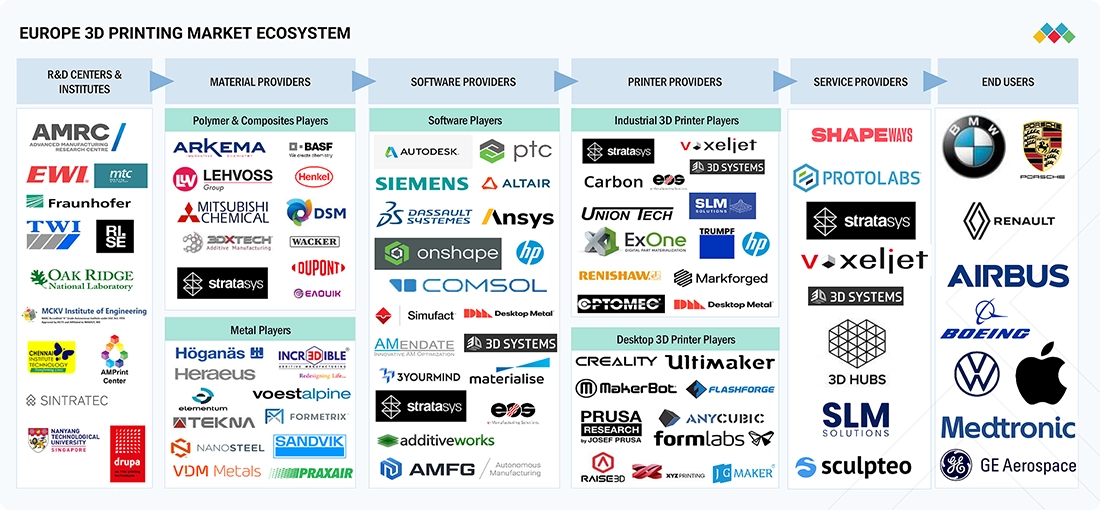
Logos and trademarks shown above are the property of their respective owners. Their use here is for informational and illustrative purposes only.
MARKET SEGMENTS
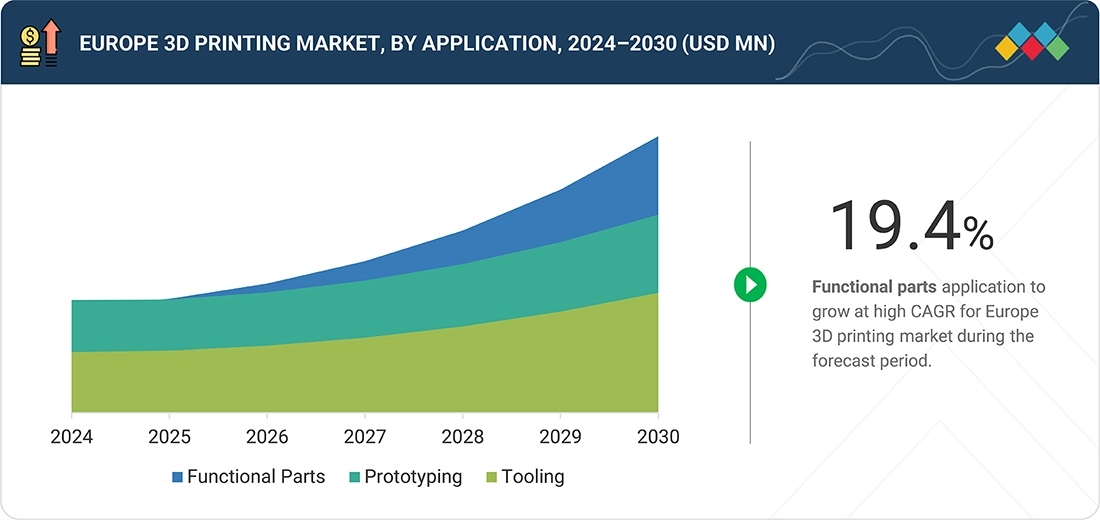
Source: Secondary Research, Interviews with Experts, MarketsandMarkets Analysis
Europe 3D Printing Market, by Offering
The services segment within the 3D printing market across Europe is projected to hold the predominant share by 2030. This growth is attributable to the escalating adoption of outsourced, on-demand additive manufacturing techniques throughout various European industries. Sectors such as aerospace, automotive, medical, and industrial equipment are actively implementing 3D printing services to optimize capital expenditure and streamline production processes. With ongoing advancements in additive manufacturing technologies and the increased availability of sophisticated metal and polymer materials, European organizations are increasingly outsourcing activities such as design, prototyping, and small-batch manufacturing to specialized service bureaus. This shift facilitates faster production cycles, cost competitiveness, and the development of customized components that traditional manufacturing methods cannot efficiently produce.
Europe 3D Printing Market, by Application
The manufacturing sector of functional parts in Europe is anticipated to experience a substantial CAGR owing to notable advancements in additive manufacturing technology, which facilitates high-volume production of structurally robust, end-use components. Innovations such as continuous liquid interface production (CLIP), high-speed sintering (HSS), and multi-jet fusion markedly decrease printing durations and enhance material compatibility. These technological developments enable European industries to produce high-performance components that exhibit superior strength, temperature resistance, and durability, making them suitable for demanding aerospace and automotive applications throughout the region.
Europe 3D Printing Market, by Vertical
The automotive sector is expected to experience strong growth in the 3D printing market in Europe, driven by rising demand for lightweight, durable, and customized parts that enhance efficiency and vehicle performance. European automakers are increasingly utilizing additive manufacturing for rapid prototyping, tooling, and manufacturing low-volume structural and electric vehicle components, thereby significantly reducing production time and costs. The technology enhances design flexibility for complex shapes and supports on-demand production, helping automakers accelerate innovation and respond more quickly to regulatory and sustainability challenges.
REGION
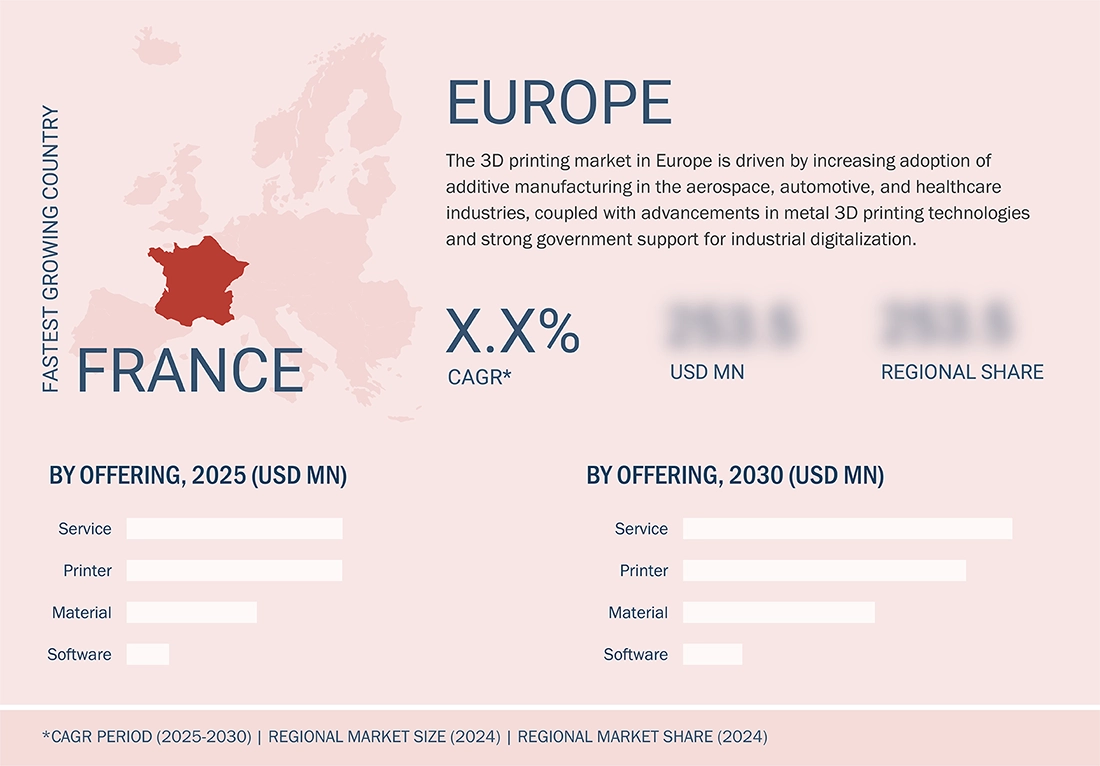
France is expected to be the fastest-growing country across the 3D printing market in Europe during the forecast period
France is expected to have the highest CAGR in the 3D printing market in Europe due to strong government funding for additive manufacturing, rapid adoption across aerospace and automotive industries, and the growing innovation hubs supporting industrial 3D printing startups.
Europe 3D Printing Market: COMPANY EVALUATION MATRIX
In the 3D printing market landscape, Stratasys stands out as the leading player, backed by its extensive technology portfolio, a strong global customer base, and leadership in industrial-grade additive manufacturing. Its continuous innovation and deep application expertise solidify its dominant market position. TRUMPF, recognized as an emerging leader, is quickly gaining ground with its advanced metal 3D printing capabilities and robust laser technology foundation.
Source: Secondary Research, Interviews with Experts, MarketsandMarkets Analysis
KEY MARKET PLAYERS
- Stratasys (US)
- EOS GmbH (Germany)
- HP Development Company, L.P. (US)
- 3D Systems, Inc. (US)
- General Electric Company (US)
- Materialise (Belgium)
- Nano Dimension (US)
- voxeljet AG (Germany)
- SLM Solutions (Germany)
- Renishaw plc. (UK)
- Prodways Group (France)
- UltiMaker (Netherlands)
- Höganäs AB (Sweden)
- TRUMPF (Germany)
- Rapid Shape GmbH (Germany)
MARKET SCOPE
| REPORT METRIC | DETAILS |
|---|---|
| Market Size in 2024 (Value) | USD 4.25 Billion |
| Market Forecast in 2030 (Value) | USD 9.04 Billion |
| Growth Rate | CAGR of 15.5% from 2025-2030 |
| Years Considered | 2021-2030 |
| Base Year | 2024 |
| Forecast Period | 2025-2030 |
| Units Considered | Value (USD Million/Billion), Volume (Thousand Units) |
| Report Coverage | Revenue forecast, company ranking, competitive landscape, growth factors, and trends |
| Segments Covered |
|
| Regional Scope | Europe (UK, Germany, France, Italy, Spain) |
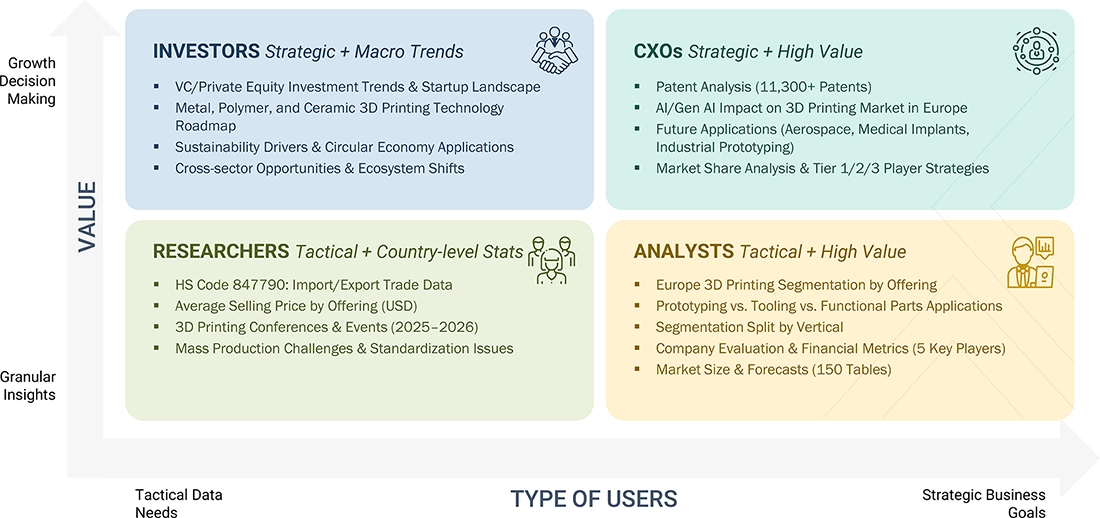
WHAT IS IN IT FOR YOU: Europe 3D Printing Market REPORT CONTENT GUIDE
DELIVERED CUSTOMIZATIONS
We have successfully delivered the following deep-dive customizations:
| CLIENT REQUEST | CUSTOMIZATION DELIVERED | VALUE ADDS |
|---|---|---|
| Manufacturing Company/Industrial End User (Automotive, Aerospace, Healthcare, Consumer Goods, Energy) | Assessment of adoption readiness for additive manufacturing across prototyping, tooling, and end-use production; evaluation of total cost of ownership (TCO), workflow integration with existing production lines, and benchmarking productivity benefits vs. subtractive manufacturing | Enables data-driven investment decisions, accelerates AM adoption to reduce lead times and production costs, and improves part design flexibility and supply chain resilience. |
| 3D Printer OEM/Material Provider/Technology Provider | Competitive benchmarking of printer performance metrics (speed, build volume, precision), material capabilities, software features, and partnerships; analysis of regulatory and certification requirements and regional demand hotspots | Strengthens product positioning, supports technology differentiation, and enhances roadmap prioritization to target high-growth industrial AM applications across Europe |
| Software Vendor/Platform Provider/Service Bureau | Mapping of competitive landscape across AM software workflows (design optimization, simulation, slicing, and workflow automation), opportunity sizing for 3D printing services, and pricing benchmarking for prototyping and volume production services | Identifies scalable opportunities for platform expansion, improves go-to-market and partnership strategy, and supports customer acquisition and expansion into emerging industrial use cases |
RECENT DEVELOPMENTS
- April 2025 : 3D Systems introduced three new application-specific 3D printing solutions: the Figure 4 135 platform for high-mix, low-volume production, a process-optimizing module for EXT Titan Pellet printers, and QuickCast Diamond for precision casting. The Figure 4 135 offered fast, tooling-free production with high accuracy, making it ideal for sectors like electronics, motorsports, and healthcare.
- March 2025 : Stratasys?Ltd unveiled the Neo800+, a large-format SLA 3D printer, at the AMUG conference, later showcased at Rapid?+?TCT. Building on the Neo800, it integrated ScanControl+ to boost print speeds by up to 50%, while maintaining high accuracy. Enhanced features included vacuum protection, Z-stage collision detection, and environmental monitoring, reducing post-processing and improving reliability for aerospace, automotive, and industrial applications.
- June 2024 : Materialise and ArcelorMittal partnered to improve metal 3D printing using Materialise’s next-gen build processor and ArcelorMittal’s AdamIQ steel powders. The collaboration aimed to optimize laser powder bed fusion (LPBF) by enhancing speed, quality, and cost-efficiency. This MOU will help develop and validate new applications and alloys for steel additive manufacturing, boosting productivity and performance.
Table of Contents
 Exclusive indicates content/data unique to MarketsandMarkets and not available with any competitors.
Methodology
The research process for this technical, market-oriented, and commercial study of the Europe 3D Printing Market included the systematic gathering, recording, and analysis of data about companies operating in the market. It involved the extensive use of secondary sources, directories, and databases (Factiva, Oanda, and OneSource) to identify and collect relevant information. In-depth interviews were conducted with various primary respondents, including experts from core and related industries and preferred manufacturers, to obtain and verify critical qualitative and quantitative information as well as to assess the growth prospects of the market. Key players in the Europe 3D Printing Market were identified through secondary research, and their market rankings were determined through primary and secondary research. This included studying annual reports of top players and interviewing key industry experts, such as CEOs, directors, and marketing executives.
Secondary Research
In the secondary research process, various secondary sources were used to identify and collect information for this study. These include annual reports, press releases, and investor presentations of companies, as well as whitepapers, certified publications, and articles from recognized associations and government publishing sources. Research reports from a few consortia and councils were also consulted to structure qualitative content. Secondary sources included corporate filings (such as annual reports, investor presentations, and financial statements); trade, business, and professional associations; white papers; Journals and certified publications; articles by recognized authors; gold-standard and silver-standard websites; directories; and databases. Data was also collected from secondary sources, such as the International Trade Centre (ITC) and the International Monetary Fund (IMF).
List of key secondary sources
|
Source |
Web Link |
|
NATIONAL INSTITUTE OF STANDARDS AND TECHNOLOGY |
https://www.nist.gov/additive-manufacturing |
|
US National Science Foundation |
https://new.nsf.gov/funding/opportunities/advanced-manufacturing-am |
|
US Government Accountability Office |
https://www.gao.gov/ |
|
The International Trade Administration, US Department of Commerce |
https://www.trade.gov/ |
|
US Department of Energy |
https://www.energy.gov/ |
|
US Department of Health & Human Services |
https://www.cdc.gov/niosh/index.htm |
|
European Commission |
https://commission.europa.eu/index_en |
|
National Institute of Advanced Industrial Science and Technology (AIST) |
https://www.aist.go.jp/index_en.html |
|
American Society for Testing and Materials (ASTM) |
https://www.astm.org/ |
|
CSA Group Testing & Certification Inc |
https://www.csagroup.org/ |
|
International Electrotechnical Commission (IEC) |
https://www.iec.ch/homepage |
|
The British Standards Institution |
https://www.bsigroup.com/en-IN/ |
|
Ministry of Economy, Trade and Industry |
https://www.meti.go.jp/english/ |
|
Additive Manufacturing Green Trade Association (AMGTA) |
https://amgta.org/ |
Primary Research
Extensive primary research was conducted after understanding and analyzing the Europe 3D Printing Market scenario through secondary research. Approximately 30% of the primary interviews were conducted with the demand side, and 70% with the supply side. Primary data was collected through questionnaires, emails, and telephonic interviews. Various departments within organizations, such as sales, operations, and administration, were contacted to provide a holistic viewpoint in the report.
Market Size Estimation
In the complete market engineering process, top-down and bottom-up approaches and several data triangulation methods have been used to estimate and forecast the market size for the overall market segments and subsegments listed in this report. Extensive qualitative and quantitative analyses have been performed on the complete market engineering process to list the key information/insights throughout the report. The following table explains the process flow of the market size estimation.
The key players in the market were identified through secondary research, and their rankings in the respective regions were determined through primary and secondary research. This entire procedure involved the study of the annual and financial reports of top players, as well as interviews with industry experts such as chief executive officers, vice presidents, directors, and marketing executives, for quantitative and qualitative key insights. All percentage shares, splits, and breakdowns were determined using secondary sources and verified through primary sources. All parameters that affect the markets covered in this research study were accounted for, viewed in extensive detail, verified through primary research, and analyzed to obtain the final quantitative and qualitative data. This data was consolidated, supplemented with detailed inputs and analysis from MarketsandMarkets, and presented in this report.
Data Triangulation
After arriving at the overall size of the Europe 3D Printing Market through the process explained above, the overall market has been split into several segments. Data triangulation procedures have been employed to complete the overall market engineering process and arrive at the exact statistics for all the segments, wherever applicable. The data has been triangulated by studying various factors and trends from both the demand and supply sides. The market has also been validated using both top-down and bottom-up approaches.
Market Definition
Three-dimensional (3D) printing is the process of building a real 3D object from a digital model by joining thin layers of materials (which might be in solid, powder, or liquid forms), usually layer upon layer in horizontal cross-section, unlike subtractive manufacturing methods. It is also known as additive manufacturing (AM) or freeform fabrication. 3D printing is the most common term in the consumer markets, while AM is mainly used in the industrial markets. 3D printing is used for prototyping, tooling, and functional part manufacturing. The manufactured functional parts are used in various verticals, such as automotive, aerospace, healthcare, jewelry, education, tooling, consumer goods, and art & architecture.
Key Stakeholders
- 3D printing product and solution providers
- 3D printing-related service providers
- 3D printing material and accessory providers
- 3D printing consulting companies
- 3D printing assembly companies
- 3D printing software providers
- 3D printing-related associations, organizations, forums, and alliances
- Government and corporate offices
- Venture capitalists, private equity firms, and start-up companies
- Distributors and traders
- End users willing to know more about 3D printing technologies and the latest technological developments in the Europe 3D Printing Market
Report Objectives
- To define, describe, segment, and forecast the size of the Europe 3D Printing Market, in terms of offering, technology, process, vertical, application, and region
- To give detailed information regarding drivers, restraints, opportunities, and challenges influencing the growth of the market
- To provide a value chain analysis, ecosystem analysis, case study analysis, patent analysis, Trade analysis, technology analysis, pricing analysis, key conferences and events, key stakeholders and buying criteria, Porter’s five forces analysis, investment and funding scenario, and regulations pertaining to the market
- To provide a detailed overview of the value chain analysis of the 3D printing ecosystem
- To strategically analyze micromarkets with regard to individual growth trends, prospects, and contributions to the total market
- To analyze opportunities for stakeholders by identifying high-growth segments of the market
- To strategically profile the key players, comprehensively analyze their market positions in terms of ranking and core competencies, and provide a competitive market landscape.
- To analyze strategic approaches such as product launches, acquisitions, agreements, and partnerships in the Europe 3D Printing Market.
Available customizations:
With the given market data, MarketsandMarkets offers customizations according to the company’s specific needs. The following customization options are available for the report:
Company Information
- Detailed analysis and profiling of additional market players (up to seven)
Key Questions Addressed by the Report
What is the projected value of the Europe 3D printing market?
The Europe 3D printing market is projected to reach USD 9.04 billion by 2030 from USD 4.40 billion in 2025, growing at a CAGR of 15.5%.
Which country dominates the Europe 3D printing market?
Germany dominates the Europe 3D printing market and is expected to grow at a CAGR of around 14.9% during the forecast period.
Which offering segment leads the Europe 3D printing market?
The services segment is expected to account for the largest share of the Europe 3D printing market by 2030.
Which application segment is expected to grow the fastest in the market?
The functional parts segment is projected to register the highest CAGR due to increasing adoption of additive manufacturing for production applications.
Who are the key players in the Europe 3D printing market?
Key players in the Europe 3D printing market include Stratasys, EOS GmbH, HP Development Company, 3D Systems, General Electric, and Materialise.


Personalize This Research
- Triangulate with your Own Data
- Get Data as per your Format and Definition
- Gain a Deeper Dive on a Specific Application, Geography, Customer or Competitor
- Any level of Personalization
Let Us Help You
- What are the Known and Unknown Adjacencies Impacting the Europe 3D Printing Market
- What will your New Revenue Sources be?
- Who will be your Top Customer; what will make them switch?
- Defend your Market Share or Win Competitors
- Get a Scorecard for Target Partners

Custom Market Research Services
We Will Customise The Research For You, In Case The Report Listed Above Does Not Meet With Your Requirements
Get 10% Free CustomisationTESTIMONIALS

Tetsuya Ohhira
Business Development Manager-Technology Business
Nikon Corporation,
Leading Japanese MNC specializing in optics and imaging productswww.nikon.com
MarketsandMarkets™ response
is quick. Their attitude is flexible and positive. Analyst Insights are globally considered and
significant. Client Services quickly respond to our inquiry and demand. Their wide range of global
surveys help us make our strategic plan.
We hope Knowledge Store will be easier to search
for a report.
VP - Marketing & Business Development
Leading Provider of Process Control Solutions
We engaged with MarketsandMarkets on a study to perform an analysis and recommend a Go-To-Market strategy for metrology and process control in the semiconductor market. The study was tailored to our targets and needs with well-defined milestones. Our overall experience with the MarketsandMarkets team was very good throughout the project in all aspects including the analysis methodologies used, the quality and depth of primary and secondary data sets, the professionalism and flexibility of the team and the ability to meet the target schedule and milestones. We want to thank MarketsandMarkets team for a job well done.






Growth opportunities and latent adjacency in Europe 3D Printing Market