Europe Anti-Counterfeit Packaging Market

Europe Anti-Counterfeit Packaging Market by Technology (Mass Encoding, RFID, Tamper Evidence, Holograms, Forensic Markers), End-use Industry (Food & Beverage, Pharmaceutical, Personal Care, Electronics & Electrical, Automotive, Apparel & Footwear, Luxury Goods), and Country - Forecast to 2030




OVERVIEW
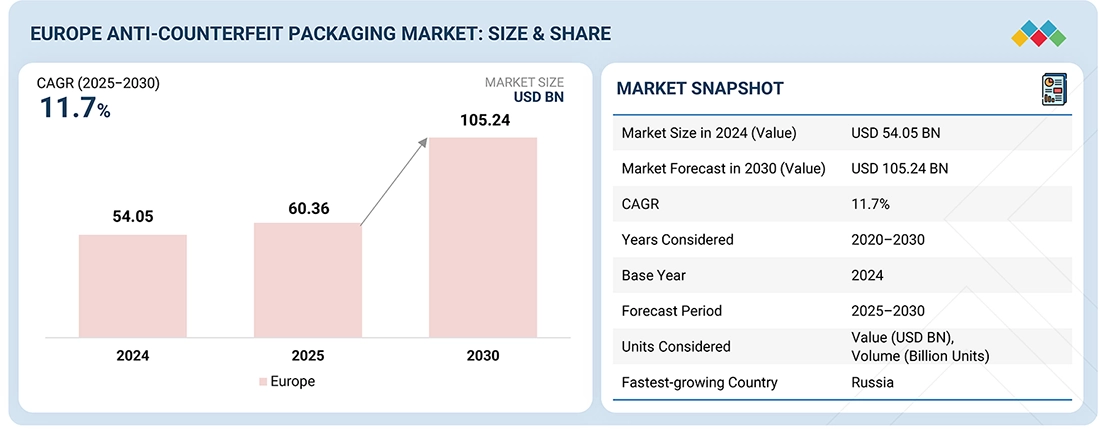
Source: Secondary Research, Interviews with Experts, MarketsandMarkets Analysis
The anti-counterfeit packaging market in Europe is projected to reach USD 105.24 billion in 2030 from USD 60.36 billion in 2025, at a CAGR of 11.7% from 2025 to 2030. The market is projected to experience robust growth during the forecast period, driven by increasing concerns over product authenticity across pharmaceuticals, luxury goods, food and beverage, electronics & electricals, and other industries. Industries are increasingly adopting anti-counterfeit solutions because they provide brand protection and ensure consumer safety through advanced track-and-trace capabilities at critical supply chain points, maintaining product integrity throughout distribution networks. One of the major growth factors is the stringent regulatory framework established by the European Medicines Agency and the EU Falsified Medicines Directive, which requires industries to implement serialization, authentication, and tamper-evident packaging technologies. The rapid growth of e-commerce, coupled with rising cross-border trade and sophisticated counterfeiting operations, is further accelerating market adoption. Anti-counterfeit technologies such as holograms, RFID tags, smart labels, blockchain integration, and color-shifting inks are gaining traction due to their ability to offer real-time verification, supply chain transparency, and consumer engagement capabilities. Moreover, industries are prioritizing solutions that enhance brand reputation and comply with traceability requirements, aligning with the European Union's commitment to consumer protection and market surveillance initiatives.
KEY TAKEAWAYS
-
BY COUNTRYRussia is expected to grow fastest, with a CAGR of 12.5%, driven by stringent regulatory reforms, proliferation of illicit trade, rapid digitalization of supply chains, and strong government-led track-and-trace mandates.
-
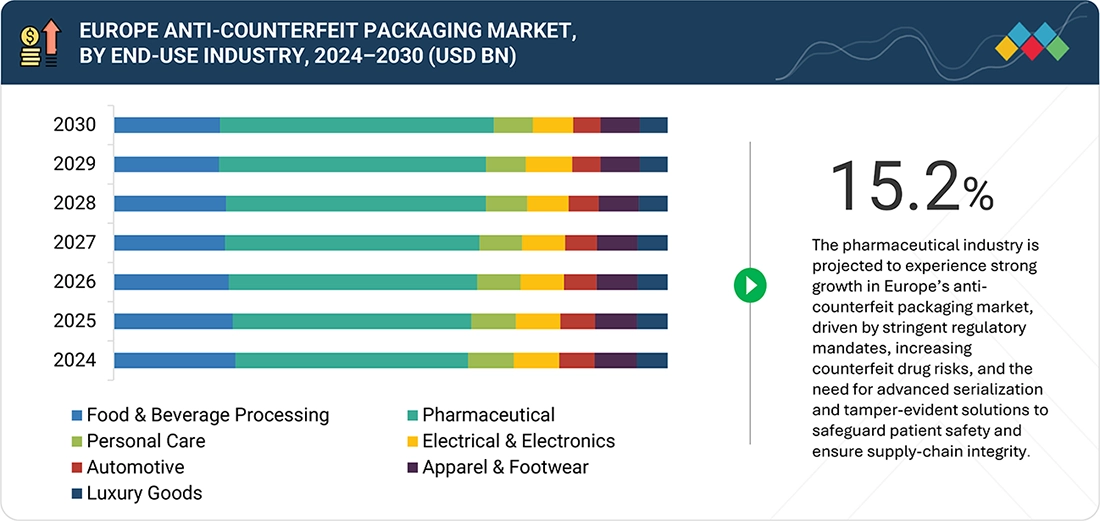
BY END-USE INDUSTRYThe pharmaceutical segment holds the largest share in the Europe anti-counterfeit packaging market, driven by stringent regulatory frameworks, rising threats of falsified medicines, and the need for end-to-end product authentication.
-
BY TECHNOLOGYMass encoding holds the largest share of the anti-counterfeit packaging market in Europe due to its scalability, cost-efficiency, and strong alignment with the region’s regulatory requirements for product serialization and traceability.
-
COMPETITIVE LANDSCAPEITL - Intelligent Label Solutions (UK), SICPA (Switzerland), AlpVision (Switzerland), Avery Dennison(US), and Zebra Technologies (US) are leading companies of the market. These companies are pursuing both organic and inorganic growth strategies, such as product launches, acquisitions, and expansions, to increase their market presence.
The anti-counterfeit packaging market in Europe is expected to grow at a strong pace, driven by the rising need for secure, traceable, and brand-protecting solutions across fast-expanding end-use industries such as pharmaceuticals, luxury goods, food and beverage, and consumer electronics. With European industries increasingly relying on sophisticated supply chain networks and sensitive distribution environments, the demand for integrated "track-and-trace" authentication systems has surged to ensure product authenticity at the exact location of consumption. The growing establishment of e-commerce platforms, cross-border trade operations within the EU, and grey market channels has further accelerated adoption, as even minimal security gaps can affect brand reputation and consumer trust. European industrial sectors facing escalating counterfeit threats are turning to anti-counterfeit packaging as a reliable solution to maintain regulatory compliance and operational brand integrity. The region's emergence as a target for counterfeit products due to high consumer spending power, premium brand concentration, and complex distribution networks is requiring stringent product authentication standards.
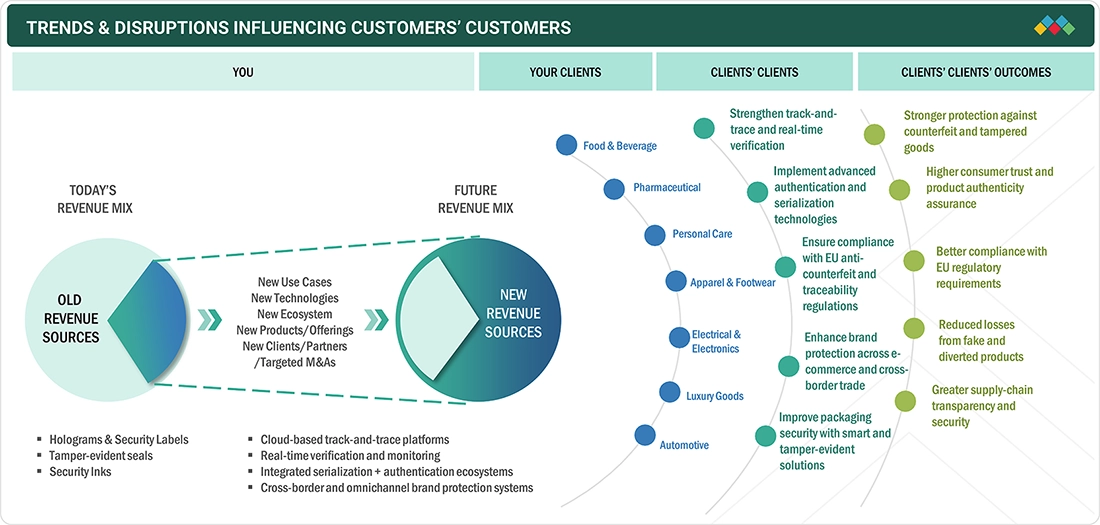
TRENDS & DISRUPTIONS IMPACTING CUSTOMERS' CUSTOMERS
The impact on consumers’ business emerges from customer trends or disruptions. Hot belts are the clients of anti-counterfeit packaging manufacturers, and target applications are the clients of anti-counterfeit packaging manufacturers. Shifts, which are changing trends or disruptions, will impact the revenues of end users. The revenue impact on end users will affect the revenue of hotbeds, which will further affect the revenues of anti-counterfeit packaging manufacturers
Source: Secondary Research, Interviews with Experts, MarketsandMarkets Analysis
MARKET DYNAMICS

Level
-
Stringent Regulatory Frameworks and Serialization Mandates

-
Rising Counterfeit Incidents Across Pharmaceutical, Food, and Consumer Goods Sectors


Level
-
High Implementation and Integration Costs

-
Technical Complexity and Lack of Standardization Across Countries


Level
-
Expansion of Digital Authentication and Connected Packaging

-
Growth of E-commerce and Cross-Border Trade Security Requirements


Level
-
Fragmented Supply Chains and Multi-Country Compliance Complexity

-
Counterfeiters’ Rapid Adoption of Sophisticated Duplication Techniques

Source: Secondary Research, Interviews with Experts, MarketsandMarkets Analysis
Driver: High Implementation and Integration Costs
Europe’s anti-counterfeit packaging market is strongly driven by increasingly stringent regulatory frameworks designed to enhance product authentication, supply-chain visibility, and consumer safety. The EU Falsified Medicines Directive (FMD), General Product Safety Regulation (GPSR), and industry-specific mandates across pharmaceuticals, food & beverage, medical devices, and cosmetics require unit-level serialization, tamper-evident features, and secure tracking systems. These regulations compel manufacturers to adopt advanced anti-counterfeit technologies such as mass encoding, RFID tagging, forensic markers, and holographic seals to ensure compliance and reduce the risk of product diversion. As European governments intensify market surveillance and impose stricter penalties for non-compliance, industries are accelerating investments in robust packaging innovations that support real-time verification and end-to-end traceability. The combined pressure of regulatory enforcement and rising consumer demand for transparency is strengthening the adoption of secure packaging, making advanced anti-counterfeit systems indispensable in Europe’s modern supply-chain infrastructure.
Restraint: Stringent Water Quality Regulations and Compliance Requirements
Despite growing adoption, the Europe anti-counterfeit packaging market faces notable restraints due to high initial investment and integration costs associated with advanced security systems. Implementing serialization lines, high-resolution printing systems, RFID infrastructure, or forensic marking technologies often requires substantial capital expenditure, particularly for small and medium-sized manufacturers. Additionally, ongoing costs related to system upgrades, database maintenance, regulatory audits, and staff training further elevate total ownership expenses. Integrating new authentication technologies into existing packaging lines can extend project timelines and necessitate equipment modifications, increasing overall operational complexity. For highly regulated industries such as pharmaceuticals, compliance-related documentation and validation procedures add further financial burden. As a result, cost-sensitive companies struggle to adopt comprehensive anti-counterfeit solutions at scale, slowing market penetration across certain regions and industry segments.
Opportunity: Expansion of Digital Authentication and Connected Packaging
Europe’s rapid digital transformation is creating major opportunities for scalable, connected anti-counterfeit packaging solutions. The growing integration of cloud-based databases, mobile authentication apps, NFC-enabled smart packaging, and blockchain traceability systems is enabling real-time verification at every stage of the supply chain. These digital solutions allow consumers, distributors, and regulatory authorities to instantly authenticate products using smartphones or scanning devices, strengthening trust and reducing the risk of counterfeit infiltration. Digital packaging also supports value-added functionalities such as product recalls, supply-chain analytics, and consumer engagement programs. As European industries move toward Industry 4.0, smart factories, and data-driven production environments, demand for digitally integrated anti-counterfeit systems is accelerating. The increasing acceptance of digital verification across pharmaceuticals, personal care, food, and luxury goods presents significant growth potential for packaging companies offering connected, intelligent, and service-based authentication solutions.
Challenge: Fragmented Supply Chains and Multi-Country Compliance Complexity
Europe’s highly interconnected yet fragmented supply-chain ecosystem presents significant challenges for the implementation of uniform anti-counterfeit packaging practices. Products often move through multiple distribution centers, logistics partners, repackaging sites, and border checkpoints before reaching consumers, increasing the risk of tampering or substitution. Ensuring consistent authentication across these diverse touchpoints requires harmonized standards, centralized databases, and collaborative verification systems, which remain difficult to standardize across countries. Differences in national regulations, serialization requirements, customs inspections, and data-sharing policies complicate the achievement of seamless traceability. Managing compliance across this fragmented landscape imposes administrative burdens on manufacturers, distributors, and regulatory authorities. These complexities make it challenging to achieve full supply-chain transparency, slowing the adoption of advanced anti-counterfeit technologies across Europe.
EUROPE ANTI-COUNTERFEIT PACKAGING MARKET: COMMERCIAL USE CASES ACROSS INDUSTRIES
| COMPANY | USE CASE DESCRIPTION | BENEFITS |
|---|---|---|
 |
Sanofi Europe – Multi-Country Pharmaceutical Serialization Program strengthened its anti-counterfeit packaging infrastructure across manufacturing sites in France, Germany, and Italy to comply with EU Falsified Medicines Directive (FMD) requirements and address rising counterfeit infiltration through parallel trade routes. The company implemented advanced serialization lines with high-resolution DataMatrix coding, tamper-evident carton sealing, and automated vision-inspection modules. Packaging lines were upgraded to enable unit-level traceability and real-time data exchange with the European Medicines Verification System (EMVS). The project required integration of production-floor systems, enterprise-level databases, and cross-border verification networks to ensure traceability from manufacturing to pharmacies. | Achieved 100% compliance with EU-FMD safety features across all European markets, eliminating risk of product rejection at national verification hubs. Reduced counterfeit substitution risk by over 60% through unit-level authentication and end-to-end verification. Improved supply-chain visibility allowed Sanofi to detect anomalies in distribution routes within minutes rather than days. Enhanced patient safety and regulatory confidence while enabling seamless recall management and faster batch verification across 28 EU markets. |
 |
Nestlé Purina – Premium Pet Food Anti-Counterfeit Labeling Program was launched across European markets after counterfeit pet-nutrition products began circulating on online marketplaces. The company deployed multi-layered anti-counterfeit packaging for premium pet food SKUs, integrating NFC-enabled tamper-evident seals, encrypted QR codes, micro-text labeling, and dynamic serialization codes linked to a cloud-based authentication platform. Each product pack was embedded with consumer-scannable verification features, allowing buyers to validate product authenticity via smartphone. The system was rolled out across production facilities in Switzerland and Germany, with centralized monitoring of scan patterns to identify suspicious distribution clusters. | Reduced counterfeit listings across major online retailers by over 50% within the first year of deployment. Improved consumer trust and engagement through mobile authentication, with more than 1.8 million product scans recorded across Europe. Enabled early detection of grey-market diversion by identifying abnormal scan behavior in high-risk geographies. Strengthened brand protection for premium SKUs while enhancing supply-chain transparency and customer experience. |
Logos and trademarks shown above are the property of their respective owners. Their use here is for informational and illustrative purposes only.
MARKET ECOSYSTEM
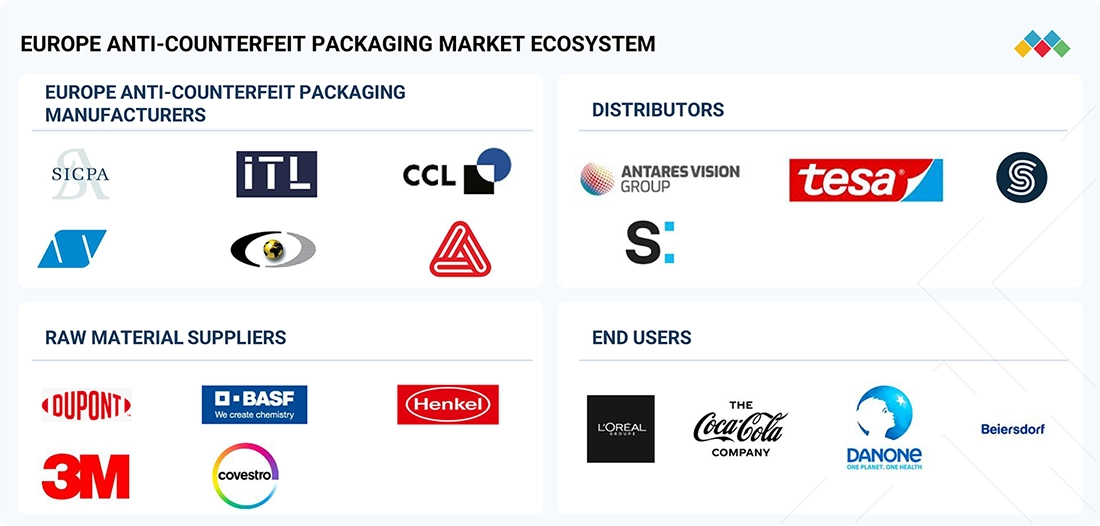
The market ecosystem of anti-counterfeit packaging in Europe is shaped by an integrated value chain involving raw material suppliers, security-feature developers, printing and converting specialists, technology vendors, and brand owners across industries. Key components, such as security inks, holographic foils, tamper-evident seals, RFID/NFC tags, serialized codes, blockchain identifiers, and digital verification labels, are engineered and combined to provide multilayer protection against counterfeiting, tampering, and unlawful diversion. Packaging converters configure and optimize these features based on product sensitivity, regulatory requirements, and supply-chain complexity, followed by rigorous authentication testing, regulatory validation, and compatibility assessments with existing packaging lines. Deployment methods, including high-resolution digital printing, variable-data coding, secure lamination, and embedded electronic tagging, ensure consistent performance across applications in pharmaceuticals, food and beverages, personal care, electronics, automotive, luxury goods, and others. Finished solutions support compliance with stringent European regulations such as the EU Falsified Medicines Directive (FMD), General Product Safety Regulation (GPSR), and industry-specific authentication standards. Market growth is further influenced by rising counterfeit incidents, regulatory enforcement, sustainability transitions in packaging materials, and digital transformation initiatives. The integration of technologies such as serialization platforms, cloud-based verification systems, machine-vision inspection, IoT-enabled tracking, and blockchain traceability enhances supply-chain transparency, consumer trust, operational efficiency, and product security throughout the European value chain.
Logos and trademarks shown above are the property of their respective owners. Their use here is for informational and illustrative purposes only.
MARKET SEGMENTS
Source: Secondary Research, Interviews with Experts, MarketsandMarkets Analysis
Europe Anti-Counterfeit Packaging Market, By Technology
In 2024, mass encoding accounted for the largest share of Europe's anti-counterfeit packaging market due to its critical role in enabling large-scale serialization, aggregation, and supply-chain traceability across highly regulated end-use industries such as pharmaceuticals, food & beverages, electronics, and luxury goods. Europe’s stringent regulatory frameworks, particularly the EU Falsified Medicines Directive (FMD), Tobacco Products Directive (TPD), and rising adoption of GS1-compliant serialization standards, require billions of individual product units to be assigned unique, machine-readable digital identities, making mass encoding an essential capability for brand owners and packaging converters. The technology enables high-speed printing and assignment of barcodes, QR codes, data matrices, RFID/NFC identifiers, and digital watermarks directly on packaging lines without disrupting production throughput, which is vital for Europe’s advanced and automation-intensive packaging ecosystem. The rapid expansion of e-commerce and cross-border trade in Europe has further amplified the need for unit-level product authentication, driving manufacturers toward scalable, high-accuracy encoding platforms. Increasing investments in smart packaging lines, integration of track-and-trace systems, and the move toward digital product passports under the EU Green Deal have strengthened the demand for mass encoding as a foundational technology.
Europe Anti-Counterfeit Packaging Market, By End-use Industry
In 2024, the pharmaceutical industry accounted for the largest share of the anti-counterfeit packaging market in Europe, driven by stringent regulatory requirements, high product vulnerability, and strong enforcement mechanisms aimed at protecting patient safety. Europe faces one of the world’s most complex and highly regulated pharmaceutical supply chains, making authentication and traceability essential components of compliance. The implementation of the EU Falsified Medicines Directive (FMD) has been a major catalyst, mandating unit-level serialization, tamper-evident packaging, and end-to-end verification through the European Medicines Verification System (EMVS). These regulations require every prescription medicine packaging sold in Europe to carry a unique identifier and security features that prevent refilling, resealing, or unauthorized substitution, directly driving the adoption of mass encoding, tamper-evident seals, holograms, and RFID/QR-based track-and-trace technologies. Rising counterfeit drug incidents, particularly involving biologics, specialty drugs, and online pharmacies, have further accelerated investment in advanced anti-counterfeit packaging. Additionally, the growth of the contract manufacturing (CMO/CRO) sector, expansion of cross-border e-commerce for OTC medicines, and increased emphasis on patient safety by national health authorities have boosted demand for authentication technologies. As pharmaceutical companies continue to digitalize their supply chains, integrate GS1 standards, and adopt smart packaging for improved visibility, the industry remains the dominant consumer of anti-counterfeit packaging solutions across Europe.
EUROPE ANTI-COUNTERFEIT PACKAGING MARKET: COMPANY EVALUATION MATRIX
In the Europe anti-counterfeit packaging market matrix, SICPA (Star) leads the market. The company has established a highly resilient and influential presence in key sectors, including pharmaceuticals, food and beverage, cosmetics, personal care, luxury goods, and high-value industrial products. Leveraging its extensive portfolio of security inks, authentication markers, serialization platforms, tamper-evident technologies, and digital traceability systems, and SICPA delivers end-to-end protection against counterfeiting and illicit trade. Its strong emphasis on innovation, supported by advanced R&D labs, integrated digital security solutions, and compliance-driven design, enables seamless adoption across regulated and consumer-facing industries. With robust implementation capabilities, real-time monitoring tools, and a comprehensive global service network, SICPA continues to shape the competitive landscape of the Europe anti-counterfeit packaging market by ensuring high-performance, scalable, and future-ready security solutions.
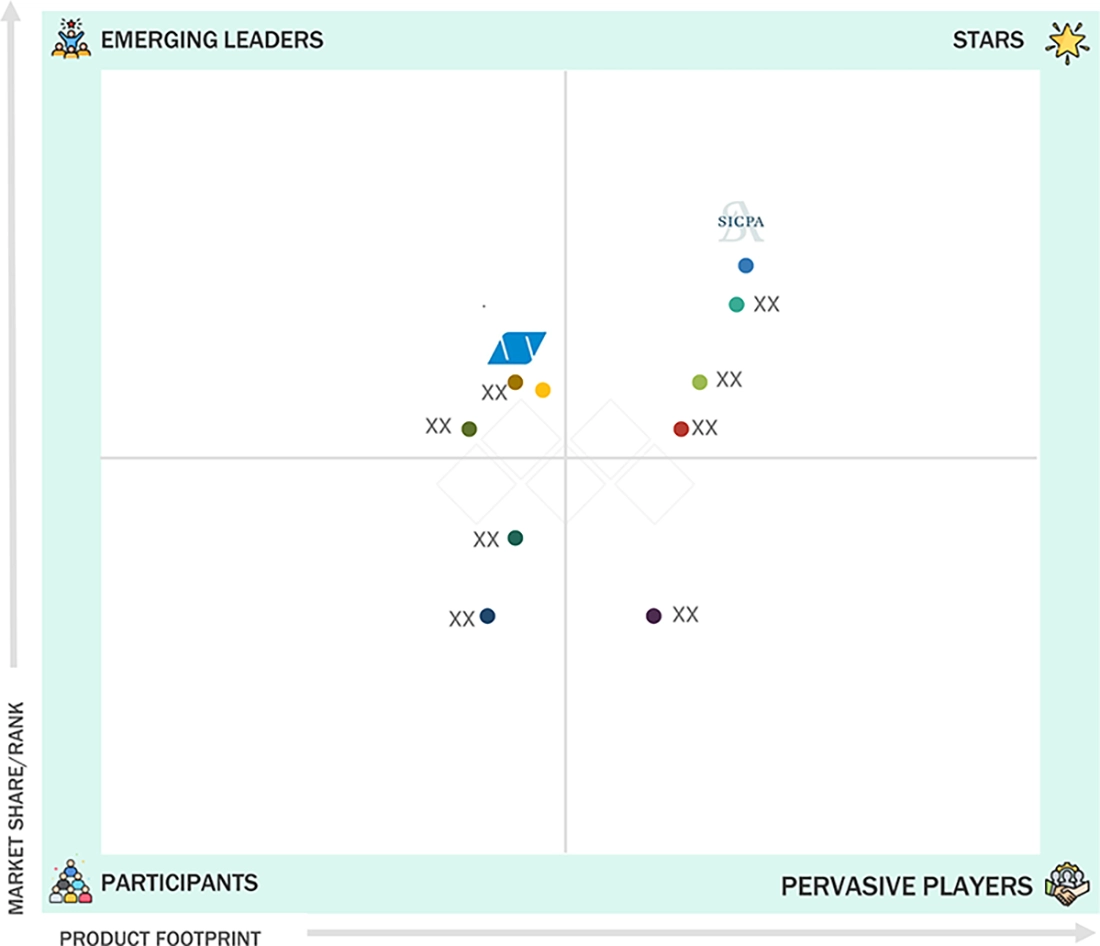
Source: Secondary Research, Interviews with Experts, MarketsandMarkets Analysis
KEY MARKET PLAYERS
- SICPA (Switzerland)
- AlpVision (Switzerland)
- Avery Dennison (US)
- CCL Industries (Canada)
- 3M (US)
- SATO Corporation (Japan)
- Zebra Technologies (US)
- ITL - Intelligent Label Solutions (UK)
- Atlantic Zeiser (Germany)
- Tageos (France)
- Schreiner Group (Germany)
- Nedap Identification Systems (Netherlands)
- Infineon Technologies (Germany)
MARKET SCOPE
| REPORT METRIC | DETAILS |
|---|---|
| Market Size in 2024 (Value) | USD 54.05 Billion |
| Market Forecast in 2030 (Value) | USD 105.24 Billion |
| Growth Rate | CAGR of 11.7% from 2025–2030 |
| Years Considered | 2020–2030 |
| Base Year | 2024 |
| Forecast Period | 2025–2030 |
| Units Considered | Value (USD Billion), Volume (Billion Units) |
| Report Coverage | Revenue forecast, company ranking, competitive landscape, growth factors, and trends. |
| Segments Covered | By Technology: Mass Encoding, RFID, Tamper Evidence, Holograms, Forensic Markers, and Other Technologies By End-Use Industry: Food & Beverage, Pharmaceuticals, Personal Care, Electrical & Electronics, Automotive, Apparel & Footwear, Luxury Goods, and Other End-use Industries |
| Countries Covered | Germany, France, UK, Italy, Russia, Spain, and Rest of Europe |
WHAT IS IN IT FOR YOU: EUROPE ANTI-COUNTERFEIT PACKAGING MARKET REPORT CONTENT GUIDE
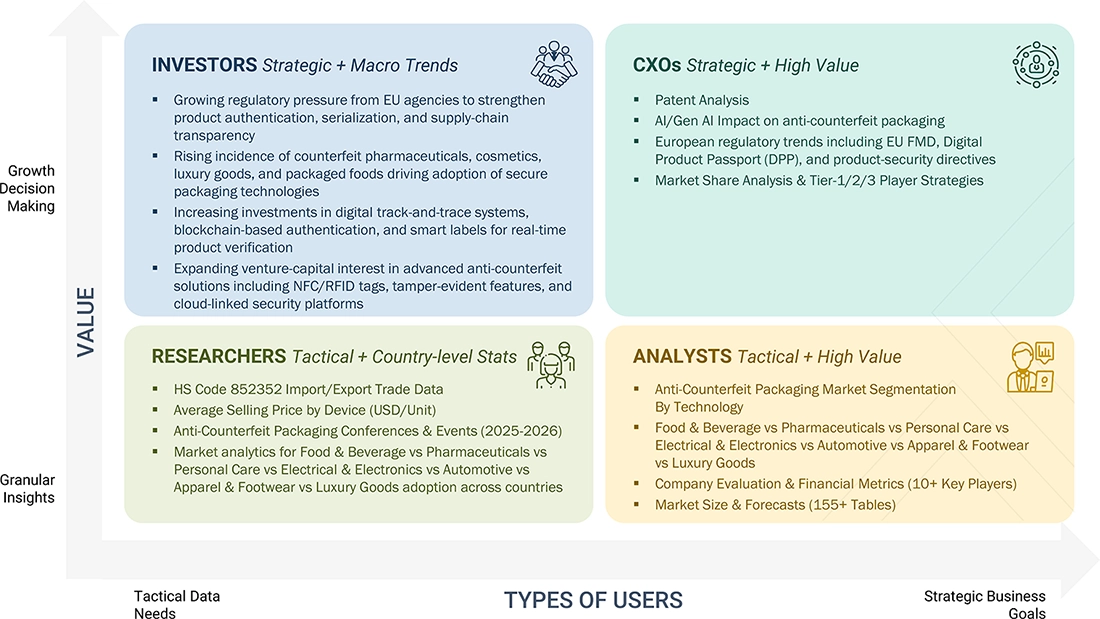
DELIVERED CUSTOMIZATIONS
We have successfully delivered the following deep-dive customizations:
| CLIENT REQUEST | CUSTOMIZATION DELIVERED | VALUE ADDS |
|---|---|---|
| Authentication and Brand Protection Market | • Detailed company profiles of authentication and brand protection competitors (financials, product portfolio) • Market segmentation by technology (overt, covert, digital, forensic) • Market segmentation by offering (security labels, holograms, RFID/NFC, barcodes, QR Codes) Market Segmentation by authentication mode (smartphone, blockchain) Market Segmentation by application (electronics, pharmaceuticals, automobiles, food & beverages, apparel, luxury goods, cosmetics, and other applications) | • Identified & profiled 20+authentication and brand protection companies • Track adoption trends in high-growth application areas (such as electronics, pharmaceuticals, automobiles, food & beverages, apparel, cosmetics) |
RECENT DEVELOPMENTS
- June 2023 : CCL Industries Inc., announced the signing of a binding agreement to acquire Pouch Partners s.r.l., Italy ("Pouch Partners") from Pouch Partners AG, Switzerland, a company owned by Swiss-headquartered Capri-Sun Group.
- September 2022 : SICPA SA and UbiQD, Inc. announced the expansion of their partnership in the development of anti-counterfeit security inks based on UbiQD's quantum dot technology. The two companies have been co-developing QD-based security features for the past six years.
- June 2022 : Intelligent Label Solutions launched a 360RFID solution that provides businesses with a comprehensive package to adopt and integrate RFID technology into their operations, offering inlays, hardware, software, and professional support.
- May 2022 : CCL Industries Inc., announced the acquisition of Floramedia Group B.V. ("Floramedia"), a company, based in Westzaan with in-house tag & label creation and production, complemented by sales offices in seven countries.
- May 2022 : CCL Industries Inc. announced plans for a significant expansion at its Innovia business unit near Leipzig in Germany. A new 8-meter-wide multi-layer co-extrusion line will produce highly engineered thin gauge label films to support growing, sustainability-driven demand for lower resin content materials. The new technology is unique for label films, with 36,000 tons of annual capacity designed for best-in-class energy efficiency.
Table of Contents
 Exclusive indicates content/data unique to MarketsandMarkets and not available with any competitors.
Methodology
The study involved four major activities for estimating the current size of the Europe anti-counterfeit packaging market. Exhaustive secondary research was conducted to gather information on the market, the peer market, and the parent market. The next step was to validate these findings, assumptions, and sizes with the industry experts across the value chain of Europe anti-counterfeit packaging through primary research. Both the top-down and bottom-up approaches were employed to estimate the overall size of the Europe anti-counterfeit packaging market. After that, market breakdown and data triangulation procedures were used to determine the size of different segments and sub-segments of the market.
Secondary Research
In the secondary research process, various secondary sources such as Hoovers, Factiva, Bloomberg BusinessWeek, and Dun & Bradstreet were referred to, to identify and collect information for this study on the Europe anti-counterfeit packaging market. These secondary sources included annual reports, press releases & investor presentations of companies, white papers, certified publications, articles by recognized authors, regulatory bodies, trade directories, and databases.
Primary Research
Various primary sources from both the supply and demand sides of the Europe anti-counterfeit packaging market were interviewed to obtain qualitative and quantitative information. The primary sources from the supply-side included industry experts, such as Chief Executive Officers (CEOs), vice presidents, marketing directors, sales professionals, and related key executives from various leading companies and organizations operating in the Europe anti-counterfeit packaging industry.
To know about the assumptions considered for the study, download the pdf brochure
Market Size Estimation
Both the top-down and bottom-up approaches were used to estimate and validate the size of the Europe anti-counterfeit packaging market. These approaches were also used extensively to estimate the size of various dependent segments of the market. The research methodology used to estimate the market size included the following details:
- The key players were identified through extensive secondary research.
- The industry’s supply chain and market size, in terms of value, were determined through primary and secondary research processes.
- All percentage shares, split, and breakdowns were determined using secondary sources and verified through primary sources.
- All possible parameters that affect the markets covered in this research study were accounted for, viewed in extensive detail, verified through primary research, and analyzed to obtain the final quantitative and qualitative data.
- The research includes the study of reports, reviews, and newsletters of key industry players, along with extensive interviews with key officials, such as directors and marketing executives.
Data Triangulation
After arriving at the overall market size from the estimation process explained above, the total market was split into several segments and sub-segments. The data triangulation and market breakdown procedures were employed, wherever applicable, to complete the overall market engineering process and arrive at the exact statistics for all segments and sub-segments of the Europe anti-counterfeit packaging market. The data was triangulated by studying various factors and trends from both the demand- and supply-side.
In addition, the market size was validated by using both the top-down and bottom-up approaches. Then, it was verified through primary interviews. Hence, for every data segment, there are three sources—top-down approach, bottom-up approach, and expert interviews. The data were assumed to be correct when the values arrived at from the three sources matched.
Market Definition
Anti-counterfeiting involves various methods and techniques to protect products from being illegally duplicated, distributed, or sold. Anti-counterfeit packaging encompasses any packaging that integrates features or technologies designed to prevent unauthorized parties from copying, tampering with, or diverting the product. These features can be visible, hidden, or forensic, based on the required level of security and verification. The technologies used in anti-counterfeit packaging are mass encoding, RFID, holograms, forensic markers, and others. These technologies can be utilized in various types of packaging, such as bottles, cartons, and bags. They can either be integrated into the packaging materials themselves or added as separate components. The anti-counterfeit packaging solution is widely used in the end-use industries such as pharmaceutical, personal care, and food & beverage.
Key Stakeholders
- Raw material suppliers
- Packaging manufacturers & suppliers
- Logistics & shipment companies
- Technology companies
- Traders & distributors of anti-counterfeit and authentication packaging
- Commercial R&D institutions
- Industry associations and regulatory bodies
- Retailers
- End users
Research Objectives
- To estimate and forecast the Europe anti-counterfeit packaging market, in terms of value and volume
- To provide detailed information about the major factors (drivers, restraints, opportunities, and challenges) influencing the market growth
- To define, describe, and forecast the market size, based on technology, end-use industry and region
- To strategically analyze micro markets, with respect to individual growth trends, prospects, and their contribution to the total market
- To analyze growth opportunities in the market for stakeholders and provide details on the competitive landscape for market leaders
- To strategically profile key players and comprehensively analyze their market shares and core competencies
- To analyze competitive developments, such as acquisition, expansion, and new product development in the Europe anti-counterfeit packaging market
Available Customizations
With the given market data, MarketsandMarkets offers customizations according to client-specific needs.
The following customization options are available for the Europe anti-counterfeit packaging report:
Product Analysis
- Product matrix, which offers a detailed comparison of the product portfolio of companies
Regional Analysis
- Further analysis of the Europe anti-counterfeit packaging market for additional countries
Company Information
- Detailed analysis and profiling of additional market players (up to five)


Personalize This Research
- Triangulate with your Own Data
- Get Data as per your Format and Definition
- Gain a Deeper Dive on a Specific Application, Geography, Customer or Competitor
- Any level of Personalization
Let Us Help You
- What are the Known and Unknown Adjacencies Impacting the Europe Anti-Counterfeit Packaging Market
- What will your New Revenue Sources be?
- Who will be your Top Customer; what will make them switch?
- Defend your Market Share or Win Competitors
- Get a Scorecard for Target Partners

Custom Market Research Services
We Will Customise The Research For You, In Case The Report Listed Above Does Not Meet With Your Requirements
Get 10% Free CustomisationTESTIMONIALS






Growth opportunities and latent adjacency in Europe Anti-Counterfeit Packaging Market