Europe Automated Material Handling Equipment Market

Europe Automated Material Handling Equipment Market by Product (Industrial Robots, Autonomous Mobile Robots, Automated Guided Vehicles, Automated Storage & Retrieval Systems (ASRS), Cranes, Conveyors & Sortation Systems, WMS) - Forecast to 2030




OVERVIEW
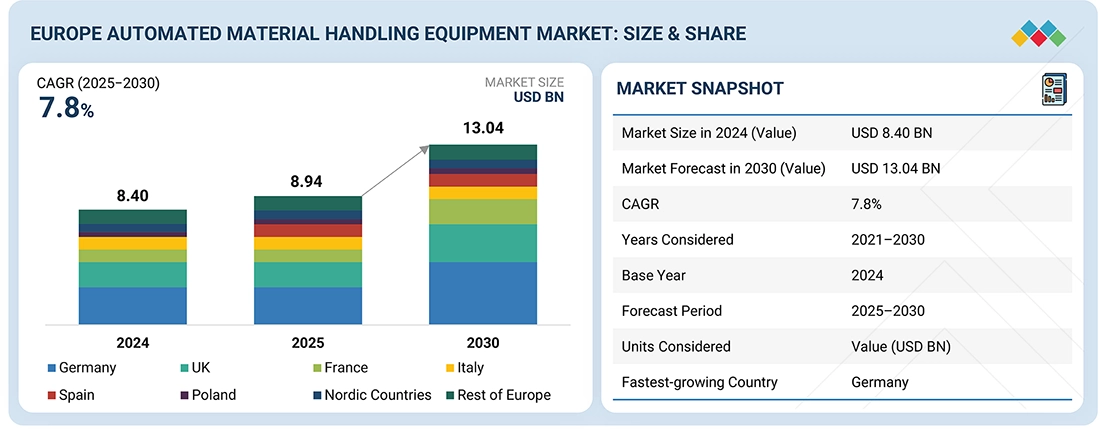
Source: Secondary Research, Interviews with Experts, MarketsandMarkets Analysis
The Europe automated material handling equipment market is projected to grow from USD 8.94 billion in 2025 to USD 13.04 billion by 2030, registering a CAGR of 7.8%. Market expansion in Europe is being driven by accelerated warehouse automation as e-commerce penetration deepens and labor constraints intensify across major logistics hubs such as Germany, the Netherlands, and France. Companies are investing heavily in automated systems such as AGVs, ASRS, AMRs, automated forklifts, and conveyor systems to support high-volume fulfilment, cross-border distribution, and next-day delivery commitments. Advancements in robotics, IoT-enabled fleet management, and AI-powered WMS/WES solutions are improving real-time visibility, accuracy, and operational uptime in European facilities. Additionally, the push toward decarbonization, energy-efficient material handling, and EU-backed digitalization incentives is further strengthening the adoption of automated material handling equipment across manufacturing, retail, and 3PL environments.
Market Size & Forecast
• 2025 Market Size: USD 8.94 Billion
• 2030 Projected Market Size: USD 13.04 Billion
• CAGR (2025-2030): 7.8%
• WMS Segment: Highest CAGR
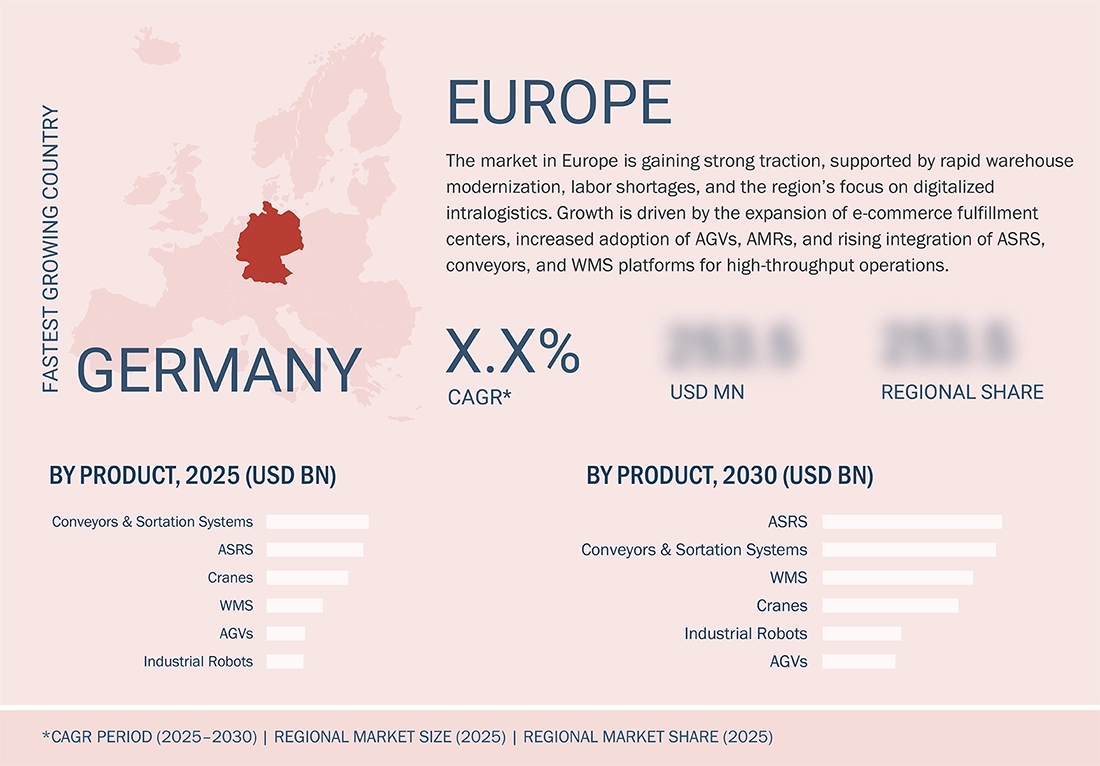
• Germany: Largest Market Share
KEY TAKEAWAYS
-
BY COUNTRYGermany led the Europe automated material handling equipment market in 2024 with a share of 34.4%.
-
BY PRODUCTThe WMS segment is projected to grow at the highest CAGR of 15.2% from 2025 to 2030.
-
BY INDUSTRYThe e-commerce & retail industry segment is expected to witness a high CAGR during the forecast period.
-
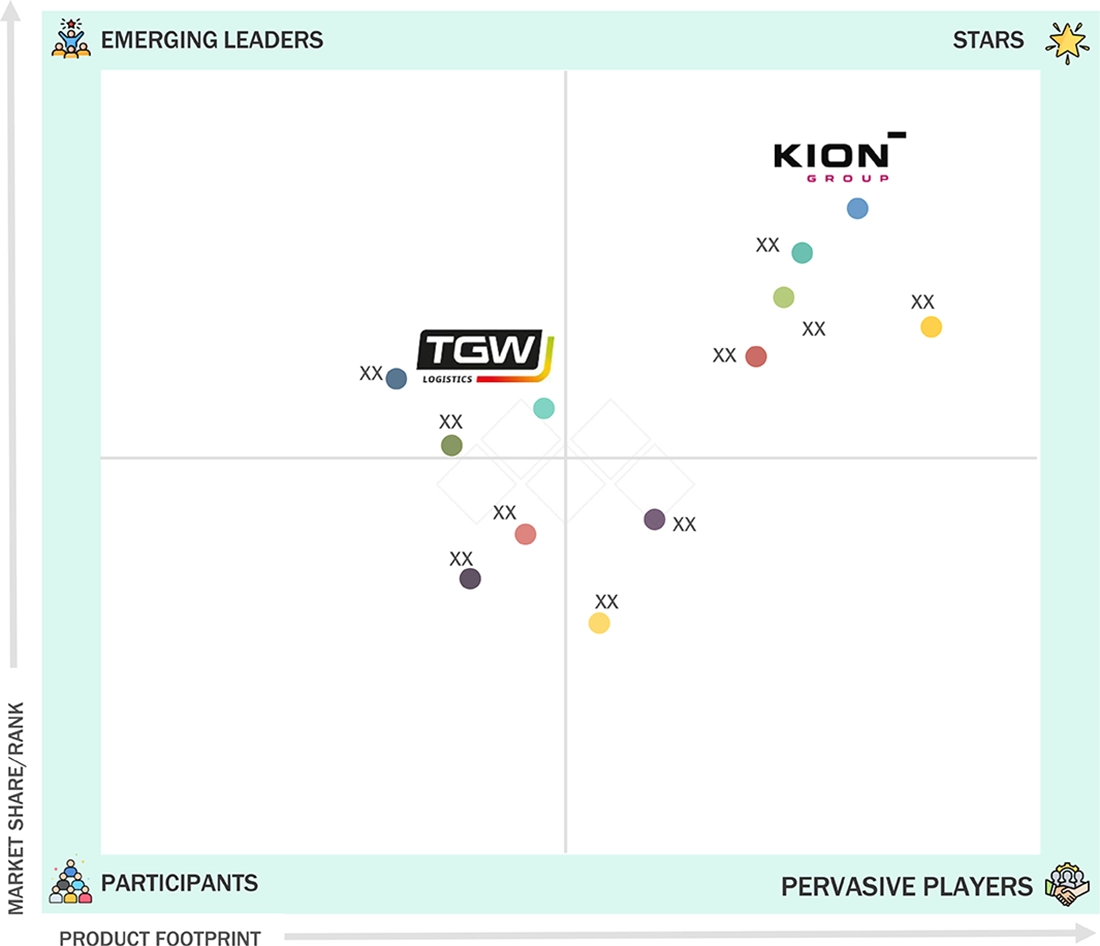
COMPETITIVE LANDSCAPEKION Group AG and Jungheinrich AG were identified as some of the star players in the Europe automated material handling equipment market, given their strong market share and extensive product footprint.
The Europe automated material handling equipment market is evolving rapidly as the region transitions toward data-driven logistics and resilient supply chains. Growing emphasis on sustainability is pushing warehouses to replace conventional handling equipment with energy-efficient automation, including electric forklifts, low-emission AGVs, and regenerative conveyor systems. Stringent labor regulations and higher wage structures are prompting operators to deploy high-density ASRS and goods-to-person systems to maximize space utilization. Adoption is further accelerated by the expansion of pan-European distribution corridors and the rise of nearshoring manufacturing in Eastern Europe. With digital compliance frameworks, cybersecurity readiness, and seamless ERP-WMS integration becoming operational priorities, advanced material handling solutions are emerging as a core enabler of stable fulfilment capacity, faster order processing, and future-ready warehouse infrastructure across Europe.
TRENDS & DISRUPTIONS IMPACTING CUSTOMERS' CUSTOMERS
The Europe automated material handling equipment market is rapidly reshaping warehousing, manufacturing, and cross-border distribution networks as companies intensify automation to manage fluctuating demand, labor scarcity, and stricter sustainability requirements. Ongoing industrial digitalization across the region, combined with a push toward smart factories and energy-efficient operations, is accelerating the transition from manual workflows to fully automated intralogistics. AI-driven orchestration, IoT-based asset tracking, and integrated WMS/WES systems are enhancing real-time decision-making control, inventory traceability, and resource utilization within European facilities. Growing adoption across pan-European e-commerce corridors, regional 3PL hubs, automotive clusters in Germany and Central Europe, and cold-chain food and pharma warehouses is enhancing order accuracy.
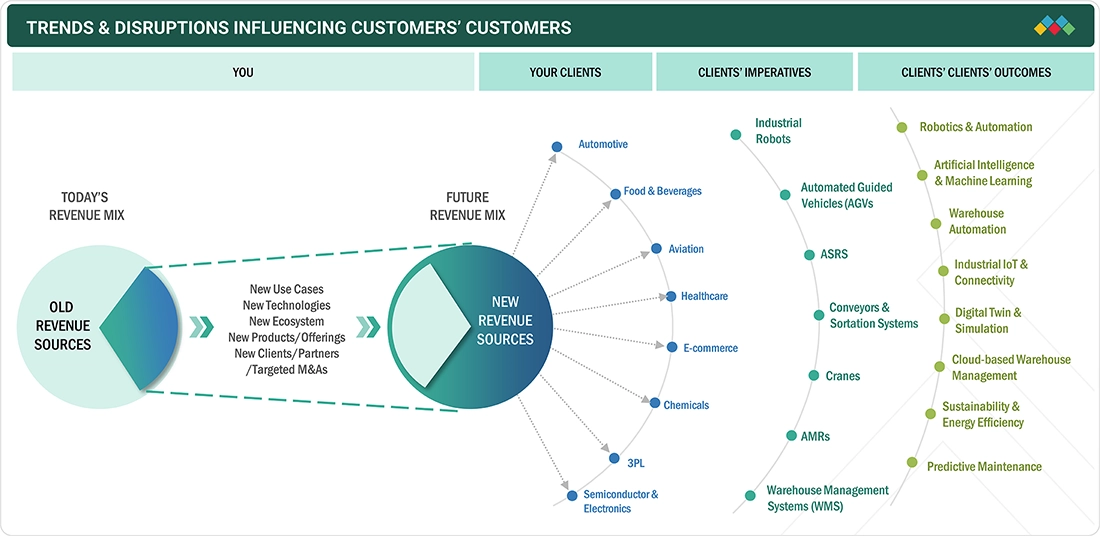
Source: Secondary Research, Interviews with Experts, MarketsandMarkets Analysis
MARKET DYNAMICS

Level
-
Focus on implementing mobile robots in logistics operations

-
Emphasis on efficient space utilization in warehouses


Level
-
Shortage of skilled workforce


Level
-
Growing demand for quick and efficient last-mile delivery in e-commerce

-
Rising demand for automated material handling solutions in healthcare sector


Level
-
Mitigating production and revenue losses from equipment downtime

Source: Secondary Research, Interviews with Experts, MarketsandMarkets Analysis
Driver: Focus on implementing mobile robots in logistics operations
The growing implementation of mobile robots across Europe logistics hubs is accelerating warehouse digitalization, supported by rising e-commerce volumes, labor shortages, and the shift toward goods-to-person fulfillment models. The increasing use of AMRs for picking, transport, sorting, and pallet movement is enhancing flexibility, scalability, and operational efficiency across distribution networks. As companies strive for faster delivery and space optimization, mobile robots are emerging as a key driver of modern intralogistics in Europe.
Restraint: Shortage of skilled workforce
The adoption in Europe is often slowed by the limited availability of technicians skilled in robotics integration, software configuration, and system troubleshooting. As automation becomes more complex, companies must invest in extensive training programs or depend on external service teams, which increases implementation costs and prolongs deployment timelines. Retaining experienced personnel is also challenging due to strong talent competition across automotive, manufacturing, and logistics sectors.
Opportunity: Growing demand for quick and efficient last-mile delivery in e-commerce
With dense urban populations, rising online shopping, and increasing expectations for same-day and next-day delivery, retailers and logistics providers are exploring AMRs and micro-fulfilment automation to reduce delivery time and improve operational efficiency. Urban micro-warehouses across the UK, Germany, and France are becoming key deployment sites, where AMRs can support order picking, parcel sorting, and short-range goods movement to complement human drivers.
Challenge: Mitigating production and revenue losses from equipment downtime
Equipment downtime remains a critical challenge as production interruptions lead to costly delays and reduced operational output. This impact is especially severe in high-volume industries such as automotive, food & beverage, and pharmaceuticals, where even short stoppages can result in significant revenue loss. Consequently, companies are pushed to invest more in predictive and preventive maintenance to ensure continuous system reliability.
europe-automated-material-handling-equipment-market: COMMERCIAL USE CASES ACROSS INDUSTRIES
| COMPANY | USE CASE DESCRIPTION | BENEFITS |
|---|---|---|
 |
KION delivers end-to-end intralogistics automation combining industrial trucks, AGVs/AMRs, ASRS, conveyors, sortation, and warehouse software through Dematic. It supports large fulfillment centers, automotive plants, and cold storage environments with scalable robotic solutions integrated with WMS/WCS and data orchestration platforms. | Enhances throughput with automated pallet and case handling. Reduces labor cost and downtime via sensor-driven monitoring and predictive maintenance. Accelerates order fulfillment for e-commerce and omnichannel logistics with flexible system expansions and modular automation upgrades. |
 |
KNAPP provides warehouse automation solutions, including shuttle-based ASRS, robotic picking, smart conveyors, AMRs, and WMS/WCS software. Its systems are widely deployed in retail, pharmaceuticals, grocery, and e-commerce distribution hubs, leveraging AI-driven picking and goods-to-person workflows with real-time visibility. | Improves order accuracy and picking productivity. Supports micro-fulfillment and high-speed distribution with energy-efficient automated storage. Enhances supply chain resilience through intelligent routing, analytics-based optimization, and reduced manual handling requirements. |
 |
SSI Schaefer offers integrated storage automation covering ASRS, pallet shuttles, conveyors, automated cranes, AGVs, and warehouse control systems. Solutions serve industrial manufacturing, FMCG, and logistics hubs with scalable modules aligned to high-density storage and fast material flow requirements. | Increases warehouse capacity utilization and reduces travel time in material movement. Enables high-performance distribution with reliable 24/7 automated operation. Lowers operational cost via end-to-end digitalization, maintenance planning, and energy-efficient automated handling. |
Logos and trademarks shown above are the property of their respective owners. Their use here is for informational and illustrative purposes only.
MARKET ECOSYSTEM
The Europe automated material handling equipment market comprises a strong network of automation OEMs, robotics innovators, ASRS specialists, and software providers supporting manufacturing and logistics efficiency. Leading players like KION Group AG, SSI Schäfer, Kardex, and TGW Logistics offer AMRs, AGVs, conveyors, ASRS, robotic palletizers, and warehouse software, with adoption driven by e-commerce, automotive, pharmaceuticals, and food & beverage sectors. The push for smart warehousing, Industry 4.0, and resilient supply chains is accelerating automation across the region.
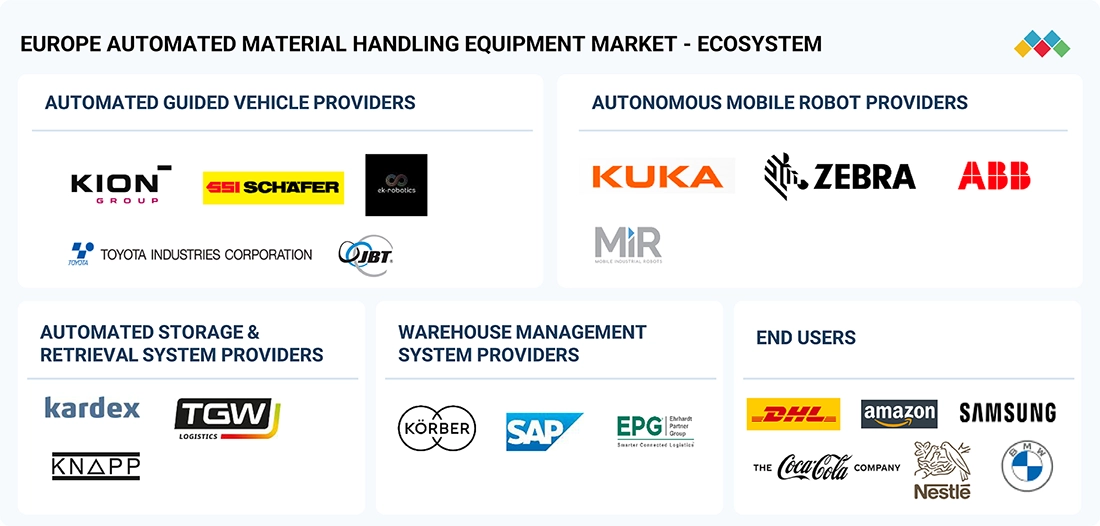
Logos and trademarks shown above are the property of their respective owners. Their use here is for informational and illustrative purposes only.
MARKET SEGMENTS
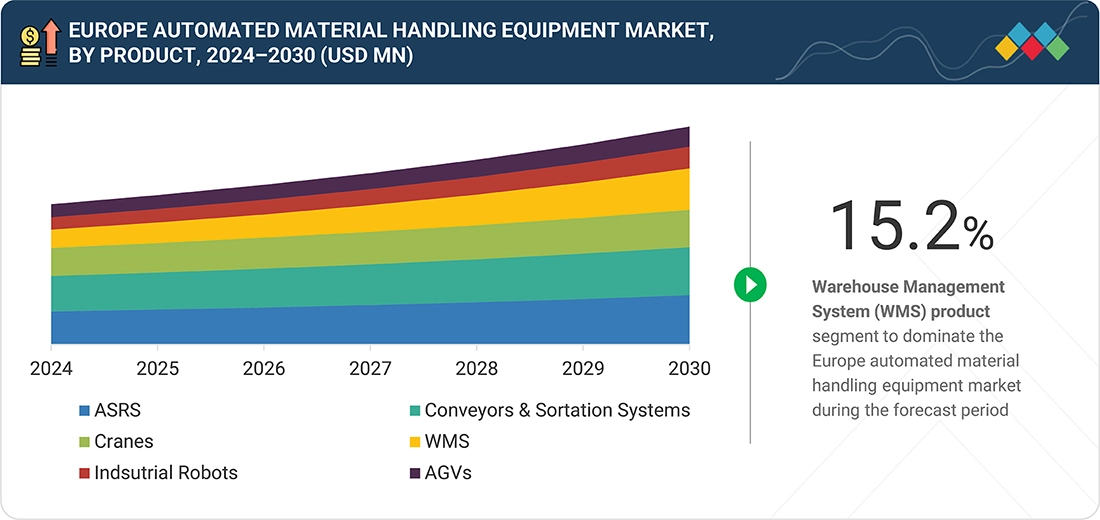
Source: Secondary Research, Interviews with Experts, MarketsandMarkets Analysis
Europe Automated Material Handling Equipment Market, by Product
The European industrial robots market is expected to grow at a significant CAGR, fueled by rising automation across automotive, electronics, and general manufacturing sectors. The growing demand for enhanced precision, higher productivity, and cost-efficient operations is driving adoption, as well as faster last-mile delivery demand, alongside labor shortages and the shift toward Industry 4.0. Increasing investments in smart factories and collaborative robot deployments are further accelerating market growth across Europe.
Europe Automated Material Handling Equipment Market, by System Type
The unit load material handling systems segment is expected to hold the largest share in the Europe automated material handling equipment market, driven by widespread adoption across e-commerce, retail, automotive, and manufacturing warehouses. Strong demand for palletized storage, case handling, and automated retrieval operations is fueling preference for unit load solutions over bulk load systems. Their capability to boost throughput, optimize picking, and maximize space utilization makes them the preferred choice for high-volume distribution and fulfillment centers across Europe.
Europe Automated Material Handling Equipment Market, by Industry
The e-commerce & retail sector is expected to grow at a significant CAGR during the forecast period. The rapid expansion of online shopping, omnichannel fulfillment strategies, and rising consumer demand are driving investment in advanced automation solutions. Adoption of technologies such as automated conveyors, ASRS, AMR, and AGVs enables faster order processing, optimized inventory management, and enhanced warehouse efficiency across these sectors.
REGION
US to hold largest market share North Automated Material Handling Equipment Market during forecast period
Germany holds the largest share of the Europe automated material handling equipment market, supported by its strong manufacturing base, advanced logistics infrastructure, and leading e-commerce players. High automation readiness, expansion of smart warehouses, and growing investments in robotics are driving market growth. Government initiatives promoting Industry 4.0 and the adoption of digital supply chain technologies further solidify Germany's position as the key revenue contributor in the region.
europe-automated-material-handling-equipment-market: COMPANY EVALUATION MATRIX
In the Europe automated material handling equipment market matrix, KION Group AG (Star) leads with a comprehensive automation portfolio encompassing AMRs, AGVs, conveyor systems, and ASRS solutions. Its strong presence, supported by expanding deployments across manufacturing, e-commerce, and food & beverage facilities, positions the company as a key driver of high-throughput warehouse modernization across Europe. TGW Logistics (Emerging Leader) is steadily strengthening its position through increasing adoption of its conveyor systems, AMRs, ASRS, and warehouse automation solutions across the region.
Source: Secondary Research, Interviews with Experts, MarketsandMarkets Analysis
KEY MARKET PLAYERS
- KION GROUP AG (Germany)
- KNAPP AG (Austria)
- Toyota Industries Corporation (Japan)
- Jungheinrich AG (Germany)
- SSI SCHAEFER (Germany)
- KUKA SE & Co. KGaA (Germany)
- Beumer Group (Germany)
- TGW Logistics (Austria)
- Daifuku Co., Ltd. (Japan)
- Honeywell International Inc. (US)
- Hyster-Yale Materials Handling, Inc. (US)
- JBT (US)
MARKET SCOPE
| REPORT METRIC | DETAILS |
|---|---|
| Market Size in 2024 (Value) | USD 8.40 Billion |
| Market Forecast in 2030 (Value) | USD 13.04 Billion |
| Growth Rate | CAGR of 7.8% from 2025–2030 |
| Years Considered | 2021–2030 |
| Base Year | 2024 |
| Forecast Period | 2025–2030 |
| Units Considered | Value (USD Billion) |
| Report Coverage | Revenue Forecast, Company Ranking, Competitive Landscape, Growth Factors, and Trends |
| Segments Covered |
|
| Countries Covered | Germany, UK, France, Italy, Spain, Poland, Nordic Countries, and Rest of Europe |
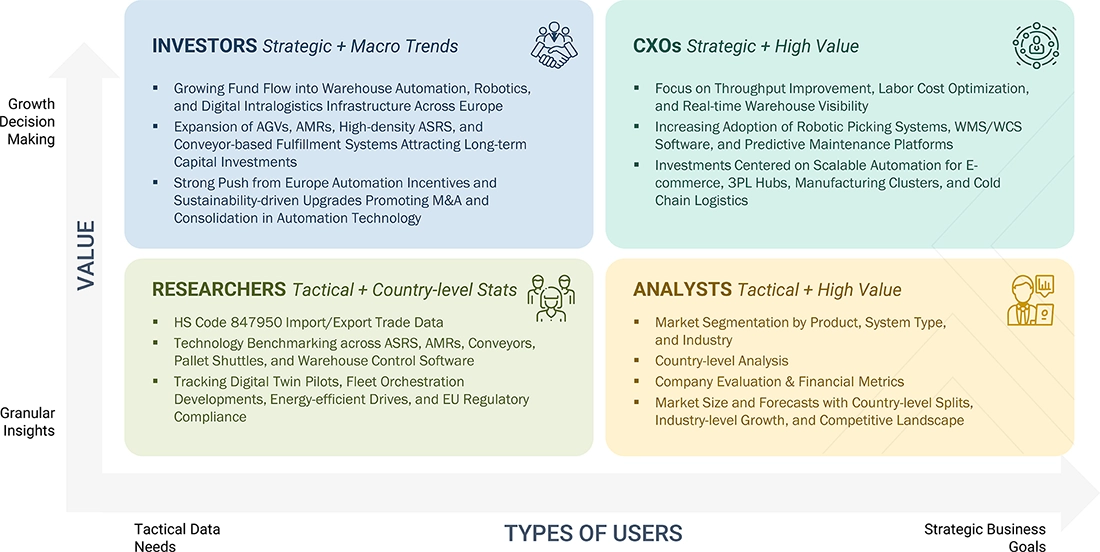
WHAT IS IN IT FOR YOU: europe-automated-material-handling-equipment-market REPORT CONTENT GUIDE
DELIVERED CUSTOMIZATIONS
We have successfully delivered the following deep-dive customizations:
| CLIENT REQUEST | CUSTOMIZATION DELIVERED | VALUE ADDS |
|---|---|---|
| E-commerce & 3PL Warehouse Operators (Europe) |
|
|
| Automotive & Industrial Manufacturing Plants |
|
|
| Food & Beverage & Cold-chain Warehouses |
|
|
RECENT DEVELOPMENTS
- September 2025 : KNAPP partnered with PICARD to modernize its logistics operations at the Bochum, Germany, facility. The solution included the Evo Shuttle automated small parts warehouse with 58,000 storage locations, Pick-it-Easy workstations, and the KiSoft One logistics software integrated with KiSoft SCADA and KiSoft Analytics. This automation enhanced delivery speed, reliability, process efficiency, and warehouse scalability, supporting PICARD’s global growth strategy and long-term competitiveness.
- March 2024 : Jungheinrich AG launched a new electric pedestrian stacker series - EJC 1i series. By leveraging lithium-ion batteries and an updated truck design, these vehicles were distinguished by their notably compact dimensions and substantially enhanced residual capacity and performance.
- November 2023 : KION GROUP AG introduced its own fuel cell systems tailored for its industrial trucks. This leading global intralogistics firm engineered a 24-volt system specifically designed for warehouse trucks. The company's Hamburg plant inaugurated a new production line capable of manufacturing up to 5,000 fuel cell systems annually.
- October 2023 : Toyota Material Handling Japan (TMHJ), a division of Toyota Industries Corporation, innovated the MEGALORE power storage system, which reuses ENELORE Lithium-Ion Batteries (LIBs) for electric lift trucks. This initiative facilitated the establishment of a circular system for lift truck LIBs and promoted the extensive adoption of storage batteries.
Table of Contents
 Exclusive indicates content/data unique to MarketsandMarkets and not available with any competitors.
Methodology
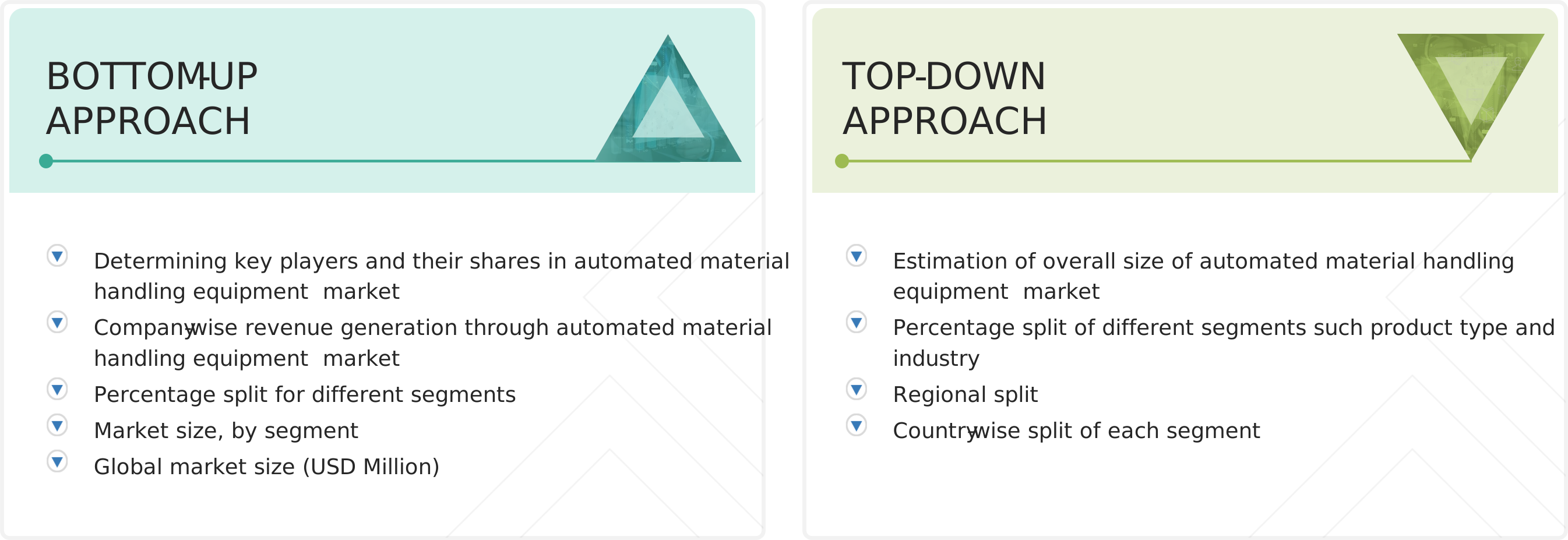
The study involved four major activities in estimating the current size of the Europe automated material handling equipment market. Exhaustive secondary research has been conducted to gather information on the market, adjacent markets, and the overall Europe automated material handling equipment landscape. These findings, along with assumptions and projections, were validated through primary research involving interviews with industry experts and key stakeholders across the value chain. Both top-down and bottom-up approaches were utilized to estimate the overall market size. Subsequently, market breakdown and data triangulation techniques were applied to determine the sizes of various segments and subsegments. Two key sources, secondary and primary, were leveraged to conduct a comprehensive technical and commercial assessment of the Europe automated material handling equipment market.
Secondary Research
Various secondary sources have been referred to in the secondary research process to identify and collect important information for this study. The secondary sources include annual reports, press releases, and investor presentations of companies; white papers; journals and certified publications; and articles from recognized authors, websites, directories, and databases. Secondary research has been conducted to obtain key information about the industry’s supply chain, the market’s value chain, the total pool of key players, market segmentation according to the industry trends (to the bottom-most level), regional markets, and key developments from market- and technology-oriented perspectives. The secondary data has been collected and analyzed to determine the overall market size, further validated by primary research.
Primary Research
Extensive primary research was conducted after gaining knowledge about the current scenario of the Europe automated material handling equipment market through secondary research. This primary data was collected through questionnaires, emails, and telephonic interviews.
To know about the assumptions considered for the study, download the pdf brochure
Market Size Estimation
Both top-down and bottom-up approaches have been used to estimate and validate the total size of the Europe automated material handling equipment market. These methods have also been used extensively to estimate the size of various subsegments in the market. The following research methodology has been used to estimate the market size:
- Major players in the industry and markets have been identified through extensive secondary research.
- The industry’s value chain and market size (in terms of value) have been determined through primary and secondary research processes.
- All percentage shares, splits, and breakdowns have been determined using secondary sources and verified through primary sources.
Europe Automated Material Handling Equipment Market: Top-Down and Bottom-Up Approach
Data Triangulation
After arriving at the overall size of the Europe automated material handling equipment market from the market size estimation process explained above, the total market has been split into several segments and subsegments. Data triangulation and market breakdown procedures have been employed, wherever applicable, to complete the overall market engineering process and arrive at the exact statistics for all segments and subsegments of the market. The data has been triangulated by studying various factors and trends from both the demand and supply sides. Along with this, the market size has been validated using both top-down and bottom-up approaches.
Market Definition
The Europe automated material handling equipment (AMHE) market comprises advanced systems and solutions that automate the movement, storage, control, and management of materials within warehouses, manufacturing facilities, and distribution centers. Core product categories include automated storage and retrieval systems (ASRS), conveyors, cranes, automated guided vehicles (AGVs), industrial robots, autonomous mobile robots (AMRs), and warehouse management systems (WMS), each designed to enhance efficiency, accuracy, and productivity. Based on functionality, AMHE is utilized for transport, storage, order picking, and inventory management across diverse sectors. Integration of robotics, AI, and IoT technologies plays a vital role in enabling intelligent operations, predictive maintenance, and real-time visibility.
Key Stakeholders
- Integrators of Material Handling Systems
- Government Bodies, Venture Capitalists, and Private Equity Firms
- Manufacturers of Europe automated material handling equipment
- Technology Providers (AI, IoT, Robotics, Sensors)
- Research Organizations, Forums, Alliances, and Associations
- Warehousing Companies
- E-commerce and Retail Companies
- Automotive and Industrial Manufacturers
- Food and Beverage Producers
- Healthcare and Pharmaceutical Companies
- Aviation and Aerospace Operators
- Semiconductor and Electronics Manufacturers
- Construction and Heavy Machinery Companies
- Software and Service Providers
Report Objectives
- To define, describe and forecast the Europe automated material handling equipment market, in terms of product type, industry and region.
- To provide detailed information regarding major factors influencing the market growth (drivers, restraints, opportunities, and challenges)
- To provide a detailed overview of the value chain of Europe automated material handling equipment market.
- To strategically analyze micromarkets with respect to individual growth trends, prospects, and contributions to the Europe automated material handling equipment market
- To analyze opportunities in the market for stakeholders by identifying high-growth segments of the Europe automated material handling equipment market.
- To strategically profile key players and comprehensively analyze their market position in terms of ranking and core competencies, along with detailing the competitive landscape for market leaders
- To analyze competitive strategies, such as product launches, expansions, mergers and acquisitions, adopted by key market players in the Europe automated material handling equipment market.
Available Customizations:
With the given market data, MarketsandMarkets offers customizations according to the company’s specific needs. The following customization options are available for the report:
Company Information
- Detailed analysis and profiling of additional market players (up to 5)


Personalize This Research
- Triangulate with your Own Data
- Get Data as per your Format and Definition
- Gain a Deeper Dive on a Specific Application, Geography, Customer or Competitor
- Any level of Personalization
Let Us Help You
- What are the Known and Unknown Adjacencies Impacting the Europe Automated Material Handling Equipment Market
- What will your New Revenue Sources be?
- Who will be your Top Customer; what will make them switch?
- Defend your Market Share or Win Competitors
- Get a Scorecard for Target Partners

Custom Market Research Services
We Will Customise The Research For You, In Case The Report Listed Above Does Not Meet With Your Requirements
Get 10% Free CustomisationTESTIMONIALS

Tetsuya Ohhira
Business Development Manager-Technology Business
Nikon Corporation,
Leading Japanese MNC specializing in optics and imaging productswww.nikon.com
MarketsandMarkets™ response
is quick. Their attitude is flexible and positive. Analyst Insights are globally considered and
significant. Client Services quickly respond to our inquiry and demand. Their wide range of global
surveys help us make our strategic plan.
We hope Knowledge Store will be easier to search
for a report.
VP - Marketing & Business Development
Leading Provider of Process Control Solutions
We engaged with MarketsandMarkets on a study to perform an analysis and recommend a Go-To-Market strategy for metrology and process control in the semiconductor market. The study was tailored to our targets and needs with well-defined milestones. Our overall experience with the MarketsandMarkets team was very good throughout the project in all aspects including the analysis methodologies used, the quality and depth of primary and secondary data sets, the professionalism and flexibility of the team and the ability to meet the target schedule and milestones. We want to thank MarketsandMarkets team for a job well done.






Growth opportunities and latent adjacency in Europe Automated Material Handling Equipment Market