Europe Battery Energy Storage System (BESS) Market

Europe Battery Energy Storage System (BESS) Market by Type (Lithium-ion Battery, Advanced Lead Acid Battery, Flow Battery, Sodium-ion Battery), Capacity (Below 30 kWh, 30 kWh to 10 MWh, Above 10 MWh), & Connection Type (On-grid, Off-grid) - Forecast to 2030




OVERVIEW
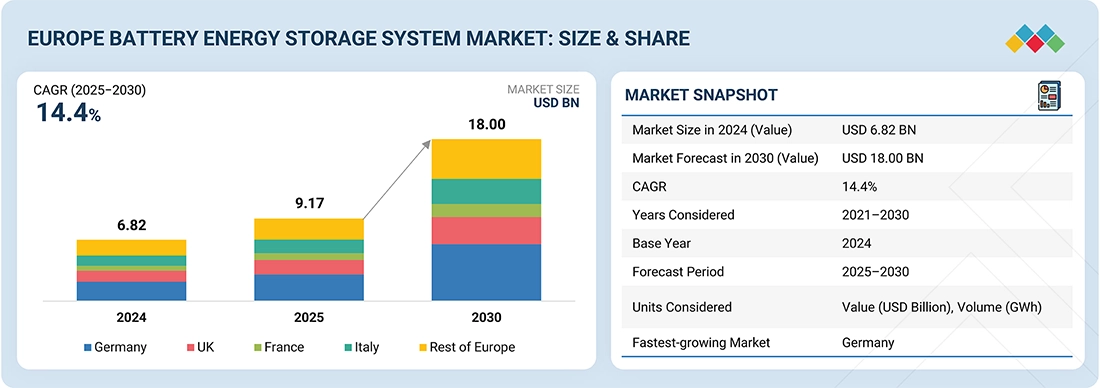
Source: Secondary Research, Interviews with Experts, MarketsandMarkets Analysis
The battery energy storage system (BESS) market in Europe is projected to grow from USD 9.17 billion in 2025 to USD 18.00 billion by 2030, at a CAGR of 14.4%. The BESS market in Europe is poised for steady and robust growth through 2030, driven by the acceleration of renewable energy deployment, grid modernization initiatives, and the increasing adoption of electrification across the region. Countries such as Germany, the UK, Spain, Italy, and France are rapidly deploying storage to support grid stability, manage peak load, and enhance energy security. Favorable policy frameworks, capacity markets, and strong investment activity are further improving project economics, while expanding installations in data centers, commercial facilities, and utility-scale plants continue to broaden the market scope. As investment in wind-plus-storage, solar-plus-storage, and distributed energy systems increases, Europe is expected to remain a significant and strategically important market for BESS over the forecast period.
Market Size & Forecast
KEY TAKEAWAYS
-
BY COUNTRYGermany accounted for the largest share of 31.7% of the BESS market in Europe in 2024.
-
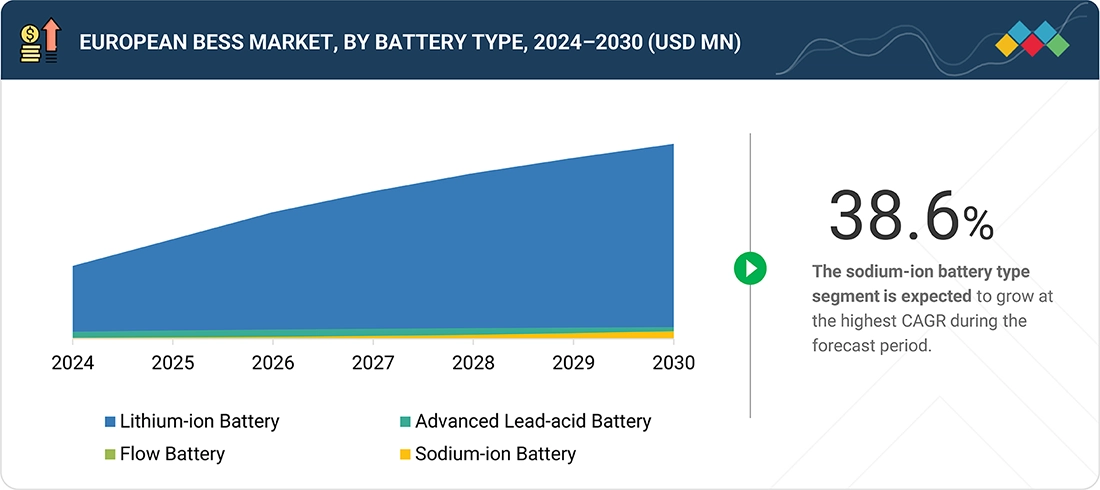
BY BATTERY TYPEBy battery type, the lithium-ion battery segment is expected to account for the largest market share of 88.2% in 2030.
-
BY APPLICATIONUtility-scale applications will grow at the highest CAGR of 15.2% during the forecast period.
-
COMPETITIVE LANDSCAPESiemens Energy is recognized as a leading player in the BESS market in Europe, due to its strong technological leadership, comprehensive solution portfolio, extensive regional footprint, and proven ability to execute and scale large BESS deployments efficiently across Europe.
-
COMPETITIVE LANDSCAPESaft and Faradion have distinguished themselves among european startups and SMEs through rapid innovation, competitive pricing, and expanding deployment capabilities within the regional energy storage market.
The BESS market in Europe is expanding steadily, driven by the acceleration of renewable energy deployment, increasing electrification, and a growing emphasis on grid flexibility across mature power systems. Lithium-ion remains the dominant technology due to its strong performance, declining costs, and expanding cell manufacturing in countries such as Germany, Poland, and Hungary. Meanwhile, long-duration solutions, including flow batteries, are gaining interest for industrial and utility-scale applications. Supportive policies, capacity market participation, and significant investments in large wind and solar projects are further driving adoption in key markets, including Germany, the UK, Spain, and Italy. Rising demand for reliable backup power in data centers, commercial facilities, and industrial sites is also contributing to market growth, alongside the modernization of transmission and distribution networks. With continued investment, regulatory support, and expanding project pipelines, Europe is positioning itself as one of the most strategic regions for energy storage deployment and grid transformation.
TRENDS & DISRUPTIONS IMPACTING CUSTOMERS' CUSTOMERS
The Europe BESS market is being shaped by significant trends and disruptions within the energy ecosystem. These changes are driven by the rapid integration of renewable energy sources, increasing electrification, and a growing demand for grid flexibility and resilience. The rising deployment of offshore wind and distributed solar power is leading utilities, commercial users, data centers, EV charging operators, and municipalities to adopt storage solutions to manage peak demand, regulate frequency, and ensure reliable power delivery. In parallel, advancements in battery technologies, including improved lithium-ion chemistries, emerging sodium-ion chemistries, and long-duration flow batteries, are transforming the technological landscape. Additionally, the digital transformation through smart grids, AI-driven energy management, data analytics, and IoT-enabled monitoring is further enhancing storage performance and unlocking new value streams. This positions BESS as a crucial enabler of Europe’s low-carbon, resilient, and intelligent energy infrastructure.
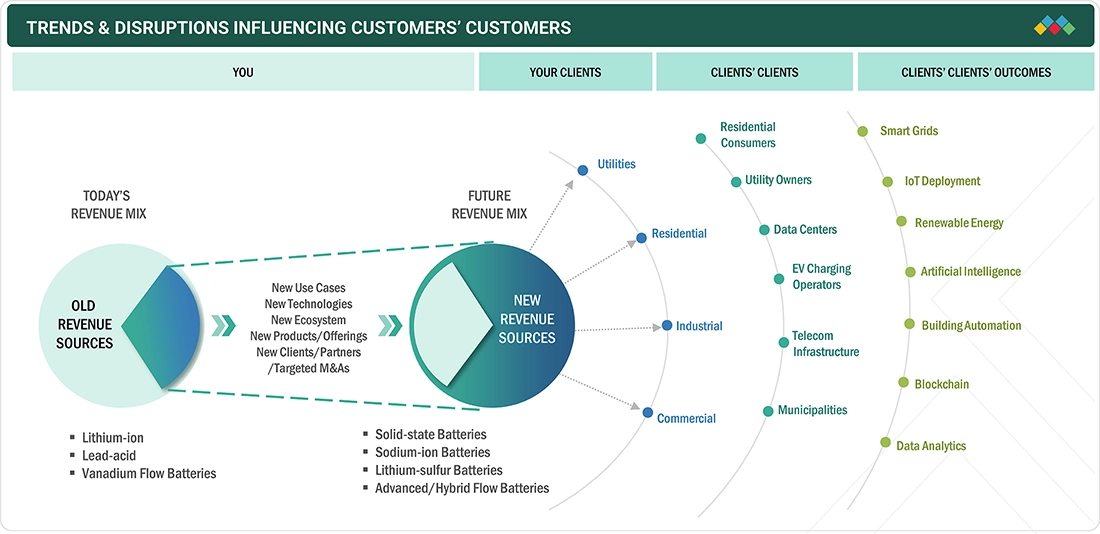
Source: Secondary Research, Interviews with Experts, MarketsandMarkets Analysis
MARKET DYNAMICS

Level
-
Increasing renewable energy integration across Europe

-
Strong policy support through EU Green Deal and national subsidies


Level
-
High installation and maintenance costs


Level
-
Expansion of large-scale energy storage to support offshore wind projects

-
Decline in lithium-ion battery prices


Level
-
Overheating and deterioration issues related to Li-ion batteries

Source: Secondary Research, Interviews with Experts, MarketsandMarkets Analysis
Driver: Increasing renewable energy integration across Europe
The rapid deployment of wind and solar power across Europe is creating strong demand for energy storage to balance intermittency and maintain grid stability. Storage systems are being used to support peak load management, smooth renewable output, and reduce curtailment. As renewable targets continue to rise, energy storage has become an essential enabler of Europe’s energy transition and decarbonization strategy.
Restraint: High installation costs of battery energy storage systems
Despite growing market interest, high upfront capital costs for battery systems remain a major barrier in Europe. Expenses related to equipment, safety systems, and grid interconnection increase the overall investment burden, particularly for utility-scale projects. These cost challenges can delay deployment, limiting adoption in price-sensitive markets.
Opportunity: Expansion of large-scale energy storage to support offshore wind projects
Europe’s booming offshore wind sector is generating significant opportunities for large-scale energy storage, particularly in Germany, the UK, and the Nordic countries. Storage systems help manage variability, reduce curtailment, and stabilize grid operations as offshore capacity grows. This creates a promising pathway for long-duration and hybrid storage solutions to scale rapidly over the coming years.
Challenge: Overheating and deterioration issues related to Li-ion batteries
Thermal management and safety remain key concerns for lithium-ion storage, especially in large installations. Overheating risks, accelerated degradation, and fire safety requirements demand robust engineering, monitoring, and regulatory compliance. These challenges increase system complexity and maintenance needs, impacting deployment timelines and operating costs.
EUROPE BESS MARKET: COMMERCIAL USE CASES ACROSS INDUSTRIES
| COMPANY | USE CASE DESCRIPTION | BENEFITS |
|---|---|---|
 |
Grid-scale and utility BESS solutions integrated with power electronics, EMS, and grid control platforms for renewable balancing, peak load management, and frequency regulation. | Seamless integration with grid infrastructure, advanced control and monitoring systems, high reliability for critical energy applications, and optimized performance for wind/solar hybrid projects. |
 |
Battery energy storage systems leveraging automotive battery technology for charging infrastructure support, industrial backup power, and hybrid renewable projects, including heavy-duty fleet electrification hubs. | High durability and cycle life from automotive-grade batteries, strong thermal management, fast deployment for charging and microgrid applications, and sustainable solutions aligned with european decarbonization goals. |
 |
Blade battery and LFP-based BESS for commercial, industrial, and utility-scale energy management | Superior safety, long lifecycle, high thermal stability, and reliable power delivery |
 |
Lithium-ion BESS solutions for grid-scale, C&I, and renewable integration projects | High energy density, strong performance in harsh conditions, advanced safety systems, and optimized cost-efficiency |
 |
Utility-scale and C&I BESS solutions using advanced lithium-ion chemistries for renewable integration, microgrids, and backup power applications, with modular systems adaptable for european regulatory and grid requirements. | High efficiency and energy density, strong safety features, a customizable modular design for flexible deployments, and proven reliability for large-scale storage projects that support grid stability and decarbonization initiatives. |
Logos and trademarks shown above are the property of their respective owners. Their use here is for informational and illustrative purposes only.
MARKET ECOSYSTEM
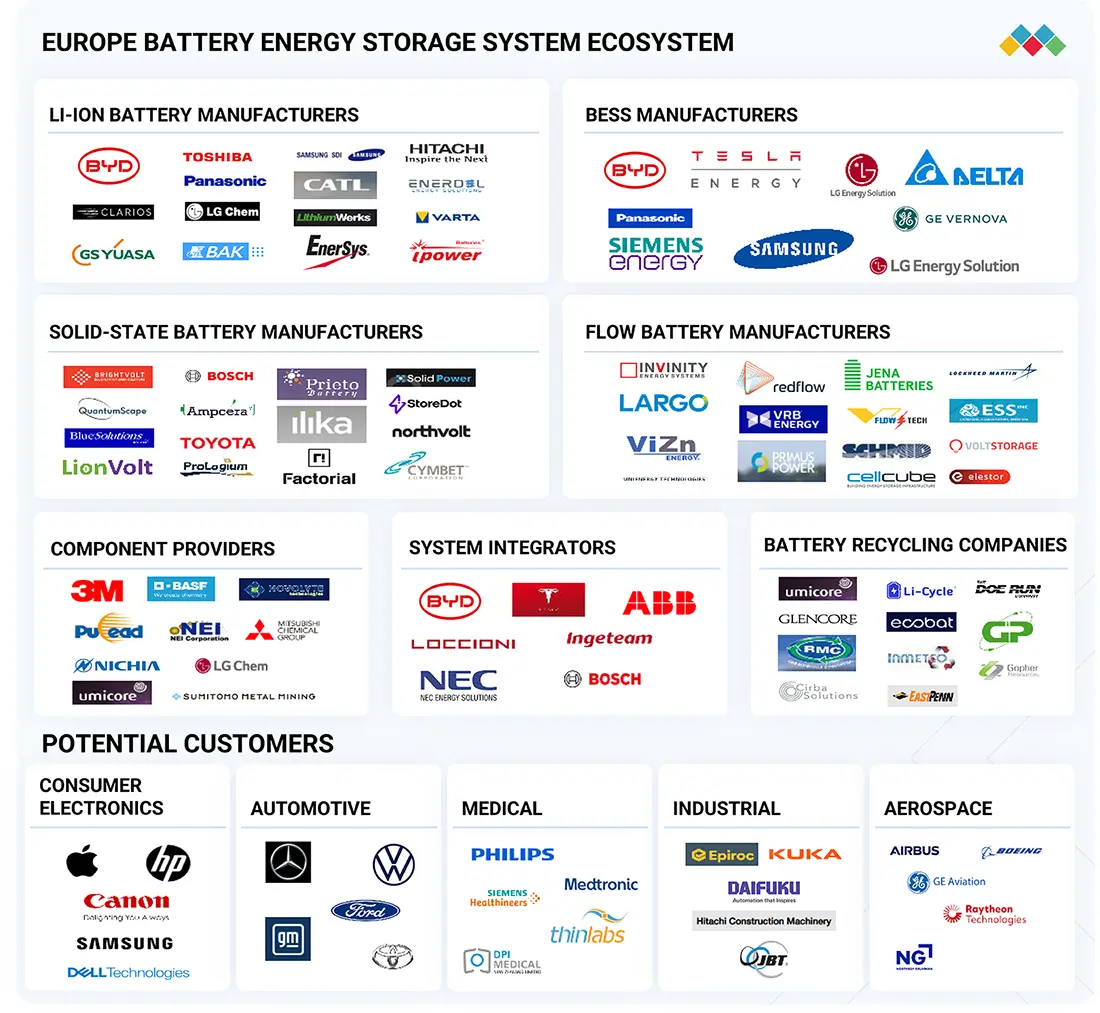
The BESS ecosystem in Europe is expanding steadily, supported by the rapid deployment of renewables, growing electrification, and strong requirements for grid flexibility and reliable backup power. A broad network of system integrators, utilities, technology providers, and policymakers is driving adoption across utility, commercial, and industrial sectors, including data centers and critical infrastructure. Increasing manufacturing activity in countries such as Germany, Poland, and Hungary, combined with robust project pipelines in markets like the UK, Spain, and Italy, is strengthening the region’s position. Together, these developments are reinforcing Europe’s role as a major hub for advanced energy storage solutions and grid transformation.
Logos and trademarks shown above are the property of their respective owners. Their use here is for informational and illustrative purposes only.
MARKET SEGMENTS
Source: Secondary Research, Interviews with Experts, MarketsandMarkets Analysis
Europe BESS Market, by Battery Type
Lithium-ion batteries are expected to account for the largest market share due to their high energy density, strong cycle performance, and suitability for a wide range of applications. Their use spans utility-scale wind-plus-storage and solar-plus-storage projects, commercial backup systems, microgrids, and behind-the-meter installations, making them the preferred technology across the region. Declining battery costs, expanding local manufacturing, and increasing deployment for frequency regulation and peak-load management are reinforcing lithium-ion’s leadership in the Europe BESS market.
Europe BESS Market, by Application
Utility-scale BESS is emerging as the most prominent application segment in Europe, driven by rapid renewable expansion, growing demand for grid flexibility, and rising need for large-capacity energy shifting. Major offshore wind and solar projects, combined with supportive national policies and market mechanisms, are accelerating adoption. Investments by utilities and grid operators in storage for peak-load management, balancing services, and reliability enhancement are strengthening momentum, positioning utility-scale BESS as a key growth engine in the european market.
REGION
Germany is expected to be the fastest-growing country in the BESS market in Europe
Europe is a rapidly growing market for battery energy storage, driven by ambitious decarbonization targets, increasing renewable integration, and strong policy support for grid modernization. Countries such as Germany, the UK, Spain, Italy, and France are scaling up storage deployment to enhance grid stability, reduce curtailment, and support energy transition. Germany stands out as one of the fastest-growing markets, supported by large offshore wind projects, capacity mechanisms, and rising demand for peak-load management. Collectively, these developments position Europe as a key growth engine for BESS deployment.

EUROPE BESS MARKET: COMPANY EVALUATION MATRIX
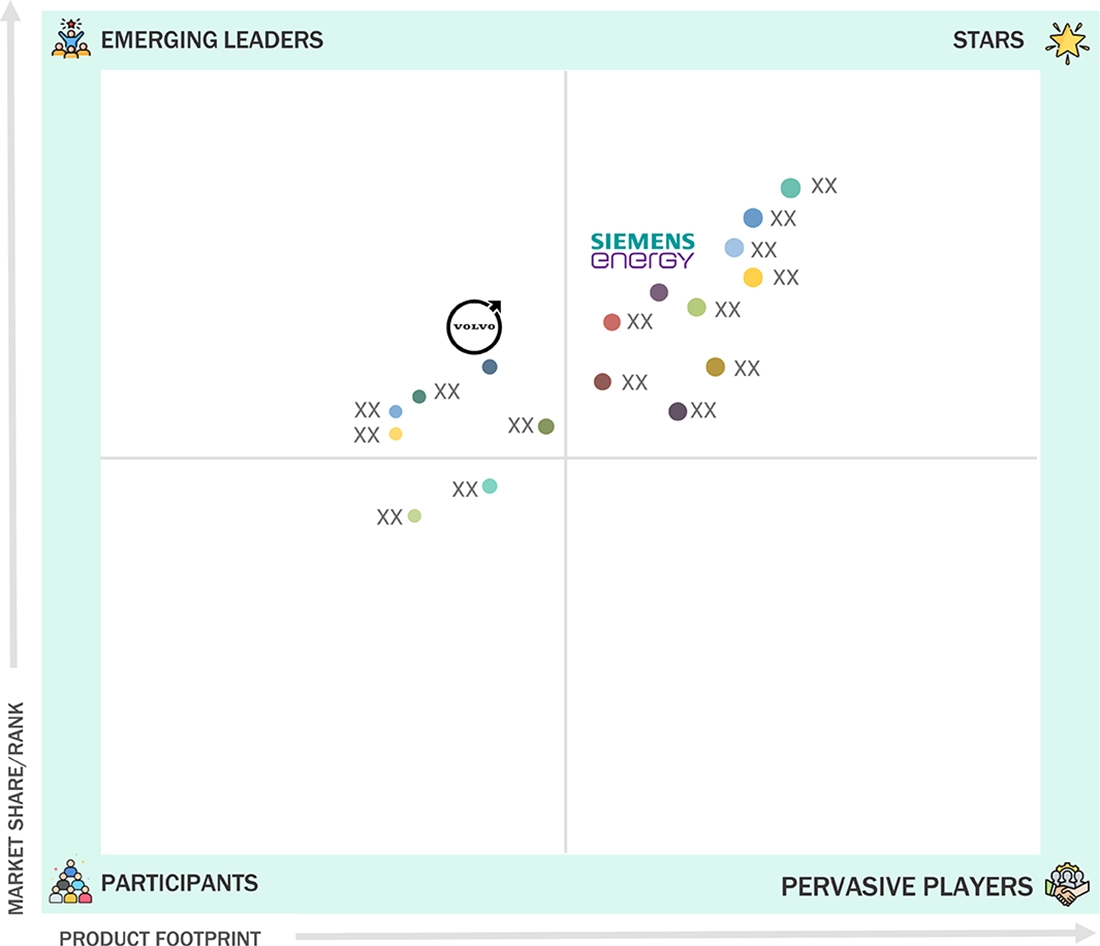
In the Europe BESS market matrix, Siemens Energy (Star) leads with strong technological capability, established grid expertise, and a comprehensive portfolio of utility-scale storage solutions for frequency regulation, renewable integration, and critical infrastructure. Meanwhile, AB Volvo (Emerging) is gaining visibility through its automotive battery platform, durable storage solutions for industrial and charging applications, and a growing role in fleet electrification hubs across the region.
Source: Secondary Research, Interviews with Experts, MarketsandMarkets Analysis
KEY MARKET PLAYERS
- Siemens Energy (Germany)
- BYD Company Ltd. (China)
- LG Energy Solution (South Korea)
- Samsung SDI Co., Ltd. (South Korea)
- AB Volvo
- SUNGROW (China)
- CATL (China)
- Panasonic Corporation (Japan)
- Hitachi Energy Ltd. (Switzerland)
- Tesla (US)
- Gotion (China)
- Saft (France)
- Delta Electronics, Inc. (Taiwan)
- Faradion (UK)
MARKET SCOPE
| REPORT METRIC | DETAILS |
|---|---|
| Market Size in 2024 (Value) | USD 6.82 Billion |
| Market Forecast in 2030 (Value) | USD 18.00 Billion |
| Growth Rate | CAGR of 14.4% from 2025–2030 |
| Years Considered | 2021–2030 |
| Base Year | 2024 |
| Forecast Period | 2025–2030 |
| Units Considered | Value (USD Billion), Volume (GWh) |
| Report Coverage | Revenue Forecast, Company Ranking, Competitive Landscape, Growth Factors, and Trends |
| Segments Covered |
|
| Regional Scope | Europe (Germany, UK, France, Italy, and Rest of Europe |
WHAT IS IN IT FOR YOU: EUROPE BESS MARKET REPORT CONTENT GUIDE

DELIVERED CUSTOMIZATIONS
We have successfully delivered the following deep-dive customizations:
| CLIENT REQUEST | CUSTOMIZATION DELIVERED | VALUE ADDS |
|---|---|---|
| Country Opportunity Deep-Dive: Europe (Germany, UK, Spain, Italy, France) |
|
|
| Commercial & Industrial Storage Adoption (Europe) |
|
|
| Market Forecasting & Scenario Planning (Europe) |
|
|
RECENT DEVELOPMENTS
- September 2025 : SUNGROW rolled out PowerTitan 3.0, the next-generation utility-scale BESS, launched in Manila for Southeast Asia. It features higher energy density, smarter management, and improved round-trip efficiency (RTE). It is designed for CAPEX efficiency and stable grid integration, enabling safer operations, reduced costs, and enhanced renewable energy utilization
- April 2025 : Contemporary Amperex Technology Co., Limited partnered with the RIOH to advance battery swapping technology through joint R&D, policy research, standardization, and scenario-based applications. Together, they planned to develop a national battery swapping infrastructure for electric heavy trucks along key freight routes to improve logistics efficiency and support the transition to low-carbon transportation.
- June 2024 : NGK Insulators secured a contract to supply containerized NAS batteries for a grid-storage demonstration project at Hungary’s state-owned MVM Balance power station. The project aims to stabilize the electric grid by storing surplus energy and providing adjustment capacity.
Table of Contents
 Exclusive indicates content/data unique to MarketsandMarkets and not available with any competitors.
Methodology
The study involved four major activities in estimating the current size of the Europe BESS Market. Exhaustive secondary research has been conducted to gather information on the market, adjacent markets, and the overall BESS landscape. These findings, along with assumptions and projections, were validated through primary research involving interviews with industry experts and key stakeholders across the value chain. Both top-down and bottom-up approaches were utilized to estimate the overall market size. Subsequently, market breakdown and data triangulation techniques were applied to determine the sizes of various segments and subsegments. Two key sources, secondary and primary, were leveraged to conduct a comprehensive technical and commercial assessment of the battery energy storage system (BESS) market.
Secondary Research
Various secondary sources were consulted during the secondary research process to identify and collect relevant information for this study. The secondary sources include annual reports, press releases, and investor presentations of companies; white papers; journals and certified publications; and articles from recognized authors, websites, directories, and databases. Secondary research has been conducted to obtain key information about the industry’s supply chain, the market’s value chain, the total pool of key players, market segmentation according to the industry trends (to the bottom-most level), regional markets, and key developments from market- and technology-oriented perspectives. The secondary data has been collected and analyzed to determine the overall market size, further validated by primary research.
Primary Research
Extensive primary research was conducted after gaining knowledge about the current scenario of the battery energy storage system (BESS) market through secondary research. Several primary interviews were conducted with experts from the demand and supply sides across Europe. This primary data was collected through questionnaires, emails, and telephone interviews.
Market Size Estimation
Both top-down and bottom-up approaches have been used to estimate and validate the total size of the Europe BESS Market. These methods have also been used extensively to estimate the size of various subsegments in the market. The following research methodology has been used to estimate the market size:
- Major players in the industry and markets have been identified through extensive secondary research.
- The industry’s value chain and market size (in terms of value) have been determined through primary and secondary research processes.
- All percentage shares, splits, and breakdowns have been determined using secondary sources and verified through primary sources.
Data Triangulation
After arriving at the overall size of the battery energy storage system (BESS) market from the market size estimation process explained above, the total market has been split into several segments and subsegments. Data triangulation and market breakdown procedures have been employed, wherever applicable, to complete the overall market engineering process and arrive at the exact statistics for all segments and subsegments of the market. The data has been triangulated by studying various factors and trends from both the demand and supply sides. Along with this, the market size has been validated using both top-down and bottom-up approaches.
Market Definition
A battery energy storage system is embedded with a rechargeable battery in the form of battery packs and modules. The system stores energy from solar arrays, wind, or the electric grid and then discharges that energy later to provide electricity or other grid services when needed. Rechargeable batteries are typically more expensive but have a lower environmental impact compared to non-rechargeable (disposable) batteries. Rechargeable batteries incur high upfront costs but can be charged several times after the initial purchase. Battery energy storage systems are used during low-peak periods to store surplus energy and provide it to end users during periods of high peak demand for electricity.
Key Stakeholders
- Battery Energy Storage System Manufacturers
- Technology Providers
- Material Providers
- Government Bodies and Industry Associations
- Research Institutes and Organizations
- Battery Cell and Battery Pack Manufacturers
- Equipment Suppliers
- System Integrators
- Energy Storage Solution and Service Providers
- Energy Storage Research Institutions
- Government and Research Organizations
- Grid Operators
- Retail Service Providers
- Lithium-ion Batteries, Electrochemical Capacitors, and Other Energy Storage Product Manufacturers
- Utility Providers
- Power Distribution and IT Consultants
Report Objectives
- To define, describe, and forecast the battery energy storage system (BESS) market in terms of battery type, energy capacity, ownership, connection type, application, and region.
- To describe and forecast the market, in terms of value, with regards to Europe, and its countries, including Germany, UK, France, Italy, and Rest of Europe.
- To provide detailed information regarding major factors influencing the market growth (drivers, restraints, opportunities, and challenges)
- To offer a detailed overview of the value chain of the Europe BESS Market.
- To strategically analyze micromarkets with respect to individual growth trends, prospects, and contributions to the Europe BESS Market
- To study opportunities in the market for stakeholders by identifying high-growth segments of the Europe BESS Market.
- To strategically profile key players and comprehensively analyze their market position in terms of ranking and core competencies, along with detailing the competitive landscape for market leaders
- To analyze competitive strategies, such as product launches, expansions, mergers, and acquisitions, adopted by key market players in the Europe BESS Market.
Available Customizations
With the market data given, MarketsandMarkets offers customizations according to the company’s specific needs. The following customization options are available for the report:
Company Information:
- Detailed analysis and profiling of additional market players (up to 5)
Key Questions Addressed by the Report
What is the projected market value of the Europe battery energy storage system (BESS) market by 2030?
The Europe battery energy storage system (BESS) market is projected to reach USD 22.36 billion by 2030, growing from USD 12.24 billion in 2025 at a CAGR of 13.5% during the forecast period.
Which countries are key contributors in the Europe battery energy storage system market?
Germany, the UK, France, and Spain are key contributors to the Europe BESS market due to strong renewable energy adoption, grid modernization initiatives, and supportive government policies.
What are the key segments of the Europe battery energy storage system market?
The key segments of the Europe BESS market include battery type (lithium-ion, advanced lead acid, flow, sodium-ion), energy capacity (below 30 kWh, 30 kWh–10 MWh, above 10 MWh), connection type (grid-connected and off-grid), ownership types, and applications (residential, commercial & industrial, and utility).
Which segment holds a significant share or is expected to grow fastest in the Europe battery energy storage system market?
The lithium-ion battery segment holds a dominant share due to cost effectiveness and performance, while utility-scale applications are expected to witness fastest growth supported by large renewable energy storage projects.
Who are the key players operating in the Europe battery energy storage system market?
Key players operating in the Europe BESS market include Tesla, Inc., LG Energy Solution, Panasonic Holdings Corporation, Samsung SDI, BYD Company Ltd., Siemens AG, ABB Ltd., Schneider Electric SE, Saft Groupe S.A., and Fluence Energy, LLC, reflecting a competitive and technology-driven landscape.


Personalize This Research
- Triangulate with your Own Data
- Get Data as per your Format and Definition
- Gain a Deeper Dive on a Specific Application, Geography, Customer or Competitor
- Any level of Personalization
Let Us Help You
- What are the Known and Unknown Adjacencies Impacting the Europe Battery Energy Storage System (BESS) Market
- What will your New Revenue Sources be?
- Who will be your Top Customer; what will make them switch?
- Defend your Market Share or Win Competitors
- Get a Scorecard for Target Partners

Custom Market Research Services
We Will Customise The Research For You, In Case The Report Listed Above Does Not Meet With Your Requirements
Get 10% Free CustomisationTESTIMONIALS

Tetsuya Ohhira
Business Development Manager-Technology Business
Nikon Corporation,
Leading Japanese MNC specializing in optics and imaging productswww.nikon.com
MarketsandMarkets™ response
is quick. Their attitude is flexible and positive. Analyst Insights are globally considered and
significant. Client Services quickly respond to our inquiry and demand. Their wide range of global
surveys help us make our strategic plan.
We hope Knowledge Store will be easier to search
for a report.
VP - Marketing & Business Development
Leading Provider of Process Control Solutions
We engaged with MarketsandMarkets on a study to perform an analysis and recommend a Go-To-Market strategy for metrology and process control in the semiconductor market. The study was tailored to our targets and needs with well-defined milestones. Our overall experience with the MarketsandMarkets team was very good throughout the project in all aspects including the analysis methodologies used, the quality and depth of primary and secondary data sets, the professionalism and flexibility of the team and the ability to meet the target schedule and milestones. We want to thank MarketsandMarkets team for a job well done.






Growth opportunities and latent adjacency in Europe Battery Energy Storage System (BESS) Market