Europe Cryogenic Equipment Market

Europe Cryogenic Equipment Market by Equipment (Tanks, Valves, Vaporizers, Pumps), Cryogen (Nitrogen, Argon, Oxygen, LNG, Hydrogen), End-use Industry (Energy & Power, Chemical, Metallurgy, Transportation), System Type, Application - Forecast to 2030




OVERVIEW
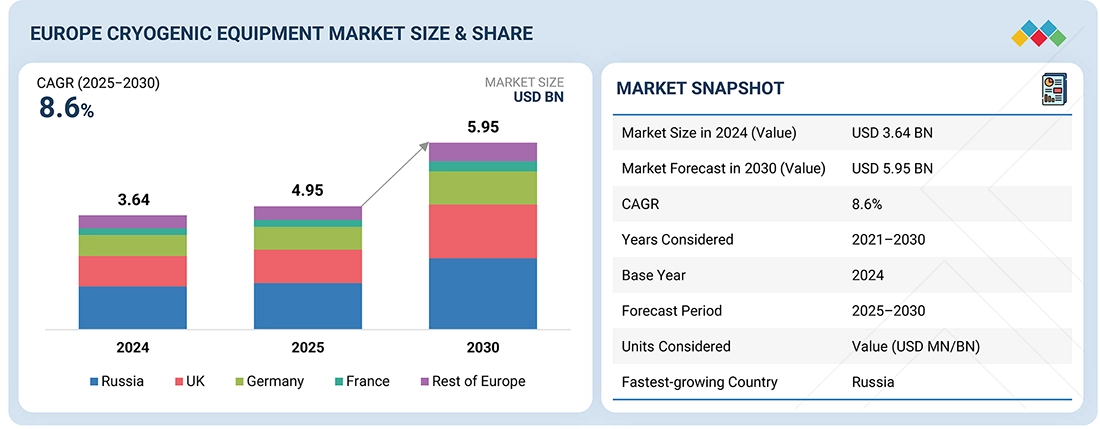
Source: Secondary Research, Interviews with Experts, MarketsandMarkets Analysis
The Europe cryogenic equipment market is projected to reach USD 5.95 billion by 2030 from an estimated USD 3.94 billion in 2025, growing at a CAGR of 8.6% during the forecast period. The need for cryogenic equipment is increasing as the region shifts towards cleaner energy, particularly LNG and hydrogen projects that require large-scale low-temperature storage and handling systems. As EU emissions regulations tighten, businesses and power producers shift from coal and oil to gas and low-carbon fuels, leading to increased demand for cryogenic tanks, vaporizers, and pumps. At the same time, the growing healthcare, biotech, and semiconductor industries rely on dependable liquid nitrogen and specialty gas systems, which increases equipment needs.
KEY TAKEAWAYS
-
BY COUNTRYRussia is likely to account for a 37.70% share of the North America cryogenic equipment market in 2025.
-
BY EQUIPMENTBy equipment, the tanks segment is projected to grow at the fastest rate from 2025 to 2030.
-
BY CRYOGENBy cryogen, the LNG segment is estimated to register the highest CAGR of 9.6% during the forecast period.
-
BY SYSTEM TYPEBy system type, the storage segment is expected to dominate the market between 2025 and 2030.
-
BY END-USE INDUSTRYBy end-use industry, the energy and power segment is estimated to register the highest CAGR of 10.2% during the forecast period.
-
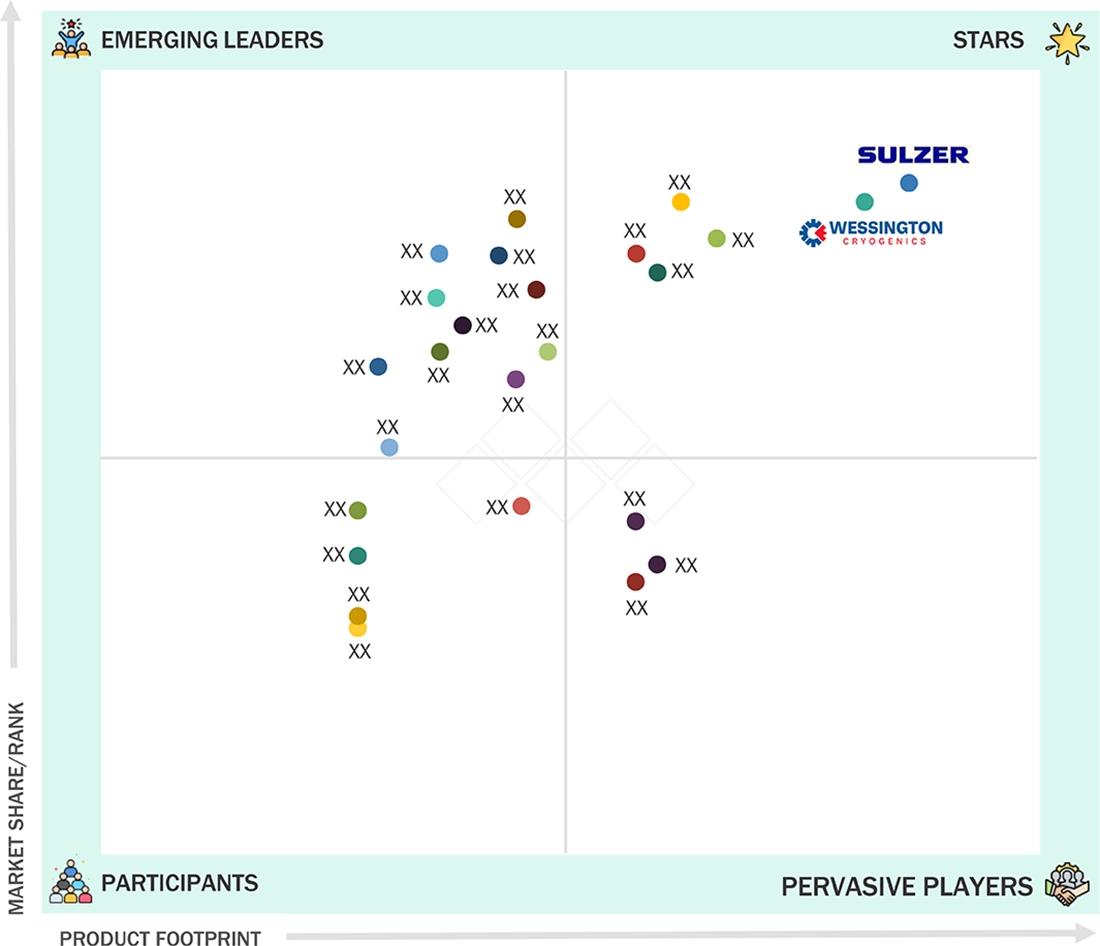
COMPETITIVE LANDSCAPEAir Liquide (France), Wessington Cryogenics (UK), Sulzer Ltd. (Switzerland), Air Products and Chemicals, Inc. (US) and Parker Hannifin Corp. (US) were identified as some of the star players in Europe cryogenic equipment market.
The need for cryogenic equipment is increasing in Europe due to increased LNG imports, industrial gas production, and investments in clean energy infrastructure. To meet stricter emissions limits, utilities, industries, and transportation operators are shifting toward low-carbon fuels that require large-scale liquefaction, storage, and regasification facilities. Growing healthcare, biotechnology, and semiconductor industries increase the need for dependable liquid nitrogen and specialty gas systems. These trends continue to fuel the demand for sophisticated cryogenic tanks, vaporizers, pumps, and control systems.
TRENDS & DISRUPTIONS IMPACTING CUSTOMERS' CUSTOMERS
The Europe cryogenic equipment market is being altered by rapid LNG import growth, new hydrogen projects, and increased demand for industrial gases in industries such as metallurgy, healthcare, and electronics production. These trends lead to substantial investments in storage tanks, regasification units, and distribution systems. However, they also produce disruptions as supply chains respond to unpredictable gas prices, shifting trade flows, and developing EU climate policies favoring low-carbon fuels. The market is dynamic, with providers offering highly efficient, low-leakage, and digitally monitored cryogenic systems gaining a competitive advantage. Legacy assets face faster obsolescence and tougher compliance requirements.?
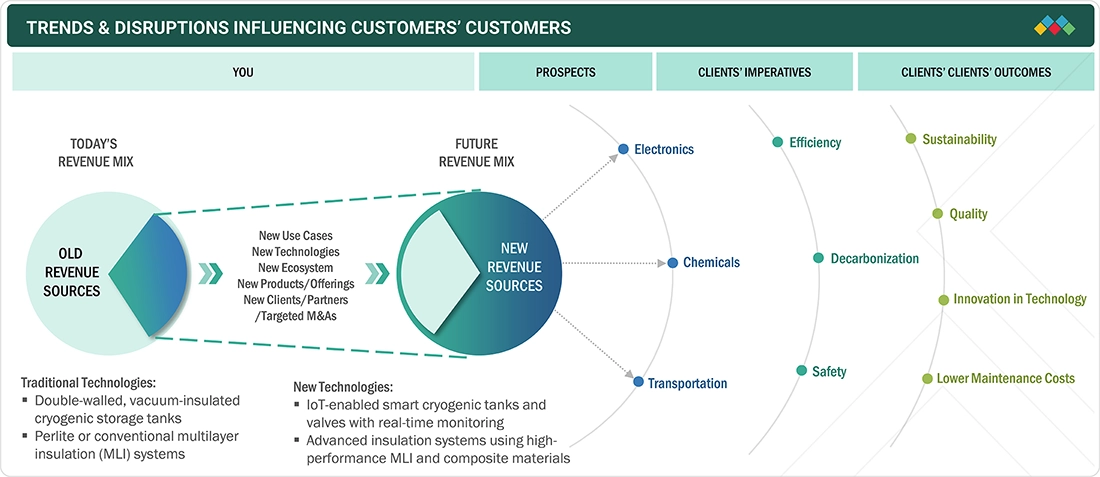
Source: Secondary Research, Interviews with Experts, MarketsandMarkets Analysis
MARKET DYNAMICS

Level
-
Shift toward low-carbon, clean energy sources

-
Mounting of industrial gases across metallurgy, oil & gas and energy power industries


Level
-
Fluctuations in raw material prices


Level
-
Fluctuations in raw material prices

-
Expanding use cases of cryogenic electronics


Level
-
Expanding use cases of cryogenic electronics

Source: Secondary Research, Interviews with Experts, MarketsandMarkets Analysis
Driver: High acceptance of LNG as source of efficient energy
Increasing LNG popularity is one of the major drivers for the Europe cryogenic equipment market due to its cleaner and more efficient alternative to coal and oil as the source of power generation, industries, and transportation. With the EU tightening of the emissions standards and phasing out coal, the utilities and industrial users are converting to LNG to reduce the CO2, SO and NO emissions whilst retaining high energy density and as a stable baseload. This change necessitates massive import terminals, storage tanks, regasification forces, and distribution infrastructure, which rely on sophisticated cryogenic tanks, pumps, vaporizers, and control systems to prevent the risk of dealing with LNG in very low temperatures.
Restraint: Fluctuations in raw material prices
Highly fluctuating prices of major metals, including stainless steel, aluminum, nickel and other specialized alloys, utilized in cryogenic tanks, valves and pumps are a high impact on the cost of production within the cryogenic equipment market in Europe. The constant movement of the energy and commodity market complicates the ability of the equipment manufacturers to predict the cost of input requirements, negotiate long term supply agreements and keep the resultant product affordable to the final users. Such volatility puts a strain on margins, slows investment decisions to new capacity or R&D, and may result in postponement or contraction of LNG, hydrogen and industrial gas projects that are highly dependent on capital-intensive cryogenic infrastructure.
Opportunity: Rise in space explorations
The emerging pipeline of space and satellite missions in Europe presents an excellent opportunity to the Europe cryogenic equipment market since the launch vehicles and upper stages will need liquid oxygen and liquid hydrogen and other propellants that are kept at a low temperature. The ESA and national space programs and new providers of private launches invest in new launch pads, test facilities, and propellant depots, which rely on high-performance cryogenic tanks, transfer lines, and control systems. Such projects drive the need of special storage, ground-support, and transportation equipment, which stimulates the development of lightweight materials, thermal insulation, and high-reliability components that are offered by the Europe cryogenic OEMs.
Challenge: Safety and environmental risks
Cryogenic leakages of the cryogenic fluids, including LNG, liquid hydrogen, and liquid oxygen, are safety and environmental flourishes to the Europe cryogenic equipment market. Uncontrolled releases may lead to rapid vaporization, fire or explosion, and in the case of methane, considerable greenhouse gas emissions that will counter the climate benefits of fuel switching coal or oil. Strong containment systems, high-integrity valves, continuous monitoring and strict maintenance regimes, therefore demand operator investment and raise lifecycle costs and make new projects in cryogenic infrastructure difficult to permit and regulate in Europe.
EUROPE CRYOGENIC EQUIPMENT MARKET: COMMERCIAL USE CASES ACROSS INDUSTRIES
| COMPANY | USE CASE DESCRIPTION | BENEFITS |
|---|---|---|
 |
Supplies engineered cryogenic storage tanks, ISO containers, and LNG/LBG fueling stations to support gas distribution, energy, and petrochemical customers across Europe | Delivered reliable large-capacity storage and distribution solutions that improve thermal efficiency | Reduce product losses | Enable safer handling of LNG and industrial gases through high-performance, vacuum-insulated pressure vessels tailored to site requirements |
 |
Designs and manufactures cryogenic tanks, coldboxes, and helium and hydrogen liquefaction and refrigeration systems for gas producers, industrial plants, and research institutes in Europe | Enabled secure long-term storage and efficient liquefaction of industrial and specialty gases with standardized tanks and custom plants that meet European pressure equipment standards | Enhance process reliability | Lower operating costs for end users |
 |
Provides cryogenic containers, transport vessels, and piping systems for liquid nitrogen and other liquefied gases to laboratories, blood banks, clinics, and research institutions across Germany and wider Europe | Achieved safer, more efficient cryogen handling and reduced evaporation losses for medical and scientific users through high-quality storage vessels and transfer lines optimized for low-temperature performance and regulatory compliance |
Logos and trademarks shown above are the property of their respective owners. Their use here is for informational and illustrative purposes only.
MARKET ECOSYSTEM
The Europe cryogenic equipment ecosystem comprises cryogenic equipment manufacturers, industrial gas manufacturers, raw material suppliers, and end users. European OEMs and system integrators integrate these components and then supply the LNG terminals, industrial gas producers, metallurgy plants, healthcare facilities, and other end customers around the region with customized cryogenic storage and distribution systems.
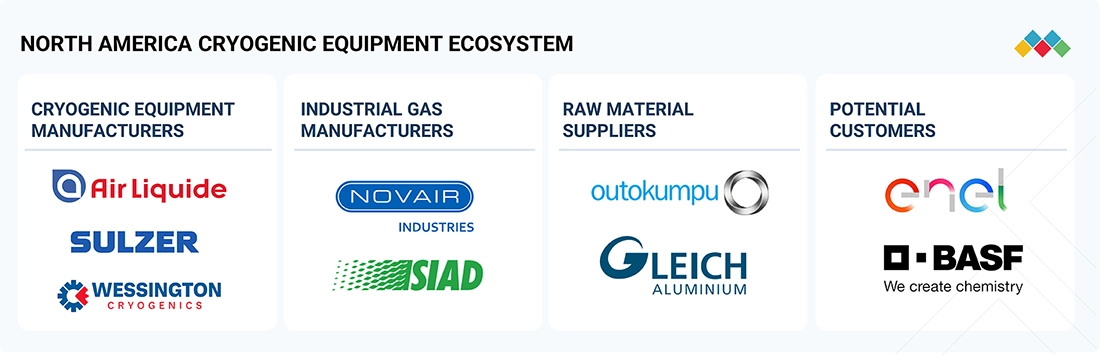
Logos and trademarks shown above are the property of their respective owners. Their use here is for informational and illustrative purposes only.
MARKET SEGMENTS
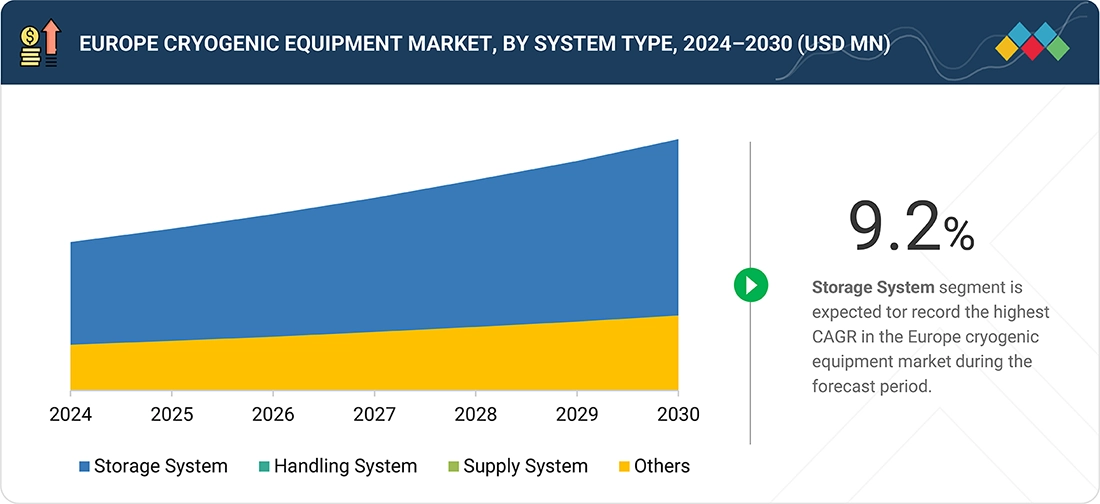
Source: Secondary Research, Interviews with Experts, MarketsandMarkets Analysis
Europe Cryogenic Equipment Market, by Equipment
The equipment segments include tanks, valves, vaporizers, pumps, and other equipment. Tanks is the fastest-growing segment as LNG storage and industrial gas distribution projects across Europe increasingly rely on large, insulated cryogenic tanks for safe bulk storage and transport.
Europe Cryogenic Equipment Market, by Cryogen
The key cryogen segments are nitrogen, oxygen, argon, LNG, hydrogen, and other cryogens. LNG is the fastest-growing cryogen segment due to the shift toward cleaner fuels and rising LNG imports for power generation, industry, and transportation require extensive cryogenic infrastructure for liquefaction, storage, and regasification.
Europe Cryogenic Equipment Market, by System Type
System type segments comprise storage systems, handling systems, supply systems, and other system configurations. Storage systems form the largest segment, as they encompass large-scale cryogenic tanks, terminals, and associated containment solutions that underpin LNG bunkering, hydrogen storage, and industrial gas reserves across the region.
Europe Cryogenic Equipment Market, by End-use Industry
End-user segments include metallurgy, energy and power, chemical, electronics, transportation (shipping and rail), and other industries. Metallurgy is the largest end-user segment because steel and metal processing plants consume high volumes of industrial gases such as oxygen, nitrogen, and argon, driving sustained demand for cryogenic storage, distribution, and supply systems.?
REGION
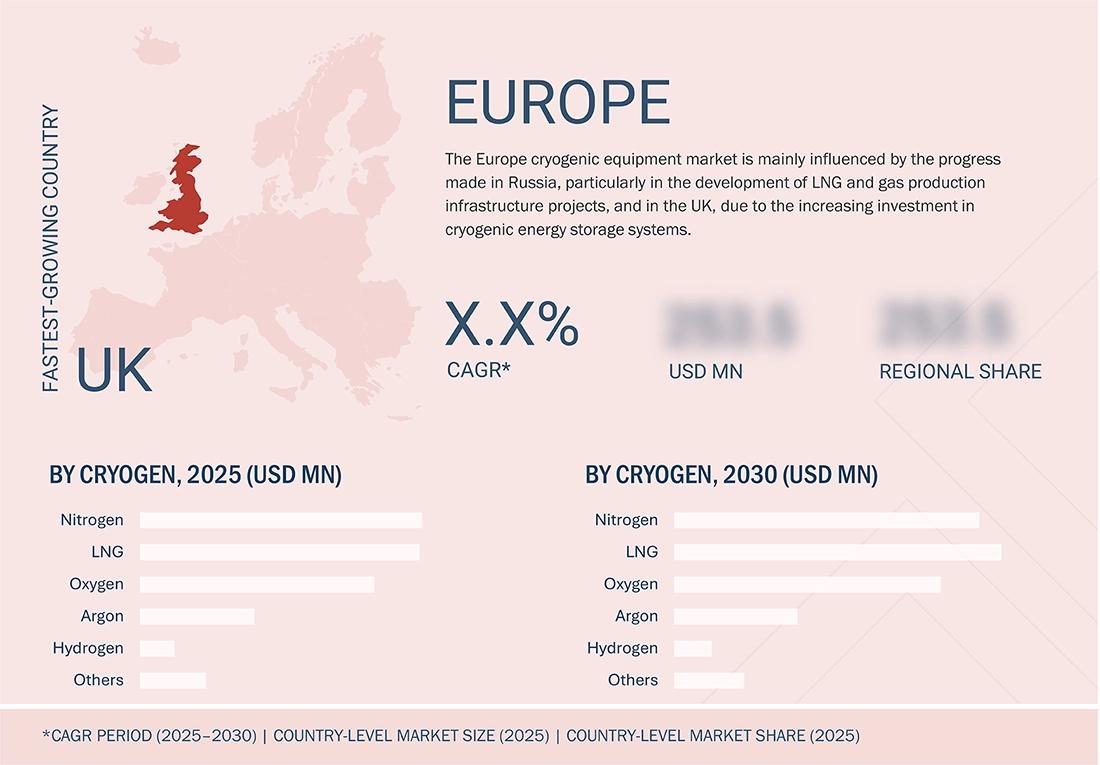
UK to be fastest-growing country in North America cryogenic equipment market during forecast period
The UK is the fastest-growing country in the Europe cryogenic equipment market, owing to the expanding LNG import and regasification infrastructure, which requires advanced cryogenic storage and handling systems. Strong demand from industrial gases, chemical manufacturing, and biomedical sectors further boosts growth. Additionally, investments in energy security, clean energy projects, such as hydrogen and long-duration energy storage, and modernization of industrial facilities fuel the adoption of cryogenic technologies in the UK. This diversified demand across energy, industrial, and research applications drives rapid market expansion.
EUROPE CRYOGENIC EQUIPMENT MARKET: COMPANY EVALUATION MATRIX
Wessington Cryogenics and Sulzer ltd are positioned as stars in theEurope cryogenic equipment market matrix, reflecting clear leadership in market share and product breadth. The company differentiates itself through an extensive cryogenic equipment portfolio and strong reach across industries such as electronics and transportation.
Source: Secondary Research, Interviews with Experts, MarketsandMarkets Analysis
KEY MARKET PLAYERS
- Air Liquide (France)
- Wessington Cryogenics (UK)
- Sulzer Ltd (Switzerland)
- Air Products and Chemicals (US)
- Parker Hannifin Corp. (US)
- Emerson Electric Co. (US)
- Taylor-Wharton (US)
- Linde plc (Ireland)
- Flowserve Corporation (US)
- Nikkiso Co., Ltd (Japan)
MARKET SCOPE
| REPORT METRIC | DETAILS |
|---|---|
| Market Size in 2024 (Value) | USD 3.64 BN |
| Market Forecast in 2030 (Value) | USD 5.95 BN |
| Growth Rate | CAGR of 8.6% from 2025-2030 |
| Years Considered | 2021–2030 |
| Base Year | 2024 |
| Forecast Period | 2025–2030 |
| Units Considered | Value (USD Million) |
| Report Coverage | Revenue forecast, company ranking, competitive landscape, growth factors, and trends |
| Segments Covered |
|
| Countries Covered | Russia, the UK, Germany, France, and Rest of Europe |
WHAT IS IN IT FOR YOU: EUROPE CRYOGENIC EQUIPMENT MARKET REPORT CONTENT GUIDE
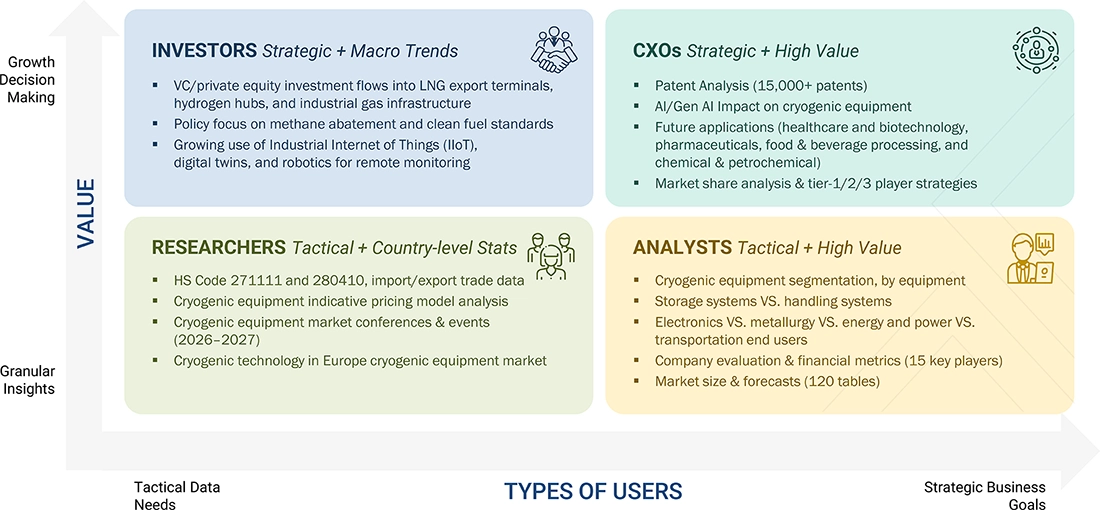
DELIVERED CUSTOMIZATIONS
We have successfully delivered the following deep-dive customizations:
| CLIENT REQUEST | CUSTOMIZATION DELIVERED | VALUE ADDS |
|---|---|---|
| Energy & power | Mapping of European LNG import and small-scale terminals; sizing and specification of cryogenic tanks, pumps, vaporizers, and transfer lines for LNG regasification and peak-shaving plants; benchmarking of high-efficiency storage, handling, and boil-off gas management technologies suitable for EU safety and emission standards. | Maximize LNG storage and fuel-supply availability for power plants, reduce product losses and energy consumption in liquefaction and regasification, and support switching from coal and oil to LNG in line with EU decarbonization targets.skyquestt+1? |
| Metallurgy | Screening and design support for cryogenic storage tanks, vaporizers, and distribution lines for high-purity gases used in blast furnaces, ladle metallurgy, heat-treatment, and continuous casting operations; comparison of centralized versus distributed storage concepts at European steel mills. |
|
| Transportation | Cryogenic network analysis for European LNG bunkering corridors covering ports, highway corridors, and logistics hubs; sizing of mobile and fixed storage tanks, fuel trailers, and satellite stations for marine and road transport. |
|
RECENT DEVELOPMENTS
- February 2022 : Air Liquide partnered with Airbus, Korean Air, and Incheon to develop the first hydrogen usage roadmap at and around Incheon airport and support the development of the hydrogen ecosystem.
- August 2021 : Air Products signed an agreement with SCD JV S.c.a.r.l (Italy), an EPC joint venture led by Saipem, Chiyoda and Daewoo, for an LNG train project. The project comprises an LNG production train and a combined liquefaction unit, for which Air Products will supply its proprietary main cryogenic heat exchangers and liquefaction process technology, enabling efficient large-scale natural gas liquefaction.
- May 2021 : Chart Industries signed a strategic commercial agreement with Cryomotive (Germany), alongside a minority equity investment, to collaborate on cryogenic hydrogen storage and refueling technologies. Under this partnership, Chart will expand its presence in the hydrogen market and expects to supply liquid hydrogen pumps, hydrogen storage tanks, and transportation systems for Cryomotive applications over the next five years, increasing its hydrogen addressable market by about USD 100 million.
Table of Contents
 Exclusive indicates content/data unique to MarketsandMarkets and not available with any competitors.


Personalize This Research
- Triangulate with your Own Data
- Get Data as per your Format and Definition
- Gain a Deeper Dive on a Specific Application, Geography, Customer or Competitor
- Any level of Personalization
Let Us Help You
- What are the Known and Unknown Adjacencies Impacting the Europe Cryogenic Equipment Market
- What will your New Revenue Sources be?
- Who will be your Top Customer; what will make them switch?
- Defend your Market Share or Win Competitors
- Get a Scorecard for Target Partners

Custom Market Research Services
We Will Customise The Research For You, In Case The Report Listed Above Does Not Meet With Your Requirements
Get 10% Free CustomisationTESTIMONIALS

Kimberly Murphy
GLOBAL MARKETING DIRECTOR
Bently Nevada,
Leading Condition Monitoring & Asset Protectionwww.bakerhughesds.com/bently-nevada

MarketsandMarkets™ showed consistent rigor for success and relentlessly worked with Bently Nevada stakeholders to positively impact go-to-market strategy. Their proactiveness and flexibility has been instrumental in achieving the objectives to grow our sales pipeline in key industrial markets.

DARRICK HUEBER
Business Development Leader
Nexus Controls LLC,
Leading Manufacturer of Automation System & Electrical Panelswww.bakerhughesds.com/nexus-controls

We partnered with MarketsandMarkets to expand our business further by tapping into new industrial segments. It was critical for us to gather crucial business insights about specific markets to achieve this goal. MarketsandMarkets engagement model and client services helped us provide those insights, it was really impressive and valuable for my business. The team was extremely flexible and helpful.

Mike Schoff
Global Industrial Commercial Strategy Leader
Nexus Controls LLC
Leading Manufacturer of Automation System & Electrical Panelswww.bakerhughesds.com/nexus-controls
We consulted MarketsandMarkets for potential Partner Identification. Overall, it was a good experience. The insights provided through interviews conducted by the team helped us put together the questionnaire required for discussion with the selected partners. Their ability to provide insights through interviews with customers in a timely manner was quite impressive.






Growth opportunities and latent adjacency in Europe Cryogenic Equipment Market