Europe Indoor Location Market Size, Share, Growth Opportunities & Latest Trends

Europe Indoor Location Market by Technology (BLE, UWB, Wi-Fi, RFID, Magnetic Positioning), Solution [Indoor Tracking (Asset & People Tracking, Indoor Location Analytics), Indoor Navigation, Database Management System] - Forecast to 2030




OVERVIEW
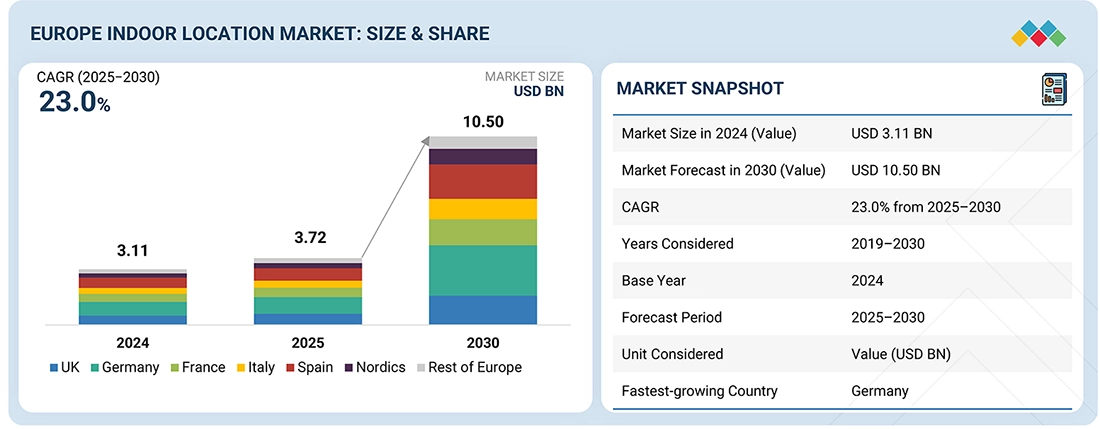
Source: Secondary Research, Interviews with Experts, MarketsandMarkets Analysis
Europe Indoor Location Market size was valued USD 3.72 billion in 2025 and is projected to reach USD 10.50 billion by 2030, registering a CAGR of 23.0%
KEY TAKEAWAYS
-
By OfferingBy offering, the services segment is projected to register the highest CAGR of 25.1% during the forecast period.
-
By TechnologyBy technology, the BLE segment is projected to account for the largest share of 30.3% during the forecast period.
-
By ApplicationBy application, the remote monitoring segment is projected to be the fastest-growing segment with a CAGR of 23.2% during the forecast period.
-
By VerticalBy vertical, the retail segment is estimated to account for the largest market share of 22.7% in 2025.
-
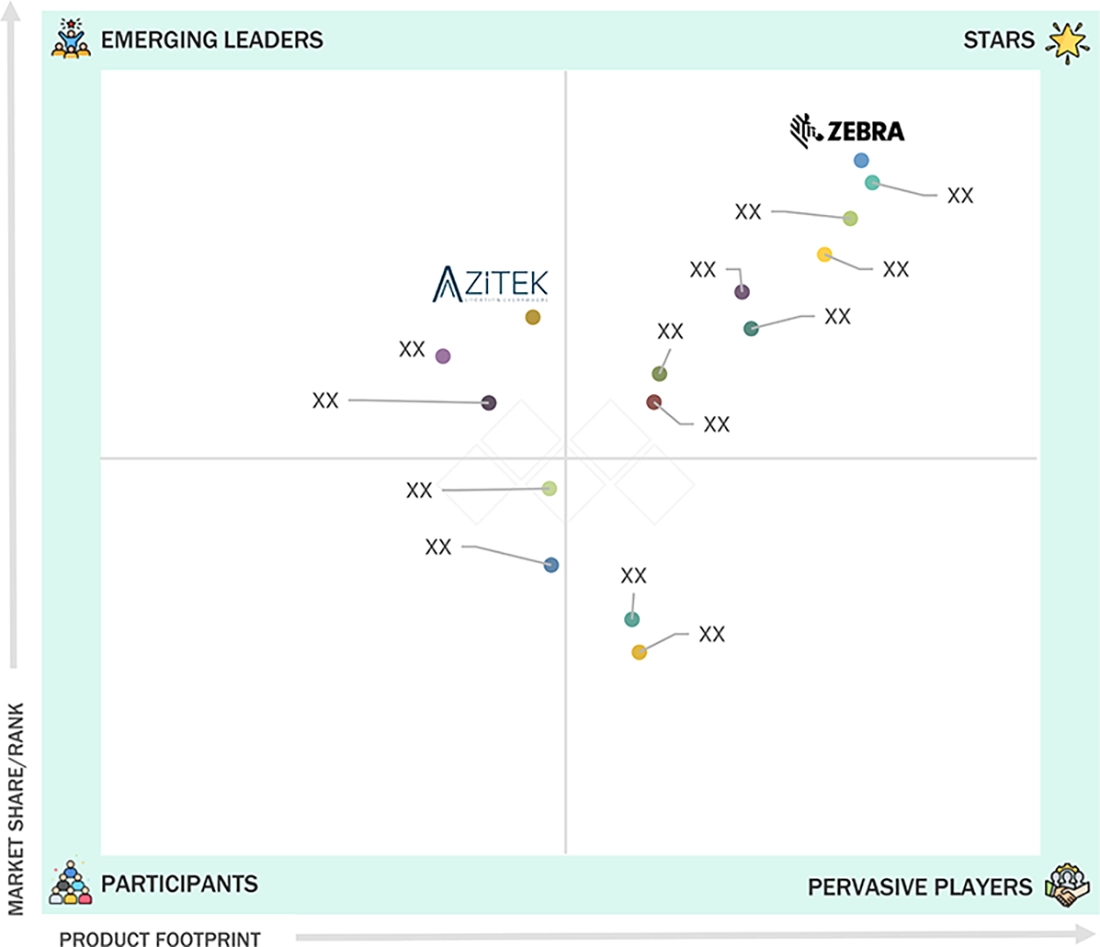
Competitive Landscape - Key PlayersCisco, Zebra Technologies, Google, Microsoft, HPE, Ubisense, Here Technologies, and Quuppa were identified as star players in the Europe indoor location market, given their strong market share and product footprint.
-
Competitive Landscape - Startups/SMEsSitum, Navenio, Polestar Indoor Positioning, Azitek, and indooratlas were identified as startups/SMEs in the Europe indoor location market, securing strong footholds in specialized niche areas, underscoring their potential as emerging market leaders.
The Europe Indoor Location Market is driven by the rising demand for smart buildings and operational efficiency. These solutions utilize RTLS and BLE for asset tracking. Industrial automation integrates UWB and wayfinding to help workers and equipment navigate complex spaces more effectively, which is also expected to further drive the market.
TRENDS & DISRUPTIONS IMPACTING CUSTOMERS' CUSTOMERS
The Europe indoor location market revenue was driven by hardware-heavy sales of beacons and RFID tags alongside one-time installation and licensing fees. While the current revenue models emphasize recurring SaaS subscriptions centered on cloud-based location analytics and IoT integration, the industry’s hotbets in the future would include high-precision UWB for industrial automation, RTLS for healthcare optimization, and occupancy-aware systems designed to meet EU green building sustainability mandates.
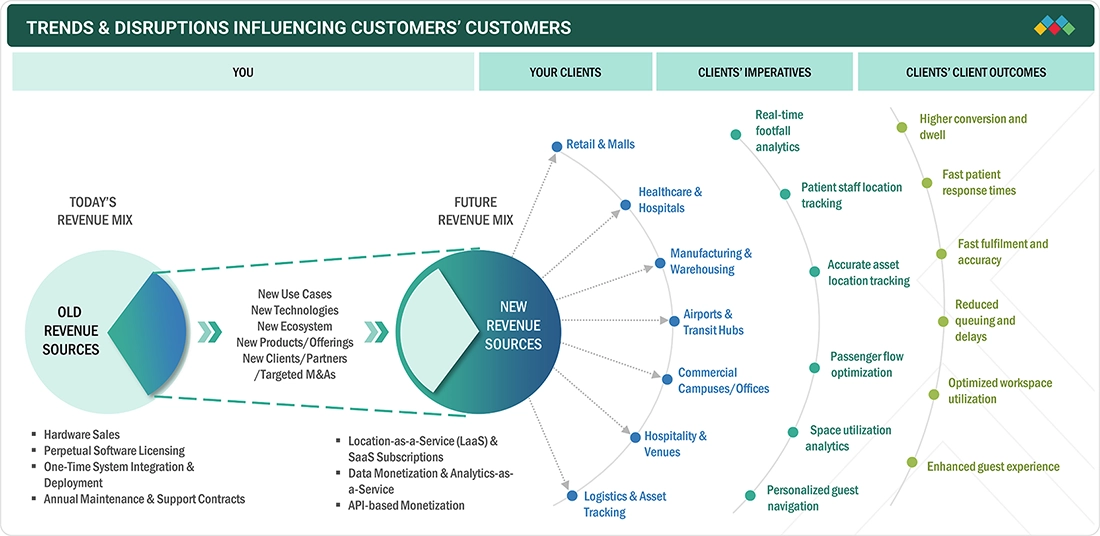
Source: Secondary Research, Interviews with Experts, MarketsandMarkets Analysis
MARKET DYNAMICS

Level
-
Growth of smartphones and connected devices

-
Demand for real-time tracking in healthcare and retail


Level
-
High setup and maintenance costs

-
Stringent GDPR and data privacy


Level
-
Expansion of smart cities and smart buildings

-
Modernization of public transport and smart railway networks


Level
-
Signal interference and building materials

-
Lack of standardization of technologies across different systems

Source: Secondary Research, Interviews with Experts, MarketsandMarkets Analysis
Driver: Growth of smartphones and connected devices
Almost everyone in Europe owns a smartphone that can connect to Bluetooth and Wi-Fi. This allows stores and offices to use existing technology to send maps or deals directly to people's phones without needing them to buy new equipment. It makes indoor navigation easy and helpful for daily users. This is proving to be a major driver for the Europe indoor location market.
Restraint: Stringent GDPR and data privacy
Setting up a high-quality system with sensors and software in a large building can be very expensive. Businesses have to pay for regular updates and battery changes for the small tracking tags. For smaller companies, these costs are often too high to justify the switch.
Opportunity: Expansion of smart cities and smart buildings
European governments are investing heavily in "Smart Cities" to make urban life more efficient and connected. This creates a big opening for indoor location technology to be built directly into new train stations, airports, and public offices. These systems help guide the public and manage large crowds during busy hours.
Challenge: Signal interference and building materials
Indoor signals from Wi-Fi or Bluetooth often get blocked or bounced by thick concrete walls, metal beams, and glass. This makes it very difficult to get an exact location, sometimes showing a person is in the wrong room. Solving these blind spots is a major technical hurdle for engineers today.
EUROPE INDOOR LOCATION MARKET: COMMERCIAL USE CASES ACROSS INDUSTRIES
| COMPANY | USE CASE DESCRIPTION | BENEFITS |
|---|---|---|
 |
UWB RTLS for factories, enabling precise tracking of assets, operators, and AGVs | Centimeter accuracy, optimized workflows, fast throughput, reduced downtime |
 |
Indoor mapping and positioning for airports, malls, and smart buildings | Accurate wayfinding, contextual services | Improved passenger navigation and analytics |
 |
AoA-based positioning for retail, healthcare, and manufacturing RTLS | Low-latency tracking, precise location | Better staff coordination and safety |
 |
Magnetic-field positioning and wayfinding for complex indoor environments | Battery-free positioning, seamless navigation | Enhanced UX and location services |
 |
Sensor-fusion platform combining BLE, Wi-Fi, and UWB for precise location tracking | Centralized analytics, flexible deployments, interoperable integrations, and actionable insights |
Logos and trademarks shown above are the property of their respective owners. Their use here is for informational and illustrative purposes only.
MARKET ECOSYSTEM
The Europe indoor location market ecosystem consists of global solution and service providers (Microsoft, HPE/Aruba, Cisco, Zebra, Google) that supply core infrastructure, cloud platforms, AP-based positioning, enterprise radios, tags, and mapping SDKs. It also covers regional solution and service providers (Ubisense, HERE Technologies, Quuppa, Sonitor, Situm) that deliver high-precision RTLS, AoA/UWB, magnetic and ultrasound positioning, verticalized solutions, and indoor maps.
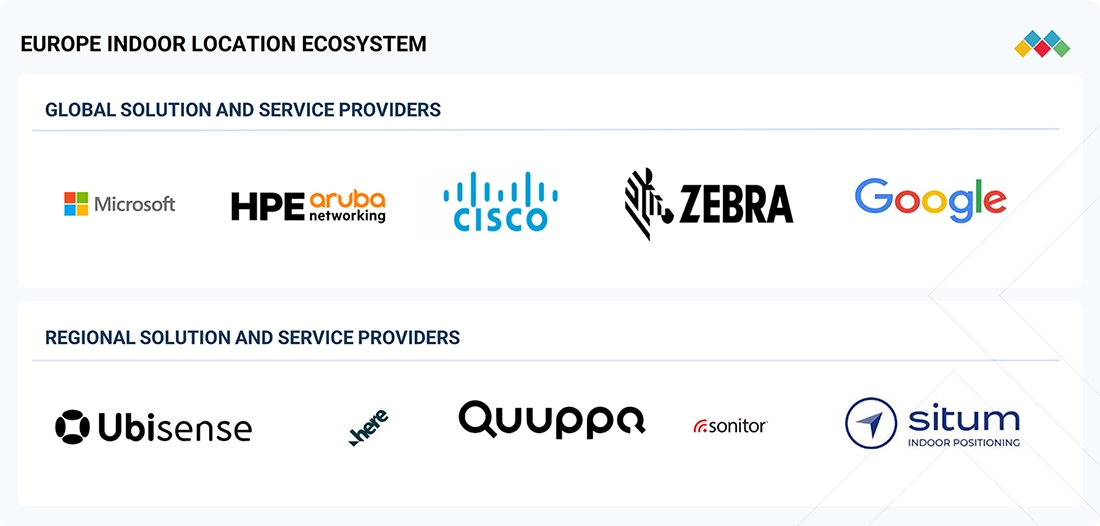
Logos and trademarks shown above are the property of their respective owners. Their use here is for informational and illustrative purposes only.
MARKET SEGMENTS
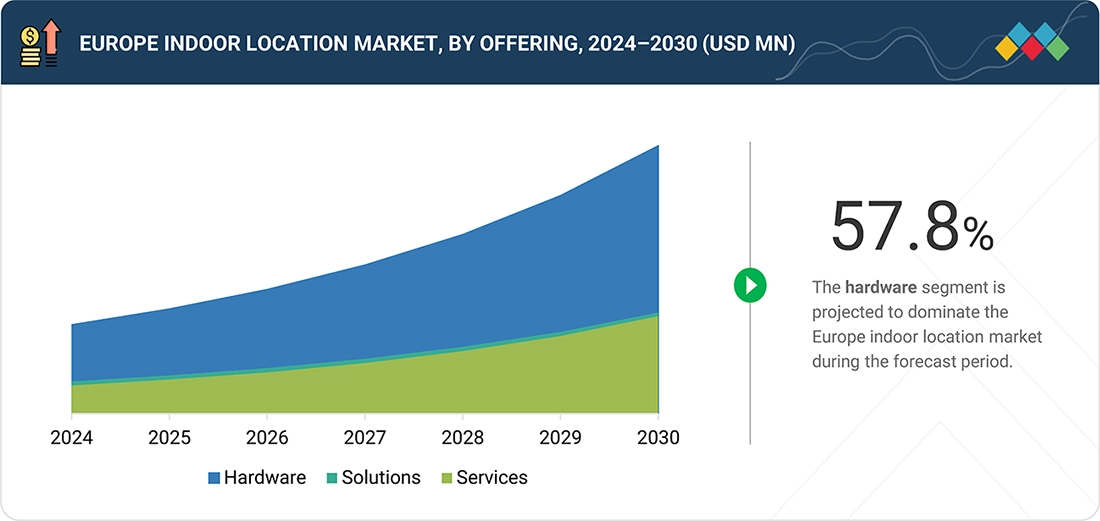
Source: Secondary Research, Interviews with Experts, MarketsandMarkets Analysis
Europe Indoor Location Market, By Offering
The hardware segment is projected to dominate the Europe indoor location market. Key components of an indoor location system include Bluetooth beacons, UWB tags, RFID readers, and specialized sensors. This segment is primarily driven by the significant initial capital expenditure required for large-scale installations in hospitals, warehouses, and retail centers. Hardware installations are essential for any software-driven tracking system. As European companies continue to expand their smart building initiatives, the demand for these tangible assets ensures that hardware remains the leading contributor to the overall market value in the region.
Europe Indoor Location Market, By Technology
The Bluetooth Low Energy (BLE) segment is projected to be the fastest-growing segment in the Europe indoor location market during the forecast period due to its ideal combination of affordability and performance. This technology employs compact, battery-powered beacons, and tags that communicate with standard smartphones and IoT devices, providing a flexible foundation for asset tracking and customer engagement. Its rapid growth is driven by its low power requirements and ease of integration, enabling European businesses to achieve quick scalability and high returns on investment without the heavy infrastructure costs that come with other high-precision systems.
Europe Indoor Location Market, By Application
The remote monitoring segment is projected to be the fastest-growing segment in the Europe indoor location market. This application offers real-time visibility into the status and location of valuable assets and personnel. By utilizing continuous data streams from sensors and tags, companies can monitor operations across large facilities without the need for human intervention. This capability significantly improves safety and operational efficiency. The rising demand for automated oversight, especially in industries such as manufacturing and healthcare, is further expected to be the primary factor driving the growth of the remote monitoring segment.
Europe Indoor Location Market, By Vertical
The retail segment is projected to lead the market during the forecast period. In the retail sector, indoor location technology is a key component of the modern "phygital" experience, which combines physical and digital shopping. This technology enables European retailers to connect online and in-store shopping more effectively. By utilizing location-based data, stores can send personalized marketing messages directly to shoppers' smartphones and enhance their store layouts. The retail segment has seen a high adoption rate of indoor location systems due to improvements in customer engagement, high conversion rates, and efficient inventory management.
EUROPE INDOOR LOCATION MARKET: COMPANY EVALUATION MATRIX
In the Europe indoor location market evaluation matrix, Zebra (Star) leads with a strong market share and extensive product footprint, driven by broad, enterprise-grade hardware (RFID, UWB, BLE tags, scanners) and deep vertical focus in healthcare, retail, manufacturing, and logistics. On the other hand, Azitek (Emerging Leader) is gaining visibility by leveraging UWB and RFID sensor fusion to deliver high-accuracy, battery-efficient asset tracking tailored for industrial and logistics environments that require real-time, low-maintenance visibility.
Source: Secondary Research, Interviews with Experts, MarketsandMarkets Analysis
KEY MARKET PLAYERS
- Zebra Technologies (US)
- Cisco (US)
- Google (US)
- Microsoft (US)
- HPE (US)
- Ubisense (UK)
- Here Technologies (Netherlands)
- Sonitor Technologies (Norway)
- Infsoft (Germany)
- Quuppa (Finland)
- Navenio (UK)
- Situm (Spain)
- Azitek (Portugal)
- Polestar Indoor Positioning (France)
- IndoorAtlas (Finland)
MARKET SCOPE
| REPORT METRIC | DETAILS |
|---|---|
| Market Size in 2024 (Value) | USD 3.11 Billion |
| Market Forecast in 2030 (Value) | USD 10.50 Billion |
| Growth Rate | CAGR of 23.0% during 2025–2030 |
| Years Considered | 2019–2030 |
| Base Year | 2024 |
| Forecast Period | 2025–2030 |
| Units Considered | Value (USD Billion) |
| Report Coverage | Revenue forecast, company ranking, competitive landscape, growth factors, and trends |
| Segments Covered |
|
| Countries Covered | UK, Germany, France, Italy, Spain, Nordics, Rest of Europe |
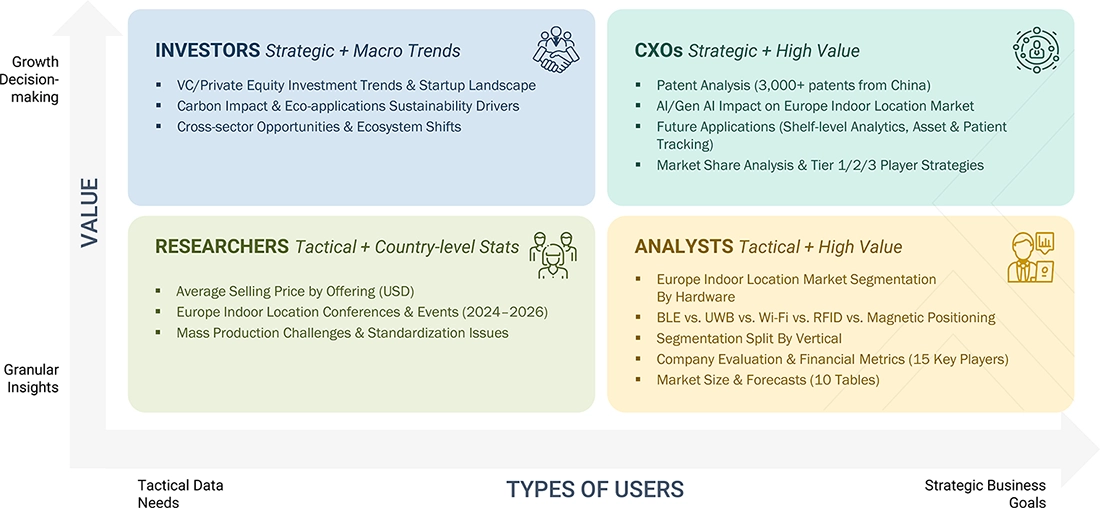
WHAT IS IN IT FOR YOU: EUROPE INDOOR LOCATION MARKET REPORT CONTENT GUIDE
DELIVERED CUSTOMIZATIONS
We have successfully delivered the following deep-dive customizations:
| CLIENT REQUEST | CUSTOMIZATION DELIVERED | VALUE ADDS |
|---|---|---|
| Leading Solution Provider (Europe) | Product matrix, which gives a detailed comparison of the product portfolio of each company | Enhanced understanding of competitive positioning and product offerings |
| Leading Service Provider (Europe) | Detailed analysis and profiling of additional market players (up to 5) | Deeper insights into market dynamics and potential strategic partnerships |
RECENT DEVELOPMENTS
- August 2025 : A Norwegian indoor mapping provider, MazeMap, acquired a German software company, Thing-it. The deal combined MazeMap’s navigation technology with Thing-it’s workplace management capabilities (such as room booking and occupancy sensing) to create a unified "user-centric workplace experience" platform for smart buildings.
- October 2024 : Navenio, a UK-based company, released the results of its strategic partnership with a facility management giant, Mitie. The deployment of Navenio’s infrastructure-free indoor location technology at Cumberland Infirmary reportedly reduced task response times by 58% and increased daily cleaning tasks by 247%, showcasing the operational impact of their indoor positioning system in healthcare.
- September 2024 : Pointr confirmed a global rollout of its "AI-built maps and instant wayfinding technology" for LinkedIn’s office buildings. The partnership, as highlighted in an official announcement, aimed to digitalize LinkedIn’s workplace to support hybrid work models, transitioning from a pilot to a global deployment within just one month.
- May 2024 : A Danish indoor mapping company, MapsPeople, expanded its contract with a large US-based customer. The deal involved delivering "High Definition 3D indoor maps" for the client's new headquarters. Under the contract, MapsPeople would upgrade maps for 190 existing office buildings using its new AI-driven Map Update Automation solution.
Table of Contents
 Exclusive indicates content/data unique to MarketsandMarkets and not available with any competitors.
Methodology
The study involved four major activities in estimating the current size of the Europe indoor location market. Exhaustive secondary research was done to collect information on the market, peer, and parent markets. The next step was to validate these findings, assumptions, and sizing with industry experts across the value chain through primary research. Both top-down and bottom-up approaches were employed to estimate the total Europe indoor location market size. After that, the market breakup and data triangulation techniques were used to estimate the market size of segments and subsegments.
Secondary Research
Various secondary sources, such as Bloomberg and BusinessWeek, were referred to in the secondary research process to identify and collect information for this study. The secondary sources included company annual reports, press releases, and investor presentations; white papers; journals, such as Linux Journal and Container Journal; and articles from recognized authors, directories, and databases.
Primary Research
In the primary research process, various sources from both the supply and demand sides were interviewed to obtain qualitative and quantitative information for the report. The primary sources from the supply side included industry experts, such as Chief Executive Officers (CEOs), Chief Technology Officers (CTOs), Chief Operating Officers (COOs), Vice Presidents (VPs), marketing directors, technology and innovation directors, and related key executives from various key companies and organizations operating in the Europe indoor location market. The primary sources from the demand side included Europe Indoor location end users, network administrators/consultants/specialists, Chief Information Officers (CIOs), and subject-matter experts from enterprises and government associations.
Market Size Estimation
The top-down and bottom-up approaches were used to make market estimates and forecast the Europe indoor location market, as well as other dependent submarkets. The bottom-up procedure was used to arrive at the overall market size of the Europe indoor location market using key companies’ revenue and their offerings in the market. The research methodology used to estimate the market size includes the following:
- The key players in the Europe indoor location market have been identified through extensive secondary research.
- In terms of value, the market size has been determined through primary and secondary research processes.
- All percentage shares, splits, and breakups have been determined using secondary sources and verified through primary sources.
Data Triangulation
This study determined and confirmed the exact value of the overall parent market size through data triangulation and validation through primary interviews. The overall market size was then used in the top-down procedure to estimate the size of other individual markets via percentage splits of the market segmentation.
Market Definition
Indoor location or indoor positioning technology facilitates the navigation and tracking of objects and people in a building using sensory information captured by mobile devices. It includes hardware, software, and service components to provide indoor location services to various vertical organizations. Indoor location solutions may collect location data using Radio Frequency (RF), Visible Light Communication (VLC), Sound Navigation and Ranging (Sonar), Light Detection and Ranging (Lidar), or any technology or a combination of technologies.
Key Stakeholders
- Indoor location solution providers
- Independent Software Vendors (ISVs)
- Investors and Venture Capitalists (VCs)
- Support and maintenance service providers
- Value-added Resellers (VARs) and distributors
Report Objectives
- To determine and forecast the Europe indoor location market by offering (hardware, solutions, and services), application, technology, vertical, and region from 2024 to 2029, and analyze the various macroeconomic and microeconomic factors that affect the market growth.
- To provide detailed information about the major factors (drivers, restraints, opportunities, and challenges) influencing the growth of the Europe indoor location market.
- To analyze each submarket for individual growth trends, prospects, and contributions to the overall Europe indoor location market.
- To analyze the opportunities in the market for stakeholders by identifying the high-growth segments of the Europe indoor location market.
- To profile the key market players; provide a comparative analysis based on business overviews, regional presence, product offerings, business strategies, and key financials; and illustrate the market's competitive landscape.
- Track and analyze competitive developments in the market, such as mergers and acquisitions, product developments, partnerships and collaborations, and Research and Development (R&D) activities.
Available Customizations
With the given market data, MarketsandMarkets offers customizations as per the company’s specific needs. The following customization options are available for the report:
Company Information
- Detailed analysis and profiling of two additional market players
Key Questions Addressed by the Report
What is the projected size of the Europe Indoor Location Market by 2030?
The Europe Indoor Location Market is projected to grow from USD 3.72 billion in 2025 to USD 10.50 billion by 2030, at a CAGR of 23.0%.
What factors are driving growth in the Europe Indoor Location Market?
Key drivers include rising adoption of smart buildings, Industry 4.0 automation, and increasing demand for real-time asset and people tracking.
Which technology segment leads the Europe Indoor Location Market?
Bluetooth Low Energy (BLE) leads the market, accounting for 30.3% share due to cost-effectiveness and scalability across enterprise deployments.
What are the emerging trends in the Europe Indoor Location Market?
Key trends include UWB-based precision tracking, SaaS-based analytics, occupancy intelligence, and digital twin integration.
Who are the leading players in the Europe Indoor Location Market?
Major players include Cisco, Zebra Technologies, Google, Microsoft, and HPE.


Personalize This Research
- Triangulate with your Own Data
- Get Data as per your Format and Definition
- Gain a Deeper Dive on a Specific Application, Geography, Customer or Competitor
- Any level of Personalization
Let Us Help You
- What are the Known and Unknown Adjacencies Impacting the Europe Indoor Location Market
- What will your New Revenue Sources be?
- Who will be your Top Customer; what will make them switch?
- Defend your Market Share or Win Competitors
- Get a Scorecard for Target Partners

Custom Market Research Services
We Will Customise The Research For You, In Case The Report Listed Above Does Not Meet With Your Requirements
Get 10% Free CustomisationTESTIMONIALS






Growth opportunities and latent adjacency in Europe Indoor Location Market