Europe Microirrigation System Market

Europe Microirrigation System Market by Type (Drip & Microsprinklers), Crop Type (Orchard Crops & Vineyards, Field Crops, Plantation Crops), End User (Farmers, Industrial Users, Other End Users), and Country – Forecast to 2030




OVERVIEW
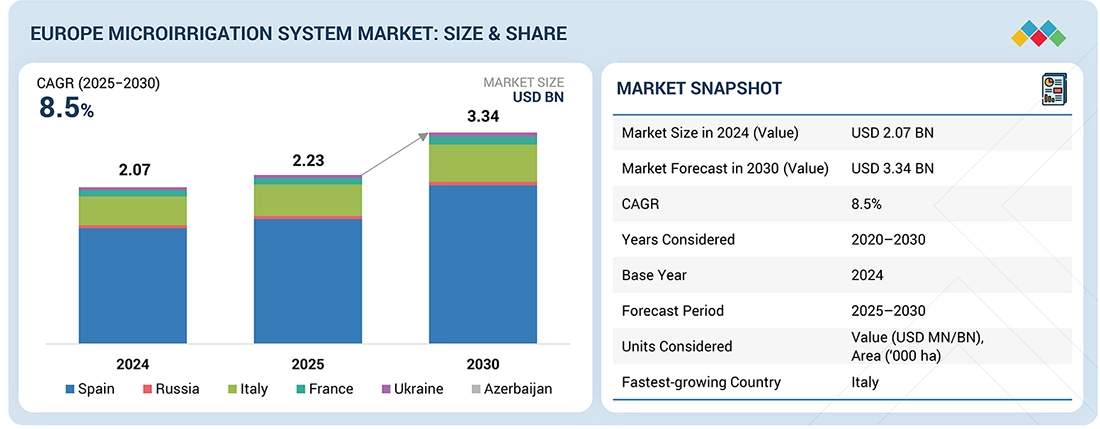
Source: Secondary Research, Interviews with Experts, MarketsandMarkets Analysis
The Europe microirrigation system market is estimated to be USD 2.23 billion in 2025 and USD 3.34 billion by 2030, registering a CAGR of 8.5% from 2025 to 2030. Market expansion is mostly influenced by major, structural, long, term changes rather than by short, term agricultural cycles. For instance, less groundwater availability, more frequent droughts, and stricter water, use regulations in Southern and Western Europe are making farmers to change their irrigation practices drastically. Through microirrigation, they are able to meet the water demand in an economical way and solve the problem of water shortage in a manner that is friendly to nature. Microirrigation also enables precise water and nutrient application, saves water that can be used from runoff and evaporation, and energy consumption can be reduced. The most intensive water access restrictions with a higher concentration of a few selected products, such as orchards, vineyards, vegetables, olives, and greenhouses, are where the adoption has reached its peak. In these districts, irrigation is not only essential for the survival of the farm. Therefore, there has been a steady demand for the upgrading, retrofitting, and replacement of the old conventional irrigation equipment all over Europe.
KEY TAKEAWAYS
-
By CountrySpain accounted for a 74.1% share of the Europe microirrigation system market in 2024.
-
By TypeBy type, the micro-sprinkler segment is expected to register the highest CAGR of 8.7% during the forecast period.
-
By Crop TypeBy crop type, the orchard crops & vineyards segment dominated with a market share of 68.6% in 2024.
-
By End UserBy end user, the industrial users will grow at a higher rate, supported by growth in the commercial farming.
-
Competitive Landscape – Key PlayersKey players include the Toro company, Rivulis, and Rain Bird Corporation supported by strong brand equity and regional distribution.
-
Competitive Landscape – StartupsEmerging companies such as N-drip and Innari are gaining traction in drip and sprinkler irrigation segments.
The Europe microirrigation systems market is projected to grow from USD 2.23 billion in 2025 to USD 3.34 billion by 2030, at a CAGR of 8.5% during the forecast period. The regional market growth is shaped by structural pressures rather than discretionary technology upgrades. Rising water scarcity, stricter enforcement of environmental regulations, and shifting farm cost structures are forcing irrigation efficiency to become a baseline requirement for commercial agriculture. In many parts of Europe, particularly the Mediterranean belt, irrigation choices are closely tied to regulatory compliance and long-term farm viability.
TRENDS & DISRUPTIONS IMPACTING CUSTOMERS' CUSTOMERS
The Europe microirrigation system market is driven by primary agricultural applications, with around 80% of the revenue coming from drip and microsprinkler systems utilized in orchards, vineyards, horticulture, and greenhouses. Nevertheless, the growth path is changing as the demand is moving from merely irrigation hardware to more expensive systems that provide precision, reliability, and compliance with regulations. Expansion next is led by the increased use of automation, digital controls, and data, driven irrigation management, in particular, in water- scarce and climate-sensitive areas. Farmers across Europe are becoming more willing to buy such technology that is scalable and water and energy-efficient; thus, also contributing to lessening the operational risk. This change is causing the market to be dominated by solution, oriented models that still maintain steady value growth while the total irrigated acreage increases at a slower pace.
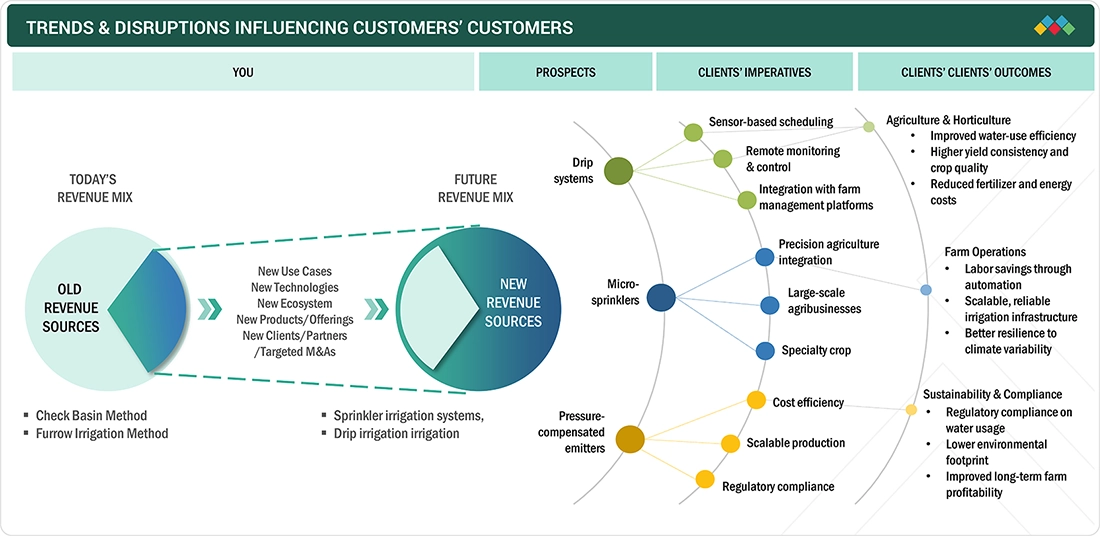
Source: Secondary Research, Interviews with Experts, MarketsandMarkets Analysis
MARKET DYNAMICS

Level
-
Increasing water scarcity and implementation of strict water-use regulations across Southern and Western Europe

-
Rising adoption of precision agriculture and climate-resilient farming practices


Level
-
High upfront CAPEX for system installation and automation

-
Fragmented subsidy and incentive structures across EU countries


Level
-
Accelerating adoption of precision and sustainable irrigation solutions aligned with EU Green Deal objectives

-
Retrofit and modernization of legacy irrigation infrastructure


Level
-
Limited technical expertise and awareness

-
Complexity of compliance with country-specific water and environmental regulations

Source: Secondary Research, Interviews with Experts, MarketsandMarkets Analysis
Driver: Increasing water scarcity and implementation of strict water-use regulations across Southern and Western Europe
Water scarcity is reshaping to be a long, term problem in Southern and Western Europe mainly due to falling groundwater levels, less reservoir recharge, and more frequent and longer droughts which are all consequences of climate change. On top of that, governments and river basin authorities are putting in place stricter regulations on water use. These include limits on irrigation withdrawals, more stringent groundwater licensing, and higher water prices. Such measures are hitting hard, especially in the Mediterranean regions of Spain, Italy, and France where agriculture is the main sector competing with urban and industrial users for the limited water resources. Consequently, farmers are getting more and more stressed out to deploy efficient irrigation systems that will enable them to make water application accurate, water losses minimal, ensure that they meet regulations and at the same time keep crop productivity at the same level.
Restraint: High upfront CAPEX for system installation and automation
High upfront capital expenditure is still one of the main factors that limit the Europe microirrigation system market, particularly for small- and mid-sized farms. The installation of microirrigation is a process that requires a significant amount of money for emitters, piping and filtration units, pressure regulation equipment, pumps, automation hardware, sensors, and control systems. Besides, in several cases, it is necessary to pay more for the system design, land preparation, retrofitting of the existing infrastructure, and skilled installation. These systems, which provide long, term savings in water, energy, and labor consumption, can be postponed at the initial stage of financial turmoil, especially in the areas where access to subsidies, financing, or cost, sharing programs is limited or fragmented.
Opportunity: Accelerating adoption of precision and sustainable irrigation solutions aligned with EU Green Deal objectives
The transition to precision and environmentally friendly irrigation methods in Europe is speeding up as farming becomes more in line with the goals of the EU Green Deal and other policy frameworks, such as the Farm to Fork Strategy and Water Framework Directive. These measures call for the saving of water, lessening of the environmental impact, and better use of resources. This is a direct incentive to the use of micro, irrigation systems that lower water losses and make the fertilization process more efficient.
Challenge: Limited technical expertise and awareness
As a result of limited technical knowledge and awareness that small and medium farmers have, the Europe microirrigation systems market is facing a major challenge. Many small farm operators are not sufficiently familiar with aspects such as system design, pressure management, automation settings, and fertigation optimization, which can cause microirrigation to be seen as a complicated and risky area for them. In areas where landholdings are fragmented, access to well, trained agronomists, installers, and after, sales support is often difficult, which raises the chances of incorrect installation and lower performance. Consequently, some farmers are still using conventional irrigation methods even though water and energy costs are higher. Closing this gap will need more powerful extension services, dealer, led training initiatives, farms for demonstration, and easy, to, understand system designs to create trust and thus, adoption will be faster in small and medium agricultural producers.
EUROPE MIRCROIRRIGATION SYSTEM MARKET: COMMERCIAL USE CASES ACROSS INDUSTRIES
| COMPANY | USE CASE DESCRIPTION | BENEFITS |
|---|---|---|
 |
Drip and micro-irrigation solutions for high-value crops, orchards, vineyards, and commercial landscaping, supported by smart controls and automation | Improved irrigation precision | Reduced labor and energy costs | Scalable system deployment | Higher return on irrigation investment |
 |
Micro-irrigation systems for permanent crops and open-field agriculture, including pressure-compensated drip and microsprinklers suited for varied European terrains | Uniform water distribution | Adaptability to uneven land | Reduced input losses | Improved yield stability |
 |
Drip and microsprinkler solutions for orchards, vineyards, horticulture, and greenhouse cultivation across Mediterranean and Western Europe, integrated with fertigation and automation | High water-use efficiency | Consistent crop quality | Compliance with EU water regulations | Improved long-term farm profitability |
 |
Drip and micro-irrigation systems for agriculture, greenhouses, turf, and landscape applications with strong emphasis on system reliability | Reduced water wastage | Improved crop and landscape performance | Regulatory compliance | Lower lifecycle maintenance needs |
Logos and trademarks shown above are the property of their respective owners. Their use here is for informational and illustrative purposes only.
MARKET ECOSYSTEM
The Europe microirrigation system market is evolving as water efficiency and regulatory compliance become strategic priorities for agricultural and non-agricultural users across the region. Growers are increasingly adopting drip and microsprinkler systems to manage limited water resources, improve irrigation uniformity, and support productivity in high-value crops, such as orchards, vineyards, horticulture, and greenhouse cultivation, where precise moisture control directly affects yield quality and consistency. Market growth is further supported by rising labor costs and farm consolidation, which are accelerating demand for low-maintenance and automated irrigation solutions. At the same time, sustainability targets, climate adaptation requirements, and cost optimization pressures—reinforced by EU and national policies—are reshaping investment decisions. As a result, micro-irrigation in Europe is increasingly viewed not as an optional efficiency upgrade, but as essential infrastructure for long-term farm resilience and competitiveness.
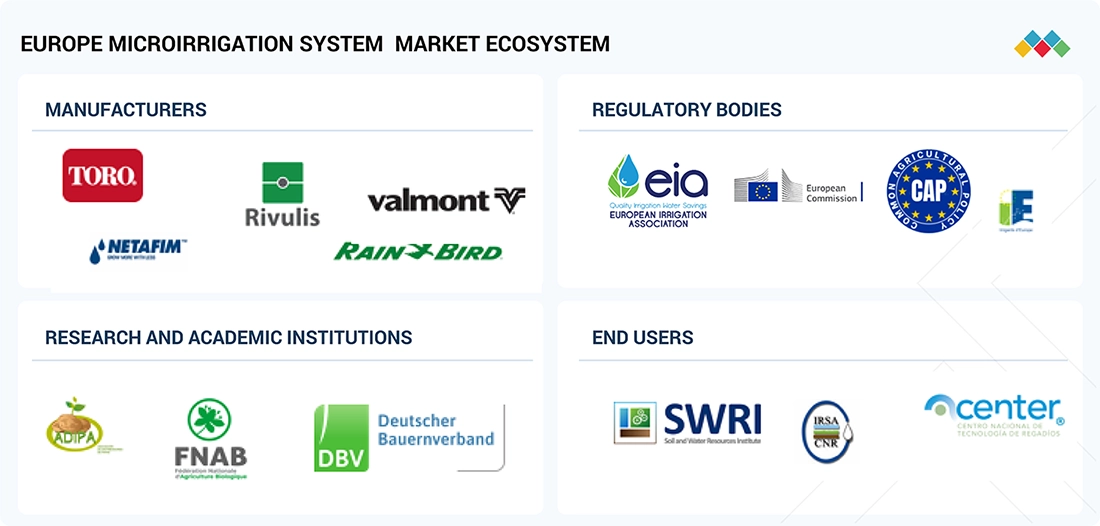
Logos and trademarks shown above are the property of their respective owners. Their use here is for informational and illustrative purposes only.
MARKET SEGMENTS
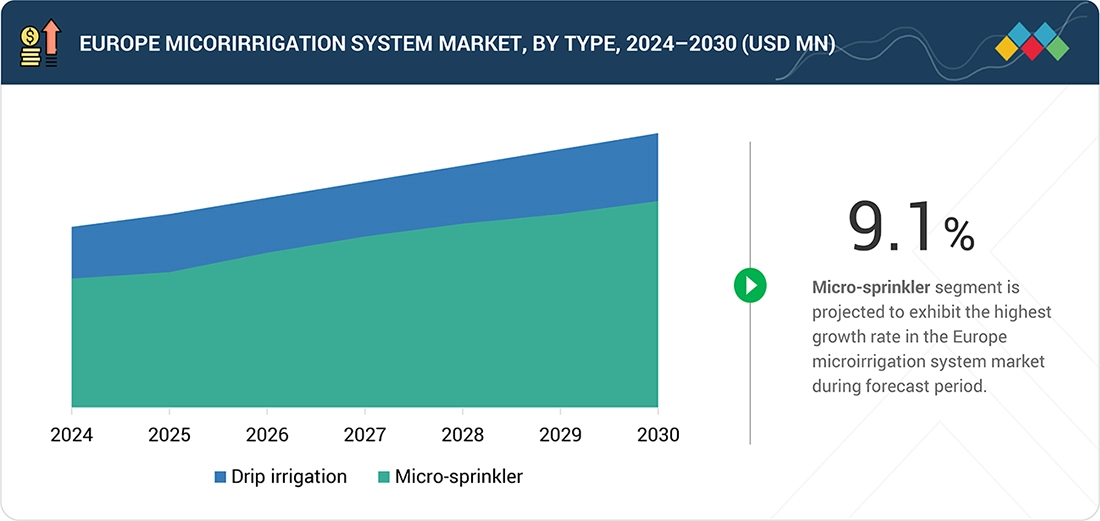
Source: Secondary Research, Interviews with Experts, MarketsandMarkets Analysis
Europe Microirrigation System Market, By Type
Drip irrigation is the largest and most established product segment by volume in the Europe microirrigation system market, as a result of the strong focus on water conservation, regulatory compliance, and high-value crop production. Drip systems are extensively utilized in orchards, vineyards, vegetables, olives, and greenhouse cultivation, where the delivery of water and nutrients must be precisely controlled to keep the quality of the yield under increasingly limited water allocations and changing climate conditions. Drip irrigation is the largest and most established product segment by volume in the Europe micro, irrigation systems market, as a result of the regions strong focus on water conservation, regulatory compliance, and high, value crop production. Drip systems are extensively utilized in orchards, vineyards, vegetables, olives, and greenhouse cultivation, where the delivery of water and nutrients must be precisely controlled to keep the quality of the yield under increasingly limited water allocations and changing climate conditions.
Europe Microirrigation System Market, By Crop Type
By crop type, orchards and vineyards comprise the biggest portion of the Europe microirrigation system market, duly representing the areas intense concentration of permanent, high-value crops. The main reason behind this predominance is the contribution of crops, such as as grapes, olives, citrus, apples, almonds, and stone fruits, to the economy of Southern and Mediterranean Europe. In these crops, controlled and exact irrigation is the main factor in keeping the quality, the size, and the yield stability of the fruit even when the climate becomes more and more unpredictable. Microirrigation, especially drip and low, flow microsprinkler systems, allows the targeted delivery of water and nutrients right to the root zone, which lessens water stress and over time, improves plant health for long crop lifecycles. The adoption is additionally facilitated by the increased use of automation, soil, moisture sensors, and pressure, compensating devices that enable growers to efficiently manage irrigation in varying soils and terrains. Considering the permanency of orchards and vineyards, their higher capital intensity, and the stricter water, use regulations all over Europe, these segments are anticipated to continue being the main drivers of micro, irrigation demand in the next years.
Europe Microirrigation System Market, By End User
The largest portion of the Europe micro, irrigation systems market is farmers which is a result of their need to use water efficiently, to stabilize yields, and to handle climate, related risks. Among commercial growers of permanent and high, value crops such as orchards, vineyards, horticulture, and greenhouse produce, where the quality of the crop and thus the profit depends directly on the irrigation, the adoption rate is the highest. Drip and microsprinkler systems allow the warm and fertilization of plants to be done in a targeted way, thus losses are minimized, and the crops can be kept at a constant level of performance despite increasingly variable weather conditions. The demand driven by farmers in Europe is accompanied by economic and policy incentives, such as EU and national subsidies, for irrigation modernization, water, conservation programs, and sustainability, linked funding. The main factors contributing to the acceleration of adoption are a better understanding of precision agriculture, increase in labor costs, and a need to automate irrigation management. When European growers will still pay more attention to long, term resilience, regulatory compliance, and cost efficiency, farmers will still be the main end, user group that will be pushing the demand for micro, irrigation systems in the region.
REGION
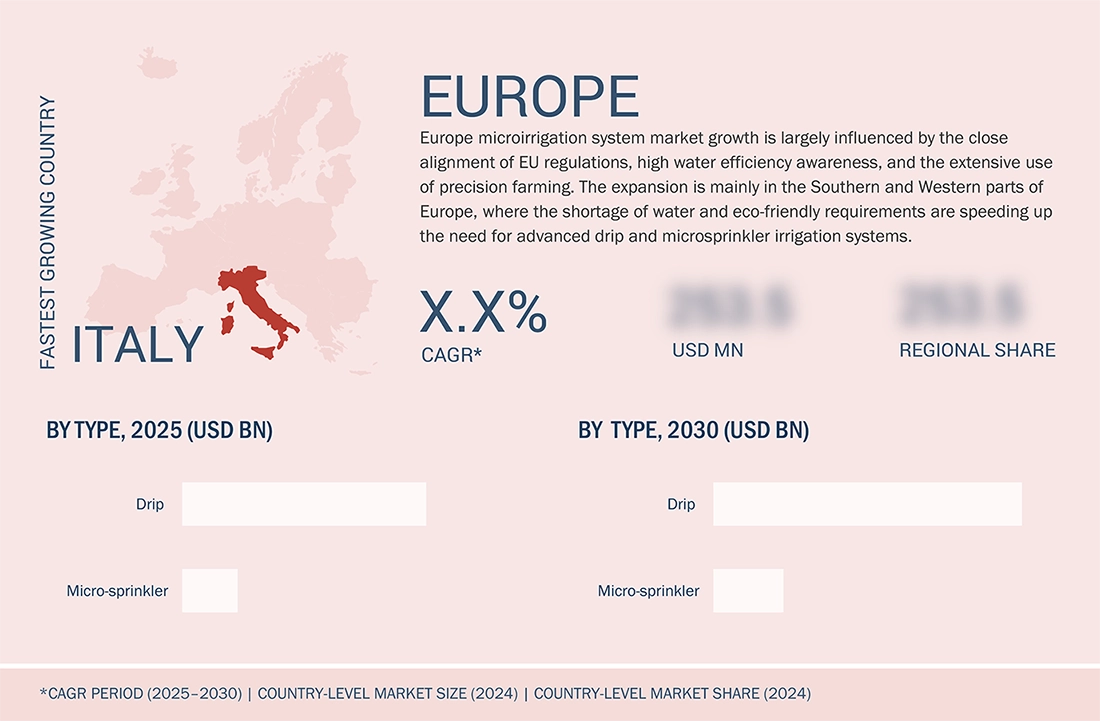
Italy to be fastest-growing country in Europe microirrigation system market during forecast period
The microirrigation system market in Italy is projected to be the fastest-growing in Europe during the forecast period. This change will come as a result of water stress due to structural issues, regulations, and crop economics. Among others, repeated droughts, decreasing groundwater levels, and stricter enforcement of water, use regulations (especially in Southern and Central Italy) are causing agriculture to change rapidly to more efficient irrigation systems. Growth in this area is well backed by the large number of high-value permanent crops, which mainly consist of vineyards, olives, fruits, nuts, and horticulture. These are the sectors where exact and dependable irrigation is absolutely necessary for the quality of the yield and the competitiveness of the export. When water efficiency is the main concern for the viability of a farm, Italian farmers are certainly going to make the transition from conventional sprinkler and surface irrigation to drip and microsprinkler systems. The local market enlargement is likewise bolstered by irrigation modernization programs that are supported by the government, EU CAP funding, and the rising investment in precision agriculture and digital farming solutions. The existence of commercial farms, the well-developed distributor networks, and the gradually increasing use of automation, fertigation, and pressure-compensated technologies are speeding up the system penetration. Consequently, the country is becoming a major contributor to the Europe microirrigation system market where it will be responsible for most of the incremental growth during the forecast period.
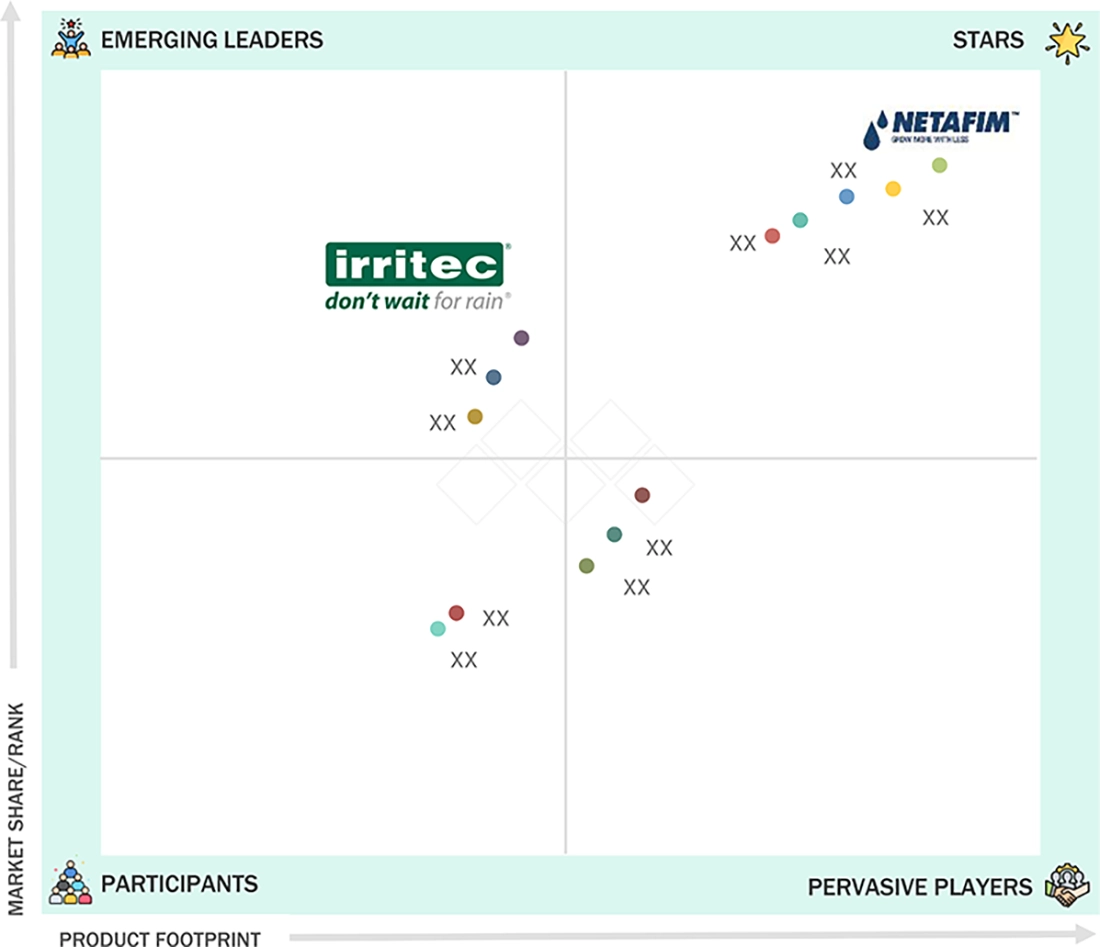
EUROPE MICROIRRIGATION SYSTEM MARKET: COMPANY EVALUATION MATRIX
The competitive structure of the Europe microirrigation systems market is clearly evident and is primarily influenced by four factors: engineering quality, product breadth, regional presence, and aftersales capability. Global leaders such as Netafim is at the center of the activity, leveraging their advanced drip and microsprinkler portfolios, strong brand recognition, and well, established dealer networks across Southern and Western Europe. There are equally strong Europe, based manufacturers such as Irritec S. p. A., which compete through localized product customization, project execution expertise, and close alignment with EU regulatory and sustainability requirements. The market is thus moderately concentrated, with innovation being led by precision irrigation technologies, automation, and service, led solutions, while mid, sized specialists and local suppliers still have a significant role in regional growth and customer support.
Source: Secondary Research, Interviews with Experts, MarketsandMarkets Analysis
KEY MARKET PLAYERS
- Netafim (Israel)
- Rain Bird Corporation (US)
- The Toro Company (US)
- Rivulis (Singapore)
- Valmont Industries (US)
- HUNTER INDUSTRIES (US)
- Nelson Irrigation (US)
- T-L Irrigation (US)
- Irritec S.P.A
- REINKE MANUFACTURING CO., INC.
- Eurodrip S,A
- N-Drip
- INNARI
MARKET SCOPE
| REPORT METRIC | DETAILS |
|---|---|
| Market Size in 2024 (Value) | USD 2.07 Billion |
| Market Forecast in 2030 (Value) | USD 3.34 Billion |
| Growth Rate | CAGR of 8.5% from 2025–2030 |
| Years Considered | 2020–2030 |
| Base Year | 2024 |
| Forecast Period | 2025–2030 |
| Units Considered | Value (USD Million/Billion), Area ('000 Hectares) |
| Report Coverage | Revenue forecast, company ranking, competitive landscape, growth factors, and trends |
| Segments Covered |
|
| Countries Covered | Spain, Russia, Italy, France, Ukraine, Azerbaijan, and Rest of Europe |
WHAT IS IN IT FOR YOU: EUROPE MIRCROIRRIGATION SYSTEM MARKET REPORT CONTENT GUIDE
DELIVERED CUSTOMIZATIONS
We have successfully delivered the following deep-dive customizations:
| CLIENT REQUEST | CUSTOMIZATION DELIVERED | VALUE ADDS |
|---|---|---|
| Micro-Irrigation Systems Market Overview (Europe) |
|
|
| Crop-wise Demand Analysis |
|
|
| End-User & Channel Analysis |
|
|
RECENT DEVELOPMENTS
- January 2025 : Lindsay Corporation (NYSE: LNN) finished acquiring a 49.9% minority stake in Austria-based Pessl Instruments, a global developer of AgTech solutions. This investment boosts Lindsay’s innovation plans by speeding up digital and data-driven irrigation technologies. It will help produce food, fuel, and fiber more efficiently to meet growing global demand.
- April 2024 : Rivulis launched the D4000 PC drip line, a thin-wall, pressure-compensated system designed to expand drip irrigation into previously unsuitable terrains. By delivering uniform water distribution across long runs and sloped or uneven landscapes, the product removes key limitations of conventional thin-wall drip. Strategically, this innovation broadens Rivulis’ addressable market, supports higher grower productivity and profitability, and strengthens its position in precision irrigation for challenging field conditions.
- April 2024 : Rivulis Irrigation Ltd. and Eurodrip S.A. agreed to merge in an all-share transaction, forming a global leader in micro-irrigation. Subject to regulatory approvals, the combined company will operate 18 manufacturing plants and employ ~1,800 people across 30 countries on five continents, significantly expanding global market coverage and scale.
- January 2024 : Lindsay Corporation unveiled a new user interface for its FieldNET platform, part of a remote monitoring and control solution for any brand of center pivot irrigation, providing farmers with assistance from routine monitoring up to and including industry-leading, highly sophisticated agronomic recommendations for irrigation via FieldNET Advisor.
Table of Contents
 Exclusive indicates content/data unique to MarketsandMarkets and not available with any competitors.
Methodology
This research study involved the extensive use of secondary sources—directories and databases, such as Bloomberg Businessweek and Factiva—to identify and collect information useful for a technical, market-oriented, and commercial study of the Europe Mircroirrigation System Market. In-depth interviews were conducted with various primary respondents—such as key industry participants, subject matter experts (SMEs), C-level executives of key market players, and industry consultants—to obtain and verify critical qualitative and quantitative information, as well as to assess prospects.
Secondary Research
The secondary sources referred to for this research study include government sources (such as the Food and Agriculture Organization (FAO), the International Commission on Irrigation & Drainage (ICID), The Organization for Economic Co-operation and Development (OECD), United States Department of Agriculture (USDA), and the World Bank, corporate filings (such as annual reports, press releases, investor presentations, and financial statements)), and trade, business, and professional associations, among others. The secondary data was collected and analyzed to arrive at the overall Europe Mircroirrigation System Market size, which was further validated by primary research.
Primary Research
The market comprises several stakeholders in the supply chain; these include suppliers, manufacturers, and end-use product manufacturers. Various primary sources from both the supply and demand sides of the market were interviewed to obtain qualitative and quantitative information. The primary interviewees from the demand side include key opinion leaders, executives, vice presidents, and CEOs of the agriculture industry. The primary sources from the supply side include research institutions involved in R&D activities, key opinion leaders, and manufacturers of microirrigation systems.
To know about the assumptions considered for the study, download the pdf brochure
Market Size Estimation
Both the top-down and bottom-up approaches were used to estimate and validate the total size of the Europe Mircroirrigation System Market. These approaches were also used extensively to determine the size of various subsegments in the market. The research methodology used to estimate the market size includes the following details:
- The key players in the industry and the markets were identified through extensive secondary research.
- The Europe Mircroirrigation System Market was determined through primary and secondary research.
- All percentage shares, splits, and breakdowns were determined using secondary sources and verified through primary sources.
- All macroeconomic and microeconomic factors affecting the growth of the Europe Microirrigation System Market were considered while estimating the market size.
- All parameters that affect the market covered in this research study were accounted for, viewed in extensive detail, verified through primary research, and analyzed to obtain final quantitative and qualitative data.
Bottom-up Approach
The figure represents the overall market size estimation process employed through the bottom-up approach for this study.
The bottom-up approach was implemented for data extracted from secondary research to validate the market segment sizes obtained, which is explained below:
- The market for microirrigation systems was identified based on factors, such as COVID-19 impact on the trade and supply of agricultural inputs, company presence, and their revenues and product availability; crop production, exports, and imports; the adoption of organic farming based on key crops, and average usage of drip & micro-sprinkler irrigation systems on crop application rates in the industry.
- For each country, the increase in microirrigation area was considered, along with the replacement rate of microirrigation equipment in the existing area to arrive at the market demand. This area with potential market demand was then multiplied with the average selling price (ASP) of microirrigation equipment per hectare to arrive at the country's market size. Similar ASP was considered across all the countries in the region, with certain price variations done based on product availability and export/import dependency of the country for drip equipment. After arriving at each country's market value, these market values were summed to arrive at the regional Europe Mircroirrigation System Market size. This was checked with the Europe Mircroirrigation System Market share splits provided by the industry experts. A similar approach was performed for other regions as well.
- Following this, the market size for each region was estimated by summing up the country-level data. Further, the market size at the global level was estimated by summing up the regional level data, which has been validated through primary interviews conducted with microirrigation system manufacturers, government institutions, research organizations, suppliers, and distributors.
- The global number for microirrigation systems was arrived at after giving certain weightage factors for secondary sources, and primary sources obtained.
Top-Down Approach
The top-down approach was used to triangulate the data obtained through this study:
The top-down approach was also implemented for the data extracted from secondary research to validate the share of the market segment obtained. For the calculation of the Europe Mircroirrigation System Market, the revenues of the major players operating in the Europe Mircroirrigation System Market were considered. The global share of the major players in the Europe Mircroirrigation System Market was validated with the primary respondents. The regional splits were arrived at by considering the presence and number of products sold by the company in the particular region alongside the land area being brought under microirrigation systems.
Data Triangulation
After arriving at the overall Europe Microirrigation System Market size from the above estimation process using both top-down and bottom-up approaches, the total market was split into several segments and subsegments. To complete the overall Europe Mircroirrigation System Market estimation and arrive at the exact statistics for all segments and subsegments, the data triangulation and market breakdown procedures were employed wherever applicable. The data was triangulated by studying various factors and trends from the demand and supply sides
Market Definition
According to US EPA (United States Environmental Protection Agency), microirrigation is a low-pressure, low-flow-rate type of irrigation that can reduce the likelihood of overwatering a landscape. This form of irrigation delivers water directly to where it is needed most-the root zone of plants. It also delivers the water slowly and over a longer period of time, preventing runoff and reducing evaporation. Microirrigation systems use 20 to 50 percent less water than conventional sprinkler systems and can reduce residential or commercial landscape irrigation water use.
According to F.R. Lamm, J.E. Ayars, and F.S. Nakayama in the book titled ‘Microirrigation for Crop Production: Design, Operation and Management,’ microirrigation is defined as:
“Microirrigation is the slow application of water on, above, or below the soil by surface drip, subsurface drip, bubbler, and micro sprinkler systems. Water is applied as discrete or continuous drips, tiny streams, or miniature spray through emitters or applicators placed along a water delivery line adjacent to the plant row.”
Microirrigation systems include drip method and micro-sprinkler method of irrigation systems. The approach in both systems involves a controlled supply of water in small quantities with the required consistency. Microirrigation is low pressure and low-volume irrigation system suitable for high-return value crops such as fruit and vegetable crops. Microirrigation is a modern method of irrigation; by this method, water is irrigated through drippers, micro-sprinklers, foggers, and other emitters on the surface or subsurface of the land
Key Stakeholders
- Microirrigation systems manufacturers
- Microirrigation systems importers and exporters
- Microirrigation systems traders, distributors, and suppliers
- Government and research organizations
-
Government regulatory agencies
- Food and Agriculture Organization (FAO)
- United States Department of Agriculture (USDA)
- Environmental Protection Agency (EPA)
- Department of Environment, Food, and Rural Affairs (DEFRA)
Report Objectives
Market Intelligence
- To determine and project the size of the Europe Microirrigation System Market with respect to type, crop type, end user, and region
- To identify the attractive opportunities in the market by determining the largest and fastest-growing segments across regions
- To provide detailed information about the key factors influencing the market growth (drivers, restraints, opportunities, and challenges)
- To provide the regulatory framework and market entry process related to the Europe Mircroirrigation System Market
- To analyze the micromarkets with respect to individual growth trends, prospects, and their contribution to the total market
Competitive Intelligence
- To identify and profile the key players in the Europe Mircroirrigation System Market
- To provide a comparative analysis of market leaders based on the following:
- Product offerings
- Business strategies
- Strengths and weaknesses
- Key financials
- To understand the competitive landscape and identify the major growth strategies adopted by players across countries
To provide insights on key product innovations and investments in the Europe Mircroirrigation System Market
Customization Options
MarketsandMarkets offers customizations according to client-specific scientific needs with the given market data.
The following customization options are available for the report:
Product Analysis
- Product matrix, which gives a detailed comparison of the product portfolio of each company
Geographic Analysis
- Further breakdown of the Europe Mircroirrigation System Market forecast into Germany, UK, the Netherlands, and other EU and non-EU countries.
Company Information
- Detailed analyses and profiling of additional market players (up to five)


Personalize This Research
- Triangulate with your Own Data
- Get Data as per your Format and Definition
- Gain a Deeper Dive on a Specific Application, Geography, Customer or Competitor
- Any level of Personalization
Let Us Help You
- What are the Known and Unknown Adjacencies Impacting the Europe Microirrigation System Market
- What will your New Revenue Sources be?
- Who will be your Top Customer; what will make them switch?
- Defend your Market Share or Win Competitors
- Get a Scorecard for Target Partners

Custom Market Research Services
We Will Customise The Research For You, In Case The Report Listed Above Does Not Meet With Your Requirements
Get 10% Free CustomisationTESTIMONIALS

Business Innovation Director
US Based Leading Agribusiness,
Food and Ingredients ManufacturerI highly appreciate the team's efficiency for a well conducted study that helped us clarify some blind spots in food and agricultural niche markets. Although compiling information for B2B markets is very difficult, the MnM team pulled out the task successfully. The quality of research, level of insights, and responsiveness of team were commendable.






Growth opportunities and latent adjacency in Europe Microirrigation System Market