Europe Modular Construction Market

Europe Modular Construction Market by Material (Wood, Steel, Concrete), By End-Use Industry (Residential, Office Education, Retail & Commercial, Hospitality, Healthcare), and Region – Forecast to 2030




OVERVIEW
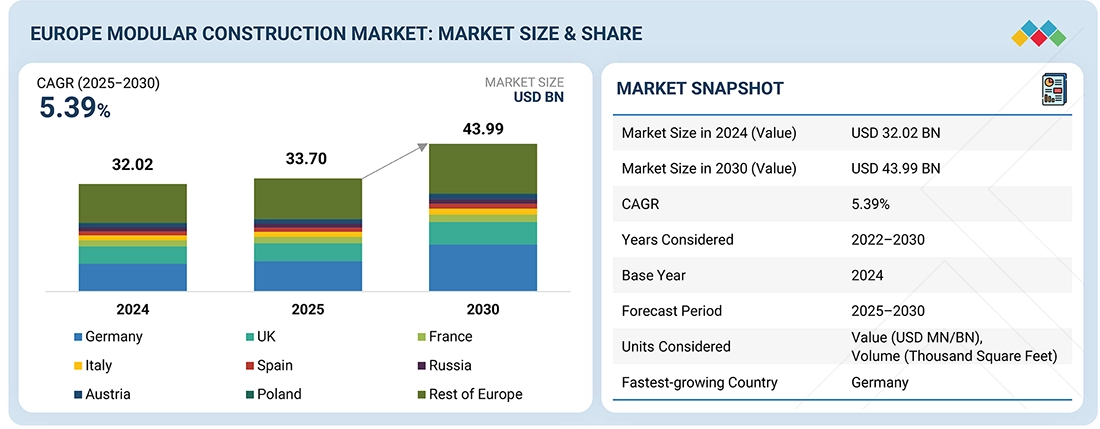
Source: Secondary Research, Interviews with Experts, MarketsandMarkets Analysis
The modular construction market in Europe is projected to reach USD 43.99 billion by 2030 from USD 33.70 billion in 2025, at a CAGR of 5.39% during the forecast period. Quick urban growth and ongoing housing shortages, coupled with pressure to deliver quality homes more quickly, propel the momentum. The urban share is expected to rise from 75% today to 83.7% by 2050. Shortfalls have already been observed: the UK completed just 208,600 new dwellings in 2024–25, against a target of 300,000 per year; France has more than 4 million people in housing distress; and Germany, despite an urbanization rate of 77.9%, still suffers from a high backlog in its metropolitan cities. Simultaneously, increasing labor costs and stringent EU sustainability regulations under the European Green Deal are driving builders toward quicker, more resource-efficient methods. Permanent modular construction allows the fulfillment of a project by up to half and reduces on-site waste by up to 90%, thus becoming fully compliant with Eurocodes and the Construction Products Regulation; it has many positive sides when compared with traditional building. At the policy level, backing is strong: the UK Affordable Homes Programme, the EU Recovery and Resilience Facility of nearly USD 780 billion, and various national modular housing incentives, along with advances in BIM, digital twins, and precision off-site fabrication, remain key accelerants to the adoption of the technology. Overall, these forces continue to drive growth across the modular construction market in Europe.
KEY TAKEAWAYS
-
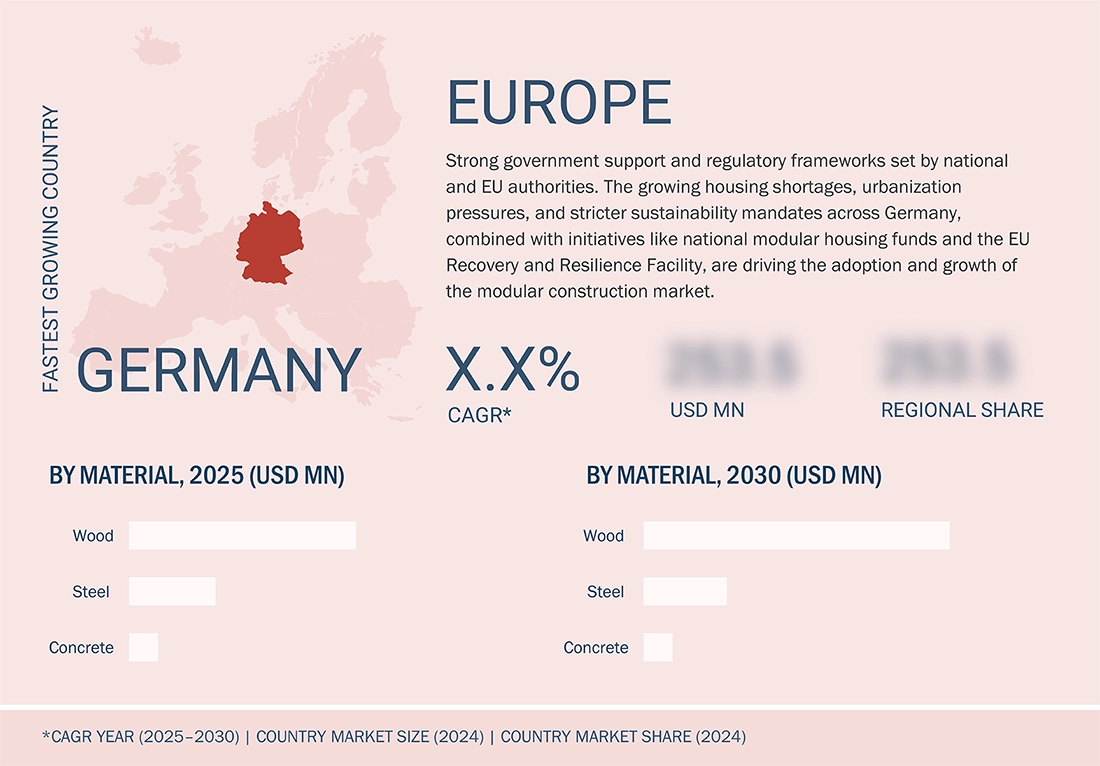
By CountryGermany's modular construction market dominated, with a share of 25.9% in 2024.
-
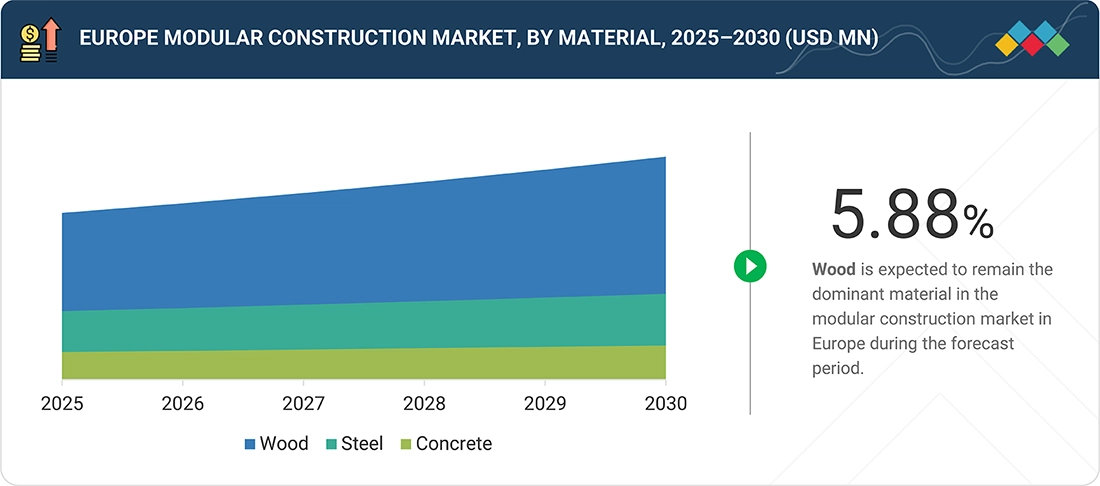
By MaterialBy material, the wood segment is expected to register the highest CAGR of 5.88% from 2025 to 2030, in terms of value.
-
By End-use IndustryBy end-use industry, the healthcare segment is expected to dominate the market, growing at the highest CAGR of 5.81%.
-
Competitive Landscape - Key PlayersLaing O'Rourke, Skanska AB, Modulaire Group, Kleusberg GmbH & Co. KG, and Bouygues Construction were identified as the leading players in the modular construction market in Europe, as they have focused on innovation, broad industry coverage, and strong operational & financial strength.
-
Competitive Landscape- StartupsInvestwood, SA, Modulous, and Elements Europe, among others, have distinguished themselves among startups and SMEs due to their strong product portfolio and business strategy.
The modular construction market in Europe is expanding rapidly as countries face mounting pressures to deliver faster, more sustainable, and cost-efficient buildings. According to the European Commission, the EU needs to renovate or replace nearly 75% of its building stock to meet 2030 energy-efficiency targets, while labor shortages affect over 40% of construction firms across major economies (Source: EC, Eurostat). Traditional construction methods struggle to meet the rising demand for housing, schools, healthcare facilities, and low-carbon infrastructure, especially as urban populations grow and skilled labor becomes increasingly scarce. Modular construction offers accelerated timelines, reduced on-site labor, and high energy performance, making it increasingly attractive to developers and public authorities. Manufacturers can leverage this opportunity by scaling factory capacity, adopting digital tools such as BIM and automated production, offering standardized yet customizable modules, and partnering with governments on housing, education, and healthcare projects across Europe.
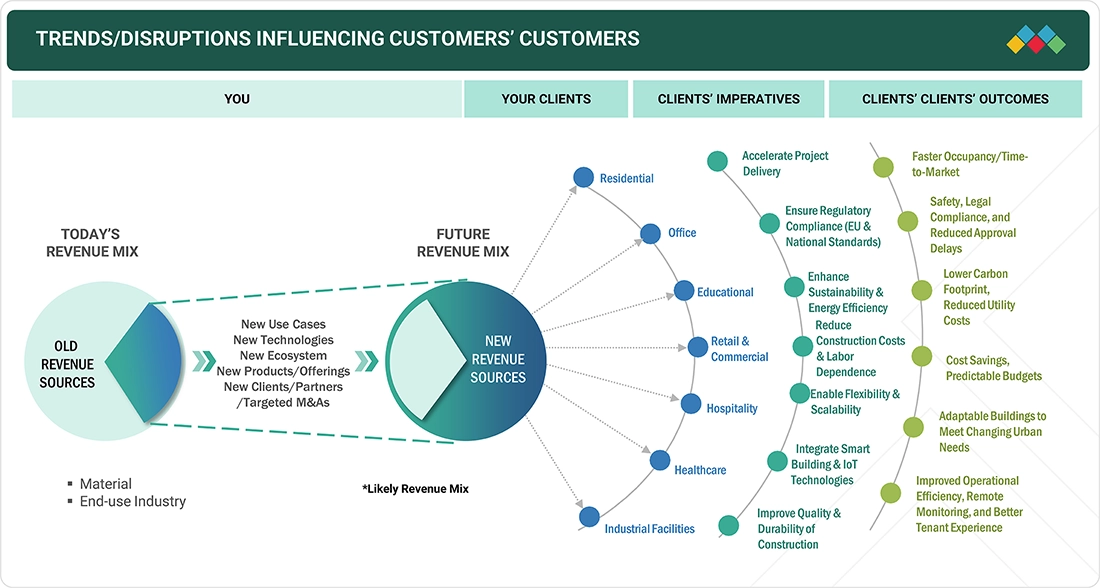
TRENDS & DISRUPTIONS IMPACTING CUSTOMERS' CUSTOMERS
The influence on end-use sectors in the European modular construction market is driven by rising demand for faster, sustainable, and cost-efficient building solutions. Key sectors, including residential, office, education, healthcare, hospitality, and public infrastructure, increasingly prefer modular methods due to housing shortages, aging building stock, and labor constraints in traditional construction. EU energy-efficiency targets and national green-building initiatives further accelerate adoption across both public and private projects. Differences in regulations, procurement policies, and government funding for housing, schools, and healthcare also shape uptake across regions. Together, these factors drive demand for modular solutions, guide investment in digital and industrialized construction technologies, and support the development of standardized yet flexible modular systems across Europe.
Source: Secondary Research, Interviews with Experts, MarketsandMarkets Analysis
MARKET DYNAMICS

Level
-
Rising demand fueled by housing shortages and rapid urbanization

-
Strong EU sustainability mandates advancing low-carbon construction


Level
-
High initial investments and financing constraints for modular facilities

-
Susceptibility to supply chain delays and cross-border logistic issues


Level
-
Integration of advanced technologies for next-generation modular construction

-
Growing government funding and public-sector adoption of modular solutions


Level
-
Ongoing misconceptions about quality, longevity, and design flexibility

-
Acute shortage of specialized skills and training in modular design and assembly

Source: Secondary Research, Interviews with Experts, MarketsandMarkets Analysis
Driver: Rising demand fueled by housing shortages and rapid urbanization
Europe's cities are struggling to cope with rapid urban growth and persistent housing shortages. According to Eurostat, more than three-quarters of the EU population already lives in urban areas, a share expected to rise to approximately 83.7% by 2050. The footprint of built-up land continues to grow by over 3% per decade, with Germany, Poland, the UK, and France being the hardest hit. In the UK, the Ministry of Housing reported just 208,600 net new homes in 2024–25, a significant shortfall of the 300,000-per-year target, leaving a substantial backlog of homes to be built. Meanwhile, similar gaps exist in Germany, where 77.9% of the population lives in towns and cities, according to Destatis. Cities such as Berlin are struggling to keep pace. Estimates by the Fondation Abbé Pierre, an organization that tracks the number of people in housing distress, say it is as many as 4 million, including 350,000 homeless, in France. Modular construction can significantly reduce the crisis barrier by cutting delivery times by as much as 50%, with off-site fabrication. It enables governments and developers to deliver high-quality, affordable homes and student housing much faster than traditional methods, thus becoming an important tool to close Europe's growing housing gap while aligning with the EU's sustainable development goals.
Restraint: High initial investments and financing constraints for modular facilities
The substantial initial investment needed for modular factories and modern technologies continues to be a considerable obstacle, particularly for small and medium-sized enterprises, despite potential long-term savings. Establishing a singular prefabrication facility often requires an investment of €5–10 million, which discourages entry in cost-sensitive areas. The European Central Bank’s SAFE survey indicates that 22% of euro-area construction SMEs see access to finance as their principal impediment, significantly exceeding the 15% average for other sectors. In Eastern Europe, the issue is particularly acute: the World Bank’s 2025 MSME Finance Gap study reveals a €5.7 trillion funding deficit in emerging countries, but the EBRD anticipates merely 3.0% investment growth in 2025 due to stringent credit conditions and subdued private lending. These financial obstacles restrict factory expansion, exacerbate regional inequalities, and confine modular building predominantly to major entities, hindering the sector's capacity to scale and address Europe's pressing housing and sustainability demands.
Opportunity: Integration of advanced technologies for next-generation modular construction
The integration of Building Information Modeling (BIM), artificial intelligence (AI), and 3D printing is facilitating the development of advanced modular buildings, achieving unparalleled customization, waste minimization, and efficiency. The European Commission requires Building Information Modeling (BIM) for publicly funded construction projects in 12 Member States, with complete implementation anticipated throughout the EU by 2030 in accordance with the Public Procurement Directive. The EU's Digital Europe Programme (2021-2027) has designated €1.4 billion for artificial intelligence and advanced digital skills, directly facilitating adoption in the construction sector. The tangible effects are evident: the European Construction Industry Federation (FIEC) indicates that BIM adoption has attained 60–70% in Nordic nations and the Netherlands, reducing design errors by as much as 40% and facilitating efficient off-site manufacturing. Over 30 ongoing projects under Horizon Europe merge 3D printing with modular methods, including full-scale concrete-printed modular houses in both Germany and Denmark. Aligned with the EU Green Deal and smart urban frameworks such as the European Urban Initiative (€450 million for 2021–2027), these technologies position modular building as a core pillar of sustainable, precise urban growth throughout the continent.
Challenge: Ongoing misconceptions about quality, longevity, and design flexibility
Despite decades of demonstrated efficacy, adverse impressions of modular buildings as transient, inferior, or aesthetically inflexible persist, obstructing widespread acceptance throughout Europe. Public and professional skepticism often arises from outdated associations with post-war prefabricated housing, obscuring contemporary permanent modular construction (PPMC) that meets or exceeds conventional standards. The European Committee for Standardization (CEN) asserts that modular systems adhere entirely to Eurocodes and the Construction Products Regulation (CPR); however, the UK’s House of Commons Housing Select Committee (2021) and the subsequent 2023 follow-up inquiry emphasized that "perceived poor quality and lack of design flexibility" persist as the primary obstacles identified by local authorities and housing associations in rejecting off-site methods. The 2024 report from the European Construction Industry Federation (FIEC) indicates that merely 38% of architects and engineers surveyed deem modular construction appropriate for complex or high-end projects, notwithstanding evidence from government-supported initiatives in Sweden and the Netherlands showcasing design lifespans exceeding 60 years and complete architectural flexibility. These ingrained assumptions impede procurement decisions, restrict public financing distribution, and perpetuate a preference for traditional construction, considerably limiting the sector's growth potential.
EUROPE MODULAR CONSTRUCTION MARKET: COMMERCIAL USE CASES ACROSS INDUSTRIES
| COMPANY | USE CASE DESCRIPTION | BENEFITS |
|---|---|---|
 |
Elements Europe provided precisely engineered modular units for the 17-story Motel One hotel in central London, which was built atop a five-story office podium to facilitate urban hospitality integration. | Faster construction timelines with minimal on-site disruption in busy urban environments, ensuring high quality and maximizing space efficiency for commercial properties |
 |
Forta PRO supplied 144 prefabricated modules forming 72 buildings across 5,200 square meters for Hage’s Badehotel in Denmark, elevated on pillars to preserve the coastal landscape. | Minimizes environmental impact and on-site disruption, allowing seamless integration with natural surroundings while providing panoramic views and sustainable luxury hospitality |
 |
Mute developed and installed its proprietary Mute Modular system for its own 840 m² headquarters office in Warsaw, Poland, featuring 17 movable zones for flexible workspaces including meetings and hot desking. | Reduces waste and CO2 emissions through efficient prefabrication, enables two-week assembly for rapid deployment, and offers adaptability to evolving work models with significant time and cost savings |
Logos and trademarks shown above are the property of their respective owners. Their use here is for informational and illustrative purposes only.
MARKET ECOSYSTEM
An ecosystem map of the modular construction market in Europe shows a tightly linked value chain enabling fast, efficient, and sustainable building delivery. It begins with suppliers of engineered timber, structural steel, precast concrete, insulation materials, and digital design components that feed into manufacturers producing 2D panels, 3D volumetric modules, bathroom pods, and hybrid systems. Logistics partners, crane operators, and on-site assembly contractors ensure the smooth transport, installation, and commissioning of equipment. The ecosystem is supported by developers, architects, engineering firms, and public procurement bodies that integrate modular solutions into large-scale projects. Key end-use sectors include residential, office, education, retail & commercial, hospitality, healthcare, and other institutional buildings. Regulatory bodies, building standards agencies, and sustainability frameworks further guide quality, safety, and energy efficiency requirements, reinforcing the adoption of modular construction across Europe.
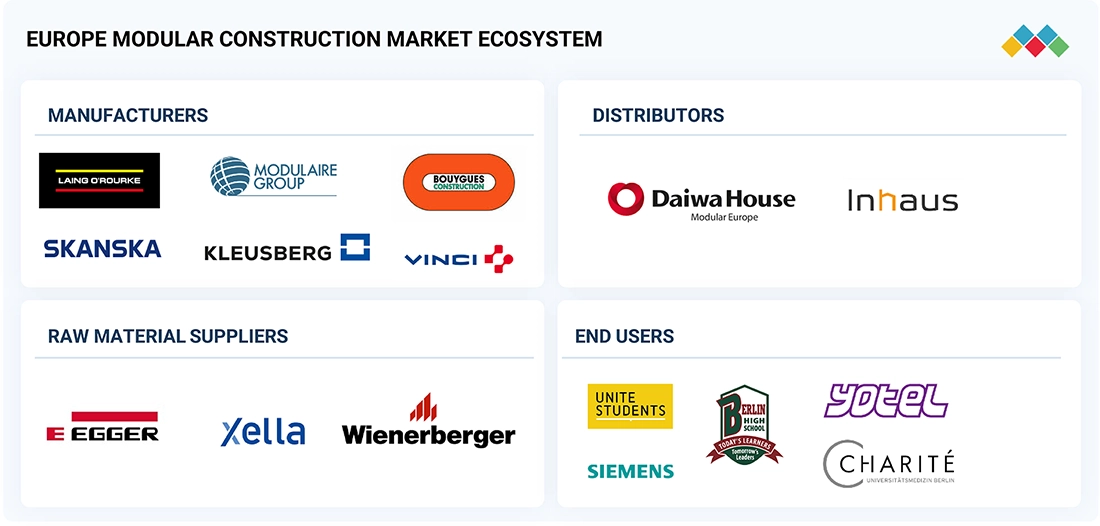
Logos and trademarks shown above are the property of their respective owners. Their use here is for informational and illustrative purposes only.
MARKET SEGMENTS
Source: Secondary Research, Interviews with Experts, MarketsandMarkets Analysis
Europe Modular Construction Market, By Material
In 2024, wood accounted for the largest share of the modular construction market in Europe, driven by strong demand for sustainable, low-carbon building materials. Europe’s climate and energy-efficiency policies have accelerated the adoption of mass timber, cross-laminated timber (CLT), and glulam in modular and prefabricated construction. Countries such as Germany, France, Sweden, and Austria actively promote timber-based building to meet EU 2030 climate targets, while Europe remains a global leader in engineered wood production, ensuring a steady supply for modular manufacturers. Wood is preferred for its low embodied carbon, excellent thermal performance, lighter weight, and ease of assembly, which enable faster construction in residential, educational, and mid-rise urban projects. As developers and public authorities increasingly prioritize sustainability and rapid construction, wood continues to dominate material selection, strengthening its position as the leading material in Europe’s modular construction landscape.
Europe Modular Construction Market, By End-use Industry
In 2024, the residential end-use industry was the largest contributor to the modular construction market in Europe, with structural housing needs and policy-driven demand being the main factors to support the trend. As per Bundesverband Deutscher Fertigbau (BDF) data, modular and prefabricated methods accounted for 26.1% of newly approved single- and two-family homes in Germany, up from 24.5% in 2023, reflecting a strong change towards factory-built housing. Across Europe, the housing gap remains substantial, with regional estimates indicating a shortage of over 9 million homes. Furthermore, almost half of the EU’s residential buildings were constructed before 1980 and require major energy-efficiency upgrades. These limitations, along with increased urbanization, high construction prices, and a shortage of skilled labor, have made modular construction a viable solution for development that is faster and can be scaled up. The method has also gained popularity in the construction of single-family houses, multi-family apartments, student housing, and social housing. Political measures that are conducive to the implementation of the technology such as green-building standards, renovation incentives, and simplified permitting, are additionally helping to consolidate the residential sector as the main source of market growth for Europe whose driving force is modular construction.
REGION
Germany to be the fastest-growing country in the Europe modular construction market during the forecast period
Germany is expected to be the fastest-growing country in the European modular construction market, driven by the rising utilization of prefabricated and modular building techniques. The Bundesverband Deutscher Fertigbau (BDF) reports that 26.1% of newly permitted single- and two-family dwellings in 2024 utilized offsite prefabrication, an increase from 24.5% in 2023. Out of 44,293 total permitted residences, 11,543 were prefabricated, indicating a growing preference for expedited and efficient construction methods. Prefabrication is also growing in the multi-family sector, where buildings produced by modular and serial production increased from 7.0% in 2023 to 8.2% in 2024, underlining its scalability for urban residential projects. This trend spans crucial end-use sectors, including Residential, Office, Education, Retail & Commercial, Hospitality, Healthcare, and other institutional projects, driven by labor shortages, regulatory incentives for sustainable construction, and the demand for cost- and time-efficient building solutions.
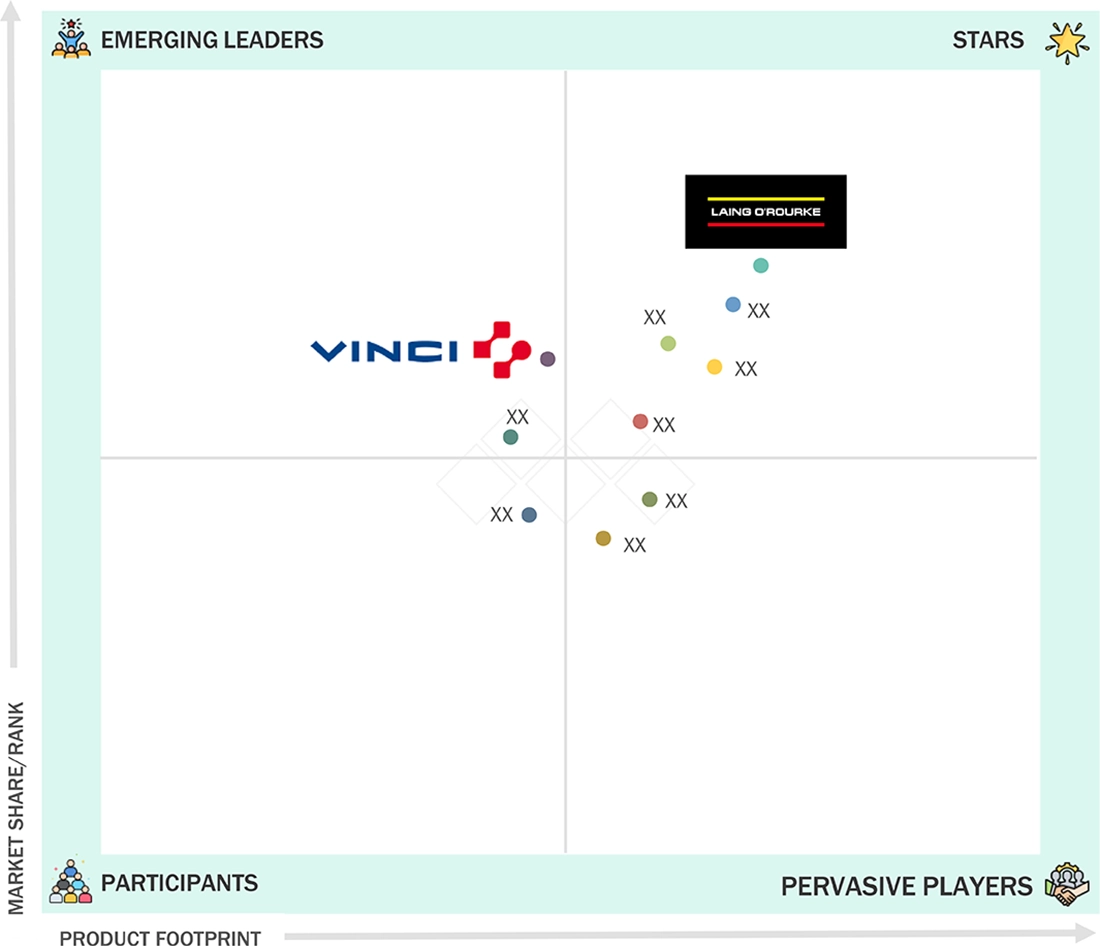
EUROPE MODULAR CONSTRUCTION MARKET: COMPANY EVALUATION MATRIX
Laing O'Rourke (Star) leads the Europe modular construction market with its strong regional presence, advanced prefabrication techniques, and integration of smart construction technologies, enabling cost-efficient, high-quality, and time-saving solutions across residential, commercial, and public infrastructure projects. Vinco S.A. (Emerging Leader) is expanding rapidly by offering flexible, sustainable, and affordable modular solutions tailored to diverse project needs, capturing growing demand across multiple sectors.
Source: Secondary Research, Interviews with Experts, MarketsandMarkets Analysis
KEY MARKET PLAYERS
- Laing O’Rourke
- Skanska AB
- Modulaire Group
- Kleusberg GmbH & Co. KG
- Bouygues Construction
- Vinci S.A.
- Wernick Group
- KOMA MODULAR
- Premier Modular
- ALHO Group
MARKET SCOPE
| REPORT METRIC | DETAILS |
|---|---|
| Market Size in 2024 (Value) | USD 32.02 BN |
| Market Size in 2030 (Value) | USD 43.99 BN |
| CAGR | 5.39% |
| Years Considered | 2022–2030 |
| Base Year | 2024 |
| Forecast Period | 2025–2030 |
| Units Considered | Value (USD MN/BN) Volume (Thousand Square Feet) |
| Report Coverage | Revenue forecast, company ranking, competitive landscape, growth factors, and trends |
| Segments Covered |
|
| Countries Covered | Germany, France, UK, Spain, Poland, Italy, Russia, Austria, Rest of Europe |
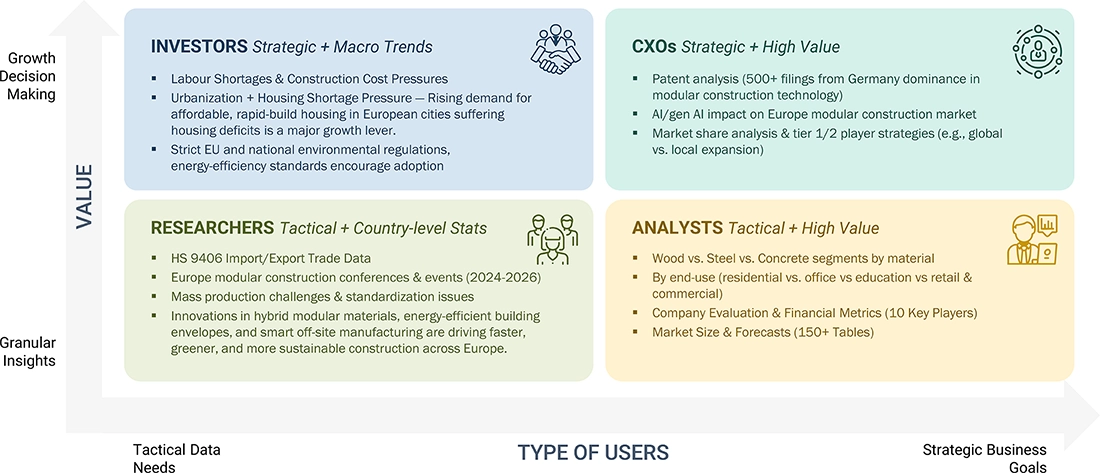
WHAT IS IN IT FOR YOU: EUROPE MODULAR CONSTRUCTION MARKET REPORT CONTENT GUIDE
DELIVERED CUSTOMIZATIONS
We have successfully delivered the following deep-dive customizations:
| CLIENT REQUEST | CUSTOMIZATION DELIVERED | VALUE ADDS |
|---|---|---|
| German-based Modular Construction Manufacturers |
|
|
| Wood-based European Modular Construction Manufacturers |
|
|
| Steel-based European Modular Construction Manufacturers |
|
|
RECENT DEVELOPMENTS
- March 2024 : Skanska recently received a contract from Statsbygg to construct an extension to the Ullersmo prison located in Kløfta, Norway. This expansion encompasses approximately 7,000 square meters, comprising both indoor and outdoor elements of the prison.
- February 2024 : Laing O’Rourke has secured a significant contract from the CBH Group in Western Australia for the implementation of the Cranbrook Rail Outloading Project. This initiative is part of a larger effort encompassing 11 rail siding projects at CBH sites.
- December 2022 : Modulaire Group announced its agreement to acquire Mobile Mini UK Holdings Limited (“Mobile Mini UK”) from a subsidiary of WillScot Mobile Mini Holdings Corp.
- November 2022 : Laing O'Rourke unveiled a USD 7.7 million investment in electric construction equipment, marking the launch of Australia’s premier renewable fleet consisting of 250-ton crawler cranes and telehandlers.
- March 2022 : Robotics Australia Group and Laing O’Rourke entered into a partnership to integrate robotics-related technologies in modular construction.
Table of Contents
 Exclusive indicates content/data unique to MarketsandMarkets and not available with any competitors.
Methodology
The study involved four major activities for estimating the current size of the Europe Modular Construction Market . Exhaustive secondary research was conducted to gather information on the market, the peer market, and the parent market. The next step was to validate these findings, assumptions, and sizes with the industry experts across the value chain of modular construction through primary research. Both the top-down and bottom-up approaches were employed to estimate the overall size of the Europe Modular Construction Market . After that, market breakdown and data triangulation procedures were used to determine the size of different segments and sub-segments of the market.
Secondary Research
In the secondary research process, various secondary sources such as Hoovers, Factiva, Bloomberg BusinessWeek, and Dun & Bradstreet were referred to, to identify and collect information for this study on the Europe Modular Construction Market . These secondary sources included annual reports, press releases & investor presentations of companies, white papers, certified publications, articles by recognized authors, regulatory bodies, trade directories, and databases.
Primary Research
Various primary sources from both the supply and demand sides of the Europe Modular Construction Market were interviewed to obtain qualitative and quantitative information. The primary sources from the supply-side included industry experts, such as Chief Executive Officers (CEOs), vice presidents, marketing directors, sales professionals, and related key executives from various leading companies and organizations operating in the Europe modular construction industry. The breakdown of the profiles of primary respondents is as follows:
To know about the assumptions considered for the study, download the pdf brochure
Market Size Estimation
Both the top-down and bottom-up approaches were used to estimate and validate the size of the Europe Modular Construction Market . These approaches were also used extensively to estimate the size of various dependent segments of the market. The research methodology used to estimate the market size included the following details:
- The key players were identified through extensive secondary research.
- The industry’s supply chain and market size, in terms of value, were determined through primary and secondary research processes.
- All percentage shares, split, and breakdowns were determined using secondary sources and verified through primary sources.
- All possible parameters that affect the markets covered in this research study were accounted for, viewed in extensive detail, verified through primary research, and analysed to obtain the final quantitative and qualitative data.
- The research includes the study of reports, reviews, and newsletters of key industry players, along with extensive interviews with key officials, such as directors and marketing executives.
Data Triangulation
After arriving at the overall market size from the estimation process explained above, the total market was split into several segments and sub-segments. The data triangulation and market breakdown procedures were employed, wherever applicable, to complete the overall market engineering process and arrive at the exact statistics for all segments and sub-segments of the Europe Modular Construction Market. The data was triangulated by studying various factors and trends from both the demand- and supply-side. In addition, the market size was validated by using both the top-down and bottom-up approaches. Then, it was verified through primary interviews. Hence, for every data segment, there are three sources—top-down approach, bottom-up approach, and expert interviews. The data were assumed to be correct when the values arrived at from the three sources matched.
Market Definition
The Modular Construction Market refers to the industry sector encompassing the design, fabrication, and assembly of building components in controlled factory environments for subsequent installation at construction sites. This approach to construction involves the prefabrication of standardized modules or components, which are then transported and assembled on-site to create structures ranging from residential homes and commercial buildings to industrial facilities and infrastructure projects.
Key Stakeholders
- Raw material suppliers
- Modular construction manufacturers
- Government & regulatory bodies
- Research organizations
- Associations and industry bodies
- Contractors, architects, and engineers
- End users
- Traders and distributors
Report Objectives
- To estimate and forecast the Europe Modular Construction Market , in terms of value and volume.
- To provide detailed information about the major factors (drivers, restraints, opportunities, and challenges) influencing the market growth.
- To define, describe, and forecast the market size, based on type, material, end-use industry, and region.
- To strategically analyze micromarkets, with respect to individual growth trends, prospects, and their contribution to the total market.
- To analyze growth opportunities in the market for stakeholders and provide details on the competitive landscape for market leaders.
- To strategically profile key players and comprehensively analyze their market shares and core competencies.
- To analyze competitive developments, such as merger & acquisition, expansion & investment, agreement, and new product development in the Europe Modular Construction Market .
Available Customizations
With the given market data, MarketsandMarkets offers customizations according to client-specific needs.
The following customization options are available for the modular construction report:
Product Analysis
- Product matrix, which offers a detailed comparison of the product portfolio of companies
Regional Analysis
- Further analysis of the Europe Modular Construction Market for additional countries
Company Information
- Detailed analysis and profiling of additional market players (up to five)


Personalize This Research
- Triangulate with your Own Data
- Get Data as per your Format and Definition
- Gain a Deeper Dive on a Specific Application, Geography, Customer or Competitor
- Any level of Personalization
Let Us Help You
- What are the Known and Unknown Adjacencies Impacting the Europe Modular Construction Market
- What will your New Revenue Sources be?
- Who will be your Top Customer; what will make them switch?
- Defend your Market Share or Win Competitors
- Get a Scorecard for Target Partners

Custom Market Research Services
We Will Customise The Research For You, In Case The Report Listed Above Does Not Meet With Your Requirements
Get 10% Free CustomisationTESTIMONIALS

We at Nissan Chemicals Corporation have been clients of MarketsandMarkets for more than a year now. We recently consulted MarketsandMarkets for a study, the team at MarketsandMarkets was extremely professional and organized. The business insights were very detailed and aligned well with our expectations that really helped us formulate the Business Plans and device new strategies for development themes. MarketsandMarkets offers a unique combination of expertise and dedicated engagement model. Their research findings have helped us in designing our Pricing Strategy which will make it easier for us to predict the future sales and profits for the next ten years. We look forward to working with MarketsandMarkets in the future.
VP of Strategy & New Business Development
Leading Specialty Chemical Company
The MarketsandMarkets Engagement Model, composed of both the Knowledge Store and advisory custom research, has greatly helped us in understanding our markets and making strategic decisions. The Knowledge Store is a fast way to allow everyone in our organization to understand more about most any market they are interested in. The ability to then get custom research done and get answers to specific strategic questions and market insight has been spectacular. The Markets and Markets team feel more like colleagues than vendors and their services have helped us change our culture where statements of things like growth opportunities and competitive position are always backed by industry research.

Rich Gibson,
Director, Corporate Strategy
Milliken & Company,
Leading Industrial Manufacturer of specialty chemical, floor covering, performance and protective textile materials, and healthcaremilliken.com
MarketsandMarkets is a trusted resource that helps us to better understand markets that are near-adjacencies-whether its technology, value chain or geography. Their Knowledge Store platform provides a dashboard of markets and their characteristics which is easy to use and saves us time.
Adam Shaw,
Market Development and Strategy Manager
AdvanSix Inc. USA,
An American Leader in Chemicalswww.advansix.com
The Knowledge Store from MarketsandMarkets is a valuable tool which has helped my team acquire greater insight in to the end markets that our business serves. This has enabled us to help our company build stronger strategies throughout our planning process.
TOSHIO KINOSHITA
Senior Chif Consultion Research & Consulting Division
Mitsubishi Chemical Research Corporation,
Leading Manufacturer of Chemical Productswww.mitsubishichem-res.co.jp/en/

We recently engaged with MarketsandMarkets for a study, the team not only clearly understood our business objectives but was also extremely professional in the way they handled the entire project. The study was efficiently conducted in a phase-wise manner, and the engagement model furnished us with high-quality business insights that far exceeded our expectations at each phase. We were especially happy that MarketsandMarkets could provide us with both, an English as well as a Japanese version of the study. A special thanks to the Analyst Team and Client Services Team, whose fluency in Japanese enhanced our comfort level, as we could converse with them in our preferred language.
Independent entrepreneurs
Arrow Precision
We approached MarketsandMarkets for study on Proppants Market, and their work exceeded our expectations. The study conducted was comprehensive and enabled us to view the market through the various dimensions. In addition, the team was extraordinarily responsive throughout the process and resolved our queries on time. I strongly recommend MarketsandMarkets and will certainly consider them for additional market assessments we will need in the future.
Global engineering company, Japan
Deputy Manager,
Strategic Planning OfficeThe high-quality insights shared by the MarketsandMarkets team helped us understand the pharmaceutical plant designers in a specific geography. It also captured the risks that we may likely face in communicating with our potential partners. The study would enable us identify partners, which would impact our future growth.






Growth opportunities and latent adjacency in Europe Modular Construction Market