Europe Modular Data Center Market

Europe Modular Data Center Market by Solution [All-in-one and Prefabricated Modules (IT, Power, Cooling), Form Factor (ISO Containers, Enclosures, Skid-mounted), Deployment Type (Indoor, Outdoor), End User (Enterprises, CSPs, TSPs)] - Forecast to 2030




OVERVIEW
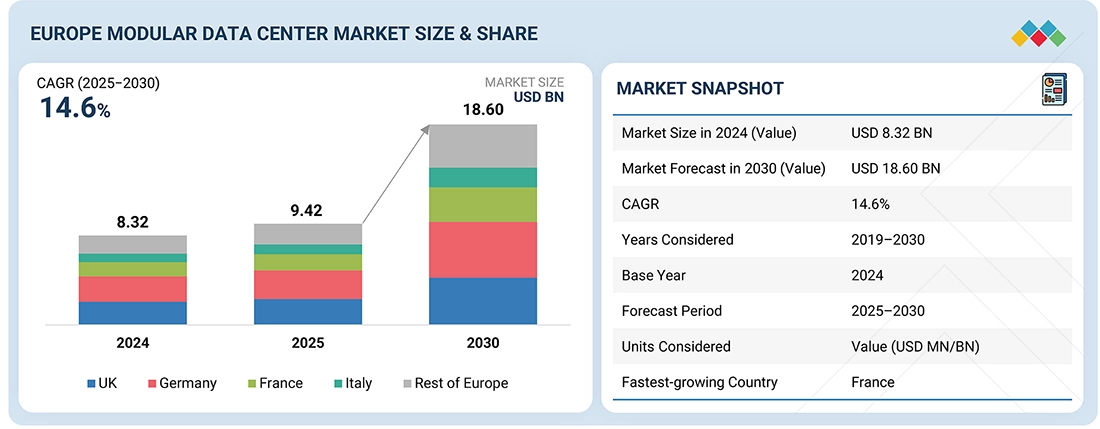
Source: Secondary Research, Interviews with Experts, MarketsandMarkets Analysis
The Europe modular data center market in Europe is expected to reach USD 9.42 billion in 2025 and USD 18.60 billion by 2030, exhibiting a CAGR of 14.6% during the forecast period. Market is shifting toward edge, sustainability, and rapid deployment, making it a high-growth sector for investors in hyperscale, telecom, and green tech solutions. Modular data centers allow organizations to deploy them quickly, scale them easily, and provide lower initial capital investment costs in comparison to traditional data center options. Additionally, the stringent EU energy-efficiency regulations are accelerating the adoption of more sustainable or 'green' modular designs throughout the region. The greatest demand is coming from Germany, the UK, France, the Netherlands, and the Nordic countries, while Eastern Europe is quickly being developed into a low-cost alternative for expanding operations.
KEY TAKEAWAYS
-
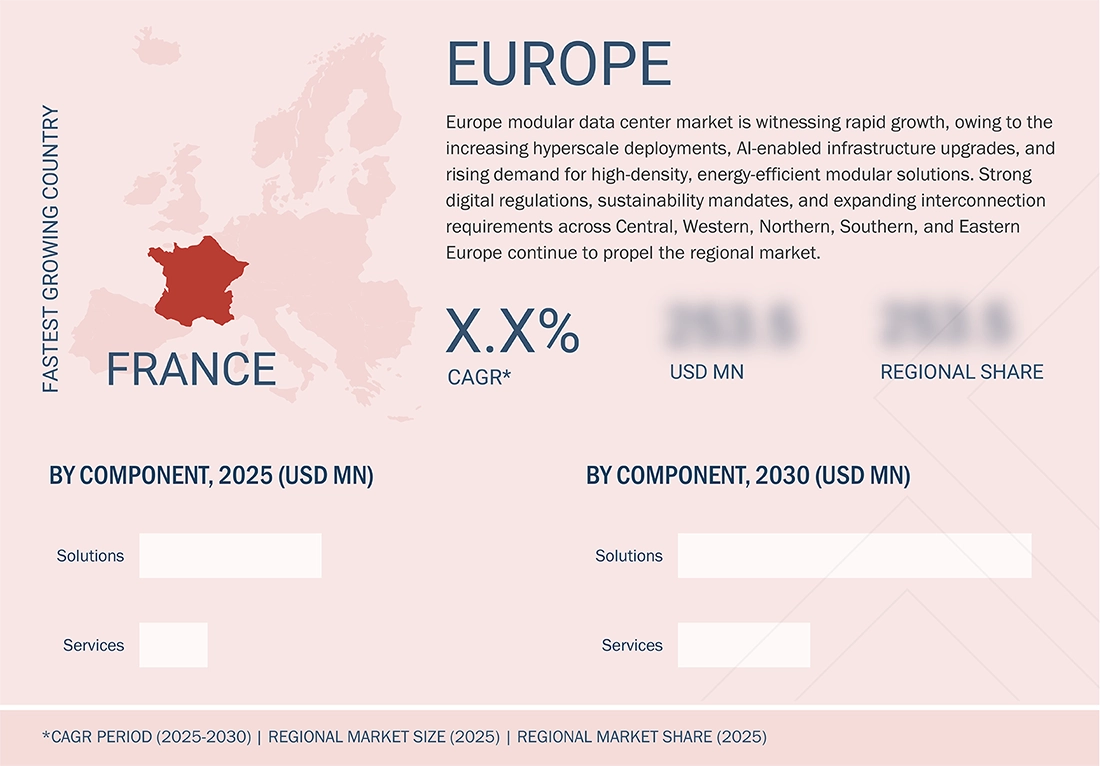
By CountryFrance is expected to grow at the fastest CAGR of 16.0% between 2025 and 2030.
-
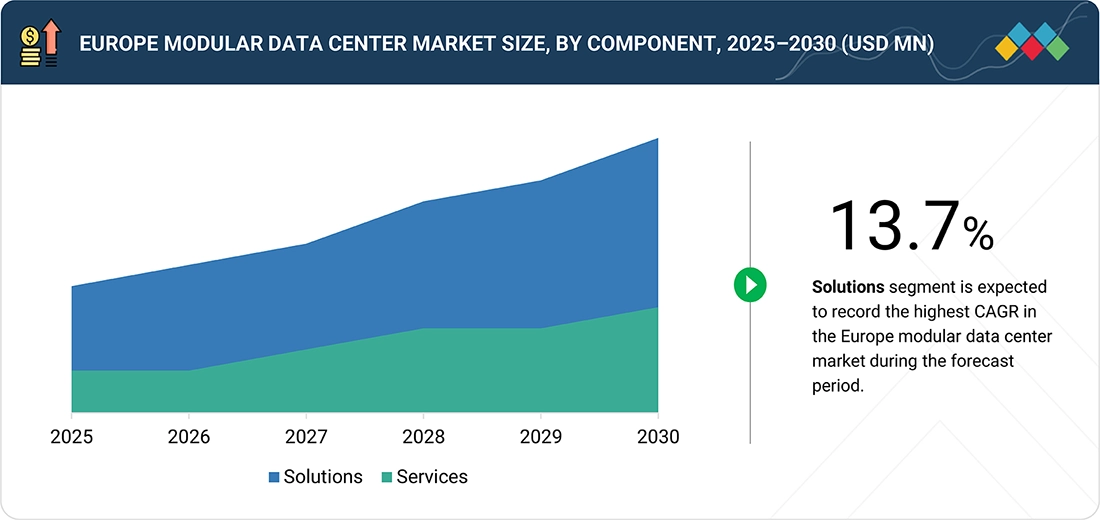
By ComponentSolutions is expected to dominate the market with a share of 72.8% in 2025.
-
By Form FactorSkid-mounted systems segment is projected to grow at the fastest rate at a CAGR of 18.1% during the forecast period.
-
By Build TypeAll in one data center segment is expected to grow at the highest CAGR during the forecast period.
-
By Data Center SizeLarge-sized data center is expected to dominate the market in 2025.
-
By Deployment TypeOutdoor is expected to grow at the fastest CAGR during the forecast period.
-
By End UserCloud service providers segment accounted for the largest market share in 2025.
-
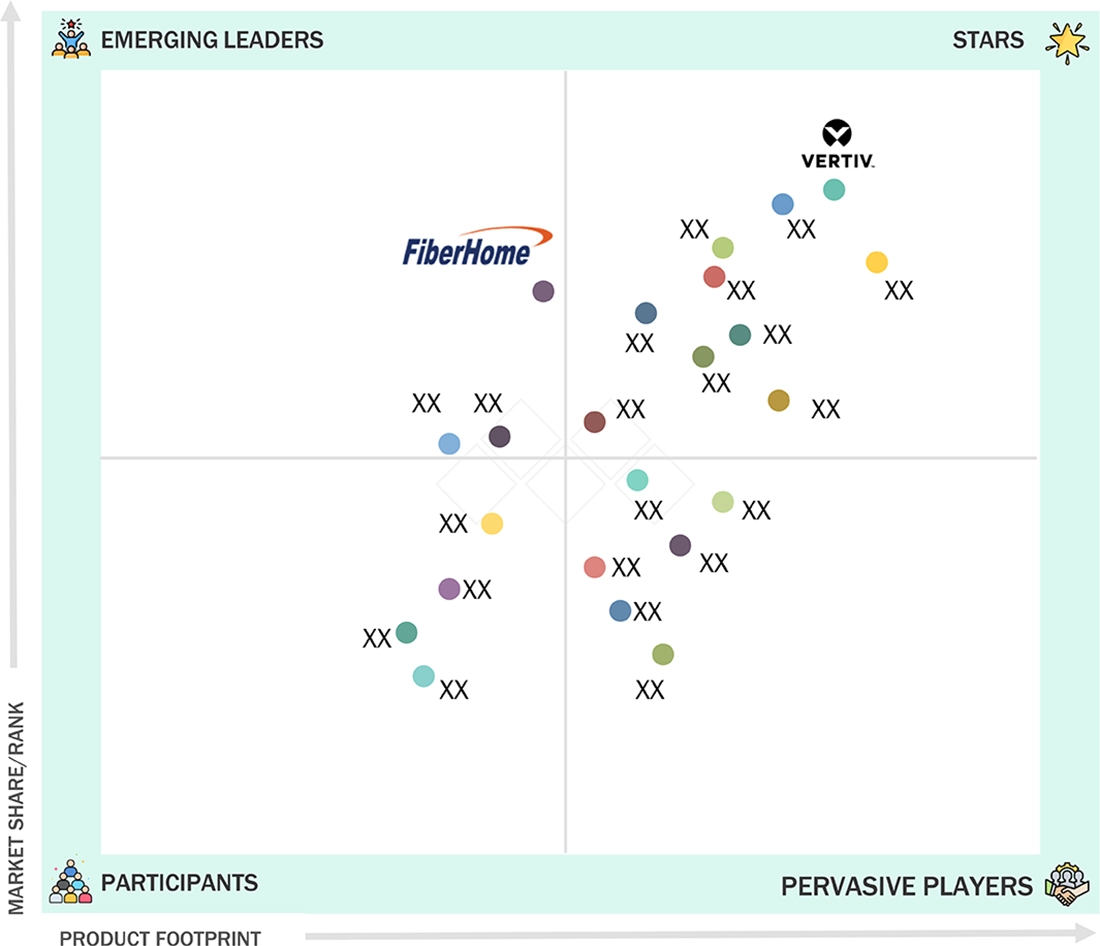
Competitive LandscapeVertiv, Schneider Electric, Huawei, ABB and Stulz were identified as some of the star players in Europe modular data center market, given their strong market share and product footprint.
-
Competitive LandscapeTAS, Volta, BASX Solutions , Modular Power Solutions, and Cannon Technologies have distinguished themselves among startups and SMEs by securing strong footholds in Europe modular data center market.
Modular data centers are growing in popularity in Europe due to the focus on speedy installation, scalability and energy efficiency of infrastructure. With the growth of edge computing, cloud services, 5G technology, and other business applications, there is a significant need for modular data centers. Furthermore, the increased focus on sustainable solutions from a regulatory standpoint has led to an increase in the use of "green" designs for modular data centers. Companies looking for lower capital expenditures, increased resiliency and a more flexible path for digital growth are expected to have additional interest in modular data centers.
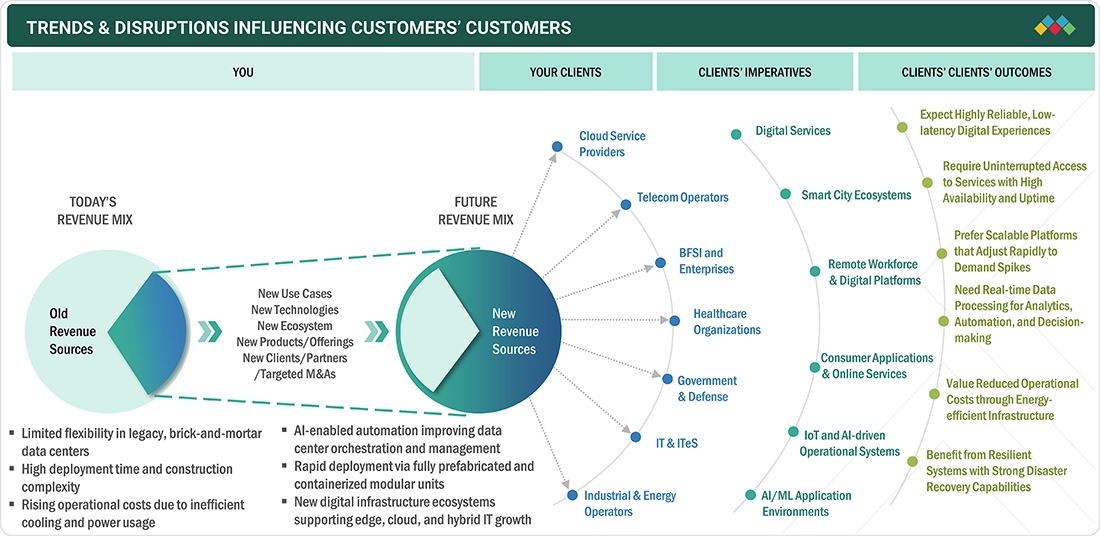
TRENDS & DISRUPTIONS IMPACTING CUSTOMERS' CUSTOMERS
Organizations are increasingly moving from traditional data center buildings to prefabricated and modular construction models, which are faster to deploy, more flexible and typically have lower operational costs for data center operators. With these characteristics considered, the demand for modular solutions is growing quickly, as data center providers focus on providing scalable and efficient infrastructure. Beyond the adoption of cloud services and the rise of digitalization, significant disruptors are edge computing, the increase of AI-driven workloads, the expansion of 5G networks, and increased energy efficiency regulations.
Source: Secondary Research, Interviews with Experts, MarketsandMarkets Analysis
MARKET DYNAMICS

Level
-
Expansion of edge computing and 5G networks

-
Rising demand from hyperscale and cloud providers


Level
-
Complex regulatory and permitting processes

-
Requirement for high initial capital investments


Level
-
Growth of renewable-powered modular data centers

-
Rising demand for edge and micro data centers


Level
-
Supply chain and component availability risks

-
Integration with legacy and hybrid IT environments

Source: Secondary Research, Interviews with Experts, MarketsandMarkets Analysis
Driver: Rising demand from hyperscale and cloud providers
Cloud service providers are expanding into secondary and emerging European markets. Modular data centers allow hyperscalers to scale capacity quickly, reduce construction timelines, and manage capital expenditure efficiently while meeting regional compliance and data sovereignty requirements.
Restraint: Complex regulatory and permitting processes
The fragmented nature of Europe’s regulatory system has made it more challenging to assess and implement modular deployments due to differences in requirements between countries, including planning approvals, energy usage limits and environmental compliance. This results in extended timeframes for implementation and increased costs due to the need for additional administrative support.
Opportunity: Growth of renewable-powered modular data centers
European region shift toward renewable energy presents a wide, open field of opportunities for solar, wind, and hydro, powered modular data centers. The Nordics, the Netherlands, and France are perfect places to roll out green modular solutions that not only fulfill the energy transition but also meet corporate ESG and carbon neutrality goals.
Challenge: Supply chain and component availability risks
Components, such as power modules, advanced cooling systems, and prefabricated enclosures, are essential for the modularity of data centers. The availability of these essential components is impacted by supply chain disruptions, geopolitical tensions, and trade restrictions within the European region. These constraints result in extended lead times, delays in project schedules, and higher procurement costs for stakeholders involved in the Europe modular data center market.
EUROPE MODULAR DATA CENTER MARKET: COMMERCIAL USE CASES ACROSS INDUSTRIES
| COMPANY | USE CASE DESCRIPTION | BENEFITS |
|---|---|---|
 |
In Germany, T-Systems required rapid expansion of data center capacity to support growing cloud and digital service demand. Vertiv delivered a prefabricated, Tier III-compliant modular data center solution, enabling fast deployment, high availability, and scalable infrastructure aligned with strict operational and regulatory requirements. | Reduced deployment time to nine months compared with traditional builds | Improved scalability | Lower capital and operating costs | Enhanced energy efficiency | Faster time-to-market, supporting reliable cloud services and long-term growth objectives |
 |
MNG Kargo, operating across Turkey in the Eurasia region, modernized its data center infrastructure to support rapid e-commerce growth and nationwide logistics operations. Huawei deployed a Smart Modular Data Center to provide resilient, scalable, and centrally managed IT capacity across distributed transit centers, ensuring uninterrupted, data-driven logistics services. | Rapid plug-and-play deployment | Integrated power, cooling, and monitoring | Simplified remote operations | Reduced operational complexity | Improved service reliability | Lowered maintenance effort | Scalable capacity to support sustained logistics growth and consistent service performance |
 |
HPE needed robust, high-availability power infrastructure for its modular data centers deployed in Zaltbommel, Netherlands and beyond within the EMEA region. Eaton supplied integrated UPS systems, power distribution devices, and PDUs tailored to meet the high power density and reliability requirements of edge and remote high-performance computing sites. | Ensured 100?% uptime through a fully integrated electrotechnical infrastructure designed for extreme and variable conditions | Improved reliability | Reduced maintenance | Optimized space and performance enhancing HPE’s modular data centers’ operational resilience |
Logos and trademarks shown above are the property of their respective owners. Their use here is for informational and illustrative purposes only.
MARKET ECOSYSTEM
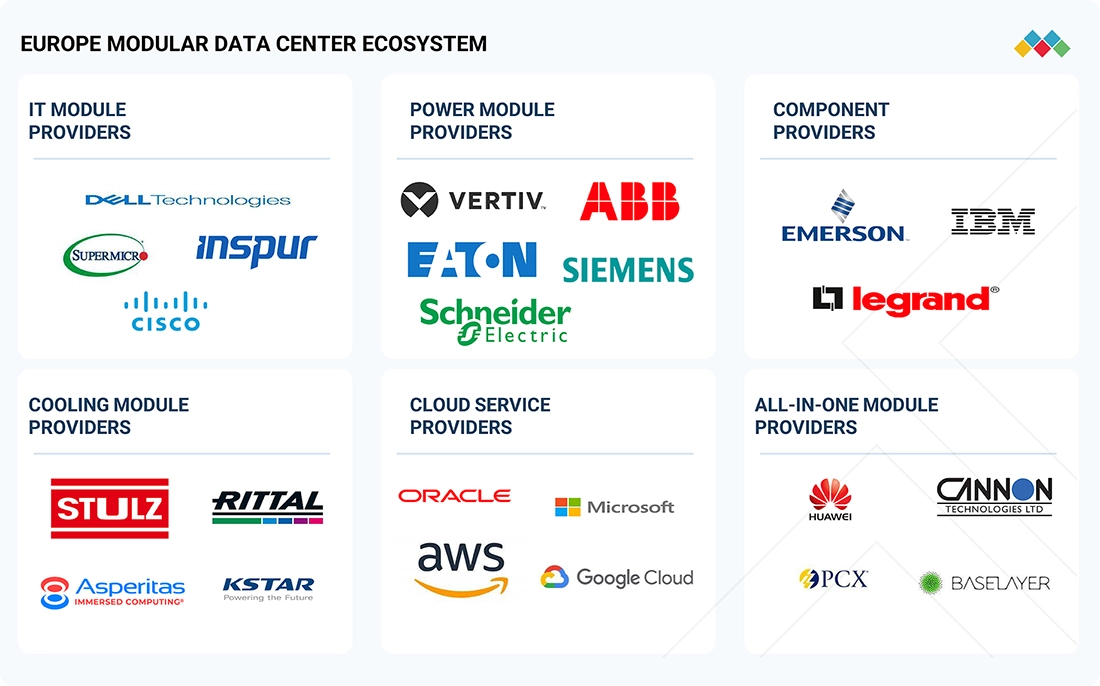
The Europe modular data center ecosystem comprises diverse providers across multiple segments, ensuring integrated solutions and efficient operations. Key IT module providers include Dell Technologies, Supermicro, Inspur, and Cisco, while power module solutions are offered by Vertiv, ABB, Eaton, Siemens, and Schneider Electric. Cooling modules are supplied by Stulz, Rittal, Asperitas, and KSTAR. Cloud services are supported by AWS, Oracle, Microsoft, and Google Cloud. Component providers, such as Emerson, Legrand, and IBM, complement the ecosystem, with all-in-one module offerings from Huawei, Cannon Technologies, PCX, and Baselayer, facilitating rapid deployment, scalability, and optimized performance for enterprises and hyperscale data center applications.
Logos and trademarks shown above are the property of their respective owners. Their use here is for informational and illustrative purposes only.
MARKET SEGMENTS
Source: Secondary Research, Interviews with Experts, MarketsandMarkets Analysis
Europe Modular Data Center Market, By Component
Solutions constitute the largest segment of the Europe modular data center market. They provide rapid deployment and efficient consumption of energy. They also make it easy to scale. These improve performance with monitoring and automation. They assist in rapid deployment and reduce costs and to address technology needs.
Europe Modular Data Center Market, By Form Factor
The largest form factor in the Europe modular data center market is enclosures. Pre-fabricated and self-contained units are being utilized by enterprise and service providers for easier deployment. They come in standard designs and offer speedier installation. Enclosures improve space use, enhance cooling, and better power management. They also fit different IT infrastructure needs.
Europe Modular Data Center Market, By Build Type
Semi prefabricated data center forms the largest build type in the Europe modular data center market. These types of data centers combine the advantages of off-site construction and on-site customization for maximum flexibility in deployment and construction time. Semi prefabricated data centers are built for efficiency, resiliency and the ability to adapt to fluctuations in IT workloads while providing continual support to an organizations long-term business continuity.
Europe Modular Data Center Market, By Data Center Size
Large data centers forms the largest segment in the Europe modular data center market. Their high capacity and simple scalability make them an ideal choice for large organizations looking to centralize IT operations around high-volume workloads. They also optimize energy usage and support companies in establishing robust, future-proof infrastructures for enterprise/cloud computing.
Europe Modular Data Center Market, By Deployment Type
In the Europe modular data center market, the indoor deployments are rising. Indoor deployment provides secure and controlled environments. Organizations use indoor modules to ensure optimal performance, efficiency of energy use, and ease of upkeep. Indoor modules offer support for benchmarking high-density computer environments and scalable infrastructure from a centralized location.
Europe Modular Data Center Market, By End User
In Europe, cloud service providers account for the largest portion of end users of modular data center solutions. To meet the demands from clients, providers require infrastructure systems that offer scalability, quick deployment and adaptability to changing business requirements. Using a modular data center enables these providers to efficiently manage energy usage and continuously deliver reliable and secure computing resources to an increasing customer base.
REGION
France to be fastest-growing region in Europe modular data center market during forecast period
The France modular data center is witnessing rapid growth. This reflects the popularity of modular and prefabricated facilities among enterprises, as well as cloud providers, as they opt to build these types of data centers. In addition, government policies that promote green data centers (the France 2030 Plan), an increasing amount of edge computing to deliver improved service efficiency, and AI-enabled optimization of energy efficiency are encouraging companies and industries alike to create scalable, efficient, and current infrastructures.
EUROPE MODULAR DATA CENTER MARKET: COMPANY EVALUATION MATRIX
Vertiv is positioned in the Stars quadrant of the Europe modular data center market, supported by its comprehensive infrastructure solutions, strong global presence, and advanced energy-efficient and scalable modular offerings. Its robust technology portfolio, emphasis on reliability, and focus on smart, sustainable data center solutions reinforce its market leadership. FiberHome is categorized as an Emerging Leader, driven by its growing modular data center portfolio, innovative deployment capabilities, and increasing adoption across enterprises and service providers seeking flexible, cost-efficient, and rapidly deployable data center solutions.
Source: Secondary Research, Interviews with Experts, MarketsandMarkets Analysis
KEY MARKET PLAYERS
- Dell Technologies (US)
- Vertiv (US)
- Schneider Electric (France)
- Huawei (China)
- Eaton (Ireland)
- STULZ (Germany)
- ABB (Switzerland)
- Cannon Technologies (UK)
- Flexenclosure (Sweden)
- Legrand (France)
- Siemens (Germany)
- Cannon Technologies (UK)
- Airedale Modine (UK)
- Skanska (Sweden)
- BladeRoom Data Centres (UK)
- FiberHome (China)
MARKET SCOPE
| REPORT METRIC | DETAILS |
|---|---|
| Market Size in 2024 (Value) | USD 8.32 Billion |
| Market Forecast in 2030 (Value) | USD 18.60 Billion |
| Growth Rate | CAGR of 14.6% from 2025–2030 |
| Years Considered | 2019–2030 |
| Base Year | 2024 |
| Forecast Period | 2025–2030 |
| Units Considered | Value (USD Million/Billion) |
| Report Coverage | Revenue forecast, company ranking, competitive landscape and growth factors trends |
| Segments Covered |
|
| Countries Covered | UK, Germany, France, Italy, and Rest of Europe |
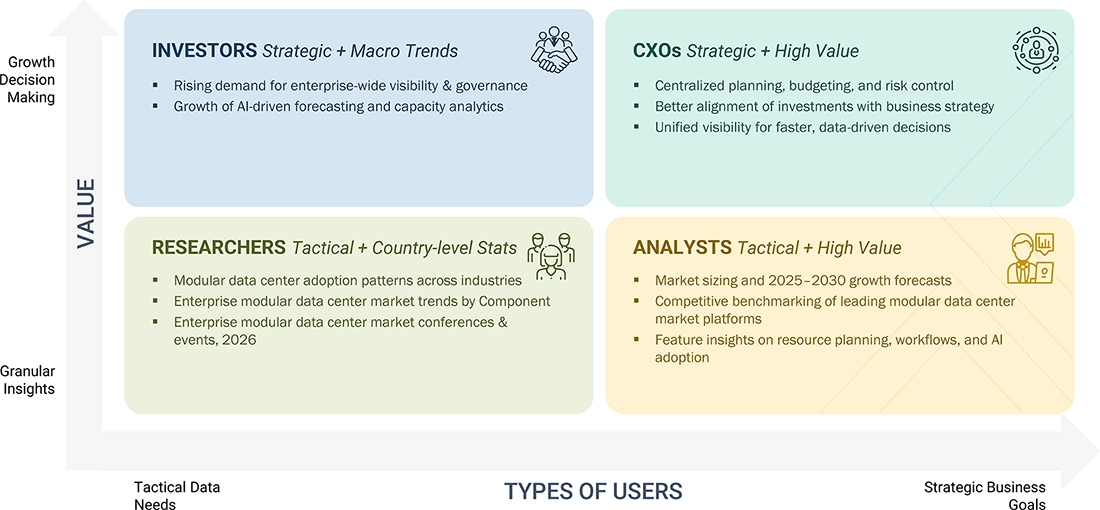
WHAT IS IN IT FOR YOU: EUROPE MODULAR DATA CENTER MARKET REPORT CONTENT GUIDE
DELIVERED CUSTOMIZATIONS
We have successfully delivered the following deep-dive customizations:
| CLIENT REQUEST | CUSTOMIZATION DELIVERED | VALUE ADDS |
|---|---|---|
| Competitive benchmarking of modular data center vendors across Europe |
|
|
| Cross-segment market sizing for European modular data center deployments |
|
|
| Evaluation of regional deployment readiness across European sub-markets |
|
|
RECENT DEVELOPMENTS
- December 2025 : Vertiv and GreenScale announced a strategic collaboration in Europe to deploy factory-integrated, prefabricated AI-ready data center platforms, combining Vertiv’s OneCore hybrid modules with GreenScale’s campus developments to accelerate high-density, liquid-cooled infrastructure builds and streamline scalable AI capacity deployment.
- November 2025 : Siemens and Delta formalized a strategic partnership to deliver prefabricated, modular power systems for data centers, targeting rapid deployment, reduced capital expenditure and lower carbon emissions in the European and Asia-Pacific markets by combining scalable, plug-and-play electrical infrastructure with advanced UPS, battery and thermal technologies.
- June 2024 : Ballard and Vertiv formed a strategic technology partnership focused on integrating hydrogen-powered fuel cell backup power with advanced UPS systems for data centers, demonstrating scalable, zero-emission energy solutions that enhance sustainability and support growing power demands in North America and Europe.
Table of Contents
 Exclusive indicates content/data unique to MarketsandMarkets and not available with any competitors.
Methodology
The study involved four major activities in estimating the Europe Modular Data Center market. We conducted secondary research to gather information on the market, competitors, and parent market. The next stage was to validate these findings and assumptions and size them with industry professionals across the value chain using primary research. Top-down and bottom-up methodologies were used to determine the total market size. We used the market breakup and data triangulation techniques to estimate the market size of the Europe modular data center market segments.
Secondary Research
Multiple sources were utilized to find and gather data for this research project in the secondary research phase. Other sources used were annual reports, press releases, investor presentations, white papers, journals, publications, and articles from reputable sources, directories, and databases. Information was also collected from additional secondary sources like academic journals, official government sites, blogs, and online platforms of vendors.
Primary Research
Primary sources included industry experts from the core and associated industries, preferred software suppliers, hardware manufacturers, distributors, service providers, technology developers, alliances, and organizations representing all parts of the industry's value chain. In-depth interviews were conducted with primary respondents, including major industry participants, subject-matter experts, C-level executives of important market companies, and industry consultants, to acquire and verify critical qualitative and quantitative data and analyze the market's potential.
We performed primary interviews to gain insights such as market statistics, the current trends disrupting the industry, new use cases applied, revenue data collected from products and services, market breakdowns, market size projections, market predictions, and data triangulation. Primary research has helped us grasp different technology trends, segmentation types, industry trends, and geographies. Demand-side stakeholders, such as Chief Information Officers (CIOs), Chief Technology Officers (CTOs), and Chief Security Officers (CSOs); installation teams of governments/end users using Europe modular data center solutions and services; and digital initiatives project teams, were interviewed to understand the buyer's perspective on suppliers, products, service providers, and their current use of services, which will affect the overall Europe modular data center market.
Market Size Estimation
We estimated and forecasted the Modular Data Management market. And other related submarkets using top-down and bottom-up methodologies. We used a bottom-up approach to calculate the overall market size by analyzing the revenues and offerings of significant market players. This study used data triangulation methods and validation through primary interviews to determine and confirm the precise worth of the whole parent market. We used the overall market size in the top-down process to estimate the size of other particular markets using percentage splits of market segments.
We used top-down and bottom-up approaches to estimate and validate the Europe Modular Data Center market and other dependent subsegments.
The research methodology used to estimate the market size included the following details:
- We identified key players in the market through secondary research. We then determined their revenue contributions in the respective countries through primary and secondary research.
- This procedure included studying top market player’s annual and financial reports and extensive interviews for key insights from industry leaders, such as Chief Executive Officers (CEOs), VPs, directors, and marketing executives.
- All percentage splits and breakups were determined using secondary sources and verified through primary sources.
Using top-down and bottom-up methodologies, we estimated and forecasted the Europe Modular Data Center market and related submarkets. We used a bottom-up approach to calculate the overall market size by analyzing the revenues and offerings of significant market players. This study used data triangulation methods and validation through primary interviews to determine and confirm the precise worth of the whole parent market. We used the overall market size in the top-down process to estimate the size of other particular markets using percentage splits of market segments.
Europe Modular Data Center Market : Top-Down and Bottom-Up Approach
Data Triangulation
After determining the overall market size, the market was divided into segments and subsegments using the previously described market size estimating techniques. Where applicable, data triangulation and market breakup methods were used to complete the whole market engineering process and ascertain the exact numbers for each market segment and subsegment. The data was triangulated by evaluating many elements and trends on the demand and supply sides of the Europe Modular Data Center market.
Market Definition
Considering the views of various sources and associations, MarketsandMarkets defines Modular Data Center as “references a deployment method and engineered solution for assembling a portable data center out of prefabricated modular components (commonly ISO standard container dimensions) that enable scalability and a rapid delivery schedule. Characteristics of modular data centers include standardization, rapid time to market, multiple power and cooling options, ease of deployment, greater reliability, location flexibility, smaller footprint, minimal construction dependencies, ease of scale, reduced stranded capacity and lower cost among others
Stakeholders
- Cloud Service Providers (CSPs)
- Original Equipment Manufacturers (OEMs)
- Data Center Equipment Suppliers
- Colocation Providers
- Technology Services Providers
- Data Center Managed Services Providers
- Government Organizations
- Networking Companies
- Consultants/Consultancies/Advisory Firms
- Support and Maintenance Service Providers
- Telecom Service Providers
- Information Technology (IT) Infrastructure Providers
- System Integrators (SIs)
- Regional Associations
- Independent Software Vendors
- Value-added Resellers and Distributors
Report Objectives
- To define, describe, and forecast the Europe Modular Data Center market based on component, form factor, deployment type, build type, data center size, end user, and region
- To strategically analyze the market subsegments with respect to individual growth trends, prospects, and contributions to the total market
- To provide detailed information related to the major factors influencing the growth of the market (drivers, restraints, opportunities, and challenges)
- To strategically analyze macro and micro markets with respect to growth trends, prospects, and their contribution to the overall market
- To analyze industry trends, patents and innovations, and pricing data related to the market
- To analyze the opportunities in the market for stakeholders and provide details of the competitive landscape for major players.
- To profile key players in the market and comprehensively analyze their market share/ranking and core competencies.
- To track and analyze competitive developments, such as mergers & acquisitions, product developments, and partnerships & collaborations in the market.
Available Customizations
With the given market data, MarketsandMarkets offers customizations per the company's specific needs. The following customization options are available for the report:
Product Analysis
- The product matrix provides a detailed comparison of each company's product portfolio.
Geographic Analysis as per Feasibility
- Further breakup of the Asia Pacific market into countries contributing 75% to the regional market size
- Further breakup of the North America market into countries contributing 75% to the regional market size
- Further breakup of the Latin America market into countries contributing 75% to the regional market size
- Further breakup of the Middle East & Africa market into countries contributing 75% to the regional market size
- Further breakup of the Europe market into countries contributing 75% to the regional market size
Company Information
- Detailed analysis and profiling of additional market players (up to 5)
Key Questions Addressed by the Report
What is the projected size of the Europe Modular Data Center Market by 2030?
The Europe Modular Data Center Market is projected to grow from USD 9.42 billion in 2025 to USD 18.60 billion by 2030, at a CAGR of 14.6%.
What is driving the growth of the Europe Modular Data Center Market?
Growth is driven by AI workloads, edge computing, 5G expansion, rapid deployment needs, and stringent EU energy-efficiency regulations.
Which countries are leading the Europe Modular Data Center Market?
Germany, the UK, France, the Netherlands, and the Nordic countries are the leading markets, while Eastern Europe is emerging rapidly.
What are the key technology trends shaping the Europe Modular Data Center Market?
Key trends include AI-enabled operations, prefabricated infrastructure, liquid cooling, edge computing, and green modular designs.
Who are the leading players in the Europe Modular Data Center Market?
Major players include Vertiv, Schneider Electric, Huawei, ABB, Eaton, STULZ, Siemens, Dell Technologies, Legrand, and Cannon Technologies.
Which component segment holds the largest market share?
The solutions segment is expected to dominate the Europe Modular Data Center Market with a 72.8% share in 2025


Personalize This Research
- Triangulate with your Own Data
- Get Data as per your Format and Definition
- Gain a Deeper Dive on a Specific Application, Geography, Customer or Competitor
- Any level of Personalization
Let Us Help You
- What are the Known and Unknown Adjacencies Impacting the Europe Modular Data Center Market
- What will your New Revenue Sources be?
- Who will be your Top Customer; what will make them switch?
- Defend your Market Share or Win Competitors
- Get a Scorecard for Target Partners

Custom Market Research Services
We Will Customise The Research For You, In Case The Report Listed Above Does Not Meet With Your Requirements
Get 10% Free CustomisationTESTIMONIALS






Growth opportunities and latent adjacency in Europe Modular Data Center Market