Europe Probiotics Market

Europe Probiotics Market by Product Type (Functional Food & Beverages, Dietary Supplements, and Feed), Ingredient (Bacteria and Yeast), End User (Human and Animal), Distribution Channel, and Region - Forecast to 2030




OVERVIEW
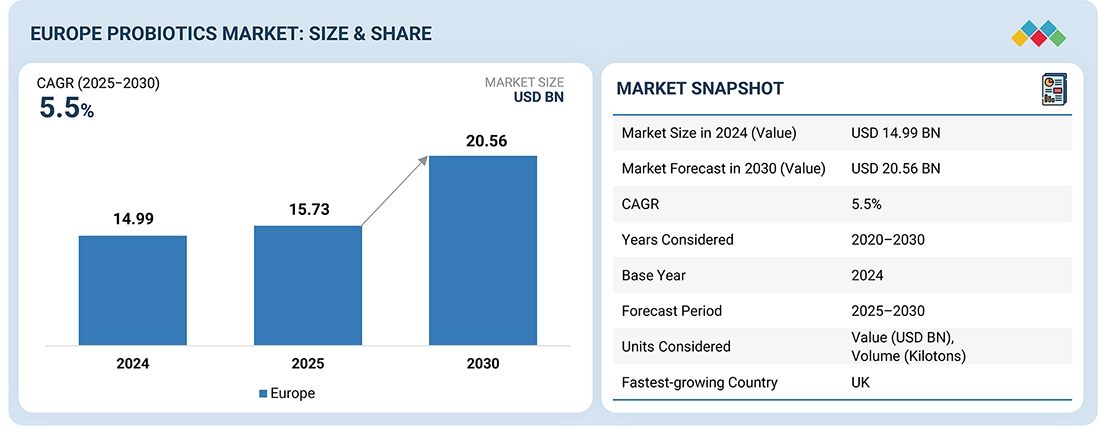
Source: Secondary Research, Interviews with Experts, MarketsandMarkets Analysis
The probiotics market in Europe is estimated to be USD 15.73 billion in 2025 and is projected to reach USD 20.56 billion by 2030, registering a CAGR of 5.5% from 2025 to 2030. The market is witnessing steady growth, driven by the increasing adoption of functional foods, preventive healthcare, and digestive health solutions across food & beverages, dietary supplements, pharmaceuticals, and animal nutrition industries. As consumer preferences continue to shift toward natural, microbiome-supporting, and clean-label health solutions, probiotics derived from bacterial and yeast strains such as Lactobacillus and Bifidobacterium are gaining wider commercial relevance as scientifically supported functional ingredients.
KEY TAKEAWAYS
-
BY COUNTRYRussia accounted for the largest share (21.1%) of the probiotics market in Europe in 2024.
-
BY PRODUCT TYPEBy product type, the dietary supplements segment is expected to register the highest CAGR of 7.7% during the forecast period.
-
BY INGREDIENTSBy ingredient, the bacteria segment dominated the market in 2024 with an 88.3% share.
-
BY DISTRIBUTION CHANNELBy distribution channel, the online retail segment is expected to witness the fastest growth during the forecast period.
-
BY END USERBy end user, the human segment is estimated to dominate the market.
-
Competitive Landscape – Key PlayersKey players include Danone S.A., Probi AB, and Nestlé S.A., supported by established brands, clinical research capabilities, and extensive regional distribution networks.
The probiotics market in Europe is projected to reach USD 20.56 billion by 2030, registering a CAGR of 5.5% during the forecast period. The market is poised for steady growth, supported by rising demand for products that promote digestive wellness and immune support. Increasing use of probiotics across foods, beverages, and supplements, along with greater consumer awareness of gut health, is strengthening market momentum. Innovation in convenient and shelf-stable formats, paired with expanding retail availability, is further driving adoption. Continued investment in evidence-based probiotic solutions is expected to support long-term market development.
TRENDS & DISRUPTIONS IMPACTING CUSTOMERS' CUSTOMERS
Current revenues are concentrated in a narrow range of core applications, which are mainly traditional functional food and beverage formats, but over time, this mix is expected to change. Future revenues will come from new use cases and new technologies, improved products, partnerships, and target market penetration. Emerging segments are expected to hold a bigger share of total revenues, which underlines changes across product type and ingredients, sales channels, and end-use areas. It points to a structural shift in the market. Client imperatives across functional foods and beverages, dietary supplements, and animal nutrition are dynamic and evolving. Companies are focusing on clean labels, food safety, freshness, stable live cultures, lower waste, sustainable processing, better nutrient absorption, cost control, scale-up ability, and regulatory fit. These requirements are directly translated into measurable downstream outcomes across end-use sectors. In food and beverages, they would entail lower usage of synthetic preservatives with longer shelf life, stronger digestive health claims, and clearer labeling of sources. In feed, outcomes are reflected in a healthier gut, stronger immunity, and reduced antibiotic dependence. In personal care and wellness-oriented applications, the outcomes are reflected in enhanced microbiome balance, improved product compatibility through gut-skin positioning, and lower use of synthetic functional additives. All these shifts point out how the changing client needs are redefining the demand across the probiotics value chain in Europe.
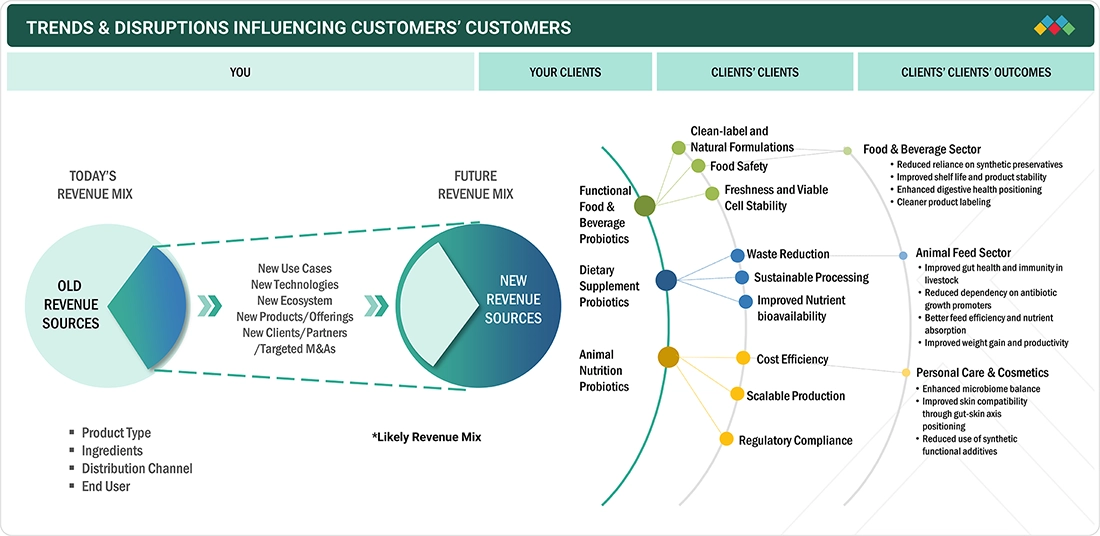
Source: Secondary Research, Interviews with Experts, MarketsandMarkets Analysis
MARKET DYNAMICS

Level
-
•Growing consumer focus on digestive health and immunity

-
•Increasing clinical validation of probiotic strains


Level
-
§Strict regulatory scrutiny by EFSA

-
§Higher production and formulation costs


Level
-
§Rising preference for natural and preventive health solutions

-
§Growth in personalized nutrition and microbiome-based solutions


Level
-
§Complexities in integrating probiotics in functional foods

-
§Intolerance of probiotics to stomach acid and bile

Source: Secondary Research, Interviews with Experts, MarketsandMarkets Analysis
Driver: Growing consumer focus on digestive health and immunity
The growing interest of consumers in digestive health, the immune system, and preventive health is a major demand driver for probiotics in Europe. The market is driven by rising awareness of gut-microbiome benefits. The demand for probiotic yogurts, fermented dairy products, and drinks with added benefits continues to be strong in countries such as Germany, France, the UK, and Italy, thus contributing to the overall market growth. Digestive discomfort, health issues associated with lifestyle, and recovery post-antibiotic consumption are slowly becoming common. Consequently, consumers now include probiotic foods and supplements as part of their daily diets. The growing preference for clean-label, scientifically proven ingredients, as well as recommendations from health care professionals, are additional factors that support the continuous growth of probiotics consumption in Europe.
Restraint: Strict regulatory scrutiny by EFSA
The primary restraint on probiotic manufacturers is regulatory oversight by the European Food Safety Authority (EFSA), which has rigorous requirements for health claim approvals and strain validation. EFSA places very strict scientific standards. This makes it harder for brands to communicate functional benefits on product labels, thereby slowing new product launches and limiting marketing flexibility. The demand for extensive clinical evidence adds to the development timelines and costs. This is a challenge, particularly for small companies, which typically have limited R&D capacity. Additionally, the differences in regulatory interpretation among different European markets make it relatively more difficult for a manufacturer to scale up probiotic foods and supplements.
Opportunity: Rising preference for natural and preventive health solutions
The shift toward natural and self-care choices in Europe is creating definite growth avenues for probiotic foods and supplements. Consumers increasingly seek products that contribute to gut health and immunity. Most consumers prefer this over medication. The transition is opening up a way to new product concepts. Manufacturers are devising plant-based probiotics, shelf-stable drinks, products for women's health, and targeted microbiome solutions. Moreover, there is an increase in personalized nutrition, and microbiome testing is also growing, opening up new avenues in product development for probiotics for particular age groups and specific health needs.
Challenge: Complexities in integrating probiotics in functional foods
A key challenge in the probiotics market in Europe is adding live cultures to food and beverages without compromising their quality. This means that the strains must remain active, have an acceptable flavor, and survive through shelf life. Many strains are vulnerable to heat, oxygen, and certain processing conditions, which complicates the formulation and manufacturing procedures. The stability of probiotics during storage and transport, particularly under cold-chain restrictions, is an added cost and operational burden. These limitations narrow the framework of food-and-beverage categories that can safely accommodate probiotics. This is necessitating ongoing investment in encapsulation technologies, fermentation capabilities, and product efficacy testing.
EUROPE PROBIOTICS MARKET: COMMERCIAL USE CASES ACROSS INDUSTRIES
| COMPANY | USE CASE DESCRIPTION | BENEFITS |
|---|---|---|
 |
Probiotic fermented milk drinks for daily digestive health consumption | Supports gut balance, improves digestion, and helps strengthen immunity |
 |
Probiotic infant formulas and medical nutrition products designed for early-life and clinical use | Improves nutrient absorption, supports immune development, and enhances digestive tolerance |
 |
Probiotic yogurt and drinking yogurt for functional food applications | Enhances digestive comfort, supports immune health, and meets clean-label preferences |
 |
Probiotic drops, tablets, and oral health products | Provides digestive relief, supports infant gut health, and improves overall wellness |
Logos and trademarks shown above are the property of their respective owners. Their use here is for informational and illustrative purposes only.
MARKET ECOSYSTEM
The probiotics market in Europe is growing, wherein food, beverage, and healthcare manufacturers are applying probiotic solutions in support of digestive health, immunity, and general wellness. Probiotics have a wide range of applications in functional foods, supplements, medical nutrition, and animal feeds to restore gut balance and nutrient absorption. The market growth in the region is also fostered through a strong base of fermentation capabilities, a mature dairy processing industry, rising preferences for natural and clean-label products, and stringent EFSA-led regulatory standards that channel toward scientific validation and preventive health. Increasing consumer awareness of microbiome health, combined with a gradual shift toward sustainable bio-based nutrition, continues to maintain the status of probiotics as a major player in food and healthcare innovation today. With long-term wellness taking precedence among European consumers, probiotics are expected to be one of the key drivers of product development across diverse areas of application.
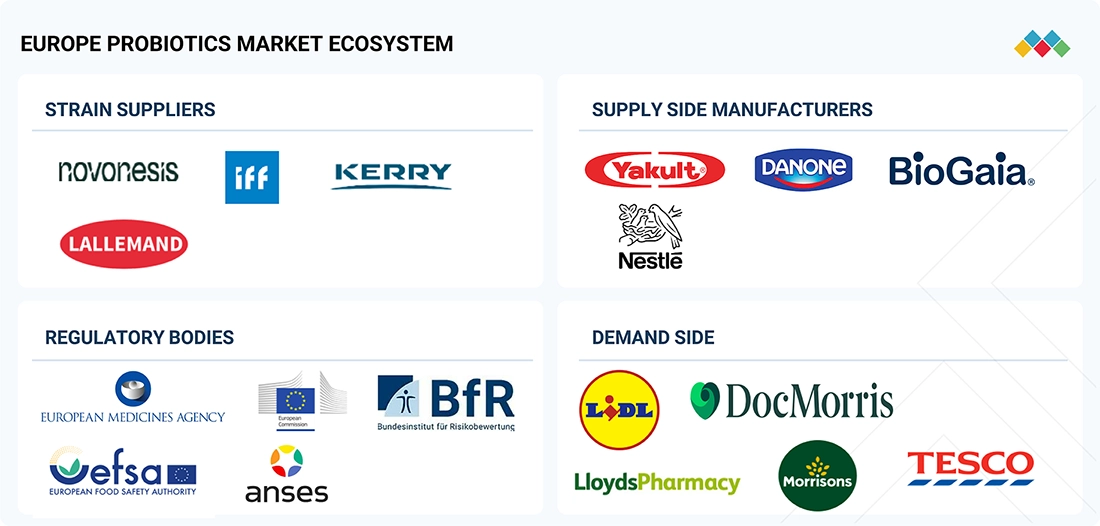
Logos and trademarks shown above are the property of their respective owners. Their use here is for informational and illustrative purposes only.
MARKET SEGMENTS
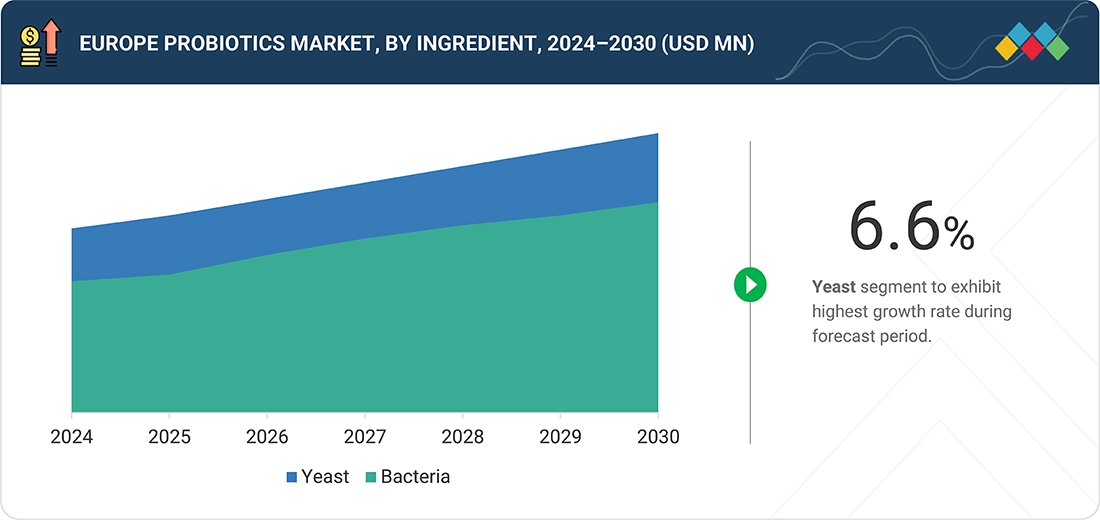
Source: Secondary Research, Interviews with Experts, MarketsandMarkets Analysis
Europe Probiotics Market, By Ingredient
The probiotics market in Europe is estimated to be dominated by the bacteria segment, which is supported by the extensive application of Lactobacillus, Bifidobacterium, and Streptococcus in yogurts, fermented dairy drinks, infant formulas, dietary supplements, and animal feed. These strains capture the market as they are supported by clinical studies in digestive health, immunity, and microbiome balance. Besides that, Europe has great fermentation capabilities, a mature dairy industry, and strict EFSA safety and quality standards. The strong position of strain suppliers and the good cold-chain systems also contribute to the bacteria segment's growth in major European countries. While the demand for yeast-based probiotics is growing gradually in niche applications, bacterial probiotics are still competitive because they are familiar to consumers, have higher strain diversity, and have proven product performance. Hence, they will retain a larger market share.
Europe Probiotics Market, By Distribution Channel
By distribution channel, the hypermarkets & supermarkets segment is estimated to account for the largest share of the probiotics market in Europe. This is due to the large number of products available, high consumer purchases, and the broad presence of these stores in both urban and rural areas. These large-scale stores are preferred by consumers for buying probiotic yogurts, fermented dairy drinks, fortified beverages, and an ever-growing assortment of probiotic dietary supplements. The combination of their low prices, regular promotions, and a well-functioning cold-chain system all contribute to the selling of probiotic products that are sensitive to temperature while ensuring that the products are safe and of good quality. Even though online platforms and pharmacy chains are making steady progress, especially for supplement products, hypermarkets and supermarkets remain the most preferred and commercially important channel owing to their convenience, wide brand availability, and capacity to generate high-volume sales in European countries.
Europe Probiotics Market, By Product Type
By product type, the functional foods and beverages segment is estimated to dominate the probiotics market in Europe. This is supported by strong consumption of probiotic-rich yogurts, fermented milk drinks, kefir, cultured dairy products, and fortified beverages across major countries such as Germany, the UK, France, Italy, and the Nordics. This segment leads due to Europe’s mature dairy industry, high consumer trust in fermented foods, and rising focus on digestive wellness and immunity. Food manufacturers continue to introduce new probiotic formulations with clean-label positioning, natural ingredients, and clinically supported strains, further strengthening market adoption. While probiotic dietary supplements are expanding rapidly, especially among consumers seeking targeted gut health and immunity benefits, functional foods and beverages remain the dominant category because of their daily-use appeal, strong retail penetration, and long-standing integration in European diets.
REGION
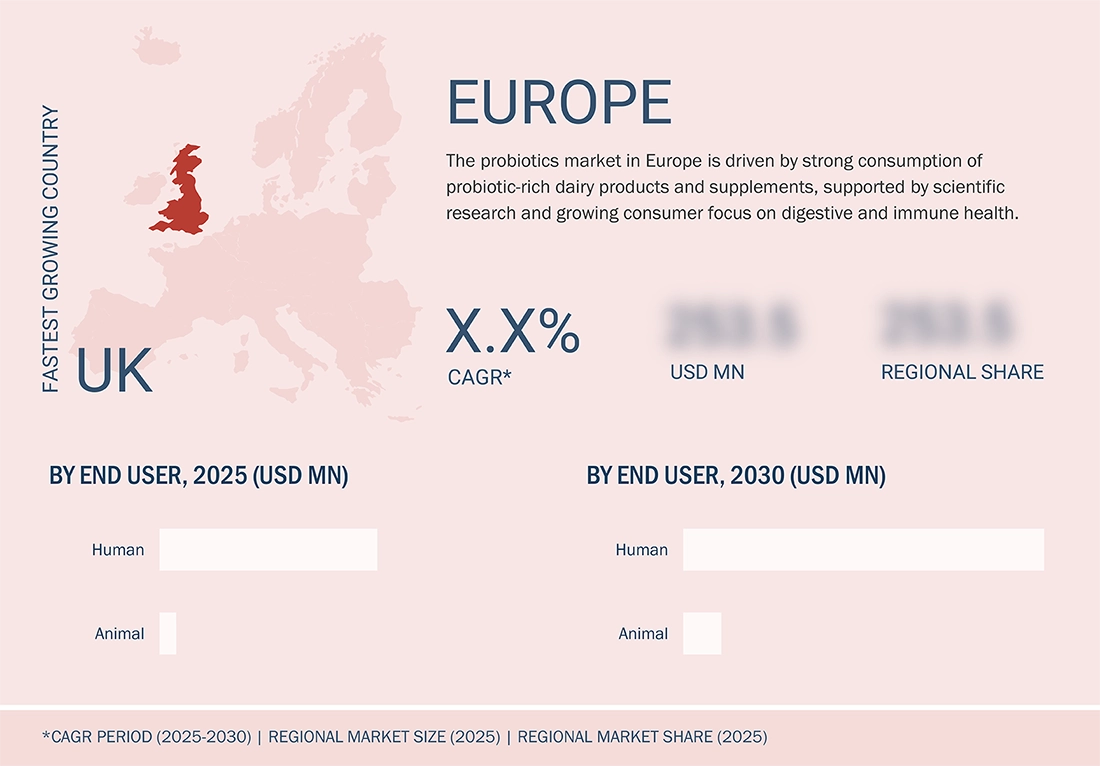
UK to be fastest-growing country in Europe probiotics market during forecast period
The UK is anticipated to be the fastest-growing market for probiotics in Europe during the forecast period. Growth is being driven by a strong consumer focus on digestive health, immunity, and functional nutrition. Demand for probiotic yogurts, fermented drinks, and dietary supplements is high, and consumption of plant-based and shelf-stable probiotic products is also increasing. The UK has an established retail environment. This supports the growth of the probiotics market. High penetration of online sales, coupled with the increasing roles of pharmacies and health stores, is improving the availability of these products. Medical professionals are also influencing consumer uptake and awareness about microbiome health. Additionally, companies are investing in research and development of products with clean label claims and are focusing on scientifically validated benefits along with easy-to-use formats. As brands provide science-backed wellness solutions in more convenient delivery formats, the UK will remain the fastest-growing market in the region throughout the period of prediction.
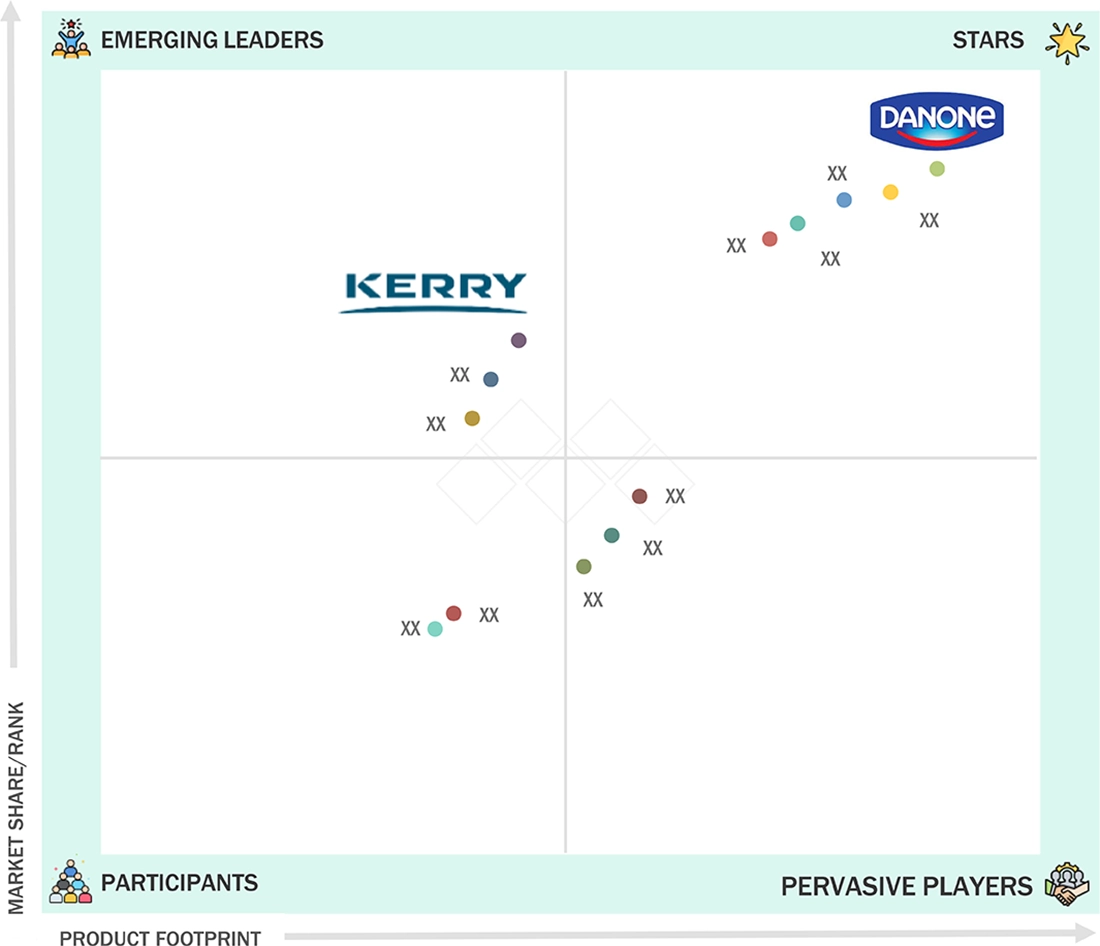
EUROPE PROBIOTICS MARKET: COMPANY EVALUATION MATRIX
A competitive landscape framework for the probiotics market in Europe classifies companies as Stars, Emerging Leaders, Participants, or Pervasive Players based on their innovation capabilities, market reach, and growth prospects. Danone is positioned as a Star, supported by its strong leadership in probiotic yogurts and fermented dairy drinks, extensive European distribution network, and continuous investment in clinically supported formulations. Kerry is identified as an Emerging Leader, driven by its expanding probiotic ingredient portfolio, including BC30, and its growing role in supplying functional food and beverage manufacturers across the region. Participants typically include niche or country-specific brands with focused portfolios, while Pervasive Players maintain established market presence but show limited innovation momentum relative to category leaders.
Source: Secondary Research, Interviews with Experts, MarketsandMarkets Analysis
KEY MARKET PLAYERS
- Danone S.A. (France)
- Probi AB (Sweden)
- Nestlé S.A. (Switzerland)
- Kerry Group plc (Ireland)
- BioGaia AB (Sweden)
- Bio-K Plus International Inc. (Canada)
- Daflorn Probiotics Ltd. (Bulgaria)
- Yakult Honsha Co., Ltd. (Japan)
- Arla Foods (Denmark)
- AB-Biotics S.A. (Spain)
- PepsiCo, Inc. (US
- Institut Allergosan (Austria)
- General Mills, Inc. (US)
- International Flavors & Fragrances Inc. (US)
- Sabinsa Corporation (US)
- Chobani, LLC. (US)
MARKET SCOPE
| REPORT METRIC | DETAILS |
|---|---|
| Market Size in 2024 (Value) | USD 14.99 Billion |
| Market Forecast in 2030 (Value) | USD 20.56 Billion |
| Growth Rate | CAGR of 5.5% from 2025 to 2030 |
| Years Considered | 2020–2030 |
| Base Year | 2024 |
| Forecast Period | 2025–2030 |
| Units Considered | Value (USD Billion), Volume (Kilotons) |
| Report Coverage | Revenue forecast, company ranking, competitive landscape, growth factors, and trends |
| Segments Covered |
|
| Countries Covered | Russia, UK, Italy, Germany, Spain, Rest of Europe |
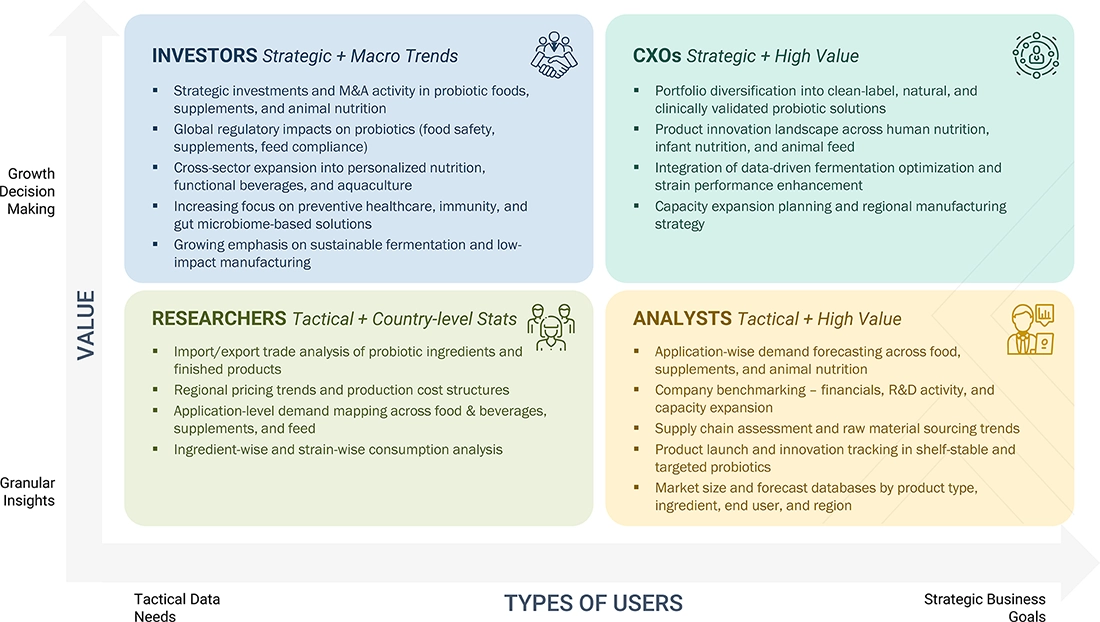
WHAT IS IN IT FOR YOU: EUROPE PROBIOTICS MARKET REPORT CONTENT GUIDE
DELIVERED CUSTOMIZATIONS
We have successfully delivered the following deep-dive customizations:
| CLIENT REQUEST | CUSTOMIZATION DELIVERED | VALUE ADDS |
|---|---|---|
| Probiotic Ingredients Market |
|
|
| Digestive Health Supplements Market |
|
|
| Animal Nutrition Probiotics Market |
|
|
RECENT DEVELOPMENTS
- November 2025 : Probi expanded its offering with new probiotic applications targeting Sports & Active Nutrition and Pet Health, broadening its science-based solutions beyond traditional human digestive benefits.
- June 2025 : Danone completed the acquisition of The Akkermansia Company (TAC), a Belgium-based biotics specialist, giving Danone access to the proprietary strain Akkermansia muciniphila to expand its next-generation gut health offerings.
- February 2021 : Probi entered into a long-term partnership with Perrigo, a major consumer-health player in Europe, to expand the distribution of clinically supported probiotic products targeting digestive health and immunity across major EU markets.
Table of Contents
 Exclusive indicates content/data unique to MarketsandMarkets and not available with any competitors.
Methodology
This research involves the extensive use of secondary sources; directories; and databases (Bloomberg and Factiva) to identify and collect information useful for a technical, market-oriented, and commercial study of the Europe Probiotics market. In-depth interviews were conducted with various primary respondents, such as key industry participants, Subject Matter Experts (SMEs), C-level executives of key market players, and industry consultants, to obtain and verify critical qualitative and quantitative information and to assess prospects.
Secondary Research
In the secondary research process, various sources, such as the Food and Agricultural Organization (FAO), United States Department of Agriculture (USDA), U.S. Food and Drug Administration (FDA) U.S. Food and Drug Administration (FDA), European Food Safety Authority (EFSA), World Health Organization (WHO), Consumer Healthcare Products Association (CHPA), European Federation of Associations of Health Product Manufacturers (EHPM), Canadian Health Food Association (CHFA), and Health Food Manufacturers' Association (HFMA), associations were referred to identify and collect information for this study. The secondary sources also include journals, press releases, investor presentations of companies, whitepapers, certified publications, articles by recognized authors and regulatory bodies, trade directories, and paid databases.
Primary Research
The Europe Probiotics market encompasses various stakeholders involved in the supply chain, raw material manufacturers, raw material suppliers, regulatory organizations, and research institutions. To gather comprehensive information, primary sources from both the supply and demand sides were engaged. Primary interviewees from the supply side consisted of manufacturers, distributors, importers, and technology providers involved in the production and distribution of Probiotics. On the demand side, key opinion leaders, executives, and CEOs of companies in the Probiotics industry were approached through questionnaires, emails, and telephonic interviews. This approach ensured a comprehensive and well-rounded understanding of the Europe Probiotics market from various perspectives.
Market Size Estimation
The top-down and bottom-up approaches were used to estimate and validate the market’s and various dependent submarkets’ size. The research methodology used to estimate the market size includes extensive secondary research of key players, reports, reviews, and newsletters of top market players, along with extensive interviews from leaders, such as CEOs, directors, and marketing executives.
Europe Probiotics market: Data Triangluation
After arriving at the overall size from the market size estimation process explained above, the total market was split into several segments and subsegments. The data triangulation and market breakdown procedures explained below were implemented, wherever applicable, to complete the overall market engineering process and arrive at the exact statistics for various market segments and subsegments. The data was triangulated by studying various factors and trends from the demand and supply sides. Along with this, the market size was validated using both the top-down and bottom-up approaches.
Market Definition
The joint Food and Agriculture Organization (FAO)/World Health Organization (WHO) working group defines probiotics as “live micro-organisms, which when administered in adequate amounts confer a health benefit on the host” (FAO/ WHO, 2001).
Probiotics are living microorganisms that have been shown to provide specific health benefits to consumers. They are known to support gut health and help in running the digestive system smoothly. Yogurt is one of the prime natural sources of probiotics.
According to the National Center for Complementary and Integrative Health, “Probiotics are live microorganisms that are intended to have health benefits when consumed or applied to the body.” The major function of probiotics is to maintain a healthy balance in the body. Several types of microorganisms are present in probiotics, and they may have different effects on the body. The most common bacteria belong to the group called Lactobacillus and Bifidobacterium.
Key Stakeholders
- Manufacturers, Importers and Exporters, Traders, Distributors, and Suppliers of Probiotics
- Nutraceutical Manufacturers
- Food Processors and Manufacturers
- Government and Research Organizations
- Trade Associations and Industry Bodies
-
Regulatory bodies and associations are as follows:
- Food Agriculture Organization (FAO)
- World Health Organization (WHO)
- International Dairy Federation (IDF)
- European Food & Feed Cultures Association (EFFCA)
- National Yogurt Association (NYA)
- International Scientific Association for Probiotics and Prebiotics (ISAPP)
- International Probiotics Association (IPA)
- Council for Responsible Nutrition (CRN)
- National Yogurt Association (NYA)
- International Frozen Yogurt Association (IFYA)
- American Nutrition Association (ANA)
Report Objectives
- To define, segment, and project the Europe market for Probiotics on the basis of product type, ingredient, distribution channel, end user, and region
- To provide detailed information regarding the key factors influencing the growth of the market (drivers, restraints, opportunities, and industry-specific challenges)
- To strategically analyze the micro markets with respect to individual growth trends, future prospects, and their contribution to the total market
- To analyze the opportunities in the market for stakeholders and provide a competitive landscape of the market leaders
- To project the size of the market and its submarkets, in terms of value with respect to the regions (along with the key countries)
- To strategically profile the key players and comprehensively analyze their market position and core competencies
- To analyze competitive developments in the Europe Probiotics market, including joint ventures, mergers & acquisitions, new product developments, and research & development activities
Available Customizations:
With the given market data, MarketsandMarkets offers customizations according to company-specific scientific needs.
The following customization options are available for the report:
Product Analysis
- Product Matrix, which gives a detailed comparison of the product portfolio of each company
Geographic Analysis
With the given market data, MarketsandMarkets offers customizations according to company-specific scientific needs.
- Further breakdown of the Rest of the Europe Probiotics market, by key country
- Further breakdown of the Rest of the Asia Pacific Probiotics market, by key country
- Further breakdown of the Rest of South America Probiotics market, by key country
Company Information
- Detailed analyses and profiling of additional market players


Personalize This Research
- Triangulate with your Own Data
- Get Data as per your Format and Definition
- Gain a Deeper Dive on a Specific Application, Geography, Customer or Competitor
- Any level of Personalization
Let Us Help You
- What are the Known and Unknown Adjacencies Impacting the Europe Probiotics Market
- What will your New Revenue Sources be?
- Who will be your Top Customer; what will make them switch?
- Defend your Market Share or Win Competitors
- Get a Scorecard for Target Partners

Custom Market Research Services
We Will Customise The Research For You, In Case The Report Listed Above Does Not Meet With Your Requirements
Get 10% Free CustomisationTESTIMONIALS

Business Innovation Director
US Based Leading Agribusiness,
Food and Ingredients ManufacturerI highly appreciate the team's efficiency for a well conducted study that helped us clarify some blind spots in food and agricultural niche markets. Although compiling information for B2B markets is very difficult, the MnM team pulled out the task successfully. The quality of research, level of insights, and responsiveness of team were commendable.






Growth opportunities and latent adjacency in Europe Probiotics Market