Europe Veterinary Castration Market

Europe Veterinary Castration Market By Product Type (Immunocastration Vaccines, Hormonal Implants), Animal Type (Companion Dogs, Stray Dogs, Companion Cats, Stray Cats, Swine), End User (Veterinary Clinics, Veterinary Hospitals, NGOs) - Forecast to 2032




EUROPE VETERINARY CASTRATION MARKET SIZE, SHARE & GROWTH SNAPSHOT
Source: Secondary Research, Interviews with Experts, MarketsandMarkets Analysis
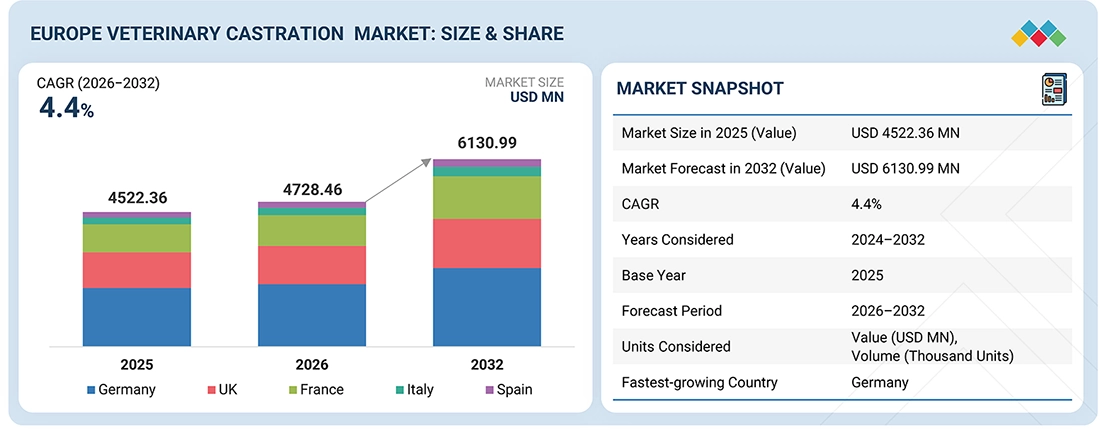
The Europe veterinary castration market is projected to grow from USD 4728.46 million in 2026 to USD 6130.99 million by 2032, at a CAGR of 4.4% during the forecast period. The market was valued at USD 4522.36 million in 2025. Market is driven by increasing focus on animal welfare, stray population control, and responsible pet ownership across key countries such as Germany, the UK, France, and Spain, along with growing adoption of non-surgical methods such as immunocastration and hormonal implants that reduce reliance on surgery, supported by ongoing regulatory initiatives from the European Union and expanding government and NGO sterilization programs, ultimately encouraging demand for cost-effective, scalable, and humane animal management solutions.
KEY TAKEAWAYS
-
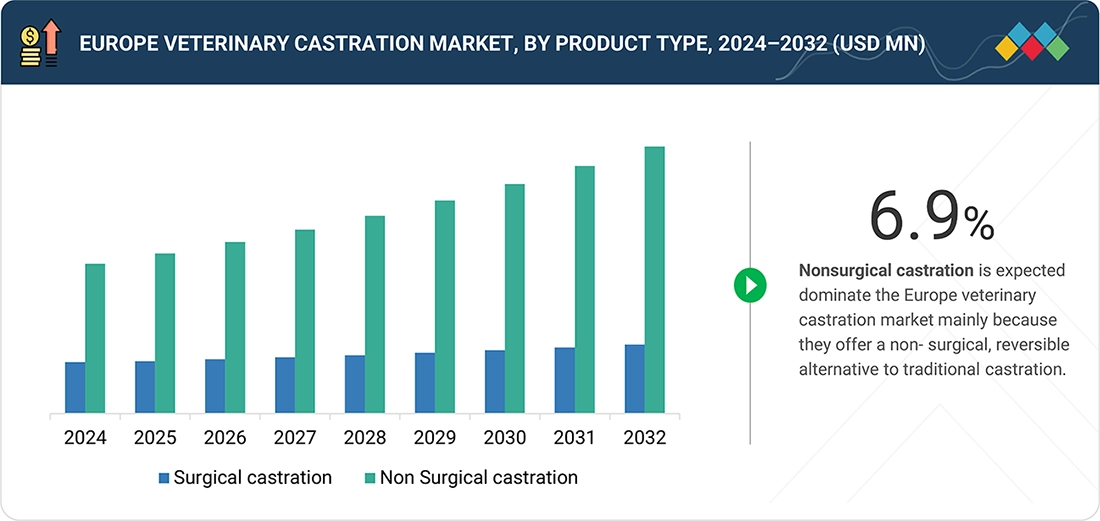
By Product TypeBased on product type, Non-surgical castration are projected to register the highest CAGR of 6.9% during the forecast period
-
By Animal TypeBased on animal type, dogs accounted for 67.2% of the market share in 2025.
-
By end userBy end user, veterinary clinics held the largest market share of 52.3% in 2025.
-
COMPETITIVE LANDSCAPE (KEY PLAYERS)Company Zoetis (US), Virbac (France) were identified as some of the star players in the market, given their strong market share and product footprint.
-
COMPETITIVE LANDSCAPE (STARTUPS/SMES)BioAZ (France) has distinguished itself as a startup/SME player by securing strong footholds in specialized niche areas, underscoring its potential as an emerging market leader.
TRENDS & DISRUPTIONS IMPACTING CUSTOMERS' CUSTOMERS
The Europe veterinary castration market is expected to undergo a significant shift in revenue generation over the next 7–10 years, driven by the transition from traditional surgical procedures to simple, non-invasive, and scalable sterilization solutions. Veterinary clinics, hospitals, and NGOs will move away from surgery-based income models toward immunocastration vaccines, and fertility control implants that reduce the need for anesthesia, surgical infrastructure, and post-operative care. These innovations will enable faster procedures, lower costs, and reduced animal stress while improving accessibility for large-scale sterilization programs. At the same time, partnerships with governments, NGOs, and animal welfare organizations will expand, supporting mass sterilization initiatives for stray and companion animals. Overall, the market will shift toward a more preventive, cost-effective, and welfare-driven ecosystem, creating new revenue streams across non-surgical technologies and field-deployable veterinary solutions.

Source: Secondary Research, Interviews with Experts, MarketsandMarkets Analysis
MARKET DYNAMICS

Level
-
§Animal welfare legislation

-
§surge in animal population & pet humanization


Level
-
§Strong veterinary inertia and dependence on surgical standards


Level
-
§Untapped female pet segment

-
§Shelter and animal welfare programs held by NGOs


Level
-
§Biological complexity in female animals

Source: Secondary Research, Interviews with Experts, MarketsandMarkets Analysis
Animal welfare legislation
The market is primarily driven by increasing animal welfare legislation and societal pressure to adopt humane alternatives to surgical castration. Regulatory focus on reducing pain and invasive procedures, along with growing awareness among veterinarians and pet owners, is encouraging the shift toward non-surgical methods. Additionally, the need for scalable solutions in high-volume settings such as livestock production and shelters is further supporting adoption.
Strong veterinary inertia and dependence on surgical standards
Strong veterinary inertia and continued dependence on established surgical standards act as a key restraint in the market. Many veterinarians prefer surgical castration due to its proven efficacy, familiarity, and predictable outcomes, making them hesitant to adopt newer non-surgical alternatives. Limited training, lower awareness, and concerns around effectiveness or reversibility further slow the transition, restricting broader adoption of innovative solutions.
Untapped female pet segment
A key growth opportunity lies in the largely untapped female pet segment, particularly cats, where surgical procedures are more complex and less frequently performed. This creates significant demand for less invasive, easy-to-administer alternatives. Expanding use in shelters and NGOs, along with innovation in long-acting and cost-effective products, further strengthens future market potential.
Biological complexity in female animals
One of the major challenges is the biological complexity of female animal reproductive systems, which makes developing effective non-surgical solutions more difficult compared to male animals. Variability in response, duration of effect, and ensuring complete fertility suppression remain technical hurdles. These challenges impact both product development and veterinarian confidence, slowing broader market penetration.
EUROPE VETERINARY CASTRATION MARKET: COMMERCIAL USE CASES ACROSS INDUSTRIES
| COMPANY | USE CASE DESCRIPTION | BENEFITS |
|---|---|---|
 |
Immunocastration vaccine used in pigs to suppress testicular function and control boar taint without surgical intervention | Non-invasive alternative to surgical castration | Improved animal welfare | Reduced stress and pain |Better meat quality outcomes |
 |
Hormonal implant used in companion animals (dogs, cats) for temporary fertility suppression and behavioral management | Reversible and long-lasting solution | Eliminates need for surgery | Improves owner convenience | Supports animal welfare |
Logos and trademarks shown above are the property of their respective owners. Their use here is for informational and illustrative purposes only.
MARKET ECOSYSTEM
The Europe veterinary castration market operates within a connected ecosystem of manufacturers, regulatory bodies, and end users. Manufacturers such as Zoetis and Virbac develop and supply non-surgical solutions such as vaccines and implants, while regulatory authorities oversee product approval, safety, and usage standards. End users including veterinary clinics, hospitals, and animal welfare organizations drive adoption through treatment decisions and large-scale implementation. The interaction between these three groups shapes market growth, influencing innovation, accessibility, and overall adoption of non-surgical castration methods.

Logos and trademarks shown above are the property of their respective owners. Their use here is for informational and illustrative purposes only.
MARKET SEGMENTS
Source: Secondary Research, Interviews with Experts, MarketsandMarkets Analysis
Europe veterinary castration market, by product type
Based on product type, hormonal implants dominate the Europe veterinary castration market due to their broad adoption in companion animals, sustained reversible action, and increasing use by veterinarians as a practical, non-invasive substitute for surgical procedures.
Europe veterinary castration market, by animal type
By animal type, dogs hold the largest share of the Europe veterinary castration market, driven by high pet ownership, strong demand for population control, and widespread adoption of convenient, non-invasive sterilization options.
Europe veterinary castration market, by end user
By end user, veterinary clinics hold the largest share of the Europe veterinary castration market, driven by high procedure volumes, strong accessibility for pet owners, and their central role in delivering both surgical and non-surgical sterilization services.
REGION
Germany is expected to be the fastest-growing region in the Europe veterinary castration market during the forecast period.
Germany is likely to be the fastest-growing market during the forecast period due to strong animal welfare regulations, increasing restrictions on surgical castration, and rapid adoption of alternatives such as immunocastration and hormonal implants, especially in the swine sector. Mandatory requirements for anesthesia and stricter welfare laws have further accelerated the shift toward non-surgical solutions.

EUROPE VETERINARY CASTRATION MARKET: COMPANY EVALUATION MATRIX
In the Europe veterinary castration market matrix, Zoetis (Star) leads with a strong portfolio of immunocastration vaccines and a broad presence across livestock and companion animal segments, driving large-scale adoption, particularly in swine. Virbac (Pervasive) maintains a solid position through its specialized offering, including the Suprelorin implant, focusing on companion animals and veterinary clinic-based solutions, with steady growth supported by increasing demand for non-invasive sterilization methods.

Source: Secondary Research, Interviews with Experts, MarketsandMarkets Analysis
KEY MARKET PLAYERS
MARKET SCOPE
| REPORT METRIC | DETAILS |
|---|---|
| Market Size in 2025 (Value) | USD 4522.36 Million |
| Market Forecast in 2032 (Value) | USD 6130.99 Million |
| CAGR | 4.4% |
| Years Considered | 2024–2032 |
| Base Year | 2025 |
| Forecast Period | 2026–2032 |
| Units Considered | USD Million |
| Report Coverage | Revenue forecast, company ranking, competitive landscape, growth factors, and trends |
| Segments Covered |
|
| Countries Covered | Germany, Italy, UK, France, Spain, Rest of Europe |
WHAT IS IN IT FOR YOU: EUROPE VETERINARY CASTRATION MARKET REPORT CONTENT GUIDE

DELIVERED CUSTOMIZATIONS
We have successfully delivered the following deep-dive customizations:
| CLIENT REQUEST | CUSTOMIZATION DELIVERED | VALUE ADDS |
|---|---|---|
| Product Analysis | In-depth assessment of veterinary castration methods, by product type (immunocastration vaccines, hormonal implants), animal type (swine, dogs, cats), and end user | Analysis of emerging trends such as immunocastration vaccines, improved anesthesia and analgesia protocols, and non-surgical alternatives aimed at enhancing animal welfare and reducing procedural stress |
| Company Information | Comprehensive profiles of key players including vaccine and pharmaceutical providers such as Zoetis, Virbac, and regional veterinary service providers | Identification of strategic collaborations, animal welfare-driven innovations, regulatory approvals for immunocastration products, and partnerships between veterinary service providers and swine producers shaping market evolution |
| Geographic Analysis | Country-level demand mapping across major European markets including Germany, France, UK, Spain, Italy, and Nordic countries; evaluation of animal welfare regulations, farming practices, and adoption of alternatives to surgical castration | Regional market outlook highlighting growth opportunities driven by strict EU animal welfare regulations, increasing shift toward pain-managed or non-surgical castration, variability in practices across countries, and rising demand for ethical livestock management solutions |
RECENT DEVELOPMENTS
- October 2024 : Zoetis completed the divestiture of its medicated feed additive (MFA) portfolio to Phibro Animal Health, sharpening its strategic focus on vaccines, biologics, and genetic programs in livestock categories that directly encompass Improvac, its flagship immunocastration product for swine.
- June 2022 : European Union approved Suprelorin use for male cats and prepubescent female dogs, expanding options for veterinarians to meet evolving owner expectations and animal care needs.
Table of Contents
 Exclusive indicates content/data unique to MarketsandMarkets and not available with any competitors.
Methodology
This study extensively used both primary and secondary sources. The research involved analyzing various factors affecting the industry to identify segmentation types, industry trends, key players, the competitive landscape, market dynamics, and major players' strategies.
Secondary Research
The secondary research process involves extensive use of secondary sources, directories, databases (such as Bloomberg Businessweek, Factiva, and D&B Hoovers), white papers, annual reports, company house documents, investor presentations, and SEC filings. It was employed to gather information for the detailed, technical, market-focused, and commercial analysis of the Europe veterinary castration market. Additionally, it helped obtain important data on key players and market classification and segmentation based on industry trends, down to the most detailed levels, along with key developments from market and technology perspectives. A database of leading industry players was also created through secondary research.
Primary Research
In the primary research process, various sources from both the supply and demand sides were interviewed to gather qualitative and quantitative information for this report. The primary sources from the supply side include industry experts such as CEOs, vice presidents, marketing and sales directors, technology and innovation directors, and other key executives from various important companies and organizations in the Europe veterinary castration market. The primary demand-side sources include medical OEMs, medical device ISOs, and service providers, among others. Primary research was conducted to validate the market segmentation, identify key players and gather insights into major industry trends and market dynamics.

Note: Managers include CEOs, COOs, CTOs, and VPs.
Others include sales and marketing managers.
Companies are classified into tiers based on their total revenue. As of 2025, Tier 1 = >USD 2 billion, Tier 2 = USD 50 million to USD 2 billion, and Tier 3 = USD 50 million.
To know about the assumptions considered for the study, download the pdf brochure
Market Size Estimation
In this report, the global Europe veterinary castration market size was determined through revenue share analysis of leading players. To do this, key market players were identified, and their revenues from Europe veterinary castration were estimated based on insights gathered during primary and secondary research. Secondary research involved analyzing the annual and financial reports of leading market players, while primary research included extensive interviews with key opinion leaders, including CEOs, directors, and senior marketing executives.
To calculate the global market value, segmental revenue was derived from revenue mappings of major solution/service providers. This process involves the following steps:
- Generating a list of major players operating in the Europe veterinary castration market
- Mapping annual revenues generated by major players from the Europe veterinary castration segment (or nearest reported business unit/service category)
- Mapping revenue of key players to cover a major share of the global market as of 2025
- Extrapolating the overall value of the Europe veterinary castration market
Europe Veterinary Castration Market : Top-Down and Bottom-Up Approach

Data Triangulation
After determining the overall market size from the estimation process described above, the Europe veterinary castration market was classified into segments and subsegments. Data triangulation and market breakdown methods were used to complete the market analysis and obtain precise statistics for all segments and subsegments. The data was triangulated by examining various factors and trends from both the demand and supply perspectives. Additionally, the Europe veterinary castration market was validated using both the top-down and bottom-up approaches.
Market Definition
Veterinary castration refers to medical methods used to suppress or eliminate an animal’s reproductive function without performing surgery, typically by targeting hormonal pathways such as gonadotropin-releasing hormone (GnRH). These approaches include immunocastration vaccines and hormonal implants. Compared to surgical methods, they are less invasive, may be reversible, and can be administered more quickly, making them suitable for situations where surgery is less feasible.
Key Stakeholders
- Companies manufacturing veterinary castration products
- Suppliers and distributors of veterinary castration products
- Animal welfare organizations & NGOs
- veterinary service providers
- veterinary health insurance payers
- Government bodies/municipal corporations
- Regulatory bodies
- Veterinary research institutes
- Business research and consulting service providers
- Venture capitalists
- Market research and consulting firms
Report Objectives
- To define, describe, and forecast the Europe veterinary castration market based on product type, animal type, end user, and region
-
To provide detailed information regarding the major factors influencing the market growth
(such as drivers, restraints, opportunities, and challenges) along with the current trends - To strategically analyze micromarkets1 concerning individual growth trends, prospects, and contributions to the overall Europe veterinary castration market
- To analyze the opportunities in the Europe veterinary castration market for stakeholders and provide details of the competitive landscape for market leaders
- To forecast the size of market segments concerning main countries, namely, Germany, the UK, Italy, France, Spain and Rest of Europe
- To profile key players and analyze their market share and core competencies2
- To analyze competitive developments, such as product launches, agreements, collaborations, and expansions, in the Europe veterinary castration market
Available customizations:
With the given market data, MarketsandMarkets offers customizations as per the company’s specific needs. The following customization options are available for the present global Europe Veterinary Castration market report:
Product Analysis
- Product matrix, which gives a detailed comparison of the product portfolios of the top twelve companies
Company Information
- Detailed analysis and profiling of additional market players (up to 10)
Country Analysis
- Further breakdown of the Rest of Europe's veterinary castration market into Russia, Finland, Switzerland, Turkey, the Czech Republic, the Netherlands, Norway, Poland, Portugal, Romania, Estonia, Austria, and Belgium


Personalize This Research
- Triangulate with your Own Data
- Get Data as per your Format and Definition
- Gain a Deeper Dive on a Specific Application, Geography, Customer or Competitor
- Any level of Personalization
Let Us Help You
- What are the Known and Unknown Adjacencies Impacting the Europe Veterinary Castration Market
- What will your New Revenue Sources be?
- Who will be your Top Customer; what will make them switch?
- Defend your Market Share or Win Competitors
- Get a Scorecard for Target Partners

Custom Market Research Services
We Will Customise The Research For You, In Case The Report Listed Above Does Not Meet With Your Requirements
Get 10% Free CustomisationTESTIMONIALS

JAYANT RAJPUROHIT
Director of Market Insights, Data and Analytics
SFI Health,
Leading Pharmaceutical Companywww.sfihealth.com/

We at SFI Health approached MarketsandMarkets for an Opportunity Assessment on "Incidence and Prevalence of Focus Indications" as we wanted to know the most attractive HCPs like Physician, Functional MD, Naturopath and Pharmacist. The project was critical for us to ensure our focus on the right target which would enable sustainable growth and profitability for SFI Health. The business insights provided exceeded our expectations and we were extremely impressed. The team at MarketsandMarkets is highly professional and detail oriented and very well understood our business needs. MarketsandMarkets offers a unique combination of expertise and dedicated engagement model. We identified 2 new products to be launched in coming months, based on the research findings provided by MarketsandMarkets. We are happy with the services and would strongly recommend MarketsandMarkets to my peers in the industry.

BEATRIZ DE LA CALLE
Head of Commercial Analytics
Qualicaps,
Leading Pharmaceutical Companywww.qualicaps.com/

We partnered with MarketsandMarkets for an assessment study on hard empty capsules. The team was extremely professional in understanding our business requirements and we received timely responses to all our queries. The market intelligence and the recommendations has met our business requirements. We were extremely impressed to see the final study results; it really exceeded our expectations. The market intelligence offered by MarketsandMarkets, and clarity on next steps will help us achieve our business objective for the Year 2021. We are happy with the services and would strongly recommend MarketsandMarkets to my peers in the industry.

Bob Williams,
Senior Director Business Development & Innovation
Bracco Diagnostics Inc.,
Italian Multinational in life sciences sector and a World Leader in imaging diagnosticsimaging.bracco.com/us-en
We were pleased with targeted insights that MarketsandMarkets identified from a custom study on the 'Radiation Dose Management Solutions Market'. Your team identified and characterized the market participants as well as underlying trends accurately. This study was useful to Bracco in formulating business strategies for our dose monitoring product lines and we thank MarketsandMarkets for the job well done.
Cody Coonradt,
Market Development and Strategy Manager
3M Health Information Systems,
Leader in Health care Coding, Payment & Analytics Solutions.www.3m.com/3M/en_US/health-information-systems-us
The value for our organization comes from three things: depth of research, specificity of segments and being easy to work with. As important as the first two are, the third can't be underestimated. MarketsandMarkets, maybe more than any other research vendor, wants to know what is top of mind for our team and what big questions we are grappling to answer.
Their customer first approach and high value engagement model, have given us great analysis and excellent value for money






Growth opportunities and latent adjacency in Europe Veterinary Castration Market