Europe X-Ray Detectors Market

Europe X-Ray Detectors Market by Technology [FPD (CsI, Gadox, A-Si, A-Se, CMOS, Fixed, Portable, Digital, Retrofit) Linescan, CCD, CR], Application [Medical (Orthopedics, Oncology, Fluoroscopy, Spinal, CVD), Dental, Security, Veterinary] Forecast to 2031




EUROPE X RAY DETECTORS MARKET SIZE, SHARE & GROWTH SNAPSHOT
Source: Secondary Research, Interviews with Experts, MarketsandMarkets Analysis
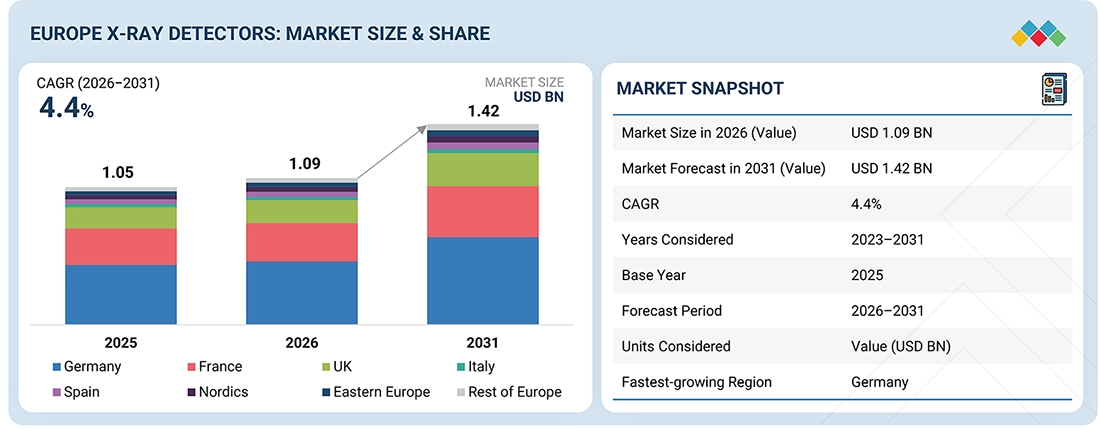
The Europe X-ray detectors market is projected to grow from USD 1.09 billion in 2026 to USD 1.42 billion by 2031, at a CAGR of 4.4% during the forecast period. The market was valued at USD 1.05 billion in 2025. The increasing demand for diagnostic imaging, driven by a higher incidence of chronic diseases and the worldwide aging of the population, is the main factor driving the Europe X-ray detectors market. This is putting additional pressure on already overloaded healthcare systems. The transition from analog to digital radiography is clearly evident in the market, as hospitals and diagnostic centers focus on faster workflows, better image quality, and lower long-term operating costs. Government-led modernization of healthcare infrastructure across European countries is a major factor driving the installation of new X-ray detectors. Demand for portable and mobile imaging solutions, especially in emergency care, home healthcare, and outpatient settings, is another key driver of the market. At the same time, strict safety regulations concerning radiation are boosting the uptake of detectors that produce reconstructed images at the same dose exposure. Technological advances such as flat-panel digital detectors, photon-counting technology, and AI-enabled imaging systems are making the process more efficient and diagnosis more reliable. In addition, non-medical markets where imaging is used for security screening and industrial non-destructive testing applications are helping keep X-ray detector manufacturers' production lines active.
KEY TAKEAWAYS
-
BY REGIONGermany dominated the European X-ray detectors market with a share 29.8% in 2025.
-
BY TECHNOLOGYBy technology, the flat panel detectors segment held a 58.4% share in terms of value in 2025.
-
BY TYPEBy type, the amorphous silicon flat panel detectors segment is projected to lead the market, registering the highest CAGR of 5.7% during the forecast period from 2026 to 2031.
-
BY PANEL TYPEBy panel type, the larger-area flat panel detectors segment represented the major market share in 2025.
-
BY PORTABILITYThe portable flat panel segment dominated the market in 2025.
-
BY PLATFORMThe digital flat panel segment is projected to record the highest CAGR among platforms from 2026 to 2031.
-
BY APPLICATIONBy application, the security and defense application segment is projected to record the highest CAGR of 4.9% from 2026 to 2031.
-
COMPETITIVE LANDSCAPE-KEY PLAYERSVarex Imaging, Thales, and Canon Inc. were recognized as key players in the Europe X-ray detectors market due to their significant market share and extensive product presence.
-
COMPETITIVE LANDSCAPE-STARTUPSCompanies such as JPI Healthcare, IBIS S.r.l., and New Medical Imaging Co. Ltd. have set themselves apart among startups and SMEs by establishing a solid presence in specialized detector technologies, highlighting their strong potential as emerging leaders in the Europe market.
The Europe X-ray detectors market is experiencing a surge in demand for diagnostic imaging, driven by rising cases of chronic diseases and a growing geriatric population, both of which are putting more pressure on healthcare systems. The development of digital radiography remains strong and is closely aligned with the needs of hospitals and diagnostic centers. These facilities want quicker workflows, better image quality, and lower operating costs over the long run. Government-led healthcare infrastructure modernization across European nations is another factor boosting the use of advanced X-ray detector technologies. There is also tremendous demand for both portable and mobile imaging solutions, which is a significant driver for the market, especially in emergency care, home healthcare, and ambulatory settings. Moreover, strict radiation safety regulations are playing a paradoxical role by shifting medical practice toward detectors that produce higher-quality images with lower dose exposure. The introduction of innovative technologies like flat-panel digital detectors, photon-counting technology, and AI-enabled imaging systems is positively affecting the clinical process and increasing diagnostic reliability. In addition, growing non-medical applications in security screening and industrial non-destructive testing are enhancing demand in the region.
TRENDS & DISRUPTIONS IMPACTING CUSTOMERS' CUSTOMERS
The rapid adoption of state-of-the-art flat-panel digital detectors, dose-reduction technologies, and seamless system integration is powering the Europe X-ray detectors market, as highlighted by major OEMs such as Siemens Healthineers, GE HealthCare, Canon Medical Systems, United Imaging Healthcare, and Carestream/Rapiscan. End-users are increasingly focused on high-quality images, rapid processing, and compliance with strict European safety and regulatory standards, prompting manufacturers to innovate beyond core detector sales. This shift is enabling new applications, new detector platforms, AI-assisted imaging workflows, and a broader network of partners across the healthcare and industrial sectors. Consequently, end-users will reap the benefits of increased diagnostic precision, improved patient and operator safety, greater workflow efficiency, and a lower total cost of ownership. Overall, these trends are not only redefining the market but also accelerating the transition from product-focused to service-oriented and outcome-based business models in Europe.

Source: Secondary Research, Interviews with Experts, MarketsandMarkets Analysis
MARKET DYNAMICS

Level
-
Increasing patient volumes requiring diagnostic imaging

-
Expanding use of X-ray detectors in security screening and industrial inspection applications


Level
-
High acquisition cost of X-ray detectors limiting adoption, particularly in cost-sensitive markets

-
Stringent regulatory and compliance requirements


Level
-
Growing demand for portable and mobile imaging solutions

-
Emerging non-medical uses


Level
-
Shortage of skilled radiologists and trained technicians

-
Increasing adoption of refurbished X-ray units

Source: Secondary Research, Interviews with Experts, MarketsandMarkets Analysis
Driver: Increasing patient volumes requiring diagnostic imaging
The demand for diagnostic imaging in Europe has been steadily increasing, driven primarily by an aging population, a higher number of people with chronic diseases (such as heart problems, cancer, and musculoskeletal issues), and the availability of healthcare services under public health systems. Imaging utilization is also significantly boosted by preventive screening programs and early-diagnosis initiatives in EU countries. The demand for advanced X-ray detectors that provide high image quality, faster acquisition, and lower radiation dose is becoming critical as hospitals and diagnostic centers cope with higher patient throughput. This, in turn, is supporting the move from analog systems to digital detectors and creating steady demand for detector upgrades in both clinical and emergency care settings.
Restraint: High acquisition cost of X-ray detectors
Although advanced digital X-ray detectors, especially flat-panel and wireless systems, have clearly demonstrated clinical benefits, their high upfront cost remains a major barrier to adoption, particularly for small hospitals, outpatient imaging centers, and public healthcare facilities operating on limited budgets. In Europe, where capital expenditure approvals are often centralized, tightly controlled, and subject to long procurement cycles, reimbursement pressures further hinder the adoption of new technologies.
Opportunity: Growing demand for portable and mobile imaging solutions
The growing focus on point-of-care diagnostics, emergency response preparedness, and decentralized healthcare delivery is a major factor benefiting the European market for portable and mobile X-ray detector solutions. Mobile imaging has found its way into intensive care units, operating theaters, nursing homes, and even remote or underprivileged regions, reducing patient transfers and making clinical work more efficient. Innovations in X-ray detectors that are lightweight, wireless, and battery-powered, all with the capability to reduce radiation dosage, are attracting medical practitioners to the use of portable X-ray systems. As a result, manufacturers have more options in terms of their support packages, product innovation, and even entry into new markets, which all contribute to a considerable increase in manufacturers' revenue.
Challenge: Shortage of skilled radiologists and trained technicians
A steady shortage of qualified radiologists and radiologic technologists across Europe is a problem for the effective use of sophisticated X-ray detector systems. The shortage may slow the imaging process, prolong diagnosis, and reduce healthcare providers’ earnings from the new technologies. Moreover, the sophistication of advanced digital imaging systems requires specialized training and continuous technical support. Therefore, healthcare providers are calling for more user-friendly detectors, automation capabilities, AI-supported workflows, and robust vendor training programs, putting more pressure on manufacturers to support adoption beyond just hardware delivery.
EUROPE X RAY DETECTORS MARKET: COMMERCIAL USE CASES ACROSS INDUSTRIES
| COMPANY | USE CASE DESCRIPTION | BENEFITS |
|---|---|---|
 |
United Imaging Healthcare’s x-ray detectors are utilized in advanced radiography systems to support comprehensive medical imaging with precision and efficiency. | They deliver high-resolution images, lower radiation exposure, streamlined workflow, enhanced system integration, and greater diagnostic reliability. |
 |
Carestream Health’s X-ray detectors are widely deployed across hospitals, diagnostic imaging centers, and outpatient clinics in Europe to support high-performance digital radiography. | They deliver high-resolution image quality with optimized dose efficiency, faster image acquisition, improved workflow productivity, and strong compatibility with both new and existing radiography systems, enhancing diagnostic accuracy and operational efficiency for healthcare providers. |
 |
Siemens Healthineers AG’s x-ray detectors are deployed in diagnostic imaging systems to enable accurate, real-time digital radiography across clinical specialties. | They offer exceptional image quality, reduced dose exposure, faster throughput, seamless interoperability, and enhanced diagnostic confidence. |
 |
Canon Medical’s x-ray detectors are used in clinical imaging systems to deliver precise, real-time digital radiography for diverse medical applications. | They provide superior image quality, reduced radiation dose, fast workflow, seamless system integration, and improved diagnostic confidence. |
Logos and trademarks shown above are the property of their respective owners. Their use here is for informational and illustrative purposes only.
MARKET ECOSYSTEM
The ecosystem of X-ray detectors in Europe is primarily organized and duly regulated, covering the entire supply chain, from material suppliers, through manufacturers and regulators, to the final users. Raw material suppliers, namely Hamamatsu, Saint-Gobain Crystals, and Photonis, operate at the upstream level and provide critical components, among which scintillators, photodetectors, and crystal materials are the most influential. Detector manufacturers, including Dectris, AGFA HealthCare, Canon Medical, Carestream, Thales, Comet Yxlon, and many others, assemble these components into sophisticated flat-panel and digital X-ray detector systems for medical, industrial, and security applications. The market remains strictly controlled by regulatory authorities represented by the EU MDR framework, the European Medicines Agency (EMA), and Germany's BfArM and Paul-Ehrlich-Institut, which guarantee high safety, quality, and radiation standards through their inspections and monitoring. End users, which include hospitals like Mount Sinai and Cleveland Clinic, as well as industrial and security operators such as Siemens Healthineers and Rapiscan Systems, create demand by requiring the best image quality, the lowest dose, the most efficient workflow, and compliance with regulations. All in all, the ecosystem is characterized by enhanced networking of technologies, strict regulations, and a gradual increase in digital detectors, portable detectors, and high-performance solutions in Europe.

Logos and trademarks shown above are the property of their respective owners. Their use here is for informational and illustrative purposes only.
MARKET SEGMENTS

Source: Secondary Research, Interviews with Experts, MarketsandMarkets Analysis
Europe X ray Detectors Market, by Technology
Flat-panel detectors (FPDs) are the leading and fastest-growing segment in the European X-ray detectors market, primarily because of their high image quality, fast image acquisition, and lower radiation exposure compared to computed radiography and CCD-based systems. In this segment, indirect conversion technologies such as amorphous silicon (a-Si) and CMOS are gaining popularity in general radiography and fluoroscopy for their combination of spatial resolution, reliability, and cost-effectiveness. Besides, manufacturers are developing new wireless, lightweight, rugged detectors to meet the increasing demand for mobile and point-of-care imaging in the European healthcare sector.
Europe X ray Detectors Market, by Application
Medical imaging represents the largest segment of the European market, supported by major applications in general radiography, mammography, and dental imaging. The modernization of hospital imaging facilities and the establishment of diagnostic centers continue to sustain strong demand, with general radiography the main application, as it is widely used in routine diagnostics and emergency care.
REGION
Germany to be dominant country in Europe X-ray detectors market during forecast period
Germany leads the European X-ray detectors market, securing the largest revenue share in 2024. This dominance stems from a mix of structural, technological, and regulatory advantages. The nation possesses one of the most modern healthcare systems in Europe, bolstered by substantial healthcare spending, extensive hospital facilities, and the widespread use of digital imaging technologies. Germany has a large geriatric population and a significant incidence of chronic diseases; thus, demand for imaging diagnostics continues to rise across fields such as radiology, orthopedics, oncology, and emergency medicine. Ongoing upgrades to hospital imaging departments, supported by favorable payment policies and public-private investment, are accelerating the replacement of analog and computed radiography systems with advanced flat-panel detectors. Moreover, Germany is home to leading manufacturers of X-ray detectors and imaging systems, which greatly support local innovation, rapid technology adoption, and strong supply chains. In addition, strict regulatory and quality standards encourage the use of high-performance, low-dose detectors, thereby strengthening Germany's position as a market leader in Europe.

EUROPE X RAY DETECTORS MARKET: COMPANY EVALUATION MATRIX
The market for X-ray detectors in Europe is moderately consolidated, with the major players, Varex Imaging, Canon Medical Systems, Agfa-Gevaert, FUJIFILM Holdings, Carestream Health, Hamamatsu Photonics, Teledyne DALSA, and Konica Minolta, holding and gradually improving their market positions mainly through technological innovations and offering a wider variety of products. In addition, the regional competitive dynamics are influenced by the fact that these companies lead in CMOS and amorphous-selenium technology, offer diverse products ranging from fixed to portable systems, and have built strong distribution and after-sales service networks that support the complex European procurement process and compliance requirements. In addition, businesses that are investing in AI-based image processing, detector miniaturization, and cloud-connected imaging solutions are gaining a competitive advantage as their operations become more efficient and the accuracy of their diagnoses improves. In the meantime, competition in the public healthcare sector, which is often very price-sensitive, has kept pricing as a key factor influencing the market, but it has come to be seen as a balancing act with performance, reliability, and regulatory compliance on the other side of the scale. On the other hand, new players from Asia are introducing cheaper products and entering into partnerships in the region, thereby posing a challenge to the existing players, who in turn will have to innovate more quickly and create value-based differentiation to survive.

Source: Secondary Research, Interviews with Experts, MarketsandMarkets Analysis
KEY MARKET PLAYERS
- Varex Imaging (US)
- Thales (France)
- Canon Inc (Japan)
- Konica Minolta, Inc (Japan)
- Agfa-Gevaert Group (Belgium)
- Carestream Health (US)
- FUJIFILM Holdings Corporation (Japan)
- Analogic Corporation (US)
- Hamamatsu Photonics K.K. (Japan)
- Teledyne Digital Imaging Inc. (Canada)
MARKET SCOPE
| REPORT METRIC | DETAILS |
|---|---|
| Market Size in 2026 (Value) | USD 1.09 Billion |
| Market Forecast in 2031 (Value) | USD 1.42 Billion |
| Growth Rate | CAGR of 4.4% from 2025–2030 |
| Years Considered | 2023–2031 |
| Base Year | 2025 |
| Forecast Period | 2026–2031 |
| Units Considered | Value (USD Million/Billion) |
| Report Coverage | Revenue forecast, company ranking, competitive landscape, growth factors, and trends |
| Segments Covered |
|
| Countries Covered | Germany, UK, France, Italy, Spain, Nordics, Eastern Europe, Rest of Europe |
WHAT IS IN IT FOR YOU: EUROPE X RAY DETECTORS MARKET REPORT CONTENT GUIDE

DELIVERED CUSTOMIZATIONS
We have successfully delivered the following deep-dive customizations:
| CLIENT REQUEST | CUSTOMIZATION DELIVERED | VALUE ADDS |
|---|---|---|
| Leading X-ray Detectors OEM |
|
|
| Raw Material Supplier |
|
|
| Defense Contractor |
|
|
RECENT DEVELOPMENTS
- January 2025 : Carestream Health obtained CE Marking approval from the European Union for its Focus HD Detectors and the DRX-Rise Mobile X-ray System.
- March 2025 : France 2030 announced its support for the ImaSpiiR-X consortium, providing €18.2 million in funding over 60 months to move from black-and-white X-ray medical imaging (which displays only tissue density) to full-color spectral imaging (capable of identifying tissue composition).
- December 2024 : Varex Imaging introduced the LUMEN HD and LUMEN HD Pro digital radiography detectors, developed to address the advancing requirements of modern healthcare imaging.
Table of Contents
 Exclusive indicates content/data unique to MarketsandMarkets and not available with any competitors.
Methodology
The research methodology for analyzing the Europe X-ray detectors market is clearly detailed on the website, outlining the structured processes and best practices followed for data collection, validation, and analysis. This transparent and systematic approach ensures high accuracy and reliability of the insights presented. Such clarity allows stakeholders to assess the robustness of the findings, conclusions, and recommendations, ultimately enabling confident and well-informed decision-making.
Secondary Research
For this secondary research, we relied on diverse sources, including D&B Hoovers, Bloomberg Businessweek, Factiva, white papers, annual reports, company filings, investor presentations, and SEC filings. This in-depth approach helped build a robust database of key players in the industry. The database provides essential insights into established companies, detailed multi-level market segmentation, trends within each segment, notable mergers and acquisitions, and the impact of cutting-edge technological innovations shaping the Europe X-ray detectors market.
Primary Research
The primary research involved both qualitative and quantitative approaches and was conducted in depth with participants from both the supply and demand sides through interviews.
On the supply side, interviews were conducted with senior-level executives, including CEOs, vice presidents, marketing and sales directors, product managers, regional managers, and R&D heads, from leading companies involved in the design, manufacturing, and distribution of X-ray detectors and imaging components. These companies include manufacturers of flat-panel detectors, CMOS detectors, scintillators, and imaging electronics, as well as original equipment manufacturers (OEMs) integrating detectors into medical imaging, industrial inspection, and security screening systems.
On the demand side, professionals interviewed included radiologists, medical imaging specialists, hospital administrators, diagnostic center managers, biomedical engineers, procurement managers, and technical experts from hospitals, diagnostic imaging centers, dental clinics, veterinary hospitals, industrial non-destructive testing (NDT) companies, airport and border security agencies, and research institutions. Additional stakeholders included representatives from medical device distributors, healthcare service providers using industrial radiography, and government organizations responsible for security screening and infrastructure safety.
Overall, this research provided valuable insights into market segmentation, key players, trends, dynamics, and growth of drivers in the market.
To know about the assumptions considered for the study, download the pdf brochure
Market Size Estimation
The report offers an in-depth analysis of the Europe X-ray detectors market, identifying key players through both primary and secondary research. Secondary research drew on annual and financial reports from major market companies, while primary research included detailed interviews with key opinion leaders, including CEOs, directors, and senior marketing executives.
To estimate the global market value, a segment-based methodology was applied, using revenue data from leading solutions and suppliers. This involved:
- Identifying major participants in the global Europe X-ray detectors market.
- Reviewing their reported annual revenues, whether directly related to x-ray detectors or reflecting broader business units and product lines.
The data was then projected to derive the overall value of the Europe X-ray detectors market.
Global Europe X-ray detectors market: Bottom-up Approach & Top-down Approach
Europe X-ray detectors market : Top-Down and Bottom-Up Approach

Data Triangulation
The research approach involved dividing the market into different participant groups and categories. Data triangulation and segmentation methods were applied to ensure the accuracy of information across all market segments. Multiple analyses were conducted to assess both the demand and supply sides of the market. By combining top-down and bottom-up approaches, the study provided a comprehensive understanding of the market.
Market Definition
X-ray detectors are devices that capture X-ray radiation and convert it into electrical signals or digital images for processing and analysis. They are a critical component of X-ray imaging systems used to visualize internal structures of objects or the human body. X-ray detectors are widely used in applications such as medical diagnostics, dental imaging, veterinary care, industrial non-destructive testing, security screening, and scientific research, enabling accurate imaging, analysis, and inspection.
Key Stakeholders
- Raw material suppliers
- Component suppliers (scintillators, photodiodes, semiconductors, ASICs)
- X-ray detector manufacturers
- Original equipment manufacturers (OEMs) of X-ray imaging systems
- Medical imaging equipment manufacturers
- Distributors and channel partners
- System integrators and service providers
- Hospitals and healthcare providers
- Diagnostic imaging centers
- Research Institutions
- Raw Material and Reagent Suppliers
- Regulatory Authorities
Report Objectives
- To define, describe, and forecast the Europe X-ray detectors market based on technology, flat-panel detector (by type, by panel type, by portability, by platform), application, and region
- To provide detailed information regarding the major factors influencing market growth (drivers, restraints, opportunities, and challenges), along with the current trends
- To strategically analyze micromarkets with respect to their individual growth trends, prospects, and contributions to the total market
- To analyze opportunities in the market for stakeholders and provide details of the competitive landscape for market leaders
- To forecast the revenue of the market segments for five regions: North America (US and Canada), Europe (Germany, France, UK, Italy, Spain, and Rest of Europe), the Asia Pacific (China, Japan, India, South Korea, Australia, and Rest of Asia Pacific), Latin America (Brazil, Mexico, and Rest of Latin America), and the Middle East & Africa
- To profile the key players and comprehensively analyze their market shares and core competencies
- To track and analyze competitive developments in the Europe X-ray detectors market, such as acquisitions, product launches, expansions, agreements, joint ventures, alliances, and collaborations
Customization Options
Based on available market data, MarketsandMarkets offers tailored customization to meet a company's specific needs. The following customization options are available for the global Europe X-ray detectors market:
Value chain analysis
A detailed analysis of the overall value chain of X-ray detectors including raw material and component suppliers (such as scintillators, semiconductor wafers, photodiodes, and electronic components), detector design and manufacturing, integration into X-ray imaging systems by OEMs, distribution and installation through channel partners, and end-use applications across healthcare diagnostics, industrial non-destructive testing, security screening, and research institutions at the regional and global levels.
Geographic analysis
- Detailed analysis of the Rest of Europe Europe X-ray detectors market (including Russia, Belgium, Netherlands, Switzerland, Sweden, Austria, Portugal, and other countries)
- Detailed analysis of the Rest of Asia Pacific Europe X-ray detectors market (including Singapore, Philippines, Taiwan, New Zealand, and other countries)


Personalize This Research
- Triangulate with your Own Data
- Get Data as per your Format and Definition
- Gain a Deeper Dive on a Specific Application, Geography, Customer or Competitor
- Any level of Personalization
Let Us Help You
- What are the Known and Unknown Adjacencies Impacting the Europe X-Ray Detectors Market
- What will your New Revenue Sources be?
- Who will be your Top Customer; what will make them switch?
- Defend your Market Share or Win Competitors
- Get a Scorecard for Target Partners

Custom Market Research Services
We Will Customise The Research For You, In Case The Report Listed Above Does Not Meet With Your Requirements
Get 10% Free CustomisationTESTIMONIALS

JAYANT RAJPUROHIT
Director of Market Insights, Data and Analytics
SFI Health,
Leading Pharmaceutical Companywww.sfihealth.com/

We at SFI Health approached MarketsandMarkets for an Opportunity Assessment on "Incidence and Prevalence of Focus Indications" as we wanted to know the most attractive HCPs like Physician, Functional MD, Naturopath and Pharmacist. The project was critical for us to ensure our focus on the right target which would enable sustainable growth and profitability for SFI Health. The business insights provided exceeded our expectations and we were extremely impressed. The team at MarketsandMarkets is highly professional and detail oriented and very well understood our business needs. MarketsandMarkets offers a unique combination of expertise and dedicated engagement model. We identified 2 new products to be launched in coming months, based on the research findings provided by MarketsandMarkets. We are happy with the services and would strongly recommend MarketsandMarkets to my peers in the industry.

BEATRIZ DE LA CALLE
Head of Commercial Analytics
Qualicaps,
Leading Pharmaceutical Companywww.qualicaps.com/

We partnered with MarketsandMarkets for an assessment study on hard empty capsules. The team was extremely professional in understanding our business requirements and we received timely responses to all our queries. The market intelligence and the recommendations has met our business requirements. We were extremely impressed to see the final study results; it really exceeded our expectations. The market intelligence offered by MarketsandMarkets, and clarity on next steps will help us achieve our business objective for the Year 2021. We are happy with the services and would strongly recommend MarketsandMarkets to my peers in the industry.

Bob Williams,
Senior Director Business Development & Innovation
Bracco Diagnostics Inc.,
Italian Multinational in life sciences sector and a World Leader in imaging diagnosticsimaging.bracco.com/us-en
We were pleased with targeted insights that MarketsandMarkets identified from a custom study on the 'Radiation Dose Management Solutions Market'. Your team identified and characterized the market participants as well as underlying trends accurately. This study was useful to Bracco in formulating business strategies for our dose monitoring product lines and we thank MarketsandMarkets for the job well done.
Cody Coonradt,
Market Development and Strategy Manager
3M Health Information Systems,
Leader in Health care Coding, Payment & Analytics Solutions.www.3m.com/3M/en_US/health-information-systems-us
The value for our organization comes from three things: depth of research, specificity of segments and being easy to work with. As important as the first two are, the third can't be underestimated. MarketsandMarkets, maybe more than any other research vendor, wants to know what is top of mind for our team and what big questions we are grappling to answer.
Their customer first approach and high value engagement model, have given us great analysis and excellent value for money






Growth opportunities and latent adjacency in Europe X-Ray Detectors Market