Excavator Market Size, Share & Analysis

Excavator Market by Equipment Type (Crawler, Mini, Wheeled), Power Output (<100 HP, 101-200 HP, 201-400 HP, >400 HP), Tonnage Capacity (<10 Tons, 10-20 Tons, 21-40 Tons, >40 Tons), Propulsion, Battery Capacity, and Region - Global Forecast to 2032




OVERVIEW

Source: Secondary Research, Interviews with Experts, MarketsandMarkets Analysis
The excavator market is projected to grow from USD 54.49 billion in 2026 to USD 71.74 billion by 2032 at a CAGR of 4.7%. The market is expanding, driven by electric and hybrid powertrains delivering up to 30–40% lower fuel consumption, advanced hydraulic systems with load-sensing, variable-flow pumps, and energy recovery, and autonomous or semi-autonomous models capable of GPS-guided precision digging and telematics integration. A growing share of global construction activity is now concentrated in urban redevelopment (metro rail expansions, underground utility replacements, basement retrofitting, smart city retrofits) rather than on greenfield megaprojects alone. This shift toward mechanized Urban Redevelopment & Brownfield Projects would drive the demand for excavators. However, the industry is facing cost escalations due to emissions regulations. Tightening emission standards (Stage V, Tier 4 Final, and equivalent norms) have significantly increased the complexity of engines, aftertreatment systems, and electronic systems. This raises upfront equipment costs, increases maintenance sophistication, and puts margin pressure on OEMs, especially in price-sensitive markets.
KEY TAKEAWAYS
-
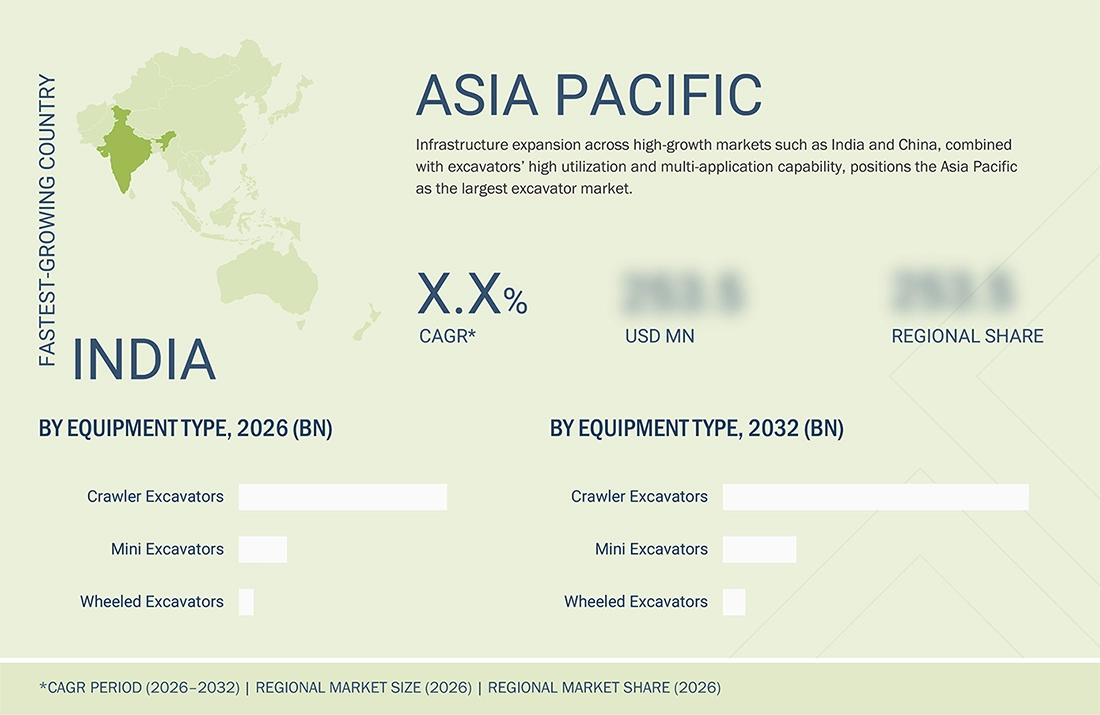
BY REGIONThe Asia Pacific market accounted for >75% share of the global excavator market in 2025.
-
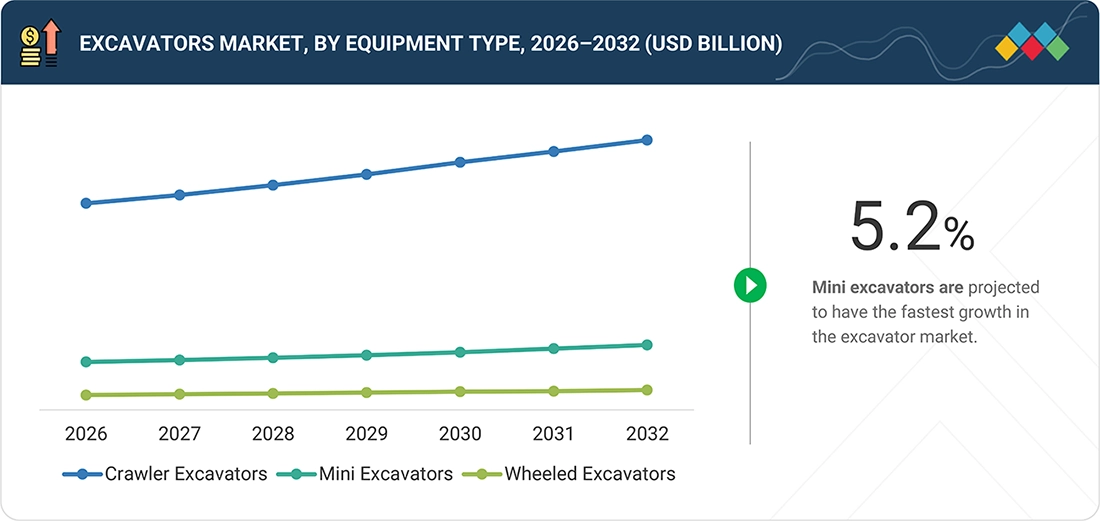
BY EQUIPMENT TYPEThe mini excavator segment is projected to register the fastest growth with a CAGR of 5.2% during the forecast period.
-
BY PROPULSIONThe ICE segment is projected to dominate the market during the forecast period.
-
BY TONNAGE CAPACITYExcavators under <10 Tons are projected to register the highest CAGR during the forecast period.
-
BY POWER OUTPUTThe 101–200 HP segment is projected to dominate the market during the forecast period.
-
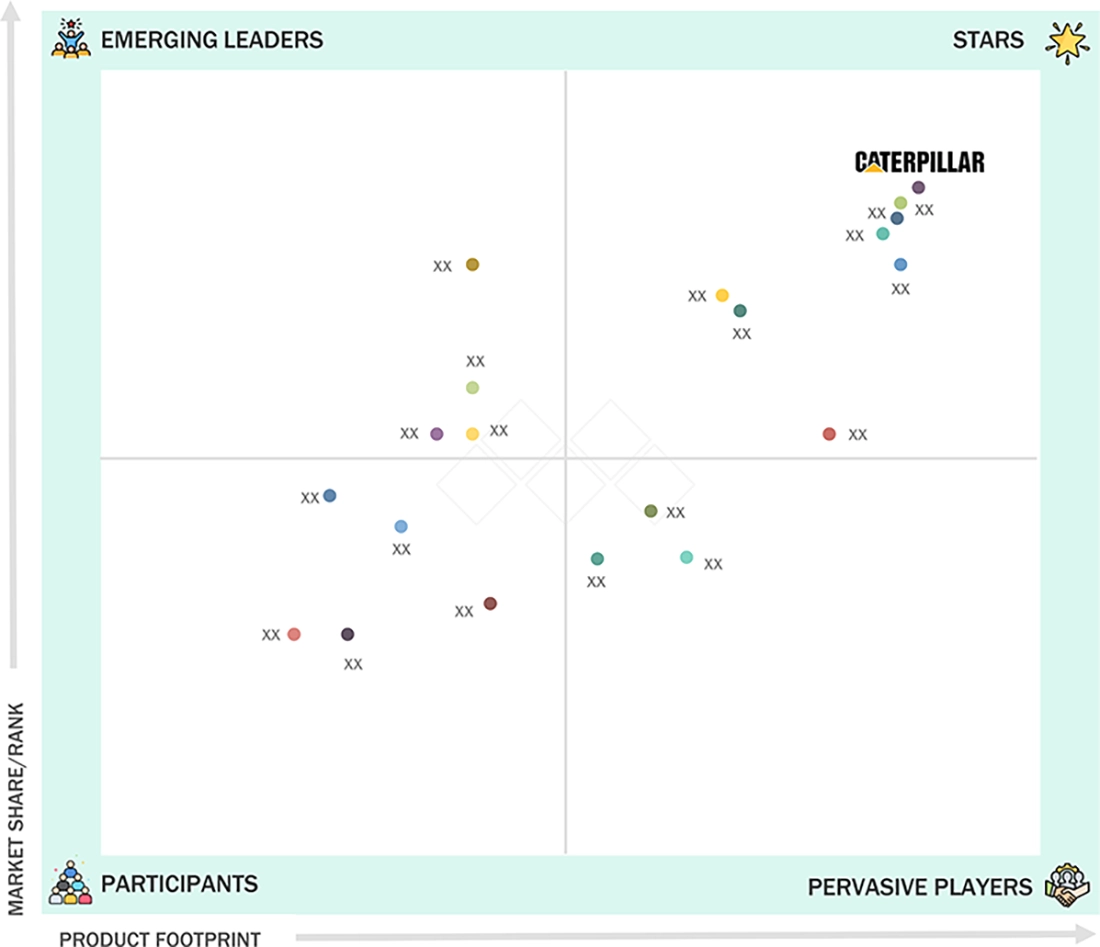
COMPETITIVE LANDSCAPECompanies like Caterpillar Inc. and Komatsu Co., Ltd. were identified as two of the STAR players in the global excavator market, primarily due to their strong business networks and strategic growth, which have enabled them to establish market positions.
The excavator market is experiencing robust growth, driven by advancements in hybrid powertrains offering 20-30% fuel savings, intelligent automation with 5-15% cycle time reductions, and bucket capacities from 0.5-5 m³ across 5-100 ton classes, alongside lower emissions and operating costs. Integration of telematics and connected features, such as real-time fleet monitoring, AI predictive maintenance, and remote diagnostics, is boosting uptime by 15-25%, operator safety, and project efficiency. Also, product innovations such as electric/hybrid drivelines, advanced hydraulic systems with electronic controls, and modular attachments are driving adoption in urban infrastructure, mining, and quarrying projects.
TRENDS & DISRUPTIONS IMPACTING CUSTOMERS' CUSTOMERS
By 2026, the industrial vehicle industry is entering a "Value over Volume" phase where the primary driver is no longer just the machinery's physical capacity, but its digital and environmental footprint. For the Client (OEM/Fleet Owner), the imperative is to integrate machinery into a "digital worksite ecosystem," using digital twins to monitor real-time loads and anti-collision sensors, thereby improving site safety by 25%. For the Client's Client (The Contractor), the imperative is operational survival in a labor-strapped market; they increasingly demand "Agentic AI" and autonomous machines capable of making independent decisions on-site. This creates a massive opportunity for the rental and Vehicle-as-a-Service (VaaS) models, as contractors seek flexible access to high-tech, expensive assets without the risk of long-term capital exposure.
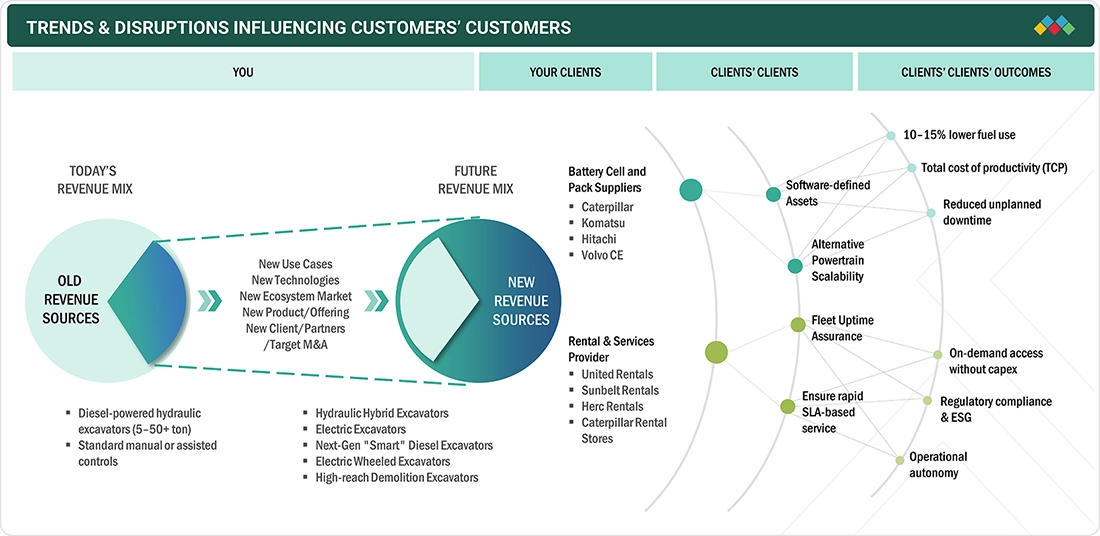
Source: Secondary Research, Interviews with Experts, MarketsandMarkets Analysis
MARKET DYNAMICS

Level
-
Capital-intensive infrastructure pipeline supporting equipment intensity

-
Production-scale mining and aggregates throughput expansion


Level
-
High acquisition cost with exposure to economic cycles


Level
-
Adoption of electric excavators in compact segments

-
Deployment of connected fleet and predictive maintenance systems


Level
-
Rising compliance requirements under advanced emission norms

Source: Secondary Research, Interviews with Experts, MarketsandMarkets Analysis
Drivers – Capital-intensive infrastructure pipeline supporting equipment intensity
The excavator market is growing due to large infrastructure projects such as metro systems, ports, highways, and smart cities, which require more machines on-site. Excavators with digging forces of 120–500 kN, reach of 15–20 m, and bucket sizes of 1.5–6 m³ are widely used. Features like load-sensing hydraulics, automated digging, and telematics-based fleet management help increase efficiency. OEMs are adding predictive maintenance and IoT monitoring to reduce downtime. High-value infrastructure projects are, therefore, a key driver for advanced excavators.
Restraints – High cquisition cost with exposure to economic cycles
Excavators are expensive, ranging from USD 80,000 for mini models to over USD 500,000 for large machines. Total costs include fuel (12–30 L/h), hydraulic oil changes, and operator training, making investment significant. Demand fluctuates with economic cycles in construction and mining. Electric and hybrid models with 150–250 kWh batteries have high upfront costs, even though they are cheaper to operate over time.
Opportunities – Adoption of electric excavators in compact segments
Mini and compact excavators (<10 tons) are being electrified for urban sites, offering zero emissions, torque similar to 10–12 ton diesel machines, and 4–6 hours of operation per charge. Fast-charging batteries (<2 hours) and energy recovery systems improve usability. OEMs can provide modular electric platforms and telematics energy monitoring to improve uptime and reduce operating costs, especially in emission-sensitive areas.
Challenges – Rising compliance requirements under advanced emission norms
Regulations like EU Stage V, US Tier 4 Final, and China VI require advanced aftertreatment systems (DOC, DPF, SCR, urea dosing). Compliance adds cost and complexity while maintaining performance. Retrofitting older machines is expensive. OEMs must integrate engine and hydraulic controls, improve thermal management, and use IoT sensors to ensure emissions compliance, creating operational and technical challenges.
EXCAVATOR MARKET: COMMERCIAL USE CASES ACROSS INDUSTRIES
| COMPANY | USE CASE DESCRIPTION | BENEFITS |
|---|---|---|
 |
Large-scale construction, mining, and urban infrastructure projects; models like the PC220LCi-12 use intelligent machine control for digital jobsite productivity. | Improves efficiency, precision, and safety on sites; reduces fuel consumption and operational costs; enables remote monitoring and automated control |
 |
Deployment of zero-emission and hybrid excavators for urban construction and medium-class applications; the company showcased battery and hydrogen-powered models at Bauma 2025. | Reduces emissions, supports regulatory compliance, lowers energy costs, and enables operation in emission-sensitive zones |
 |
Roadwork, port construction, and infrastructure projects across Asia Pacific regions; focus on electric and hybrid models. | Enhances productivity with telematics-enabled fleet management, reduces fuel costs, and improves operator comfort and safety |
 |
Mining, industrial, and civil construction in emerging Asia Pacific markets; the company offers mid-range and heavy excavators adapted for local conditions. | Provides high durability, lower maintenance, and cost-effective performance for diverse terrains and applications |
 |
Large mining, infrastructure, and heavy civil projects in the Asia Pacific; the company offers hybrid and fuel-efficient models. | Optimizes operational efficiency, reduces downtime with predictive maintenance, and supports large-scale project deployment |
Logos and trademarks shown above are the property of their respective owners. Their use here is for informational and illustrative purposes only.
MARKET ECOSYSTEM
The ecosystem analysis highlights various excavator market players, primarily represented by excavator manufacturers, component suppliers, rental & service providers, and infrastructure providers.
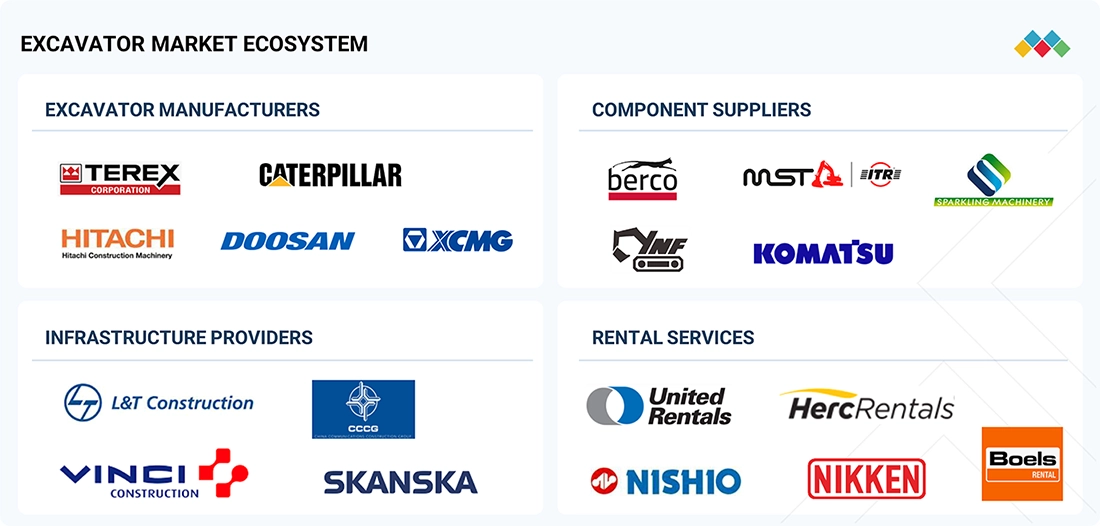
Logos and trademarks shown above are the property of their respective owners. Their use here is for informational and illustrative purposes only.
MARKET SEGMENTS
Source: Secondary Research, Interviews with Experts, MarketsandMarkets Analysis
Exacavator Market, By Equipment Type
The mini excavator segment is currently the fastest-growing in the market due to increasing urban construction, redevelopment projects, and confined job sites where compact machines are essential. OEMs are introducing electric and hybrid mini excavators in the 3–7 ton range, featuring low-noise operation, high-efficiency hydraulics, and automated digging cycles to enhance productivity. These machines offer lower acquisition costs and reduced operational expenses, making them attractive to small contractors, rental fleets, and infrastructure developers. Advanced technologies such as telematics-based monitoring, energy-recovery hydraulic systems, and remote diagnostics further support operational efficiency.
Exacavator Market, By Tonnage Capacity
The 10–20 ton excavator segment is the largest in terms of value due to its versatility in medium-to-large construction, infrastructure, and mining projects. OEMs are supplying diesel, hybrid, and emerging electric models in this range, featuring bucket capacities of 0.6–1.5 m³, digging depths of 4–6 m, and hydraulic digging forces of 80–150 kN. Advanced technologies such as load-sensing hydraulics, automated digging patterns, telematics fleet management, and energy-recovery systems improve operational efficiency and reduce fuel consumption. These machines are favored by contractors for their optimal balance of mobility, lifting capacity, and fuel efficiency, making them suitable for urban, industrial, and semi-remote sites. The Asia Pacific generates the highest demand driven by rapid infrastructure expansion, whereas in Europe, there are regulatory incentives for low-emission machinery and fleet modernization programs accelerate adoption.
Exacavator Market, By Propulsion
Electric excavators are the fastest-growing due to rising environmental regulations and global decarbonization efforts. They produce zero tailpipe emissions, making them ideal for urban and environmentally sensitive projects. Lower operating costs, reduced maintenance, and quieter operation improve efficiency and usability. OEMs like Caterpillar, Komatsu, Volvo, Hitachi, and Doosan are launching advanced electric models with improved batteries, hybrid options, and telematics support. Government incentives and subsidies in Europe, North America, and the Asia Pacific accelerate adoption. Advancements in battery technology are closing the performance gap with diesel machines, enabling longer runtimes and higher productivity.
REGION
Asia Pacfic is expected to be the largest region in the global excavator market during the forecast period.
The Asia Pacific excavator market is the largest due to rapid urbanization, industrialization, and large-scale infrastructure projects in countries like China, India, and Indonesia. Expanding mining operations further increase demand for high-capacity machines. Leading OEMs such as Caterpillar, Komatsu, Hitachi, Volvo, and LiuGong are introducing region-specific models, from compact urban units to large mining excavators. Significant R&D investment in China, Japan, and India focuses on fuel-efficient, hybrid, and electric models tailored to local conditions. For example, in April 2025, Komatsu unveiled the next-generation PC220LCi-12 hydraulic excavator at Bauma 2025, featuring advanced ICT and intelligent machine control, while Hitachi showcased an expanded zero-emission range, including battery and hydrogen-powered models from mini to medium class. The adoption of telematics, IoT-enabled fleet management, and government incentives for low-emission equipment is accelerating deployment, making Asia-Pacific the largest excavator market globally.
EXCAVATOR MARKET: COMPANY EVALUATION MATRIX
The micro quadrant provides information on major players that offer excavators and outlines the findings and analysis of how well each vendor performs within the predefined criteria. The company evaluation matrix for the excavator market positions players based on market share/rank and product footprint. Companies in the Stars quadrant, for example, Caterpillar Inc., lead the excavator market with strong market presence and wide product portfolios.
Source: Secondary Research, Interviews with Experts, MarketsandMarkets Analysis
KEY MARKET PLAYERS
- Caterpillar (US)
- Komatsu Co., Ltd. (Japan)
- Deere & Company (US)
- SANY (China)
- AB Volvo (Sweden)
- Zoomlion Heavy Industry Science & Technology Co., Ltd. (China)
- Doosan Enerbility (South Korea)
- Terex Corporation (US)
- CNH Industrial N.V. (UK)
- Liebherr (Switzerland)
- J C Bamford Excavators Ltd. (UK)
- Kobelco Construction Machinery Co., Ltd. (Japan)
MARKET SCOPE
| REPORT METRIC | DETAILS |
|---|---|
| Market Size in 2026 | USD 54.49 billion |
| Market Size Forecast in 2032 | USD 71.74 billion |
| Growth Rate | 4.7% |
| Years Considered | 2022-2032 |
| Base Year | 2025 |
| Forecast Period | 2026-2032 |
| Units Considered | Value (USD Billion), Volume (Units) |
| Report Coverage | Revenue Forecast, Regional Market Shares, Competitive Landscape, Driving Factors, Trends & Disruption, OEM Analysis, Bill of Materials, Total Cost of Ownership, and Others |
| Segments Covered | • By Equipment Type (Crawler Excavator, Mini Excavator, Wheeled Excavator) • By Propulsion (ICE, Hydrogen) • By Power Output (<100 HP, 101-200 HP, 201-400 HP, and >400 HP) • By Tonnage Capacity (<10 Tons, 10-20 Tons, 21-40 Tons, >40 Tons) • By Battery Capacity (<50 KWH, 50-150 KWH, 151-300 KWH, >301 KWH) |
| Regional Scope | Asia Pacific, Europe, and North America |
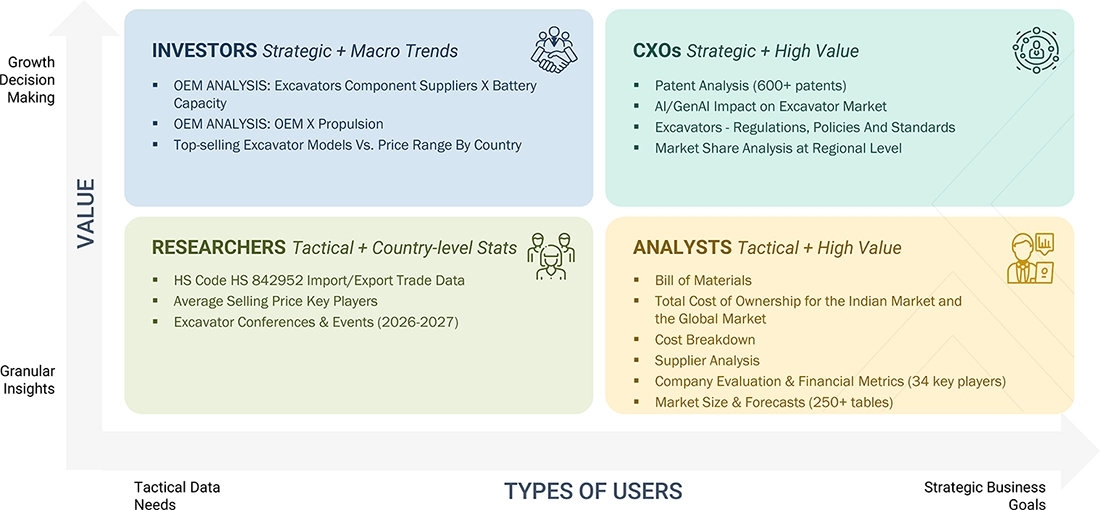
WHAT IS IN IT FOR YOU: EXCAVATOR MARKET REPORT CONTENT GUIDE
DELIVERED CUSTOMIZATIONS
We have successfully delivered the following deep-dive customizations:
| CLIENT REQUEST | CUSTOMIZATION DELIVERED | VALUE ADDS |
|---|---|---|
| Global Excavator OEM |
|
|
| Regional Rental Major |
|
|
| Component Tier 1 (Engines/Hydraulics) |
|
|
RECENT DEVELOPMENTS
- January 2026 : Volvo CE added the ECR255 short-swing crawler excavator to its new generation lineup, with a planned tradeshow debut at CONEXPO-CON/AGG 2026.
- January 2026 : Volvo Construction Equipment launched three next-generation compact excavator models such as ECR90, EC65, and EW65, updating its compact lineup ahead of CONEXPO-CON/AGG 2026.
- December 2025 : JCB India introduced its 52-tonne class excavator and expanded excavator range at EXCON 2025, including mid-size and mini models with improved efficiency and hydraulics.
- December 2025 : Escorts Kubota U22-6 mini excavator was officially launched in the domestic market via regulatory filing as part of its showcase at EXCON 2025, with a 2.2t class and zero-tail swing design.
Table of Contents
 Exclusive indicates content/data unique to MarketsandMarkets and not available with any competitors.
Methodology
The study encompassed four primary tasks to determine the present and future scope of the Excavator Market . Initially, extensive secondary research was conducted to gather data on the market, its related sectors, and overarching industries. Subsequently, these findings and assumptions were corroborated and validated through primary research involving industry experts across the value chain. The complete market size was estimated by using both top-down and bottom-up methodology. Following this, a market breakdown and data triangulation approach were utilized to determine the size of specific segments and subsegments within the market.
Secondary Research
The secondary sources referred to the company's annual reports/presentations, industry association publications, directories, technical handbooks, World Economic Outlook, technical articles, and databases, which were used to identify and collect information for an extensive study of the market. The secondary sources used while estimating the market sizing are the Association of Equipment Manufacturers, the Committee for European Construction Equipment (CECE), corporate filings (such as annual reports, investor presentations, and financial statements), and off-highway associations. Secondary data was collected and analyzed to determine the overall market size, further validated through primary research. The primary sources—experts from related industries, OEMs, rental service players, and component suppliers—were interviewed to obtain and verify critical information and assess prospects and market estimations. Historical sales data has been collected and analyzed, and the industry trend is considered to arrive at the forecast, which is further validated by primary research.
Primary Research
In the primary research process, various primary sources from both the supply and demand sides were interviewed to obtain qualitative and quantitative information on the market. The primary sources from the supply side included various industry experts, such as CXOs, vice presidents, directors from business development, marketing, product development/innovation teams, and related key executives from various key companies. Various system integrators, industry associations, independent consultants/industry veterans, and key opinion leaders were also interviewed.
Primary interviews have been conducted to gather insights such as market sizing estimation and forecast, future technology trends, and upcoming technologies in the market. Data triangulation of all these points was done using the information gathered from secondary research and model mapping. Stakeholders from the demand and supply sides have been interviewed to understand their views on the aforementioned points.
To know about the assumptions considered for the study, download the pdf brochure
Market Size Estimation
A detailed market estimation approach was followed to estimate and validate the value of the Excavator Market and other dependent submarkets, as mentioned below.
- The bottom-up approach was used to estimate and validate the market size. The market size, by equipment and country, was derived by mapping the historical sales of different equipment at the country level. These data points were largely fetched from the country-level associations, off-highway databases, and OEM data excerpts. The market size, by value, was derived by multiplying the equipment-wise average selling price with the respective equipment volume calculated in units. Each country/region's total volume and value of each country/ region are then summed up to reveal the total volume of the global market for each type. The data was validated through primary interviews with industry experts. The market is further segmented into the equipment categorywhich includes power output, engine capacity, propulsion, and electric construction equipment. The penetration of different segments was derived from secondary research and primary interviews.
- The gathered market data was consolidated, enhanced with detailed inputs, analyzed, and presented in this report.
Data Triangulation
All percentage shares, splits, and breakdowns have been determined using secondary sources and verified by primary sources. All parameters that affect the markets covered in this research study have been accounted for, viewed in extensive detail, and analyzed to obtain the final quantitative and qualitative data. This data has been consolidated and enhanced with detailed inputs and analysis from MarketsandMarkets and presented in the report.
Market Definition
CONSTRUCTION EQUIPMENT: Construction equipment refers to a wide range of heavy machinery and tools used in the commercial, residential, and infrastructure sectors. These machines play a crucial role in enhancing the quality, safety, and productivity of construction projects. Common types of construction equipment include excavators, loaders, dozers, graders, scrapers, dump trucks, mixers, compactors, and cranes. Each type of equipment is designed to handle specific tasks, enabling construction teams to complete projects more efficiently and safely.
Stakeholders
- Construction Equipment manufacturers
- Raw Material Suppliers for Construction Equipment component/system manufacturers
- Consulting companies (Road, Building & Infrastructure)
- Tier 1 companies (Aftertreatment device manufacturers & component suppliers)
- Battery, motor, and other electric construction equipment part suppliers
- Equipment service providers
- Off-Vehicle Safety Regulatory Bodies
- Government and research institutions
- Off-highway and heavy equipment associations
- Rental equipment service providers
Report Objectives
-
To define, describe, and forecast the Excavator Market in terms of value (USD million) and volume (thousand units) based on the following segments:
- By Equipment Type (Articulated Dump Trucks, Asphalt Finishers, Backhoe Loaders, Crawler Dozers, Crawler Excavators, Crawler Loaders, Mini Excavators, Motor Graders, Motor Scrapers, Rigid Dump Trucks, Road Rollers, Rough Terrain Lift Truck (RTLT) Masted, Rough Terrain Lift Truck (RTLT) Telescopic, Skid-Steer Loaders, Wheeled Excavators, Wheeled Loaders <80 HP, Wheeled Loaders >80 HP, Compactors, and Pick and Carry Cranes)
- By Equipment Category (Earthmoving, Material Handling, Heavy Construction Vehicles, Others)
- By Propulsion Type (Diesel, CNG/LNG/RNG)
- By Power Output (<100HP, 101-200HP, 201-400HP, >400 HP)
- By Engine Capacity (<5L, 5-10L,>10L)
- By Application (Commercial, Residential, Infrastructure)
- By Aftertreatment Device (Diesel Oxidation Catalyst, Diesel Particulate Filter, Exhaust Gas Recirculation, Selective Catalyst Reduction)
- Rental, by Application (Commercial, Residential, Infrastructure)
- Electric & hybrid Market, By Equipment Type (Electric Dump Truck, Electric Dozer, Electric Loader, Electric Excavator, Electric Motor Grader, Electric Load Haul Dump)
- Electric Excavator Market , By Battery Chemistry (Lithium Iron Phosphate, Lithium Nickel Manganese Cobalt Oxide, Others)
- Compact Excavator Market , Global Shipment by OEM (Bobcat, Caterpillar, Hitachi Construction Equipment, CNH Industrial, Hyundai Construction Equipment Co., Ltd, JCB, Deere & Company, Komatsu, Kubota Corporation, Liebherr, Liugong Machinery Co., Ltd, Terex Corporation, AB Volvo, Wacker Neuson SE, Yanmar Holdings Co., Ltd, Kobelco)
-
By Region (Asia Pacific, Europe, North America, The Middle East, and the Rest of the World)
- To understand the dynamics (drivers, restraints, opportunities, and challenges) of the market
- To analyze the market share of leading players operating in the market and evaluate the company evaluation quadrant.
- To strategically analyze key player strategies and company revenue analysis
-
To study the following with respect to the market
- Trends and Disruptions Impacting Customers’ Businesses
- Market Ecosystem
- Supply Chain Analysis
- Patent Analysis
- Regulatory Landscape
- Case Study Analysis
- Key Conferences and Events
- Investment and Funding Scenario
- Pricing Analysis
- To analyze recent developments, including supply contracts, new product launches, expansions, and mergers & acquisitions undertaken by key industry participants in the market
- To analyze the opportunities in the market for stakeholders and provide details of the competitive landscape for market leaders
Available Customizations
MarketsandMarkets offers the following customizations for this market report:
Excavator Market , BY END-USE INDUSTRY
- Construction& Infrastructure
- Mining
- Oil & Gas
- Manufacturing
- Others
Note: This chapter will be further segmented at the country level in terms of volume and value
Excavator Market , BY EMISSION REGULATION
- STAGE II
- STAGE III
- STAGE III a
- STAGE III b
- STAGE IV
- STAGE V
- STAGE VI
- TIER 3
- TIER 4
- TIER 5
Note: This chapter will be further segmented at the country level in terms of volume and value
ELECTRIC Excavator Market , BY COUNTRY
- China
- India
- Japan
- Indonesia
- US
- Canada
- Mexico
- Germany
- UK
- France
- Italy
- Spain
Note: This chapter will be further segmented at the regional level (Asia Pacific, Europe, North America, and the Rest of the World) in terms of volume and value


Personalize This Research
- Triangulate with your Own Data
- Get Data as per your Format and Definition
- Gain a Deeper Dive on a Specific Application, Geography, Customer or Competitor
- Any level of Personalization
Let Us Help You
- What are the Known and Unknown Adjacencies Impacting the Excavator Market
- What will your New Revenue Sources be?
- Who will be your Top Customer; what will make them switch?
- Defend your Market Share or Win Competitors
- Get a Scorecard for Target Partners

Custom Market Research Services
We Will Customise The Research For You, In Case The Report Listed Above Does Not Meet With Your Requirements
Get 10% Free CustomisationTESTIMONIALS

JIM NAAS
PRODUCT DIRECTOR, WEASLER
Weasler Engineering, a CentroMotion organization
Global Provider of Industrial Actuation & Control Solutionswww.weasler.com
Our organization was interested in learning more about the attractiveness of a particular market space. We contacted MarketsandMarkets to help us based on previous positive experiences we had with them. The results did not disappoint! We discussed our objectives with them, and the team at MarketsandMarkets developed and executed a proposal that met our needs precisely. We were very impressed by their level of expertise, the quality of the analysis and their insightful recommendations. We would not hesitate in working with them again in the future.

Matt Kardel,
Vice President
Aptiv,
A global technology company that develops safer, greener and more connected solutions.www.aptiv.com
We contracted with
MarketsandMarkets to evaluate the value chain and potential go-to-market partners related to our
interest in the Fleet Management space. The team successfully completed the work on time and at the
pricing agreed. MarketsandMarkets listened and understood our objectives and collaborated well with
us to help us get the visibility we needed to make an investment.
We have subsequently used
MarketsandMarkets again related to Smart Cities to good results.






Growth opportunities and latent adjacency in Excavator Market