Farm Implements Market

Farm Implements Market Equipment Type (Cultivators, Tillers, Seeders & Planters, Rotavators, Sprayers, Harvesters, Balers), Operation Type, End-Use (Commercial, Residential, Others), and Region - Global Forecast to 2032




OVERVIEW
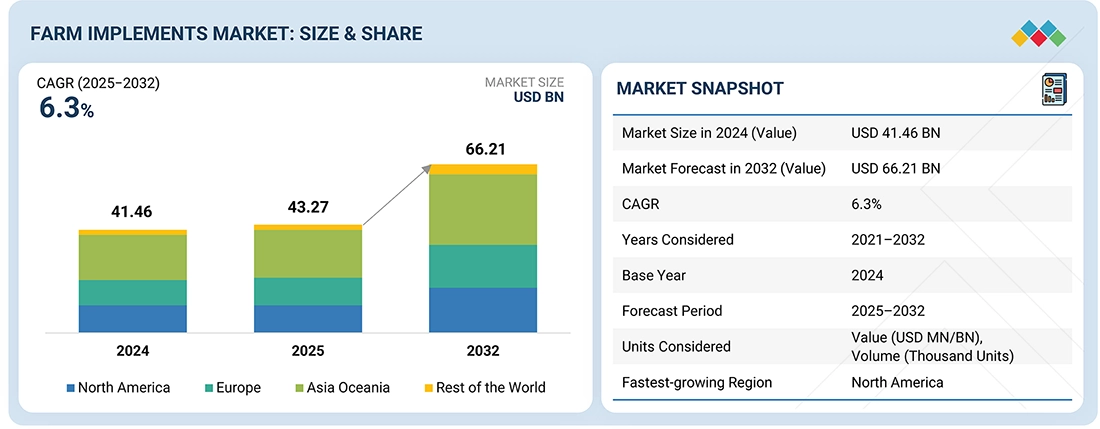
Source: Secondary Research, Interviews with Experts, MarketsandMarkets Analysis
The farm implements market is projected to grow from USD 43.27 billion in 2025 to USD 66.21 billion by 2032, with a CAGR of 6.3%. The market is growing steadily as farmers are adopting better tools for land preparation, planting, crop care, and harvesting. Additionally, the global farming ecosystem is evolving with greater access to tractors, wider use of custom-hiring services, and government incentives that make implements more affordable for small and mid-sized farms.
Farm Implements Market Size and Forecast:
- Market Size Value in 2024: USD 41.46 Billion
- Market Size Value in 2025: USD 43.27 Billion
- Revenue Forecast in 2032: USD 66.21 Billion
- Growth Rate: CAGR of 6.3% from 2025 to 2032
- Data available from 2021 to 2032
- Base year: 2024
- Forecast period: 2025–2032
- Largest Growing Region: Asia Oceania
- Units Considered: Value (USD Billion), Volume (Units)
Key Farm Implements Market Trends and Insights
- Market Growth: Growth is driven by increasing agricultural mechanization, rising demand for improved farm productivity, and growing adoption of advanced farming equipment across developed and emerging economies.
-
Technology Impact: Precision farming technologies, GPS-enabled equipment, smart sensors, and data-driven farm management systems are enhancing operational efficiency and crop yields.
- Growing Trends: The market is witnessing increased adoption of autonomous farm equipment, precision agriculture tools, electric and hybrid farm machinery, and IoT-enabled farm implements.
- Growth Opportunities: Opportunities are driven by government support for agricultural modernization, expansion of commercial farming operations, technological advancements in farm equipment, and increasing focus on sustainable farming practices.
KEY TAKEAWAYS
-
BY Equipment TypeSprayers are expected to record the highest CAGR of 8.2% during the forecast period.
-
BY Operation TypeSelf-propelled implements are expected to grow at the fastest rate during the forecast period.
-
BY End UseResidential farming is expected to be the fastest-growing segment, with a CAGR of 11.3%.
-
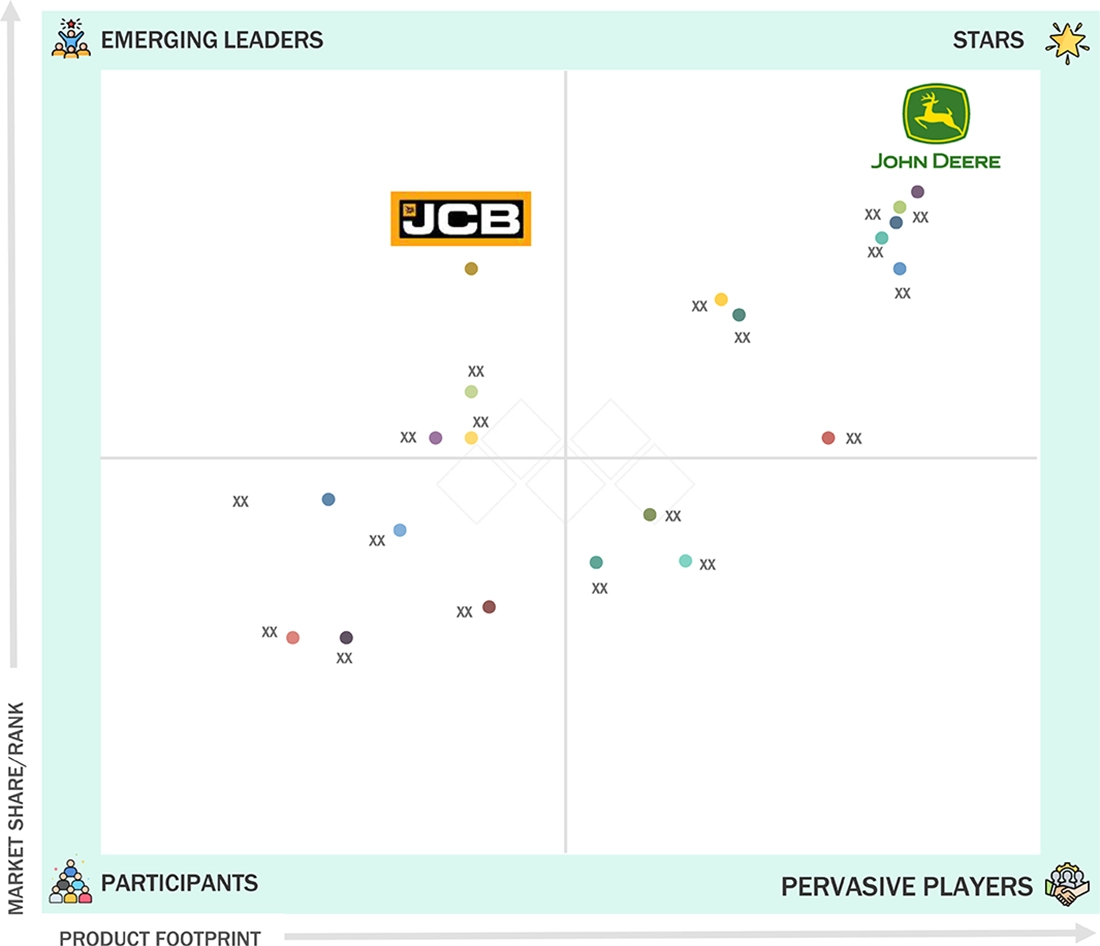
COMPETITIVE LANDSCAPEDeere & Company and AGCO Corporation were identified as star players in the global farm implements market, primarily due to their strong business networks and strategic growth, which have enabled these companies to establish their market positions.
TRENDS & DISRUPTIONS IMPACTING CUSTOMERS' CUSTOMERS
The farm implements market is shifting from low-tech mechanical tools to smart, connected, and precision-driven equipment. OEMs must adopt electronics, sensors, ISOBUS, automation, and electrification to stay competitive, while farmers benefit through higher productivity, lower downtime, and better crop outcomes.
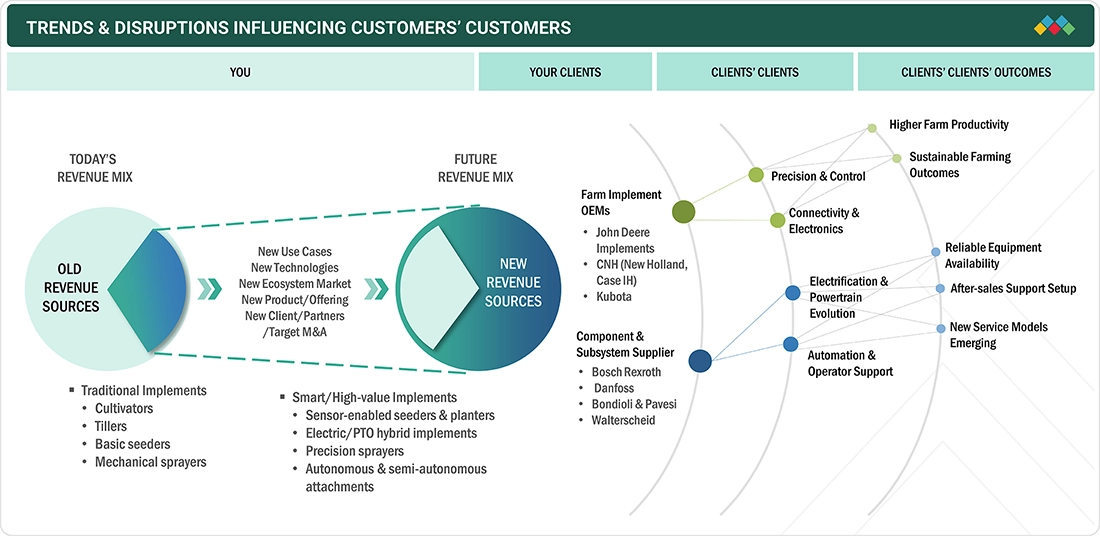
Source: Secondary Research, Interviews with Experts, MarketsandMarkets Analysis
MARKET DYNAMICS

Level
-
Integration of sensors, IoT, and ISOBUS in implements

-
Rise of tractor sales


Level
-
High maintenance requirements for advanced implements

-
Increased supply of used equipment


Level
-
Advent of autonomous and semi-autonomous farm implements

-
Expansion of commercial farming


Level
-
Seasonal demand

Source: Secondary Research, Interviews with Experts, MarketsandMarkets Analysis
Driver: Integration of sensors, IoT, and ISOBUS in implements
The growing use of sensors, IoT devices, and ISOBUS systems—standardized communication protocols that enable tractors and implements, regardless of brand, to exchange data and operate through a single, unified control interface—is significantly supporting the market for farm implements. Farmers can now monitor seed placement, spraying accuracy, tillage depth, and machine load in real time, helping reduce input costs and improve crop yields. OEMs such as John Deere have recently expanded their ISOBUS-compatible implement features and released updates to Active Implement Guidance. Similarly, AGCO’s latest precision planting and spraying systems have integrated sensors and digital controls. These upgrades make implements more accurate, easier to operate, and better connected with tractors, encouraging faster adoption across both commercial and mid-sized farms.
Restraint: High maintenance requirements for advanced implements
High-end implements such as precision planters, hydraulic loaders, balers, sprayers, and rotavators require frequent maintenance because blades, discs, bearings, sensors, and hydraulic lines wear out quickly under tough field conditions. This increases operating costs for farmers and causes downtime during peak seasons, which directly impacts productivity. Even though OEMs like Deere, CNH, and AGCO are improving durability through better materials and sealed-bearing systems, electronic controllers, ISOBUS modules, and sensor kits still need specialized diagnostics and calibration that many rural service centers are not yet equipped to provide. ISOBUS systems, in particular, require software updates, compatibility checks, and trained technicians to ensure stable communication between tractor and implement, capabilities that are still limited in emerging markets. The gap between technology adoption and service readiness slows farmer confidence, especially in Asia Oceania and Africa, where after-sales networks are still developing.
Opportunity: Advent of autonomous and semi-autonomous farm implements
A significant opportunity in the farm implements market is the increasing demand for autonomous and semi-autonomous attachments that reduce labor needs and enhance operational accuracy. Implements such as robotic weeders, auto-level tillage tools, precision-guided sprayers, and camera-based row-following planters enable farmers to cover more acres with fewer operators. OEMs like Kuhn have introduced automated boom-control systems for sprayers, and Kverneland is developing ISOBUS-based auto-adjust tillage tools. These innovations demonstrate that autonomy is no longer confined to large tractors; it is progressively extending into farm implements. As labor shortages increase and farms seek predictable, consistent work quality, the demand for autonomous and semi-autonomous implements is expected to grow.
Challenge: Seasonal demand
Many tools are used only briefly each season, such as seeders and planters during sowing, and harvest tools or balers during a limited harvest period. Since these implements may be used for just 20 to 30 days a year, farmers find it hard to justify investing in them, especially for high-value or advanced models. This low utilization often leads small and mid-sized farms to rent equipment instead of purchasing, which slows down new equipment sales. Although OEMs are working to introduce multi-crop, multi-season implements, the seasonal nature of farming still restricts year-round use. As a result, utilization-based economics remain a major obstacle to faster adoption in many regions.
FARM IMPLEMENTS MARKET: COMMERCIAL USE CASES ACROSS INDUSTRIES
| COMPANY | USE CASE DESCRIPTION | BENEFITS |
|---|---|---|
 |
Automated boom-height control in sprayers that adjusts to crop canopy and field undulations using sensors. | Ensures uniform spray coverage, reduces chemical waste, and improves accuracy in uneven terrain. |
 |
ISOBUS-enabled tillage implements that auto-adjust working depth and settings based on soil conditions. | Better soil preparation, fuel savings, and consistent tillage quality with minimal operator input. |
 |
Autonomous weeding robots are used in vineyards and vegetable farms to mechanically remove weeds without chemicals. | Cuts herbicide use, lowers labor demand, and maintains crop rows with high precision. |
Logos and trademarks shown above are the property of their respective owners. Their use here is for informational and illustrative purposes only.
MARKET ECOSYSTEM
The farm implements market ecosystem brings together component suppliers, implement manufacturers, tractor OEMs, dealers, and service networks that collectively provide tillage, planting, spraying, and harvesting tools to farmers. Together, this ecosystem promotes mechanization, productivity, and technology adoption across the global agriculture industry.
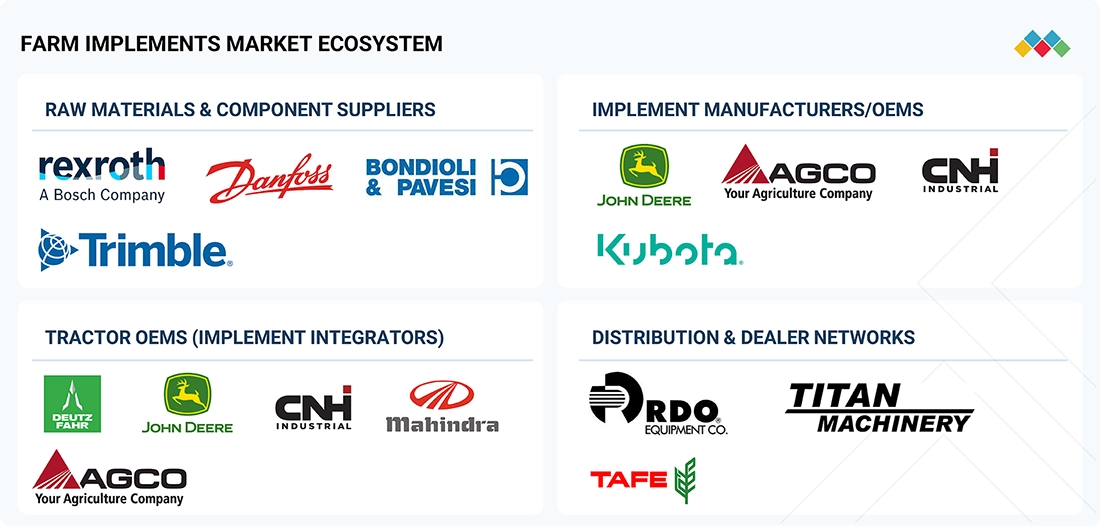
Logos and trademarks shown above are the property of their respective owners. Their use here is for informational and illustrative purposes only.
MARKET SEGMENTS
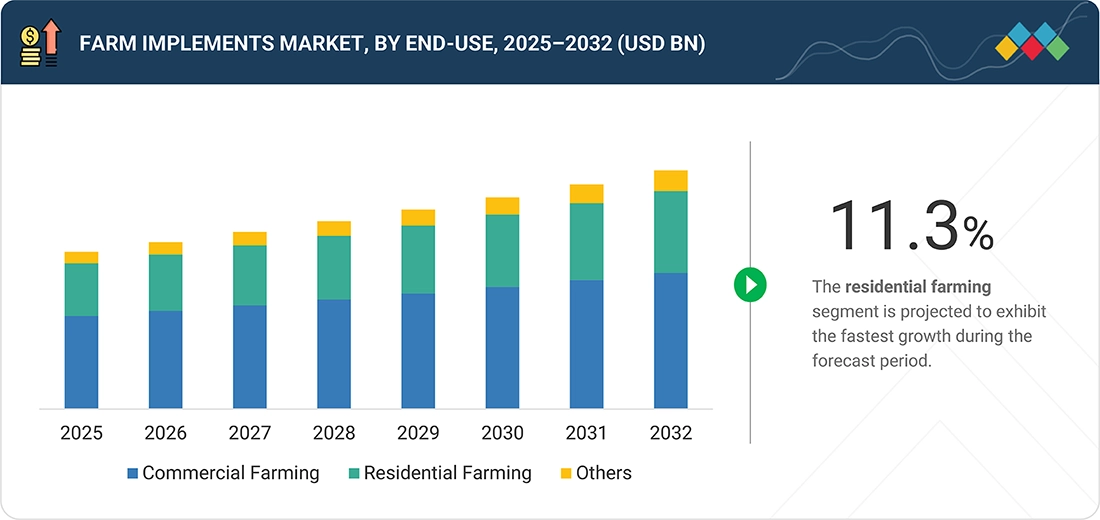
Source: Secondary Research, Interviews with Experts, MarketsandMarkets Analysis
Farm Implements Market, By Equipment Type
Harvesters dominate the farm implements market by equipment type, as they are high-value, widely used on commercial farms, and replace a lot of manual harvest work. Modern harvesters combine cutting, threshing, and cleaning in one pass and have added features such as crop-specific headers, improved threshing mechanisms, GPS guidance, residue management, and hybrid powertrains to cut fuel use and losses.
Farm Implements Market, By Operation Type
Tractor-mounted implements dominate the farm implements market by operation type, as most tillage, planting, and spraying are done with tools attached to tractors via three-point hitches and PTO systems, making them essential for modern mechanized farming. These implements enable farmers to perform multiple tasks with a single machine, enhancing efficiency and decreasing dependence on manual labor.
Farm Implements Market, By End-Use
Commercial farming dominates the farm implements market by end-use, as large farms and agricultural enterprises invest heavily in mechanized tools like harvesters, precision planters, sprayers, and balers to increase productivity and lower labor costs. These farms often operate across hundreds or thousands of acres, making high-value, tractor-mounted, and self-propelled implements crucial for timely sowing and harvesting.
REGION
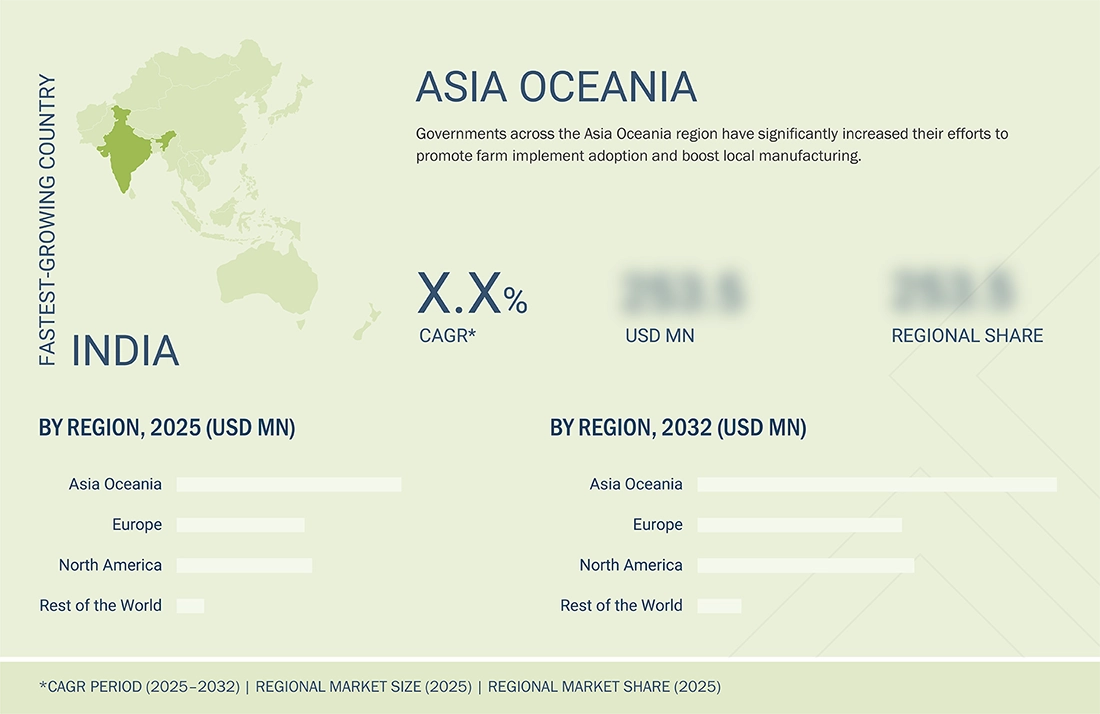
During the forecast period, Asia Oceania is expected to be the largest region in the global farm implements market
Asia Oceania is expected to be the largest market for farm implements, accounting for more than 43% share in 2025, driven by large, cropped areas, fast tractor adoption, and active mechanization programs in countries such as India, China, and Australia. The rising tractor and implement sales further drive the demand for mounted implements, harvesters, and precision tools. Major OEMs with deep presence in the region, such as Mahindra, Escorts, and TAFE in India, Zoomlion and other Chinese makers, Kubota and Yanmar from Japan, and global players like John Deere, are either localizing products or launching region-specific models to meet soil, crop, and farm-size needs.
FARM IMPLEMENTS MARKET: COMPANY EVALUATION MATRIX
The micro quadrant provides information on major players offering farm implements and highlights the findings and analysis of how well each OEM performs within the predefined criteria. The company evaluation matrix for the farm implements market ranks players based on market share and product footprint. Deere & Company (Star) leads the farm implements market with a strong presence and extensive product portfolios.
Source: Secondary Research, Interviews with Experts, MarketsandMarkets Analysis
KEY MARKET PLAYERS
- DEERE & COMPANY
- AGCO CORPORATION
- KUBOTA CORPORATION
- MAHINDRA AND MAHINDRA LTD.
- CNH INDUSTRIAL
- CLAAS KGAM
- YANMAR CO.LTD.
- AGRO TRACTOR S.P.A
- SONALIKA INTERNATIONAL TRACTORS LTD.
- TRACTORS AND FARM EQUIPMENT LTD.
MARKET SCOPE
| REPORT METRIC | DETAILS |
|---|---|
| Market Size Value in 2024 | USD 41.46 BN |
| Revenue Forecast in 2032 | USD 66.21 BN |
| CAGR | 6.3% |
| Years Considered | 2021 – 2032 |
| Base Year | 2024 |
| Forecast Period | 2032 |
| Units Considered | Value (USD MN/BN), Volume (Thousand Units) |
| Report Coverage | Revenue forecast, regional market shares, competitive landscape, driving factors, trends & disruption, OEM analysis, and others |
| Segments Covered |
|
| Regions Covered | Asia Oceania, Europe, North America, Rest of the World |
WHAT IS IN IT FOR YOU: FARM IMPLEMENTS MARKET REPORT CONTENT GUIDE
DELIVERED CUSTOMIZATIONS
We have successfully delivered the following deep-dive customizations:
| CLIENT REQUEST | CUSTOMIZATION DELIVERED | VALUE ADDS |
|---|---|---|
| Region-wise deep dive for Asia-Pacific and India | • Added country-level segmentation for India, China, Japan, and Australia, with trends in tractor adoption, mechanization drivers, and policy support | • Gives sharper regional insights, helping clients prioritize high-growth markets and plan market entry or expansion |
RECENT DEVELOPMENTS
- November 2025 : At EIMA Agrimach India 2025, VST Tillers Tractors Ltd unveiled its first electric tiller and electric weeder, marking an expansion into electric farm implements designed for cleaner and more cost-efficient farming. These new machines aim to reduce fuel costs and support sustainable practices, especially for small farms transitioning toward electrified tools.
- November 2025 : AGCO highlighted a broad portfolio at Agritechnica 2025, including new autonomous and precision implement technologies, smart retrofit options, and advanced planting/spraying solutions. Featured innovations include the Fendt IDEAL combine and AI-based RowPilot weed control, plus mixed-fleet precision modules like Farm ENGAGE and SymphonyVision for real-time planting and spraying accuracy.
- August 2025 : Case IH launched a new lineup of farm equipment and precision solutions at the 2025 Farm Progress Show, including high-power machines like the Steiger 785 Quadtrac and updated models across its range aimed at increasing productivity and uptime for farmers. The showcase reflects a push toward more efficient, robust harvesting and field equipment offerings.
- August 2025 : At the 2025 Farm Progress Show, several OEMs such as Case IH, AGCO, John Deere, and Kinze revealed their latest agricultural machinery and implements. These debuts include updates in tillage, planting, and harvesting equipment, emphasizing modern features and operator-friendly designs showcased to a large farming audience
Table of Contents
 Exclusive indicates content/data unique to MarketsandMarkets and not available with any competitors.
Methodology
This research study involved extensive secondary sources, such as company annual reports/presentations, industry association publications, industry magazine articles, directories, technical handbooks, World Economic Outlook, technical articles, and databases, to identify and collect information on the Farm implements market. In-depth interviews were conducted with various primary respondents, including key industry participants, subject-matter experts, C-level executives of key market players (farm implements component/system providers, farm implements OEMs, and technology suppliers), and industry consultants, among other experts, to obtain and verify critical qualitative and quantitative information and assess market prospects.
Secondary Research
Secondary sources for this research study included farm implements associations and organizations, corporate filings (such as annual reports, investor presentations, and financial statements), and trade, business, and industry associations. Secondary data was collected and analyzed to determine the overall market size, which was further validated by primary research.
Primary Research
Extensive primary research was conducted after understanding the farm implements market scenario through secondary research. Several primary interviews were conducted with market experts from demand (OEMs) and supply (farm implements suppliers and component manufacturers) across major regions, namely, North America, Europe, and Asia Pacific. Approximately 100% primary interviews were conducted from the demand sides. Primary data was collected through questionnaires, emails, and telephonic interviews.
The canvassing of primaries covered various departments within organizations, such as sales, operations, and marketing, to provide a holistic viewpoint in the report. After interacting with industry experts, brief sessions were conducted with highly experienced independent consultants to reinforce the findings from primaries. This and the opinions of in-house subject matter experts led to the conclusions described in the remainder of this report.
To know about the assumptions considered for the study, download the pdf brochure
Market Size Estimation
A detailed market estimation approach was followed to estimate and validate the value and volume of the farm implements market and other dependent submarkets, as mentioned below:
- The bottom-up approach was used to estimate and validate the size of the farm tractor market. The market size by power output, in terms of volume, was derived by multiplying the country-level breakup for each power output category (<30 HP, 31–70 HP, 71–130 HP, 131–250 HP, and >250 HP) with regional-level farm implements sales.
- The country-level market, by power output by volume, was multiplied by the country-level average selling price (ASP) for each application to get the market for each application by value.
- The summation of the regional-level market would give the global market by power output category (<30 HP, 31–70 HP, 71–130 HP, 131–250 HP, and >250 HP). The total value of each region was then summed up to derive the total value of the market by power output.
- All key macro indicators affecting the revenue growth of the market segments and subsegments were accounted for, viewed in extensive detail, verified through primary research, and analyzed to get the validated and verified quantitative and qualitative data.
The market data was consolidated and added with detailed inputs, analyzed, and presented in this report.
Data Triangulation
After arriving at the overall market size, the market was split into several segments and subsegments using the market size estimation processes explained above. Data triangulation and market breakdown procedures were employed to complete the overall market engineering process and arrive at the exact statistics of each market segment and subsegment, wherever applicable. The data was triangulated by studying various factors and trends from both the demand and supply sides.
Market Definition
Farm implements is machines used on farmlands to perform various agricultural activities. These machines help enhance efficiency and productivity. Tractors, combines, sprayers, balers, and implements are the key farm implements categories used in several farming activities, such as plowing, planting and seeding, harvesting, crop care, and threshing.
Stakeholders
- Farm Implements Manufacturers
- Farm Implements and Component Manufacturing Associations
- Farm Implements Component Suppliers
- Farm Implements Dealers and Distributors
- Government and Regulatory Authorities
- Research Professionals
- Farm Implements Importers, Retailers, and Dealers
- Tier 1 System Suppliers
Report Objectives
- To segment and forecast the size of the farm implements market in terms of volume (units) and value (USD million) from 2021 to 2032
-
To define, describe, and forecast the farm tractor market by value and volume based on
- Power output (<30 HP, 31–70 HP, 71–130 HP, 131–250 HP, and >250 HP) at country and regional levels
- Drive type (two-wheel drive and four-wheel drive) at the regional level
- Region [Asia Oceania, Europe, North America, and the Rest of the World (RoW)], along with key countries in each of these regions
- To define, describe, and forecast the farm implements market by value based on equipment type (cereal combines, non-cereal combines, balers, self-propelled sprayers, and tractor-mounted sprayers)
- To define, describe, and forecast the farm implements market by value, based on function (plowing & cultivating, sowing & planting, plant protection & fertilizing, harvesting & threshing, and others) at the regional level
- To define, describe, and forecast the farm implements rental market by value based on equipment type (tractors, combines, sprayers, balers, and others) at the regional level
-
To define, describe, and forecast the farm tractor rental market by value based on
- Power output (<30 HP, 31–70 HP, 71–130 HP, 131–250 HP, and >250 HP) at the regional level
- To define, describe, and forecast the electric tractor market, by value and volume, based on propulsion (battery electric, hybrid electric, hydrogen) at the regional level
- To define, describe, and forecast the forestry equipment market by value based on equipment type (Feller Buncher, Harvester, Forwarder, Skidder, Swing Machines, Knuckleboom Loader, Others)
- To understand the market dynamics (drivers, restraints, opportunities, and challenges) of the farm implements market
- To strategically analyze markets concerning individual growth trends, prospects, and contributions to the total market
- To analyze the opportunities for stakeholders and details of the competitive landscape for market leaders
- To analyze the market share of the key players in the farm implements market
- To strategically analyze the market with supply chain analysis, market ecosystem, trade analysis, case studies, ASP analysis, conferences and events, OEM analysis, OEM wise sales data for key countries, OEM wise sales data for combine harvester in key countries, patent analysis, Tractor models from top OEMs with price range, farm implements market outlook by country, OEM strategy for future investment by the key players, total cost of ownership for electric and diesel tractor, total cost of ownership, investment and funding scenario, trends/disruptions impacting buyers, technology trends, and regulatory analysis
- To track and analyze competitive developments such as deals (joint ventures, mergers & acquisitions, partnerships, collaborations), new product developments, and other activities carried out by key industry participants.
-
To study the following concerning the market:
- Supply Chain Analysis
- Ecosystem Analysis
- Technology Analysis
- Trade Analysis
- Case Study Analysis
- Patent Analysis
- Regulatory Landscape
- Conferences and Events
- Average Selling Price Analysis
- Buying Criteria
- To analyze opportunities for stakeholders and the competitive landscape for market leaders
- To track and analyze competitive developments such as product developments, deals, and others undertaken by the key industry participants
Available Customizations
With the given market data, MarketsandMarkets offers customizations based on the company’s needs.
- Farm implements Market, by Drive Type, at Country level (for countries covered in the scope of the report)
- Agriculture Sprayer Market, by Type (for countries covered in the scope of the report)
- Profiling of additional market players (up to 5)
Key Questions Addressed by the Report
What is the current market size of the Farm Implements Market, and how is it expected to grow?
The Farm Implements Market is projected to grow from USD 43.27 billion in 2025 to USD 66.21 billion by 2032, at a CAGR of 6.3% during the forecast period.
What are the key factors driving the growth of the Farm Implements Market?
The market is driven by increasing agricultural mechanization, rising demand for higher farm productivity, government support for farm modernization, and the adoption of precision farming technologies.
Which region is expected to dominate the Farm Implements Market during the forecast period?
Asia Pacific is expected to dominate the Farm Implements Market due to increasing mechanization, large agricultural land, supportive government initiatives, and rising demand for advanced farming equipment.
What are the latest trends shaping the Farm Implements Market?
Key trends include precision agriculture, GPS-enabled implements, ISOBUS-compatible equipment, autonomous farm machinery, and IoT-enabled smart farming solutions.
Who are the leading companies in the Farm Implements Market, and what strategies are they adopting?
Leading companies are focusing on product innovation, precision farming technologies, strategic partnerships, and expanding smart implement portfolios to improve farming efficiency and strengthen their market presence.


Personalize This Research
- Triangulate with your Own Data
- Get Data as per your Format and Definition
- Gain a Deeper Dive on a Specific Application, Geography, Customer or Competitor
- Any level of Personalization
Let Us Help You
- What are the Known and Unknown Adjacencies Impacting the Farm Implements Market
- What will your New Revenue Sources be?
- Who will be your Top Customer; what will make them switch?
- Defend your Market Share or Win Competitors
- Get a Scorecard for Target Partners

Custom Market Research Services
We Will Customise The Research For You, In Case The Report Listed Above Does Not Meet With Your Requirements
Get 10% Free CustomisationTESTIMONIALS

JIM NAAS
PRODUCT DIRECTOR, WEASLER
Weasler Engineering, a CentroMotion organization
Global Provider of Industrial Actuation & Control Solutionswww.weasler.com
Our organization was interested in learning more about the attractiveness of a particular market space. We contacted MarketsandMarkets to help us based on previous positive experiences we had with them. The results did not disappoint! We discussed our objectives with them, and the team at MarketsandMarkets developed and executed a proposal that met our needs precisely. We were very impressed by their level of expertise, the quality of the analysis and their insightful recommendations. We would not hesitate in working with them again in the future.

Matt Kardel,
Vice President
Aptiv,
A global technology company that develops safer, greener and more connected solutions.www.aptiv.com
We contracted with
MarketsandMarkets to evaluate the value chain and potential go-to-market partners related to our
interest in the Fleet Management space. The team successfully completed the work on time and at the
pricing agreed. MarketsandMarkets listened and understood our objectives and collaborated well with
us to help us get the visibility we needed to make an investment.
We have subsequently used
MarketsandMarkets again related to Smart Cities to good results.






Growth opportunities and latent adjacency in Farm Implements Market