



Feed Additives Market
Report Code
AGI 2286
Published in
Mar, 2026, By MarketsandMarkets™
Feed Additives Market by Type (Amino Acids, Phosphates, Vitamins, Acidifiers, Carotenoids, Enzymes, Antioxidants, Antibiotics, Phytogenics, Probiotics, and Others), Source, Form, Livestock, End Users, Function, and Region - Global Forecast to 2031

USD 67.90 Billion
MARKET SIZE, 2031

CAGR 6.0%
(2026-2031)

400
REPORT PAGES

350
MARKET TABLES
OVERVIEW
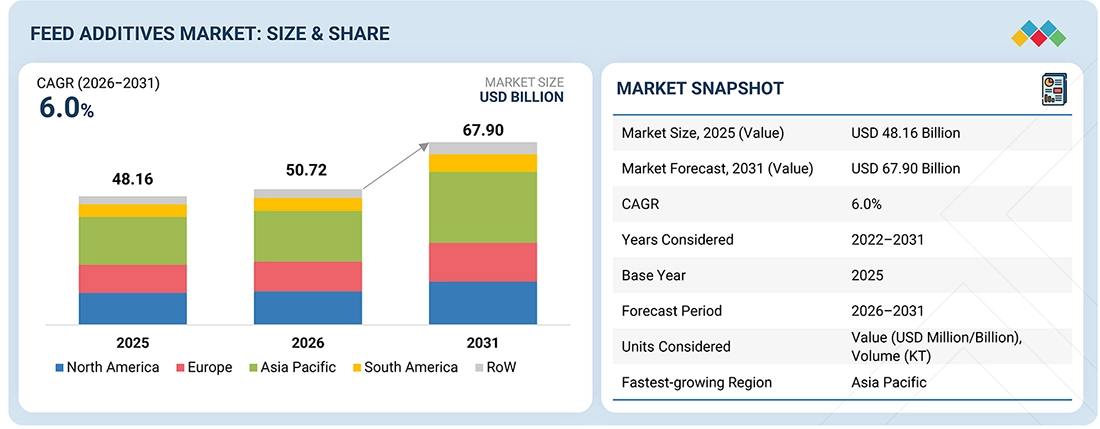
Source: Secondary Research, Interviews with Experts, MarketsandMarkets Analysis
The global feed additives market is projected to reach USD 67.90 billion by 2031 from USD 50.72 billion in 2026, at a CAGR of 6.0%. Growth of the market is driven by higher livestock production and rising demand for quality meat, milk, and eggs. In addition to a stronger emphasis on animal health and feed efficiency, the reduced use of antibiotic growth promoters, increased incomes, rapid urbanization, and improved access through organized and digital feed channels further enhance the market.
Market Size and Forecast:
- Market Size Value in 2025: USD 48.16 Billion
- Market Size Value in 2026: USD 50.72 Billion
- Revenue Forecast in 2031: USD 67.90 Billion
- Growth Rate: CAGR of 6.0% from 2026 to 2031
- Base year: 2025
- Forecast period: 2026–2031
- Asia Pacific accounted for 36.8% of the feed additives market in 2025.
- The amino acids segment is estimated to lead the market with a market share of 28% in 2031.
Key Market Trends and Insights
-
By Product Type: The Amino Acids segment holds the largest share of the global feed additives market, driven by its essential role in improving animal growth, feed efficiency, nutrient utilization, and overall livestock performance.
-
Industry Evolution: Livestock producers are increasingly adopting specialty feed additives, including probiotics, prebiotics, enzymes, and phytogenics, to enhance animal health and productivity while reducing reliance on antibiotic growth promoters.
-
Market Drivers: Rising global demand for meat, dairy, and poultry products, increasing focus on animal nutrition, growing concerns regarding livestock health, and stringent regulations on feed quality are supporting market expansion.
-
Future Potential: Emerging opportunities lie in precision animal nutrition, sustainable feed solutions, functional additives for gut health and immunity, and the growing commercialization of natural and antibiotic-free feed products.
KEY TAKEAWAYS
-
BY REGIONAsia Pacific accounted for 36.8% of the feed additives market in 2025.
-
BY TYPEBy type, the amino acids segment is estimated to lead the market with a market share of 28% in 2031.
-
BY SOURCEBy source, the synthetic segment is estimated to hold the largest market share in 2025.
-
BY LIVESTOCKBy livestock, the poultry segment is projected to grow at the fastest CAGR during the forecast period.
-
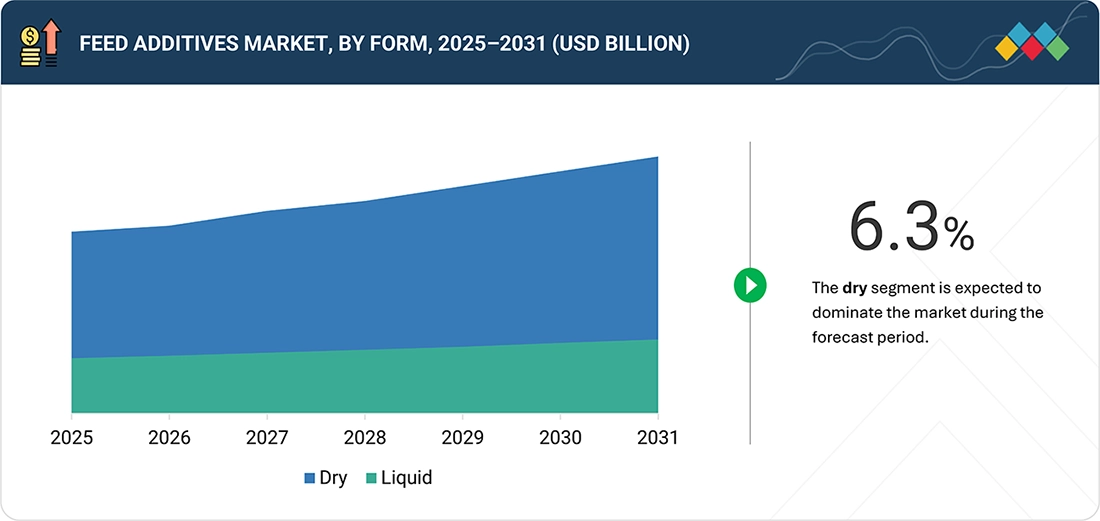
BY FORMBy form, the dry segment is estimated to account for a dominant market share in 2025.
-
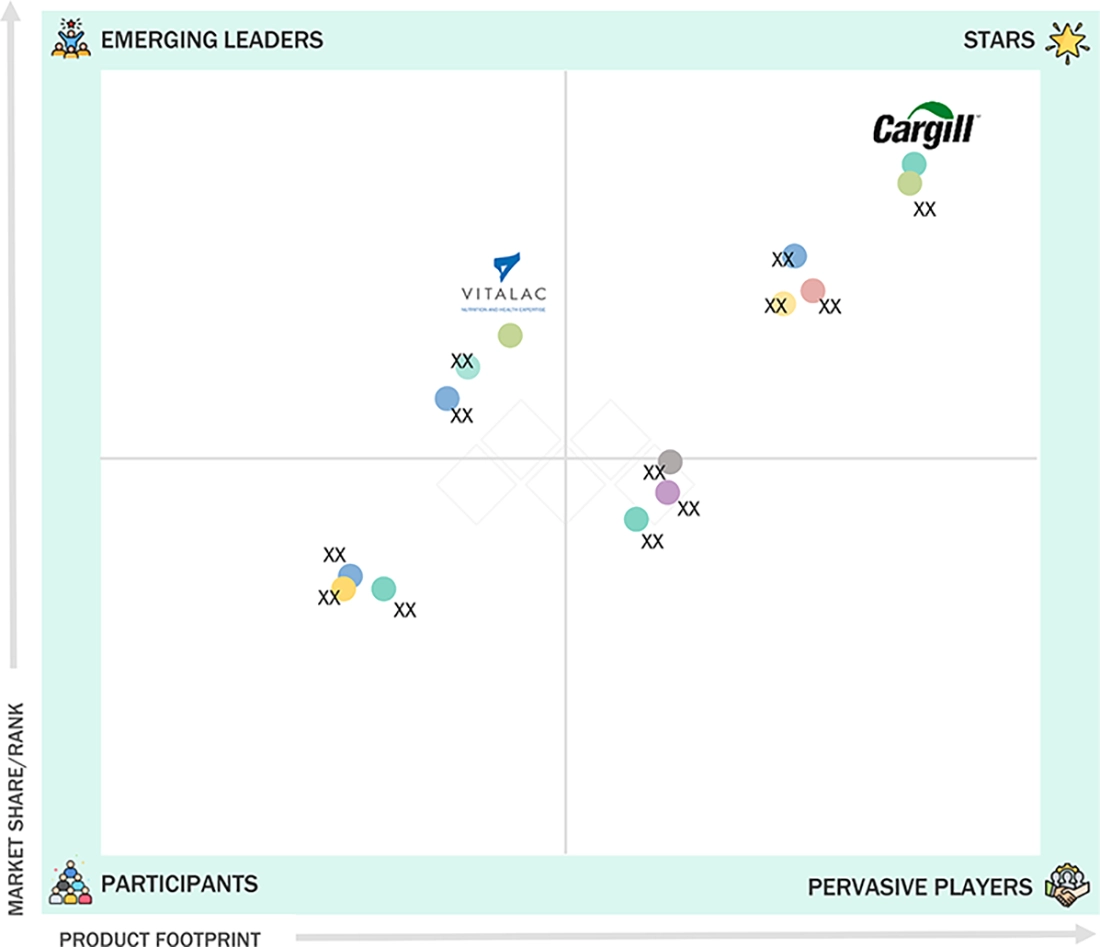
COMPETITIVE LANDSCAPE - KEY PLAYERSCargill, Incorporated and ADM were identified as some of the star players in the feed additives market (global), given their global presence and strong product footprint.
-
COMPETITIVE LANDSCAPE - STARTUPSVITALAC and Tex Biosciences (P) Ltd., among others, have distinguished themselves among startups and SMEs by securing strong footholds in specialized niche areas, underscoring their potential as emerging market leaders.
The feed additives market is growing as farmers increasingly focus on better animal health and feed quality. Higher incomes and the move toward organized and modern farming are also helping increase demand across the globe.
TRENDS & DISRUPTIONS IMPACTING CUSTOMERS' CUSTOMERS
The impact of new revenue sources in the feed additives market is natural sources of feed additives such as probiotics, vitamins, phytogenic, enzymes, and antioxidants; the revenue shift for feed manufacturers in the market is projected to appear across various segments, such as customized animal nutrition, feed manufacturers, livestock growers, and integrated livestock producers. At the consumer end, the demand is projected to be on the rise for improved milk quality and yield, clean-label, residue-free animal products, improved gut health & immunity, and enhanced animal productivity.
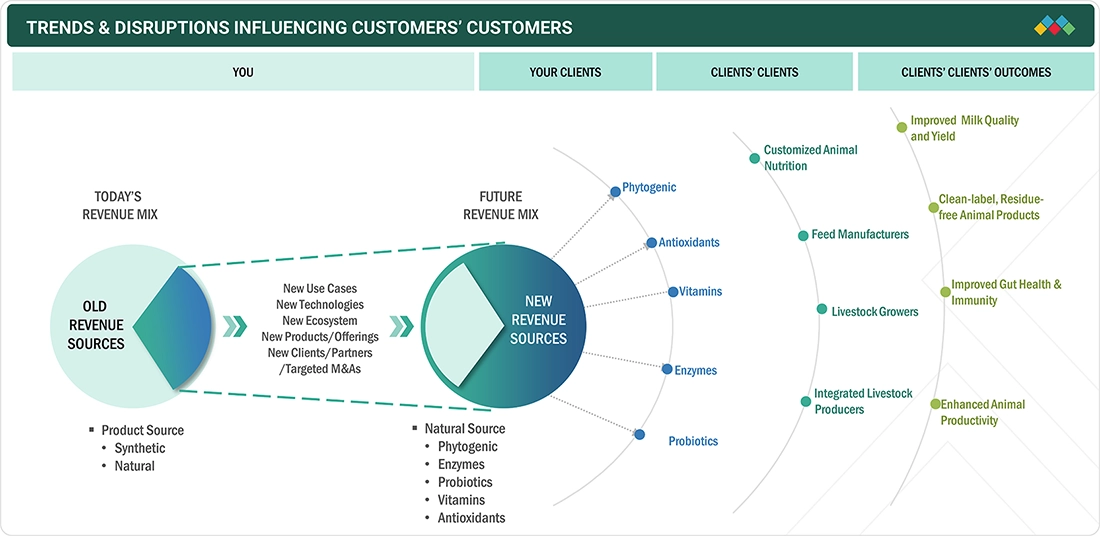
Source: Secondary Research, Interviews with Experts, MarketsandMarkets Analysis
MARKET DYNAMICS

Drivers
Impact
Level
Level
-
Rapid growth of commercial poultry, pork, and aquaculture

-
Increase in demand and consumption of livestock-based products


RESTRAINTS
Impact
Level
Level
-
Volatile raw material prices for feed additives

-
Price sensitivity among smallholder farmers


OPPORTUNITIES
Impact
Level
Level
-
Shift toward natural growth promoters

-
Increase in demand for nutritional supplements for monogastric animals


CHALLENGES
Impact
Level
Level
-
Quality control of genetic feed additive products manufactured by Asian companies

-
Sustainability of feed and livestock chain

Source: Secondary Research, Interviews with Experts, MarketsandMarkets Analysis
Driver: Rapid growth of commercial poultry, pork, and aquaculture
The rapid growth of commercial poultry, pork, and fish farming is driven by rising global demand for protein-rich foods. As farmers strive to improve animal health and growth rates, the use of feed additives—such as vitamins, minerals, probiotics, and enzymes—has become essential. These additives enhance nutrient absorption, support digestion, and boost immunity, leading to healthier animals and better feed conversion ratios. Additionally, with a shift toward sustainable practices, there is increasing interest in natural additives that reduce antibiotic use, addressing consumer safety concerns. As research and technology advance in animal nutrition, the demand for specialized feed additives is expected to grow, helping farmers meet global food needs while prioritizing animal welfare.
Restraint: Volatile raw material prices for feed additives
Feed additive producers rely on raw materials like grains, minerals, and chemicals, which often experience price fluctuations due to supply and demand changes, weather events, and geopolitical factors. These price changes can exert significant pressure on profit margins, leading to volatility in pricing for consumers. To manage these challenges, producers may engage in long-term contracts, diversify their supplier base, or explore alternative raw materials to stabilize costs and maintain profitability. Ultimately, the evolving landscape of raw material prices plays a crucial role in the economics of the feed additive industry.
Opportunity: Shift toward natural growth promoters
As many countries reduce the use of antibiotic growth promoters due to concerns about antibiotic resistance, farmers are increasingly seeking natural alternatives to enhance animal health and growth. Probiotics, which improve gut health and digestion, enzymes that enhance nutrient bioavailability, and plant-based additives with antimicrobial properties are gaining popularity. These natural solutions not only support livestock well-being but also align with consumer demand for sustainable and ethically raised food products. This shift reflects a broader trend towards sustainable agriculture, helping to create healthier animals and more environmentally friendly production systems.
Challenge: Quality control of genetic feed additive products manufactured by Asian companies
The quality and consistency of feed additive products are crucial for the health and productivity of livestock, yet differences in manufacturing standards among Asian suppliers can lead to significant discrepancies. These variations can erode trust among consumers and producers who depend on these products. To address this issue, companies must invest in rigorous testing and ensure compliance with international standards, enhancing transparency in the manufacturing process. By doing so, they can build trust, meet market demands, and create a more reliable and sustainable supply chain in the agricultural sector.
FEED ADDITIVES MARKET: COMMERCIAL USE CASES ACROSS INDUSTRIES
| COMPANY | USE CASE DESCRIPTION | BENEFITS |
|---|---|---|
 |
Application of amino acid feed additives to optimize protein utilization and support growth performance in poultry, swine, and aquaculture | Improves feed efficiency, reduces nitrogen excretion, and enables cost-effective and sustainable animal production |
 |
Integration of specialty feed additives and nutritional solutions through its animal nutrition brands to support health, performance, and sustainability across livestock systems | Enhances animal productivity, supports responsible feed practices, and improves long-term production efficiency for producers |
 |
Application of enzymes, vitamins, and performance-enhancing nutritional solutions to support gut health, immunity, and nutrient digestibility | Improves animal health and feed conversion while enabling antibiotic-free and science-based nutrition programs |
Logos and trademarks shown above are the property of their respective owners. Their use here is for informational and illustrative purposes only.
MARKET ECOSYSTEM
The feed additives ecosystem is composed of a diverse network of feed additive manufacturers, regulatory authorities, distributors, and feed manufacturers. As one of the fastest-growing global markets, the region is characterized by rapid innovation, evolving consumer priorities, and increasing participation from both established multinational brands and emerging startups. These stakeholders collectively shape the competitive landscape by developing science-backed, functional, and personalized feed additive products tailored to regional health needs.
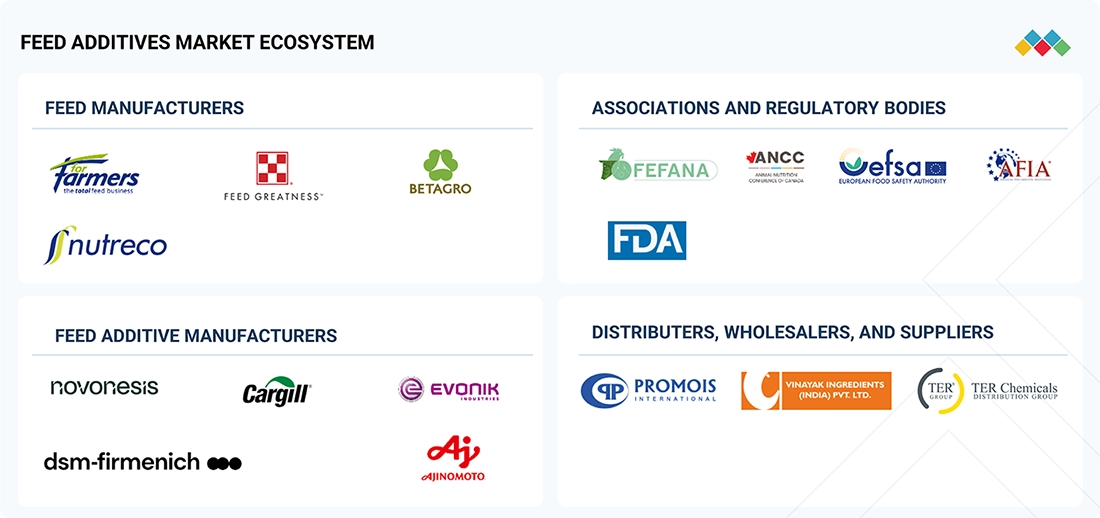
Logos and trademarks shown above are the property of their respective owners. Their use here is for informational and illustrative purposes only.
MARKET SEGMENTS
Source: Secondary Research, Interviews with Experts, MarketsandMarkets Analysis
Feed Additives Market, By Type
Amino acids are essential in animal nutrition as they enhance growth and improve feed efficiency across various sectors, including poultry, pork, and aquaculture. By serving as the building blocks of proteins, amino acids promote muscle development and overall health. In poultry, for instance, their inclusion in feed formulations leads to faster growth and better feed conversion ratios, while in pork production, crucial amino acids like lysine and methionine support metabolic processes and overall health. Similarly, in aquaculture, balanced amino acid profiles facilitate optimal growth rates in fish and shrimp. As global demand for protein rises, the importance of amino acids in livestock nutrition will continue to grow, driving profitability and resource efficiency in farming operations.
Feed Additives Market, By Source
Synthetic sources dominate the market primarily due to their consistent quality, ease of supply, and cost-effectiveness. Unlike natural sources, synthetic materials provide reliable and uniform products that meet industry standards, crucial for large-scale operations. Their production in controlled environments minimizes supply chain disruptions, ensuring timely delivery. Additionally, synthetic ingredients support large-scale feed production at stable costs, enabling manufacturers to achieve economies of scale and maintain competitive pricing, which is essential for profitability in industries with tight margins.
Feed Additives Market, By Livestock
Poultry farming has rapidly grown across various regions, making it a dominant force in the agricultural market. This growth is driven by increasing consumer demand for chicken and advancements in farming techniques. The significant amount of feed required per bird fuels strong demand for feed additives, which enhance nutrient absorption, promote growth, and maintain health. As poultry operations expand, farmers invest in these additives to improve yield and sustainability, creating a robust market that highlights the interconnectedness of poultry production and the feed supply chain.
Feed Additives Market, By Form
Dry form additives dominate the market for several compelling reasons, primarily centered around their convenience and efficiency in handling. These additives are easy to store, mix, and transport, making them particularly appealing to feed manufacturers engaged in large-volume production. The dry form minimizes the risk of spoilage and maintains stability during storage, allowing producers to streamline their operations without the complications associated with liquid alternatives. Furthermore, the uniformity and consistency of dry additives facilitate accurate dosing, which is crucial in ensuring a balanced and nutritious feed. As a result, feed makers consistently prefer dry additives, finding that they enhance the overall effectiveness and quality of livestock nutrition while optimizing production workflows.
REGION
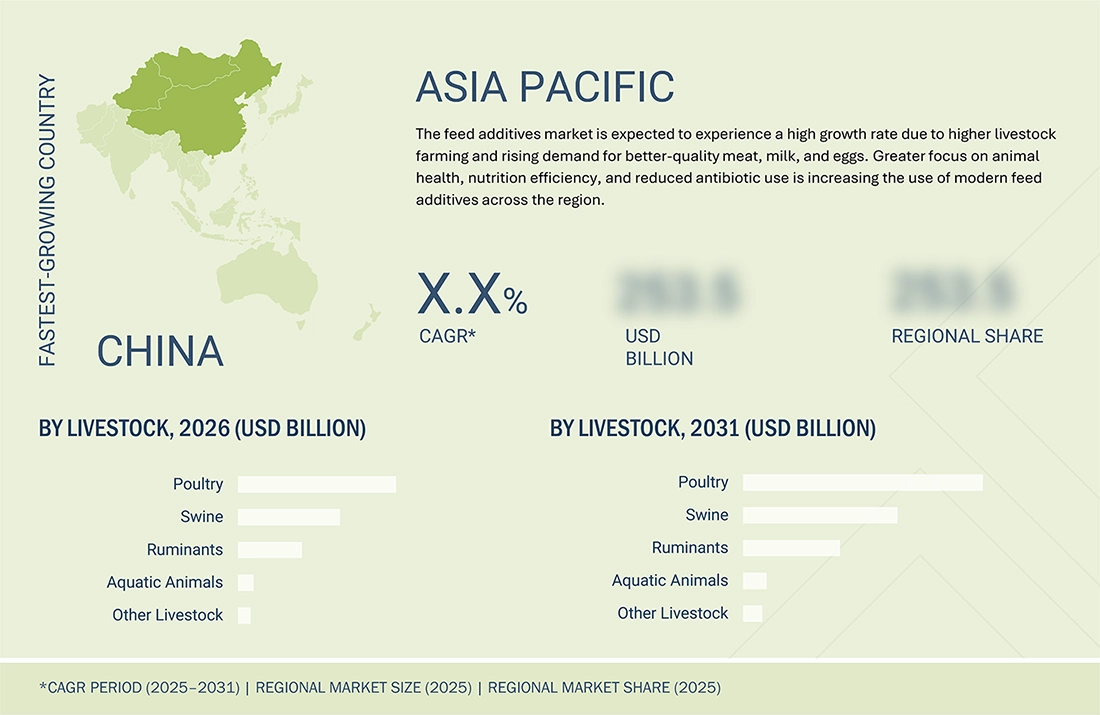
Asia Pacific to be fastest-growing region in feed additives market during forecast period
The feed additives market in Asia Pacific is projected to register the highest CAGR during the forecast period. The market growth in China is driven by rising poultry, pork, and aquaculture production across. Higher focus on animal health, feed efficiency, and reduced antibiotic use is also increasing the demand for functional feed additives. Expanding commercial farming and better feed supply networks continue to support market growth across key Asia Pacific countries.
FEED ADDITIVES MARKET: COMPANY EVALUATION MATRIX
In the feed additives market matrix, ADM and Cargill (Stars) lead with a strong market share and extensive product footprint, driven by their strong geographical presence, significant formulation and distribution capabilities, and strong ties with distribution channels. Vitalac (Emerging Leader) is gaining visibility with its specialized feed additive offerings, strengthening its position through specific product offerings.
Source: Secondary Research, Interviews with Experts, MarketsandMarkets Analysis
KEY MARKET PLAYERS
- Cargill, Incorporated (US)
- ADM (US)
- International Flavors & Fragrances Inc. (US)
- Evonik Industries AG (Germany)
- BASF SE (Germany)
- DSM-Firmenich (Switzerland)
- Alltech (US)
- Ajinomoto Co., Inc. (Japan)
- Novonesis Group (Denmark)
- Adisseo (France)
- Jubilant Ingrevia Limited (India)
- Nutreco (Netherlands)
- BRF Global (Brazil)
- Volac International Ltd. (UK)
- Kemin Industries, Inc. (US)
MARKET SCOPE
| REPORT METRIC | DETAILS |
|---|---|
| Market Size, 2025 (Value) | USD 48.16 Billion |
| Market Forecast in 2031 (Value) | USD 67.90 Billion |
| Growth Rate | CAGR of 6.0% from 2026 to 2031 |
| Years Considered | 2022–2031 |
| Base Year | 2025 |
| Forecast Period | 2026–2031 |
| Units Considered | Value (USD Million/Billion), Volume (KT) |
| Report Coverage | Revenue Forecast, Company Ranking, Competitive Landscape, Growth Factors, and Trends |
| Segments Covered |
|
| Regions Covered | North America, Europe, Asia Pacific, South America, RoW |
WHAT IS IN IT FOR YOU: FEED ADDITIVES MARKET REPORT CONTENT GUIDE
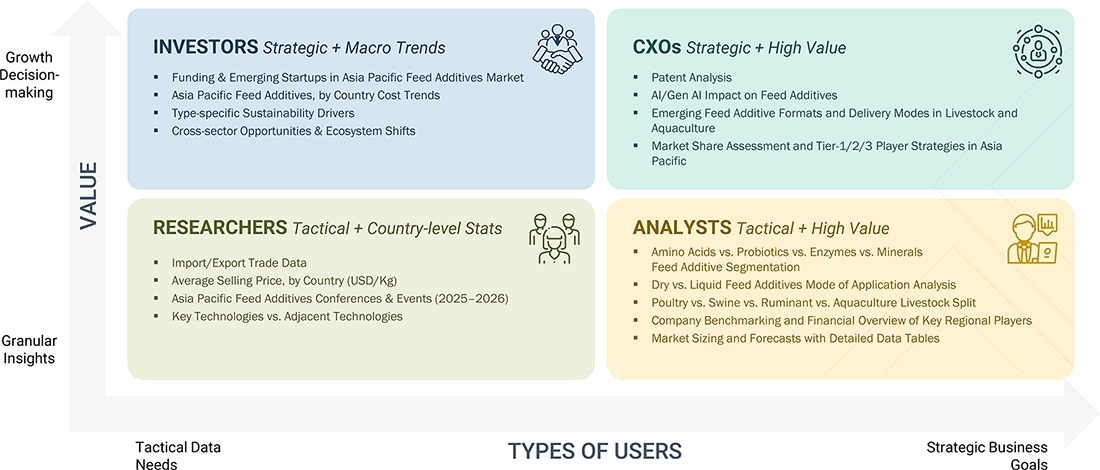
DELIVERED CUSTOMIZATIONS
We have successfully delivered the following deep-dive customizations:
| CLIENT REQUEST | CUSTOMIZATION DELIVERED | VALUE ADDS |
|---|---|---|
| China-based Feed Additive Manufacturers |
|
|
| Feed Additives, Type Segment Assessment |
|
|
RECENT DEVELOPMENTS
- July 2026: Evonik Industries AG completed the backward integration of its global MetAMINO® (DL-methionine) production network, including on-site production of methyl mercaptan at its Mobile, Alabama, hub. The project completes backward integration across Evonik’s production hubs in Europe, Asia, and the Americas, strengthening supply security and production efficiency for MetAMINO®, a methionine feed additive used in animal nutrition. This is a major manufacturing and supply-chain development directly involving a feed additive
- June 2026: ADM opened a new premix and feed additives production facility in Apucarana, Paraná, Brazil, with approximately 40,000 metric tons of annual installed capacity. The 7,500-square-meter facility incorporates automated mixing, dosage control, cross-contamination mitigation and traceability systems and is designed to supply ADM’s Brazilian animal-nutrition business. The investment represents a substantive manufacturing-capacity expansion directly involving feed additives.
- April 2026: International Flavors & Fragrances Inc. (IFF) launched PureStrong™, a new probiotic developed specifically for canine digestive health. The product is part of IFF’s Animal Nutrition & Health business and represents a new microbial-based nutritional additive designed for inclusion in pet diets, making it a direct new-product development within feed additives rather than a general animal-nutrition announcement.
- October 2025 : BASF launched Lutavit A/D3 1000/200 NXT, a next-generation microencapsulated blend of vitamins A and D3 designed to enhance feed efficiency, stability, and sustainability in animal diets.
- September 2025 : ADM launched Digest Carb, a dairy nutrition solution designed to optimize rumen starch and fiber utilization. The product aimed to improve efficiency and milk performance, supporting productivity in dairy operations.
Table of Contents
 Exclusive indicates content/data unique to MarketsandMarkets and not available with any competitors.
TITLE
PAGE NO
1
INTRODUCTION
34
2
EXECUTIVE SUMMARY
43
3
PREMIUM INSIGHTS
48
4
MARKET OVERVIEW
Navigate shifting livestock markets with innovative practices and rising demand for sustainable feed solutions.
52
4.1
INTRODUCTION
4.2
MARKET DYNAMICS
4.2.1
DRIVERS
4.2.1.1
INCREASE IN DEMAND AND CONSUMPTION OF LIVESTOCK-BASED PRODUCTS
4.2.1.2
GROWTH IN FEED PRODUCTION
4.2.1.3
RISE IN AWARENESS ABOUT FEED QUALITY
4.2.1.4
STANDARDIZATION OF MEAT PRODUCTS OWING TO DISEASE OUTBREAKS
4.2.1.5
IMPLEMENTATION OF INNOVATIVE ANIMAL HUSBANDRY PRACTICES TO IMPROVE MEAT QUALITY
4.2.2
RESTRAINTS
4.2.2.1
BAN ON ANTIBIOTICS IN DIFFERENT NATIONS
4.2.2.2
VOLATILE RAW MATERIAL PRICES
4.2.2.3
STRINGENT REGULATORY FRAMEWORK
4.2.3
OPPORTUNITIES
4.2.3.1
SHIFT TOWARD NATURAL GROWTH PROMOTERS
4.2.3.2
INCREASE IN DEMAND FOR NUTRITIONAL SUPPLEMENTS FOR MONOGASTRIC ANIMALS
4.2.3.3
GROWTH OF PRECISION LIVESTOCK FARMING DRIVING DEMAND FOR ADVANCED FEED ADDITIVES
4.2.3.4
GROWING DEMAND FOR NATURAL AND CLEAN-LABEL FEED ADDITIVES
4.2.4
CHALLENGES
4.2.4.1
QUALITY CONTROL OF GENETIC FEED ADDITIVE PRODUCTS MANUFACTURED BY ASIAN COMPANIES
4.2.4.2
SUSTAINABILITY OF FEED AND LIVESTOCK CHAIN
4.3
UNMET NEEDS AND WHITE SPACES
4.3.1
UNMET NEEDS IN FEED ADDITIVES MARKET
4.3.2
WHITE SPACE OPPORTUNITIES
4.4
INTERCONNECTED MARKETS AND CROSS-SECTOR OPPORTUNITIES
4.4.1
INTERCONNECTED MARKETS
4.4.2
CROSS-SECTOR OPPORTUNITIES
4.5
STRATEGIC MOVES BY TIER-1/2/3 PLAYERS
5
INDUSTRY TRENDS
Discover growth opportunities and competitive dynamics shaping the global feed additives market.
70
5.1
PORTER’S FIVE FORCES ANALYSIS
5.1.1
INTENSITY OF COMPETITIVE RIVALRY
5.1.2
BARGAINING POWER OF SUPPLIERS
5.1.3
BARGAINING POWER OF BUYERS
5.1.4
THREAT OF SUBSTITUTES
5.1.5
THREAT OF NEW ENTRANTS
5.2
MACROECONOMICS OUTLOOK
5.2.1
INTRODUCTION
5.2.2
GROWTH OPPORTUNITIES IN DEVELOPING REGIONS
5.2.3
KEY ECONOMIC AND SECTORAL FORCES INFLUENCING GLOBAL FEED ADDITIVES MARKET IN 2025
5.3
VALUE CHAIN ANALYSIS
5.3.1
RESEARCH AND PRODUCT DEVELOPMENT
5.3.2
RAW MATERIAL SOURCING
5.3.3
PRODUCTION
5.3.4
QUALITY CONTROL & SAFETY
5.3.5
DISTRIBUTION & LOGISTICS
5.3.6
MARKETING & SALES
5.3.7
END USERS
5.4
ECOSYSTEM ANALYSIS/MARKET MAP
5.4.1
DEMAND SIDE
5.4.2
SUPPLY SIDE
5.5
PRICING ANALYSIS
5.5.1
INTRODUCTION
5.5.2
INDICATIVE PRICE TREND AMONG MARKET PLAYERS
5.5.3
AVERAGE SELLING PRICE TREND, BY REGION
5.6
TRADE ANALYSIS
5.6.1
IMPORT SCENARIO OF HS CODE 230990
5.6.2
EXPORT SCENARIO OF HS CODE 230990
5.7
KEY CONFERENCES AND EVENTS, 2026–2027
5.8
TRENDS/DISRUPTIONS IMPACTING BUYERS
5.9
INVESTMENT & FUNDING SCENARIO
5.10
CASE STUDY ANALYSIS
5.10.1
EVONIK VLAND BIOTECH JOINT VENTURE STRENGTHENS GUT HEALTH SOLUTIONS IN CHINA
5.10.2
DSM-FIRMENICH STRENGTHENS MYCOTOXIN RISK MANAGEMENT WITH NEW FEED ADDITIVE PLANT IN INDIA
5.10.3
ADM AQUATRAX (PICHIA GUILLIERMONDII) ENHANCES IMMUNE RESPONSE AND GROWTH PERFORMANCE IN SHRIMP
5.10.4
CARGILL ACQUIRES DELACON TO LEAD GLOBAL PHYTOGENIC FEED ADDITIVES MARKET
5.11
IMPACT OF 2025 US TARIFF - FEED ADDITIVES MARKET
5.11.1
INTRODUCTION
5.11.2
PRICE IMPACT ANALYSIS
5.11.3
IMPACT ON COUNTRIES/REGIONS
5.11.3.1
US
5.11.3.2
EUROPE
5.11.3.3
ASIA PACIFIC
5.11.4
IMPACT ON END USE INDUSTRIES
6
TECHNOLOGY ADVANCEMENTS, AI-DRIVEN IMPACT, PATENTS, INNOVATIONS, AND FUTURE APPLICATIONS
AI-driven innovations redefine feed additive technologies, enhancing sustainability and efficiency across livestock nutrition.
92
6.1
TECHNOLOGY ANALYSIS
6.1.1
KEY TECHNOLOGIES
6.1.1.1
FERMENTATION & BIOPROCESSING
6.1.1.2
CHEMICAL SYNTHESIS
6.1.1.3
PREMIX BLENDING TECHNOLOGY
6.1.1.4
MICROENCAPSULATION TECHNOLOGY FOR FEED
6.1.2
COMPLEMENTARY TECHNOLOGY
6.1.2.1
FEED PELLETING TECHNOLOGY
6.1.2.2
PRECISION & MICRO-DOSING SYSTEMS
6.1.2.3
ANIMAL HEALTH MONITORING SYSTEMS
6.1.3
ADJACENT TECHNOLOGIES
6.1.3.1
PRECISION NUTRITION
6.1.3.2
EXTRUSION PROCESSING TECHNOLOGY
6.1.4
TECHNOLOGY/PRODUCT ROADMAP
6.1.4.1
SHORT-TERM | FOUNDATION & EARLY COMMERCIALIZATION
6.1.4.2
MID-TERM | EXPANSION & STANDARDIZATION
6.1.4.3
LONG-TERM | PRECISION NUTRITION
6.2
PATENT ANALYSIS
6.3
FUTURE APPLICATIONS
6.3.1
ASPARAGOPSIS SEAWEED-BASED METHANE REDUCTION ADDITIVE BY FUTUREFEED (CSIRO)
6.3.2
NANO-MINERALS AS NEXT-GENERATION SOLUTION FOR SUSTAINABLE POULTRY NUTRITION
6.3.3
HIGH-DOSE (SUPER-DOSING) PHYTASE FOR ENHANCED NUTRIENT UTILIZATION IN POULTRY
6.3.4
OPTIMIZING NITROGEN EFFICIENCY IN DAIRY COWS THROUGH RUMEN-PROTECTED ESSENTIAL AMINO ACID SUPPLEMENTATION
6.3.5
PHYTOGENIC ADDITIVES AND ORGANIC ACIDS AS ANTIBIOTIC ALTERNATIVES IN BROILER PRODUCTION
6.4
IMPACT OF GENERATIVE AI ON FEED ADDITIVES MARKET
6.4.1
INTRODUCTION
6.4.2
TOP USE CASES AND MARKET POTENTIAL
6.4.3
BEST PRACTICES IN FEED ADDITIVES
6.4.4
CASE STUDIES OF AI IMPLEMENTATION IN FEED ADDITIVES MARKET
6.4.5
INTERCONNECTED ADJACENT ECOSYSTEM AND IMPACT ON MARKET PLAYERS
6.4.6
CLIENTS’ READINESS TO ADOPT GENERATIVE AI FEED ADDITIVES
6.5
SUCCESS STORIES AND REAL-WORLD APPLICATIONS
7
SUSTAINABILITY AND REGULATORY LANDSCAPE
Navigate evolving global regulations and sustainability initiatives for strategic compliance and competitive advantage.
109
7.1
REGIONAL REGULATIONS AND COMPLIANCE
7.1.1
REGULATORY BODIES, GOVERNMENT AGENCIES, AND OTHER ORGANIZATIONS
7.1.2
INDUSTRY STANDARDS
7.1.3
LABELING REQUIREMENTS AND CLAIMS
7.1.4
ANTICIPATED REGULATORY CHANGES IN NEXT 5–10 YEARS
7.1.4.1
MANDATORY VALIDATION OF EFFICACY, SAFETY & ENVIRONMENTAL IMPACT
7.1.4.2
GLOBAL HARMONIZATION OF FEED ADDITIVE CLASSIFICATIONS & APPROVAL PATHWAYS
7.1.4.3
STRENGTHENED CONTAMINANT, RESIDUE & ANTIMICROBIAL CONTROL REGULATIONS
7.1.4.4
DIGITAL LABELING, TRACEABILITY & SUPPLY CHAIN TRANSPARENCY
7.2
SUSTAINABILITY INITIATIVES
7.2.1
SUSTAINABLE SOURCING
7.2.2
CARBON FOOTPRINT REDUCTION INITIATIVES
7.2.3
CIRCULAR ECONOMY APPROACHES
7.3
SUSTAINABILITY IMPACT AND REGULATORY POLICY INITIATIVES
7.4
CERTIFICATIONS, LABELING, ECO-STANDARDS
8
CUSTOMER LANDSCAPE AND BUYER BEHAVIOR
Unlock revenue potential by addressing unmet needs and optimizing stakeholder influence in buyer decisions.
122
8.1
DECISION-MAKING PROCESS
8.2
KEY STAKEHOLDERS & BUYING CRITERIA
8.2.1
KEY STAKEHOLDERS IN BUYING PROCESS
8.2.2
BUYING CRITERIA
8.3
ADOPTION BARRIERS AND INTERNAL CHALLENGES
8.4
UNMET NEEDS OF VARIOUS APPLICATION INDUSTRIES ACROSS SUPPLY CHAIN
8.5
MARKET PROFITABILITY
8.6
REVENUE POTENTIAL
8.6.1
COST DYNAMICS
8.6.2
MARGIN OPPORTUNITIES, BY TYPE
9
FEED ADDITIVES MARKET, BY TYPE
Market Size & Growth Rate Forecast Analysis to 2031 in USD Million and Kilotons | 96 Data Tables
131
9.1
INTRODUCTION
9.2
AMINO ACIDS
9.2.1
METHIONINE
9.2.1.1
ABILITY TO TAILOR AMINO ACID SUPPLEMENTS FOR LIVESTOCK TO DRIVE MARKET
9.2.2
LYSINE
9.2.2.1
RELATIVELY HIGH VALUE AND DIGESTIBILITY OF LYSINE TO BOOST MARKET
9.2.3
THREONINE
9.2.3.1
ROLE IN PROVIDING OPTIMAL PROTEIN SYNTHESIS TO BOOST MARKET
9.2.4
TRYPTOPHAN
9.2.4.1
ABILITY TO IMPROVE PROTEIN UTILIZATION AND STRESS REDUCTION IN LIVESTOCK TO DRIVE MARKET
9.2.5
OTHER AMINO ACIDS
9.3
PHOSPHATES
9.3.1
DICALCIUM PHOSPHATE
9.3.1.1
ROLE IN REGULATING ENERGY METABOLISM AND MAINTAINING ADEQUATE DIETARY LEVELS FOR LIVESTOCK TO DRIVE MARKET
9.3.2
MONOCALCIUM PHOSPHATE
9.3.2.1
ABILITY TO PREVENT ABNORMAL DEVELOPMENT OF BONES IN LIVESTOCK TO PROPEL MARKET
9.3.3
MON0-DICALCIUM PHOSPHATE
9.3.3.1
ENHANCEMENT OF FUNCTIONING OF IMMUNE SYSTEM TO DRIVE MARKET
9.3.4
DEFLUORINATED PHOSPHATE
9.3.4.1
ROLE IN REDUCING FLUORINE CONTENT IN ANIMAL FEED TO BOOST MARKET
9.3.5
TRICALCIUM PHOSPHATE
9.3.5.1
ROLE IN ENHANCEMENT OF IMMUNE SYSTEM AND ENERGY REGULATION OF LIVESTOCK TO DRIVE MARKET
9.3.6
OTHER PHOSPHATES
9.4
VITAMINS
9.4.1
FAT-SOLUBLE VITAMINS
9.4.1.1
ROLE OF VITAMINS AS KEY CONSTITUENT OF METABOLIC FUNCTIONS TO DRIVE MARKET
9.4.2
WATER-SOLUBLE VITAMINS
9.4.2.1
SIGNIFICANCE OF WATER-SOLUBLE VITAMINS FOR OPTIMUM GROWTH AND DEVELOPMENT OF LIVESTOCK TO DRIVE MARKET
9.5
ACIDIFIERS
9.5.1
PROPIONIC ACID
9.5.1.1
ROLE IN SILAGE PRODUCTION AND PREVENTION OF FERTILITY DISORDERS IN LIVESTOCK TO DRIVE MARKET
9.5.2
FORMIC ACID
9.5.2.1
ROLE IN CONSISTENT FEED FORMULATIONS AND FEED PRESERVATION TO DRIVE MARKET
9.5.3
CITRIC ACID
9.5.3.1
IMPORTANCE OF CITRIC ACID IN ENHANCING IMMUNITY OF VACCINATED BROILERS TO BOOST MARKET
9.5.4
LACTIC ACID
9.5.4.1
SIGNIFICANCE OF LACTIC ACID IN IMPROVING ANIMAL HEALTH AND PRODUCTIVITY TO DRIVE MARKET
9.5.5
SORBIC ACID
9.5.5.1
IMPORTANCE OF SORBIC ACID IN FEED PRESERVATION TO DRIVE MARKET
9.5.6
MALIC ACID
9.5.6.1
ROLE AS COST-EFFICIENT PRESERVATIVE AND ACIDITY REGULATOR TO DRIVE MARKET
9.5.7
BENZOIC ACID
9.5.7.1
STRONG ANTIMICROBIAL PROPERTIES AND LOW PUNGENCY TO DRIVE MARKET
9.5.8
OTHER ACIDIFIERS
9.6
CAROTENOIDS
9.6.1
ASTAXANTHIN
9.6.1.1
HEALTH BENEFITS OF ASTAXANTHIN TO FUEL MARKET GROWTH
9.6.2
CANTHAXANTHIN
9.6.2.1
ROLE OF CANTHAXANTHIN IN PROVIDING CONSISTENT EGG COLOR TO BOOST MARKET
9.6.3
LUTEIN
9.6.3.1
HEALTH BENEFITS OF LUTEIN AND IMPROVEMENT OF FEED PALATABILITY TO DRIVE MARKET
9.6.4
BETA CAROTENE
9.6.4.1
IMPROVEMENT OF REPRODUCTIVE PERFORMANCE OF RUMINANTS AND PROTECTION AGAINST OXIDATIVE STRESS TO ACCELERATE MARKET GROWTH
9.6.5
OTHER CAROTENOIDS
9.7
ENZYMES
9.7.1
PHYTASE
9.7.1.1
LOW COST AND NUTRITIONAL BENEFITS TO BOOST GROWTH
9.7.2
CARBOHYDRASE
9.7.2.1
SIGNIFICANCE IN IMPROVEMENT OF DIGESTIBILITY OF CARBOHYDRATES IN FEED INGREDIENTS TO DRIVE MARKET
9.7.3
PROTEASE
9.7.3.1
ROLE IN REDUCTION OF DIETARY PROTEIN LEVELS OF LIVESTOCK TO DRIVE MARKET
9.7.4
OTHER ENZYMES
9.8
MYCOTOXIN DETOXIFIERS
9.8.1
BINDERS
9.8.1.1
INCREASE IN AWARENESS REGARDING BENEFITS OF BINDERS TO DRIVE MARKET
9.8.2
MODIFIERS
9.8.2.1
ENHANCEMENT OF FEED BY CONVERSION OF MYCOTOXIN INTO LESS TOXIC COMPOUNDS TO DRIVE MARKET
9.9
FLAVORS & SWEETENERS
9.9.1
FEED FLAVORS
9.9.1.1
RISE IN FOCUS ON IMPROVING LIVESTOCK PERFORMANCE TO DRIVE MARKET
9.9.2
FEED SWEETENERS
9.9.2.1
ROLE OF SWEETENERS TO MASK UNDESIRED TASTE OF FEED TO DRIVE MARKET
9.10
ANTIBIOTICS
9.10.1
TETRACYCLINE
9.10.1.1
ROLE IN IMPROVEMENT OF EGG PRODUCTION AND FEED EFFICIENCY TO DRIVE MARKET
9.10.2
PENICILLIN
9.10.2.1
SIGNIFICANCE OF PENICILLIN AS ANTIBIOTIC TO DRIVE MARKET
9.10.3
OTHER ANTIBIOTICS
9.11
MINERALS
9.11.1
POTASSIUM
9.11.1.1
REGULATION OF METABOLISM OF PROTEINS AND CARBOHYDRATES TO BOOST MARKET
9.11.2
CALCIUM
9.11.2.1
ROLE OF CALCIUM IN STRENGTHENING BONES AND IMPROVING EGGSHELL QUALITY TO DRIVE MARKET
9.11.3
PHOSPHORUS
9.11.3.1
VITAL ROLE OF PHOSPHORUS IN EGG PRODUCTION AND PREVENTION OF SKELETAL DEFORMITIES TO DRIVE MARKET
9.11.4
MAGNESIUM
9.11.4.1
NECESSITY OF MAGNESIUM FOR BONE GROWTH AND STABILITY TO DRIVE MARKET
9.11.5
SODIUM
9.11.5.1
ROLE OF SODIUM IN REGULATION OF ACID-BASE EQUILIBRIUM AND MAINTENANCE OF OSMOTIC PRESSURE TO DRIVE MARKET
9.11.6
IRON
9.11.6.1
SIGNIFICANCE OF IRON IN FORMATION OF HEMOGLOBIN AND MYOGLOBIN TO DRIVE MARKET
9.11.7
ZINC
9.11.7.1
ROLE OF ZINC IN DEVELOPMENT OF IMMUNE SYSTEM AND REPRODUCTIVE CAPACITY TO DRIVE MARKET
9.11.8
COPPER
9.11.8.1
HEALTH BENEFITS OF COPPER AND VITAL ROLE IN CELLULAR RESPIRATION TO BOOST MARKET
9.11.9
MANGANESE
9.11.9.1
ROLE IN EFFICIENT FUNCTIONING OF MITOCHONDRIA IN CELLS AND PREVENTION OF OXIDATIVE STRESS TO DRIVE MARKET
9.11.10
OTHER MINERALS
9.12
ANTIOXIDANTS
9.12.1
SYNTHETIC ANTIOXIDANTS
9.12.1.1
ROLE IN PROTECTION OF FAT-SOLUBLE VITAMINS AGAINST OXIDATIVE DEGRADATION TO DRIVE MARKET
9.12.2
NATURAL ANTIOXIDANTS
9.12.2.1
FEWER SIDE EFFECTS THAN SYNTHETIC ANTIOXIDANTS TO DRIVE MARKET
9.13
NON-PROTEIN NITROGEN
9.13.1
UREA
9.13.1.1
LOW COST AND EASY AVAILABILITY TO DRIVE MARKET
9.13.2
AMMONIA
9.13.2.1
ROLE OF AMMONIA IN IMPROVING DIGESTIBILITY AND INCREASING FEED INTAKE TO DRIVE MARKET
9.13.3
OTHER NON-PROTEIN NITROGEN ADDITIVES
9.14
PHYTOGENICS
9.14.1
ESSENTIAL OILS
9.14.1.1
ROLE IN IMPROVEMENT OF GUT HEALTH AND HEALTHY DIGESTION IN POULTRY TO BOOST MARKET
9.14.2
FLAVONOIDS
9.14.2.1
IMPROVEMENT OF GUT HEALTH AND HEART STRESS CONTROL IN LIVESTOCK TO BOOST MARKET
9.14.3
SAPONINS
9.14.3.1
ROLE OF SAPONINS IN SUPPRESSING INTESTINAL AND RUMINAL AMMONIA PRODUCTION TO DRIVE MARKET
9.14.4
OLEORESINS
9.14.4.1
ROLE OF OLEORESINS IN IMPARTING COLOR, FLAVOR, AND AROMA TO LIVESTOCK FEED TO DRIVE MARKET
9.14.5
OTHER PHYTOGENICS
9.15
PRESERVATIVES
9.15.1
MOLD INHIBITORS
9.15.1.1
ROLE OF MOLD INHIBITORS IN PREVENTING MOLD GROWTH AND CONTAMINATION TO DRIVE MARKET
9.15.2
ANTICAKING AGENTS
9.15.2.1
SIGNIFICANCE OF ANTICAKING AGENTS IN PREVENTING ACCUMULATION OF FEED NUTRIENTS TO DRIVE MARKET
9.16
PROBIOTICS
9.16.1
BACTERIA
9.16.1.1
BACTERIAL PROBIOTICS ENHANCING ANIMAL YIELD THROUGH GUT HEALTH OPTIMIZATION
9.16.1.2
LACTOBACILLUS
9.16.1.2.1
POTENTIAL TO REPLACE ANTIBIOTIC GROWTH PROMOTERS TO DRIVE MARKET
9.16.1.3
BIFIDOBACTERIA
9.16.1.3.1
BENEFITS TO ADULT LIVESTOCK, SUCH AS CONTROLLING PH LEVEL OF LARGE INTESTINE TO ACCELERATE MARKET GROWTH
9.16.1.4
STREPTOCOCCUS
9.16.1.4.1
USAGE IN MANUFACTURE OF VARIOUS FEED PROBIOTIC PRODUCTS TO DRIVE MARKET
9.16.1.5
BACILLUS
9.16.1.5.1
BACILLUS PROBIOTICS: STABLE, SPORE-POWERED SOLUTIONS FOR SUPERIOR ANIMAL PERFORMANCE
9.16.2
YEAST & FUNGI
9.16.2.1
ROLE IN INCREASED PRODUCTION OF MILK IN DAIRY CATTLE TO DRIVE MARKET
10
FEED ADDITIVES MARKET, BY FUNCTION
Market Size & Growth Rate Forecast Analysis
191
10.1
INTRODUCTION
10.2
GUT HEALTH
10.2.1
INCREASED DEMAND FOR HEALTHY GUT MICROBIOTA TO IMPROVE DIGESTION AND PREVENT GASTROINTESTINAL DISEASES
10.3
PALATABILITY ENHANCERS
10.3.1
IMPROVED TASTE, SMELL, AND OVERALL APPEAL OF ANIMAL FEED TO DRIVE DEMAND
10.4
GROWTH BOOSTERS
10.4.1
RISING DEMAND FOR MEAT TO DRIVE DEMAND FOR GROWTH BOOSTERS
10.5
IMMUNE SYSTEM SUPPORT
10.5.1
INCREASED DISEASE INCIDENCES TO DRIVE DEMAND
10.6
FEED EFFICIENCY IMPROVEMENT
10.6.1
OPTIMIZING ANIMAL PERFORMANCE THROUGH SMARTER FEED UTILIZATION
10.7
OTHER FUNCTIONS
11
FEED ADDITIVES MARKET, BY END USER
Market Size & Growth Rate Forecast Analysis
195
11.1
INTRODUCTION
11.2
COMMERCIAL FEED MANUFACTURERS
11.3
INTEGRATED LIVESTOCK AND POULTRY PRODUCTION COMPANIES
11.4
AQUAFEED MANUFACTURING INDUSTRY
11.5
PET FOOD MANUFACTURING INDUSTRY
11.6
FEED PREMIX MANUFACTURING INDUSTRY
11.7
COMMERCIAL FARMS (ON FARM FEED MIXING)
12
FEED ADDITIVES MARKET, BY LIVESTOCK
Market Size & Growth Rate Forecast Analysis to 2031 in USD Million | 20 Data Tables
199
12.1
INTRODUCTION
12.2
POULTRY
12.2.1
RISE IN DEMAND FOR HIGH-QUALITY CHICKEN AND EGGS TO DRIVE MARKET
12.2.2
BROILERS
12.2.3
LAYERS
12.2.4
BREEDERS
12.3
RUMINANTS
12.3.1
INCREASE IN CONSUMPTION OF DAIRY PRODUCTS AND BEEF TO DRIVE DEMAND
12.3.2
CALF
12.3.3
DAIRY
12.3.4
BEEF
12.3.5
OTHER RUMINANTS
12.4
SWINE
12.4.1
RISE IN PORK TRADE AND CONCERNS OVER MEAT SAFETY TO BOOST MARKET
12.4.2
STARTERS
12.4.3
GROWERS
12.4.4
SOWS
12.5
AQUATIC ANIMALS
12.5.1
INCREASE IN AQUAFEED PRODUCTION TO DRIVE MARKET
12.5.2
FISH
12.5.3
CRUSTACEANS
12.5.4
MOLLUSKS
12.5.5
OTHER AQUATIC ANIMALS
12.6
OTHER LIVESTOCK
13
FEED ADDITIVES MARKET, BY SOURCE
Market Size & Growth Rate Forecast Analysis to 2031 in USD Million | 6 Data Tables
215
13.1
INTRODUCTION
13.2
SYNTHETIC
13.2.1
COST-EFFECTIVENESS AND HIGH STABILITY PROPERTIES TO PROPEL GROWTH
13.3
NATURAL
13.3.1
CONCERNS REGARDING ANTIBIOTIC RESISTANCE TO DRIVE MARKET FOR NATURAL ADDITIVES
14
FEED ADDITIVES MARKET, BY FORM
Market Size & Growth Rate Forecast Analysis to 2031 in USD Million | 6 Data Tables
220
14.1
INTRODUCTION
14.2
DRY
14.2.1
CONVENIENCE IN STORAGE, HANDLING, AND TRANSPORTATION TO DRIVE MARKET
14.3
LIQUID
14.3.1
UNIFORM MIXING AND PRECISE DOSING OF LIQUID FEED ADDITIVES TO PROPEL MARKET
15
FEED ADDITIVES MARKET, BY REGION
Comprehensive coverage of 9 Regions with country-level deep-dive of 16 Countries | 106 Data Tables.
225
15.1
INTRODUCTION
15.2
NORTH AMERICA
15.2.1
US
15.2.1.1
INCREASING TREND OF PRECISION FEEDING TECHNIQUES TO BOOST DEMAND FOR EFFECTIVE FEED ADDITIVES
15.2.2
CANADA
15.2.2.1
RISE IN DEMAND FOR MEAT AND LENIENT REGULATIONS PERTAINING TO USE OF GROWTH PROMOTERS TO BOOST MARKET
15.2.3
MEXICO
15.2.3.1
SIGNIFICANT RISE IN LIVESTOCK PRODUCTION TO DRIVE FEED ADDITIVE CONSUMPTION IN MEXICO
15.3
EUROPE
15.3.1
SPAIN
15.3.1.1
HIGHER PREFERENCE FOR MEAT AND DAIRY PRODUCTS TO BOOST MARKET
15.3.2
RUSSIA
15.3.2.1
INCREASING FEED PRODUCTION RATE TO DRIVE MARKET
15.3.3
GERMANY
15.3.3.1
TECHNOLOGICAL ADVANCEMENTS IN LIVESTOCK MANAGEMENT TO DRIVE MARKET
15.3.4
FRANCE
15.3.4.1
HIGH DOMESTIC DEMAND FOR MEAT PRODUCTS TO DRIVE MARKET
15.3.5
ITALY
15.3.5.1
FOCUS ON IMPROVING ANIMAL HEALTH AND NUTRITION TO DRIVE MARKET
15.3.6
UK
15.3.6.1
RISING DEMAND FOR HIGH-QUALITY MEAT AND DAIRY PRODUCTS TO BOOST MARKET
15.3.7
REST OF EUROPE
15.4
ASIA PACIFIC
15.4.1
CHINA
15.4.1.1
LARGE FEED PRODUCTION TO DRIVE MARKET
15.4.2
INDIA
15.4.2.1
INCREASED CONSUMPTION OF MEAT AND DAIRY PRODUCTS TO DRIVE MARKET
15.4.3
JAPAN
15.4.3.1
INCREASING CONSUMER DEMAND FOR PREMIUM ANIMAL-BASED PRODUCTS TO DRIVE MARKET
15.4.4
THAILAND
15.4.4.1
EXPORT OPPORTUNITIES IN POULTRY AND AQUACULTURE INDUSTRY TO DRIVE MARKET
15.4.5
INDONESIA
15.4.5.1
HIGH DEMAND FOR FEED DUE TO GROWING POULTRY SECTOR TO DRIVE MARKET
15.4.6
REST OF ASIA PACIFIC
15.5
SOUTH AMERICA
15.5.1
BRAZIL
15.5.1.1
BRAZIL'S THRIVING MEAT EXPORT INDUSTRY TO DRIVE MARKET
15.5.2
ARGENTINA
15.5.2.1
HIGH CONSUMPTION OF MEAT AND THRIVING LIVESTOCK INDUSTRY TO DRIVE MARKET
15.5.3
REST OF SOUTH AMERICA
15.6
REST OF THE WORLD (ROW)
15.6.1
MIDDLE EAST
15.6.1.1
RISING DEMAND FOR ANIMAL-BASED PRODUCTS TO DRIVE MARKET
15.6.2
AFRICA
15.6.2.1
INCREASE IN DISEASE OUTBREAKS TO DRIVE MARKET
16
COMPETITIVE LANDSCAPE
Discover top strategies and market positions of leading animal nutrition companies through 2025.
282
16.1
OVERVIEW
16.2
KEY PLAYER COMPETITIVE STRATEGIES/RIGHT TO WIN
16.3
REVENUE ANALYSIS, 2022–2024
16.4
MARKET SHARE ANALYSIS, 2025
16.5
BRAND/PRODUCT COMPARISON
16.5.1
CARGILL, INCORPORATED (DELACON)
16.5.2
ADM (PANCOSMA)
16.5.3
NUTRECO (SELKO)
16.5.4
ADISSEO (RHODIMET)
16.5.5
DSM-FIRMENICH (MYCOFIX)
16.6
COMPANY VALUATION AND FINANCIAL METRICS
16.6.1
COMPANY VALUATION
16.6.2
EV/EBITDA
16.7
COMPANY EVALUATION MATRIX: KEY PLAYERS, 2025
16.7.1
STARS
16.7.2
EMERGING LEADERS
16.7.3
PERVASIVE PLAYERS
16.7.4
PARTICIPANTS
16.7.5
COMPANY FOOTPRINT: KEY PLAYERS, 2025
16.7.5.1
COMPANY FOOTPRINT
16.7.5.2
REGIONAL FOOTPRINT
16.7.5.3
TYPE FOOTPRINT
16.7.5.4
LIVESTOCK FOOTPRINT
16.7.5.5
FORM FOOTPRINT
16.7.5.6
SOURCE FOOTPRINT
16.8
COMPANY EVALUATION MATRIX: STARTUPS/SMES, 2025
16.8.1
PROGRESSIVE COMPANIES
16.8.2
RESPONSIVE COMPANIES
16.8.3
DYNAMIC COMPANIES
16.8.4
STARTING BLOCKS
16.8.5
COMPETITIVE BENCHMARKING: KEY STARTUPS/SMES, 2025
16.8.5.1
DETAILED LIST OF KEY STARTUPS/SMES
16.8.5.2
COMPETITIVE BENCHMARKING OF KEY STARTUPS/SMES
16.9
COMPETITIVE SCENARIO AND TRENDS
16.9.1
PRODUCT LAUNCHES
16.9.2
DEALS
16.9.3
EXPANSIONS
16.9.4
OTHER DEVELOPMENTS
17
COMPANY PROFILES
In-depth Company Profiles of Leading Market Players with detailed Business Overview, Product and Service Portfolio, Recent Developments, and Unique Analyst Perspective (MnM View)
309
17.1
KEY PLAYERS
17.1.1
CARGILL, INCORPORATED
17.1.1.1
BUSINESS OVERVIEW
17.1.1.2
PRODUCTS/SOLUTIONS/SERVICES OFFERED
17.1.1.3
RECENT DEVELOPMENTS
17.1.1.3.1
DEALS
17.1.1.3.2
EXPANSIONS
17.1.1.3.3
PRODUCT LAUNCHES
17.1.1.4
MNM VIEW
17.1.1.4.1
KEY STRENGTHS
17.1.1.4.2
STRATEGIC CHOICES
17.1.1.4.3
WEAKNESSES & COMPETITIVE THREATS
17.1.2
ADM
17.1.3
INTERNATIONAL FLAVORS & FRAGRANCES INC.
17.1.4
EVONIK INDUSTRIES AG
17.1.5
BASF SE
17.1.6
DSM-FIRMENICH
17.1.7
ALLTECH
17.1.8
AJINOMOTO CO., INC.
17.1.9
NOVONESIS GROUP
17.1.10
ADISSEO
17.1.11
JUBILANT INGREVIA LIMITED
17.1.12
NUTRECO
17.1.13
BRF GLOBAL
17.1.14
VOLAC INTERNATIONAL LTD.
17.1.15
KEMIN INDUSTRIES, INC.
17.1.16
LALLEMAND INC.
17.1.17
BENTOLI
17.1.18
NEOSPARK DRUGS AND CHEMICALS PRIVATE LIMITED
17.1.19
NOVUS INTERNATIONAL, INC.
17.1.20
GLOBAL NUTRITION INTERNATIONAL
17.2
OTHER PLAYERS
17.2.1
VITALAC
17.2.2
TEX BIOSCIENCES (P) LTD.
17.2.3
CENTAFARM SRL
17.2.4
NUQO FEED ADDITIVES
17.2.5
PHYTOBIOTICS FUTTERZUSATZSTOFFE GMBH
18
RESEARCH METHODOLOGY
407
18.1
RESEARCH DATA
18.1.1
SECONDARY DATA
18.1.2
PRIMARY DATA
18.1.2.1
BREAKDOWN OF PRIMARY PROFILES
18.1.2.2
KEY INSIGHTS FROM INDUSTRY EXPERTS
18.2
MARKET SIZE ESTIMATION
18.2.1
TOP-DOWN APPROACH
18.2.2
SUPPLY-SIDE ANALYSIS
18.2.3
BOTTOM-UP APPROACH (DEMAND SIDE)
18.3
DATA TRIANGULATION
18.4
RESEARCH ASSUMPTIONS
18.5
RESEARCH LIMITATIONS AND RISK ASSESSMENT
19
ADJACENT & RELATED MARKETS
418
19.1
INTRODUCTION
19.2
STUDY LIMITATIONS
19.3
AQUAFEED MARKET
19.3.1
MARKET DEFINITION
19.3.2
MARKET OVERVIEW
19.4
COMPOUND FEED MARKET
19.4.1
MARKET DEFINITION
19.4.2
MARKET OVERVIEW
20
APPENDIX
421
20.1
DISCUSSION GUIDE
20.2
KNOWLEDGESTORE: MARKETSANDMARKETS’ SUBSCRIPTION PORTAL
20.3
CUSTOMIZATION OPTIONS
20.4
RELATED REPORTS
20.5
AUTHOR DETAILS
LIST OF TABLES
TABLE 1
INCLUSIONS AND EXCLUSIONS
TABLE 2
USD EXCHANGE RATES, 2020–2024
TABLE 3
KEY MOVES AND STRATEGIC FOCUS
TABLE 4
FEED ADDITIVES MARKET: PORTER’S FIVE FORCES ANALYSIS
TABLE 5
FEED ADDITIVES MARKET ECOSYSTEM
TABLE 6
INDICATIVE PRICE TREND AMONG MARKET PLAYERS FOR FEED ADDITIVE TYPE (USD/TON)
TABLE 7
AVERAGE SELLING PRICE TREND (ASP) OF FEED ADDITIVES, BY REGION, 2022–2025 (USD/TON)
TABLE 8
IMPORT SCENARIO FOR HS CODE: 230990, BY COUNTRY, 2020–2024 (TONS)
TABLE 9
EXPORT SCENARIO FOR HS CODE: 230990, BY COUNTRY, 2020–2024 (TONS)
TABLE 10
FEED ADDITIVES MARKET: LIST OF KEY CONFERENCES AND EVENTS, 2026–2027
TABLE 11
LIST OF MAJOR PATENTS PERTAINING TO FEED ADDITIVES MARKET, 2020–2026
TABLE 12
TOP USE CASES AND MARKET POTENTIAL
TABLE 13
BEST PRACTICES: COMPANIES IMPLEMENTING USE CASES
TABLE 14
FEED ADDITIVES MARKET: CASE STUDIES RELATED TO GEN AI IMPLEMENTATION
TABLE 15
INTERCONNECTED ADJACENT ECOSYSTEM AND IMPACT ON MARKET PLAYERS
TABLE 16
NORTH AMERICA: LIST OF REGULATORY BODIES, GOVERNMENT AGENCIES, AND OTHER ORGANIZATIONS
TABLE 17
EUROPE: LIST OF REGULATORY BODIES, GOVERNMENT AGENCIES, AND OTHER ORGANIZATIONS
TABLE 18
ASIA PACIFIC: LIST OF REGULATORY BODIES, GOVERNMENT AGENCIES, AND OTHER ORGANIZATIONS
TABLE 19
SOUTH AMERICA: LIST OF REGULATORY BODIES, GOVERNMENT AGENCIES, AND OTHER ORGANIZATIONS
TABLE 20
GLOBAL INDUSTRY STANDARDS IN FEED ADDITIVES MARKET
TABLE 21
LABELING REQUIREMENTS AND CLAIMS IN FEED ADDITIVES MARKET
TABLE 22
CERTIFICATIONS, LABELING, AND ECO-STANDARDS IN FEED ADDITIVES MARKET
TABLE 23
INFLUENCE OF STAKEHOLDERS ON BUYING PROCESS FOR FEED ADDITIVE SOURCES
TABLE 24
KEY BUYING CRITERIA FOR FEED ADDITIVE SOURCES
TABLE 25
UNMET NEEDS IN FEED ADDITIVES MARKET: APPLICATION INDUSTRIES ACROSS SUPPLY CHAIN
TABLE 26
COST DYNAMICS IN FEED ADDITIVES MARKET
TABLE 27
MARGIN OPPORTUNITIES IN FEED ADDITIVES MARKET, BY TYPE
TABLE 28
FEED ADDITIVES MARKET, BY TYPE, 2022–2025 (USD MILLION)
TABLE 29
FEED ADDITIVES MARKET, BY TYPE, 2026–2031 (USD MILLION)
TABLE 30
FEED ADDITIVES MARKET, BY TYPE, 2022–2025 (KT)
TABLE 31
FEED ADDITIVES MARKET, BY TYPE, 2026–2031 (KT)
TABLE 32
FEED AMINO ACIDS MARKET, BY TYPE, 2022–2025 (USD MILLION)
TABLE 33
FEED AMINO ACIDS MARKET, BY TYPE, 2026–2031 (USD MILLION)
TABLE 34
FEED AMINO ACIDS MARKET, BY REGION, 2022–2025 (USD MILLION)
TABLE 35
FEED AMINO ACIDS MARKET, BY REGION, 2026–2031 (USD MILLION)
TABLE 36
FEED AMINO ACIDS MARKET, BY REGION, 2022–2025 (KT)
TABLE 37
FEED AMINO ACIDS MARKET, BY REGION, 2026–2031 (KT)
TABLE 38
FEED PHOSPHATES MARKET, BY TYPE, 2022–2025 (USD MILLION)
TABLE 39
FEED PHOSPHATES MARKET, BY TYPE, 2026–2031 (USD MILLION)
TABLE 40
FEED PHOSPHATES MARKET, BY REGION, 2022–2025 (USD MILLION)
TABLE 41
FEED PHOSPHATES MARKET, BY REGION, 2026–2031 (USD MILLION)
TABLE 42
FEED PHOSPHATES MARKET, BY REGION, 2022–2025 (KT)
TABLE 43
FEED PHOSPHATES MARKET, BY REGION, 2026–2031 (KT)
TABLE 44
FEED VITAMINS MARKET, BY TYPE, 2022–2025 (USD MILLION)
TABLE 45
FEED VITAMINS MARKET, BY TYPE, 2026–2031 (USD MILLION)
TABLE 46
FEED VITAMINS MARKET, BY REGION, 2022–2025 (USD MILLION)
TABLE 47
FEED VITAMINS MARKET, BY REGION, 2026–2031 (USD MILLION)
TABLE 48
FEED VITAMINS MARKET, BY REGION, 2022–2025 (KT)
TABLE 49
FEED VITAMINS MARKET, BY REGION, 2026–2031 (KT)
TABLE 50
FEED ACIDIFIERS MARKET, BY TYPE, 2022–2025 (USD MILLION)
TABLE 51
FEED ACIDIFIERS MARKET, BY TYPE, 2026–2031 (USD MILLION)
TABLE 52
FEED ACIDIFIERS MARKET, BY REGION, 2022–2025 (USD MILLION)
TABLE 53
FEED ACIDIFIERS MARKET, BY REGION, 2026–2031 (USD MILLION)
TABLE 54
FEED ACIDIFIERS MARKET, BY REGION, 2022–2025 (KT)
TABLE 55
FEED ACIDIFIERS MARKET, BY REGION, 2026–2031 (KT)
TABLE 56
FEED CAROTENOIDS MARKET, BY TYPE, 2022–2025 (USD MILLION)
TABLE 57
FEED CAROTENOIDS MARKET, BY TYPE, 2026–2031 (USD MILLION)
TABLE 58
FEED CAROTENOIDS MARKET, BY REGION, 2022–2025 (USD MILLION)
TABLE 59
FEED CAROTENOIDS MARKET, BY REGION, 2026–2031 (USD MILLION)
TABLE 60
FEED CAROTENOIDS MARKET, BY REGION, 2022–2025 (KT)
TABLE 61
FEED CAROTENOIDS MARKET, BY REGION, 2026–2031 (KT)
TABLE 62
FEED ENZYMES MARKET, BY TYPE, 2022–2025 (USD MILLION)
TABLE 63
FEED ENZYMES MARKET, BY TYPE, 2026–2031 (USD MILLION)
TABLE 64
FEED ENZYMES MARKET, BY REGION, 2022–2025 (USD MILLION)
TABLE 65
FEED ENZYMES MARKET, BY REGION, 2026–2031 (USD MILLION)
TABLE 66
FEED ENZYMES MARKET, BY REGION, 2022–2025 (KT)
TABLE 67
FEED ENZYMES MARKET, BY REGION, 2026–2031 (KT)
TABLE 68
FEED MYCOTOXIN DETOXIFIERS MARKET, BY TYPE, 2022–2025 (USD MILLION)
TABLE 69
FEED MYCOTOXIN DETOXIFIERS MARKET, BY TYPE, 2026–2031 (USD MILLION)
TABLE 70
FEED MYCOTOXIN DETOXIFIERS MARKET, BY REGION, 2022–2025 (USD MILLION)
TABLE 71
FEED MYCOTOXIN DETOXIFIERS MARKET, BY REGION, 2026–2031 (USD MILLION)
TABLE 72
FEED MYCOTOXIN DETOXIFIERS MARKET, BY REGION, 2022–2025 (KT)
TABLE 73
FEED MYCOTOXIN DETOXIFIERS MARKET, BY REGION, 2026–2031 (KT)
TABLE 74
FEED FLAVORS & SWEETENERS MARKET, BY TYPE, 2022–2025 (USD MILLION)
TABLE 75
FEED FLAVORS & SWEETENERS MARKET, BY TYPE, 2026–2031 (USD MILLION)
TABLE 76
FEED FLAVORS & SWEETENERS MARKET, BY REGION, 2022–2025 (USD MILLION)
TABLE 77
FEED FLAVORS & SWEETENERS MARKET, BY REGION, 2026–2031 (USD MILLION)
TABLE 78
FEED FLAVORS & SWEETENERS MARKET, BY REGION, 2022–2025 (KT)
TABLE 79
FEED FLAVORS & SWEETENERS MARKET, BY REGION, 2026–2031 (KT)
TABLE 80
FEED ANTIBIOTICS MARKET, BY TYPE, 2022–2025 (USD MILLION)
TABLE 81
FEED ANTIBIOTICS MARKET, BY TYPE, 2026–2031 (USD MILLION)
TABLE 82
FEED ANTIBIOTICS MARKET, BY REGION, 2022–2025 (USD MILLION)
TABLE 83
FEED ANTIBIOTICS MARKET, BY REGION, 2026–2031 (USD MILLION)
TABLE 84
FEED ANTIBIOTICS MARKET, BY REGION, 2022–2025 (KT)
TABLE 85
FEED ANTIBIOTICS MARKET, BY REGION, 2026–2031 (KT)
TABLE 86
FEED MINERALS MARKET, BY TYPE, 2022–2025 (USD MILLION)
TABLE 87
FEED MINERALS MARKET, BY TYPE, 2026–2031 (USD MILLION)
TABLE 88
FEED MINERALS MARKET, BY REGION, 2022–2025 (USD MILLION)
TABLE 89
FEED MINERALS MARKET, BY REGION, 2026–2031 (USD MILLION)
TABLE 90
FEED MINERALS MARKET, BY REGION, 2022–2025 (KT)
TABLE 91
FEED MINERALS MARKET, BY REGION, 2026–2031 (KT)
TABLE 92
FEED ANTIOXIDANTS MARKET, BY TYPE, 2022–2025 (USD MILLION)
TABLE 93
FEED ANTIOXIDANTS MARKET, BY TYPE, 2026–2031 (USD MILLION)
TABLE 94
FEED ANTIOXIDANTS MARKET, BY REGION, 2022–2025 (USD MILLION)
TABLE 95
FEED ANTIOXIDANTS MARKET, BY REGION, 2026–2031 (USD MILLION)
TABLE 96
FEED ANTIOXIDANTS MARKET, BY REGION, 2022–2025 (KT)
TABLE 97
FEED ANTIOXIDANTS MARKET, BY REGION, 2026–2031 (KT)
TABLE 98
FEED NON-PROTEIN NITROGEN MARKET, BY TYPE, 2022–2025 (USD MILLION)
TABLE 99
FEED NON-PROTEIN NITROGEN MARKET, BY TYPE, 2026–2031 (USD MILLION)
TABLE 100
FEED NON-PROTEIN NITROGEN MARKET, BY REGION, 2022–2025 (USD MILLION)
TABLE 101
FEED NON-PROTEIN NITROGEN MARKET, BY REGION, 2026–2031 (USD MILLION)
TABLE 102
FEED NON-PROTEIN NITROGEN MARKET, BY REGION, 2022–2025 (KT)
TABLE 103
FEED NON-PROTEIN NITROGEN MARKET, BY REGION, 2026–2031 (KT)
TABLE 104
FEED PHYTOGENICS MARKET, BY TYPE, 2022–2025 (USD MILLION)
TABLE 105
FEED PHYTOGENICS MARKET, BY TYPE, 2026–2031 (USD MILLION)
TABLE 106
FEED PHYTOGENICS MARKET, BY REGION, 2022–2025 (USD MILLION)
TABLE 107
FEED PHYTOGENICS MARKET, BY REGION, 2026–2031 (USD MILLION)
TABLE 108
FEED PHYTOGENICS MARKET, BY REGION, 2022–2025 (KT)
TABLE 109
FEED PHYTOGENICS MARKET, BY REGION, 2026–2031 (KT)
TABLE 110
FEED PRESERVATIVES MARKET, BY TYPE, 2022–2025 (USD MILLION)
TABLE 111
FEED PRESERVATIVES MARKET, BY TYPE, 2026–2031 (USD MILLION)
TABLE 112
FEED PRESERVATIVES MARKET, BY REGION, 2022–2025 (USD MILLION)
TABLE 113
FEED PRESERVATIVES MARKET, BY REGION, 2026–2031 (USD MILLION)
TABLE 114
FEED PRESERVATIVES MARKET, BY REGION, 2022–2025 (KT)
TABLE 115
FEED PRESERVATIVES MARKET, BY REGION, 2026–2031 (KT)
TABLE 116
FEED PROBIOTICS MARKET, BY TYPE, 2022–2025 (USD MILLION)
TABLE 117
FEED PROBIOTICS MARKET, BY TYPE, 2026–2031 (USD MILLION)
TABLE 118
FEED PROBIOTICS MARKET, BY BACTERIA TYPE, 2022–2025 (USD MILLION)
TABLE 119
FEED PROBIOTICS MARKET, BY BACTERIA TYPE, 2026–2031 (USD MILLION)
TABLE 120
FEED PROBIOTICS MARKET, BY REGION, 2022–2025 (USD MILLION)
TABLE 121
FEED PROBIOTICS MARKET, BY REGION, 2026–2031 (USD MILLION)
TABLE 122
FEED PROBIOTICS MARKET, BY REGION, 2022–2025 (KT)
TABLE 123
FEED PROBIOTICS MARKET, BY REGION, 2026–2031 (KT)
TABLE 124
FEED ADDITIVES MARKET, BY LIVESTOCK, 2022–2025 (USD MILLION)
TABLE 125
FEED ADDITIVES MARKET, BY LIVESTOCK, 2026–2031 (USD MILLION)
TABLE 126
POULTRY FEED ADDITIVES MARKET, BY TYPE, 2022–2025 (USD MILLION)
TABLE 127
POULTRY FEED ADDITIVES MARKET, BY TYPE, 2026–2031 (USD MILLION)
TABLE 128
POULTRY FEED ADDITIVES MARKET, BY REGION, 2022–2025 (USD MILLION)
TABLE 129
POULTRY FEED ADDITIVES MARKET, BY REGION, 2026–2031 (USD MILLION)
TABLE 130
RUMINANT FEED ADDITIVES MARKET, BY TYPE, 2022–2025 (USD MILLION)
TABLE 131
RUMINANT FEED ADDITIVES MARKET, BY TYPE, 2026–2031 (USD MILLION)
TABLE 132
RUMINANT FEED ADDITIVES MARKET, BY REGION, 2022–2025 (USD MILLION)
TABLE 133
RUMINANT FEED ADDITIVES MARKET, BY REGION, 2026–2031 (USD MILLION)
TABLE 134
SWINE FEED ADDITIVES MARKET, BY TYPE, 2022–2025 (USD MILLION)
TABLE 135
SWINE FEED ADDITIVES MARKET, BY TYPE, 2026–2031 (USD MILLION)
TABLE 136
SWINE FEED ADDITIVES MARKET, BY REGION, 2022–2025 (USD MILLION)
TABLE 137
SWINE FEED ADDITIVES MARKET, BY REGION, 2026–2031 (USD MILLION)
TABLE 138
AQUAFEED ADDITIVES MARKET, BY TYPE, 2022–2025 (USD MILLION)
TABLE 139
AQUAFEED ADDITIVES MARKET, BY TYPE, 2026–2031 (USD MILLION)
TABLE 140
AQUAFEED ADDITIVES MARKET, BY REGION, 2022–2025 (USD MILLION)
TABLE 141
AQUAFEED ADDITIVES MARKET, BY REGION, 2026–2031 (USD MILLION)
TABLE 142
OTHER LIVESTOCK FEED ADDITIVES MARKET, BY REGION, 2022–2025 (USD MILLION)
TABLE 143
OTHER LIVESTOCK FEED ADDITIVES MARKET, BY REGION, 2026–2031 (USD MILLION)
TABLE 144
FEED ADDITIVES MARKET, BY SOURCE, 2022–2025 (USD MILLION)
TABLE 145
FEED ADDITIVES MARKET, BY SOURCE, 2026–2031 (USD MILLION)
TABLE 146
SYNTHETIC FEED ADDITIVES MARKET, BY REGION, 2022–2025 (USD MILLION)
TABLE 147
SYNTHETIC FEED ADDITIVES MARKET, BY REGION, 2026–2031 (USD MILLION)
TABLE 148
NATURAL FEED ADDITIVES MARKET, BY REGION, 2022–2025 (USD MILLION)
TABLE 149
NATURAL FEED ADDITIVES MARKET, BY REGION, 2026–2031 (USD MILLION)
TABLE 150
FEED ADDITIVES MARKET, BY FORM, 2022–2025 (USD MILLION)
TABLE 151
FEED ADDITIVES MARKET, BY FORM, 2026–2031 (USD MILLION)
TABLE 152
DRY FEED ADDITIVES MARKET, BY REGION, 2022–2025 (USD MILLION)
TABLE 153
DRY FEED ADDITIVES MARKET, BY REGION, 2026–2031 (USD MILLION)
TABLE 154
LIQUID FEED ADDITIVES MARKET, BY REGION, 2022–2025 (USD MILLION)
TABLE 155
LIQUID FEED ADDITIVES MARKET, BY REGION, 2026–2031 (USD MILLION)
TABLE 156
FEED ADDITIVES MARKET, BY REGION, 2022–2025 (USD MILLION)
TABLE 157
FEED ADDITIVES MARKET, BY REGION, 2026–2031 (USD MILLION)
TABLE 158
FEED ADDITIVES MARKET, BY REGION, 2022–2025 (KT)
TABLE 159
FEED ADDITIVES MARKET, BY REGION, 2026–2031 (KT)
TABLE 160
NORTH AMERICA: FEED ADDITIVES MARKET, BY COUNTRY, 2022–2025 (USD MILLION)
TABLE 161
NORTH AMERICA: FEED ADDITIVES MARKET, BY COUNTRY, 2026–2031 (USD MILLION)
TABLE 162
NORTH AMERICA: FEED ADDITIVES MARKET, BY TYPE, 2022–2025 (USD MILLION)
TABLE 163
NORTH AMERICA: FEED ADDITIVES MARKET, BY TYPE, 2026–2031 (USD MILLION)
TABLE 164
NORTH AMERICA: FEED ADDITIVES MARKET, BY TYPE, 2022–2025 (KT)
TABLE 165
NORTH AMERICA: FEED ADDITIVES MARKET, BY TYPE, 2026–2031 (KT)
TABLE 166
NORTH AMERICA: FEED ADDITIVES MARKET, BY LIVESTOCK, 2022–2025 (USD MILLION)
TABLE 167
NORTH AMERICA: FEED ADDITIVES MARKET, BY LIVESTOCK, 2026–2031 (USD MILLION)
TABLE 168
NORTH AMERICA: FEED ADDITIVES MARKET, BY FORM, 2022–2025 (USD MILLION)
TABLE 169
NORTH AMERICA: FEED ADDITIVES MARKET, BY FORM, 2026–2031 (USD MILLION)
TABLE 170
NORTH AMERICA: FEED ADDITIVES MARKET, BY SOURCE, 2022–2025 (USD MILLION)
TABLE 171
NORTH AMERICA: FEED ADDITIVES MARKET, BY SOURCE, 2026–2031 (USD MILLION)
TABLE 172
US: FEED ADDITIVES MARKET, BY LIVESTOCK, 2022–2025 (USD MILLION)
TABLE 173
US: FEED ADDITIVES MARKET, BY LIVESTOCK, 2026–2031 (USD MILLION)
TABLE 174
CANADA: FEED ADDITIVES MARKET, BY LIVESTOCK, 2022–2025 (USD MILLION)
TABLE 175
CANADA: FEED ADDITIVES MARKET, BY LIVESTOCK, 2026–2031 (USD MILLION)
TABLE 176
MEXICO: FEED ADDITIVES MARKET, BY LIVESTOCK, 2022–2025 (USD MILLION)
TABLE 177
MEXICO: FEED ADDITIVES MARKET, BY LIVESTOCK, 2026–2031 (USD MILLION)
TABLE 178
EUROPE: FEED ADDITIVES MARKET, BY COUNTRY, 2022–2025 (USD MILLION)
TABLE 179
EUROPE: FEED ADDITIVES MARKET, BY COUNTRY, 2026–2031 (USD MILLION)
TABLE 180
EUROPE: FEED ADDITIVES MARKET, BY TYPE, 2022–2025 (USD MILLION)
TABLE 181
EUROPE: FEED ADDITIVES MARKET, BY TYPE, 2026–2031 (USD MILLION)
TABLE 182
EUROPE: FEED ADDITIVES MARKET, BY TYPE, 2022–2025 (KT)
TABLE 183
EUROPE: FEED ADDITIVES MARKET, BY TYPE, 2026–2031 (KT)
TABLE 184
EUROPE: FEED ADDITIVES MARKET, BY LIVESTOCK, 2022–2025 (USD MILLION)
TABLE 185
EUROPE: FEED ADDITIVES MARKET, BY LIVESTOCK, 2026–2031 (USD MILLION)
TABLE 186
EUROPE: FEED ADDITIVES MARKET, BY FORM, 2022–2025 (USD MILLION)
TABLE 187
EUROPE: FEED ADDITIVES MARKET, BY FORM, 2026–2031 (USD MILLION)
TABLE 188
EUROPE: FEED ADDITIVES MARKET, BY SOURCE, 2022–2025 (USD MILLION)
TABLE 189
EUROPE: FEED ADDITIVES MARKET, BY SOURCE, 2026–2031 (USD MILLION)
TABLE 190
SPAIN: FEED ADDITIVES MARKET, BY LIVESTOCK, 2022–2025 (USD MILLION)
TABLE 191
SPAIN: FEED ADDITIVES MARKET, BY LIVESTOCK, 2026–2031 (USD MILLION)
TABLE 192
RUSSIA: FEED ADDITIVES MARKET, BY LIVESTOCK, 2022–2025 (USD MILLION)
TABLE 193
RUSSIA: FEED ADDITIVES MARKET, BY LIVESTOCK, 2026–2031 (USD MILLION)
TABLE 194
GERMANY: FEED ADDITIVES MARKET, BY LIVESTOCK, 2022–2025 (USD MILLION)
TABLE 195
GERMANY: FEED ADDITIVES MARKET, BY LIVESTOCK, 2026–2031 (USD MILLION)
TABLE 196
FRANCE: FEED ADDITIVES MARKET, BY LIVESTOCK, 2022–2025 (USD MILLION)
TABLE 197
FRANCE: FEED ADDITIVES MARKET, BY LIVESTOCK, 2026–2031 (USD MILLION)
TABLE 198
ITALY: FEED ADDITIVES MARKET, BY LIVESTOCK, 2022–2025 (USD MILLION)
TABLE 199
ITALY: FEED ADDITIVES MARKET, BY LIVESTOCK, 2026–2031 (USD MILLION)
TABLE 200
UK: FEED ADDITIVES MARKET, BY LIVESTOCK, 2022–2025 (USD MILLION)
TABLE 201
UK: FEED ADDITIVES MARKET, BY LIVESTOCK, 2026–2031 (USD MILLION)
TABLE 202
REST OF EUROPE: FEED ADDITIVES MARKET, BY LIVESTOCK, 2022-2025 (USD MILLION)
TABLE 203
REST OF EUROPE: FEED ADDITIVES MARKET, BY LIVESTOCK, 2026-2031 (USD MILLION)
TABLE 204
ASIA PACIFIC: FEED ADDITIVES MARKET, BY COUNTRY, 2022-2025 (USD MILLION)
TABLE 205
ASIA PACIFIC: FEED ADDITIVES MARKET, BY COUNTRY, 2026-2031 (USD MILLION)
TABLE 206
ASIA PACIFIC: FEED ADDITIVES MARKET, BY TYPE, 2022-2025 (USD MILLION)
TABLE 207
ASIA PACIFIC: FEED ADDITIVES MARKET, BY TYPE, 2026-2031 (USD MILLION)
TABLE 208
ASIA PACIFIC: FEED ADDITIVES MARKET, BY TYPE, 2022-2025 (KT)
TABLE 209
ASIA PACIFIC: FEED ADDITIVES MARKET, BY TYPE, 2026-2031 (KT)
TABLE 210
ASIA PACIFIC: FEED ADDITIVES MARKET, BY LIVESTOCK, 2022-2025 (USD MILLION)
TABLE 211
ASIA PACIFIC: FEED ADDITIVES MARKET, BY LIVESTOCK, 2026-2031 (USD MILLION)
TABLE 212
ASIA PACIFIC: FEED ADDITIVES MARKET, BY FORM, 2022-2025 (USD MILLION)
TABLE 213
ASIA PACIFIC: FEED ADDITIVES MARKET, BY FORM, 2026-2031 (USD MILLION)
TABLE 214
ASIA PACIFIC: FEED ADDITIVES MARKET, BY SOURCE, 2022-2025 (USD MILLION)
TABLE 215
ASIA PACIFIC: FEED ADDITIVES MARKET, BY SOURCE, 2026-2031 (USD MILLION)
TABLE 216
CHINA: FEED ADDITIVES MARKET, BY LIVESTOCK, 2022-2025 (USD MILLION)
TABLE 217
CHINA: FEED ADDITIVES MARKET, BY LIVESTOCK, 2026-2031 (USD MILLION)
TABLE 218
INDIA: FEED ADDITIVES MARKET, BY LIVESTOCK, 2022-2025 (USD MILLION)
TABLE 219
INDIA: FEED ADDITIVES MARKET, BY LIVESTOCK, 2026-2031 (USD MILLION)
TABLE 220
JAPAN: FEED ADDITIVES MARKET, BY LIVESTOCK, 2022-2025 (USD MILLION)
TABLE 221
JAPAN: FEED ADDITIVES MARKET, BY LIVESTOCK, 2026-2031 (USD MILLION)
TABLE 222
THAILAND: FEED ADDITIVES MARKET, BY LIVESTOCK, 2022-2025 (USD MILLION)
TABLE 223
THAILAND: FEED ADDITIVES MARKET, BY LIVESTOCK, 2026-2031 (USD MILLION)
TABLE 224
INDONESIA: FEED ADDITIVES MARKET, BY LIVESTOCK, 2022-2025 (USD MILLION)
TABLE 225
INDONESIA: FEED ADDITIVES MARKET, BY LIVESTOCK, 2026-2031 (USD MILLION)
TABLE 226
REST OF ASIA PACIFIC: FEED ADDITIVES MARKET, BY LIVESTOCK, 2022-2025 (USD MILLION)
TABLE 227
REST OF ASIA PACIFIC: FEED ADDITIVES MARKET, BY LIVESTOCK, 2026-2031 (USD MILLION)
TABLE 228
SOUTH AMERICA: FEED ADDITIVES MARKET, BY COUNTRY, 2022-2025 (USD MILLION)
TABLE 229
SOUTH AMERICA: FEED ADDITIVES MARKET, BY COUNTRY, 2026-2031 (USD MILLION)
TABLE 230
SOUTH AMERICA: FEED ADDITIVES MARKET, BY TYPE, 2022-2025 (USD MILLION)
TABLE 231
SOUTH AMERICA: FEED ADDITIVES MARKET, BY TYPE, 2026-2031 (USD MILLION)
TABLE 232
SOUTH AMERICA: FEED ADDITIVES MARKET, BY TYPE, 2022-2025 (KT)
TABLE 233
SOUTH AMERICA: FEED ADDITIVES MARKET, BY TYPE, 2026-2031 (KT)
TABLE 234
SOUTH AMERICA: FEED ADDITIVES MARKET, BY LIVESTOCK, 2022-2025 (USD MILLION)
TABLE 235
SOUTH AMERICA: FEED ADDITIVES MARKET, BY LIVESTOCK, 2026-2031 (USD MILLION)
TABLE 236
SOUTH AMERICA: FEED ADDITIVES MARKET, BY FORM, 2022-2025 (USD MILLION)
TABLE 237
SOUTH AMERICA: FEED ADDITIVES MARKET, BY FORM, 2026-2031 (USD MILLION)
TABLE 238
SOUTH AMERICA: FEED ADDITIVES MARKET, BY SOURCE, 2022-2025 (USD MILLION)
TABLE 239
SOUTH AMERICA: FEED ADDITIVES MARKET, BY SOURCE, 2026-2031 (USD MILLION)
TABLE 240
BRAZIL: FEED ADDITIVES MARKET, BY LIVESTOCK, 2022-2025 (USD MILLION)
TABLE 241
BRAZIL: FEED ADDITIVES MARKET, BY LIVESTOCK, 2026-2031 (USD MILLION)
TABLE 242
ARGENTINA: FEED ADDITIVES MARKET, BY LIVESTOCK, 2022-2025 (USD MILLION)
TABLE 243
ARGENTINA: FEED ADDITIVES MARKET, BY LIVESTOCK, 2026-2031 (USD MILLION)
TABLE 244
REST OF SOUTH AMERICA: FEED ADDITIVES MARKET, BY LIVESTOCK, 2022-2025 (USD MILLION)
TABLE 245
REST OF SOUTH AMERICA: FEED ADDITIVES MARKET, BY LIVESTOCK, 2026-2031 (USD MILLION)
TABLE 246
ROW: FEED ADDITIVES MARKET, BY REGION, 2022-2025 (USD MILLION)
TABLE 247
ROW: FEED ADDITIVES MARKET, BY REGION, 2026-2031 (USD MILLION)
TABLE 248
ROW: FEED ADDITIVES MARKET, BY TYPE, 2022-2025 (USD MILLION)
TABLE 249
ROW: FEED ADDITIVES MARKET, BY TYPE, 2026-2031 (USD MILLION)
TABLE 250
ROW: FEED ADDITIVES MARKET, BY TYPE, 2022-2025 (KT)
TABLE 251
ROW: FEED ADDITIVES MARKET, BY TYPE, 2026-2031 (KT)
TABLE 252
ROW: FEED ADDITIVES MARKET, BY LIVESTOCK, 2022-2025 (USD MILLION)
TABLE 253
ROW: FEED ADDITIVES MARKET, BY LIVESTOCK, 2026-2031 (USD MILLION)
TABLE 254
ROW: FEED ADDITIVES MARKET, BY FORM, 2022-2025 (USD MILLION)
TABLE 255
ROW: FEED ADDITIVES MARKET, BY FORM, 2026-2031 (USD MILLION)
TABLE 256
ROW: FEED ADDITIVES MARKET, BY SOURCE, 2022-2025 (USD MILLION)
TABLE 257
ROW: FEED ADDITIVES MARKET, BY SOURCE, 2026-2031 (USD MILLION)
TABLE 258
MIDDLE EAST: FEED ADDITIVES MARKET, BY LIVESTOCK, 2022-2025 (USD MILLION)
TABLE 259
MIDDLE EAST: FEED ADDITIVES MARKET, BY LIVESTOCK, 2026-2031 (USD MILLION)
TABLE 260
AFRICA: FEED ADDITIVES MARKET, BY LIVESTOCK, 2022-2025 (USD MILLION)
TABLE 261
AFRICA: FEED ADDITIVES MARKET, BY LIVESTOCK, 2026-2031 (USD MILLION)
TABLE 262
OVERVIEW OF STRATEGIES ADOPTED BY KEY FEED ADDITIVE MARKET PLAYERS, 2021–2026
TABLE 263
FEED ADDITIVES MARKET: DEGREE OF COMPETITION, 2025
TABLE 264
FEED ADDITIVES MARKET: REGIONAL FOOTPRINT, 2025
TABLE 265
FEED ADDITIVES MARKET: TYPE FOOTPRINT, 2025
TABLE 266
FEED ADDITIVES MARKET: LIVESTOCK FOOTPRINT, 2025
TABLE 267
FEED ADDITIVES MARKET: FORM FOOTPRINT, 2025
TABLE 268
FEED ADDITIVES MARKET: SOURCE FOOTPRINT, 2025
TABLE 269
FEED ADDITIVES MARKET: DETAILED LIST OF KEY STARTUPS/SMES, 2025
TABLE 270
FEED ADDITIVES MARKET: COMPETITIVE BENCHMARKING OF KEY STARTUPS/SMES, 2025
TABLE 271
FEED ADDITIVES MARKET: PRODUCT LAUNCHES, 2022–JANUARY 2026
TABLE 272
FEED ADDITIVES MARKET: DEALS, 2022–JANUARY 2026
TABLE 273
FEED ADDITIVES MARKET: EXPANSIONS, 2022–JANUARY 2026
TABLE 274
FEED ADDITIVES MARKET: OTHER DEALS/DEVELOPMENTS, 2022–JANUARY 2026
TABLE 275
CARGILL, INCORPORATED: COMPANY OVERVIEW
TABLE 276
CARGILL, INCORPORATED: PRODUCTS/SOLUTIONS/SERVICES OFFERED
TABLE 277
CARGILL, INCORPORATED: DEALS
TABLE 278
CARGILL, INCORPORATED: EXPANSIONS
TABLE 279
CARGILL, INCORPORATED: PRODUCT LAUNCHES
TABLE 280
ADM: COMPANY OVERVIEW
TABLE 281
ADM: PRODUCTS/SOLUTIONS/SERVICES OFFERED
TABLE 282
ADM: PRODUCT LAUNCHES
TABLE 283
ADM: DEALS
TABLE 284
ADM: EXPANSIONS
TABLE 285
INTERNATIONAL FLAVORS & FRAGRANCES INC.: COMPANY OVERVIEW
TABLE 286
INTERNATIONAL FLAVORS & FRAGRANCES INC.: PRODUCTS/SOLUTIONS/SERVICES OFFERED
TABLE 287
INTERNATIONAL FLAVORS & FRAGRANCES INC.: PRODUCT LAUNCHES
TABLE 288
INTERNATIONAL FLAVORS & FRAGRANCES INC.: EXPANSIONS
TABLE 289
EVONIK INDUSTRIES AG: COMPANY OVERVIEW
TABLE 290
EVONIK INDUSTRIES AG: PRODUCTS/SOLUTIONS/SERVICES OFFERED
TABLE 291
EVONIK INDUSTRIES AG: PRODUCT LAUNCHES
TABLE 292
EVONIK INDUSTRIES AG: DEALS
TABLE 293
EVONIK INDUSTRIES AG: EXPANSIONS
TABLE 294
BASF SE: COMPANY OVERVIEW
TABLE 295
BASF SE: PRODUCTS/SOLUTIONS/SERVICES OFFERED
TABLE 296
BASF SE: PRODUCT LAUNCHES
TABLE 297
BASF SE: DEALS
TABLE 298
DSM-FIRMENICH: COMPANY OVERVIEW
TABLE 299
DSM-FIRMENICH: PRODUCTS/SOLUTIONS/SERVICES OFFERED
TABLE 300
DSM-FIRMENICH: PRODUCT LAUNCHES
TABLE 301
DSM-FIRMENICH: DEALS
TABLE 302
DSM-FIRMENICH: EXPANSIONS
TABLE 303
ALLTECH: COMPANY OVERVIEW
TABLE 304
ALLTECH: PRODUCTS/SOLUTIONS/SERVICES OFFERED
TABLE 305
ALLTECH: PRODUCT LAUNCHES
TABLE 306
ALLTECH: DEALS
TABLE 307
AJINOMOTO CO., INC.: COMPANY OVERVIEW
TABLE 308
AJINOMOTO CO., INC.: PRODUCTS/SOLUTIONS/SERVICES OFFERED
TABLE 309
AJINOMOTO CO., INC.: DEALS
TABLE 310
NOVONESIS GROUP: COMPANY OVERVIEW
TABLE 311
NOVONESIS GROUP: PRODUCTS/SOLUTIONS/SERVICES OFFERED
TABLE 312
NOVONESIS GROUP: DEALS
TABLE 313
ADISSEO: COMPANY OVERVIEW
TABLE 314
ADISSEO: PRODUCTS/SOLUTIONS/SERVICES OFFERED
TABLE 315
ADISSEO: DEALS
TABLE 316
JUBILANT INGREVIA LIMITED: COMPANY OVERVIEW
TABLE 317
JUBILANT INGREVIA LIMITED: PRODUCTS/SOLUTIONS/SERVICES OFFERED
TABLE 318
JUBILANT INGREVIA LIMITED: EXPANSIONS
TABLE 319
NUTRECO: COMPANY OVERVIEW
TABLE 320
NUTRECO: PRODUCTS/SOLUTIONS/SERVICES OFFERED
TABLE 321
NUTRECO: DEALS
TABLE 322
NUTRECO: EXPANSIONS
TABLE 323
BRF GLOBAL: COMPANY OVERVIEW
TABLE 324
BRF GLOBAL: PRODUCTS/SOLUTIONS/SERVICES OFFERED
TABLE 325
BRF GLOBAL: DEALS
TABLE 326
VOLAC INTERNATIONAL LTD.: COMPANY OVERVIEW
TABLE 327
VOLAC INTERNATIONAL LTD.: PRODUCTS/SOLUTIONS/SERVICES OFFERED
TABLE 328
VOLAC INTERNATIONAL LTD.: EXPANSIONS
TABLE 329
VOLAC INTERNATIONAL LTD.: OTHER DEVELOPMENTS
TABLE 330
KEMIN INDUSTRIES, INC.: COMPANY OVERVIEW
TABLE 331
KEMIN INDUSTRIES, INC.: PRODUCTS/SOLUTIONS/SERVICES OFFERED
TABLE 332
KEMIN INDUSTRIES, INC.: PRODUCT LAUNCHES
TABLE 333
KEMIN INDUSTRIES, INC.: DEALS
TABLE 334
KEMIN INDUSTRIES, INC.: EXPANSIONS
TABLE 335
LALLEMAND INC.: COMPANY OVERVIEW
TABLE 336
LALLEMAND INC.: PRODUCTS/SOLUTIONS/SERVICES OFFERED
TABLE 337
LALLEMAND INC.: PRODUCT LAUNCHES
TABLE 338
LALLEMAND INC.: DEALS
TABLE 339
BENTOLI: COMPANY OVERVIEW
TABLE 340
BENTOLI: PRODUCTS/SOLUTIONS/SERVICES OFFERED
TABLE 341
BENTOLI: DEALS
TABLE 342
NEOSPARK DRUGS AND CHEMICALS PRIVATE LIMITED: COMPANY OVERVIEW
TABLE 343
NEOSPARK DRUGS AND CHEMICALS PRIVATE LIMITED: PRODUCTS/SOLUTIONS/SERVICES OFFERED
TABLE 344
NOVUS INTERNATIONAL, INC.: COMPANY OVERVIEW
TABLE 345
NOVUS INTERNATIONAL, INC.: PRODUCTS/SOLUTIONS/SERVICES OFFERED
TABLE 346
NOVUS INTERNATIONAL, INC.: DEALS
TABLE 347
NOVUS INTERNATIONAL, INC.: OTHER DEALS/DEVELOPMENTS
TABLE 348
GLOBAL NUTRITION INTERNATIONAL: COMPANY OVERVIEW
TABLE 349
GLOBAL NUTRITION INTERNATIONAL: PRODUCTS/SOLUTIONS/SERVICES OFFERED
TABLE 350
VITALAC: COMPANY OVERVIEW
TABLE 351
TEX BIOSCIENCES (P) LTD.
TABLE 352
CENTAFARM SRL: COMPANY OVERVIEW
TABLE 353
NUQO FEED ADDITIVES: COMPANY OVERVIEW
TABLE 354
PHYTOBIOTICS FUTTERZUSATZSTOFFE GMBH: COMPANY OVERVIEW
TABLE 355
KEY DATA FROM PRIMARY SOURCES
TABLE 356
MARKETS ADJACENT TO FEED ADDITIVES MARKET
TABLE 357
AQUAFEED MARKET, BY FORM, 2020–2023 (USD MILLION)
TABLE 358
AQUAFEED MARKET, BY FORM, 2024–2029 (USD MILLION)
TABLE 359
COMPOUND FEED MARKET, BY SOURCE, 2018–2022 (USD MILLION)
TABLE 360
COMPOUND FEED MARKET, BY FORM, 2024–2029 (USD MILLION)
LIST OF FIGURES
FIGURE 1
FEED ADDITIVES MARKET SEGMENTATION
FIGURE 2
STUDY YEARS CONSIDERED
FIGURE 3
MARKET SCENARIO
FIGURE 4
GLOBAL FEED ADDITIVES MARKET, 2022–2031 (USD BILLION)
FIGURE 5
MAJOR STRATEGIES ADOPTED BY KEY PLAYERS IN FEED ADDITIVES MARKET, 2021–JANUARY 2026
FIGURE 6
DISRUPTIONS INFLUENCING GROWTH OF FEED ADDITIVES MARKET
FIGURE 7
HIGH-GROWTH SEGMENTS IN FEED ADDITIVES MARKET
FIGURE 8
ASIA PACIFIC TO REGISTER HIGHEST CAGR DURING FORECAST PERIOD
FIGURE 9
FOCUS ON ANIMAL HEALTH AND PRODUCTIVITY TO CREATE LUCRATIVE OPPORTUNITIES FOR MARKET PLAYERS
FIGURE 10
AMINO ACIDS SEGMENT AND ASIA PACIFIC TO ACCOUNT FOR LARGEST MARKET SHARES IN 2026
FIGURE 11
AMINO ACIDS SEGMENT TO LEAD MARKET IN 2026
FIGURE 12
POULTRY SEGMENT TO LEAD MARKET IN 2026
FIGURE 13
DRY SEGMENT TO DOMINATE MARKET IN 2026
FIGURE 14
SYNTHETIC SEGMENT TO DOMINATE MARKET IN 2026
FIGURE 15
CHINA TO DOMINATE MARKET IN 2026
FIGURE 16
DRIVERS, RESTRAINTS, OPPORTUNITIES, AND CHALLENGES IN FEED ADDITIVES MARKET
FIGURE 17
COMPARISON OF GLOBAL LIVESTOCK AND FISH PRODUCTION IN TERMS OF PROTEIN, 2020–2022 VS. PROJECTIONS FOR 2032 (METRIC TONS)
FIGURE 18
GLOBAL MEAT PRODUCTION IN CARCASS WEIGHT EQUIVALENT 2020–2022 VS. 2032 (METRIC TONS)
FIGURE 19
GLOBAL FEED PRODUCTION, 2020-2024 (MILLION TONS)
FIGURE 20
REGIONAL FEED PRODUCTION, 2024 (MILLION TONS)
FIGURE 21
LEADING FEED PRODUCING COUNTRIES, 2024 (MILLION TONS)
FIGURE 22
PORTER’S FIVE FORCES ANALYSIS: FEED ADDITIVES MARKET
FIGURE 23
VALUE CHAIN ANALYSIS OF FEED ADDITIVES MARKET: RAW MATERIAL SOURCING AND MANUFACTURING TO BE KEY CONTRIBUTORS
FIGURE 24
ECOSYSTEM MAP
FIGURE 25
INDICATIVE PRICE TREND AMONG MARKET PLAYERS, BY TYPE (USD/TON)
FIGURE 26
AVERAGE SELLING PRICE TREND, BY REGION, 2022–2025 (USD/TON)
FIGURE 27
IMPORT OF HS CODE 230990, BY KEY COUNTRY, 2020–2024 (TONS)
FIGURE 28
EXPORT OF HS CODE 230990, BY KEY COUNTRY, 2020–2024 (TONS)
FIGURE 29
TRENDS/DISRUPTIONS IMPACTING BUYERS IN FEED ADDITIVES MARKET
FIGURE 30
INVESTMENT & FUNDING SCENARIO, 2020–2024 (USD MILLION)
FIGURE 31
NUMBER OF PATENTS GRANTED BETWEEN 2015 AND 2026
FIGURE 32
REGIONAL ANALYSIS OF PATENTS GRANTED FOR FEED ADDITIVES
FIGURE 33
FUTURE APPLICATIONS
FIGURE 34
FEED ADDITIVES MARKET DECISION-MAKING FACTORS
FIGURE 35
INFLUENCE OF STAKEHOLDERS ON BUYING PROCESS FOR FEED ADDITIVE SOURCES
FIGURE 36
INFLUENCE OF STAKEHOLDERS ON BUYING PROCESS FOR FEED ADDITIVE SOURCES
FIGURE 37
ADOPTION BARRIERS AND INTERNAL CHALLENGES
FIGURE 38
FEED ADDITIVES MARKET, BY TYPE, 2026 VS. 2031 (USD MILLION)
FIGURE 39
FEED ADDITIVES MARKET, BY LIVESTOCK, 2026 VS. 2031 (USD MILLION)
FIGURE 40
FEED ADDITIVES MARKET, BY SOURCE, 2026 VS. 2031 (USD MILLION)
FIGURE 41
FEED ADDITIVES MARKET, BY FORM, 2026 VS. 2031 (USD MILLION)
FIGURE 42
FEED ADDITIVES MARKET, BY KEY COUNTRY, 2026-2031 (USD MILLION)
FIGURE 43
NORTH AMERICA: FEED ADDITIVES MARKET SNAPSHOT
FIGURE 44
ASIA PACIFIC: FEED ADDITIVES MARKET SNAPSHOT
FIGURE 45
REVENUE ANALYSIS FOR KEY COMPANIES, 2022–2024 (USD BILLION)
FIGURE 46
SHARE OF LEADING COMPANIES IN FEED ADDITIVES MARKET, 2025
FIGURE 47
FEED ADDITIVES MARKET: BRAND/PRODUCT COMPARISON
FIGURE 48
COMPANY VALUATION FOR MAJOR PLAYERS IN FEED ADDITIVES MARKET, 2024
FIGURE 49
EV/EBITDA OF KEY COMPANIES, 2024
FIGURE 50
FEED ADDITIVES MARKET: COMPANY EVALUATION MATRIX (KEY PLAYERS), 2025
FIGURE 51
FEED ADDITIVES MARKET: COMPANY FOOTPRINT, 2025
FIGURE 52
FEED ADDITIVES MARKET: COMPANY EVALUATION MATRIX (STARTUPS/SMES), 2025
FIGURE 53
CARGILL, INCORPORATED: COMPANY SNAPSHOT
FIGURE 54
ADM: COMPANY SNAPSHOT
FIGURE 55
INTERNATIONAL FLAVORS & FRAGRANCES INC.: COMPANY SNAPSHOTS
FIGURE 56
EVONIK INDUSTRIES AG: COMPANY SNAPSHOTS
FIGURE 57
BASF SE: COMPANY SNAPSHOT
FIGURE 58
DSM-FIRMENICH: COMPANY SNAPSHOTS
FIGURE 59
AJINOMOTO CO., INC.: COMPANY SNAPSHOT
FIGURE 60
NOVONESIS GROUP: COMPANY SNAPSHOT
FIGURE 61
ADISSEO: SNAPSHOT
FIGURE 62
JUBILANT INGREVIA LIMITED: COMPANY SNAPSHOT
FIGURE 63
BRF GLOBAL: COMPANY SNAPSHOT
FIGURE 64
FEED ADDITIVES MARKET: RESEARCH DESIGN
FIGURE 65
KEY DATA FROM SECONDARY SOURCES
FIGURE 66
BREAKDOWN OF PRIMARY INTERVIEWS, BY COMPANY TYPE, DESIGNATION, AND REGION
FIGURE 67
MARKET SIZE ESTIMATION METHODOLOGY: TOP-DOWN APPROACH
FIGURE 68
SUPPLY-SIDE ANALYSIS: SOURCES OF INFORMATION AT EVERY STEP
FIGURE 69
FEED ADDITIVES MARKET SIZE ESTIMATION: BOTTOM-UP APPROACH
FIGURE 70
DATA TRIANGULATION
Methodology
This study employed two primary approaches to estimate the current size of the feed additives market. Exhaustive secondary research was done to collect information on the type, livestock, source, form, function (qualitative), and end user (qualitative) segments of the market. The next step involved validating these findings, assumptions, and sizing with industry experts across the value chain through primary research. The top-down and bottom-up approaches were employed to estimate the complete market size. Thereafter, data triangulation was used to estimate the market size of segments and subsegments.
Secondary Research
This research study used extensive secondary sources—directories and databases such as Bloomberg Businessweek and Factiva—to identify and collect information for a technical, market-oriented, and commercial market study. In the secondary research process, sources such as annual reports, press releases & investor presentations of companies, white papers, feed-related journals, certified publications, articles from recognized authors, directories, and databases were referred to identify and collect information. Secondary research was mainly used to obtain key information about the industry’s supply chain, the pool of key players, and market classification and segmentation based on the industry trends to the bottom-most level, regional markets, and key developments from market- and technology-oriented perspectives.
Primary Research
Extensive primary research was conducted after obtaining information regarding the feed additives market scenario through secondary research. Several primary interviews were conducted with market experts from the demand and supply sides across major countries of North America, Europe, Asia Pacific, South America, and the Rest of the World. Primary data was collected through questionnaires, emails, and telephonic interviews. The primary sources from the supply side included various industry experts, such as Chief Experience Officers (CXOs), vice presidents (VPs), directors from business development, marketing, research, and development teams, and related key executives from distributors and key opinion leaders.
Primary interviews were conducted to gather insights, including market statistics, revenue data from products and services, market breakdowns, market size estimations, market forecasting, and data triangulation. Primary research also helped to understand the various trends related to type, livestock, source, form, function (qualitative), end user (qualitative), and region. Stakeholders from the demand side, such as livestock growers who are using feed additives, complete feed manufacturers, and others, were interviewed to understand the buyer’s perspective on the suppliers, products, and their current usage of feed additives and the outlook of their business, which will affect the overall market.
Breakdown of Primary Interviews
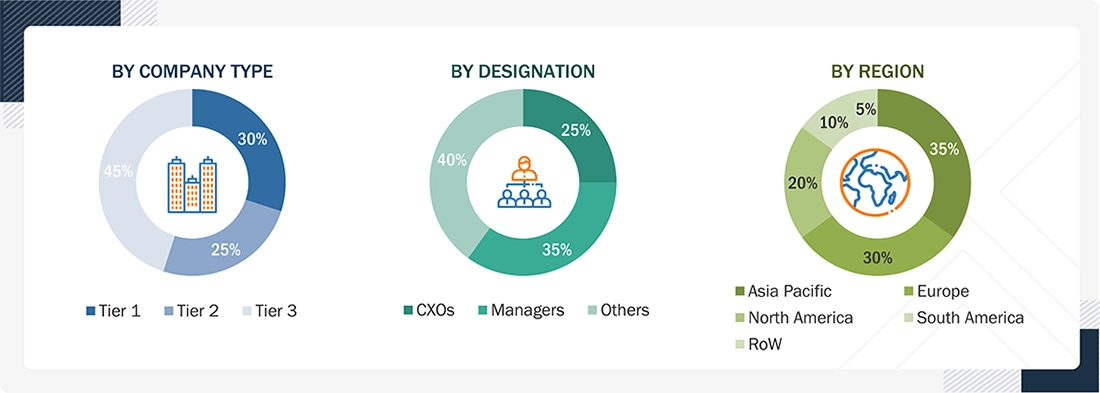
Note: The three tiers of the companies are defined based on their total revenues in 2023 or 2024, based on the availability of financial data: Tier 1: Revenue > USD 1 billion; Tier 2: USD 100 million ≤ revenue ≤ USD 1 billion; Tier 3: Revenue < USD 100 million. RoW includes Africa and the Middle East.
|
COMPANY NAME |
DESIGNATION |
|
Cargill, Incorporated (US) |
Product Development Manager |
|
ADM (US) |
Sales Manager |
|
DSM-Firmenich (Switzerland) |
Manager |
|
International Flavors & Fragrances Inc. (US) |
Head of Processing Department |
|
BASF SE (Germany) |
Marketing Manager |
|
Ajinomoto Co. Inc (Japan) |
Sales Executive |
Market Size Estimation
The top-down and bottom-up approaches were used to estimate and validate the total size of the feed additives market. These approaches were also used extensively to determine the size of various subsegments in the market. The research methodology used to estimate the market size includes the following details:
- The key players in the industry and the overall markets were identified through extensive secondary research.
- All shares, splits, and breakdowns were determined using secondary sources and verified through primary sources.
- All possible parameters that affect the market covered in this research study were accounted for, viewed in extensive detail, verified through primary research, and analyzed to obtain final quantitative and qualitative data.
Feed Additives Market : Top-Down and Bottom-Up Approach
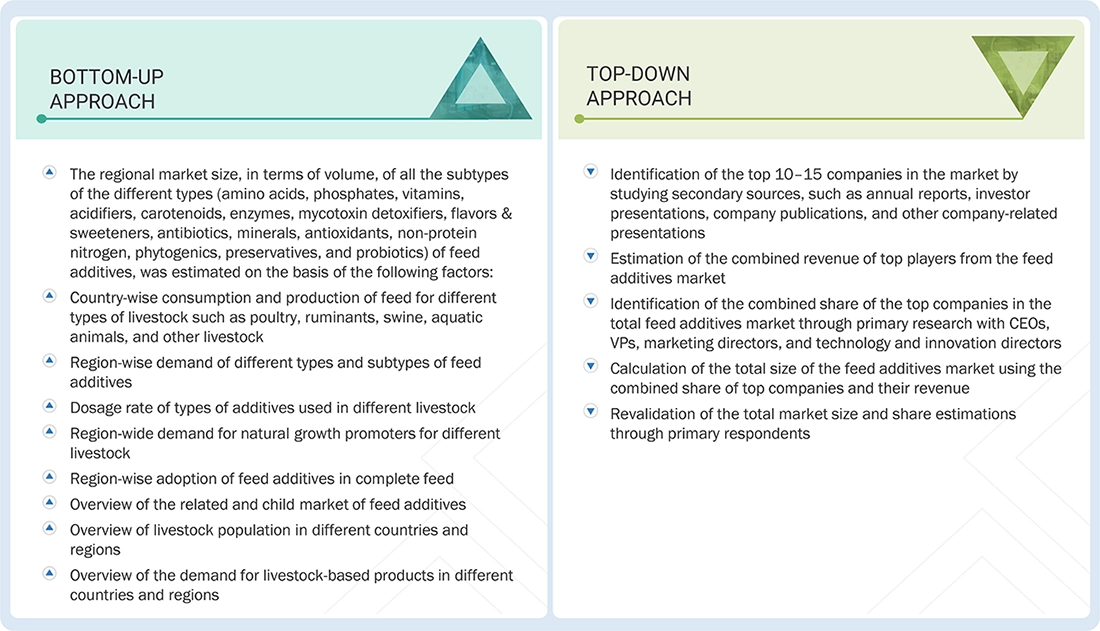
Data Triangulation
After determining the overall market size from the estimation process explained above, the total market was split into several segments and subsegments. The data triangulation procedure was employed, wherever applicable, to estimate the overall feed additives market and obtain precise statistics for all segments and subsegments. The data was triangulated by studying various factors and trends from the demand and supply sides. The market size was also validated using the top-down and bottom-up approaches.
Market Definition
According to the European Food Safety Authority, “Feed additives are products used in animal nutrition to achieve an effect on the feed itself, on the animals, on food products obtained from the animals consuming the feed additive, or on the environment. For instance, feed additives are used to enhance the flavor of feed, to meet the need for certain nutrients, or to increase the performance of animals in good health. They are used in feed for food-producing animals and in pet food.”
According to the European Commission, “Feed additives are defined as products used in animal nutrition for the purpose of improving the quality of feed and the quality of food from animal origin, or to improve the animals’ performance and health, e.g., providing enhanced digestibility of the feed materials. Feed additives may not be put on the market unless authorization has been given, following a scientific evaluation demonstrating that the additive has no harmful effects on human and animal health and the environment.”
Key Stakeholders
- Feed manufacturers
- Dairy, poultry farms, and livestock farms
- Feed importers and exporters
- Intermediary suppliers such as traders and distributors of feed additives such as amino acids, phosphates, enzymes, vitamins, acidifiers, carotenoids, mycotoxin detoxifiers, flavors & sweeteners, antibiotics, minerals, antioxidants, nonprotein nitrogen, phytogenics, preservatives, and probiotics
- Government and research organizations
-
Associations and industry bodies:
- Food and Agriculture Organization (FAO)
- United States Department of Agriculture (USDA)
- European Food Safety Authority (EFSA)
- European Association of Specialty Feed Ingredients and their Mixtures (FEFANA)
- International Feed Industry Federation (IFIF)
- Organization for Economic Co-operation and Development (OECD)
- Animal Feed Manufacturers Association (AFMA)
- The Irish Grain and Feed Association (IGFA)
- National Grain and Feed Association (NGFA)
- The Compound Feed Manufacturers Association (CLFMA)
- Brazilian Poultry Association and the Brazilian Chicken Producers and Exporters Association (UBABEF)
- Japan Feed Manufacturers Association (JAFMA)
- Animal Nutrition Association of Canada (ANAC)
Report Objectives
- To determine and project the size of the feed additives market based on type, livestock, source, form, function (qualitative), end user (qualitative), and region, over five years, ranging from 2026 to 2031
- To identify the attractive opportunities in the market by determining the largest and fastest-growing segments across regions
- To provide detailed information about the key factors influencing market growth (drivers, restraints, opportunities, and challenges)
- To analyze the opportunities in the market for stakeholders and provide details of the competitive landscape for market leaders
- To analyze the micromarkets with respect to individual growth trends, prospects, and their contribution to the total market
- To identify and profile the key players in the market
- To understand the competitive landscape and identify the major growth strategies adopted by players across the key regions.
Available customizations:
With the given market data, MarketsandMarkets offers customizations according to company-specific scientific needs. The following customization options are available for the report:
PRODUCT ANALYSIS
Product matrix, which gives a detailed comparison of the product portfolio of each company
GEOGRAPHIC ANALYSIS
With the given market data, MarketsandMarkets offers customizations according to company-specific scientific needs
- Further breakdown of the Rest of Europe feed additives market into key countries
- Further breakdown of the Rest of Asia Pacific feed additives market into key countries
- Further breakdown of the Rest of South America feed additives market into key countries
COMPANY INFORMATION
- Detailed analyses and profiling of additional market players (up to five)
Key Questions Addressed by the Report
What is the projected size of the global feed additives market by 2031?
The global feed additives market is estimated to be valued at USD 50.72 billion in 2026 and is projected to reach USD 67.90 billion by 2031, growing at a CAGR of 6.0% during the forecast period.
What are feed additives and why are they important in animal nutrition?
Feed additives are ingredients added to animal feed to improve digestion, enhance nutrient absorption, boost immunity, and support healthy animal growth. Common feed additives include amino acids, vitamins, enzymes, probiotics, minerals, and phytogenics, which help livestock maintain optimal health and productivity.
What factors are driving the growth of the feed additives market?
The feed additives market is expanding due to the increasing global demand for animal protein, including meat, milk, eggs, and fish. The shift toward commercial and intensive livestock production systems, along with the need to improve feed efficiency and animal health, is also driving the adoption of feed additives.
Why are amino acids widely used in animal feed?
Amino acids help improve feed conversion efficiency and ensure that animals receive balanced nutrition. They support faster growth, better muscle development, and improved productivity, making them an important component in modern livestock feed formulations.
Who are the key companies in the global feed additives market?
Key companies operating in the feed additives market include Cargill, Incorporated (US), ADM (US), International Flavors & Fragrances Inc. (US), Evonik Industries AG (Germany), BASF SE (Germany), DSM-Firmenich (Switzerland), Alltech (US), Ajinomoto Co., Inc. (Japan), Novonesis Group (Denmark), Adisseo (France), Jubilant Ingrevia Ltd (India), Nutreco (Netherlands), BRF Global (Brazil), Volac International Ltd. (UK), Kemin Industries, Inc. (US), Lallemand Inc. (Canada), Bentoli (US), Neospark Drugs and Chemicals Pvt. Ltd. (India), Novus International, Inc. (US), and Global Nutrition International (France).
Fact checked
Personalize This Research
- Triangulate with your Own Data
- Get Data as per your Format and Definition
- Gain a Deeper Dive on a Specific Application, Geography, Customer or Competitor
- Any level of Personalization
Let Us Help You
- What are the Known and Unknown Adjacencies Impacting the Feed Additives Market
- What will your New Revenue Sources be?
- Who will be your Top Customer; what will make them switch?
- Defend your Market Share or Win Competitors
- Get a Scorecard for Target Partners

Custom Market Research Services
We Will Customise The Research For You, In Case The Report Listed Above Does Not Meet With Your Requirements
Get 10% Free CustomisationTESTIMONIALS

Business Innovation Director
US Based Leading Agribusiness,
Food and Ingredients ManufacturerI highly appreciate the team's efficiency for a well conducted study that helped us clarify some blind spots in food and agricultural niche markets. Although compiling information for B2B markets is very difficult, the MnM team pulled out the task successfully. The quality of research, level of insights, and responsiveness of team were commendable.
- Rest Of Europe Feed Additives Market
- Rest Of Asia Pacific Feed Additives Market
- US Feed Additives Market
- Canada Feed Additives Market
- Mexico Feed Additives Market
- France Feed Additives Market
- Germany Feed Additives Market
- Italy Feed Additives Market
- Spain Feed Additives Market
- Russia Feed Additives Market
- UK Feed Additives Market
- China Feed Additives Market
- India Feed Additives Market
- Japan Feed Additives Market
- Thailand Feed Additives Market
- Indonesia Feed Additives Market
- Brazil Feed Additives Market
- Argentina Feed Additives Market
Growth opportunities and latent adjacency in Feed Additives Market






Jordan
Jul, 2026
Which feed additive categories are experiencing the highest demand?.
Amanda
Jul, 2026
What is driving growth in the feed additives market?.
Nova
Jul, 2026
The overlap between specialty chemicals, feed nutrition additives, and performance polymers is becoming increasingly important in animal nutrition innovation..
Dakota
Jul, 2026
Polymers and encapsulation technologies could play a major role in the future of feed additives..