Fluoropolymers Market

Fluoropolymers Market by Product Type (PTFE, PVDF, FEP, PFA, ETFE, PVF), Application (Films, Coatings, Additives), End-Use Industry (Aerospace, Automotive, Building & Construction, Electrical & Electronics, Industrial & Machinery, Packaging), and Region - Global Forecast to 2030




FLUOROPOLYMERS MARKET SIZE
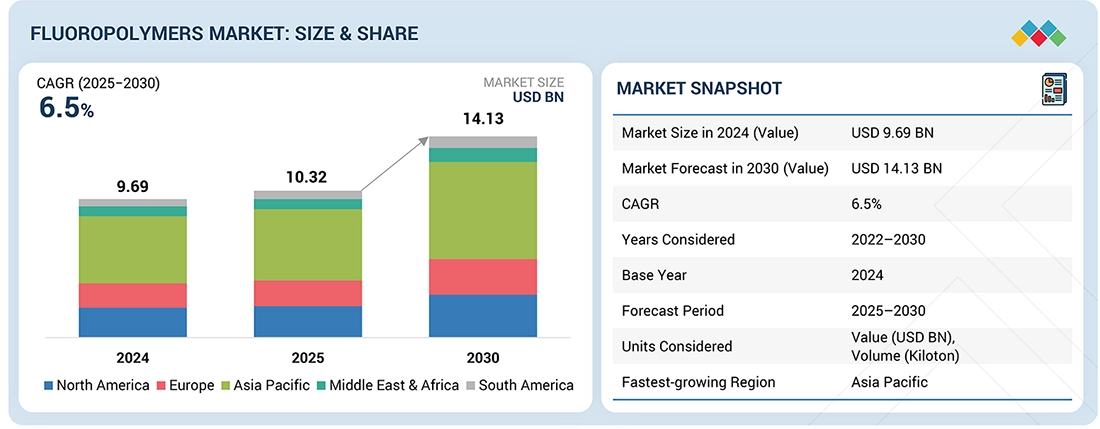
Source: Secondary Research, Interviews with Experts, MarketsandMarkets Analysis | Updated on : April 28, 2026
The fluoropolymers market was valued at USD 10.32 billion in 2025 and is projected to reach USD 14.13 billion by 2030, growing at 6.5% cagr from 2025 to 2030. The global fluoropolymers market size is propelled by their outstanding chemical resistance, high thermal stability, and low friction properties, thus they are unavoidably used in various applications across industries. The increasing demand from chemical processing, automotive, electronics, and construction sectors is the main factor that drives the market especially for the applications that require durability in extreme conditions. Furthermore, the rapid industrialization in developing countries, infrastructure projects, and the continued demand for high-performance and durable materials are some of the factors that contribute to the expansion of the fluoropolymers market worldwide.
KEY TAKEAWAYS
-
By RegionAsia Pacific has the largest market accounting for 48.2% share of the fluoropolymers market.
-
By Product TypePTFE accounted for the highest market share (45%) in 2024.
-
By ApplicationFilms is the fastest-growing application segment, with a growth rate of 6.4% during forecast period.
-
By End-use IndustryElectrical & electronics is the fastest-growing end-use industry segment during forecast period.
-
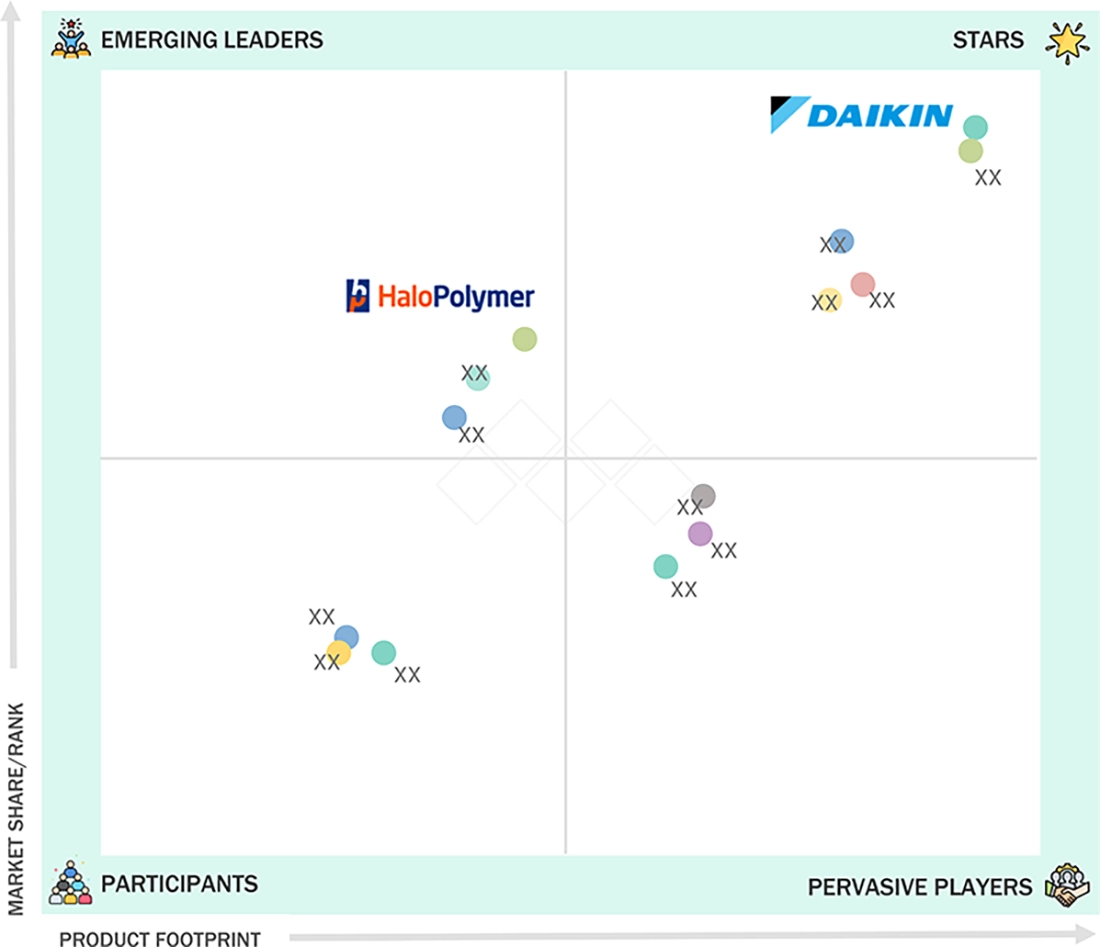
Competitive Landscape - Key PlayersThe Chemours Company, Daikin Industries, Inc., and Arkema were identified as some of the star players in the fluoropolymers market, given their strong market share and product footprint.
-
Competitive Landscape - StartupsWuhan Everflon Fluoropolymers Co., Ltd, Guarniflon S.p.A., and MAFLON S.p.A., among others, have distinguished themselves among startups and SMEs by securing strong footholds in specialized niche areas.
The demand for fluoropolymers is driven due to their resistance to chemicals, thermal stability, low friction, and durability allowing them to be used in the most demanding applications. Moreover, the rapid development of the market is propelled by the increasing demand from end-use industries, such as chemical processing, automotive, electronics, construction, and aerospace. The gradual consumption of fluoropolymers in lithium-ion batteries, semiconductors, and renewable energy systems is the additional factor contributing to the market growth. Due to the strict environmental and safety regulations, industries are increasingly opting for high-performing, durable materials which in turn is also driving the demand for fluoropolymers. On top of these, industrialization, infrastructure development in emerging markets, and constant innovations in polymer processing and product development are some of the factors that are supporting the global fluoropolymers market.
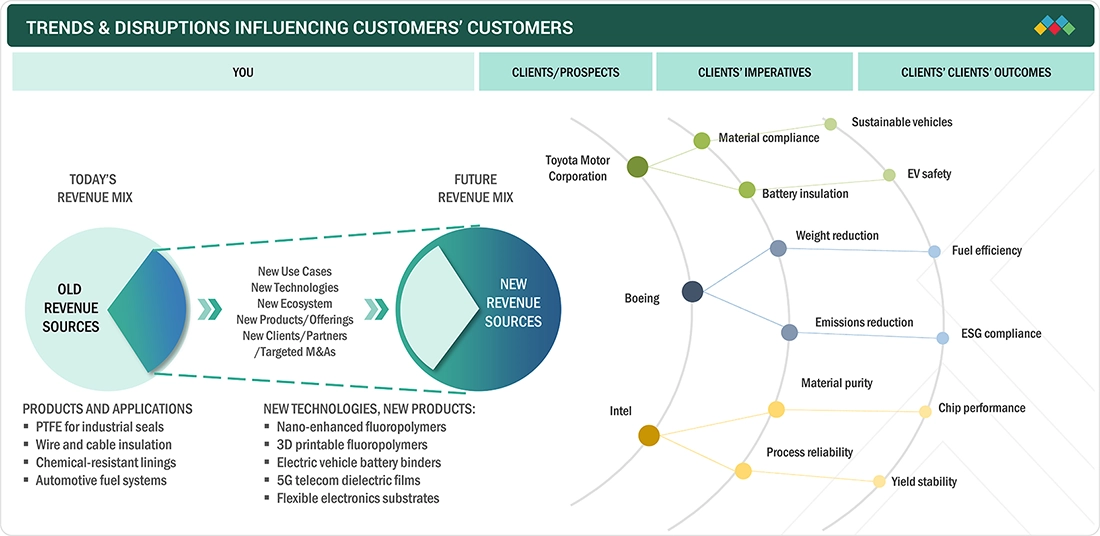
TRENDS & DISRUPTIONS IMPACTING CUSTOMERS' CUSTOMERS
The impact of clients business' on the fluoropolymers market is influenced by the current market trends in the areas of regulations, performance, and sustainability. Toyota, Boeing, and Intel are the major clients in the fluoropolymers market. The rising cost of compliance with PFAS regulations and the push for electric vehicles by Toyota are two major streams of demand for fluoropolymers that are both non-toxic and highly performing. Boeing's commitment to the use of advanced fluoropolymer coatings is driven by the company's strategy of lightweighting, reducing fuel consumption, and cutting emissions. On the other hand, Intel's focus on node scaling, material purity, and contamination control is imposing more stringent standards in the semiconductor applications. In synergy, the three clients are dictating innovativeness, the quality of the products, and the direction of the investments all over the world's fluoropolymers market.
Source: Secondary Research, Interviews with Experts, MarketsandMarkets Analysis
FLUOROPOLYMERS MARKET DYNAMICS

Level
-
Rising demand from the automotive and aerospace industries

-
Increasing use in renewable energy applications


Level
-
High production and raw material costs

-
Complex manufacturing processes


Level
-
Development of eco-friendly fluoropolymers

-
Infrastructure and industrial growth in emerging economies


Level
-
Managing regulatory compliance globally

-
Supply chain volatility

Source: Secondary Research, Interviews with Experts, MarketsandMarkets Analysis
Driver: Rising demand from automotive and aerospace industries
The main factor pushing the fluoropolymers market is increasing demand from the automotive and aerospace industries. Both sectors are seeking high-performance materials that can withstand even the most extreme conditions. Fluoropolymers are characterized by their outstanding thermal stability, chemical resistance, low friction, and low weight, thus, suitable for fuel-efficient cars, aircraft components, and high-performance engines. They are used in the conduct of fuel, the making of gaskets and seals, insulation for wires, and coatings, and all these applications contribute to both durability and safety. Fluoropolymers provide two main benefits to components by extending their operational life while decreasing the frequency of maintenance work. The increasing need for lightweight materials that meet regulations and provide long-lasting durability results from the growing production of aircraft, the modernization of existing fleets, and the introduction of advanced vehicles.
Restraint: High production and raw material costs
High production and raw material costs are the biggest limitations for the fluoropolymers market, as these materials demand fluorine-based monomers, which are costly, besides the use of energy-intensive manufacturing processes. The production of fluoropolymers involves a series of chemical reactions that are very complicated and require heavy investments in quality control and specialized equipment, thus raising production costs. As a result, the end products are more expensive than those of regular polymers, which limits their use to cost-sensitive applications and industries. The high price can deter manufacturers from choosing fluoropolymers when relatively cheap options like polypropylene or polyethylene can meet basic performance requirements, thereby slowing overall market growth.
Opportunity: Development of eco-friendly fluoropolymers
The development of eco-friendly fluoropolymers is a major opportunity in the fluoropolymers market as environmental regulations and sustainability concerns are continually rising. Manufacturers are being forced to find and innovate safe, low-toxicity, and recyclable fluoropolymer substitutes due to the increasing bans on PFAS and the growing concern for the environment. In this regard, eco-friendly fluoropolymers which can still have the excellent performance of the traditional ones, can help the companies not only to comply with the regulations but also to enter new markets. Moreover, such innovations improve brand reputation and customer loyalty, especially among the automotive, electronics, and healthcare sectors, where the use of sustainable materials is becoming more important. Consequently, this will not only lead to long-term market acceptance but also to a competitive advantage.
Challenge: Managing regulatory compliance globally
Managing regulatory compliance globally is considered to be a significant challenge for the fluoropolymers market because of the different environmental, safety, and chemical regulations in different areas of the world. The restrictions concerning PFAS are very different in North America, Europe, and Asia Pacific, thus, making the situation difficult for manufacturers who are working in more than one market. The companies need to be always informed about the latest regulations, have their products re-formulated, and put money into testing and documentation required for compliance, all of which lead to higher costs and slower product development. Moreover, inconsistent regulations may limit the access to certain markets and cause supply chains to be interrupted. The partial regulatory situation is a hindrance for the fluoropolymer manufacturers that are trying to produce the same global standard product in terms of performance, profitability, and legal compliance.
FLUOROPOLYMERS MARKET: COMMERCIAL USE CASES ACROSS INDUSTRIES
| COMPANY | USE CASE DESCRIPTION | BENEFITS |
|---|---|---|
 |
Fluoropolymers for chemical-resistant linings, seals, coatings, and wire insulation | Enhanced durability, corrosion resistance, longer service life, reduced maintenance |
 |
High-performance fluoropolymers for automotive, electronics, and semiconductor applications | High thermal stability, electrical insulation, lightweight performance |
 |
Specialty fluoropolymers for coatings, membranes, batteries, and industrial components | Improved chemical resistance, energy efficiency, regulatory compliance |
 |
Fluoropolymer solutions for aerospace, electronics, filtration, and industrial sealing | Reliable performance under extreme temperatures and harsh environments |
 |
Advanced fluoropolymers for high-purity, energy, and mobility applications | Superior chemical stability, process efficiency, long-term reliability |
Logos and trademarks shown above are the property of their respective owners. Their use here is for informational and illustrative purposes only.
FLUOROPOLYMERS MARKET ECOSYSTEM
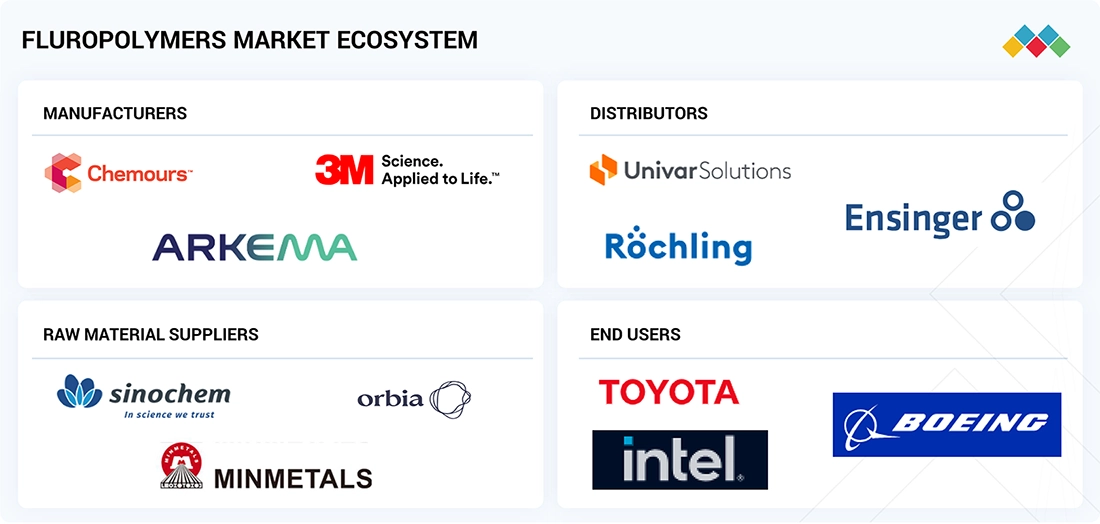
The fluoropolymers market ecosystem consists of raw material suppliers (Sinochem International Corporation, China Minmetals Corporation, Orbia), manufacturers (The Chemours Company, 3M, Arkema), distributors (Univar Solutions LLC, Röchling SE & Co. KG, Ensinger), and end users (TOYOTA MOTOR CORPORATION, Boeing, Intel Corporation). The ecosystem starts with the upstream sources of fluorspar, fluorine, and specialty chemical intermediates which are used as raw materials. The above-mentioned inputs are then put through the process of fluoropolymer manufacturers producing PTFE, PVDF, and ETFE. The channels of distribution, compounders, and fabricators further send these materials to final users that take in the automobile, aviation, electronics, chemical processing, healthcare, and energy industries as well as the renewable ones which require high-performance, long-lasting, and chemically resistant materials.
Logos and trademarks shown above are the property of their respective owners. Their use here is for informational and illustrative purposes only.
FLUOROPOLYMERS MARKET SEGMENTS
Source: Secondary Research, Interviews with Experts, MarketsandMarkets Analysis
Fluoropolymers market, by product type
In the fluoropolymers market, PTFE holds the largest share in the market in terms of product type because of its unparalleled mixture of chemical resistance, thermal stability, friction, and electrical insulation. PTFE is not only used in these but also has the potential to be used in chemical processing, automotive, electronics, construction, and healthcare industries where applications involve linings, gaskets, seals, non-stick coatings, and wire insulation. The main reasons for PTFE being widely accepted are its long-standing commercial availability, proven reliability across difficult environments, and ability to cut down on maintenance and downtime.
Fluoropolymers market, by application
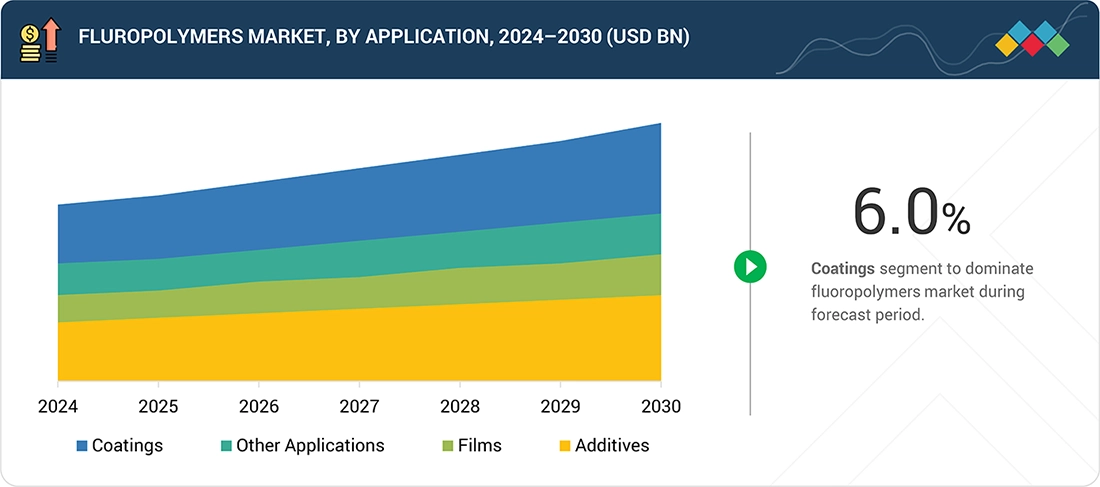
Coatings have the largest share in the fluoropolymers market due to their chemical resistance, non-stick, and weatherability along with high thermal stability. These coatings are the primary barriers against corrosion, wear, and heat for metal surfaces in chemical processing machines, kitchenware, structural parts in architecture, automotive components, and industrial equipment. It Fluoropolymer coatings can lengthen the life of the equipment, take away maintenance costs, and increase the efficiency of operations that make them so irresistible. Furthermore, the constantly increasing demand for long-lasting, high-performing, and low-friction surface solutions is propelling the use and thus, the market of fluoropolymer-based coatings even more.
Fluoropolymers market, by end-use industry
Electrical & electronics is the fastest-growing industry in the market of fluoropolymers owing to the rapid advancements in the areas of the electronics, the electrification, and, consequently, the miniaturization of components. Fluoropolymers exhibit great electric insulation, high dielectric strength, fire resistance, and thermal stability, which are highly sought in wire and cable insulation, semiconductors, connectors, and flexible printed circuits. The demand is further driven by the rollout of the 5G network, increase of data centers, consumer electronics, and electric vehicles. Moreover, the chemical and high-temperature resistance of fluoropolymers not only guarantees reliability and longer service life in high-performance electronic applications but also is a factor contributing to their higher adoption rates.
REGION
Asia Pacific to be fastest-growing region in global fluoropolymers market during forecast period
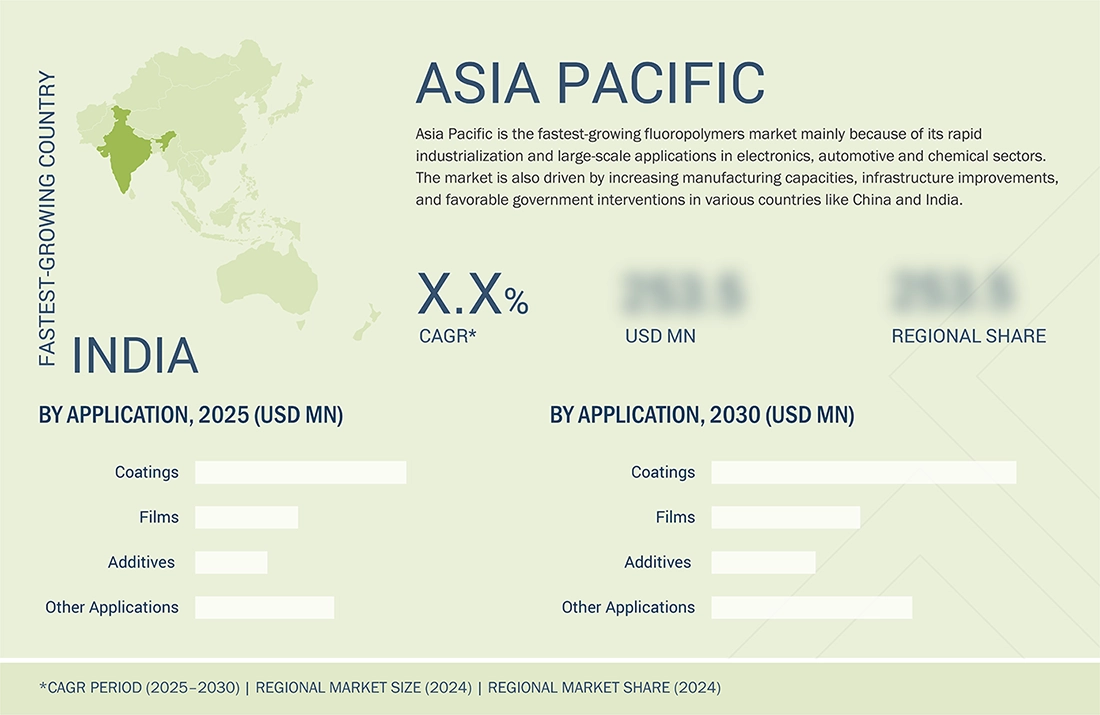
Asia Pacific is the fastest-growing region in the fluoropolymers market mainly due to its rapid industrialization, expanding manufacturing, and a great increase in various end-use industries including electronics, automotive, chemicals, and renewable energy. Major electronics and semiconductor production centers that attract fluoropolymers include China, Japan, South Korea, and India. Besides, the gradual investment in electric vehicles, infrastructure, and solar power projects is another contributor to the demand in the region. Furthermore, the existence of large-scale fluoropolymer manufacturers, cost-efficient production, and increasing domestic consumption are driving the market growth in the Asia Pacific region.
FLUOROPOLYMERS MARKET: COMPANY EVALUATION MATRIX
Daikin Industries is a star company in the fluoropolymers market due to its wide range of products, advanced technology, and worldwide presence in the production of high-performance fluoropolymers such as PTFE, PVDF, FEP, and ETFE. The company’s strong position in automotive, electronics, and semiconductor applications gives it a firm grip on the market. On the other hand, HaloPolymer is becoming an emerging leader by concentrating on high-purity and specialty fluoropolymers that are not so common and used mainly in chemical processing and pharmaceutical applications. The company’s rapidly expanding manufacturing capacities, pricing benefits, and concentration on customized solutions are the main factors behind its quick development and strengthening global recognition in the fluoropolymers industry.
Source: Secondary Research, Interviews with Experts, MarketsandMarkets Analysis
KEY MARKET PLAYERS
- The Chemours Company (US)
- DAIKIN INDUSTRIES, Ltd. (Japan)
- Arkema (France)
- 3M (US)
- Solvay (Belgium)
- Saint-Gobain (France)
- DONGYUE GROUP (China)
- HaloPolymer (Russia)
- SABIC (Saudi Arabia)
- Mitsubishi Chemical Corporation (Japan)
FLUOROPOLYMERS MARKET REPORT SCOPE
| REPORT METRIC | DETAILS |
|---|---|
| Market Size in 2024 (Value) | USD 9.69 Billion |
| Market Forecast in 2030 (Value) | USD 14.13 Billion |
| Growth Rate | CAGR of 6.5% from 2025–2030 |
| Years Considered | 2022–2030 |
| Base Year | 2024 |
| Forecast Period | 2025–2030 |
| Units Considered | Value (USD Million/Billion), Volume (Kiloton) |
| Report Coverage | Revenue Forecast, Company Ranking, Competitive Landscape, Growth Factors, and Trends |
| Segments Covered |
|
| Regions Covered | North America, Asia Pacific, Europe, South America, and Middle East & Africa |
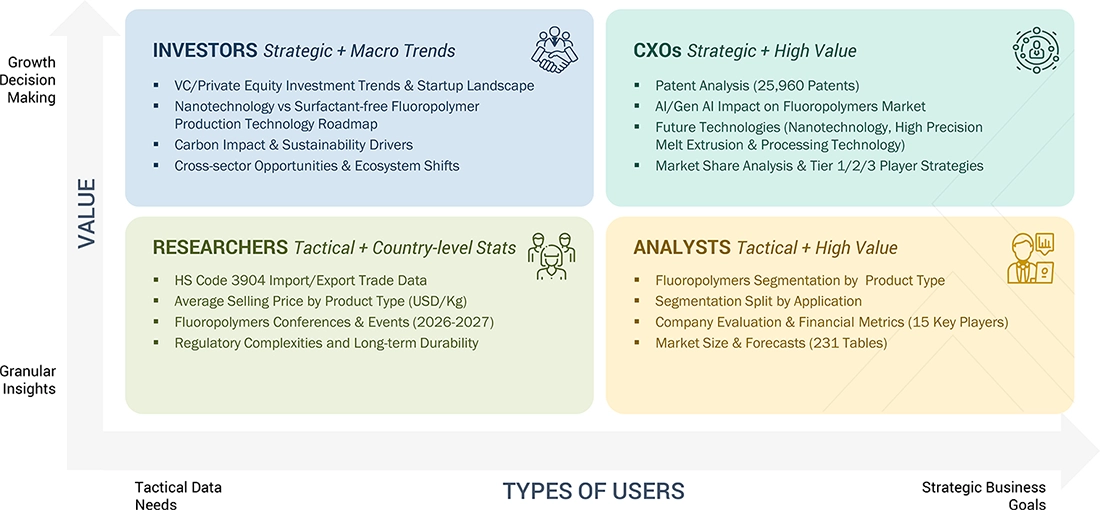
WHAT IS IN IT FOR YOU: FLUOROPOLYMERS MARKET REPORT CONTENT GUIDE
DELIVERED CUSTOMIZATIONS
We have successfully delivered the following deep-dive customizations:
| CLIENT REQUEST | CUSTOMIZATION DELIVERED | VALUE ADDS |
|---|---|---|
| Fluoropolymer Manufacturers | Supplier and competitor profiling by polymer type, capacity, certifications, and regional footprint | Benchmark competitors, identify white spaces, strengthen production and expansion strategies |
| End-use Industry OEMs | Application-wise performance and cost comparison of fluoropolymers across industries | Optimize material selection, reduce lifecycle costs, improve product reliability |
| Raw Material Suppliers | Regional mapping of fluorine, fluorspar, and monomer demand and supply dynamics | Identify high-growth markets, evaluate integration opportunities, improve supply planning |
RECENT DEVELOPMENTS
- August 2025 : The Chemours Company (Chemours) entered a partnership with SRF Limited of India, to upgrade its global fluoropolymer and fluoroelastomer supply. This collaboration utilized the manufacturing know-how of SRF and the product technology of Chemours, thereby increasing flexibility in the operation and making it possible to secure the supply of high-quality fluoropolymers for various industries such as semiconductor, automotive, aerospace, chemical processing. The strategic agreement facilitated the diversification of Chemours’ operations globally without the need for upfront capital investment, thus supplementing existing operations and backing its transition to higher-value applications. The two firms stressed their commitment to quality, advanced materials, and responsible manufacturing, which has been very significant in their long-term collaboration in performance fluoropolymers.
- August 2024 : AGC created a fluoropolymer production method free of surfactants that drastically reduced the production of fluorinated waste and kept durability, resistance to high temperature, chemicals and freezing conditions to excellent standards. The process aimed at the production of semiconductors, electronics, automotive and energy sectors, thus enabling earth-friendly, high-performance manufacturing. With its AGC plus-2026 strategy, AGC pledged to work on innovations, sustainability and dependable large-scale supply by the year 2030.
- Jan 2022 : Arkema has raised its PVDF production capacity expansion at Changshu, China from 35% to 50% driven by strong demand from lithium-ion batteries along with other industries. Furthermore, the company declared a 50% increase in PVDF capacity in Pierre-Bénite, France, which began production in early 2023 and is set to cater to the growing requirements of batteries, water filtration, coatings, and semiconductors.
Table of Contents
 Exclusive indicates content/data unique to MarketsandMarkets and not available with any competitors.
Methodology
The study involved four major activities in estimating the market size of the Fluoropolymers market. Exhaustive secondary research was done to collect information on the market, the peer market, and the parent market. The next step was to validate these findings, assumptions, and sizing with industry experts across the value chain through primary research. Both top-down and bottom-up approaches were employed to estimate the complete market size. Thereafter, the market breakdown and data triangulation procedures were used to estimate the market size of the segments and subsegments.
Secondary Research
In the secondary research process, various secondary sources have been referred to for identifying and collecting information for this study. These secondary sources include annual reports, press releases, investor presentations of companies, white papers, certified publications, trade directories, certified publications, articles from recognized authors, gold standard and silver standard websites, and databases.
Secondary research has been used to obtain key information about the value chain of the industry, monetary chain of the market, the total pool of key Fluoropolymers, market classification and segmentation according to industry trends to the bottom-most level, and regional markets. It was also used to obtain information about the key developments from a market-oriented perspective.
Primary Research
The Fluoropolymers market comprises several stakeholders in the value chain, which include raw material suppliers, manufacturers, and end users. Various primary sources from the supply and demand sides of the Fluoropolymers market have been interviewed to obtain qualitative and quantitative information. The primary interviewees from the demand side include key opinion leaders in end-use sectors. The primary sources from the supply side include manufacturers, associations, and institutions involved in the Fluoropolymers industry.
Primary interviews were conducted to gather insights such as market statistics, data of revenue collected from the products and services, market breakdowns, market size estimations, market forecasting, and data triangulation. Primary research also helped in understanding the various trends related to type, form, application, end-use industry, and region. Stakeholders from the demand side, such as CIOs, CTOs, and CSOs were interviewed to understand the buyer’s perspective on the suppliers, products, component providers, and their current usage of Fluoropolymers and future outlook of their business which will affect the overall market.
Market Size Estimation
The top-down approach was used to estimate and validate the size of various submarkets for Fluoropolymers for each region. The research methodology used to estimate the market size included the following steps:
- The key players in the industry have been identified through extensive secondary research.
- The supply chain of the industry has been determined through primary and secondary research.
- The global market was then segmented into five major regions and validated by industry experts.
- All percentage shares, splits, and breakdowns based on type, form, application, end-use industry, and region were determined using secondary sources and verified through primary sources.
- All possible parameters that affect the markets covered in this research study were accounted for, viewed in extensive detail, verified through primary research, and analyzed to get the final quantitative and qualitative data. This data was consolidated and added with detailed inputs and analysis and presented in this report.
Data Triangulation
After arriving at the total market size from the estimation process Fluoropolymers above, the overall market has been split into several segments and sub-segments. To complete the overall market engineering process and arrive at the exact statistics for all the segments and sub-segments, the data triangulation and market breakdown procedures have been employed, wherever applicable. The data has been triangulated by studying various factors and trends from both the demand and supply sides. Along with this, the market size has been validated by using both the top-down and bottom-up approaches and primary interviews. Hence, for every data segment, there have been three sources—top-down approach, bottom-up approach, and expert interviews. The data was assumed correct when the values arrived from the three sources matched.
Market Definition
Fluoropolymers are fluorine-based polymers that are more thermally stable than other fluoropolymers. These materials, namely, PTFE, FEP, PFA/MFA, and ETFE, can be processed at operating temperatures of above 302°F. These Fluoropolymers have superior mechanical properties, such as high chemical resistance and heat stability in comparison to commodity plastics & engineering plastics. They are used in high-end applications with extreme temperature requirements in the form of coatings, films & membranes, and tubing. They are used in industries such as medical, automotive, electronics, and construction.
Key Stakeholders
- Fluoropolymers Manufacturers
- Fluoropolymers Traders, Distributors, and Suppliers
- Raw Type Suppliers
- Government and Private Research Organizations
- Associations and Industrial Bodies
- R&D Institutions
- Environmental Support Agencies
Report Objectives
- To define, describe, and forecast the size of the Fluoropolymers market, in terms of value and volume.
- To provide detailed information regarding the major factors (drivers, opportunities, restraints, and challenges) influencing the growth of the market.
- To estimate and forecast the market size based on type, form, application, end-use industry, and region.
- To forecast the size of the market with respect to major regions, namely, Europe, North America, Asia Pacific, Middle East & Africa, and South America, along with their key countries.
- To strategically analyze micromarkets1 with respect to individual growth trends, prospects, and their contribution to the overall market.
- To analyze opportunities in the market for stakeholders and provide a competitive landscape of market leaders.
- To track and analyze recent developments such as expansions, new product launches, partnerships & agreements, and acquisitions in the market.
- To strategically profile key market players and comprehensively analyze their core competencies.
Available Customizations
Along with the given market data, MarketsandMarkets offers customizations according to the company’s specific needs. The following customization options are available for the report:
Regional Analysis
- Further breakdown of a region with respect to a particular country or additional application
Company Information
- Detailed analysis and profiles of additional market players
Tariff & Regulations
- Regulations and impact on HPF market
Key Questions Addressed by the Report
What are the key applications of the Fluoropolymers Market?
The Fluoropolymers Market is widely used across industries such as automotive, construction, electronics, packaging, and industrial manufacturing where high-performance materials and components are essential.
What factors are driving the growth of the Fluoropolymers Market?
The growth of the Fluoropolymers Market is driven by rising industrial demand, expanding end-use industries, technological advancements, and increasing global manufacturing activities.
Which regions dominate the Fluoropolymers Market?
Asia-Pacific, North America, and Europe are major regions in the Fluoropolymers Market due to strong manufacturing bases, growing industrial infrastructure, and increasing investments in advanced materials.
Who are the major end-users in the Fluoropolymers Market?
Key end-users in the Fluoropolymers Market include automotive, aerospace, construction, electronics, consumer goods, and energy industries that require reliable and high-quality materials.
What challenges are affecting the Fluoropolymers Market?
Major challenges in the Fluoropolymers Market include fluctuating raw material prices, environmental regulations, supply chain disruptions, and the need for continuous innovation to stay competitive.


Personalize This Research
- Triangulate with your Own Data
- Get Data as per your Format and Definition
- Gain a Deeper Dive on a Specific Application, Geography, Customer or Competitor
- Any level of Personalization
Let Us Help You
- What are the Known and Unknown Adjacencies Impacting the Fluoropolymers Market
- What will your New Revenue Sources be?
- Who will be your Top Customer; what will make them switch?
- Defend your Market Share or Win Competitors
- Get a Scorecard for Target Partners

Custom Market Research Services
We Will Customise The Research For You, In Case The Report Listed Above Does Not Meet With Your Requirements
Get 10% Free CustomisationTESTIMONIALS
We at Nissan Chemicals Corporation have been clients of MarketsandMarkets for more than a year now. We recently consulted MarketsandMarkets for a study, the team at MarketsandMarkets was extremely professional and organized. The business insights were very detailed and aligned well with our expectations that really helped us formulate the Business Plans and device new strategies for development themes. MarketsandMarkets offers a unique combination of expertise and dedicated engagement model. Their research findings have helped us in designing our Pricing Strategy which will make it easier for us to predict the future sales and profits for the next ten years. We look forward to working with MarketsandMarkets in the future.
VP of Strategy & New Business Development
Leading Specialty Chemical Company
The MarketsandMarkets Engagement Model, composed of both the Knowledge Store and advisory custom research, has greatly helped us in understanding our markets and making strategic decisions. The Knowledge Store is a fast way to allow everyone in our organization to understand more about most any market they are interested in. The ability to then get custom research done and get answers to specific strategic questions and market insight has been spectacular. The Markets and Markets team feel more like colleagues than vendors and their services have helped us change our culture where statements of things like growth opportunities and competitive position are always backed by industry research.

Rich Gibson,
Director, Corporate Strategy
Milliken & Company,
Leading Industrial Manufacturer of specialty chemical, floor covering, performance and protective textile materials, and healthcaremilliken.com
MarketsandMarkets is a trusted resource that helps us to better understand markets that are near-adjacencies-whether its technology, value chain or geography. Their Knowledge Store platform provides a dashboard of markets and their characteristics which is easy to use and saves us time.
Adam Shaw,
Market Development and Strategy Manager
AdvanSix Inc. USA,
An American Leader in Chemicalswww.advansix.com
The Knowledge Store from MarketsandMarkets is a valuable tool which has helped my team acquire greater insight in to the end markets that our business serves. This has enabled us to help our company build stronger strategies throughout our planning process.
TOSHIO KINOSHITA
Senior Chif Consultion Research & Consulting Division
Mitsubishi Chemical Research Corporation,
Leading Manufacturer of Chemical Productswww.mitsubishichem-res.co.jp/en/

We recently engaged with MarketsandMarkets for a study, the team not only clearly understood our business objectives but was also extremely professional in the way they handled the entire project. The study was efficiently conducted in a phase-wise manner, and the engagement model furnished us with high-quality business insights that far exceeded our expectations at each phase. We were especially happy that MarketsandMarkets could provide us with both, an English as well as a Japanese version of the study. A special thanks to the Analyst Team and Client Services Team, whose fluency in Japanese enhanced our comfort level, as we could converse with them in our preferred language.
Independent entrepreneurs
Arrow Precision
We approached MarketsandMarkets for study on Proppants Market, and their work exceeded our expectations. The study conducted was comprehensive and enabled us to view the market through the various dimensions. In addition, the team was extraordinarily responsive throughout the process and resolved our queries on time. I strongly recommend MarketsandMarkets and will certainly consider them for additional market assessments we will need in the future.
Global engineering company, Japan
Deputy Manager,
Strategic Planning OfficeThe high-quality insights shared by the MarketsandMarkets team helped us understand the pharmaceutical plant designers in a specific geography. It also captured the risks that we may likely face in communicating with our potential partners. The study would enable us identify partners, which would impact our future growth.






Growth opportunities and latent adjacency in Fluoropolymers Market