Functional Food Probiotics Market

Functional Food Probiotics Market by Product Type (Dairy Products, Infant Formula, Cereals, Other Functional Food), Ingredient (Bacteria, Yeast), Distribution Channel, Form, and Region – Global Forecast to 2030




OVERVIEW
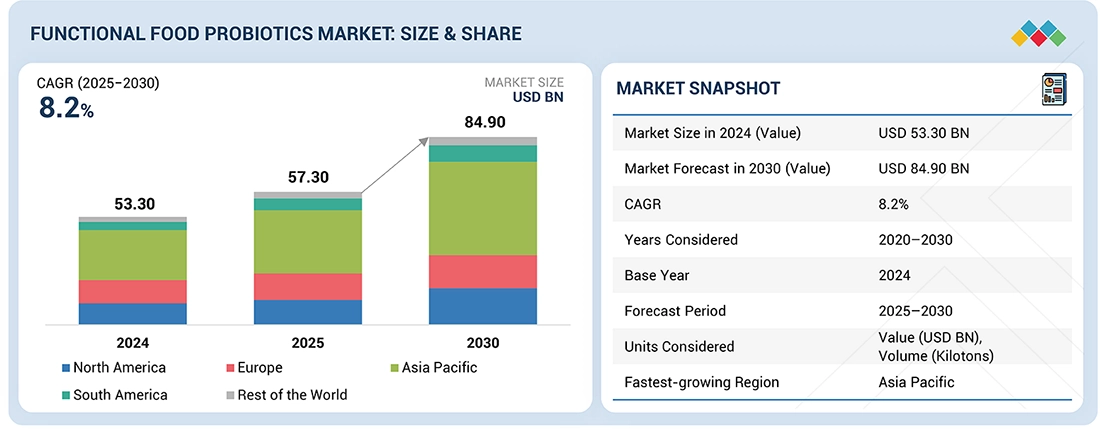
Source: Secondary Research, Interviews with Experts, MarketsandMarkets Analysis
The functional food probiotics market is estimated at USD 57.30 billion in 2025 and is projected to reach USD 84.90 billion by 2030 at an estimated CAGR of 8.2% from 2025 to 2030. Growing demand for digestive health, immune support, and preventive nutrition across functional foods continues to fuel this market. Living beneficial microorganisms, mainly bacteria and yeasts, are termed functional food probiotics, which have a direct positive impact on gut and immune health when incorporated into foods. Functional food containing probiotics maintains gut microbiota balance, improves nutrient absorption, and enables intestinal barrier integrity. Their application extends to dairy products, infant formulas, cereals, and so many other functional foods. Increasing consumer awareness regarding health in relation to the microbiome, increased preference for clean label and natural ingredients, and acceptance of non-dairy and shelf-stable probiotic formats are, therefore, supporting the growth of this market.
KEY TAKEAWAYS
-
By RegionNorth America accounted for 35.8% of the market share in 2024.
-
By Product TypeBy product type, the infant formula segment is projected to register the highest CAGR of 9.9% during the forecast period.
-
By IngredientBy ingredient, the bacteria segment is estimated to dominate the market.
-
By Distribution ChannelBy distribution channel, the hypermarkets/supermarkets segment is expected to exhibit the fastest growth between 2025 and 2030.
-
By FormBy form, the dry segment is expected to hold a significant market share during the forecast period.
-
Competitive Landscape – Key PlayersKey players include Nestlé, Danone S.A., General Mills, Arla Foods, and Meiji Co., Ltd., supported by strong brand equity and regional distribution.
-
Competitive Landscape – StartupsEmerging players such as The Good Bug, Epigamia, and Pendulum are gaining traction in the functional food probiotics market through targeted probiotic-based food formulations.
The functional food probiotics market is projected to register a CAGR of 8.2% from 2025 to 2030. The industry is expanding rapidly, mostly due to consumers' increased awareness of the connection between immunity and gut health. Food producers have seen this as a chance to increase the variety of probiotic-containing functional foods. This is supported by the growing focus on preventive health care, which has boosted the production of digestive health solutions in foods across various formats.
TRENDS & DISRUPTIONS IMPACTING CUSTOMERS' CUSTOMERS
Shifts in customer needs and new market changes are pushing companies to rethink how they use functional food probiotics, as the market moves from older formats to new use cases and technologies that change how the market grows. This shift is creating new needs for dairy producers, infant formula makers, and cereal manufacturers. Dairy producers need to keep probiotics steady through fermentation and storage, and they also need to ensure there is no change in taste or texture. Infant formula makers require strains that are already proven, safe, and able to survive high-heat steps while meeting strict rules. Cereal manufacturers put their effort into keeping probiotics alive in baked and extruded products and making sure the dry products still taste and feel right. These needs directly shape what the customers end up receiving. Food manufacturers need probiotic products that stay stable and support stronger functional claims. Trends in this market include preventive healthcare and clean-label, gut-friendly foods. As these trends accelerate or shift, they impact the revenue streams of end users, which, in turn, affect the overall market performance and growth opportunities for functional food manufacturers across the world.
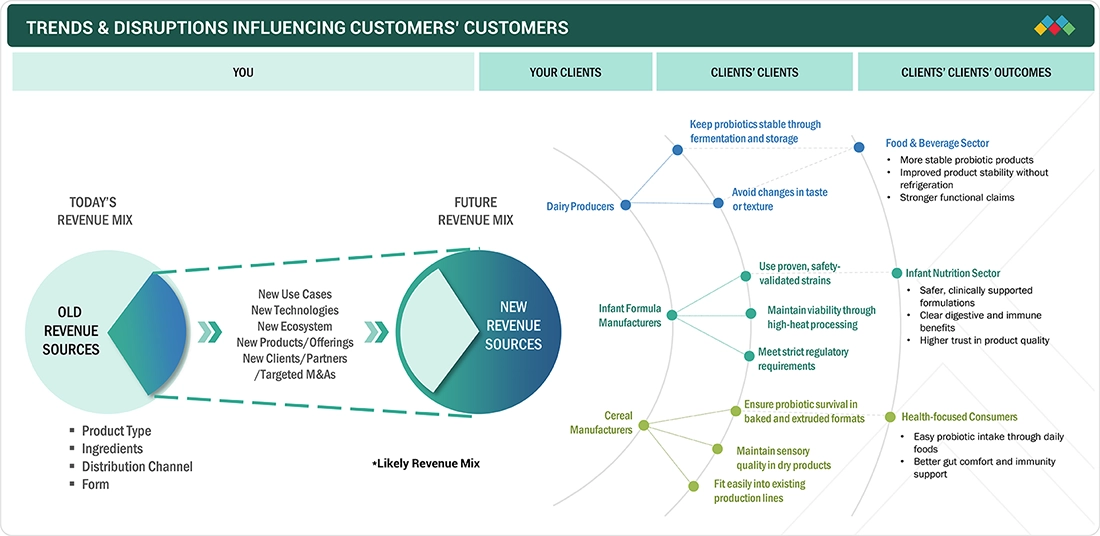
Source: Secondary Research, Interviews with Experts, MarketsandMarkets Analysis
MARKET DYNAMICS

Level
-
•Rising consumer focus on preventive health

-
•Stronger clinical evidence and ingredient innovation


Level
-
•Variability in strain performance and efficacy

-
•Uncertain regulations and claim limitations


Level
-
•Rising demand for personalized and targeted nutrition

-
•Growth in plant-based and clean-label probiotic foods


Level
-
•Complex regulatory requirements across regions

-
•Increasing competition and reduced differentiation

Source: Secondary Research, Interviews with Experts, MarketsandMarkets Analysis
Driver: Rising consumer focus on preventive health
One of the main drivers for the functional food probiotics market is the rising focus of consumers on preventive healthcare. Consumer mindset is shifting from treating illness to preventing it in the first place. They are recognizing that the gut microbiome influences more than digestion. It also affects immunity, mental health, nutrient absorption, and chronic disease risk. Probiotics are seen as a natural way to balance the microbiome. Many consumers prefer food-based solutions that can help prevent health issues. Probiotic foods like yogurt, kefir, and fermented products fit into this preventive framework because they are accessible, daily consumables with added functional benefits. There are also studies linking microbiome health to various health outcomes, reinforcing consumer belief in probiotics as a preventive tool. This increases willingness to try, adopt, and regularly purchase probiotic products.
Restraint: Variability in strain performance and efficacy
The main limitation of the functional food probiotics market is the variation in strain performance and efficacy. This is caused by the fact that different probiotic strains yield different results depending on product formats, processing conditions, and consumer groups, making it difficult for brands to promise uniform outcomes. Certain strains die off during manufacturing, storage, or digestion, while others fail to show benefits for all consumers, resulting in varying experiences for consumers. This issue of doubt makes the product less trustworthy, hinders innovation, raises validation costs for companies, and restricts the extent to which brands can make health claims on packaging. Consequently, the market is confronted with difficulties in scaling up products having foreseeable and reproducible performance.
Opportunity: Rising demand for personalized and targeted nutrition
Consumers are looking for products that suit their gut-health needs, lifestyles, and health objectives, resulting in a rise in demand for personalized and targeted nutrition. This offers functional food probiotics manufacturers a significant opportunity to cater to this demand. The industries to benefit from this shift are those that manufacture strain-specific formulations, age-based blends, condition-focused products, and customized probiotic foods linked to microbiome testing. It also opens up a market for premium pricing, stronger brand differentiation, and long-term consumer loyalty because people are more willing to buy products that they feel are just right for their personal health profile. This trend not only influences market players in developing new product lines but also encourages them to form partnerships with digital health platforms to drive data-driven innovations across the category.
Challenge: Complex regulatory requirements across regions
The functional food probiotics market must navigate complex government regulations as different countries impose different requirements for strain approval, health claims, and safety testing. This can be costly in terms of compliance, resulting in the restriction of the entry of functional food probiotic products into different regions. The classification of probiotics varies across markets, with some treating them as food, others as dietary supplements, and still others as quasi-pharmaceuticals. This classification hinders companies from being able to globally standardize their formulations or claims. Additionally, these discrepancies create a situation where the brands can only communicate limited benefits to the customers. As marketing becomes inflexible, the chances of getting product approvals also get delayed, if not rejected. In this way, operational complexity and longer time-to-market have become the major challenges for companies when they are trying to expand into new regions.
FUNCTIONAL FOOD PROBIOTICS MARKET: COMMERCIAL USE CASES ACROSS INDUSTRIES
| COMPANY | USE CASE DESCRIPTION | BENEFITS |
|---|---|---|
 |
Probiotic cultures used in fermented dairy and yogurt products for everyday digestive health | Supports gut health positioning, enables daily consumption, and ensures consistent product performance |
 |
Use of probiotic strains in functional dairy and medical nutrition food products | Improves digestive tolerance, supports immune health, and addresses specific nutrition needs |
 |
Application of probiotics in yogurt and cultured dairy foods | Adds functional value to core food categories |
 |
Integration of probiotics in value-added dairy products | Enhances product functionality and supports premium dairy positioning |
Logos and trademarks shown above are the property of their respective owners. Their use here is for informational and illustrative purposes only.
MARKET ECOSYSTEM
The functional food probiotics market follows a defined value chain. It connects strain providers, manufacturers, regulators, and retail outlets. Together, each group plays its role in the development, production, approval, and selling of probiotic foods. At the top of the chain are the strain suppliers. Among them, Novonesis, IFF, Kerry, Lallemand, and Probi are developing and testing probiotic organisms for use in functional beverages and foods. Moreover, they enhance the strains with quality, stability, and performance for digestion, immunity, and the specific health support area. Their efforts result in the availability of cultures that are safe, reliable, and in compliance with global food standards for manufacturers. The end products are developed by the manufacturers using these strains. Danone, Yakult, Nestlé, General Mills, and Arla Foods are some of the companies that manufacture yogurt, dairy snacks, and other probiotic formats in various ways. They deal with formulation, taste, packaging, and market-specific adjustments. Their infrastructure and expertise allow them to launch new probiotic products into both mature and growing regions. The regulators greatly influence the market operation. The FDA, EFSA, FSSAI, TGA, and the European Commission are among the agencies that determine the rules for safety, labeling, and health claims. These regulations impact the company product launches, claims, and compliance management. Since different regions have different standards, global brands need to maintain alignment. On the demand side, the retailers and e-commerce platforms provide the reach of the category. Walmart, Amazon, Kroger, Tesco, and Apollo Pharmacy make the category available through their extensive store networks as well as online channels. Their participation in price, shelf space, and consumer awareness plays an important role in attracting more consumers to probiotic foods, thereby sustaining the growth of the category. Together, these groups shape how fast the market moves, how products evolve, and how the functional food probiotics category grows worldwide.
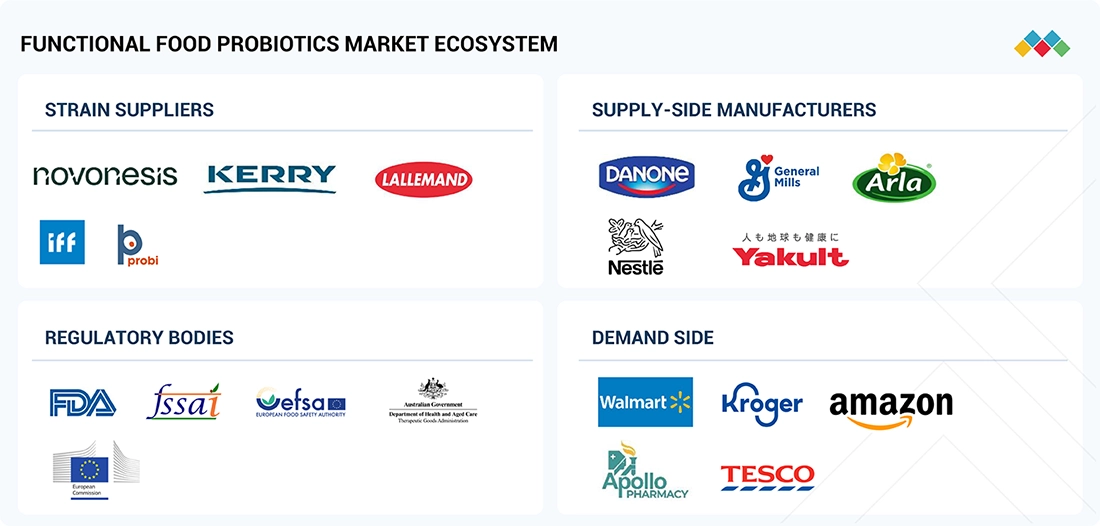
Logos and trademarks shown above are the property of their respective owners. Their use here is for informational and illustrative purposes only.
MARKET SEGMENTS
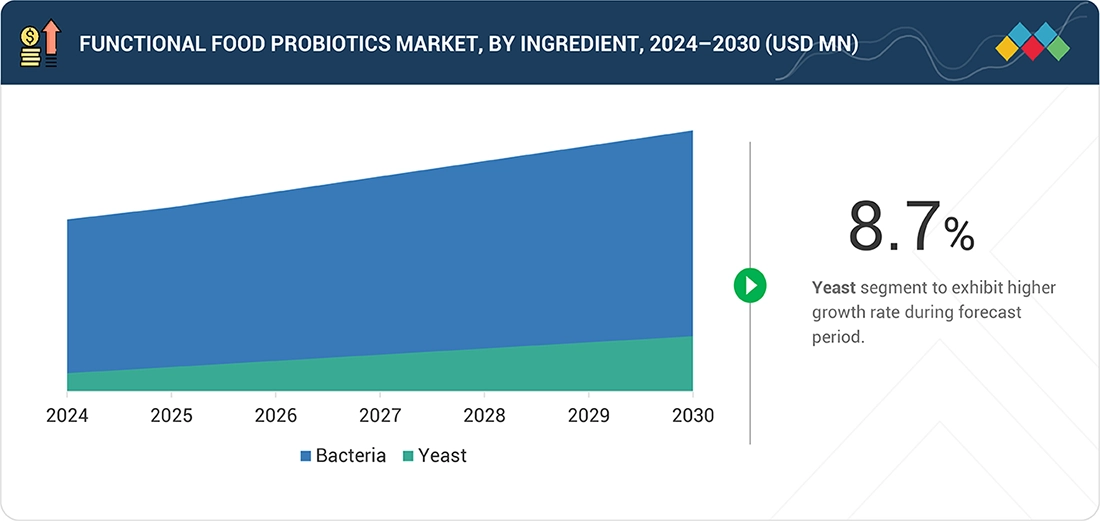
Source: Secondary Research, Interviews with Experts, MarketsandMarkets Analysis
Functional Food Probiotics Market, By Product Type
By product type, the functional food probiotics market's leading position is held by dairy products. Yogurt, cultured milk drinks, kefir, and probiotic cheese are preferred by consumers as they are user-friendly and compatible with daily eating habits. Besides, these products allow probiotic strains to be active through processing and storage, which is a great advantage for the brands in terms of consistent quality. The combination of trust, taste, and stability keeps dairy products as the most preferred probiotic food choice in both developed and growing markets.
Functional Food Probiotics Market, By Ingredient
By ingredient, the bacteria segment is estimated to dominate the functional food probiotics market. Bacterial strains like Lactobacillus and Bifidobacterium are commonly used by probiotic food manufacturers because they are regarded as safe, stable, and effective across different food formats. These strains are resistant to the usual processing steps, can adjust to different product bases, and provide clear digestive and immune benefits that consumers can easily understand. Growth is sustained by a robust demand for daily foods that are known to maintain gut balance, boost immunity, and provide overall wellness. Additionally, food manufacturers prefer bacteria since there is a larger pool of research, easier sourcing, and more predictable behavior in final products. With steady retail presence, wide strain availability, and high consumer trust, the bacteria segment continues to lead the ingredient category in functional food probiotics.
Functional Food Probiotics Market, By Distribution Channel
By distribution channel, the hypermarkets and supermarkets segment is estimated to hold a significant market share. This is because hypermarkets/supermarkets are accessible to a wide range of consumers and draw mainstream attention to health-related products. They also provide easy access to foods that contain probiotic supplements during regular shopping. This is the main point of sales for probiotic-functioning foods such as dairy products, snacks, cereals, and fortified packaged foods that suit an everyday wellness routine. Their large shelf space supports high product availability, clear labeling, and strong merchandising, which helps consumers compare probiotic benefits and make quick decisions.
REGION
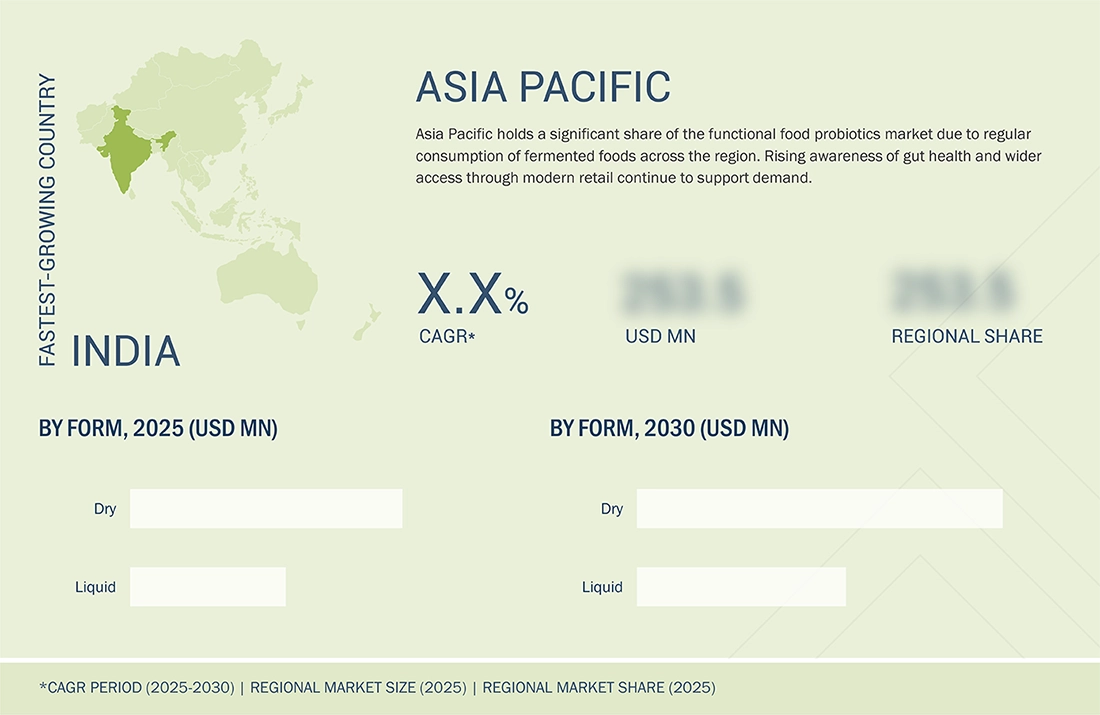
Asia Pacific to be fastest-growing region in global functional food probiotics market
The Asia Pacific region is the largest and most dynamic market for functional food probiotics globally. Asia’s rising population and urbanization are increasing the need for better food nutrition. Young people in the region are increasingly more mindful of spending and have increased awareness towards gut health, immune response, and microbiome. This shift in focus makes Asia Pacific the largest growth engine for probiotic-based functional policies. Functional food probiotics are culturally accepted, readily available, and easily incorporated into daily use in the region. New structured retail, pharmacy distribution, and online shopping, coupled with local producers, are improving food probiotics access. Asia has a strong base in food processing, and new investments in probiotics formulations are improving access to food probiotics. Easily attainable probiotic functional foods and supportive legislation for functional food and food supplements are improving product development and access. The need for preventive health measures, a busy lifestyle, and clean-label nutrition is improving the adoption of probiotics. All these reasons make the Asia Pacific the fastest-growing regional market for functional food probiotics.
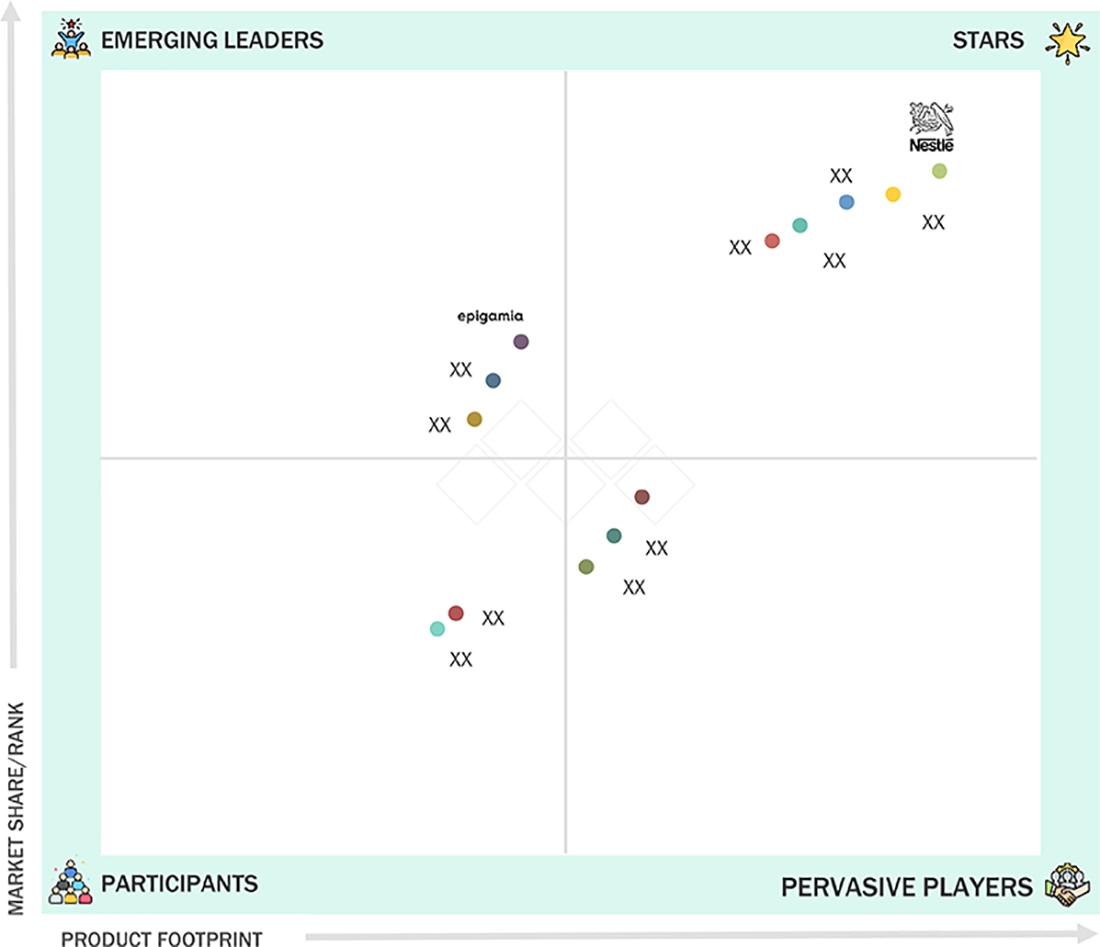
FUNCTIONAL FOOD PROBIOTICS MARKET: COMPANY EVALUATION MATRIX
In the functional food probiotics market landscape, Nestlé and Danone (Stars) lead with a strong market presence supported by their extensive production capabilities, broad functional probiotics food portfolios, and well-established distribution networks across various channels. They offer proven probiotic strains, high-quality formulations, and trusted brands across regions. Emerging players such as Epigamia and Pendulum (Emerging Leaders) are gaining popularity by targeting gut health and immunity through differentiated formulations.
Source: Secondary Research, Interviews with Experts, MarketsandMarkets Analysis
KEY MARKET PLAYERS
- Nestlé (Switzerland)
- Danone (France)
- General Mills (US)
- Arla Foods (Denmark)
- Meiji Co., Ltd. (Japan)
- Morinaga Milk Industry Co., Ltd. (Japan)
- Lifeway Foods, Inc. (US)
- Lallemand Inc. (Canada)
- Velbiom (India)
- NextFoods, Inc. (US)
- The Good Bug (India)
- Pendulum (US)
- Epigamia (India)
- Good Culture (US)
- Biomel (UK)
MARKET SCOPE
| REPORT METRIC | DETAILS |
|---|---|
| Market Size in 2024 (Value) | USD 53.30 Billion |
| Market Forecast in 2030 (Value) | USD 84.90 Billion |
| Growth Rate | CAGR of 8.2% from 2025 to 2030 |
| Years Considered | 2020–2030 |
| Base Year | 2024 |
| Forecast Period | 2025–2030 |
| Units Considered | Value (USD Billion), Volume (Kilotons) |
| Report Coverage | Revenue forecast, company ranking, competitive landscape, growth factors, and trends |
| Segments Covered |
|
| Region Covered | North America, Europe, Asia Pacific, South America, Rest of the World |
WHAT IS IN IT FOR YOU: FUNCTIONAL FOOD PROBIOTICS MARKET REPORT CONTENT GUIDE
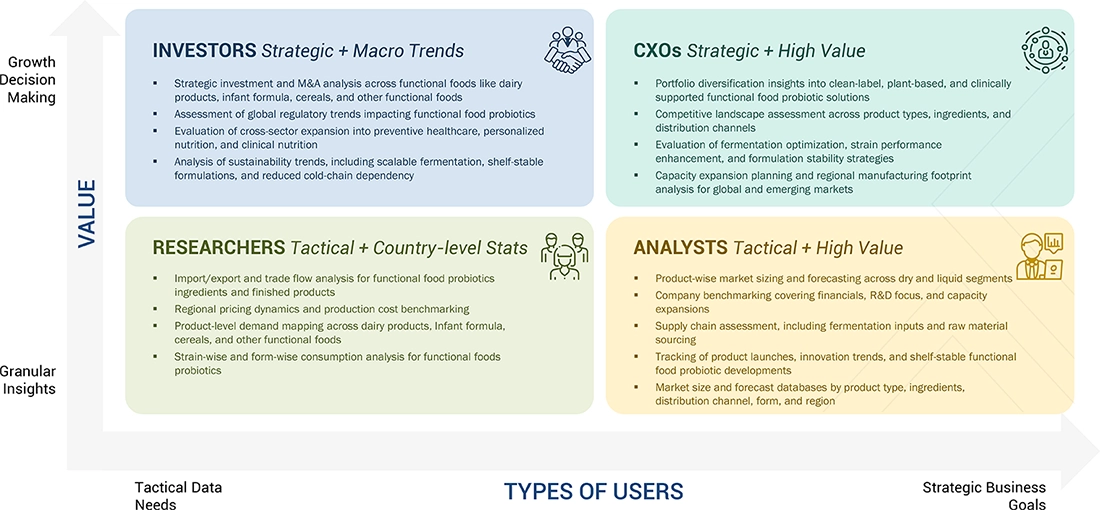
DELIVERED CUSTOMIZATIONS
We have successfully delivered the following deep-dive customizations:
| CLIENT REQUEST | CUSTOMIZATION DELIVERED | VALUE ADDS |
|---|---|---|
| Functional food Probiotics Ingredients Market |
|
|
| Clean-label Functional Foods Market |
|
|
| Gut Health Nutrition Market |
|
|
RECENT DEVELOPMENTS
- October 2025 : Lallemand Health Solutions showcased new probiotic solutions at Vitafoods Asia 2025, introducing clinically supported strains targeting digestive health, women’s health, and healthy aging for functional food applications.
- July 2025 : Lifeway Foods, Inc. (US) expanded its probiotic dairy distribution with thousands of new retail placements across major US supermarket chains, strengthening market reach for kefir and cultured functional foods.
- March 2025 : Lallemand Health Solutions launched “Cerenity,” a new clinically studied probiotic formula developed to support healthy aging. The product targets cognitive health, stress balance, and overall vitality, expanding Lallemand’s science-based probiotic portfolio for functional nutrition.
Table of Contents
 Exclusive indicates content/data unique to MarketsandMarkets and not available with any competitors.


Personalize This Research
- Triangulate with your Own Data
- Get Data as per your Format and Definition
- Gain a Deeper Dive on a Specific Application, Geography, Customer or Competitor
- Any level of Personalization
Let Us Help You
- What are the Known and Unknown Adjacencies Impacting the Functional Food Probiotics Market
- What will your New Revenue Sources be?
- Who will be your Top Customer; what will make them switch?
- Defend your Market Share or Win Competitors
- Get a Scorecard for Target Partners

Custom Market Research Services
We Will Customise The Research For You, In Case The Report Listed Above Does Not Meet With Your Requirements
Get 10% Free CustomisationTESTIMONIALS

Business Innovation Director
US Based Leading Agribusiness,
Food and Ingredients ManufacturerI highly appreciate the team's efficiency for a well conducted study that helped us clarify some blind spots in food and agricultural niche markets. Although compiling information for B2B markets is very difficult, the MnM team pulled out the task successfully. The quality of research, level of insights, and responsiveness of team were commendable.






Growth opportunities and latent adjacency in Functional Food Probiotics Market