Fundus Camera Market

Fundus Camera Market by Product (Mydriatic and Non Mydriatic Fundus Cameras, Hybrid Fundus Cameras), Modality (Mobile, Stationary), Application (Diabetic Retinopathy, Glaucoma), End User (Hospitals, Ophthalmology Clinics): Global Forecast to 2031




FUNDUS CAMERA MARKET SIZE, SHARE & GROWTH SNAPSHOT
The fundus camera market is projected to reach USD 0.61 billion by 2031 from USD 0.45 billion in 2025, at a CAGR of 5.9% during the forecast period. The fundus camera market is driven by the rising prevalence of diabetic retinopathy, glaucoma, and age-related macular degeneration, an increasing geriatric population, and rapid adoption of AI-enabled retinal imaging and non-mydriatic devices. Growing healthcare expenditure, expansion of large-scale eye-screening programs, and the proliferation of teleophthalmology and portable, smartphone-based fundus cameras further boost demand. However, the high cost of advanced systems and a limited number of trained ophthalmic technicians restrict market growth. Meanwhile, advancements in AI-based image analysis, handheld and mobile imaging, and ROP screening present significant opportunities for future market expansion.
KEY TAKEAWAYS
-
BY END USERHospitals hold the largest market share in the fundus camera market because they serve as primary centers for both diagnostic and surgical eye care services. They are equipped with advanced infrastructure, skilled ophthalmologists, and comprehensive care facilities, attracting a high patient volume. Additionally, hospitals' ability to invest in high-end imaging systems for complex screening and follow-up strengthens their dominance over other end users in the market.
-
BY REGIONNorth America holds the largest market share in the fundus camera market due to its advanced healthcare infrastructure, strong presence of leading manufacturers, and high adoption of AI-enabled retinal screening. The region's growing elderly population, high prevalence of diabetes and diabetic retinopathy, and favorable reimbursement policies further drive demand. Continuous technological advancements and robust R&D investments sustain North America's leadership in the market.
-
COMPETITIVE LANDSCAPEThe major market players have adopted both organic and inorganic strategies, including product launches, partnerships, and acquisitions. For instance, leading companies such as Canon Inc. (Japan), Carl Zeiss Meditec AG (Germany), Topcon Healthcare (Japan), and NIDEK Co., Ltd. (Japan) have expanded their portfolios and entered collaborations to strengthen their product offerings and meet the rising demand for AI-enabled and portable retinal imaging from screening programs and eye care providers.
Non-mydriatic fundus cameras hold the largest market share in the fundus camera market due to their patient comfort, faster workflow, and suitability for large-scale diabetic retinopathy and community screening programs. Technological advancements such as automated alignment, color and red-free imaging, and integration with AI grading software have improved usability and throughput. Additionally, a growing geriatric population, expanding tele-screening initiatives, and rising preference for dilation-free imaging further support segment dominance.
TRENDS & DISRUPTIONS IMPACTING CUSTOMERS' CUSTOMERS
The fundus camera market is undergoing significant transformation, driven by rapid technological advancements and evolving clinical demands. While traditional systems such as mydriatic tabletop cameras remain vital, the market is steadily shifting toward next-generation, high-growth segments. Emerging technologies—including AI-enabled diabetic retinopathy grading, ultra-widefield imaging, handheld and smartphone-based fundus cameras, and teleophthalmology platforms—are revolutionizing eye care delivery by enhancing precision, automation, and patient access. Furthermore, miniaturization of imaging devices and integration with cloud-based data management are enabling remote screening and faster clinical decisions. This technological evolution is reshaping workflows across hospitals, clinics, and screening camps, empowering providers to improve efficiency, expand accessibility, and deliver personalized eye care in an increasingly digital and patient-centered healthcare ecosystem.
MARKET DYNAMICS

Level
-
Increasing geriatric population

-
Rising prevalence of diabetic retinopathy and glaucoma


Level
-
High cost of advanced fundus cameras

-
Shortage of trained ophthalmic technicians


Level
-
Growth opportunities in emerging screening programs

-
Adoption of AI-enabled and handheld fundus cameras


Level
-
Limited access to eye care in low-income countries

-
Reimbursement variability across regions

Source: Secondary Research, Interviews with Experts, MarketsandMarkets Analysis
Driver: Rising prevalence of retinal diseases and screening programs
The rising global prevalence of diabetic retinopathy, glaucoma, and age-related macular degeneration is driving the fundus camera market by increasing the need for early and large-scale retinal screening. Innovations such as AI-powered image grading, non-mydriatic imaging, and ultra-widefield systems enhance diagnostic precision and throughput. Digital connectivity, teleophthalmology, and integration of cloud-based platforms improve workflow efficiency and accessibility. These advancements also support early disease detection, community screening, and personalized care, significantly increasing demand for advanced fundus imaging worldwide.
Restraint: High cost of advanced fundus imaging systems
The high cost of advanced fundus cameras and AI-enabled imaging platforms is restraining the growth of the market. Premium tabletop and ultra-widefield systems involve substantial investment and maintenance expenses, limiting adoption, especially in developing regions and smaller clinics. Additionally, the need for trained operators and recurring software and connectivity costs create hesitation among providers. These financial and operational challenges hinder wider accessibility and slow the overall adoption of advanced retinal imaging solutions.
Opportunity: AI, handheld, and teleophthalmology expansion
Emerging markets and screening programs present significant growth opportunities for the fundus camera market due to their large at-risk patient populations, rising incidence of diabetes, and expanding access to primary eye care. Handheld and smartphone-based fundus cameras, combined with AI-based grading and teleophthalmology, enable cost-effective mass screening in remote and underserved settings. Government blindness-prevention initiatives and growing investments in portable diagnostics further strengthen the opportunity for affordable, scalable retinal imaging.
FUNDUS CAMERA MARKET: COMMERCIAL USE CASES ACROSS INDUSTRIES
| COMPANY | USE CASE DESCRIPTION | BENEFITS |
|---|---|---|
 |
Develops non-mydriatic and hybrid fundus cameras with high-resolution retinal imaging and automated capture for diabetic retinopathy and glaucoma screening. | Improves diagnostic precision, reduces examination time, and supports high-throughput retinal screening workflows. |
 |
Provides high-resolution diagnostic imaging systems such as fundus cameras, ultra-widefield, and OCT platforms with AI integration. | Enables early and accurate detection of retinal and glaucoma disorders, supporting data-driven clinical decision-making. |
 |
Offers tabletop and robotic fundus cameras with advanced color imaging and digital integration for connected eye care. | Enhances image quality, increases clinician efficiency, and streamlines retinal documentation and follow-up. |
 |
Manufactures diagnostic and monitoring systems including digital fundus cameras and combined imaging refraction systems. | Facilitates non-invasive eye examinations, supports teleophthalmology, and improves access to eye care in remote settings. |
Logos and trademarks shown above are the property of their respective owners. Their use here is for informational and illustrative purposes only.
MARKET ECOSYSTEM
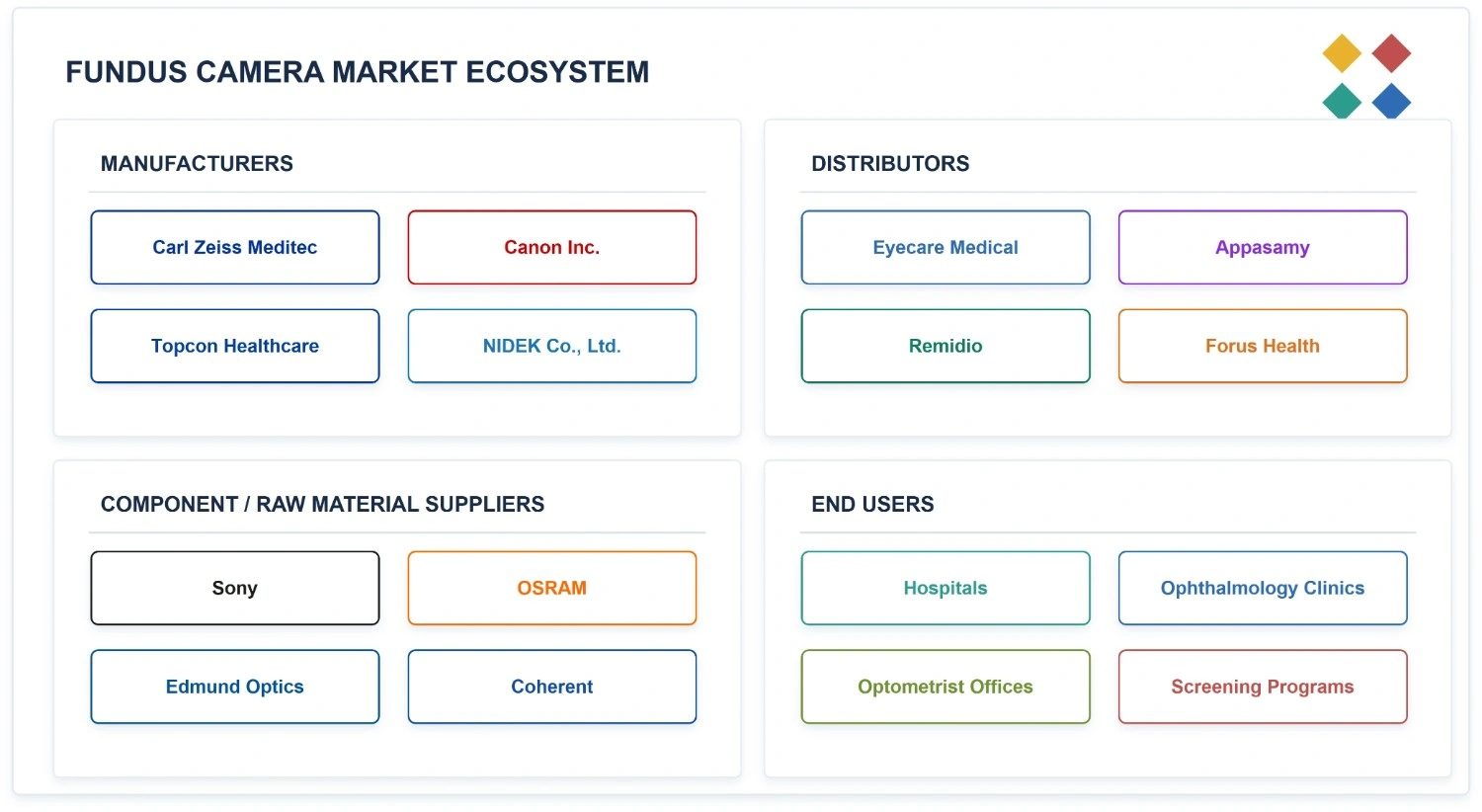
The fundus camera market is characterized by a well-integrated ecosystem that spans from raw material and component suppliers to end users, ensuring the production and delivery of advanced retinal imaging solutions. Direct and third-party suppliers provide essential optics, sensors, and illumination components, which are then utilized by leading manufacturers such as ZEISS, Topcon, Canon, NIDEK, and Optos to develop innovative diagnostic devices. These products reach the market through a diverse network of distributors, including key players like Eyecare Medical, Remidio, Appasamy Associates, and Forus Health, who facilitate sales and support to medical institutions. The primary end users in this ecosystem are prominent healthcare providers and specialized eye hospitals, including NHS, Aravind Eye Care System, Moorfields Eye Hospital, Bascom Palmer Eye Institute, and Mass Eye and Ear, emphasizing the market's focus on quality patient outcomes and technological advancement.
Logos and trademarks shown above are the property of their respective owners. Their use here is for informational and illustrative purposes only.
MARKET SEGMENTS
Fundus Camera Market, By Product Type
Non-mydriatic fundus cameras hold the largest market share in the product type segment due to patient comfort and suitability for high-volume diabetic retinopathy screening. Advanced features such as automated alignment, AI-assisted grading, and red-free imaging have improved capture quality, throughput, and ease of use. Increasing awareness, expanding access to community screening in emerging economies, and growing preference for dilation-free imaging further drive the dominance of non-mydriatic cameras in the market.
Fundus Camera Market, By Modality
Stationary/tabletop fundus cameras hold the largest market share due to their superior resolution, wide field of view, and established use across hospitals and ophthalmology clinics. These systems require fixed infrastructure but deliver detailed, surgical-grade retinal documentation. A large installed base, strong service networks, and compatibility with advanced imaging modules continue to support the dominance of tabletop systems, even as mobile and handheld devices grow in point-of-care settings.
Fundus Camera Market, By End User
Hospitals hold the largest market share in the fundus camera market because they serve as primary centers for comprehensive eye care, offering both diagnostic and surgical services under one roof. Equipped with advanced infrastructure and skilled ophthalmologists, hospitals attract a high patient volume for complex screening and follow-up. Their ability to invest in high-cost, technologically advanced imaging devices and provide specialized care further strengthens their dominance over other end users in the market.
Fundus Camera Market, By Product Type
Non-mydriatic fundus cameras hold the largest market share in the product type segment due to patient comfort and suitability for high-volume diabetic retinopathy screening. Advanced features such as automated alignment, AI-assisted grading, and red-free imaging have improved capture quality, throughput, and ease of use. Increasing awareness, expanding access to community screening in emerging economies, and growing preference for dilation-free imaging further drive the dominance of non-mydriatic cameras in the market.
Fundus Camera Market, By Modality
Stationary/tabletop fundus cameras hold the largest market share due to their superior resolution, wide field of view, and established use across hospitals and ophthalmology clinics. These systems require fixed infrastructure but deliver detailed, surgical-grade retinal documentation. A large installed base, strong service networks, and compatibility with advanced imaging modules continue to support the dominance of tabletop systems, even as mobile and handheld devices grow in point-of-care settings.
Fundus Camera Market, By End User
Hospitals hold the largest market share in the fundus camera market because they serve as primary centers for comprehensive eye care, offering both diagnostic and surgical services under one roof. Equipped with advanced infrastructure and skilled ophthalmologists, hospitals attract a high patient volume for complex screening and follow-up. Their ability to invest in high-cost, technologically advanced imaging devices and provide specialized care further strengthens their dominance over other end users in the market.
REGION
The Asia Pacific region is projected to grow at the highest CAGR in the fundus camera market
The Asia Pacific region is projected to grow at the highest CAGR in the fundus camera market during the forecast period due to its rapidly aging population, rising incidence of diabetes and vision disorders, and expanding access to advanced eye care. Increasing healthcare investments, government initiatives for blindness prevention, and growing awareness of early eye disease detection are further driving market growth. Additionally, the presence of local manufacturers, improving healthcare infrastructure, and growing adoption of affordable handheld and AI-enabled imaging technologies are fueling strong regional expansion.
FUNDUS CAMERA MARKET: COMPANY EVALUATION MATRIX
In the Fundus Camera Market matrix, Carl Zeiss Meditec (Star) leads with a strong global presence and a comprehensive retinal imaging portfolio spanning fundus, ultra-widefield, and OCT platforms. Topcon Healthcare (Emerging Leader) is gaining traction with innovative robotic and AI-enabled fundus imaging, positioning itself for rapid growth. While Carl Zeiss Meditec dominates with scale and established market leadership, Topcon Healthcare demonstrates strong potential to advance toward the leaders' quadrant.
KEY MARKET PLAYERS
- Canon Inc. (Japan)
- Carl Zeiss Meditec AG (Germany)
- Topcon Healthcare (Japan)
- NIDEK Co., Ltd. (Japan)
- Kowa Company, Ltd. (Japan)
- Optos plc (UK)
- Revenio Group (Finland)
- Heidelberg Engineering (Germany)
- Optomed Oyj (Finland)
- Visionix / Luneau Technology (France)
- Epipole Ltd. (UK)
- Phelcom Technologies (Brazil)
- Forus Health Pvt. Ltd. (India)
- Remidio Innovative Solutions (India)
- Nikon Corporation (Japan)
- CenterVue / iCare (Italy)
MARKET SCOPE
| REPORT METRIC | DETAILS |
|---|---|
| Market Size Value in 2025 | USD 0.45 Billion |
| Revenue Forecast in 2031 | USD 0.61 Billion |
| Growth Rate | CAGR of 5.9% from 2025-2031 |
| Actual data | 2023-2031 |
| Base year | 2024 |
| Forecast period | 2025-2031 |
| Units considered | Value (USD Million), Volume (Units) |
| Report Coverage | Revenue Forecast, Company Ranking, Competitive Landscape, Growth Factors, and Trends |
| Segments Covered | Product Type, Modality, Application, End User, and Region |
| Regional Scope | North America, Europe, Asia Pacific, Latin America, the Middle East & Africa, and GCC Countries |
WHAT IS IN IT FOR YOU: FUNDUS CAMERA MARKET REPORT CONTENT GUIDE
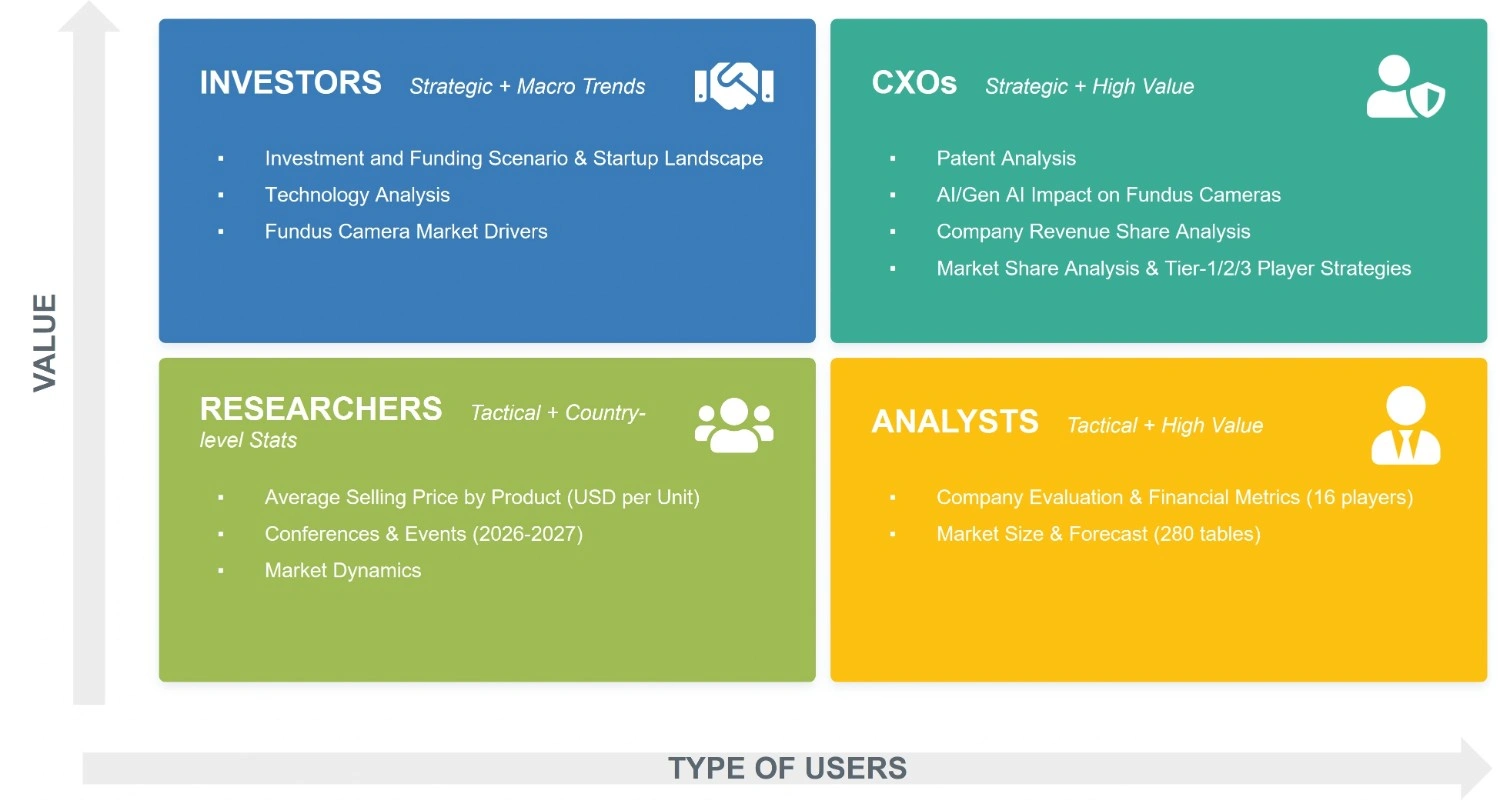
DELIVERED CUSTOMIZATIONS
We have successfully delivered the following deep-dive customizations:
| CLIENT REQUEST | CUSTOMIZATION DELIVERED | VALUE ADDS |
|---|---|---|
| Product Analysis | Comparative assessment of key fundus camera categories: mydriatic, non-mydriatic, hybrid, and ROP cameras across tabletop and handheld modalities. Analysis included pricing trends, technology evolution (AI grading, ultra-widefield, smartphone-based imaging), and adoption benchmarks. | Enables identification of high-demand product segments and emerging technologies driving precision and automation in retinal screening; supports strategic investment and product development decisions. |
| Company Information | Profiles of major players such as Canon Inc., Carl Zeiss Meditec AG, Topcon Healthcare, NIDEK Co., Ltd., and Optos plc. Insights included product portfolios, partnerships, R&D pipelines, AI integration, and global expansion strategies. | Provides visibility into competitive positioning, innovation focus (AI-enabled imaging, cloud-based data sharing), and strategic moves such as M&A and partnerships shaping the retinal imaging landscape. |
| Geographic Analysis | Detailed regional breakdown covering North America, Europe, Asia-Pacific, and Rest of World. Client-focused analysis included APAC high-growth markets (China, India, Japan) with emphasis on screening programs, healthcare infrastructure, and regulatory environment. | Supports market entry planning, identification of emerging regional opportunities, and optimization of distribution strategies; assists in prioritizing investment and partnership initiatives in high-growth economies. |
RECENT DEVELOPMENTS
- March 2024 : Topcon Healthcare expanded its automated retinal imaging portfolio, integrating AI-based screening workflows to support faster and more accessible diabetic retinopathy detection.
- October 2023 : Carl Zeiss Meditec advanced its retinal imaging platforms with enhanced ultra-widefield and connectivity features, supporting early detection and data-driven clinical decisions.
- February 2023 : Optos introduced next-generation ultra-widefield devices designed to capture a panoramic retinal view in a single image, improving peripheral pathology detection.
- August 2022 : Remidio and Forus Health expanded handheld and smartphone-based fundus camera offerings to enable large-scale, low-cost screening in remote and underserved settings.
- January 2022 : NIDEK strengthened its combined imaging and refraction systems, enhancing teleophthalmology capabilities and remote eye examination workflows.
Table of Contents
 Exclusive indicates content/data unique to MarketsandMarkets and not available with any competitors.


Personalize This Research
- Triangulate with your Own Data
- Get Data as per your Format and Definition
- Gain a Deeper Dive on a Specific Application, Geography, Customer or Competitor
- Any level of Personalization
Let Us Help You
- What are the Known and Unknown Adjacencies Impacting the Fundus Camera Market
- What will your New Revenue Sources be?
- Who will be your Top Customer; what will make them switch?
- Defend your Market Share or Win Competitors
- Get a Scorecard for Target Partners

Custom Market Research Services
We Will Customise The Research For You, In Case The Report Listed Above Does Not Meet With Your Requirements
Get 10% Free CustomisationTESTIMONIALS

JAYANT RAJPUROHIT
Director of Market Insights, Data and Analytics
SFI Health,
Leading Pharmaceutical Companywww.sfihealth.com/
We at SFI Health approached MarketsandMarkets for an Opportunity Assessment on "Incidence and Prevalence of Focus Indications" as we wanted to know the most attractive HCPs like Physician, Functional MD, Naturopath and Pharmacist. The project was critical for us to ensure our focus on the right target which would enable sustainable growth and profitability for SFI Health. The business insights provided exceeded our expectations and we were extremely impressed. The team at MarketsandMarkets is highly professional and detail oriented and very well understood our business needs. MarketsandMarkets offers a unique combination of expertise and dedicated engagement model. We identified 2 new products to be launched in coming months, based on the research findings provided by MarketsandMarkets. We are happy with the services and would strongly recommend MarketsandMarkets to my peers in the industry.

BEATRIZ DE LA CALLE
Head of Commercial Analytics
Qualicaps,
Leading Pharmaceutical Companywww.qualicaps.com/

We partnered with MarketsandMarkets for an assessment study on hard empty capsules. The team was extremely professional in understanding our business requirements and we received timely responses to all our queries. The market intelligence and the recommendations has met our business requirements. We were extremely impressed to see the final study results; it really exceeded our expectations. The market intelligence offered by MarketsandMarkets, and clarity on next steps will help us achieve our business objective for the Year 2021. We are happy with the services and would strongly recommend MarketsandMarkets to my peers in the industry.

Bob Williams,
Senior Director Business Development & Innovation
Bracco Diagnostics Inc.,
Italian Multinational in life sciences sector and a World Leader in imaging diagnosticsimaging.bracco.com/us-en
We were pleased with targeted insights that MarketsandMarkets identified from a custom study on the 'Radiation Dose Management Solutions Market'. Your team identified and characterized the market participants as well as underlying trends accurately. This study was useful to Bracco in formulating business strategies for our dose monitoring product lines and we thank MarketsandMarkets for the job well done.
Cody Coonradt,
Market Development and Strategy Manager
3M Health Information Systems,
Leader in Health care Coding, Payment & Analytics Solutions.www.3m.com/3M/en_US/health-information-systems-us
The value for our organization comes from three things: depth of research, specificity of segments and being easy to work with. As important as the first two are, the third can't be underestimated. MarketsandMarkets, maybe more than any other research vendor, wants to know what is top of mind for our team and what big questions we are grappling to answer.
Their customer first approach and high value engagement model, have given us great analysis and excellent value for money






Growth opportunities and latent adjacency in Fundus Camera Market