
South Africa Aliphatic Hydrocarbon Solvents and Thinners Market (2026-2031)

The South Africa Aliphatic Hydrocarbon Solvents and Thinners Market was valued at $52.8 Million in 2026 and projected to reach to $61.4 Million by 2031, representing a compound annual growth rate of 2.5%. South Africa's aliphatic hydrocarbon solvents and thinners market is positioned for steady, albeit moderate, expansion through 2031.


| Market Size in | USD 26.32 MN |
| Market Forecast in | |
| CAGR | |
| Forecast Period | |
| Units Considered | Value (USD MN) |
South Africa Aliphatic Hydrocarbon Solvents and Thinners Market Trends and Insights
- South Africa's market growth is driven by steady demand from the coatings, adhesives, and industrial cleaning sectors, which remain core end-use applications across the region.
- The moderate growth trajectory reflects South Africa's mature industrial base and reliance on imported feedstock, alongside regional economic constraints that temper expansion. South Africa's position within the Middle East Africa region underscores its importance as a chemical hub, yet the country faces competitive pressures from global suppliers and fluctuating currency dynamics.
- South Africa's market is characterized by established distribution networks and established relationships with multinational chemical manufacturers.
- Between 2026 and 2031, South Africa is expected to maintain steady consumption patterns, with incremental gains supported by infrastructure development and recovery in manufacturing activity..
Key Market Statistics
- CAGR (2026-2031) 2.5% CAGR
- Market Size, 2026 ~USD 52.8 Million
- Forecast, 2031 ~USD 61.4 Million
- Country South Africa
South Africa Aliphatic Hydrocarbon Solvents and Thinners Market Overview
Market Size & Growth :
South Africa's aliphatic hydrocarbon solvents and thinners market is valued at USD 52.8 million in 2026, with projected growth to USD 61.4 million by 2031, reflecting a steady CAGR of 2.5%.
Key End-Use Sectors :
The South African market is primarily driven by coatings, adhesives, and industrial cleaning applications, which collectively represent the largest demand segments across manufacturing and construction industries.
Regional Market Dynamics :
South Africa's moderate growth trajectory is supported by stable industrial activity and consistent demand from automotive, construction, and maintenance sectors, though growth remains below the global average of 4.4%.
Market Maturity :
The South African market demonstrates characteristics of a mature, stable segment with established supply chains and established relationships between manufacturers and end-users in traditional industrial applications.
South Africa Aliphatic Hydrocarbon Solvents and Thinners Market Dynamics
- The market benefits from consistent demand across established industrial sectors, particularly in coatings formulation and adhesive production, which remain essential to the region's manufacturing base.
- Growth is supported by ongoing maintenance and repair activities across automotive and construction industries. However, the South African market faces headwinds from slower economic growth compared to global peers and increasing regulatory scrutiny on volatile organic compound (VOC) emissions.
- Market participants must balance traditional solvent applications with emerging eco-friendly alternatives.
- Strategic opportunities exist in specialty formulations and industrial cleaning solutions, though overall expansion will likely remain conservative relative to faster-growing emerging markets..
Market Ecosystem
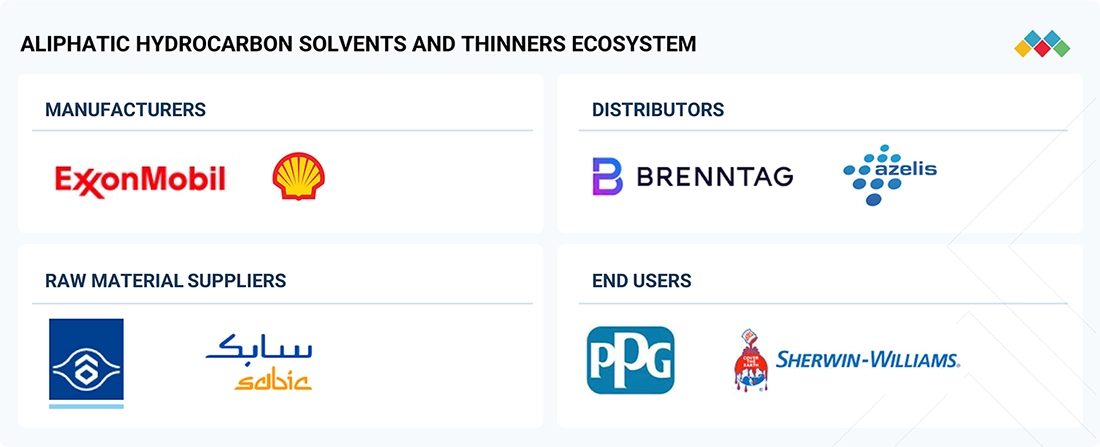
ALIPHATIC HYDROCARBON SOLVENTS & THINNERS MARKET: COMMERCIAL USE CASES ACROSS INDUSTRIES
| COMPANY | USE CASE DESCRIPTION | BENEFITS |
|---|---|---|
 |
The company produces multiple aliphatic hydrocarbon solvent products, which serve different applications in paints and coatings, adhesives and industrial cleaning, while maintaining its dedication to delivering products with reliable quality and performance. | The company provides high-purity solvents that maintain stable chemical composition to support efficient industrial applications and create better surface finishes and dependable operational results. |
 |
The company supplies hydrocarbon solvents, which serve as solutions for coating, ink and cleaning needs through its two product lines of low-aromatic solvents and performance-grade formulations. | The system provides better formulation efficiency through its ability to control evaporation while delivering safer operations with reduced odors and improved handling capabilities. |
 |
The company produces specialized hydrocarbon solvents, which include hexane, heptane and mineral spirits, to serve rubber processing, coating and extraction needs. | The product offers standard quality together with effective solvent capabilities and dependable operation for both industrial uses and specialized industrial applications. |
 |
The company creates petrochemical solvents, which find application in coatings and adhesives and industrial processes to support manufacturers who need high-volume production. | The product delivers a reliable supply together with strong solvency capability and compatibility with different formulations, which leads to better production efficiency. |
 |
The company offers a portfolio of hydrocarbon solvents and mineral spirits tailored for coatings, cleaning, and specialty industrial applications. | This ensures high-performance solvents with controlled volatility, supporting effective cleaning, dilution, and formulation consistency. |
Logos and trademarks shown above are the property of their respective owners. Their use here is for informational and illustrative purposes only.
Related Ecosystem
Bulk Chemicals And Inorganics
- Corrosion Inhibitors
- Glycol Ethers
- Acetic Acid
- Acetone
- Ammonium Nitrate
- Basf se
- DOW CHEMICAL COMPANY
- Exxon Mobil Corporation
- AZELIS HOLDINGS SA
- Sinopec limited
Key Takeaways
- South Africa's aliphatic hydrocarbon solvents market is valued at USD 52.8 million in 2026 and will reach USD 61.4 million by 2031.
- South Africa exhibits a 2.5% CAGR, reflecting moderate but stable growth driven by coatings, adhesives, and industrial applications.
- South Africa's market is constrained by economic headwinds, currency volatility, and dependence on imported raw materials.
- South Africa remains a key chemical distribution hub within the Middle East Africa region, supported by established infrastructure and multinational partnerships.
Aliphatic Hydrocarbon Solvents and Thinners Market Report Scope
| Report Metric | Details |
|---|---|
| Base Year | 2026 |
| Fastest Growing Segment | ADHESIVES (Application) |
| Forecast Period | 2026–2031 |
| Growth Rate | CAGR of 4.4% from 2026 to 2031 |
| Largest Segment | PAINTS & COATINGS (Application) |
| Market Size Base Year (Billions) | ~USD 5.26 (2026) |
| Revenue Forecast (Billions) | ~USD 6.52 (2031) |
| Segments Covered | Type, Application |
South Africa Aliphatic Hydrocarbon Solvents and Thinners Market Report Segmentation
2 segment dimensions are covered across the global market.
By Type
- Heptane
- Hexane
- Mineral Spirits
- Other Types
- Varnish Makers’ & Painters’ Naphtha
By Application
- Adhesives
- Aerosols
- Cleaning & Degreasing
- Other Applications
- Paints & Coatings
- Printing Inks
- Rubbers & Polymers
- South America
Target Audience
- Chemical Manufacturers & Suppliers : South African and international solvent producers need market-specific data to optimize production capacity, manage inventory, and identify growth opportunities within coatings, adhesives, and industrial cleaning segments.
- Coatings & Paint Producers : Manufacturers of paints, varnishes, and protective coatings in South Africa require detailed solvent demand forecasts to ensure reliable supply chain management and formulation optimization for regional customers.
- Adhesive & Sealant Manufacturers : South African adhesive producers depend on accurate solvent market intelligence to plan raw material procurement, manage costs, and develop competitive products for construction and manufacturing applications.
- Industrial Cleaning Service Providers : Cleaning and maintenance companies operating in South Africa need market insights to forecast solvent demand, optimize operational costs, and align service offerings with industrial sector growth trends.
- Investment & Business Development Teams : Private equity, venture capital, and corporate development professionals evaluating South African chemical sector opportunities require credible market data to assess investment viability and growth potential in solvents and thinners.
Key Companies in the South Africa Aliphatic Hydrocarbon Solvents and Thinners Market
| Company | HQ | Ownership | Strongest segments |
|---|---|---|---|
| CEPSA | Spain | Private Company | Refining, supply, and trading of petroleum products,Distribution and marketing of oil and gas products,Petrochemical and oleo-chemical products, |
| MOL GROUP | Hungary | Public Company | Refining, fuels, and petrochemicals (including MOL EVO, LPG, black products),Retail network, Fresh Corner, and mobility services,Upstream, oilfield services, and oilfield chemicals, |
| PETROBRAS | Brazil | Public Company | Exploration and Production,Refining, Transportation & Marketing,Gas and Low Carbon Energies, |
| EXXON MOBIL CORPORATION | United States | Public Company | Upstream (crude oil and natural gas),Energy Products (fuels, aromatics, catalysts, licensing),Chemical Products (olefins, polyolefins, intermediates), |
| SK GEOCENTRIC CO., LTD. | South Korea | Private Company | Olefins and basic aromatics,Polyolefins (LLDPE, HDPE, PP) and copolymers,Performance chemicals and solvents, |
| SHELL | United Kingdom | Public Company | Integrated Gas (including LNG and GTL),Upstream (oil, gas, and NGLs),Marketing (mobility, lubricants, commercial fuels), |
| TOTALENERGIES | France | Public Company | Oil (upstream, refining, marketing),Natural gas and LNG,Renewables and electricity, |
| CHEVRON PHILLIPS CHEMICAL COMPANY LLC | United States | Private Company | Ethylene and olefin chain (including polyethylene and normal alpha olefins),Polyethylene pipes and related applications,Specialty chemicals (organosulfur, solvents, catalysts, drilling and mining chemicals, polyalphaolefins), |
| CALUMET, INC. | United States | Public Company | Specialty Products and Solutions (solvents, waxes, customized and white oils, petrolatums, gels, esters),Montana/Renewables (renewable diesel, SAF, renewable naphtha, conventional fuels, asphalt),Performance Brands (Royal Purple, Bel-Ray, TruFuel and other high-performance products), |
CEPSA
CEPSA is a private company founded in Spain in 1929, employing 10,890 people.
MOL GROUP
MOL Group is a public company headquartered in Hungary, founded in 1991 and employing 24,744 people.
PETROBRAS
Petrobras is a public company based in Brazil, founded in 1953 with 43,199 employees.
EXXON MOBIL CORPORATION
Exxon Mobil Corporation is a public company founded in the United States in 1870, employing 57,900 people.
SK GEOCENTRIC CO., LTD.
SK Geocentric Co., Ltd. is a private company based in South Korea, founded in 1962 with 1,176 employees.
SHELL
Shell is a public company founded in the United Kingdom in 1897, employing 84,000 people.
TOTALENERGIES
TotalEnergies is a public company based in France, founded in 1924 with 94,847 employees.
CHEVRON PHILLIPS CHEMICAL COMPANY LLC
Chevron Phillips Chemical Company LLC is a private company based in the United States, founded in 2000.
CALUMET, INC.
Calumet, Inc. is a public company based in the United States, founded in 1919 with 1,540 employees.
Reasons to Buy this Report
- Accurate Market Sizing : Obtain precise valuation data for South Africa's aliphatic hydrocarbon solvents market with verified 2026 baseline (USD 52.8M) and 2031 forecast (USD 61.4M), enabling confident budget allocation and investment decisions.
- Sector-Specific Insights : Understand demand patterns across South Africa's primary end-use sectors—coatings, adhesives, and industrial cleaning—to identify high-potential customer segments and tailor product offerings accordingly.
- Competitive Positioning : Benchmark your South African operations against market growth trends (2.5% CAGR) and identify competitive advantages in a mature, stable market with established customer relationships and supply chains.
- Regulatory & Sustainability Planning : Anticipate regulatory pressures on VOC emissions and plan product innovation strategies to align with South African environmental standards while maintaining market relevance through the forecast period.
- Strategic Market Entry : Leverage detailed South Africa market analysis to evaluate entry strategies, partnership opportunities, and localization requirements specific to the region's industrial and manufacturing landscape.
Frequently asked questions
What is the market size of aliphatic hydrocarbon solvents in South Africa?
South Africa's aliphatic hydrocarbon solvents and thinners market is estimated at USD 52.8 million in 2026 and is projected to reach USD 61.4 million by 2031.
What is the growth rate for South Africa's aliphatic hydrocarbon solvents market?
South Africa's market is expected to grow at a compound annual growth rate (CAGR) of 2.5% from 2026 to 2031.
Which industries drive demand for aliphatic hydrocarbon solvents in South Africa?
South Africa's primary end-use sectors include coatings, adhesives, industrial cleaning, and manufacturing, which collectively account for the majority of solvent consumption.
What challenges does South Africa's aliphatic hydrocarbon solvents market face?
South Africa faces challenges including economic constraints, currency volatility, reliance on imported feedstock, and competition from global chemical suppliers.
Why is South Africa important in the Middle East Africa chemical market?
South Africa serves as a key chemical distribution and manufacturing hub within the Middle East Africa region, supported by established infrastructure, logistics networks, and relationships with multinational chemical companies.
RESEARCH METHODOLOGY
The research methodology used to estimate the size of the aliphatic hydrocarbon solvents and thinners market consisted of four major activities. Extensive secondary research was conducted to obtain detailed information on the market, peer markets, and parent markets. These findings, assumptions, and metrics were verified through primary interviews with experts from both the demand and supply sides of the aliphatic hydrocarbon solvents and thinners value chain. Both top-down and bottom-up approaches were used to estimate the total market size. The market sizes for various segments and subsegments were finalized using complete market segmentation and data triangulation.
Secondary Research
The research methodology for estimating and forecasting the aliphatic hydrocarbon solvents and thinners market begins with gathering data on key vendors' revenues through secondary research. The secondary research process involves consulting a range of secondary sources, including Hoover's, Bloomberg Businessweek, Factiva, the World Bank, and industry-specific journals. These secondary sources encompass annual reports, press releases, investor presentations, white papers, certified publications, articles from recognized authors, regulatory notifications, trade directories, and databases. Also, vendor offerings are considered to inform market segmentation.
Primary Research
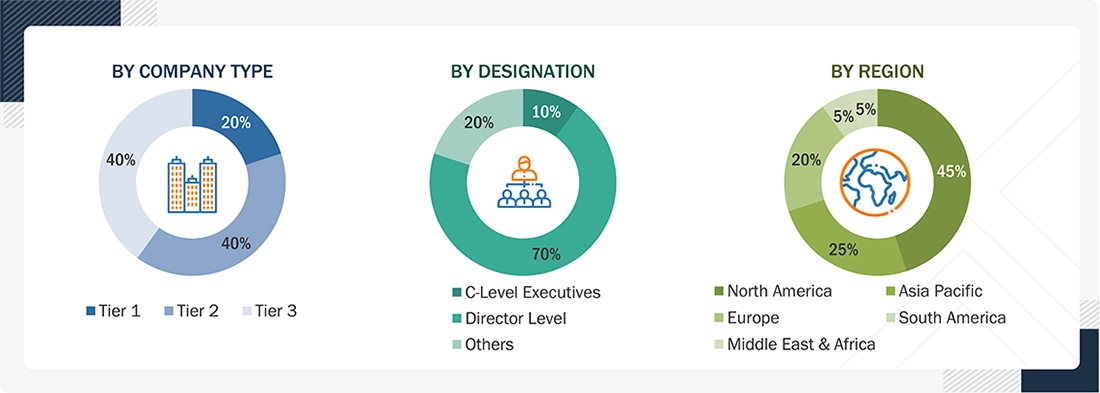
The aliphatic hydrocarbon solvents and thinners market comprises several stakeholders throughout the supply chain, including raw material suppliers, processors, end-product manufacturers, and regulatory organizations. The development of various industries, including type and application, characterizes the demand side of this market. Technological advancements and a wide range of diverse applications characterize the supply side. Various primary sources from both the supply and demand sides of the market were interviewed to obtain qualitative and quantitative information. The following is the breakdown of the primary respondents:
To know about the assumptions considered for the study, download the pdf brochure
Market Size Estimation
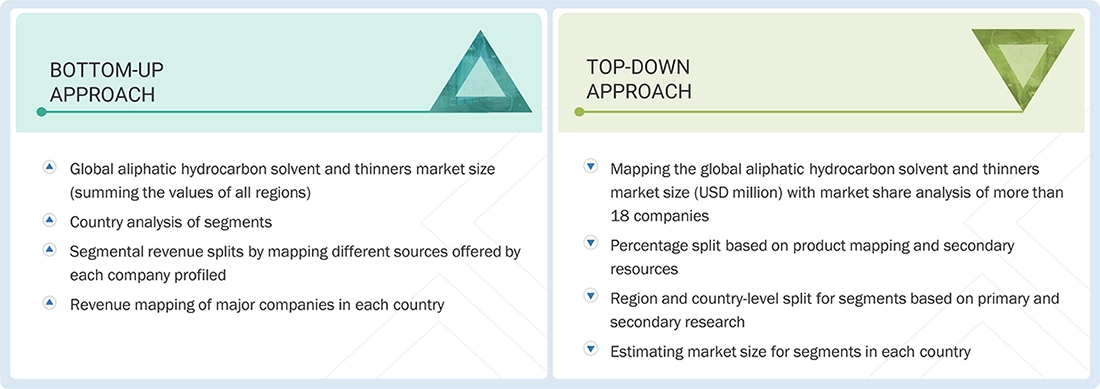
The top-down and bottom-up approaches have been used to estimate and validate the total size of the aliphatic hydrocarbon solvents and thinners market. These approaches have also been widely used to calculate the sizes of various dependent market subsegments. The research methodology used to estimate the market size included the following.
The following segments provide details about the overall market size estimation process employed in this study:
- Extensive primary and secondary research was done to identify the key players.
- The value chain and market size in terms of value of the aliphatic hydrocarbon solvents and thinners market were determined through primary and secondary research.
- All percentage shares, splits, and breakdowns were collected through secondary sources and verified through primary sources.
- All possible parameters that affect the market were covered in this research study and are viewed in extensive detail, verified through primary research, and analyzed to obtain the final quantitative and qualitative data.
- The study of reports, reviews, and newsletters of top market players, along with extensive interviews for opinions from key leaders, such as CEOs, directors, and marketing executives, is included in this research.
Data Triangulation
After estimating the overall market size using the above estimation process, the market was split into various segments and subsegments. Data triangulation and market segmentation techniques, along with the market engineering process, were employed to obtain precise market analysis data for each segment and its subsegments.
Market Definition
Aliphatic hydrocarbon solvents and thinners are petroleum-derived solvents composed primarily of straight-chain or branched alkanes. They are widely used in industrial and commercial applications due to their high solvency, low reactivity, and controlled evaporation. These solvents are commonly utilized in paints & coatings, adhesives, cleaning, and degreasing applications to adjust viscosity and improve application performance. Their ability to dissolve oils, greases, and other nonpolar substances makes them essential in various formulation and processing activities.
Key Stakeholders
- Aliphatic hydrocarbon solvents and thinners manufacturers
- Research institutions, standards organizations, and regulatory agencies such as ASTM, BIS, EDQM, and other national authorities
- Traders, distributors, suppliers, and end users of aliphatic hydrocarbon solvents and thinners
- Contract manufacturing organizations (CMOs)
- NGOs, governments, investment banks, venture capitalists, and private equity firms
Report Objectives
- To define, describe, and forecast the size of the aliphatic hydrocarbon solvents and thinners market, in terms of value, based on type, application, and region
- To provide detailed information regarding the key factors, such as drivers, restraints, opportunities, and industry-specific challenges, influencing the growth of the aliphatic hydrocarbon solvents and thinners market
- To strategically analyze micromarkets with respect to individual growth trends, prospects, and their contribution to the total market
- To analyze opportunities in the market for stakeholders and provide a competitive landscape of the market leaders
- To project the size of the market and its submarkets, in terms of value and volume, with respect to five regions (along with their respective key countries), namely, North America, Asia Pacific, Europe, South America, and the Middle East & Africa
- To provide ecosystem analysis, case study analysis, value chain, patent analysis, technology analysis, pricing analysis, Porter's five forces analysis, key stakeholders and buying criteria, investment and funding scenario, trade analysis, impact of AI/Gen AI and 2025 US tariff, key conferences and events, regulatory bodies, government agencies, and regulations about the market under study
- To strategically profile the key players and comprehensively analyze their core competencies
- To analyze competitive developments such as mergers & acquisitions, product launches, and research & development in the Aliphatic hydrocarbon solvents and thinners market
- To provide the macroeconomic outlook for all regions considered under the study
Available customizations:
Based on the given market data, MarketsandMarkets offers customizations tailored to client-specific needs.
The following customization options are available for the report:
-
Additional country-level analysis of the aliphatic hydrocarbon solvents and thinners market
Profiling of additional market players (up to five)
Product Analysis
- Product matrix, which provides a detailed comparison of each company's product portfolio
Get the Full Aliphatic Hydrocarbon Solvents and Thinners Market Report
Full forecast, segment splits, and company analysis for all Aliphatic Hydrocarbon Solvents and Thinners Market.
- China Aliphatic Hydrocarbon Solvents and Thinners Market
- Japan Aliphatic Hydrocarbon Solvents and Thinners Market
- India Aliphatic Hydrocarbon Solvents and Thinners Market
- South Korea Aliphatic Hydrocarbon Solvents and Thinners Market
- Indonesia Aliphatic Hydrocarbon Solvents and Thinners Market
- Thailand Aliphatic Hydrocarbon Solvents and Thinners Market
- Germany Aliphatic Hydrocarbon Solvents and Thinners Market
- UK Aliphatic Hydrocarbon Solvents and Thinners Market
- France Aliphatic Hydrocarbon Solvents and Thinners Market
- Italy Aliphatic Hydrocarbon Solvents and Thinners Market
- Turkey Aliphatic Hydrocarbon Solvents and Thinners Market
- Canada Aliphatic Hydrocarbon Solvents and Thinners Market
- Mexico Aliphatic Hydrocarbon Solvents and Thinners Market
- US Aliphatic Hydrocarbon Solvents and Thinners Market
- Brazil Aliphatic Hydrocarbon Solvents and Thinners Market
- Argentina Aliphatic Hydrocarbon Solvents and Thinners Market
- Rest Of Europe Aliphatic Hydrocarbon Solvents and Thinners Market
- Rest Of Asia Pacific Aliphatic Hydrocarbon Solvents and Thinners Market
- GCC Countries Aliphatic Hydrocarbon Solvents and Thinners Market
- –Rest Of GCC Countries Aliphatic Hydrocarbon Solvents and Thinners Market
- Rest Of South America Aliphatic Hydrocarbon Solvents and Thinners Market
Need a Tailored Report?
Customize this report to your needs
Get 10% FREE Customization
Customize This Report
