
South America Anti-Migrating Agent Market (2024-2029)

The South America Anti-Migrating Agent Market was valued at $4.96 Million in 2024 and projected to reach to $6.52 Million by 2029, representing a compound annual growth rate of CAGR 5.6%. South America's anti-migrating agent market is positioned for moderate but consistent growth through 2029, driven by expanding industrial applications and regulatory compliance mandates.


| Market Size in | USD 26.32 MN |
| Market Forecast in | |
| CAGR | |
| Forecast Period | |
| Units Considered | Value (USD MN) |
South America Anti-Migrating Agent Market Trends and Insights
- This steady expansion in South America reflects increasing demand from the chemicals and materials sector, driven by rising industrial applications and regulatory compliance requirements across the region.
- South America's market growth is supported by expanding manufacturing capabilities and heightened awareness of product quality and material stability in end-use industries. The anti-migrating agent market in South America is characterized by moderate but consistent expansion through the forecast period.
- South America's growth trajectory, while slightly below the global CAGR of 7%, demonstrates the region's developing market maturity and emerging opportunities in specialty chemicals.
- Key drivers in South America include growing adoption in plastics, coatings, and adhesives applications, alongside increasing investment in industrial infrastructure and manufacturing modernization across major economies in the region..
Key Market Statistics
- CAGR (2024-2029) CAGR 5.6%
- Market Size, 2024 ~USD 4.96 Million
- Forecast, 2029 ~USD 6.52 Million
- Geography South America
South America Anti-Migrating Agent Market Overview
Market Valuation :
South America's anti-migrating agent market is valued at USD 4.96 million in 2024, with Brazil representing the largest market share at USD 3.06 million, followed by Argentina at USD 1.33 million.
Growth Trajectory :
The region is projected to reach USD 6.52 million by 2029, demonstrating a steady CAGR of 5.6%, outpacing several developed markets and reflecting increasing industrial adoption.
Regulatory Drivers :
South America's anti-migrating agent demand is accelerating due to stricter environmental and safety regulations across the chemicals and materials sector, particularly in Brazil and Argentina.
Industrial Applications :
Rising demand from packaging, coatings, and polymer industries in South America is driving market expansion, supported by growing manufacturing capabilities and export-oriented production.
South America Anti-Migrating Agent Market Dynamics
- Brazil's dominance as the region's largest economy ensures it remains the primary growth engine, while Argentina and other South American nations contribute incremental demand.
- The 5.6% CAGR reflects a maturing market with steady adoption across chemicals, coatings, and packaging sectors. Future growth will be supported by increasing foreign direct investment in manufacturing, rising consumer awareness of product safety standards, and regional harmonization of chemical regulations.
- However, economic volatility and currency fluctuations in South America may present challenges.
- Companies investing in the region should focus on localized solutions, regulatory expertise, and partnerships with established distributors to capitalize on emerging opportunities..
Market Ecosystem
Related Ecosystem
Speciality Chemicals
- Corrosion Inhibitors
- Polyetheretherketone (PEEK)
- Acrylonitrile Butadiene Styrene (ABS)
- Epoxy Resin
- Polycarbonate
- Basf se
- DOW CHEMICAL COMPANY
- Evonik industries ag
- Clariant ag.
- Solvay sa
Yarns Fabric And Textile
- Agrotech
- Clothtech
- Indutech
- Oekotech
- Packtech
- MILLIKEN & COMPANY
- Toray Industries, Inc.
- 3M COMPANY
- Kimberly-Clark Corporation
- DuPont de Nemours, Inc.
Key Takeaways
- South America's anti-migrating agent market is valued at USD 4.96 million in 2024 with projected growth to USD 6.52 million by 2029.
- South America exhibits a CAGR of 5.6% over the forecast period, reflecting steady but moderate regional expansion.
- South America's market growth is driven by increasing industrial applications in plastics, coatings, and adhesives sectors.
- South America's developing manufacturing base and regulatory compliance focus support sustained market expansion through 2029.
Anti-Migrating Agent Market Report Scope
| Report Metric | Details |
|---|---|
| Base Year | 2024 |
| Fastest Growing Segment | NATURAL (Source) |
| Forecast Period | 2024-2029 |
| Growth Rate | CAGR of 7% from 2024 to 2029 |
| Largest Segment | SYNTHETIC (Source) |
| Market Size Base Year (Billions) | ~USD 0.16 (2024) |
| Revenue Forecast (Billions) | ~USD 0.22 (2029) |
| Segments Covered | Type, Source, Chemistry, Grade, Application, End-Use Industry |
South America Anti-Migrating Agent Market Report Segmentation
6 segment dimensions are covered across the global market.
By Type
- Amphoteric
- Anionic
- Cationic
- Non-Ionic
By Source
- Natural
- Synthetic
By Chemistry
- Inorganic
- Organic
- -Acrylic Acid
- -Butyl Acrylate
- -Dibutyl Phthalate
- -Ethanol
- -Metal Oxides And Hydroxides
- -Other Inorganic Chemistries
- -Other Organic Chemistries
- -Polyacrylamide
- -Silica And Silicates
- -Sodium Peroxydisulfate
By Grade
- Food
- Pharma
- Technical
By Application
- Coatings
- Digital Printing
- Dyeing
- Other Applications
- Textile Printing
- -Disperse
- -Other Dyeing Applications
- -Vat
By End-Use Industry
- Other End-Use Industries
- Paper
- Plastic
- Plastics
- Textile
Target Audience
- Chemical Manufacturers : South American chemical producers need market data to optimize anti-migrating agent formulations, understand regional demand patterns, and align production with regulatory requirements.
- Packaging & Coatings Companies : Manufacturers in the packaging and coatings sectors require insights into South American anti-migrating agent adoption rates to enhance product performance and meet customer specifications.
- Distributors & Suppliers : Regional distributors and chemical suppliers need market forecasts and country-level data to plan inventory, identify growth opportunities, and strengthen partnerships with end-users.
- Investment & Strategy Teams : Corporate strategists and investors evaluating South American expansion require detailed market sizing, growth projections, and competitive analysis to support M&A and investment decisions.
- Regulatory & Compliance Officers : Compliance professionals need regional market intelligence to understand regulatory drivers, safety standards, and market dynamics influencing anti-migrating agent demand across South America.
Countries within South America - compare and drill down
| Country | 2025 size (native) |
|---|---|
| Brazil | USD 3.06 Million |
| Argentina | USD 1.33 Million |
| Rest Of South America | USD 0.57 Million |
Country market size visualization
Reasons to Buy this Report
- Regional Market Intelligence : Gain detailed insights into South America's USD 4.96 million anti-migrating agent market with country-level breakdowns for Brazil and Argentina, enabling targeted market entry strategies.
- Growth Forecasting : Access accurate 5-year projections showing growth to USD 6.52 million by 2029, helping stakeholders plan capacity investments and resource allocation across the region.
- Competitive Positioning : Understand South America's 5.6% CAGR relative to the global 7% benchmark, identifying market maturity levels and competitive dynamics specific to regional players.
- Regulatory Landscape : Leverage insights on South American regulatory drivers and compliance requirements shaping anti-migrating agent demand in chemicals, coatings, and packaging sectors.
- Investment Decision Support : Make informed decisions on market entry, partnerships, and expansion with comprehensive data on Brazil's dominance and emerging opportunities in secondary South American markets.
Frequently asked questions
What is the current market size of anti-migrating agents in South America?
South America's anti-migrating agent market is valued at USD 4.96 million in 2024.
What is the projected market size for anti-migrating agents in South America by 2029?
South America's anti-migrating agent market is forecast to reach USD 6.52 million by 2029.
What is the CAGR for the anti-migrating agent market in South America?
South America's anti-migrating agent market is expected to grow at a CAGR of 5.6% from 2024 to 2029.
Which industries drive demand for anti-migrating agents in South America?
South America's demand is primarily driven by plastics, coatings, adhesives, and specialty chemicals manufacturing sectors.
How does South America's market growth compare to global trends?
South America's CAGR of 5.6% is slightly below the global CAGR of 7%, reflecting the region's developing market maturity.
RESEARCH METHODOLOGY
The study involved four major activities in estimating the current market size for anti-migrating agents. Exhaustive secondary research was done to collect information on the market, peer market, and parent market. The next step was to validate these findings, assumptions, and sizing with industry experts across the value chain through primary research. Both top-down and bottom-up approaches were employed to estimate the complete market size. After that, the market breakdown and data triangulation methodologies were used to estimate the market size of segments and sub-segments.
Secondary Research
In the secondary research process, various sources have been referred to for identifying and collecting information for this study. The secondary sources include annual reports, press releases, and investor presentations of companies; white papers, journals, and certified publications; and articles from recognized authors, directories, and databases. Secondary data has been collected and analyzed to arrive at the overall market size, which is further validated by primary research. Secondary research has been used to obtain key information about the value chain of the industry, monetary chain of the market, the total pool of key players, market classification and segmentation according to industry trends to the bottom-most level, and regional markets. It was also used to obtain information about the key developments from a market-oriented perspective.
Primary Research
The anti-migrating agent market involves a variety of stakeholders across the value chain, including raw material suppliers, manufacturers, and end-users. For this study, both the supply and demand sides of the market were interviewed to gather qualitative and quantitative information. Key opinion leaders from various end-use sectors were interviewed from the demand side, while manufacturers and associations were interviewed from the supply side.
Primary interviews helped to gather insights on market statistics, revenue data, market breakdowns, market size estimations, market forecasting, and data triangulation. Primary research also helped to identify trends related to type, chemistry, source, grade, application, end-use industries, and region. C-level executives from the demand side, such as CIOs, CTOs, and CSOs, were interviewed to understand their perspective on suppliers, products, and component providers, which will affect the overall market.
Breakdown of primary interviews
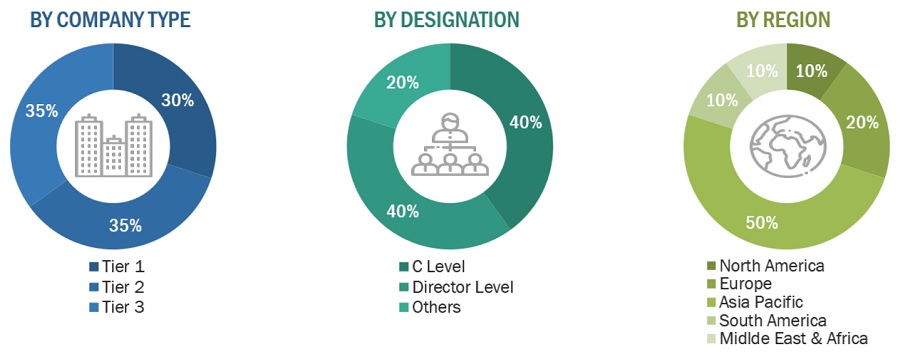
Note: Tier 1, Tier 2, and Tier 3 companies are classified based on their market revenue in 2023 available in the public domain, product portfolios, and geographical presence.
Other designations include sales representatives, production heads, and technicians.
To know about the assumptions considered for the study, download the pdf brochure
|
Company Name |
Designation |
|
Sarex Chemicals |
Sales Manager |
|
Rudolf Group |
Sales Manager |
|
LN Chemicals |
Technical Sales Manager |
|
Taiwan Dyestuff & Pigments Corp. |
Marketing Manager |
|
Spectra Specialities |
R&D Manager |
Market Size Estimation
The top-down approach was used to estimate and validate the size of various submarkets for anti-migrating agent for each region. The research methodology used to estimate the market size included the following steps:The key players in the industry have been identified through extensive secondary research.
The supply chain of the industry has been determined through primary and secondary research.
The global market was then segmented into five major regions and validated by industry experts.
All percentage shares, splits, and breakdowns based on type, chemistry, source, grade, application, end-use industry, and country were determined using secondary sources and verified through primary sources.
All possible parameters that affect the markets covered in this research study were accounted for, viewed in extensive detail, verified through primary research, and analyzed to get the final quantitative and qualitative data. This data was consolidated and added with detailed input and analysis and presented in this report.
Anti-Migrating Agent Market: Bottum-Up Approach
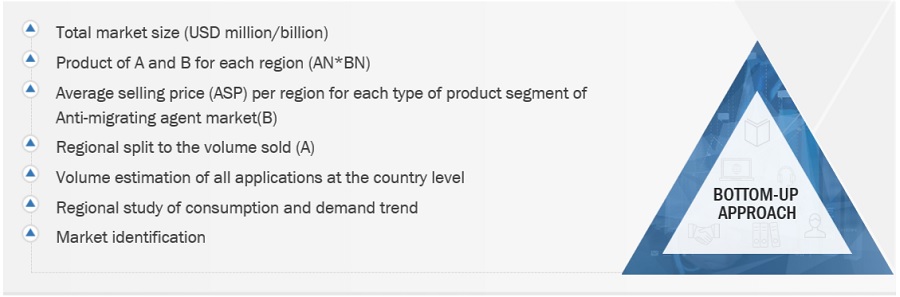
To know about the assumptions considered for the study, Request for Free Sample Report
Anti-Migrating Agent Market: Top-Down Approach
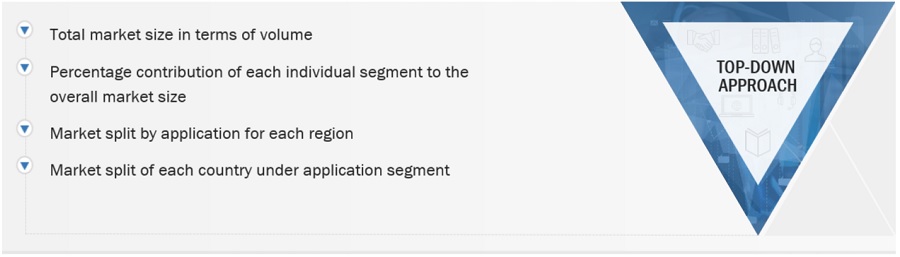
Source: Secondary Research, Interviews with Experts, and MarketsandMarkets Analysis
Data Triangulation
After arriving at the overall market size—using the market size estimation process explained above—the market was split into several segments and sub-segments. To complete the overall market engineering process and arrive at the exact statistics of each market segment and sub-segment, the data triangulation, and market breakdown procedures were employed, wherever applicable. The data was triangulated by studying various factors and trends from both the demand and supply of anti-migrating agent and their applications.
Market Definition
Anti-migrating agents are specialized chemical compounds designed to prevent the unwanted movement or migration of substances within materials. They are primarily used in various industrial processes to maintain the stability and integrity of products by inhibiting the migration of dyes, pigments, additives, or other components from one area to another.
Key Stakeholders
- Manufacturers of anti-migrating agent products
- Raw Material Suppliers
- Manufacturers In End-use Industries
- Traders, Distributors, and Suppliers
- Regional Manufacturers’ Associations
- Government and regional Agencies and Research Organizations
Objectives of the Study:
- To analyze and forecast the size of the anti-migrating agent market in terms of value and volume.
- To provide detailed information about the key factors (drivers, restraints, opportunities, and challenges) influencing the market
- To analyze and forecast the market by type, chemistry, source, grade, application, end-use industry, and region.
- To forecast the size of the market with respect to five regions: Asia Pacific, Europe, North America, South America, and the Middle East & Africa, along with their key countries
- To strategically analyze micromarkets1 with respect to individual trends, growth prospects, and their contribution to the overall market
- To analyze opportunities in the market for stakeholders and provide a competitive landscape for the market leaders.
- To analyze competitive developments in the market, such as investment & expansion, joint venture, partnership, and merger & acquisition
- To strategically profile key players and comprehensively analyze their market shares and core competencies2.
Notes: Micromarkets1 are the sub-segments of the anti-migrating agent market included in the report.
Core competencies2 of companies are determined in terms of their key developments, SWOT analysis, and key strategies adopted by them to sustain in the market.
Available Customizations:
MarketsandMarkets offers the following customizations for this market report.
- Additional country-level analysis of the anti-migrating agent market
- Profiling of additional market players (up to 3)
Get the Full Anti-Migrating Agent Market Report
Full forecast, segment splits, and company analysis for all Anti-Migrating Agent Market.
- US Anti-Migrating Agent Market
- Canada Anti-Migrating Agent Market
- Mexico Anti-Migrating Agent Market
- Germany Anti-Migrating Agent Market
- France Anti-Migrating Agent Market
- UK Anti-Migrating Agent Market
- Italy Anti-Migrating Agent Market
- Brazil Anti-Migrating Agent Market
- Argentina Anti-Migrating Agent Market
- China Anti-Migrating Agent Market
- India Anti-Migrating Agent Market
- Bangladesh Anti-Migrating Agent Market
- Vietnam Anti-Migrating Agent Market
- Egypt Anti-Migrating Agent Market
- Rest Of Europe Anti-Migrating Agent Market
- Rest Of Asia Pacific Anti-Migrating Agent Market
- GCC Anti-Migrating Agent Market
- -Rest Of GCC Anti-Migrating Agent Market
- Rest Of South America Anti-Migrating Agent Market
Need a Tailored Report?
Customize this report to your needs
Get 10% FREE Customization
Customize This Report
