
UK Autonomous Enterprise Market (2024-2029)

The UK Autonomous Enterprise Market was valued at $2374.1 Million in 2024 and projected to reach to $5560.8 Million by 2029, representing a compound annual growth rate of 18.6%. The UK autonomous enterprise market is poised for sustained growth through 2029, driven by increasing digital transformation initiatives and enterprise demand for operational efficiency.


| Market Size in | USD 26.32 MN |
| Market Forecast in | |
| CAGR | |
| Forecast Period | |
| Units Considered | Value (USD MN) |
UK Autonomous Enterprise Market Trends and Insights
- The UK's strong digital infrastructure and investment in AI-driven automation position it as a leading market within Europe for autonomous technologies.
- UK enterprises are increasingly adopting autonomous systems to enhance operational efficiency, reduce costs, and improve decision-making across sectors including finance, manufacturing, and healthcare. Driving the UK market's 18.6% compound annual growth rate is accelerating digital transformation, regulatory support for innovation, and growing demand for intelligent automation solutions.
- The UK's commitment to becoming a global AI hub, combined with substantial R&D spending and a mature technology ecosystem, creates favorable conditions for autonomous enterprise adoption.
- By 2029, the UK market is expected to more than double in size, reflecting the region's strategic focus on autonomous technologies and enterprise modernization..
Key Market Statistics
- CAGR (2024-2029) 18.6% CAGR
- Market Size, 2024 ~USD 2374.1 Million
- Forecast, 2029 ~USD 5560.8 Million
- Country UK
UK Autonomous Enterprise Market Overview
Market Valuation Growth :
The UK autonomous enterprise market is valued at $2,374.1 million in 2024, with a projected CAGR of 18.6% through 2029, reaching $5,560.8 million. This growth trajectory significantly outpaces the global average of 17.6%, positioning the UK as a high-growth market within Europe.
Digital Infrastructure Leadership :
The UK's advanced digital infrastructure and robust technology ecosystem provide a competitive advantage for autonomous enterprise adoption. Strong broadband penetration, 5G rollout, and cloud computing capabilities enable seamless deployment of autonomous systems across enterprises.
AI-Driven Automation Investment :
UK enterprises are significantly investing in AI-driven automation to enhance operational efficiency and reduce costs. Government initiatives and private sector funding support innovation in autonomous technologies, creating a favorable environment for market expansion.
Operational Efficiency Focus :
UK businesses are prioritizing autonomous systems to streamline operations, improve productivity, and maintain competitive advantage. Manufacturing, financial services, and logistics sectors are leading adoption, driving demand for intelligent automation solutions.
UK Autonomous Enterprise Market Dynamics
- UK organizations are leveraging autonomous technologies to optimize workflows, reduce manual processes, and enhance decision-making capabilities.
- The convergence of AI maturity, regulatory clarity, and investment in emerging technologies creates a favorable landscape for market expansion. Key growth drivers include rising labor costs, talent shortages, and the need for 24/7 operational continuity.
- UK enterprises across sectors are recognizing autonomous systems as critical competitive differentiators.
- With strong government support for AI innovation and a skilled workforce, the UK market is expected to maintain its growth momentum, attracting both domestic and international technology providers seeking European market penetration..
Market Ecosystem
Related Ecosystem
Software And Services
- Natural Language Processing (NLP)
- Machine Learning
- Supply Chain Management
- Predictive Analytics
- Image Sensors
- International Business Machines Corporation
- MICROSOFT CORPORATION
- Oracle Corporation
- SAP SE
- Amazon.com, Inc.
Key Takeaways
- The UK autonomous enterprise market will grow from $2,374.1M in 2024 to $5,560.8M by 2029, representing a 18.6% CAGR.
- The UK's advanced digital infrastructure and AI investment strategy position it as Europe's leading autonomous enterprise market.
- UK enterprises across finance, manufacturing, and healthcare are rapidly adopting autonomous systems for operational optimization.
- Regulatory support and R&D funding in the UK are accelerating autonomous technology deployment and market expansion.
Autonomous Enterprise Market Report Scope
| Report Metric | Details |
|---|---|
| Base Year | 2024 |
| Fastest Growing Segment | AUTONOMOUS AGENTS (Solution) |
| Forecast Period | 2024-2029 |
| Growth Rate | CAGR of 17.6% from 2024 to 2029 |
| Largest Segment | SOLUTIONS (Offering) |
| Market Size Base Year (Billions) | ~USD 50.68 (2024) |
| Revenue Forecast (Billions) | ~USD 114 (2029) |
| Segments Covered | Offering, Solution, Service, Business Function, Application, Vertical, Component, Deployment Mode, Organization Size, Technology, Code Type |
UK Autonomous Enterprise Market Report Segmentation
11 segment dimensions are covered across the global market.
By Offering
- Services
- Solutions
By Solution
- Accounts Automation
- Autonomous Agents
- Autonomous Networks
- Other Solutions
- Robotic Process Automation
- Security Automation
By Service
- Managed Services
- Professional Services
By Business Function
- Accounting & Finance
- Finance & Accounting
- Hr
- Human Resource
- It
- Operations & Supply Chain
- Sales & Marketing
- Supply Chain & Operations
By Application
- Compliance & Policy Management
- Credit Evaluation & Management
- Customer & Employee Engagement
- Data Protection & Encryption
- Endpoint Security
- Identity & Access Management (Iam)
- Incident Response Management
- Network Security
- Order Management
- Other Applications
- Predictive Maintenance
- Process Automation
- Vulnerability Management
By Vertical
- Bfsi
- Energy & Utilities
- Government & Defense
- Healthcare
- Healthcare & Life Sciences
- It & Ites
- It & Telecom
- Manufacturing
- Media & Entertainment
- Other Verticals
- Retail & Consumer Goods
- Retail & E-Commerce
- Telecom
- Transportation & Logistics
By Component
- Services
- Solutions
By Deployment Mode
- Cloud
- On-Premises
By Organization Size
- Large Enterprises
- Smes
By Technology
- AI & ML
- Other Technologies
- Predictive Analytics
- Rpa
- Ueba
By Code Type
- Full-Code
- Low-Code
- No-Code
UK: AUTONOMOUS ENTERPRISE MARKET, BY APPLICATION, 2024–2029
| Segment | 2024 | 2025 | 2026 | 2027 | 2028 | 2029 | CAGR (%) |
|---|---|---|---|---|---|---|---|
| CREDIT EVALUATION & MANAGEMENT | 378.7 | 453.3 | 545 | 653.5 | 778.3 | 917.5 | 19.4 |
| CUSTOMER & EMPLOYEE ENGAGEMENT | 528.5 | 623 | 737.4 | 870.7 | 1021 | 1185 | 17.5 |
| ORDER MANAGEMENT | 290.6 | 344.9 | 411.2 | 488.9 | 577.4 | 675.1 | 18.4 |
| OTHER APPLICATIONS | 86.7 | 104.7 | 127.1 | 153.7 | 184.7 | 219.7 | 20.4 |
| PREDICTIVE MAINTENANCE | 293.2 | 355.1 | 431.8 | 523.4 | 630.2 | 750.7 | 20.7 |
| PROCESS AUTOMATION | 796.5 | 941.7 | 1118 | 1323.9 | 1557.1 | 1812.8 | 17.9 |
| TOTAL | 2374.1 | 2822.8 | 3370.4 | 4014.2 | 4748.8 | 5560.8 | 18.6 |
Target Audience
- UK Enterprise Technology Leaders : CIOs and technology directors in UK enterprises need this data to evaluate autonomous system investments, benchmark against peers, and justify budget allocation for digital transformation initiatives aligned with market trends.
- Autonomous Technology Vendors : Software and solution providers targeting the UK market require detailed market sizing, growth forecasts, and sector-specific adoption patterns to develop go-to-market strategies and prioritize sales resources effectively.
- UK Management Consultants : Consulting firms advising UK enterprises on digital transformation need comprehensive market data to support client recommendations, validate business cases, and position autonomous solutions as strategic imperatives.
- Investment & Private Equity Firms : Investors evaluating UK autonomous enterprise companies and market opportunities require detailed market forecasts, growth drivers, and competitive landscape analysis to inform investment decisions and valuation models.
- UK Government & Policy Makers : Government agencies and policy bodies need market intelligence to develop supportive regulations, allocate innovation funding, and understand the UK's competitive position in autonomous enterprise technologies within Europe.
Reasons to Buy this Report
- UK-Specific Market Sizing : Access precise market valuation data for the UK autonomous enterprise sector with detailed 2024 baseline ($2,374.1M) and 2029 forecasts ($5,560.8M), enabling accurate business planning and investment decisions tailored to the UK market.
- Competitive Landscape Intelligence : Understand UK-specific competitive dynamics, key market players, and adoption patterns across industries. Identify market gaps and opportunities unique to the British enterprise landscape for strategic positioning.
- Growth Trajectory Analysis : Leverage the UK's 18.6% CAGR projection to benchmark performance against global trends (17.6%) and identify why the UK market outperforms. Make data-driven decisions on market entry timing and resource allocation.
- Sector-Specific Insights : Gain detailed understanding of autonomous technology adoption across UK sectors including manufacturing, financial services, and logistics. Tailor solutions and go-to-market strategies to high-opportunity verticals.
- Regulatory & Infrastructure Context : Understand UK-specific regulatory environment, digital infrastructure capabilities, and government support mechanisms for autonomous technologies. Navigate compliance requirements and leverage favorable policy conditions for market success.
Frequently asked questions
What is the current size of the UK autonomous enterprise market?
The UK autonomous enterprise market was valued at $2,374.1 million in 2024 and is forecast to reach $5,560.8 million by 2029.
What is the growth rate of the UK autonomous enterprise market?
The UK autonomous enterprise market is growing at a compound annual growth rate (CAGR) of 18.6% from 2024 to 2029.
Which industries in the UK are driving autonomous enterprise adoption?
Key UK industries adopting autonomous enterprise solutions include finance, manufacturing, healthcare, and professional services sectors.
What factors are accelerating the UK autonomous enterprise market?
Digital transformation initiatives, government AI strategy, regulatory support for innovation, and enterprise demand for cost reduction are primary growth drivers in the UK.
How does the UK market compare to other European markets?
The UK's 18.6% CAGR and mature technology ecosystem position it as one of Europe's fastest-growing and most advanced autonomous enterprise markets.
RESEARCH METHODOLOGY
The research study involved four major activities in estimating the autonomous enterprise market size. Exhaustive secondary research has been done to collect important information about the market and peer markets. The next step has been to validate these findings and assumptions and size them with the help of primary research with industry experts across the value chain. Both top-down and bottom-up approaches have been used to estimate the market size. Post which the market breakdown and data triangulation have been adopted to estimate the market sizes of segments and sub-segments.
Secondary Research
The market size of the companies offering autonomous enterprise solutions to various end users was arrived at based on the secondary data available through paid and unpaid sources and by analyzing the product portfolios of major companies in the ecosystem and rating the companies based on their performance and quality. In the secondary research process, various sources were referred to identify and collect information for the study. The secondary sources included annual reports, press releases, investor presentations of companies, white papers, journals, certified publications, and articles from recognized authors, directories, and databases.
Secondary research was mainly used to obtain critical information about industry insights, the market’s monetary chain, the overall pool of key players, market classification, and segmentation according to industry trends to the bottom-most level, regional markets, and key developments from both market- and technology-oriented perspectives.
Primary Research
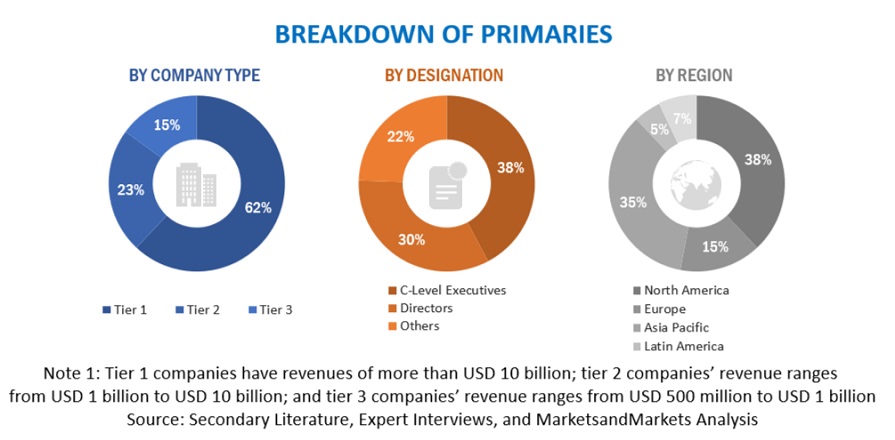
In the primary research process, various sources from the supply and demand sides were interviewed to obtain qualitative and quantitative information for the report, Such as Chief Experience Officers (CXOs), Vice Presidents (VPs), directors from business development, marketing, and product development/innovation teams, and related key executives from autonomous enterprise solution vendors, system integrators, professional and managed service providers, industry associations, independent consultants, and key opinion leaders.
Primary interviews were conducted to gather insights, such as market statistics, data on revenue collected from software and services, market breakups, market size estimations, market forecasts, and data triangulation. Stakeholders from the demand side, such as Chief Information Officers (CIOs), Chief Finance Officers (CFOs), Chief Strategy Officers (CSOs), and the installation team of end users who use autonomous enterprise, were interviewed to understand buyers’ perspectives on suppliers, products, service providers, and their current usage of Autonomous enterprise solutions which is expected to affect the overall autonomous enterprise market growth.
To know about the assumptions considered for the study, download the pdf brochure
Market Size Estimation
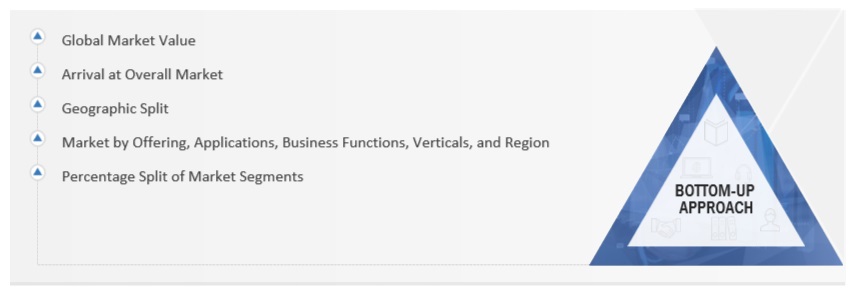
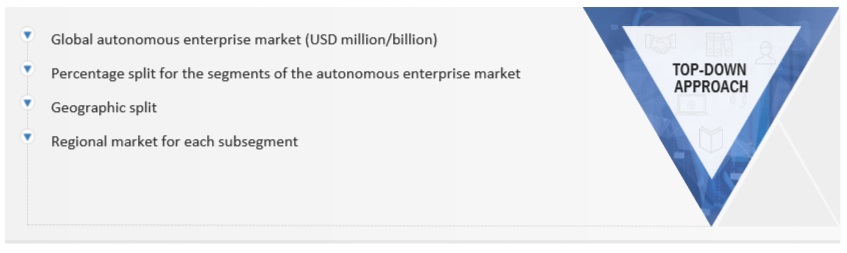
In the market engineering process, the top-down and bottom-up approaches were used along with multiple data triangulation methods to estimate and validate the size of the autonomous enterprise market and other dependent submarkets. The research methodology used to estimate the market sizes includes the following:
- Initially, MarketsandMarkets focuses on top-line investments and spending in the ecosystems. Further, significant developments in the critical market area have been considered.
- Tracking the recent and upcoming developments in the autonomous enterprise market that include investments, R&D activities, product launches, collaborations, mergers and acquisitions, and partnerships, as well as forecasting the market size based on these developments and other critical parameters.
- Conduct multiple discussions with key opinion leaders to learn about the diverse types of authentications and brand protection offerings used and the applications for which they are used to analyze the breakdown of the scope of work carried out by major companies.
- Segmenting the market based on technology types concerning applications wherein the types are to be used and deriving the size of the global application market.
- Segmenting the overall market into various market segments
- Validating the estimates at every level through discussions with key opinion leaders, such as chief executives (CXOs), directors, and operation managers, and finally with the domain experts at MarketsandMarkets
Market Size Estimation Methodology-Bottom-up approach
To know about the assumptions considered for the study, Request for Free Sample Report
Market Size Estimation Methodology-top-down approach
Data Triangulation
After arriving at the overall market size from the above estimation process, the autonomous enterprise market has been split into several segments and sub-segments. To complete the overall market engineering process and arrive at the exact statistics for all segments and sub-segments, data triangulation and market breakdown procedures have been used, wherever applicable. The data has been triangulated by studying various factors and trends from both the demand and supply sides.
The autonomous enterprise market size has been validated using top-down and bottom-up approaches.
Market Definition
Autonomous Enterprise is a self-optimizing business that applies AI and automation to decisions, operations, and servicing across the organization. It is a collection of various solutions that enable business functions such as supply chain and operations, IT, HR, accounting & finance, and sales & marketing in an enterprise.
Stakeholders
- Managed service providers
- Support and maintenance service providers
- System Integrators (Sls)/migration service providers
- Value-Added Resellers (VARs) and distributors
- Distributors and Value-added Resellers (VARs)
- System Integrators (Sls)
- Independent Software Vendors (ISV)
- Third-party providers
- Technology providers
Report Objectives
- To determine and forecast the global autonomous enterprise market by offering (solution and services), business functions, applications, vertical, and region from 2024 to 2029, and analyze the various macroeconomic and microeconomic factors affecting the market growth.
- To forecast the size of the market segments concerning five central regions: North America, Europe, Asia Pacific (APAC), Middle East & Africa (MEA), and Latin America.
- To provide detailed information about the major factors (drivers, restraints, opportunities, and challenges) influencing the growth of the autonomous enterprise market.
- Analyze each submarket concerning individual growth trends, prospects, and contributions to the overall Autonomous enterprise market.
- To analyze the opportunities in the market for stakeholders by identifying the high-growth segments of the autonomous enterprise market.
- To profile the key market players; provide a comparative analysis based on business overviews, regional presence, product offerings, business strategies, and key financials; and illustrate the market’s competitive landscape.
- Track and analyze competitive developments in the market, such as mergers and acquisitions, product developments, partnerships and collaborations, and Research and Development (R&D) activities.
Available Customizations
With the given market data, MarketsandMarkets offers customizations per the company’s specific needs. The following customization options are available for the report:
Geographic Analysis
- Further break-up of the Asia Pacific market into countries contributing 75% to the regional market size
- Further break-up of the North American market into countries contributing 75% to the regional market size
- Further break-up of the Latin American market into countries contributing 75% to the regional market size
- Further break-up of the Middle East African market into countries contributing 75% to the regional market size
- Further break-up of the European market into countries contributing 75% to the regional market size
Company Information
- Detailed analysis and profiling of additional market players (up to 5)
Get the Full Autonomous Enterprise Market Report
Full forecast, segment splits, and company analysis for all Autonomous Enterprise Market.
- Canada Autonomous Enterprise Market
- US Autonomous Enterprise Market
- Italy Autonomous Enterprise Market
- China Autonomous Enterprise Market
- India Autonomous Enterprise Market
- Brazil Autonomous Enterprise Market
- France Autonomous Enterprise Market
- Germany Autonomous Enterprise Market
- Nordics Autonomous Enterprise Market
- Rest Of Europe Autonomous Enterprise Market
- Spain Autonomous Enterprise Market
- Japan Autonomous Enterprise Market
- Rest Of Asia Pacific Autonomous Enterprise Market
- South Korea Autonomous Enterprise Market
- Mexico Autonomous Enterprise Market
- Rest Of Latin America Autonomous Enterprise Market
- Bahrain Autonomous Enterprise Market
- Ksa Autonomous Enterprise Market
- Kuwait Autonomous Enterprise Market
- Rest Of Middle East Autonomous Enterprise Market
- UAE Autonomous Enterprise Market
Need a Tailored Report?
Customize this report to your needs
Get 10% FREE Customization
Customize This Report
