
Germany Battery Cyclers Market (2024-2029)

The Germany Battery Cyclers Market was valued at $54 Million in 2024 and projected to reach to $106.6 Million by 2029, representing a compound annual growth rate of 14.6%. Germany's battery cyclers market is positioned for sustained expansion, driven by the country's leadership in electric vehicle manufacturing and commitment to decarbonization.


| Market Size in | USD 26.32 MN |
| Market Forecast in | |
| CAGR | |
| Forecast Period | |
| Units Considered | Value (USD MN) |
Germany Battery Cyclers Market Trends and Insights
- Germany's position as a leading automotive and electronics manufacturing hub drives significant demand for advanced battery testing solutions.
- The country's strong commitment to electric vehicle adoption and renewable energy storage has accelerated investment in battery cycler technology across manufacturing and R&D facilities. The German market benefits from stringent quality standards and regulatory requirements that mandate comprehensive battery testing protocols.
- Germany's established semiconductor and electronics infrastructure supports rapid adoption of battery cycler systems among OEMs and battery manufacturers.
- With a compound annual growth rate of 14.6%, Germany is poised to become a critical market for battery cycling solutions in Europe through 2029..
Key Market Statistics
- CAGR (2024-2029) 14.6% CAGR
- Market Size, 2024 ~USD 54 Million
- Forecast, 2029 ~USD 106.6 Million
- Country Germany
Germany Battery Cyclers Market Overview
Market Valuation & Growth :
Germany's battery cyclers market is valued at $54.0 million in 2024, with a robust CAGR of 14.6%, projected to reach $106.6 million by 2029, nearly doubling in size over five years.
Automotive Manufacturing Leadership :
As Europe's largest automotive manufacturer, Germany's EV production surge and battery development initiatives create substantial demand for advanced battery testing and cycling equipment across major OEMs and Tier-1 suppliers.
Renewable Energy & Storage Focus :
Germany's aggressive renewable energy targets and grid storage expansion programs drive investment in battery cyclers for energy storage systems, supporting the country's Energiewende (energy transition) goals.
Technology & Innovation Hub :
Germany's concentration of semiconductor, electronics, and automotive R&D centers creates a competitive ecosystem demanding cutting-edge battery testing solutions for product development and quality assurance.
Germany Battery Cyclers Market Dynamics
- Major automotive manufacturers including Volkswagen, BMW, and Mercedes-Benz are significantly increasing battery development investments, creating consistent demand for advanced testing equipment.
- The integration of battery cyclers into production lines and R&D facilities across Germany's industrial base will continue accelerating through 2029. Government incentives for EV adoption, coupled with Germany's renewable energy infrastructure expansion, will further stimulate market growth.
- The country's stringent quality standards and regulatory requirements for battery safety and performance necessitate sophisticated testing solutions.
- Additionally, emerging opportunities in battery recycling and second-life applications present new avenues for battery cycler deployment, supporting the circular economy initiatives central to Germany's industrial strategy..
Market Ecosystem
Related Ecosystem
Battery And Wireless Charging
- Nickel-Cadmium Battery
- Battery Electric Vehicle (BEV)
- Energy Harvesting
- Hybrid Electric Vehicle (HEV)
- Smart Cards
- Panasonic Holdings Corporation
- MOMENTIVE PERFORMANCE MATERIALS INC.
- Lg corp
- FDK Corporation
- Samsung
Automotive Electronics And Electrical Equipment
- Battery Electric Vehicle (BEV)
- Light Commercial Vehicles (LCVs)
- Fuel Cell Electric Vehicle (FCEV)
- Sensors
- Hybrid Electric Vehicle (HEV)
- BOSCH LIMITED
- DENSO Corporation
- Continental ag
- Panasonic Holdings Corporation
- Texas Instruments Incorporated
Energy Storage
- Energy Harvesting
- HVAC System
- Applicant Tracking System
- Battery Electric Vehicle (BEV)
- Carboxymethyl Cellulose (CMC)
- MOMENTIVE PERFORMANCE MATERIALS INC.
- Panasonic Holdings Corporation
- Lg corp
- ABB India Limited
- Byd company ltd.
Key Takeaways
- Germany's battery cyclers market will nearly double from $54.0M (2024) to $106.6M (2029), reflecting 14.6% CAGR growth.
- Germany's automotive sector leadership and EV manufacturing expansion drive sustained demand for battery testing infrastructure.
- Stringent German regulatory standards and quality requirements mandate advanced battery cycler adoption across industries.
- Germany's semiconductor and electronics expertise positions it as a European hub for battery cycler innovation and deployment.
Battery Cyclers Market Report Scope
| Report Metric | Details |
|---|---|
| Base Year | 2024 |
| Fastest Growing Segment | AUTOMOTIVE & TRANSPORTATION (Vertical) |
| Forecast Period | 2024-2029 |
| Growth Rate | CAGR of 15.2% from 2024 to 2029 |
| Largest Segment | END-OF-LINE (Application) |
| Market Size Base Year (Billions) | ~USD 0.79 (2024) |
| Revenue Forecast (Billions) | ~USD 1.61 (2029) |
| Segments Covered | Function, Battery Type, Vertical, Application |
Germany Battery Cyclers Market Report Segmentation
4 segment dimensions are covered across the global market.
By Function
- Cell Testing
- Module Testing
- Pack Testing
By Battery Type
- Lead-Acid
- Lithium-Ion
- Nickel-Based
- Other Battery Types
- Primary
- Secondary
By Vertical
- Automotive & Transportation
- Consumer Electronics
- Education & Research
- Energy & Utilities
- Industrial
- Other Verticals
By Application
- End-Of-Line
- Research
Target Audience
- Automotive OEMs & Suppliers : German car manufacturers and Tier-1 suppliers require detailed market insights to optimize battery testing investments, benchmark against competitors, and align R&D spending with market growth trajectories.
- Battery & Energy Storage Manufacturers : Companies developing batteries for EVs and renewable energy storage need Germany-specific market data to understand demand patterns, identify customer segments, and plan production capacity expansion.
- Equipment & Technology Providers : Manufacturers of battery cyclers and testing equipment need market intelligence to identify sales opportunities, understand customer requirements, and develop products aligned with German industrial standards.
- Investment & Private Equity Firms : Investors evaluating opportunities in Germany's battery and automotive sectors require validated market data to assess growth potential, identify acquisition targets, and make informed funding decisions.
- Government & Policy Organizations : German government agencies and industrial associations need market research to inform energy transition policies, support manufacturing competitiveness, and guide public investment in battery technology infrastructure.
Reasons to Buy this Report
- Market Size & Growth Validation : Quantified market data specific to Germany with precise valuations ($54.0M in 2024) and forecasts ($106.6M by 2029) enables accurate business planning, investment decisions, and revenue projections for the German market.
- Competitive Landscape Intelligence : Understand Germany's unique market dynamics, key players in automotive and electronics sectors, and competitive positioning to identify partnership opportunities and market entry strategies tailored to German manufacturers.
- Sector-Specific Demand Drivers : Detailed insights into Germany's EV production growth, renewable energy expansion, and battery development initiatives provide actionable intelligence on customer needs and emerging market segments within the country.
- Regulatory & Standards Compliance : Germany-specific data on quality standards, safety regulations, and compliance requirements for battery testing equipment ensures products and services meet local market expectations and regulatory frameworks.
- Strategic Investment Planning : Comprehensive market analysis supports capital allocation decisions, facility expansion planning, and resource deployment strategies for companies targeting Germany's high-value automotive and industrial sectors.
Frequently asked questions
What is the current size of Germany's battery cyclers market?
Germany's battery cyclers market was valued at $54.0 million in 2024 and is expected to grow to $106.6 million by 2029.
What is the projected growth rate for Germany's battery cyclers market?
Germany's battery cyclers market is projected to grow at a compound annual growth rate (CAGR) of 14.6% from 2024 to 2029.
Why is Germany a key market for battery cyclers?
Germany's leadership in automotive manufacturing, strong EV adoption, renewable energy initiatives, and stringent quality standards drive significant demand for advanced battery testing solutions.
Which industries in Germany are driving battery cycler demand?
Germany's automotive OEMs, battery manufacturers, semiconductor companies, and renewable energy storage providers are primary drivers of battery cycler adoption.
How does Germany's regulatory environment impact the battery cyclers market?
Germany's stringent quality and safety regulations require comprehensive battery testing protocols, mandating widespread adoption of battery cycler systems across manufacturing facilities.
RESEARCH METHODOLOGY
The study involved four major activities in estimating the current size of the battery cyclers market. Exhaustive secondary research has been done to collect information on the market, peer, and parent markets. The next step has been to validate these findings and assumptions and size them with industry experts across the value chain through primary research. Both top-down and bottom-up approaches have been employed to estimate the total market size. After that, market breakdown and data triangulation methods were used to estimate the market size of segments and subsegments. Two sources of information—secondary and primary—have been used to identify and collect information for an extensive technical and commercial study of the battery cyclers market.
Secondary Research
Secondary sources include company websites, magazines, industry news, associations, and databases (Factiva and Bloomberg). These secondary sources include annual reports, press releases, and investor presentations of companies, white papers, certified publications, articles by recognized authors, regulatory bodies, trade directories, and databases.
Primary Research
Primary sources mainly consist of several experts from the core and related industries, along with preferred battery cyclers providers, distributors, alliances, standards, and certification organizations related to various segments of this industry’s value chain.
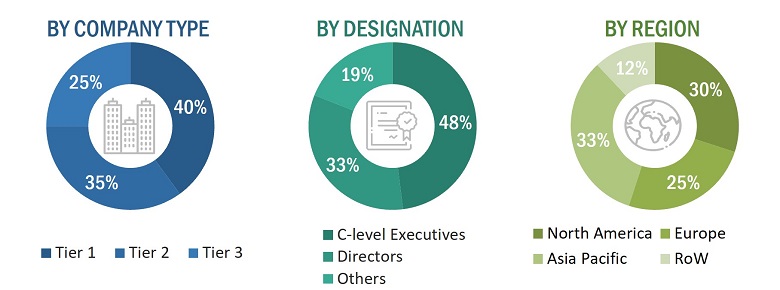
In the primary research process, various primary sources from both supply and demand sides were interviewed to obtain qualitative and quantitative information on the market. The primary sources from the supply side included various industry experts such as Chief Experience Officers (CXOs), Vice Presidents (VPs), and Directors from business development, marketing, product development/innovation teams, and related key executives from battery cyclers providers, such as AMETEK.Inc. (US), BioLogic (France), Chroma ATE, Inc. (Taiwan), Arbin Instruments (US), DIGATRON (US); research organizations, distributors, industry associations, and key opinion leaders. Following is the breakdown of primary respondents.
The breakdown of primary respondents is provided below.
To know about the assumptions considered for the study, download the pdf brochure
Market Size Estimation
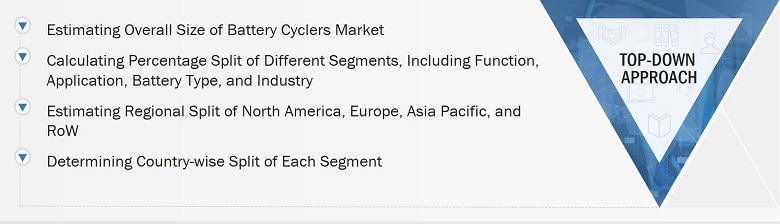
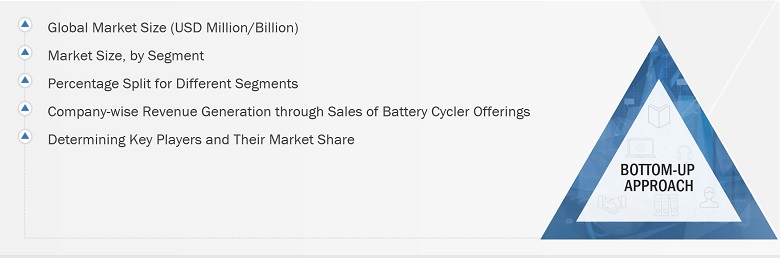
Both top-down and bottom-up approaches have been used to estimate and validate the total size of the battery cyclers market. These methods have also been used extensively to estimate the size of various subsegments in the market. The following research methodology has been used to estimate the market size:
- Major players in the industry and markets have been identified through extensive secondary research.
- The industry’s value chain and market size (in terms of value) have been determined through primary and secondary research processes.
- All percentage shares, splits, and breakdowns have been determined using secondary sources and verified through primary sources.
Top-Down Approach
In the top-down approach, the overall market size has been used to estimate the size of the individual market segments (mentioned in market segmentation) through percentage splits from secondary and primary research. For specific market segments, the size of the most appropriate immediate parent market has been used to implement the top-down approach. The bottom-up approach has also been implemented for data obtained from secondary research to validate the market size of various segments.
Battery Cyclers Market: Top-down Approach
Bottom-Up Approach
The bottom-up approach has been used to arrive at the overall size of the battery cyclers market from the revenues of the key players and their market shares. Calculations based on revenues of key companies identified in the market led to the estimation of their overall market size.
Battery Cyclers Market: Bottom-up Approach
Data Triangulation
After arriving at the overall market size from the estimation process explained above, the overall market has been split into several segments and subsegments. The market breakdown and data triangulation procedures have been employed, wherever applicable, to complete the overall market engineering process and arrive at the exact statistics for all segments and subsegments. The data has been triangulated by studying various factors and trends from both the demand and supply sides. The market has also been validated using both top-down and bottom-up approaches.
Market Definition
Battery cyclers are devices used to test and characterize rechargeable batteries. It is used to assess a rechargeable battery's health by measuring various parameters such as capacity, efficiency, self-discharge, and degradation processes. They are essential tools in battery research, development, and quality control processes. Battery cyclers can charge and discharge batteries according to predefined profiles, allowing for the analysis of various battery parameters. These devices help researchers and engineers understand the performance and behavior of batteries under different conditions, which is crucial for optimizing battery designs and assessing their suitability for specific applications.
Key Stakeholders
- Battery Manufacturers
- Government Bodies and Policymakers
- Standards Organizations, Forums, Alliances, and Associations
- Market Research and Consulting Firms
- Raw Material Suppliers and Distributors
- Research Institutes and Organizations
- Material and Technology Providers
- Battery Cell and Battery Pack Manufacturers
- Consumer Electronics Manufacturers
- Automotive Manufacturers
- Testing, Inspection, and Certification Providers
- Distributors and Resellers
Report Objectives
- To define and forecast the battery cyclers market regarding application, function, battery type, and industry.
- To describe and forecast the battery cyclers market and its value segments for four regions—North America, Europe, Asia Pacific, and the Rest of the World (RoW), along with their respective countries.
- To provide detailed information regarding the drivers, restraints, opportunities, and challenges influencing the market growth
- To strategically analyze micro-markets with respect to individual growth trends, prospects, and contributions to the overall market size
- To study the complete value chain of the battery cyclers market
- To analyze opportunities for stakeholders by identifying high-growth segments of the market
- To strategically profile the key players and comprehensively analyze their market positions in terms of their ranking and core competencies along with a detailed market competitive landscape
- To analyze competitive developments, such as product launches, acquisitions, collaborations, agreements, and partnerships, in the market
- To provide an analysis of the recession impact on the growth of the market and its segments
Available Customizations:
Based on the given market data, MarketsandMarkets offers customizations in the reports according to the client’s specific requirements. The available customization options are as follows:
Company Information
- Detailed analysis and profiling of additional market players (up to 5)
Get the Full Battery Cyclers Market Report
Full forecast, segment splits, and company analysis for all Battery Cyclers Market.
- US Battery Cyclers Market
- Canada Battery Cyclers Market
- Mexico Battery Cyclers Market
- UK Battery Cyclers Market
- France Battery Cyclers Market
- Rest Of Europe Battery Cyclers Market
- China Battery Cyclers Market
- Japan Battery Cyclers Market
- South Korea Battery Cyclers Market
- India Battery Cyclers Market
- Rest Of Asia Pacific Battery Cyclers Market
Need a Tailored Report?
Customize this report to your needs
Get 10% FREE Customization
Customize This Report
