
US Intelligent Building Automation Technologies Market (2025-2030)

The US Intelligent Building Automation Technologies Market was valued at $43291.6 Million in 2025 and projected to reach to $53351.7 Million by 2030, representing a compound annual growth rate of 10.5%. The US intelligent building automation technologies market is poised for sustained expansion through 2030, reaching $53,351.7 million.


| Market Size in | USD 26.32 MN |
| Market Forecast in | |
| CAGR | |
| Forecast Period | |
| Units Considered | Value (USD MN) |
US Intelligent Building Automation Technologies Market Trends and Insights
- This 10.5% compound annual growth rate reflects strong demand across commercial, residential, and industrial sectors in the US as organizations prioritize energy efficiency, operational cost reduction, and occupant comfort.
- The US market benefits from advanced infrastructure, high technology adoption rates, and stringent building codes that drive investment in smart automation solutions. Driving the US market expansion are increasing regulatory pressures around sustainability, rising energy costs, and the growing integration of IoT and artificial intelligence into building management systems.
- The US has emerged as a leader in deploying cloud-based building automation platforms and predictive maintenance technologies.
- Between 2025 and 2030, the US market will continue to consolidate around integrated solutions that combine HVAC control, lighting management, security, and occupancy analytics into unified platforms. The competitive landscape in the US remains fragmented, with both established technology giants and specialized automation vendors competing for market share.
- The US market's maturity and capital availability position it as a testing ground for emerging technologies such as edge computing and autonomous building systems, which are expected to reshape the sector through 2030..
Key Market Statistics
- CAGR (2025-2030) 10.5% CAGR
- Market Size, 2025 ~USD 43291.6 Million
- Forecast, 2030 ~USD 53351.7 Million
- Country US
US Intelligent Building Automation Technologies Market Overview
Market Valuation :
The US intelligent building automation technologies market is valued at $43,291.6 million in 2025, demonstrating significant investment in smart building infrastructure across the nation.
Strong Growth Trajectory :
With a CAGR of 10.5% through 2030, the US market is expanding faster than many other ICT segments, driven by regulatory compliance and sustainability mandates.
Multi-Sector Adoption :
Commercial, residential, and industrial sectors in the US are actively adopting intelligent building automation to reduce operational costs and enhance energy efficiency.
Occupant-Centric Focus :
US organizations are increasingly prioritizing occupant comfort and wellness alongside automation, creating demand for integrated smart building solutions.
US Intelligent Building Automation Technologies Market Dynamics
- This growth is underpinned by increasing energy costs, stricter environmental regulations, and corporate sustainability commitments across American enterprises.
- The commercial real estate sector, in particular, is driving adoption as building owners seek to optimize HVAC systems, lighting, and security through integrated automation platforms. Looking ahead, the US market will benefit from technological advancements in IoT, AI, and cloud computing, enabling more sophisticated building management systems.
- Rising awareness of operational efficiency and the growing emphasis on smart city initiatives at municipal levels will further accelerate market penetration.
- Investment in retrofitting existing buildings with automation technologies presents substantial opportunities for vendors and service providers..
Market Ecosystem
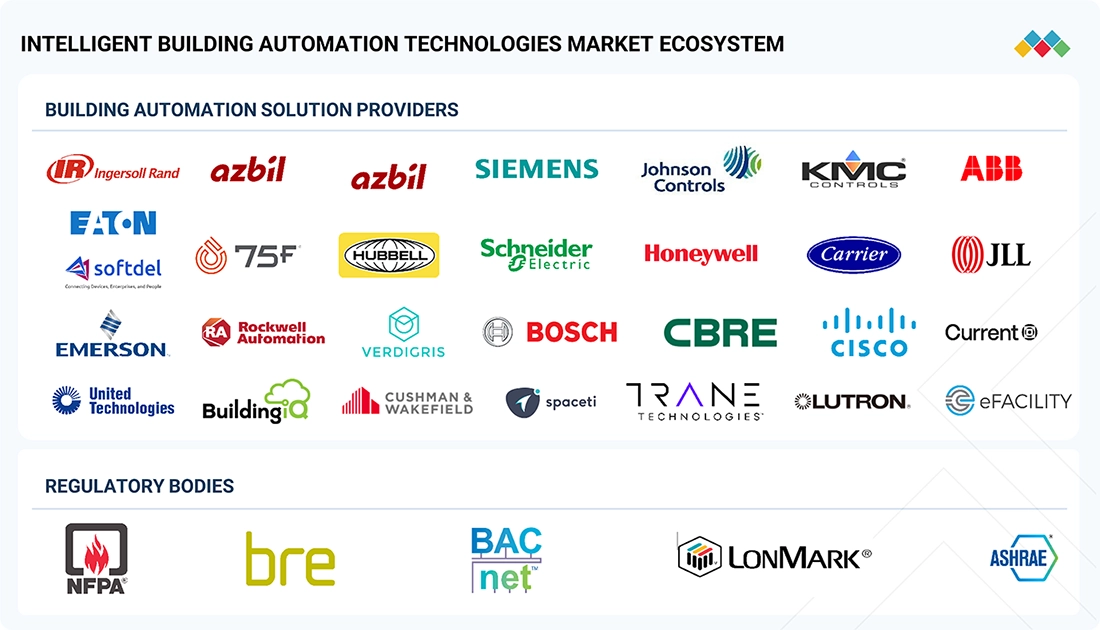
INTELLIGENT BUILDING AUTOMATION TECHNOLOGIES MARKET: COMMERCIAL USE CASES ACROSS INDUSTRIES
| COMPANY | USE CASE DESCRIPTION | BENEFITS |
|---|---|---|
 |
Siemens deployed its Desigo building automation platform across international airports in Europe and Asia to centrally manage heating, ventilation, air conditioning (HVAC), lighting, fire safety, and energy systems. The solution integrated data from multiple terminals and legacy systems, enabling real-time monitoring and automated control based on occupancy and operating schedules. | Reduced energy consumption | Improved system reliability | Centralized building operations | Enhanced passenger comfort |
 |
Schneider Electric implemented its EcoStruxure Building platform for large commercial office campuses and hospitals in North America. The solution connected building management systems, power monitoring, and energy analytics to optimize HVAC performance and support sustainability targets while maintaining strict indoor air quality standards. | Lower operating costs | Improved energy efficiency | Compliance with sustainability regulations | Better indoor environmental quality |
 |
Honeywell deployed its Building Management Solutions in healthcare and public infrastructure facilities to automate climate control, security access, and life-safety systems. The platform enabled predictive maintenance and remote system management, reducing reliance on manual inspections and on-site interventions. | Reduced downtime | Faster fault detection | Improved occupant safety | Lower maintenance costs |
Logos and trademarks shown above are the property of their respective owners. Their use here is for informational and illustrative purposes only.
Related Ecosystem
Decarbonization
Digitalization And Iot
Key Takeaways
- The US intelligent building automation market will grow from $43.3B in 2025 to $53.4B in 2030, representing a 10.5% CAGR driven by energy efficiency mandates and sustainability initiatives.
- The US market is increasingly adopting AI-powered predictive maintenance and IoT-integrated platforms that unify HVAC, lighting, security, and occupancy management into single ecosystems.
- Regulatory pressure and rising operational costs in the US are accelerating adoption of cloud-based building management systems that enable real-time monitoring and remote control capabilities.
- The US market remains highly competitive with fragmented players, creating opportunities for consolidation and differentiation through advanced analytics, edge computing, and autonomous building technologies.
Intelligent Building Automation Technologies Market Report Scope
| Report Metric | Details |
|---|---|
| Base Year | 2025 |
| Fastest Growing Segment | COMPUTING TECHNOLOGIES (Technology) |
| Forecast Period | 2025–2030 |
| Growth Rate | CAGR of 11.8% from 2025 to 2030 |
| Largest Segment | SOLUTIONS (Offering) |
| Market Size Base Year (Billions) | ~USD 109.43 (2025) |
| Revenue Forecast (Billions) | ~USD 191.14 (2030) |
| Segments Covered | Offering, Type, Facility Management, Security & Access Control System, Technology, End Use, Solution, Facility Management System, Service, Professional Service, Sensor Technology, Connectivity Technology, Wired Technology, Wireless Technology, Computing Technology, Commercial Use |
US Intelligent Building Automation Technologies Market Report Segmentation
16 segment dimensions are covered across the global market.
By Offering
- Services
- Solutions
By Type
- AI/ML
- Air Quality Sensors
- Asset Management
- Bacnet
- Bluetooth Low Energy
- Building Energy Management Systems
- Cloud Computing
- Consulting & Assessment
- Corporate & Enterprise Office Buildings
- Deployment & Integration
- Energy Management Systems
- Facility Management Systems
- Fire Detection & Prevention Systems
- Healthcare Facilities
- Hospitality
- Humidity Sensors
- Knx
- Lonworks
- Managed Services
- Motion/Occupancy Sensors
- Other Commercial Buildings
- Other Computing Technologies
- Other Sensor Technologies
- Other Solutions
- Other Wired Technologies
- Other Wireless Technologies
- Professional Services
- Retail Stores & Shopping Complexes
- Security & Access Control Systems
- Smart Meters & Energy Sensors
- Support & Maintenance
- Temperature Sensors
- Wi-Fi
- Wired Technologies
- Wireless Technologies
- Zigbee
By Facility Management
- Hvac Management Software
- Lighting Control Software
By Security & Access Control System
- Access Control Systems
- Biometric Systems
- Video Surveillance
By Technology
- Actuators
- Computing Technologies
- Connectivity Technologies
- Sensor Technologies
By End Use
- Commercial
- Industrial
- Public & Government Buildings
- Residential
- Transportation Infrastructure
By Solution
- Asset Management
- Building Energy Management Systems
- Facility Management Systems
- Fire Detection & Prevention Systems
- Other Solutions
- Security & Access Control Systems
By Facility Management System
- Hvac Controls Software
- Lighting Control Software
By Service
- Managed Services
- Professional Services
By Professional Service
- Consulting & Assessment
- Deployment & Integration
- Support & Maintenance
By Sensor Technology
- Air Quality Sensors
- Humidity Sensors
- Motion/Occupancy Sensors
- Other Sensor Technologies
- Smart Meters & Energy Sensors
- Temperature Sensors
By Connectivity Technology
- Wired Technologies
- Wireless Technologies
By Wired Technology
- Bacnet
- Knx
- Lonworks
- Other Wired Technologies
By Wireless Technology
- Bluetooth Low Energy
- Other Wireless Technologies
- Wi-Fi
- Zigbee
By Computing Technology
- AI/ML
- Cloud Computing
- Other Computing Technologies
By Commercial Use
- Corporate & Enterprise Office Buildings
- Healthcare Facilities
- Hospitality
- Other Commercial Buildings
- Retail Stores & Shopping Complexes
Target Audience
- Building Automation Vendors : Vendors need US-specific market data to refine go-to-market strategies, identify high-growth segments, and benchmark competitive positioning within the $43.3B market.
- Commercial Real Estate Investors : Real estate firms require detailed forecasts and sector insights to justify automation investments, optimize property valuations, and enhance tenant satisfaction through smart building features.
- Facility Management Companies : FM service providers need market intelligence to develop service offerings, understand client demand drivers, and capitalize on the 10.5% CAGR growth opportunity.
- Technology Consultants & Integrators : System integrators require comprehensive US market analysis to advise clients on technology selection, ROI projections, and implementation roadmaps aligned with market trends.
- Corporate Sustainability Officers : Sustainability leaders need market data to evaluate building automation solutions that support corporate ESG goals and demonstrate cost savings through energy efficiency.
Key Companies in the US Intelligent Building Automation Technologies Market
| Company | HQ | Ownership | Strongest segments |
|---|---|---|---|
| ATOS SE | France | Public Company | Managed Infrastructure & Hybrid Cloud Services,Digital Transformation & Application Services,Cybersecurity & Big Data, |
| ZENSAR TECHNOLOGIES LTD | India | Public Company | Digital and Application Services,Cloud Infrastructure and Security Services,Data Engineering and Analytics, |
| HONEYWELL INTERNATIONAL INC. | United States | Public Company | Industrial Automation,Building Automation,Energy and Sustainability Solutions (UOP and related), |
| JOHNSON CONTROLS INTERNATIONAL PLC | Ireland | Public Company | HVAC equipment and controls,Fire detection and suppression,Integrated electronic security, |
| SIEMENS AG | Germany | Public Company | Digital Industries (automation, industrial software, PLM, simulation),Smart Infrastructure (electrification, buildings, grid solutions),Mobility (rail systems, automation, services, digital solutions), |
| SCHNEIDER ELECTRIC SE | France | Public Company | Low- and medium-voltage electrical products and systems,Building management systems, power metering, and smart controls,Industrial automation, drives, and control software, |
| ABB LTD. | Switzerland | Public Company | Electrification,Motion,Automation, |
| EATON CORPORATION | Ireland | Public Company | Electrical distribution, protection, and residential/commercial products,Power quality, connectivity, and reliability equipment,Aerospace systems and components, |
| CARRIER GLOBAL CORPORATION | United States | Public Company | Residential HVAC and Heat Pumps,Commercial and Industrial HVAC, Controls, and Services,Transport Refrigeration and Cold-Chain Monitoring, |
| TRANE TECHNOLOGIES PLC | Ireland | Public Company | Commercial HVAC systems and services,Transport refrigeration (truck, trailer, rail, container),Residential HVAC and IAQ, |
| ROCKWELL AUTOMATION, INC. | United States | Public Company | Intelligent Devices,Software & Control,Lifecycle Services, |
| EMERSON ELECTRIC CO. | United States | Public Company | Final Control,Measurement & Analytical,Discrete Automation, |
| AZBIL CORPORATION | Japan | Public Company | Building Automation Business,Advanced Automation Business,Life Automation Business, |
| LEGRAND | France | Public Company | Wiring devices, connected home, and building control,Energy distribution, protection, EV charging, and UPS,Security, communication, and network solutions, |
| MITSUBISHI ELECTRIC | Japan | Public Company | Factory Automation & Industrial Systems,Building Systems (Elevators, Escalators, BMS),Air Conditioning & Refrigeration, |
| DELTA ELECTRONICS | Taiwan | Public Company | Power Electronics (including embedded power, adapters, EV power electronics, PV inverters, ESS, wind converters),Thermal Management (fans, blowers, automotive thermal, liquid cooling, indoor air quality),Automation (drives, motion, control, robots, field devices, industrial PCs, software), |
ATOS SE
ATOS SE is a French public company founded in 1997 that operates in the technology and IT services sector.
ZENSAR TECHNOLOGIES LTD
ZENSAR TECHNOLOGIES LTD is an Indian public company founded in 1963 with approximately 10,066 employees, providing IT and business services.
HONEYWELL INTERNATIONAL INC.
HONEYWELL INTERNATIONAL INC. is a diversified American public company founded in 1885 with 101,000 employees, operating across aerospace, building technologies, and industrial sectors.
JOHNSON CONTROLS INTERNATIONAL PLC
JOHNSON CONTROLS INTERNATIONAL PLC is an Irish-domiciled public company founded in 1885 with 87,000 employees, specializing in building efficiency and HVAC systems.
SIEMENS AG
SIEMENS AG is a German multinational public company founded in 1847 with 310,312 employees, operating in electrification, automation, and digitalization.
SCHNEIDER ELECTRIC SE
SCHNEIDER ELECTRIC SE is a French public company founded in 1836 with 158,122 employees, providing energy management and automation solutions.
ABB LTD.
ABB LTD. is a Swiss public company founded in 1883 with 112,700 employees, specializing in robotics, power, and automation technologies.
EATON CORPORATION
EATON CORPORATION is an Irish-domiciled public company founded in 1911 with 97,303 employees, operating in electrical, hydraulic, and mechanical power management.
CARRIER GLOBAL CORPORATION
CARRIER GLOBAL CORPORATION is an American public company founded in 2019 with 47,000 employees, providing HVAC, refrigeration, and fire safety solutions.
TRANE TECHNOLOGIES PLC
TRANE TECHNOLOGIES PLC is an Irish-domiciled public company founded in 1885 with 44,000 employees, specializing in climate control and building efficiency.
ROCKWELL AUTOMATION, INC.
ROCKWELL AUTOMATION, INC. is an American public company founded in 1903 with 26,000 employees, providing industrial automation and information technology solutions.
EMERSON ELECTRIC CO.
EMERSON ELECTRIC CO. is an American public company founded in 1890 with 71,000 employees, operating in process management and climate technologies.
AZBIL CORPORATION
AZBIL CORPORATION is a Japanese public company founded in 1906 with 9,170 employees, specializing in building automation and control systems.
LEGRAND
LEGRAND is a French public company founded in 1865 with 35,410 employees, manufacturing electrical and digital building infrastructure solutions.
MITSUBISHI ELECTRIC
MITSUBISHI ELECTRIC is a Japanese public company founded in 1921 with 150,386 employees, operating across industrial automation, power systems, and consumer electronics.
DELTA ELECTRONICS
DELTA ELECTRONICS is a Taiwanese public company founded in 1971 with 85,684 employees, providing power management and thermal management solutions.
Reasons to Buy this Report
- Accurate US Market Sizing : Obtain precise valuation data specific to the US market ($43.3B in 2025) with detailed forecasts through 2030, enabling confident investment and strategic planning decisions.
- Sector-Specific Insights : Understand growth dynamics across commercial, residential, and industrial segments within the US, identifying which sectors offer the highest ROI opportunities.
- Competitive Landscape Analysis : Gain intelligence on US-based and international vendors competing in the intelligent building automation space, including market positioning and strategic initiatives.
- Regulatory & Compliance Context : Access analysis of US energy codes, sustainability regulations, and compliance drivers shaping market demand and influencing purchasing decisions.
- Technology Trend Identification : Identify emerging technologies and integration patterns specific to the US market, from AI-driven analytics to cloud-based management platforms.
Frequently asked questions
What is the current size of the US intelligent building automation market?
The US intelligent building automation technologies market is valued at $43,291.6 million in 2025 and is expected to reach $53,351.7 million by 2030.
What is the growth rate of the US building automation market?
The US market is projected to grow at a compound annual growth rate (CAGR) of 10.5% from 2025 to 2030.
What are the primary drivers of growth in the US building automation market?
Key drivers include energy efficiency regulations, rising operational costs, increased IoT and AI integration, sustainability mandates, and the shift toward cloud-based building management systems in the US.
Which sectors are driving demand for building automation in the US?
Commercial real estate, industrial facilities, and residential properties in the US are all driving demand, with commercial buildings representing the largest segment due to operational complexity and cost pressures.
What technologies are shaping the future of the US building automation market?
Artificial intelligence, predictive analytics, edge computing, IoT sensors, cloud platforms, and autonomous building systems are the key technologies transforming the US market through 2030.
RESEARCH METHODOLOGY
This research study relied extensively on secondary sources, directories, and databases, including Dun & Bradstreet (D&B), Hoovers, and Bloomberg BusinessWeek, to identify and collect information relevant to a technical, market-oriented, and commercial study of the intelligent building automation technologies market. The primary sources were mainly industry experts from core and related industries, as well as preferred suppliers, manufacturers, distributors, service providers, technology developers, alliances, and organizations across all segments of the value chain of this market. In-depth interviews were conducted with various primary respondents, including key industry participants, subject matter experts, C-level executives of key market players, and industry consultants, to obtain and verify critical qualitative and quantitative information.
Secondary Research
The market for companies offering intelligent building automation solutions and services across different verticals has been estimated and projected using secondary data from paid and unpaid sources, as well as by analyzing their product portfolios within the ecosystem of the intelligent building automation technologies market. This process also involved rating company products based on performance and quality. In the secondary research process, various sources such as the Intelligent Buildings and Green Homes (IBGH) Conferences, the International Building Performance Simulation Association (IBPSA) Conference, and the Automation in Construction and Robotics (AECR) Conference were referred to for identifying and collecting information for this study on the intelligent building automation technologies market. The secondary sources included annual reports, press releases, investor presentations of companies, white papers, journals, certified publications, articles by recognized authors, directories, and databases. Secondary research was mainly used to obtain key information about the market's supply chain, the total pool of key players, market classification, segmentation according to industry trends down to the bottommost level, regional markets, and key developments from both market- and technology-oriented perspectives, which were further validated by primary sources.
Primary Research
In the primary research process, interviews were conducted with various primary sources from both the supply and demand sides to gather qualitative and quantitative information on the market. The supply-side sources included industry experts such as Chief Experience Officers (CXOs); Vice Presidents (VPs); directors from business development, marketing, and product development/innovation teams; key executives from intelligent building automation technology solution vendors, SIs, professional service providers, and industry associations; and key opinion leaders. Primary interviews were conducted to gather insights such as market statistics, revenue data from solutions and services, market breakdowns, market size estimates, market forecasts, and triangulated data. Primary research also helped in understanding trends related to technologies, applications, deployments, and regions. Stakeholders from the demand side, such as Chief Information Officers (CIOs), Chief Technology Officers (CTOs), Chief Strategy Officers (CSOs), and end users of intelligent building automation technology solutions, were interviewed to understand the buyer’s perspective on suppliers, products, service providers, and their current usage of intelligent building automation technology solutions, which would impact the overall building automation market.
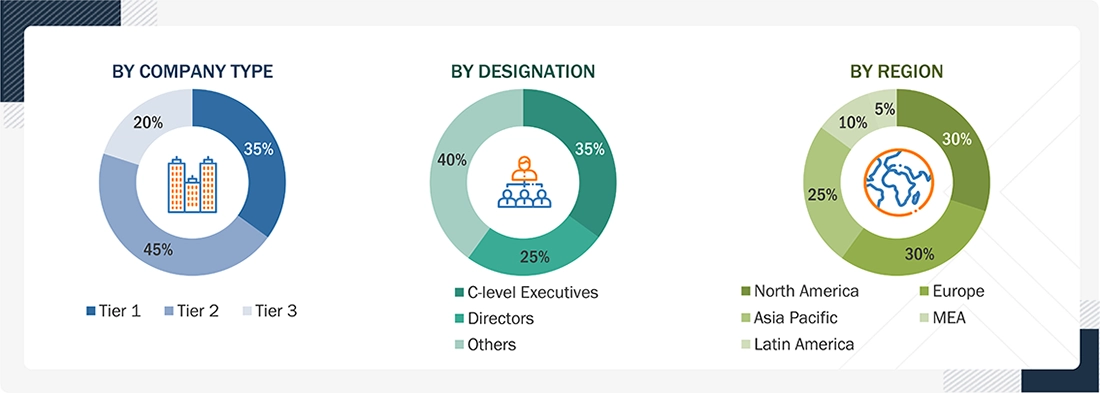
Notes: Note: Others include sales managers, marketing managers, and product managers.
To know about the assumptions considered for the study, download the pdf brochure
Source: Secondary Research, Interviews with Experts, MarketsandMarkets Analysis
Market Size Estimation
Multiple approaches were used to estimate and forecast the size of the intelligent building automation technologies market. The first approach estimates market size by summing the revenue generated by companies from the sale of intelligent building automation technology offerings.
Both top-down and bottom-up approaches were used to estimate and validate the total size of the intelligent building automation technologies market. These methods were also used to estimate the size of various segments in the market. The research methodology used to estimate the market size includes the following:
- Key players in the market were identified through extensive secondary research.
- In terms of value, the industry’s supply chain and market size were determined through primary and secondary research.
- All percentage shares, splits, and breakups were determined using secondary sources and verified with primary sources.
Top-Down and Bottom-Up Approach
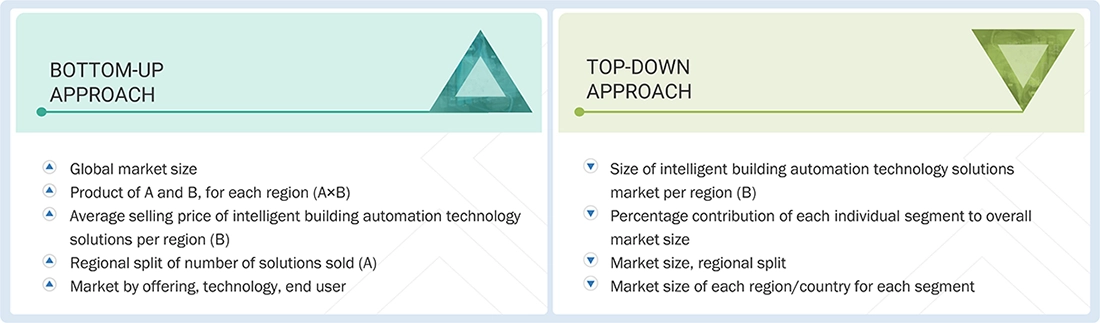
Source: Secondary Research, Interviews with Experts, MarketsandMarkets Analysis
Data Triangulation
After determining the overall market size, the intelligent building automation technologies market was divided into several segments and subsegments. A data triangulation procedure was used to complete the overall market engineering process and arrive at the exact statistics for all segments and subsegments, wherever applicable. The data was triangulated by analyzing various factors and trends from the demand and supply sides. Along with data triangulation and market breakdown, the market size was validated using the top-down and bottom-up approaches.
Market Definition
Intelligent building automation technologies use integrated automation and control systems to monitor, manage, and optimize building-wide operations, including HVAC, lighting, energy management, security and access control, fire and life safety systems, and surveillance. These technologies enable centralized, automated control of multiple building systems through a unified, digitally managed infrastructure.
Building automation solutions combine sensors, controllers, software platforms, and communication networks to collect operational data and improve building performance. By integrating core building systems into a cohesive control environment, intelligent building automation improves energy efficiency, enhances safety and security, optimizes operational costs, and improves occupant comfort across residential, commercial, industrial, and public buildings.
Stakeholders
- Building Owners and Facility Managers
- IT Departments
- Building Automation System (BAS) Providers
- System Integrators (SIs)
- Energy Providers
- Government Agencies
- Investment Firms
- Intelligent Building Automation Technologies Alliances/Groups
Report Objectives
- To determine, segment, and forecast the intelligent building automation technologies market by offering, technology, end use, and region in terms of value
- To forecast the size of the market segments with respect to five main regions: North America, Europe, Asia Pacific, Middle East & Africa, and Latin America
- To provide detailed information about the major factors (drivers, restraints, opportunities, and challenges) influencing the growth of the market
- To study the complete value chain and related industry segments, and perform a value chain analysis of the market landscape
- To strategically analyze macro and micromarkets with respect to individual growth trends, prospects, and contributions to the total market
- To analyze the industry trends, pricing data, patents, and innovations related to the market
- To analyze opportunities for stakeholders by identifying the high-growth segments of the market
- To profile key players in the market and comprehensively analyze their market share/ranking and core competencies
- To analyze competitive developments, such as mergers & acquisitions, product launches & developments, partnerships, agreements, collaborations, business expansions, and R&D activities
Available Customizations
- With the given market data, MarketsandMarkets offers customizations as per the company’s specific needs. The following customization options are available for the report:
Country-wise information
- Analysis for additional countries (up to five)
Company Information
- Detailed analysis and profiling of additional market players (up to 5)
Get the Full Intelligent Building Automation Technologies Market Report
Full forecast, segment splits, and company analysis for all Intelligent Building Automation Technologies Market.
Need a Tailored Report?
Customize this report to your needs
Get 10% FREE Customization
Customize This Report
