
North America Cargo Drones Market (2024-2029)

The North America Cargo Drones Market was valued at $783.7 Million in 2024 and projected to reach to $3488.6 Million by 2029, representing a compound annual growth rate of 28.3%. North America's cargo drones market is positioned for exceptional growth through 2029, driven by increasing e-commerce demand, labor cost pressures, and regulatory maturation.


| Market Size in | USD 26.32 MN |
| Market Forecast in | |
| CAGR | |
| Forecast Period | |
| Units Considered | Value (USD MN) |
North America Cargo Drones Market Trends and Insights
- This 28.3% compound annual growth rate reflects North America's leadership in autonomous logistics innovation and regulatory advancement.
- North America benefits from established aerospace infrastructure, significant venture capital investment, and early adoption by e-commerce and logistics operators seeking last-mile delivery solutions. The North America cargo drones market is driven by regulatory clarity from the FAA, increasing labor costs in traditional delivery networks, and growing consumer demand for faster shipping.
- North America's major metropolitan areas and sprawling suburban landscapes create ideal conditions for drone deployment across multiple use cases.
- By 2029, North America is expected to capture substantial market share as commercial operations scale and regulatory frameworks mature across the region..
Key Market Statistics
- CAGR (2024-2029) 28.3% CAGR
- Market Size, 2024 ~USD 783.7 Million
- Forecast, 2029 ~USD 3488.6 Million
- Geography North America
North America Cargo Drones Market Overview
Market Valuation & Growth :
North America's cargo drones market is valued at $783.7 million in 2024, with a robust 28.3% CAGR projected through 2029, reaching $3,488.6 million. This growth significantly outpaces many global regions, driven by technological maturity and regulatory clarity.
US Market Dominance :
The United States commands the North American market with $3,275.1 million in 2024, representing over 80% of regional value. This dominance reflects America's leadership in autonomous logistics, advanced aerospace infrastructure, and substantial venture capital deployment.
Regulatory & Infrastructure Advantage :
North America benefits from established FAA frameworks, progressive drone regulations, and mature logistics networks. These factors accelerate commercial deployment and reduce time-to-market for cargo drone operators compared to other regions.
Investment & Innovation Ecosystem :
The region attracts significant venture capital and corporate investment in autonomous delivery technologies. Major aerospace companies and startups are concentrated in North America, fostering rapid innovation in cargo drone systems and last-mile logistics solutions.
North America Cargo Drones Market Dynamics
- The region's established aerospace supply chain and advanced manufacturing capabilities provide competitive advantages in scaling production and deployment.
- Investment in autonomous logistics infrastructure continues to accelerate, with major retailers and logistics providers piloting cargo drone solutions across urban and rural markets. The forecast growth to $3,488.6 million reflects expanding use cases beyond package delivery, including medical supply transport, emergency response, and industrial logistics.
- North America's leadership in AI and autonomous systems technology, combined with favorable regulatory environments in the US and Canada, positions the region as the global innovation hub for cargo drone commercialization through the forecast period..
Market Ecosystem
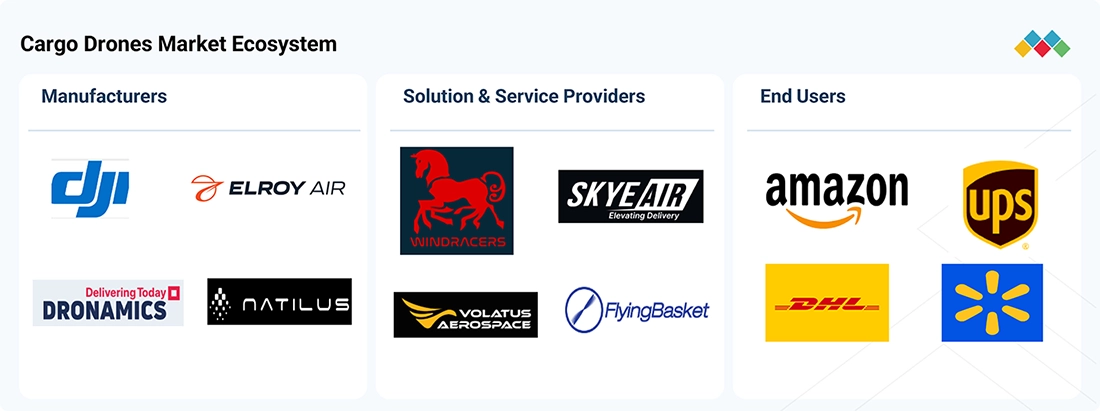
CARGO DRONES MARKET: COMMERCIAL USE CASES ACROSS INDUSTRIES
| COMPANY | USE CASE DESCRIPTION | BENEFITS |
|---|---|---|
 |
Develops cargo drones such as the FlyCart 30 for transporting goods to remote areas, construction sites, and mountainous regions | The platform supports cargo-box and winch-based delivery. | Enables direct delivery to locations with limited road access | Its payload capacity and automated flight features support the transportation of equipment and essential supplies. |
 |
Develops the ULTRA uncrewed aircraft for long-range cargo transportation, humanitarian aid, and military resupply | It is designed to operate from locations with limited infrastructure. | Supports the delivery of larger shipments over long distances | Its high payload capacity and short take-off and landing capability make it suitable for remote logistics operations. |
 |
Through Malloy Aeronautics, develops heavy-lift uncrewed aircraft for military resupply and ship-to-shore transportation | Its platforms are designed to move essential supplies in challenging environments. | Reduces reliance on conventional transport for selected resupply missions | Autonomous flight and electric propulsion support logistics operations while limiting personnel exposure to hazardous locations. |
 |
Develops the Silent Arrow family of autonomous cargo delivery aircraft for military resupply and humanitarian missions | These systems are designed to deliver supplies to remote locations with limited landing infrastructure. | Supports flexible aerial resupply without requiring a conventional runway at the delivery point | Its cargo delivery approach can help transport essential supplies to difficult-to-access areas. |
 |
Develops heavy-lift cargo drones for transporting equipment and materials to industrial sites, construction areas, offshore facilities, and remote locations | Its platforms are designed for demanding logistics tasks. | Enables direct transportation of heavy materials to locations that are difficult to reach by road | Cargo drones can reduce dependence on cranes and helicopters for selected industrial delivery operations. |
Logos and trademarks shown above are the property of their respective owners. Their use here is for informational and illustrative purposes only.
Related Ecosystem
Unmanned Systems
- Rotary Wing Aircraft
- Fixed-Wing Drones
- Sensors
- Fuel Cell
- Fixed Wing Aircraft
- LOCKHEED MARTIN CORPORATION
- Northrop Grumman Corporation
- ISRAEL AEROSPACE INDUSTRIES LTD
- Thales group
- BAE Systems plc
Key Takeaways
- North America's cargo drones market will grow from $783.7M (2024) to $3,488.6M (2029) at a 28.3% CAGR, outpacing global growth.
- North America leads in regulatory maturity with FAA frameworks enabling commercial drone operations faster than other regions.
- North America's e-commerce and logistics sectors are primary adopters, driving demand for autonomous last-mile delivery solutions.
- North America's infrastructure and capital availability position it as the fastest-growing regional market for cargo drone deployment.
Cargo Drones Market Report Scope
| Report Metric | Details |
|---|---|
| Base Year | 2024 |
| Fastest Growing Segment | >1,000 KG (Payload) |
| Forecast Period | 2024-2029 |
| Growth Rate | CAGR of 34.2% from 2024 to 2029 |
| Largest Segment | CIVIL (Application) |
| Market Size Base Year (Billions) | ~USD 1.53 (2024) |
| Revenue Forecast (Billions) | ~USD 6.65 (2029) |
| Segments Covered | Solution, Platform, Payload, Industry, Type, Range, Application |
North America Cargo Drones Market Report Segmentation
7 segment dimensions are covered across the global market.
By Solution
- Infrastructure
- Platform
- Service
- Software
By Platform
- Airframe
- Avionics
- Propulsion
- Software
By Payload
- 10-49 Kg
- 150-249 Kg
- 250-499 Kg
- 500-999 Kg
- 50-149 Kg
- >1,000 Kg
By Industry
- Agriculture
- Defense
- Healthcare
- Maritime
- Retail
By Type
- Ctol
- Fixed-Wing
- Hybrid
- Rotary-Wing
- Vtol
By Range
- Close-Range (<50 Kilometers)
- Long-Range (>650 Kilometers)
- Mid-Range (150 To 650 Kilometers)
- Short-Range (50 To 149 Kilometers)
By Application
- Civil
- Defense
Target Audience
- Logistics & E-Commerce Companies : North American retailers and logistics providers need market data to evaluate cargo drone integration, assess competitive threats, and plan autonomous delivery investments to optimize last-mile operations and reduce costs.
- Aerospace & Defense Manufacturers : OEMs and defense contractors require North America market insights to identify commercial cargo drone opportunities, assess regional demand, and develop products aligned with FAA regulations and customer requirements.
- Venture Capital & Private Equity : Investors targeting North America's autonomous logistics sector need comprehensive market sizing, growth projections, and competitive analysis to identify promising startups and evaluate investment returns in cargo drone technologies.
- Government & Regulatory Bodies : US and Canadian policymakers require market intelligence to inform drone regulations, infrastructure planning, and technology standards that support safe, efficient cargo drone operations while maintaining competitive advantage.
- Technology & Software Developers : Companies developing autonomous systems, AI, and drone management software need North America market data to understand adoption rates, customer requirements, and revenue opportunities in the region's growing cargo drone ecosystem.
Countries within North America - compare and drill down
| Country | 2025 size (native) |
|---|---|
| US | USD 3275.1 Million |
| Canada | USD 213.5 Million |
Country market size visualization
Reasons to Buy this Report
- Regional Market Sizing & Forecasts : Obtain precise market valuations for North America ($783.7M in 2024) and country-level breakdowns including the US ($3,275.1M) and Canada ($213.5M), with detailed 5-year forecasts to support strategic planning and investment decisions.
- Competitive Landscape Analysis : Understand the competitive dynamics specific to North America's cargo drone ecosystem, including key players, market consolidation trends, and differentiation strategies in the world's most mature autonomous logistics market.
- Regulatory & Policy Insights : Access North America-specific regulatory frameworks, FAA guidelines, and policy developments that directly impact market growth, commercialization timelines, and operational deployment strategies for cargo drone operators.
- Investment & Growth Opportunities : Identify high-potential segments, emerging use cases, and geographic hotspots within North America for cargo drone adoption, including last-mile delivery, medical logistics, and industrial applications with quantified market potential.
- Strategic Decision Support : Leverage North America-focused market intelligence to inform go-to-market strategies, partnership decisions, technology investments, and expansion plans in the region's rapidly evolving autonomous logistics sector.
Frequently asked questions
What is the current size of North America's cargo drones market?
North America's cargo drones market was valued at $783.7 million in 2024 and is projected to grow to $3,488.6 million by 2029.
What is the expected growth rate for cargo drones in North America?
North America's cargo drones market is expected to grow at a compound annual growth rate (CAGR) of 28.3% from 2024 to 2029.
Which industries are driving cargo drone adoption in North America?
E-commerce, logistics, last-mile delivery, and supply chain optimization are the primary industries driving cargo drone adoption across North America.
How does North America's cargo drone market compare to global growth?
North America's 28.3% CAGR is slightly below the global 34.2% CAGR, but North America maintains the largest absolute market value and most mature regulatory environment.
What regulatory factors support cargo drone growth in North America?
North America benefits from FAA regulatory frameworks that enable commercial drone operations, providing clearer pathways for deployment compared to other regions.
RESEARCH METHODOLOGY
The study followed four main steps to estimate the cargo drones market size. Secondary research was conducted to collect data on cargo drone technologies, platforms, payload capabilities, production trends, industry developments, and market dynamics across key regions. These findings were validated through primary interviews with cargo drone manufacturers, component suppliers, system integrators, logistics providers, end users, and industry experts. The research analyzed cargo drone adoption, technological developments, delivery requirements, operational capabilities, and industry demand to assess market opportunities. Market estimates were then segmented by solution, type, payload capacity, range, application, and end user. Data triangulation was applied to validate the final market estimates for each segment and subsegment.
Secondary Research
Secondary research was conducted to establish the foundation for the cargo drones market study. Data was collected from industry reports, cargo drone manufacturers, aviation authorities, logistics companies, regulatory bodies, and technology providers. Company information was reviewed through annual reports, product documents, press releases, investor presentations, and official company websites. The study also examined industry articles, white papers, and research publications covering cargo drone platforms, propulsion systems, battery technologies, payload capacity, autonomous flight systems, and cargo delivery applications. The study also gathered additional insights from industry associations and market databases to analyze market trends, technological developments, cargo drone adoption, production activities, and demand across key regions.
Primary Research
Primary research was conducted after key insights were identified through secondary analysis. The study team engaged executives from cargo drone manufacturers, component suppliers, system integrators, technology providers, logistics companies, end users, and industry experts in the cargo drones market. Discussions covered cargo drone platforms, propulsion systems, battery technologies, payload capacity, autonomous flight systems, and cargo delivery operations. Interviews were conducted through calls and written correspondence to validate market size estimates, production trends, customer requirements, technology adoption, and product developments. These inputs helped refine perspectives on competition, product development, supply chain activities, investment trends, and emerging cargo delivery applications while improving overall data accuracy.
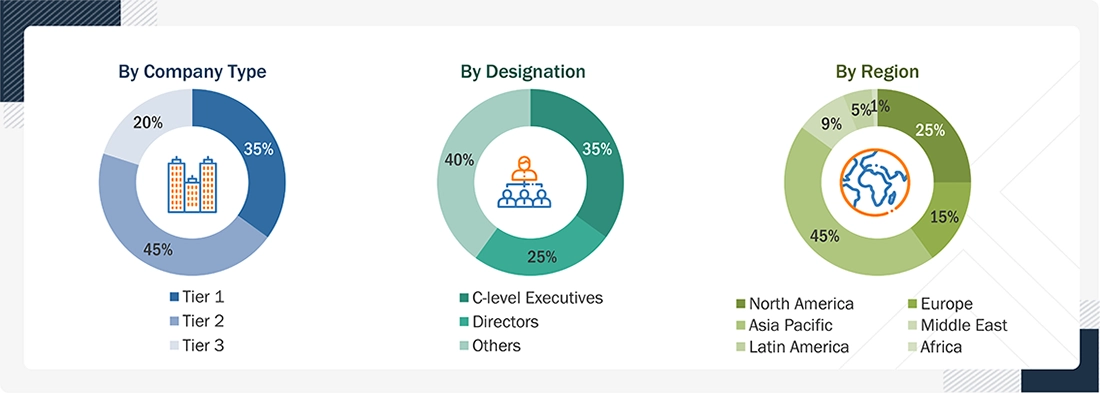
To know about the assumptions considered for the study, download the pdf brochure
Market Size Estimation
The top-down and bottom-up methods were used to estimate and validate the size of the cargo drones market. The research process involved several steps to ensure accuracy.
-
Key companies active in the cargo drones market were identified through secondary research. Their market presence was evaluated using primary inputs and published data. This included reviewing annual reports, financial disclosures, product launches, contracts, company developments, and public filings. Interviews were also conducted with company executives, technology providers, system integrators, logistics operators, and industry experts. These inputs were used to validate assumptions and refine regional market size estimates.
-
All percentage shares, segment splits, and market breakdowns were first developed using secondary information. These values were then verified through primary discussions with industry participants.
-
The analysis evaluated key factors shaping the cargo drones market, including logistics demand, e-commerce growth, cargo drone procurement, payload capacity, flight range, battery technology, and autonomous flight capabilities. Demand across commercial logistics, healthcare, industrial transportation, and government applications was also assessed. These factors were examined through primary research and used to develop quantitative and qualitative market estimates for the report.
Cargo Drones Market: Top-Down and Bottom-Up Approach
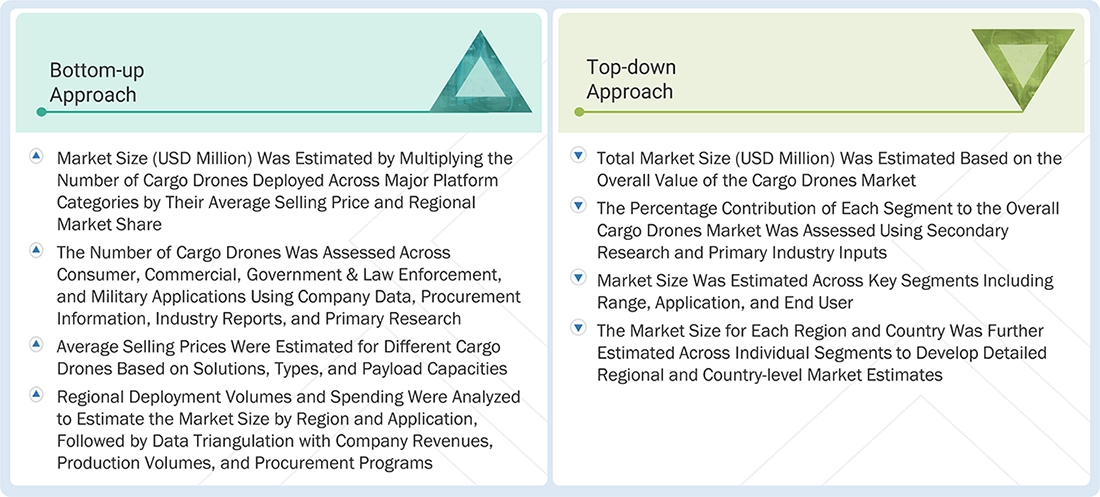
Data Triangulation
After determining the overall cargo drones market size, the market was divided into multiple segments and subsegments. Data triangulation and market breakdown procedures were applied to complete the market analysis and estimate market values for each segment and subsegment. The data was triangulated by examining demand-side and supply-side factors, including cargo drone production, manufacturer revenues, deployment trends, payload capacity, delivery requirements, and end-user demand. Additionally, the market size estimates were validated using top-down and bottom-up approaches to improve consistency and accuracy across the overall market and its individual segments.
Market Definition
A cargo drone is an unmanned aircraft that can transport a load to a location while being ecologically beneficial. Cargo drones come in small, medium, and large sizes, each with different performance capabilities. They come with cutting-edge software and strong sensors. Cargo drones support first-mile, middle-mile, and last-mile delivery.
Key Stakeholders
- Cargo drone manufacturers developing fixed-wing, multirotor, and hybrid cargo drones for logistics, industrial transportation, medical delivery, and government applications
- Cargo drone component manufacturers supplying airframes, motors, flight controllers, avionics, landing systems, and structural components used in cargo drone production
- Payload system manufacturers developing cargo compartments, payload release mechanisms, loading systems, and specialized equipment for transporting different types of goods
- Battery & energy system manufacturers developing lithium-ion batteries, high-capacity battery packs, and advanced energy systems to improve flight endurance and payload capacity
- Electric motor & propulsion system providers supplying electric motors, propellers, electronic speed controllers, and propulsion systems for cargo drone platforms
- Flight control & navigation system providers developing autopilot systems, navigation modules, flight controllers, and autonomous flight technologies for cargo transportation
- Software & artificial intelligence technology providers developing flight management software, route optimization tools, fleet management platforms, and autonomous cargo delivery solutions
- Communication & connectivity providers supplying radio communication, satellite connectivity, data links, and command-and-control systems for cargo drone operations
- Ground control station manufacturers developing systems for flight planning, remote monitoring, cargo mission management, and operational control
- Logistics & cargo delivery companies deploying cargo drones for last-mile delivery, warehouse transfers, regional freight transportation, and time-sensitive shipments
- E-commerce & retail companies exploring cargo drone delivery to improve order fulfillment, reduce delivery times, and expand access to customers in remote locations
- Healthcare & medical supply providers using cargo drones to transport medicines, vaccines, blood samples, and emergency medical supplies
- Government & defense organizations procuring cargo drones for tactical resupply, military logistics, disaster relief, and transportation of essential equipment
Report Objectives
- To define, describe, and forecast the size of the cargo drones market by solution, type, payload capacity, range, application, and end user
- To forecast the size of market segments by key countries in the following regions: North America, Europe, Asia Pacific, Middle East, and the Rest of the World
- To identify and analyze drivers, restraints, opportunities, and challenges influencing the growth of the market
- To identify industry trends, market trends, and technology trends currently prevailing in the market
- To provide an overview of the regulatory landscape for the global cargo drones market
- To analyze micromarkets with respect to individual growth trends, prospects, and their contribution to the overall market
- To analyze opportunities in the market for stakeholders by identifying key market trends
- To profile key market players and comprehensively analyze their market share and core competencies
- To analyze the degree of competition in the market by identifying growth strategies, such as agreements, acquisitions, partnerships, collaborations, and product launches, adopted by leading market players
- To identify detailed financial positions, key products, and unique selling points of leading market players
Available customizations:
MarketsandMarkets offers the following customizations for this market report:
- Additional country-level analysis of the cargo drones market
- Profiling of other market players (up to 5)
Product Analysis
- Product matrix, which provides a detailed comparison of the product portfolio of each company in the cargo drones market
Get the Full Cargo Drones Market Report
Full forecast, segment splits, and company analysis for all Cargo Drones Market.
- Canada Cargo Drones Market
- US Cargo Drones Market
- UK Cargo Drones Market
- Germany Cargo Drones Market
- France Cargo Drones Market
- Italy Cargo Drones Market
- Switzerland Cargo Drones Market
- Norway Cargo Drones Market
- Sweden Cargo Drones Market
- China Cargo Drones Market
- India Cargo Drones Market
- Japan Cargo Drones Market
- Australia Cargo Drones Market
- South Korea Cargo Drones Market
- New Zealand Cargo Drones Market
- Malaysia Cargo Drones Market
- Singapore Cargo Drones Market
- UAE Cargo Drones Market
- Saudi Arabia Cargo Drones Market
- Israel Cargo Drones Market
- Brazil Cargo Drones Market
- Mexico Cargo Drones Market
- Colombia Cargo Drones Market
- Argentina Cargo Drones Market
- Peru Cargo Drones Market
- Rest Of Europe Cargo Drones Market
Need a Tailored Report?
Customize this report to your needs
Get 10% FREE Customization
Customize This Report