
Peru Cargo Drones Market (2024-2029)

The Peru Cargo Drones Market was valued at $1.7 Million in 2024 and projected to reach to $9.3 Million by 2029, representing a compound annual growth rate of 32.5%. Peru's cargo drones market is positioned for substantial growth as logistics companies and e-commerce platforms recognize the technology's potential to overcome geographic and infrastructural barriers.


| Market Size in | USD 26.32 MN |
| Market Forecast in | |
| CAGR | |
| Forecast Period | |
| Units Considered | Value (USD MN) |
Peru Cargo Drones Market Trends and Insights
- This accelerated growth reflects Peru's increasing adoption of autonomous delivery solutions across logistics, e-commerce, and last-mile delivery sectors.
- Peru's geographic and infrastructural challenges-including remote Andean regions and limited road networks-create compelling use cases for drone-based cargo transport, positioning the nation as an emerging hub for aerial logistics innovation in Latin America. Driving Peru's market expansion are investments in regulatory frameworks, pilot programs by logistics operators, and growing demand from retailers seeking efficient delivery alternatives.
- Peru's mountainous terrain and dispersed population centers make cargo drones particularly valuable for connecting underserved communities.
- Between 2024 and 2029, Peru is expected to see increased participation from both international drone manufacturers and local startups, supported by government initiatives to modernize supply chain infrastructure and reduce delivery times in remote areas..
Key Market Statistics
- CAGR (2024-2029) 32.5% CAGR
- Market Size, 2024 ~USD 1.7 Million
- Forecast, 2029 ~USD 9.3 Million
- Country Peru
Peru Cargo Drones Market Overview
Rapid Market Expansion :
Peru's cargo drones market is projected to grow from USD 1.7 million in 2024 to USD 9.3 million by 2029, representing a 32.5% CAGR, driven by increasing logistics automation and e-commerce demand.
Geographic Advantage :
Peru's challenging terrain and dispersed settlements make cargo drones an ideal solution for last-mile delivery, particularly in remote Andean and Amazon regions where traditional infrastructure is limited.
E-commerce & Logistics Growth :
Rising digital commerce adoption in Peru is accelerating demand for autonomous delivery solutions, with retailers and logistics providers investing in drone technology to improve delivery efficiency and reduce costs.
Infrastructure Modernization :
Government initiatives and private sector investments in Peru's logistics infrastructure are creating favorable conditions for cargo drone deployment and regulatory framework development.
Peru Cargo Drones Market Dynamics
- The 32.5% CAGR reflects strong momentum driven by last-mile delivery optimization, particularly in underserved rural and mountainous regions where traditional transportation is inefficient.
- Investment in autonomous delivery capabilities is expected to accelerate as regulatory frameworks mature and operational costs decline. The forecast period through 2029 will see increased adoption across multiple sectors including retail, pharmaceutical, and food delivery.
- Strategic partnerships between local logistics providers and drone manufacturers, combined with government support for digital infrastructure, will further catalyze market expansion.
- Peru's unique geographic challenges position cargo drones as a critical enabler for economic development and improved supply chain resilience across the country..
Market Ecosystem
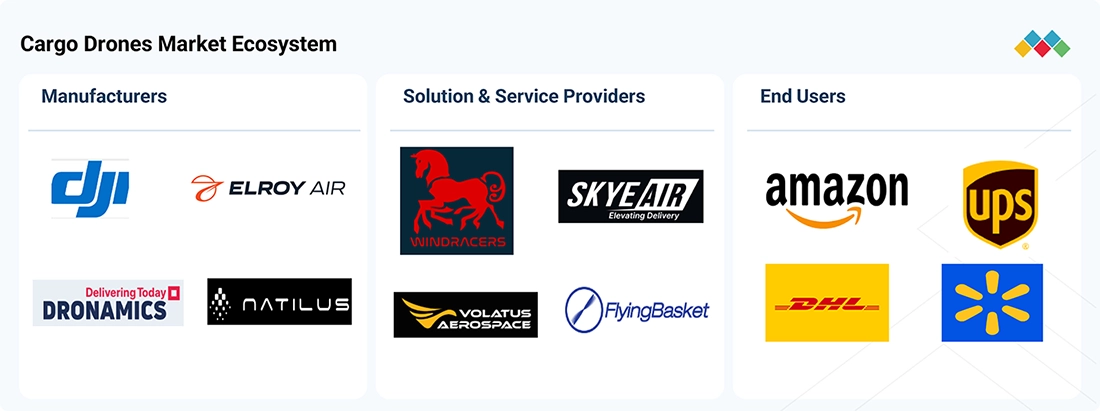
CARGO DRONES MARKET: COMMERCIAL USE CASES ACROSS INDUSTRIES
| COMPANY | USE CASE DESCRIPTION | BENEFITS |
|---|---|---|
 |
Develops cargo drones such as the FlyCart 30 for transporting goods to remote areas, construction sites, and mountainous regions | The platform supports cargo-box and winch-based delivery. | Enables direct delivery to locations with limited road access | Its payload capacity and automated flight features support the transportation of equipment and essential supplies. |
 |
Develops the ULTRA uncrewed aircraft for long-range cargo transportation, humanitarian aid, and military resupply | It is designed to operate from locations with limited infrastructure. | Supports the delivery of larger shipments over long distances | Its high payload capacity and short take-off and landing capability make it suitable for remote logistics operations. |
 |
Through Malloy Aeronautics, develops heavy-lift uncrewed aircraft for military resupply and ship-to-shore transportation | Its platforms are designed to move essential supplies in challenging environments. | Reduces reliance on conventional transport for selected resupply missions | Autonomous flight and electric propulsion support logistics operations while limiting personnel exposure to hazardous locations. |
 |
Develops the Silent Arrow family of autonomous cargo delivery aircraft for military resupply and humanitarian missions | These systems are designed to deliver supplies to remote locations with limited landing infrastructure. | Supports flexible aerial resupply without requiring a conventional runway at the delivery point | Its cargo delivery approach can help transport essential supplies to difficult-to-access areas. |
 |
Develops heavy-lift cargo drones for transporting equipment and materials to industrial sites, construction areas, offshore facilities, and remote locations | Its platforms are designed for demanding logistics tasks. | Enables direct transportation of heavy materials to locations that are difficult to reach by road | Cargo drones can reduce dependence on cranes and helicopters for selected industrial delivery operations. |
Logos and trademarks shown above are the property of their respective owners. Their use here is for informational and illustrative purposes only.
Related Ecosystem
Unmanned Systems
- Rotary Wing Aircraft
- Fixed-Wing Drones
- Sensors
- Fuel Cell
- Fixed Wing Aircraft
- LOCKHEED MARTIN CORPORATION
- Northrop Grumman Corporation
- ISRAEL AEROSPACE INDUSTRIES LTD
- Thales group
- BAE Systems plc
Key Takeaways
- Peru's cargo drones market is valued at USD 1.7 million in 2024 and is forecast to grow to USD 9.3 million by 2029 at a 32.5% CAGR.
- Peru's challenging terrain and remote communities create strong demand for drone-based last-mile delivery solutions.
- Regulatory development and government support for logistics modernization are accelerating cargo drone adoption across Peru.
- Peru is positioned as a key growth market in Latin America, attracting both multinational and local drone operators.
Cargo Drones Market Report Scope
| Report Metric | Details |
|---|---|
| Base Year | 2024 |
| Fastest Growing Segment | >1,000 KG (Payload) |
| Forecast Period | 2024-2029 |
| Growth Rate | CAGR of 34.2% from 2024 to 2029 |
| Largest Segment | CIVIL (Application) |
| Market Size Base Year (Billions) | ~USD 1.53 (2024) |
| Revenue Forecast (Billions) | ~USD 6.65 (2029) |
| Segments Covered | Solution, Platform, Payload, Industry, Type, Range, Application |
Peru Cargo Drones Market Report Segmentation
7 segment dimensions are covered across the global market.
By Solution
- Infrastructure
- Platform
- Service
- Software
By Platform
- Airframe
- Avionics
- Propulsion
- Software
By Payload
- 10-49 Kg
- 150-249 Kg
- 250-499 Kg
- 500-999 Kg
- 50-149 Kg
- >1,000 Kg
By Industry
- Agriculture
- Defense
- Healthcare
- Maritime
- Retail
By Type
- Ctol
- Fixed-Wing
- Hybrid
- Rotary-Wing
- Vtol
By Range
- Close-Range (<50 Kilometers)
- Long-Range (>650 Kilometers)
- Mid-Range (150 To 650 Kilometers)
- Short-Range (50 To 149 Kilometers)
By Application
- Civil
- Defense
PERU: CARGO DRONES MARKET, BY APPLICATION, 2024–2030
| Segment | 2024 | 2025 | 2026 | 2027 | 2028 | 2029 | 2030 | CAGR (%) |
|---|---|---|---|---|---|---|---|---|
| CIVIL | 1.4 | 2.5 | 3.6 | 4.9 | 5.6 | 6.6 | 7.4 | 32.5 |
| DEFENSE | 0.4 | 0.7 | 1 | 1.3 | 1.5 | 1.8 | 2 | 32.4 |
| TOTAL | 1.7 | 3.1 | 4.6 | 6.2 | 7.1 | 8.4 | 9.3 | 32.5 |
Target Audience
- Logistics & Supply Chain Companies : Peru-based and international logistics providers need market data to evaluate cargo drone integration opportunities, optimize last-mile delivery in remote regions, and plan technology investments aligned with market growth.
- E-commerce & Retail Operators : Peruvian e-commerce platforms and retailers require insights into cargo drone adoption trends to enhance delivery capabilities, reduce operational costs, and gain competitive advantage in underserved geographic markets.
- Drone Manufacturers & Technology Providers : Aerospace and drone technology companies need Peru-specific market analysis to assess commercial viability, identify customer segments, and develop localized solutions for Peru's unique logistics and geographic challenges.
- Investment & Private Equity Firms : Investors evaluating opportunities in Peru's logistics and aerospace sectors require detailed market forecasts and growth drivers to make informed capital allocation decisions and identify high-potential portfolio companies.
- Government & Policy Makers : Peruvian government agencies and regulatory bodies need market intelligence to develop supportive policies, infrastructure investments, and regulatory frameworks that enable sustainable cargo drone industry growth.
Reasons to Buy this Report
- Market Size & Growth Validation : Obtain precise market valuation data for Peru (USD 1.7M in 2024) with verified 32.5% CAGR projections through 2029, enabling accurate investment planning and competitive positioning in this high-growth market.
- Peru-Specific Opportunity Assessment : Understand Peru's unique geographic and infrastructural drivers for cargo drone adoption, including terrain challenges and last-mile delivery gaps, to identify targeted market entry and expansion strategies.
- Competitive Landscape Intelligence : Gain insights into Peru's emerging cargo drone ecosystem, including key players, regulatory environment, and technology adoption patterns specific to the country's logistics and e-commerce sectors.
- Investment & Partnership Guidance : Access actionable intelligence on Peru's market dynamics to support investment decisions, partnership development, and resource allocation for drone manufacturers, logistics providers, and technology integrators.
- Regulatory & Operational Roadmap : Understand Peru's evolving regulatory framework and operational requirements for cargo drones, enabling compliant market entry and sustainable business model development in this emerging market.
Frequently asked questions
What is the current size of Peru's cargo drones market?
Peru's cargo drones market was valued at USD 1.7 million in 2024 and is expected to grow significantly through 2029.
What is the projected growth rate for cargo drones in Peru?
Peru's cargo drones market is projected to grow at a compound annual growth rate (CAGR) of 32.5% from 2024 to 2029.
What will Peru's cargo drones market be worth by 2029?
Peru's cargo drones market is forecast to reach USD 9.3 million by 2029, representing more than a five-fold increase from 2024 levels.
Why is Peru's cargo drones market growing so rapidly?
Peru's geographic challenges, remote communities, limited road infrastructure, and increasing e-commerce demand are driving rapid adoption of cargo drone solutions.
What sectors are driving cargo drone adoption in Peru?
Logistics, e-commerce, last-mile delivery, and rural connectivity initiatives are the primary sectors fueling cargo drone growth in Peru.
RESEARCH METHODOLOGY
The study followed four main steps to estimate the cargo drones market size. Secondary research was conducted to collect data on cargo drone technologies, platforms, payload capabilities, production trends, industry developments, and market dynamics across key regions. These findings were validated through primary interviews with cargo drone manufacturers, component suppliers, system integrators, logistics providers, end users, and industry experts. The research analyzed cargo drone adoption, technological developments, delivery requirements, operational capabilities, and industry demand to assess market opportunities. Market estimates were then segmented by solution, type, payload capacity, range, application, and end user. Data triangulation was applied to validate the final market estimates for each segment and subsegment.
Secondary Research
Secondary research was conducted to establish the foundation for the cargo drones market study. Data was collected from industry reports, cargo drone manufacturers, aviation authorities, logistics companies, regulatory bodies, and technology providers. Company information was reviewed through annual reports, product documents, press releases, investor presentations, and official company websites. The study also examined industry articles, white papers, and research publications covering cargo drone platforms, propulsion systems, battery technologies, payload capacity, autonomous flight systems, and cargo delivery applications. The study also gathered additional insights from industry associations and market databases to analyze market trends, technological developments, cargo drone adoption, production activities, and demand across key regions.
Primary Research
Primary research was conducted after key insights were identified through secondary analysis. The study team engaged executives from cargo drone manufacturers, component suppliers, system integrators, technology providers, logistics companies, end users, and industry experts in the cargo drones market. Discussions covered cargo drone platforms, propulsion systems, battery technologies, payload capacity, autonomous flight systems, and cargo delivery operations. Interviews were conducted through calls and written correspondence to validate market size estimates, production trends, customer requirements, technology adoption, and product developments. These inputs helped refine perspectives on competition, product development, supply chain activities, investment trends, and emerging cargo delivery applications while improving overall data accuracy.
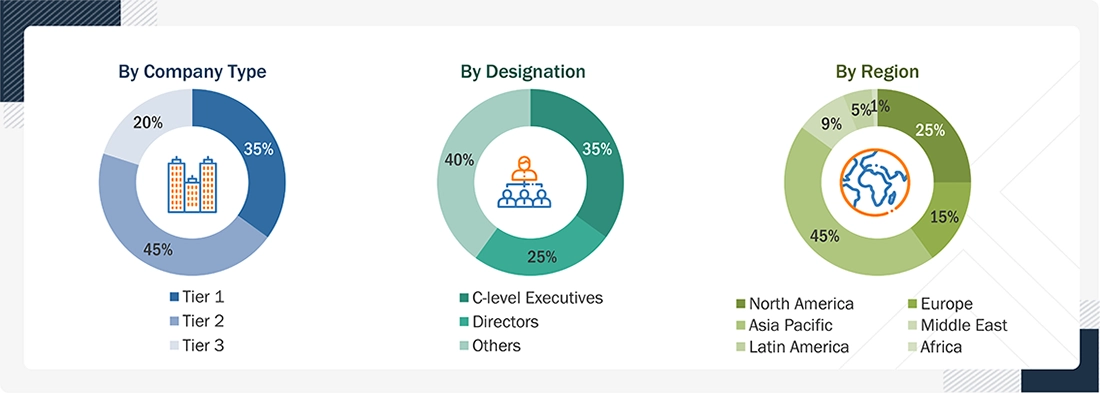
To know about the assumptions considered for the study, download the pdf brochure
Market Size Estimation
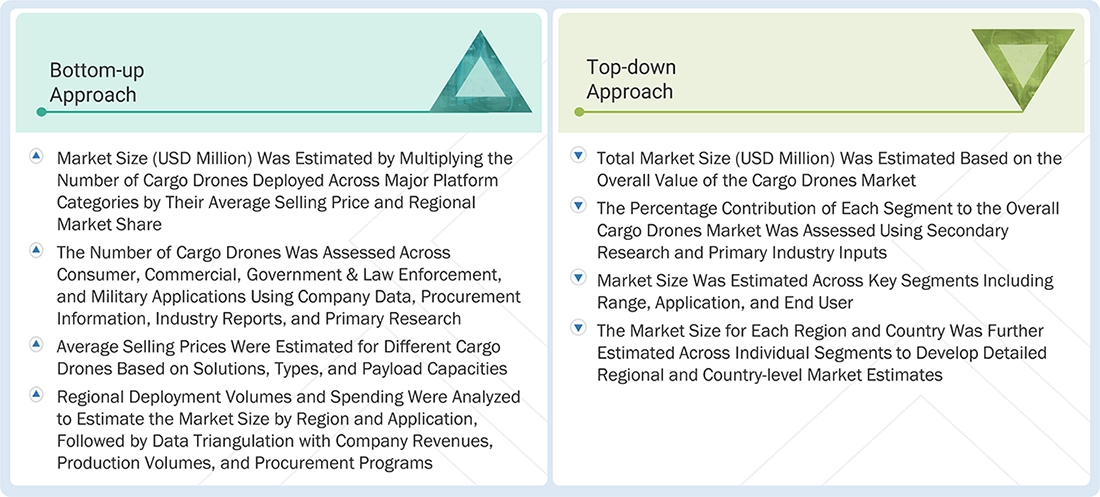
The top-down and bottom-up methods were used to estimate and validate the size of the cargo drones market. The research process involved several steps to ensure accuracy.
-
Key companies active in the cargo drones market were identified through secondary research. Their market presence was evaluated using primary inputs and published data. This included reviewing annual reports, financial disclosures, product launches, contracts, company developments, and public filings. Interviews were also conducted with company executives, technology providers, system integrators, logistics operators, and industry experts. These inputs were used to validate assumptions and refine regional market size estimates.
-
All percentage shares, segment splits, and market breakdowns were first developed using secondary information. These values were then verified through primary discussions with industry participants.
-
The analysis evaluated key factors shaping the cargo drones market, including logistics demand, e-commerce growth, cargo drone procurement, payload capacity, flight range, battery technology, and autonomous flight capabilities. Demand across commercial logistics, healthcare, industrial transportation, and government applications was also assessed. These factors were examined through primary research and used to develop quantitative and qualitative market estimates for the report.
Cargo Drones Market: Top-Down and Bottom-Up Approach
Data Triangulation
After determining the overall cargo drones market size, the market was divided into multiple segments and subsegments. Data triangulation and market breakdown procedures were applied to complete the market analysis and estimate market values for each segment and subsegment. The data was triangulated by examining demand-side and supply-side factors, including cargo drone production, manufacturer revenues, deployment trends, payload capacity, delivery requirements, and end-user demand. Additionally, the market size estimates were validated using top-down and bottom-up approaches to improve consistency and accuracy across the overall market and its individual segments.
Market Definition
A cargo drone is an unmanned aircraft that can transport a load to a location while being ecologically beneficial. Cargo drones come in small, medium, and large sizes, each with different performance capabilities. They come with cutting-edge software and strong sensors. Cargo drones support first-mile, middle-mile, and last-mile delivery.
Key Stakeholders
- Cargo drone manufacturers developing fixed-wing, multirotor, and hybrid cargo drones for logistics, industrial transportation, medical delivery, and government applications
- Cargo drone component manufacturers supplying airframes, motors, flight controllers, avionics, landing systems, and structural components used in cargo drone production
- Payload system manufacturers developing cargo compartments, payload release mechanisms, loading systems, and specialized equipment for transporting different types of goods
- Battery & energy system manufacturers developing lithium-ion batteries, high-capacity battery packs, and advanced energy systems to improve flight endurance and payload capacity
- Electric motor & propulsion system providers supplying electric motors, propellers, electronic speed controllers, and propulsion systems for cargo drone platforms
- Flight control & navigation system providers developing autopilot systems, navigation modules, flight controllers, and autonomous flight technologies for cargo transportation
- Software & artificial intelligence technology providers developing flight management software, route optimization tools, fleet management platforms, and autonomous cargo delivery solutions
- Communication & connectivity providers supplying radio communication, satellite connectivity, data links, and command-and-control systems for cargo drone operations
- Ground control station manufacturers developing systems for flight planning, remote monitoring, cargo mission management, and operational control
- Logistics & cargo delivery companies deploying cargo drones for last-mile delivery, warehouse transfers, regional freight transportation, and time-sensitive shipments
- E-commerce & retail companies exploring cargo drone delivery to improve order fulfillment, reduce delivery times, and expand access to customers in remote locations
- Healthcare & medical supply providers using cargo drones to transport medicines, vaccines, blood samples, and emergency medical supplies
- Government & defense organizations procuring cargo drones for tactical resupply, military logistics, disaster relief, and transportation of essential equipment
Report Objectives
- To define, describe, and forecast the size of the cargo drones market by solution, type, payload capacity, range, application, and end user
- To forecast the size of market segments by key countries in the following regions: North America, Europe, Asia Pacific, Middle East, and the Rest of the World
- To identify and analyze drivers, restraints, opportunities, and challenges influencing the growth of the market
- To identify industry trends, market trends, and technology trends currently prevailing in the market
- To provide an overview of the regulatory landscape for the global cargo drones market
- To analyze micromarkets with respect to individual growth trends, prospects, and their contribution to the overall market
- To analyze opportunities in the market for stakeholders by identifying key market trends
- To profile key market players and comprehensively analyze their market share and core competencies
- To analyze the degree of competition in the market by identifying growth strategies, such as agreements, acquisitions, partnerships, collaborations, and product launches, adopted by leading market players
- To identify detailed financial positions, key products, and unique selling points of leading market players
Available customizations:
MarketsandMarkets offers the following customizations for this market report:
- Additional country-level analysis of the cargo drones market
- Profiling of other market players (up to 5)
Product Analysis
- Product matrix, which provides a detailed comparison of the product portfolio of each company in the cargo drones market
Get the Full Cargo Drones Market Report
Full forecast, segment splits, and company analysis for all Cargo Drones Market.
- Canada Cargo Drones Market
- US Cargo Drones Market
- UK Cargo Drones Market
- Germany Cargo Drones Market
- France Cargo Drones Market
- Italy Cargo Drones Market
- Switzerland Cargo Drones Market
- Norway Cargo Drones Market
- Sweden Cargo Drones Market
- China Cargo Drones Market
- India Cargo Drones Market
- Japan Cargo Drones Market
- Australia Cargo Drones Market
- South Korea Cargo Drones Market
- New Zealand Cargo Drones Market
- Malaysia Cargo Drones Market
- Singapore Cargo Drones Market
- UAE Cargo Drones Market
- Saudi Arabia Cargo Drones Market
- Israel Cargo Drones Market
- Brazil Cargo Drones Market
- Mexico Cargo Drones Market
- Colombia Cargo Drones Market
- Argentina Cargo Drones Market
- Rest Of Europe Cargo Drones Market
Need a Tailored Report?
Customize this report to your needs
Get 10% FREE Customization
Customize This Report