
Australia Compression Therapy Market (2025-2030)

The Australia Compression Therapy Market was valued at $42.6 Million in 2025 and projected to reach to $59.3 Million by 2030, representing a compound annual growth rate of 6.8%. Australia's compression therapy market is positioned for sustained growth through 2030, supported by demographic shifts and increasing healthcare awareness.


| Market Size in | USD 26.32 MN |
| Market Forecast in | |
| CAGR | |
| Forecast Period | |
| Units Considered | Value (USD MN) |
Australia Compression Therapy Market Trends and Insights
- This 6.8% compound annual growth rate reflects Australia's increasing adoption of compression therapy solutions across clinical and consumer segments.
- Australia's aging population, rising prevalence of venous disorders, and growing awareness of preventive healthcare are driving demand for compression garments and devices throughout the forecast period. The Australian compression therapy market benefits from strong healthcare infrastructure and favorable reimbursement policies that support patient access to therapeutic solutions.
- Australia's emphasis on sports medicine and athletic recovery has also accelerated adoption among active populations seeking performance enhancement and injury prevention.
- Between 2025 and 2030, Australia is expected to see expanded distribution channels, increased product innovation, and greater integration of compression therapy into mainstream clinical practice, positioning the country as a key growth market within the Asia Pacific region..
Key Market Statistics
- CAGR (2025-2030) 6.8% CAGR
- Market Size, 2025 ~USD 42.6 Million
- Forecast, 2030 ~USD 59.3 Million
- Country Australia
Australia Compression Therapy Market Overview
Market Valuation :
Australia's compression therapy market is valued at $42.6 million in 2025, with strong growth trajectory reaching $59.3 million by 2030, representing a 6.8% CAGR significantly above the global average of 5.5%.
Aging Population Driver :
Australia's rapidly aging demographic is a primary catalyst for market expansion, with increasing prevalence of age-related venous disorders and chronic conditions requiring compression therapy interventions.
Clinical & Consumer Adoption :
The Australian market demonstrates dual-segment growth across clinical healthcare settings and consumer wellness applications, driven by rising awareness of compression therapy benefits among both healthcare professionals and patients.
Regional Growth Outperformance :
Australia's 6.8% CAGR outpaces the global compression therapy market growth rate of 5.5%, indicating strong regional demand and favorable market conditions for compression therapy solutions.
Australia Compression Therapy Market Dynamics
- The aging population combined with rising incidence of venous insufficiency and lymphedema creates consistent demand for compression garments and devices across hospitals, clinics, and retail channels.
- Healthcare providers are increasingly recommending compression therapy as a non-invasive treatment option, while consumer education campaigns enhance market penetration in the wellness segment.
- Technological innovations in fabric and design are expected to drive adoption among younger demographics seeking preventative solutions..
Market Ecosystem
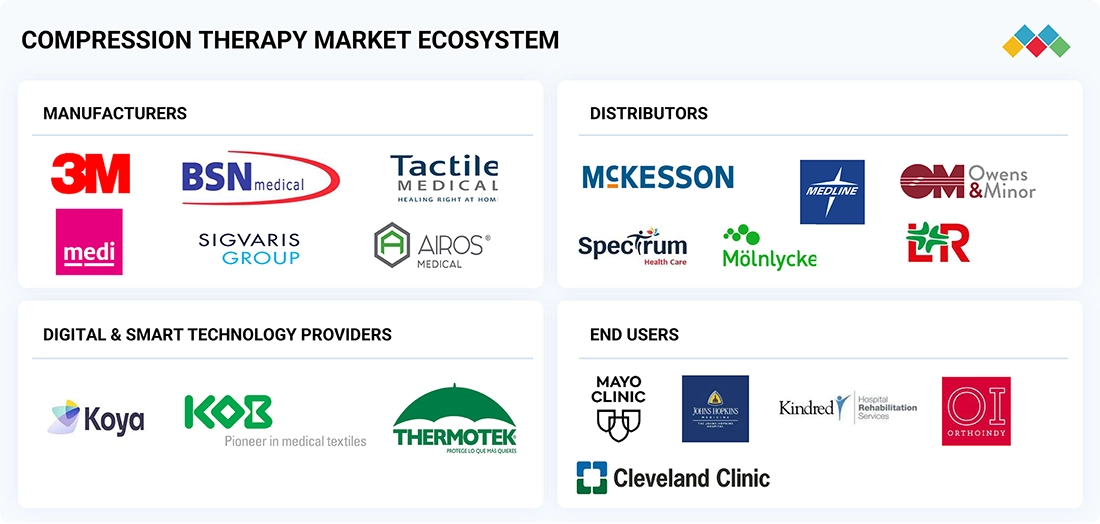
Compression Therapy Market: COMMERCIAL USE CASES ACROSS INDUSTRIES
| COMPANY | USE CASE DESCRIPTION | BENEFITS |
|---|---|---|
 |
Use of graduated compression stockings to manage chronic venous insufficiency (CVI) in elderly patients | Enhances venous circulation, alleviates leg swelling, improves mobility, and elevates overall quality of life. |
 |
Implementation of compression therapy for lymphedema management in post-cancer care patients. | Decreased limb volume, prevention of infection, pain reduction, and improved lymph drainage |
 |
Utilization of compression garments for the prevention of deep vein thrombosis (DVT) in post-operative patients | Reduced incidence of DVT, enhanced blood flow, shortened recovery time |
 |
Application of multi-layer compression bandaging in the treatment of venous leg ulcers. Application of multi-layer compression bandaging in the treatment of venous leg ulcers. | Accelerated wound healing, reduced edema, and improved patient compliance |
Logos and trademarks shown above are the property of their respective owners. Their use here is for informational and illustrative purposes only.
Related Ecosystem
Medical Devices
Key Takeaways
- Australia's compression therapy market is valued at $42.6 million in 2025 and is forecast to reach $59.3 million by 2030, representing a 6.8% CAGR.
- Australia's aging demographic and rising prevalence of venous and lymphatic disorders are primary drivers of compression therapy adoption.
- Strong healthcare infrastructure and favorable reimbursement policies in Australia support widespread patient access to compression solutions.
- Australia's sports medicine sector and focus on athletic recovery are expanding compression therapy adoption beyond clinical applications into consumer wellness markets.
Compression Therapy Market Report Scope
| Report Metric | Details |
|---|---|
| Base Year | 2025 |
| Fastest Growing Segment | LYMPHEDEMA TREATMENT (Application) |
| Forecast Period | 2025–2030 |
| Growth Rate | CAGR of 5.5% from 2025 to 2030 |
| Largest Segment | STATIC COMPRESSION THERAPY (Technique) |
| Market Size Base Year (Billions) | ~USD 4.51 (2025) |
| Revenue Forecast (Billions) | ~USD 5.9 (2030) |
| Segments Covered | Product, Technique, Application, Distribution Channel, Type |
Australia Compression Therapy Market Report Segmentation
5 segment dimensions are covered across the global market.
By Product
- Compression Bandages
- Compression Braces
- Compression Stockings
- Compression Tapes
- Compression Wraps
- Other Compression Garments
- Pneumatic Compression Devices
By Technique
- Dynamic Compression Therapy
- Static Compression Therapy
By Application
- Deep Vein Thrombosis Treatment
- Leg Ulcer Treatment
- Lymphedema Treatment
- Other Applications
- Varicose Vein Treatment
By Distribution Channel
- E-Commerce Platforms
- Home Care Settings
- Hospitals & Clinics
- Pharmacies & Retailers
By Type
- Class I
- Class Ii
- Class Iii
- Intermittent Compression Devices
- Sequential Compression Devices
Target Audience
- Medical Device Manufacturers : Compression therapy device and garment manufacturers need Australia-specific market data to assess market entry opportunities, competitive landscape, and growth potential in this outperforming regional market.
- Healthcare Providers & Hospitals : Australian hospitals and clinical facilities require market insights to understand compression therapy adoption trends, patient demand patterns, and procurement opportunities within their local healthcare system.
- Retail & Distribution Partners : Distributors and retailers in Australia need market forecasts and segment analysis to optimize inventory decisions, identify high-demand product categories, and plan expansion strategies for compression therapy products.
- Investment & Private Equity Firms : Investors evaluating opportunities in Australian healthcare require detailed market sizing and growth projections to assess the viability and ROI potential of compression therapy companies and ventures.
- Market Researchers & Consultants : Research professionals and business consultants need Australia-focused compression therapy data to support client advisory work, competitive analysis, and strategic recommendations for healthcare industry stakeholders.
Key Companies in the Australia Compression Therapy Market
| Company | HQ | Ownership | Strongest segments |
|---|---|---|---|
| DEVON MEDICAL PRODUCTS | United States | Private Company | Pneumatic compression (dynamic),Stockings (static),Wraps and bandages (static), |
| KINDRED HEALTHCARE INC. | United States | Private Company | Bandage,Wraps,Stockings, |
| BEIERSDORF AG | Germany | Public Company | Bandages,Wraps,Stockings, |
| SOLVENTUM CORPORATION (3M) | United States | ||
| ENOVIS CORPORATION | United States | Public Company | Static compression (bandages, wraps, stockings, tapes),Braces with integrated compression,Dynamic/pneumatic compression systems, |
| BSN MEDICAL (A SUBSIDIARY OF ESSITY) | Sweden | ||
| CARDINAL HEALTH | United States | Public Company | Bandages & Wraps,Stockings,Tapes, |
| TACTILE MEDICAL | United States | Public Company | Pneumatic compression systems (Flexitouch Plus, Entre Plus, Nimbl),Software and digital engagement (Kylee app, connectivity, services),Non-compression respiratory therapy (AffloVest), |
| CONVATEC INC. | United Kingdom | Public Company | Static compression (bandages, wraps, stockings, tapes, braces),Dynamic compression (pneumatic devices), |
| MEDI GMBH & CO. KG | Taiwan | Public Company | Stockings (Static),Wraps & Braces (Static),Bandages & Tapes (Static), |
| PAUL HARTMANN | Germany | Public Company | Bandages (compression, universal, zinc paste, padding),Wraps and Stockings,Tapes and Braces, |
| SMITH+NEPHEW | United Kingdom | Public Company | Bandage,Wraps,Stockings, |
DEVON MEDICAL PRODUCTS
Devon Medical Products is a private medical products company founded in 2005 and based in the United States.
KINDRED HEALTHCARE INC.
Kindred Healthcare Inc. is a private healthcare company founded in 1985 in the United States with 64,200 employees.
BEIERSDORF AG
Beiersdorf AG is a German public company founded in 1882 with 21,589 employees, operating in the healthcare and consumer goods sectors.
SOLVENTUM CORPORATION (3M)
Insufficient data available to provide a business description for Solventum Corporation (3M).
ENOVIS CORPORATION
Enovis Corporation is a public medical technology company founded in 1995 in the United States with 7,802 employees.
BSN MEDICAL (A SUBSIDIARY OF ESSITY)
Insufficient data available to provide a business description for BSN Medical (a subsidiary of Essity).
CARDINAL HEALTH
Cardinal Health is a public healthcare services and pharmaceutical distribution company founded in 1979 in the United States with 55,392 employees.
TACTILE MEDICAL
Tactile Medical is a public medical device company founded in 1995 in the United States with 1,086 employees.
CONVATEC INC.
ConvaTec Inc. is a public medical products and healthcare company founded in 1978 in the United Kingdom with 10,910 employees.
MEDI GMBH & CO. KG
Medi GmbH & Co. KG is a public medical device company founded in 1997 based in Taiwan with 17,449 employees.
PAUL HARTMANN
Paul Hartmann is a German public healthcare company founded in 1818 with 10,066 employees.
SMITH+NEPHEW
Smith+Nephew is a public medical devices and healthcare company founded in 1856 in the United Kingdom with 16,988 employees.
Reasons to Buy this Report
- Localized Market Intelligence : Gain Australia-specific insights into market size, growth rates, and competitive dynamics that differ from global trends, enabling targeted business strategy development for the Australian healthcare sector.
- Demographic Opportunity Analysis : Understand how Australia's aging population and rising venous disorder prevalence create specific market opportunities, allowing you to tailor product offerings and marketing strategies to local healthcare needs.
- Segment Performance Data : Access detailed breakdown of clinical versus consumer segments within Australia's market, identifying which channels and customer types offer the highest growth potential for your compression therapy business.
- Competitive Positioning : Benchmark your compression therapy offerings against Australian market standards and competitor strategies, enabling informed decisions on pricing, distribution, and product development for regional success.
- Investment & Expansion Planning : Utilize comprehensive Australia market forecasts through 2030 to make confident investment decisions, identify expansion opportunities, and allocate resources effectively in this high-growth regional market.
Frequently asked questions
What is the current size of Australia's compression therapy market?
Australia's compression therapy market is valued at $42.6 million in 2025 and is projected to grow to $59.3 million by 2030.
What is the growth rate of Australia's compression therapy market?
Australia's compression therapy market is growing at a compound annual growth rate (CAGR) of 6.8% from 2025 to 2030.
What factors are driving growth in Australia's compression therapy market?
Key drivers include Australia's aging population, increasing prevalence of venous disorders, strong healthcare infrastructure, favorable reimbursement policies, and growing adoption in sports medicine and athletic recovery.
How does Australia's compression therapy market compare to global trends?
Australia's 6.8% CAGR outpaces the global compression therapy market CAGR of 5.5%, indicating stronger regional growth momentum and market opportunity.
What segments are driving compression therapy adoption in Australia?
Clinical applications for venous and lymphatic disorders, sports medicine and athletic recovery, and consumer wellness segments are all contributing to market growth in Australia.
RESEARCH METHODOLOGY
The size of the compression therapy market was based on four primary studies to ensure accuracy. Initial data for the compression therapy market and related sectors was gathered from 3 to 5 secondary sources. This information was then validated through primary research to confirm the assumptions and overall market sizing. Both top-down and bottom-up approaches were employed to determine the total market size, which was subsequently refined into segment and subsegment sizes. Finally, data triangulation was conducted to verify the accuracy of the findings.
Secondary Research
Secondary research sources included directories, Factiva, white papers, Bloomberg Business, annual reports, SEC filings, business filings, and investor presentations. These sources offered valuable insights into market leaders, sector divisions, and technological differences within various segments of the compression therapy industry.
Primary Research
Primary research consisted of both quantitative and qualitative insights gathered through interviews with key stakeholders. On the demand side, participants included physicians, researchers, department heads, and staff from diagnostic centers, hospitals, and research institutes. On the supply side, interviews were conducted with CEOs, area sales managers, territory and regional sales managers, and other top executives from relevant companies. These direct conversations helped validate the findings from secondary research and provided an opportunity to directly question and confirm assumptions.
A breakdown of the primary respondents is provided below.
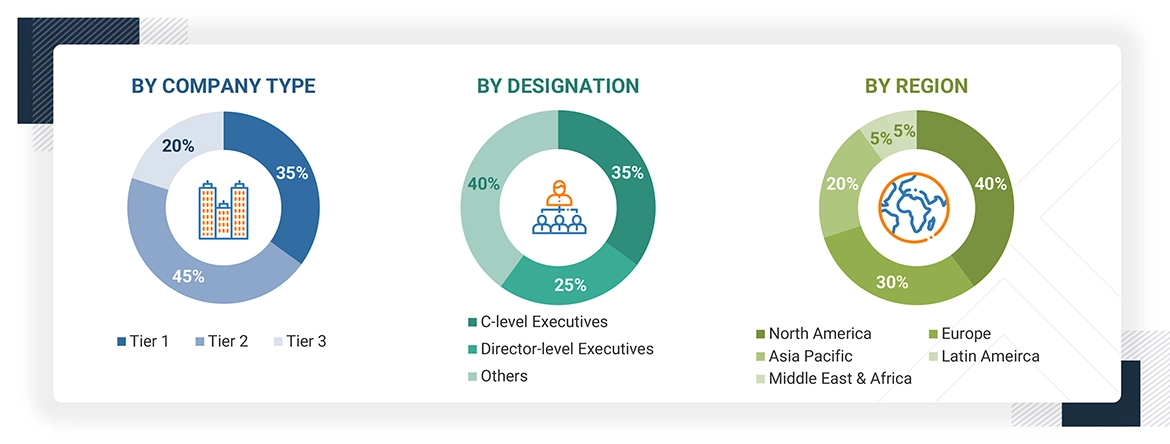
Note q: Others include sales managers, marketing managers, business development managers, product managers, distributors, and suppliers.
Note 2: Companies are classified into tiers based on their total revenue. As of 2024, Tier 1 = >USD 1 billion, Tier 2 = < USD 500 million, and Tier 3 = < USD 100 million.
To know about the assumptions considered for the study, download the pdf brochure
Market Size Estimation
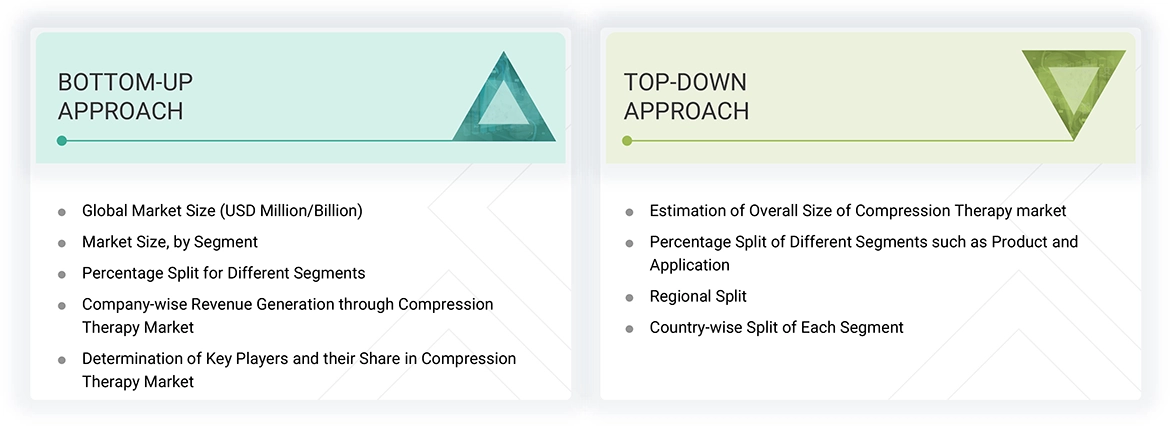
This report utilized the revenue share analysis of major companies to evaluate the size of the global compression therapy market. This analysis involved identifying key market participants and calculating their revenue from compression therapy using a variety of data collected during both primary and secondary research phases. One aspect of the secondary research included reviewing the annual and financial reports of leading market players. Conversely, primary research consisted of detailed interviews with influential thought leaders, including directors, CEOs, and key marketing executives.
To determine the overall market value, the segmental revenue was calculated by mapping the revenue of the leading solution and service providers. The process involved several steps.
- Making a list of leading international companies in the compression therapy industry
- Charting annual profits made by leading companies in the compression therapy sector (or the closest stated business unit/product category)
- 2024 revenue mapping of leading companies to cover a significant portion of the global market
- Calculating the global value of the compression therapy industry
Global Compression Therapy Market: Bottom-up and Top-down Approach
Data Triangulation
To ensure accurate data, the compression therapy market was divided into various segments and subsegments. A data triangulation process that used both top-down and bottom-up approaches was applied. This involved analyzing factors and trends from both the demand and supply sides to validate the findings for each segment. The combination of this segmentation with the triangulation process helps ensure that the market data is both accurate and reliable.
Market Definition
Compression therapy is the process of applying controlled pressure to the lower extremities to increase and improve blood flow to the heart. This mode of treatment utilizes the elastic properties of compression garments or the pneumatic force of compression devices to address specific clinical requirements as part of disease management. The compression therapy market is primarily used for managing venous disorders, lymphedema, wound care, post-surgical recovery, and sports injuries. It enhances blood circulation, reduces swelling, and promotes healing, commonly through compression garments, bandages, and devices like pneumatic pumps. Key settings include hospitals, clinics, and home care.
Stakeholders
- Manufacturers of compression garments, bandages, and devices
- Healthcare providers such as hospitals, clinics, and rehabilitation centers
- Patients using compression therapy for various conditions
- Healthcare professionals, including physicians, surgeons, and physiotherapists
- Insurance companies involved in reimbursement and coverage
- Regulatory bodies overseeing product standards and safety
- Suppliers and distributors of compression therapy products
- Research & development firms focusing on innovation and technology in compression therapy
Report Objectives
- To define, describe, and forecast the compression therapy market based on product, application, technique, distribution channel, and region
- To provide detailed information regarding the major factors influencing the growth of the market (drivers, restraints, opportunities, and industry-specific challenges)
- To strategically analyze micromarkets with respect to individual growth trends, prospects, and contributions to the total market
- To analyze opportunities in the market for stakeholders and provide details of the competitive landscape for market leaders
- To forecast the revenue of the market segments with respect to five regions: North America, Europe, the Asia Pacific, Latin America, and the Middle East & Africa
- To profile the key players and comprehensively analyze their market ranking and core competencies
- To benchmark players within the market using a proprietary Company Evaluation Matrix framework, which analyzes market players on various parameters within the broad categories of business strategy excellence and strength of product portfolio
- To analyze competitive developments such as product launches, agreements, expansions, collaborations, and acquisitions in the compression therapy market
Get the Full Compression Therapy Market Report
Full forecast, segment splits, and company analysis for all Compression Therapy Market.
- US Compression Therapy Market
- Canada Compression Therapy Market
- Germany Compression Therapy Market
- France Compression Therapy Market
- UK Compression Therapy Market
- Italy Compression Therapy Market
- Spain Compression Therapy Market
- China Compression Therapy Market
- Japan Compression Therapy Market
- India Compression Therapy Market
- South Korea Compression Therapy Market
- Brazil Compression Therapy Market
- Mexico Compression Therapy Market
- Rest Of Europe Compression Therapy Market
- Rest Of Asia Pacific Compression Therapy Market
- Rest Of Latin America Compression Therapy Market
Need a Tailored Report?
Customize this report to your needs
Get 10% FREE Customization
Customize This Report
