
South Korea Data Center Certification Market (2026-2031)

The South Korea Data Center Certification Market was valued at $27.8 Million in 2026 and projected to reach to $88 Million by 2031, representing a compound annual growth rate of 21.2%. South Korea's data center certification market is poised for sustained high-growth expansion through 2031, driven by escalating regulatory mandates, increased enterprise digitalization, and the nation's commitment to cybersecurity excellence.


| Market Size in | USD 26.32 MN |
| Market Forecast in | |
| CAGR | |
| Forecast Period | |
| Units Considered | Value (USD MN) |
South Korea Data Center Certification Market Trends and Insights
- This represents a compound annual growth rate of 21.2%, significantly outpacing global trends as South Korea strengthens its position as a regional technology hub.
- The market growth in South Korea is driven by increasing regulatory requirements, heightened focus on data security standards, and the proliferation of hyperscale data center infrastructure across the nation. South Korea's strategic importance in the Asia Pacific semiconductor and electronics ecosystem has accelerated demand for comprehensive data center certification services.
- Between 2026 and 2031, South Korea is expected to see intensified investment in compliance frameworks, ISO certifications, and third-party validation services.
- The country's advanced technological infrastructure and stringent government policies on data protection are key catalysts propelling South Korea's market expansion during this forecast period..
Key Market Statistics
- CAGR (2026-2031) 21.2% CAGR
- Market Size, 2026 ~USD 27.8 Million
- Forecast, 2031 ~USD 88 Million
- Country South Korea
South Korea Data Center Certification Market Overview
Exceptional Growth Trajectory :
South Korea's data center certification market is expanding at 21.2% CAGR, significantly outpacing the global rate of 17.4%, reflecting the country's accelerated digital transformation and regional tech leadership.
Substantial Market Valuation :
The market is valued at $27.8 million in 2026 and is projected to reach $88.0 million by 2031, representing a 216% increase over five years as compliance demands intensify across South Korea's data center infrastructure.
Regulatory Compliance Drivers :
Increasing regulatory requirements from South Korean government agencies and industry standards are compelling data center operators to invest in comprehensive certification programs to meet stringent data protection and operational standards.
Regional Technology Hub Status :
South Korea's position as a leading regional technology hub in Asia-Pacific is driving demand for world-class data center certifications, attracting multinational enterprises and local operators seeking competitive differentiation.
South Korea Data Center Certification Market Dynamics
- The market's 21.2% CAGR reflects growing investments in data center infrastructure modernization and compliance frameworks across financial services, government, and technology sectors. The outlook is further strengthened by South Korea's strategic positioning as a regional data hub for Asia-Pacific operations.
- Enterprises establishing or expanding data center facilities in South Korea increasingly prioritize certifications to meet international standards, regulatory compliance, and customer trust requirements.
- This trend is expected to accelerate as cloud adoption, AI infrastructure deployment, and cross-border data governance requirements intensify throughout the forecast period..
Market Ecosystem
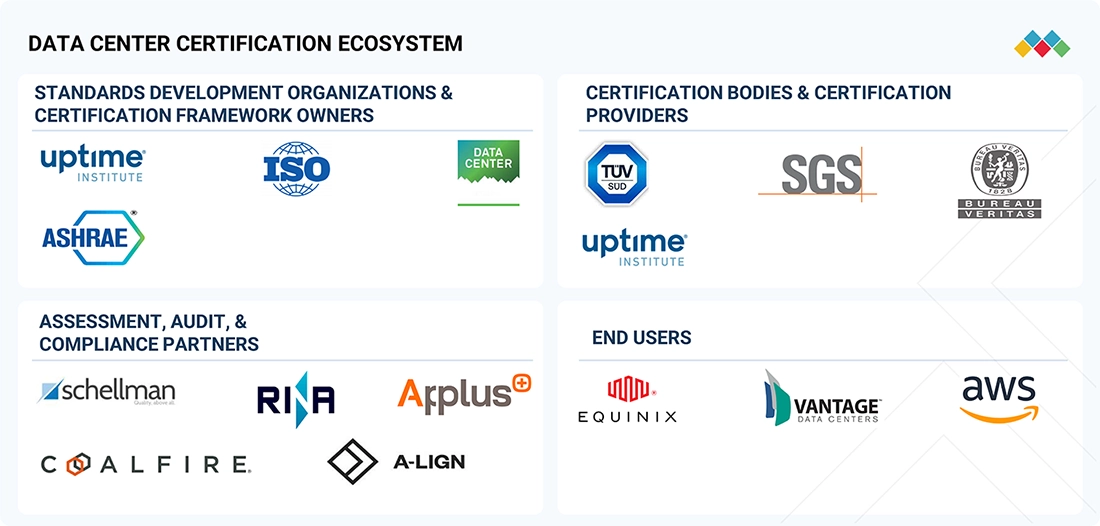
DATA CENTER CERTIFICATION MARKET SIZE, SHARE & TRENDS: COMMERCIAL USE CASES ACROSS INDUSTRIES
| COMPANY | USE CASE DESCRIPTION | BENEFITS |
|---|---|---|
 |
Certification of data center design, constructed facilities, operational sustainability, and resilience to validate infrastructure availability and operational excellence across enterprise, colocation, and hyperscale facilities | Higher infrastructure reliability | Improved uptime | Reduced operational risks |
 |
Independent certification of data center facilities covering design, commissioning, information security, energy management, and operational performance to support regulatory compliance and business continuity | Enhanced compliance | Improved operational efficiency | Greater infrastructure resilience |
 |
Certification of information security, business continuity, quality management, and operational governance for mission-critical data center environments. | Stronger governance | Improved cybersecurity posture | Increased customer confidence |
 |
Certification of sustainability, energy efficiency, environmental management, and operational performance for modern data center infrastructure | Improved ESG performance | Better energy efficiency | Enhanced regulatory compliance |
 |
Independent assessment and certification of information security, cybersecurity, and compliance programs supporting cloud, enterprise, and colocation data centers | Strengthened security assurance | Regulatory compliance | Increased stakeholder trust |
Logos and trademarks shown above are the property of their respective owners. Their use here is for informational and illustrative purposes only.
Related Ecosystem
Testing Inspection And Certification
- Eddy Current Testing (ECT)
- Safety Testing
- Signal Generators
- Acoustic Emission Testing (AET)
- Automated Test Equipment
- Sgs s.a.
- Intertek Group plc
- Bureau veritas s.a.
- TUV RHEINLAND AG
- EUROFINS SCIENTIFIC SE
Key Takeaways
- South Korea's data center certification market will grow from $27.8M (2026) to $88.0M (2031) at a 21.2% CAGR.
- South Korea's regulatory environment and data security mandates are primary drivers of certification demand.
- South Korea's position as a regional tech leader accelerates adoption of advanced compliance and validation standards.
- South Korea's market growth outpaces global averages, reflecting strong regional investment in data center infrastructure.
Data Center Certification Market Report Scope
| Report Metric | Details |
|---|---|
| Base Year | 2026 |
| Fastest Growing Segment | CONTINUOUS MONITORING & RECERTIFICATION (Certification Delivery Model) |
| Forecast Period | 2026-2031 |
| Growth Rate | CAGR of 17.4% from 2026 to 2031 |
| Largest Segment | HYPERSCALE (Data Center Type) |
| Market Size Base Year (Billions) | ~USD 1.16 (2026) |
| Revenue Forecast (Billions) | ~USD 2.6 (2031) |
| Segments Covered | Certification Type, Type, Infrastructure, Certification Delivery Model, Data Center Type, End User |
South Korea Data Center Certification Market Report Segmentation
6 segment dimensions are covered across the global market.
By Certification Type
- Facility & Reliability Certifications
- Information Security & Cybersecurity Certifications
- Infrastructure Performance & System Certifications
- Operational Certifications
- Sustainability & Energy Certifications
By Type
- Business Continuity
- Carbon & Emission
- Commissioning
- Constructed Facility
- Cybersecurity
- Design
- Electrical Safety
- Energy Efficiency
- Environmental Management
- Green Building
- Information Security Management
- Integrated System Validation
- It Service Management
- Mechanical Reliability
- Operational Sustainability
- Power Reliability & Redundancy
- Privacy & Data Protection
- Quality Management
- Resiliency
- Security Audit
- Thermal Performance
- Water & Resource Efficiency
By Infrastructure
- Cooling
- It
- Power
- Racks & Enclosures
By Certification Delivery Model
- Commissioning & Integrated Systems Validation Certification
- Construction & Installation Certification
- Continuous Monitoring & Recertification
- Design Phase Certification
- Operational Phase Certification
By Data Center Type
- Colocation
- Enterprise
- Hyperscale
By End User
- Bfsi
- Cloud Service Providers
- Government & Defense
- Healthcare & Life Sciences
- It, Technology & Digital Infrastructure Providers
- Manufacturing
- Other End Users
- Retail & E-Commerce
- Telecom & Network Operators
Target Audience
- Data Center Operators : South Korean and multinational data center operators need market intelligence to understand certification requirements, competitive benchmarks, and investment priorities for compliance infrastructure expansion.
- Certification & Compliance Service Providers : Certification bodies, auditors, and compliance consultants require detailed market data to identify growth opportunities, service demand trends, and client acquisition strategies in South Korea's expanding market.
- Enterprise IT & Security Leaders : CIOs and security executives in South Korea need insights into certification standards and market trends to ensure their data center infrastructure meets regulatory requirements and industry best practices.
- Government & Regulatory Bodies : South Korean government agencies and regulatory authorities benefit from market analysis to inform policy development, compliance frameworks, and cybersecurity standards for the data center sector.
- Technology Investors & Consultants : Investment firms and management consultants require South Korea-specific market data to evaluate opportunities in the data center certification ecosystem and advise clients on market entry strategies.
Reasons to Buy this Report
- Market-Specific Growth Intelligence : Gain detailed insights into South Korea's 21.2% CAGR trajectory and understand the unique regulatory and competitive dynamics driving market expansion faster than global averages.
- Investment Decision Support : Leverage precise market sizing ($27.8M in 2026 to $88M by 2031) and forecasts to make informed investment, expansion, and resource allocation decisions specific to the South Korean market.
- Regulatory Landscape Analysis : Understand South Korea's specific compliance requirements, government mandates, and industry standards shaping certification demand, enabling strategic positioning and service development.
- Competitive Positioning Strategy : Identify market opportunities and competitive gaps unique to South Korea's data center ecosystem, helping certification providers and operators differentiate and capture market share.
- Regional Hub Opportunity Assessment : Evaluate South Korea's role as an Asia-Pacific technology hub and its implications for multinational enterprises seeking regional data center certifications and compliance solutions.
Frequently asked questions
What is the current size of South Korea's data center certification market?
South Korea's data center certification market is valued at $27.8 million in 2026 and is projected to grow to $88.0 million by 2031.
What is the growth rate for South Korea's data center certification market?
South Korea's data center certification market is expected to grow at a compound annual growth rate (CAGR) of 21.2% from 2026 to 2031.
What factors are driving growth in South Korea's data center certification market?
South Korea's market growth is driven by stringent regulatory requirements, increased focus on data security, hyperscale data center expansion, and government policies on data protection.
How does South Korea's market compare to global trends?
South Korea's 21.2% CAGR significantly exceeds the global average of 17.4%, reflecting the country's strategic importance and advanced technological infrastructure.
Which certifications are most relevant in South Korea's data center market?
South Korea emphasizes ISO certifications, compliance frameworks, third-party validation services, and government-mandated data protection standards for data center operations.
RESEARCH METHODOLOGY
The research study involved four major activities in estimating the size of the data center certification market. Exhaustive secondary research was conducted to collect information on the market, certification ecosystem, and related industries. The findings, assumptions, and market estimates were validated through extensive primary research with certification providers, accreditation experts, data center operators, consultants, and industry specialists. Both top-down and bottom-up approaches were used to estimate the overall market size. Subsequently, market breakdown and data triangulation techniques were applied to estimate the market sizes of all segments and subsegments with a high degree of accuracy.
Secondary Research
During the secondary research process, various publicly available sources were referred to for identifying and collecting information required for this study. These sources included annual reports, sustainability reports, certification body publications, accreditation organization documents, white papers, industry associations, government publications, technical articles, investor presentations, and company press releases. Secondary research was primarily conducted to understand the certification ecosystem, market segmentation, industry trends, regulatory landscape, competitive environment, pricing trends, and regional developments from both market- and technology-oriented perspectives.
For the data center certification market, the global market size was estimated using both top-down and bottom-up approaches, along with several dependent submarkets. Major market participants were identified through extensive secondary research, and their market presence was validated through primary interviews. All percentage splits, market shares, and segmental breakdowns were derived from secondary sources and verified through primary research.
Primary Research
Extensive primary research has been conducted after understanding the data center certification market scenario through secondary research. Several primary interviews have been conducted with key opinion leaders from both demand- and supply-side vendors across five major regions—Asia Pacific, North America, Europe, South America, and the Middle East & Africa. Approximately 30% of the primary interviews have been conducted with the demand-side vendors and 70% with the supply-side vendors. Primary data has been collected mainly through telephone interviews; questionnaires and emails have also been used to collect the data.
After successful interaction with industry experts, brief sessions were conducted with highly experienced independent consultants to validate and reinforce the insights derived from our research. Coupled with perspectives from our internal subject-matter experts, this comprehensive approach has culminated in the findings presented in the report.
The breakdown of primary respondents is as follows:
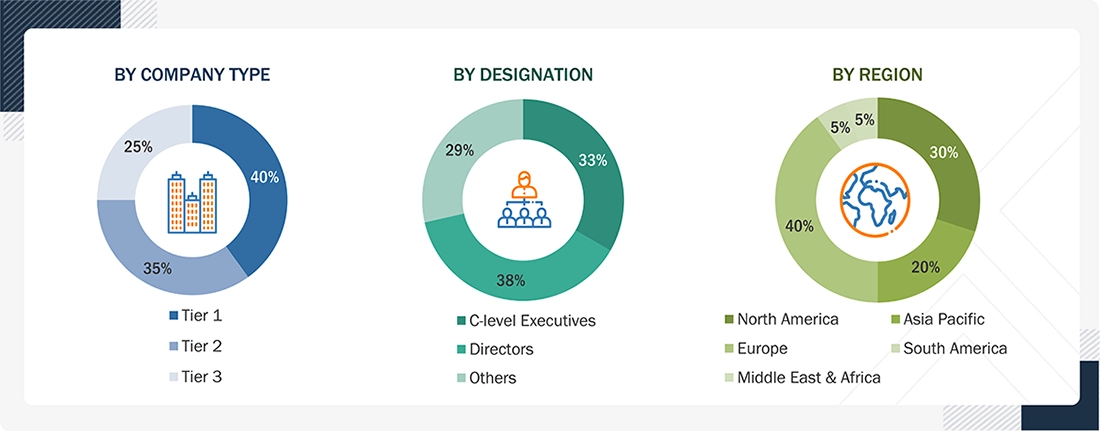
Note: Others include sales managers, marketing managers, product managers, etc.
To know about the assumptions considered for the study, download the pdf brochure
Market Size Estimation
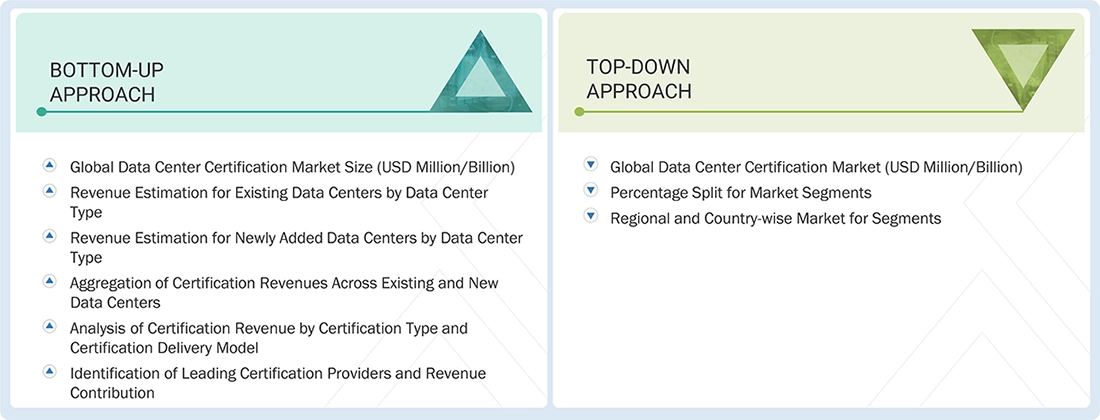
In the market engineering process, both top-down and bottom-up approaches, along with data triangulation, were used to estimate and validate the size of the data center certification market and its dependent submarkets. The research methodology used is as follows:
- Identifying global investments in hyperscale, colocation, enterprise, and edge data centers, along with trends in AI infrastructure, cloud computing, and digital transformation
- Identifying key stakeholders across the data center certification ecosystem, including certification providers, accreditation bodies, data center operators, consultants, and end users
- Analyzing major certification providers, their certification portfolios, geographic presence, accreditation status, and strategic initiatives
- Assessing the number of existing and newly commissioned data centers by data center type
- Evaluating certification adoption across different certification types, infrastructure categories, certification delivery models, and end users
- Estimating certification spending per facility across design, construction, commissioning, operations, cybersecurity, and sustainability certification stages
- Aggregating certification revenues generated across all data center types to estimate the global data center certification market size
- Segmenting the overall market by certification type, infrastructure, certification delivery model, data center type, end user, and region
- Analyzing regional and country-level market splits and validating certification demand across major data center markets
- Tracking recent market developments, including certification framework updates, accreditation programs, partnerships, acquisitions, and regional expansions
- Conducting multiple discussions with key opinion leaders to understand certification adoption trends, regulatory developments, and evolving customer requirements
- Validating the estimates at every level through discussions with key opinion leaders, such as chief executives (CXOs), directors, technology specialists, procurement managers, and operations managers, and finally with domain experts at MarketsandMarkets
Data Center Certification Market : Top-Down and Bottom-Up Approach
Data Triangulation
After arriving at the overall market size using the market size estimation processes as explained above, the market was split into several segments and subsegments. To complete the entire market engineering process and arrive at the exact statistics of each market segment and subsegment, data triangulation and market breakdown procedures were employed, wherever applicable. The data was triangulated by studying various factors and trends from the demand and supply sides in the data center certification market.
Market Definition
The data center certification market refers to the revenue generated from third-party certification services that assess and validate the design, construction, commissioning, operation, security, sustainability, resilience, and infrastructure performance of data centers. It includes facility and reliability, operational, information security and cybersecurity, sustainability and energy, and infrastructure performance certifications across IT, power, cooling, racks and enclosures, and integrated facility systems, supporting enterprise, colocation, hyperscale, and cloud data centers in achieving reliability, compliance, and operational excellence.
Key Stakeholders
- Certification framework and certification scheme owners
- Certification bodies and certification providers
- Accreditation bodies
- Standards development organizations
- Data center owners and operators
- Data center design, engineering, and commissioning firms
- Data center infrastructure integrators
- Facility management and operations service providers
- Cybersecurity and information security consultants
- Sustainability and energy management consultants
- Government and regulatory organizations
- Research institutions and industry associations
- End users
Report Objectives
- To describe, segment, and forecast the size of the data center certification market, by certification type, infrastructure, certification delivery model, data center type, and end user, in terms of value
- To forecast the size of various segments for five regions: North America, the Asia Pacific, Europe, South America, and Middle East & Africa, in terms of value
- To offer detailed information on drivers, restraints, opportunities, and challenges influencing the growth of the data center certification market
- To provide a detailed overview of the data center certification market value chain
- To strategically analyze the micromarkets concerning individual growth trends, prospects, and contributions to the overall market
- To study industry trends, technological advancements, regulatory landscape, sustainability initiatives, customer landscape & buyer behavior, the impact of AI/Gen AI, along with the macroeconomic outlook
- To analyze opportunities for various stakeholders by identifying the high-growth segments of the market
- To benchmark the key players and analyze their market position in terms of revenue, market share, and core competencies, and to provide a detailed competitive landscape for the market leaders
- To analyze competitive developments such as product launches, deals, and expansions carried out by players in the data center certification market
Available customizations:
With the given market data, MarketsandMarkets offers customizations according to the specific requirements of companies. The following customization options are available for the report:
- Detailed analysis and profiling of additional market players (up to 5)
Get the Full Data Center Certification Market Report
Full forecast, segment splits, and company analysis for all Data Center Certification Market.
- Brazil Data Center Certification Market
- Argentina Data Center Certification Market
- Rest Of Europe Data Center Certification Market
- Rest Of Asia Pacific Data Center Certification Market
- Rest Of South America Data Center Certification Market
- US Data Center Certification Market
- Canada Data Center Certification Market
- Mexico Data Center Certification Market
- UK Data Center Certification Market
- Germany Data Center Certification Market
- France Data Center Certification Market
- Italy Data Center Certification Market
- Spain Data Center Certification Market
- Russia Data Center Certification Market
- Poland Data Center Certification Market
- Switzerland Data Center Certification Market
- Sweden Data Center Certification Market
- Belgium Data Center Certification Market
- Netherlands Data Center Certification Market
- China Data Center Certification Market
- Japan Data Center Certification Market
- India Data Center Certification Market
- Australia Data Center Certification Market
- Singapore Data Center Certification Market
- Indonesia Data Center Certification Market
- New Zealand Data Center Certification Market
Need a Tailored Report?
Customize this report to your needs
Get 10% FREE Customization
Customize This Report
