
Sweden Data Center Storage Market (2026-2031)

The Sweden Data Center Storage Market was valued at $465.1 Million in 2026 and projected to reach to $748.5 Million by 2031, representing a compound annual growth rate of 8.3%. Sweden's data center storage market is poised for significant expansion, driven by the country's emergence as a critical Nordic hub for cloud infrastructure and AI computing.


| Market Size in | USD 26.32 MN |
| Market Forecast in | |
| CAGR | |
| Forecast Period | |
| Units Considered | Value (USD MN) |
Sweden Data Center Storage Market Trends and Insights
- This 8.3% compound annual growth rate reflects Sweden's strategic position as a Nordic data hub, driven by increasing cloud adoption, AI infrastructure investments, and the country's commitment to sustainable data center operations.
- Sweden's cool climate and renewable energy resources position the nation as an attractive destination for hyperscale data center deployments. The Swedish market benefits from strong digital transformation initiatives across enterprises and public sector organizations.
- Sweden's data center storage demand is accelerating due to growing data volumes, edge computing expansion, and enterprise migration to hybrid cloud environments.
- Between 2026 and 2031, Sweden is expected to see significant capital investments in advanced storage technologies, including NVMe systems and software-defined storage solutions.
- The country's emphasis on data sovereignty and GDPR compliance further strengthens demand for localized storage infrastructure. Sweden's competitive advantages in renewable energy and technological innovation create favorable conditions for sustained market expansion.
- Storage vendors and data center operators in Sweden are increasingly focusing on energy-efficient solutions and advanced cooling technologies to meet both performance and sustainability objectives through 2031..
Key Market Statistics
- CAGR (2026-2031) 8.3% CAGR
- Market Size, 2026 ~USD 465.1 Million
- Forecast, 2031 ~USD 748.5 Million
- Country Sweden
Sweden Data Center Storage Market Overview
Nordic Data Hub Leadership :
Sweden is establishing itself as a premier Nordic data center destination, leveraging its geographic position, political stability, and advanced infrastructure to attract regional and global investments in data storage solutions.
Sustainable Operations Focus :
Sweden's commitment to renewable energy and green data center practices is driving adoption of energy-efficient storage technologies, with operators prioritizing sustainability certifications and carbon-neutral operations.
AI and Cloud Infrastructure Boom :
Rapid expansion of AI workloads and cloud service adoption among Swedish enterprises is fueling demand for high-capacity, low-latency storage solutions to support advanced analytics and machine learning applications.
Strong CAGR Performance :
Sweden's data center storage market is growing at 8.3% CAGR (2026-2031), outpacing the global average of 8.2%, reflecting accelerating digital transformation and data-intensive operations across Nordic enterprises.
Sweden Data Center Storage Market Dynamics
- The market's 8.3% CAGR reflects strong demand from enterprises modernizing their IT infrastructure and multinational companies establishing regional data centers.
- Sweden's competitive advantages—including abundant renewable energy, advanced telecommunications networks, and favorable regulatory environment—continue to attract major storage infrastructure investments. Looking ahead to 2031, the market will be shaped by increasing adoption of edge computing, growing data sovereignty requirements, and continued investment in next-generation storage technologies.
- Swedish data center operators are expected to prioritize hybrid and multi-cloud storage solutions, while sustainability initiatives will remain a key differentiator.
- The convergence of AI infrastructure demands and Nordic digital leadership positions Sweden for sustained market growth and regional influence..
Market Ecosystem
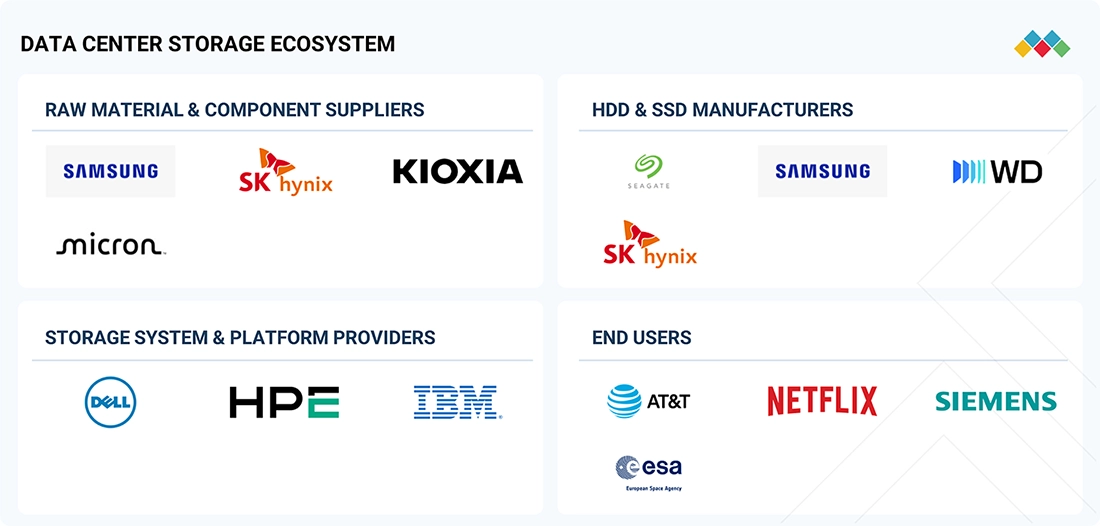
DATA CENTER STORAGE MARKET: COMMERCIAL USE CASES ACROSS INDUSTRIES
| COMPANY | USE CASE DESCRIPTION | BENEFITS |
|---|---|---|
 |
Deployment of high-performance enterprise NVMe SSDs for hyperscale data centers, AI servers, and cloud storage infrastructure requiring low-latency and high-throughput data processing | Faster data access speeds | Reduced latency | Improved power efficiency |
 |
Development of enterprise SSD solutions optimized for AI training clusters, virtualization platforms, and high-performance computing environments | Enhanced workload performance | Higher storage density | Improved energy efficiency |
 |
Integration of enterprise SSDs into cloud, database, and analytics infrastructure for scalable and data-intensive workloads | Accelerated data processing | Increased system responsiveness | Lower operational overhead |
 |
Deployment of high-capacity nearline HDDs for hyperscale storage, backup infrastructure, and archival data management applications | Cost-efficient bulk storage | High storage scalability | Reliable long-term data retention |
 |
Development of enterprise HDD and data center SSD solutions for cloud platforms, colocation facilities, and enterprise storage arrays | Optimized storage performance | Improved workload reliability | Efficient large-scale data management |
Logos and trademarks shown above are the property of their respective owners. Their use here is for informational and illustrative purposes only.
Related Ecosystem
Electronics System And Components
- Sensors
- Temperature Sensors
- Pressure Sensors
- Actuators
- Image Sensors
- Lenovo
- Samsung
- Texas Instruments Incorporated
- HONEYWELL INTERNATIONAL INC.
- Teledyne Technologies Incorporated
Key Takeaways
- Sweden's data center storage market will grow from $465.1M (2026) to $748.5M (2031) at an 8.3% CAGR, outpacing global growth rates.
- Sweden's renewable energy infrastructure and cool climate make it a preferred location for sustainable, hyperscale data center investments.
- Enterprise cloud migration and AI workload expansion are primary drivers of storage demand across Sweden's digital economy.
- GDPR compliance and data sovereignty requirements in Sweden create sustained demand for localized, secure storage solutions.
Data Center Storage Market Report Scope
| Report Metric | Details |
|---|---|
| Base Year | 2026 |
| Fastest Growing Segment | EDSFF (Form Factor) |
| Forecast Period | 2026–2031 |
| Growth Rate | CAGR of 8.2% from 2026 to 2031 |
| Largest Segment | SOLID-STATE DRIVES (Storage Medium) |
| Market Size Base Year (Billions) | ~USD 88.86 (2026) |
| Revenue Forecast (Billions) | ~USD 131.77 (2031) |
| Segments Covered | Storage Medium, Type, Interface, Capacity, Form Factor, Deployment Type, End User |
Sweden Data Center Storage Market Report Segmentation
7 segment dimensions are covered across the global market.
By Storage Medium
- Hard Disk Drives
- Solid-State Drives
By Type
- Automotive
- Bfsi
- Conventional Magnetic Recording
- Energy & Utilities
- Healthcare
- It & Telecom
- Manufacturing
- Multi-Level Cell
- Other Enterprises
- Quad-Level Cell
- Retail & E-Commerce
- Shingled Magnetic Recording
- Single-Level Cell
- Triple-Level Cell
By Interface
- Nvme
- Sas
- Sata
By Capacity
- High Capacity (10–20 Tb)
- Low Capacity (<2 Tb)
- Mid Capacity (2–10 Tb)
- Ultra-High Capacity (>20 Tb)
By Form Factor
- 2.5 Inch
- 3.5 Inch
- Add-In Cards (Aics)
- Edsff
- M.2
- U.2/U.3
By Deployment Type
- Cloud-Based
- Hybrid
- On-Premises
By End User
- Enterprises
- Government & Public Sector
- Hyperscale/Cloud Service Providers
SWEDEN: DATA CENTER STORAGE MARKET, BY END USER, 2026–2032
| Segment | 2026 | 2027 | 2028 | 2029 | 2030 | 2031 | 2032 | CAGR (%) |
|---|---|---|---|---|---|---|---|---|
| ENTERPRISES | 126.9 | 139.1 | 148.3 | 156.8 | 160.4 | 161.3 | 162.4 | 4.2 |
| GOVERNMENT & PUBLIC SECTOR | 50.7 | 58.2 | 64.6 | 70.8 | 74.7 | 77.2 | 78.6 | 7.6 |
| HYPERSCALE/CLOUD SERVICE PROVIDERS | 287.5 | 333.1 | 375.3 | 419.6 | 453.7 | 482.6 | 507.5 | 9.9 |
| TOTAL | 465.1 | 530.4 | 588.2 | 647.2 | 688.8 | 721.1 | 748.5 | 8.3 |
Target Audience
- Data Center Operators & Providers : Swedish and international data center operators need market intelligence to optimize storage infrastructure investments, understand competitive positioning, and capitalize on the 8.3% growth opportunity in the Nordic region.
- Enterprise IT Decision Makers : Swedish enterprises require insights into local storage market trends, vendor capabilities, and sustainability standards to make informed procurement decisions and align storage strategies with Nordic digital transformation initiatives.
- Technology Vendors & Manufacturers : Storage hardware and software vendors need Sweden-specific market data to identify growth opportunities, understand customer requirements, and develop targeted go-to-market strategies for the Nordic data center sector.
- Investment & Private Equity Firms : Investors evaluating opportunities in Nordic data center infrastructure require detailed market analysis, growth projections, and competitive dynamics specific to Sweden to assess investment viability and returns.
- Consulting & Systems Integration Firms : Consultants advising clients on data center modernization and storage solutions need Sweden-specific market insights, regulatory knowledge, and trend analysis to deliver credible recommendations and strategic guidance.
Key Companies in the Sweden Data Center Storage Market
| Company | HQ | Ownership | Strongest segments |
|---|---|---|---|
| SAMSUNG | South Korea | Public Company | Smartphones, tablets, wearables,Consumer electronics (TVs, audio, appliances),Memory and storage (DRAM, NAND, SSD), |
| MICRON TECHNOLOGY, INC. | United States | Public Company | DRAM components and modules (incl. LPDDR, graphics, data center, CXL),NAND & SSD (data center, client, auto/industrial, managed NAND),Automotive & embedded MCPs and NOR, |
| KIOXIA HOLDINGS CORPORATION | Japan | Public Company | NAND flash components (discrete and managed),Client and enterprise SSDs,Retail products (SD cards, USB, consumer SSD), |
| SK HYNIX INC. | South Korea | Public Company | DRAM (server, graphics, mobile, PC, consumer),NAND Flash,SSD (client and enterprise), |
| SANDISK CORPORATION | United States | Public Company | Client and enterprise SSDs,Embedded flash for mobile, IoT, automotive, and industrial,Removable cards and USB drives, |
| SEAGATE TECHNOLOGY LLC | Singapore | Public Company | Enterprise nearline HDD,Enterprise SSD and nearline systems,Legacy mission-critical HDD/SSD, |
| DAPUSTOR CORPORATION | China | Public Company | Haishen5 Series enterprise SSD,Roealsen & Jiaorong eSSD for critical businesses,QLC read-centric SSD series, |
| PENGUIN SOLUTIONS | United States | Public Company | Integrated Memory (SMART Modular, Zefr, DRAM, SSD, flash, embedded storage),Advanced Computing & AI Infrastructure (OriginAI, Altus, AMD EPYC servers, Stratus),Optimized LED (Cree LED, XLamp, J Series), |
SAMSUNG
Samsung is a South Korean multinational conglomerate founded in 1969, employing 128,735 people as a publicly traded company. The company operates across multiple industries including electronics, semiconductors, and consumer appliances.
MICRON TECHNOLOGY, INC.
Micron Technology, Inc. is a United States-based public company founded in 1978 with 53,000 employees. The company specializes in semiconductor and memory technology manufacturing.
KIOXIA HOLDINGS CORPORATION
Kioxia Holdings Corporation is a Japanese public company established in 2019 with 15,042 employees. The company focuses on memory and storage solutions.
SK HYNIX INC.
SK Hynix Inc. is a South Korean semiconductor manufacturer founded in 1949, operating as a public company with 47,639 employees. The company is a major producer of memory chips and semiconductor products.
SANDISK CORPORATION
SanDisk Corporation is a United States-based public company founded in 2024 with 11,000 employees. The company operates in the memory and storage technology sector.
SEAGATE TECHNOLOGY LLC
Seagate Technology LLC is a Singapore-based public company founded in 1978 with 30,000 employees. The company specializes in data storage solutions and hard drive manufacturing.
DAPUSTOR CORPORATION
Dapustor Corporation is a Chinese public company founded in 2016 with 426 employees. The company operates in the technology industry.
PENGUIN SOLUTIONS
Penguin Solutions is a United States-based public company founded in 1988 with 2,900 employees. The company provides technology solutions and services.
Reasons to Buy this Report
- Market-Specific Growth Projections : Access detailed forecasts showing Sweden's market expansion from $465.1M to $748.5M by 2031, enabling accurate business planning and investment decisions tailored to Nordic market dynamics.
- Competitive Landscape Intelligence : Understand Sweden's unique positioning as a Nordic data hub, including competitive advantages in renewable energy, regulatory environment, and infrastructure that differentiate it from other European markets.
- Sustainability and Compliance Insights : Gain critical intelligence on Sweden's green data center standards, renewable energy integration, and regulatory requirements essential for compliant operations and sustainable business strategies.
- Regional Investment Opportunities : Identify high-growth segments within Sweden's market, including AI infrastructure, cloud adoption, and edge computing, to prioritize capital allocation and partnership development in the Nordic region.
- Strategic Market Entry Planning : Leverage Sweden-specific market data to develop go-to-market strategies, assess competitive positioning, and make informed decisions about expansion into the Nordic data center storage sector.
Frequently asked questions
What is the current size of Sweden's data center storage market?
Sweden's data center storage market is valued at $465.1 million in 2026 and is projected to reach $748.5 million by 2031.
What is the growth rate for Sweden's data center storage market?
Sweden's data center storage market is expected to grow at a compound annual growth rate (CAGR) of 8.3% from 2026 to 2031.
Why is Sweden attractive for data center storage investments?
Sweden offers renewable energy resources, a cool climate for efficient cooling, strong digital infrastructure, GDPR compliance frameworks, and strategic Nordic positioning that make it ideal for data center storage deployments.
What technologies are driving growth in Sweden's data center storage market?
NVMe storage systems, software-defined storage solutions, cloud infrastructure expansion, edge computing, and AI-optimized storage architectures are key growth drivers in Sweden.
How does Sweden's market compare to the global data center storage market?
Sweden's 8.3% CAGR slightly exceeds the global average of 8.2%, reflecting strong regional demand and favorable market conditions for data center storage expansion.
RESEARCH METHODOLOGY
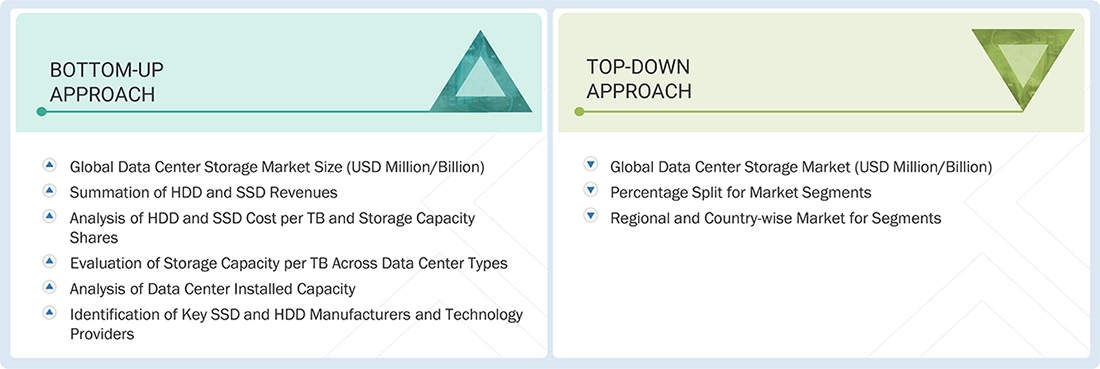
The research study involved 4 major activities in estimating the size of the data center storage market. Exhaustive secondary research has been done to collect important information about the market and peer markets. The validation of these findings, assumptions, and sizing was conducted with the help of primary research with industry experts across the data center infrastructure, semiconductor, cloud computing, hyperscale storage, and enterprise IT value chain. Both top-down and bottom-up approaches have been used to estimate the market size. Post which, the market breakdown and data triangulation have been adopted to estimate the market sizes of segments and sub-segments.
Secondary Research
In the secondary research process, various secondary sources have been referred to for identifying and collecting information required for this study. The secondary sources include annual reports, press releases, investor presentations of companies, white papers, and articles from recognized authors. Secondary research has been mainly done to obtain key information about the market’s supply chain, the pool of key SSD and HDD manufacturers, NAND flash suppliers, hyperscale data center operators, and cloud infrastructure providers, market segmentation according to industry trends, regional outlook, and developments from both market and technology perspectives.
In the data center storage market report, the global market size has been estimated using both the top-down and bottom-up approaches, along with several other dependent submarkets. The major players in the market were identified using extensive secondary research, and their presence in the market was determined using secondary and primary research. All the percentage shares, splits, and breakdowns have been determined using secondary sources and verified through primary sources.
Primary Research
Extensive primary research has been conducted after understanding the data center storage market scenario through secondary research. Several primary interviews have been conducted with key opinion leaders from both demand- and supply-side vendors across 4 major regions—Asia Pacific, North America, Europe, and RoW. Approximately 25% of the primary interviews have been conducted with the demand-side vendors and 70% with the supply-side vendors. Primary data has been collected mainly through telephone interviews, which consist of 80% of the total primary interviews; questionnaires and emails have also been used to collect the data.
After successful interaction with industry experts, brief sessions were conducted with highly experienced independent consultants to reinforce the findings of our primary research. This, along with the in-house subject matter experts’ opinions, has led us to the findings as described in the report. The breakdown of primary respondents is as follows:
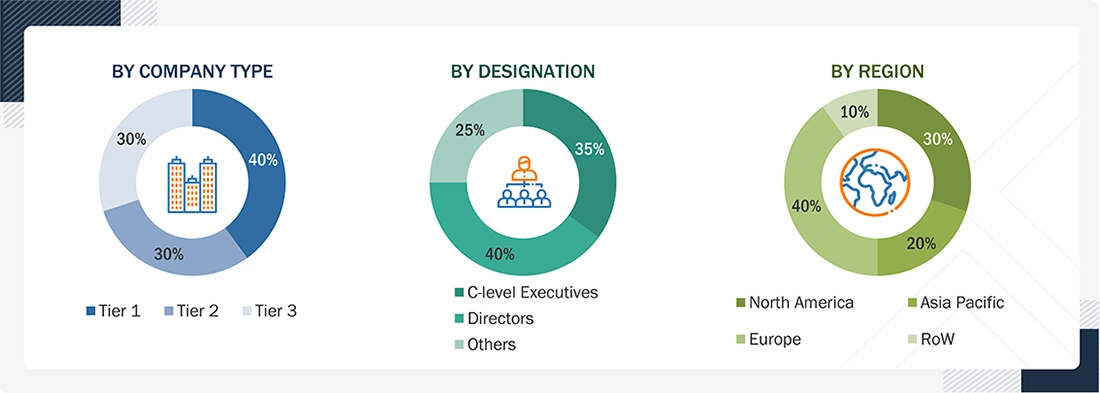
To know about the assumptions considered for the study, download the pdf brochure
Market Size Estimation
In the market engineering process, both top-down and bottom-up approaches, along with data triangulation methods, have been used to estimate and validate the size of the data center storage market and its dependent submarkets. The research methodology used to estimate the market sizes includes the following:
- Identifying top-line investments and spending across hyperscale data centers, cloud infrastructure, AI computing environments, and enterprise data center ecosystems, while considering segment-level splits and major market developments
- Identifying different stakeholders in the data center storage market that influence the overall market, along with participants across the semiconductor, storage hardware, cloud computing, and data center infrastructure value chain
- Analyzing major companies in the data center storage ecosystem and studying their product portfolios, storage technologies, manufacturing capabilities, and R&D activities
- Assessing the share and installed capacity of hyperscale data centers and general-purpose data centers globally
- Evaluating storage capacity per TB across hyperscale data centers and general-purpose data centers
- Estimating storage capacity shares and value contribution of storage mediums, including HDDs and SSDs
- Assessing storage cost per TB and revenue contribution of HDDs and SSDs across data center environments
- Aggregating HDD and SSD market revenues to estimate the global data center storage market size
- Segmenting the overall market into various segments, such as storage medium, interface, capacity, form factor, deployment type, end user, and region
- Analyzing regional- and country-level splits and validating demand patterns across major data center markets globally
- Tracking recent and upcoming market developments, including investments, product launches, technology advancements, collaborations, expansions, and partnerships, and forecasting the market size based on these developments and other critical parameters
- Conducting multiple discussions with key opinion leaders to understand storage adoption trends and technological developments related to data center HDDs and SSDs
- Validating the estimates at every level through discussions with key opinion leaders, such as chief executives (CXOs), directors, technology specialists, procurement managers, and operations managers, and finally with domain experts at MarketsandMarkets
Data Center Storage Market : Top-Down and Bottom-Up Approach
Data Triangulation
After arriving at the overall market size using the market size estimation processes as explained above, the market has been split into several segments and subsegments. To complete the entire market engineering process and arrive at the exact statistics of each market segment and subsegment, data triangulation and market breakdown procedures have been employed, wherever applicable. The data has been triangulated by studying various factors and trends from the demand and supply sides in the data center storage market.
Market Definition
The data center storage market comprises hardware-based storage solutions, including hard disk drives (HDDs) and solid-state drives (SSDs), deployed across hyperscale/cloud, colocation, and enterprise data center environments. These storage solutions are designed to support high-volume data processing, storage, backup, archival, virtualization, artificial intelligence (AI), and high-performance computing workloads. The market includes data center HDDs and SSDs based on various interfaces, capacities, form factors, deployment models, and end-user environments. Growing enterprise data generation, cloud computing adoption, and increasing AI infrastructure investments are driving global demand for scalable, high-performance, and energy-efficient data center storage solutions.
Key Stakeholders
- NAND Flash Manufacturers
- Magnetic Media and Disk Component Suppliers
- SSD Controller and Storage Semiconductor Providers
- HDD Manufacturers
- SSD Manufacturers
- Storage Module and Subsystem Integrators
- Server and Storage System OEMs
- Hyperscale Cloud Service Providers
- Data Center Operators
- AI and High-performance Computing Infrastructure Providers
- Data Center Infrastructure Integrators
- Distributors and Channel Partners
- Managed Service Providers (MSPs)
- Government and Regulatory Organizations
- Research Institutions and Industry Associations
- End Users
Report Objectives
- To describe, segment, and forecast the size of the data center storage market, by storage medium, interface, capacity, form factor, deployment type, and end user, in terms of value
- To forecast the data center storage market by storage medium, in terms of volume
- To forecast the size of various segments for four regions: North America, the Asia Pacific, Europe, and the RoW, in terms of value
- To offer detailed information on drivers, restraints, opportunities, and challenges influencing the growth of the data center storage market
- To provide a detailed overview of the data center storage market value chain
- To strategically analyze the micromarkets concerning individual growth trends, prospects, and contributions to the overall market
- To study industry trends, technological advancements, regulatory landscape, sustainability initiatives, customer landscape & buyer behavior, the impact of AI/Gen AI, along with the macroeconomic outlook
- To analyze opportunities for various stakeholders by identifying the high-growth segments of the market
- To benchmark the key players and analyze their market position in terms of revenue, market share, and core competencies, and to provide a detailed competitive landscape for the market leaders
- To analyze competitive developments such as product launches, deals, and expansions carried out by players in the data center storage market
Available Customizations:
With the given market data, MarketsandMarkets offers customizations according to the specific requirements of companies. The following customization options are available for the report:
- Detailed analysis and profiling of additional market players (up to 5)
Get the Full Data Center Storage Market Report
Full forecast, segment splits, and company analysis for all Data Center Storage Market.
- US Data Center Storage Market
- Canada Data Center Storage Market
- Mexico Data Center Storage Market
- Germany Data Center Storage Market
- UK Data Center Storage Market
- France Data Center Storage Market
- Netherlands Data Center Storage Market
- Russia Data Center Storage Market
- Italy Data Center Storage Market
- Poland Data Center Storage Market
- Spain Data Center Storage Market
- Switzerland Data Center Storage Market
- Belgium Data Center Storage Market
- China Data Center Storage Market
- Australia Data Center Storage Market
- Japan Data Center Storage Market
- India Data Center Storage Market
- Singapore Data Center Storage Market
- Indonesia Data Center Storage Market
- New Zealand Data Center Storage Market
- South Korea Data Center Storage Market
- Brazil Data Center Storage Market
- South Africa Data Center Storage Market
- Rest Of Europe Data Center Storage Market
- Rest Of Asia Pacific Data Center Storage Market
- Rest Of South America Data Center Storage Market
- GCC Data Center Storage Market
Need a Tailored Report?
Customize this report to your needs
Get 10% FREE Customization
Customize This Report
