
China Digital Radar Market (2024-2029)

The China Digital Radar Market was valued at $632.2 Million in 2024 and projected to reach to $1525.5 Million by 2029, representing a compound annual growth rate of 19.3%. China's digital radar market is poised for exceptional growth, expanding from $632.2 million in 2024 to $1,525.5 million by 2029 at a 19.3% CAGR, outpacing the global average of 18.2%.


| Market Size in | USD 26.32 MN |
| Market Forecast in | |
| CAGR | |
| Forecast Period | |
| Units Considered | Value (USD MN) |
China Digital Radar Market Trends and Insights
- This 19.3% compound annual growth rate reflects China's strategic investments in defense modernization, autonomous vehicle development, and advanced surveillance infrastructure.
- China's semiconductor and electronics sector is driving innovation in digital radar technologies, positioning the country as a critical hub for next-generation radar solutions. The digital radar market in China is propelled by increasing demand from both military and civilian applications, including automotive radar systems and weather monitoring.
- China's commitment to technological self-sufficiency and domestic semiconductor manufacturing capabilities strengthens the market's growth trajectory.
- Between 2024 and 2029, China is expected to capture significant market share within the Asia Pacific region, supported by government initiatives and substantial R&D investments in radar technology development..
Key Market Statistics
- CAGR (2024-2029) 19.3% CAGR
- Market Size, 2024 ~USD 632.2 Million
- Forecast, 2029 ~USD 1525.5 Million
- Country China
China Digital Radar Market Overview
Defense Modernization Drive :
China's strategic investments in military modernization are accelerating digital radar adoption across defense systems, positioning the country as a key growth engine for advanced radar technologies.
Autonomous Vehicle Expansion :
Rapid development of autonomous vehicle infrastructure in China is creating substantial demand for digital radar systems, with major automotive manufacturers integrating advanced sensing capabilities.
Surveillance Infrastructure Growth :
China's expanding surveillance and smart city initiatives are driving deployment of sophisticated digital radar networks for traffic management, border security, and urban monitoring applications.
Semiconductor Innovation Hub :
China's semiconductor sector is advancing domestic digital radar chip design and manufacturing, reducing import dependency and enabling cost-competitive solutions for regional and global markets.
China Digital Radar Market Dynamics
- This acceleration is driven by government-backed defense modernization programs, the proliferation of autonomous vehicles, and investments in next-generation surveillance infrastructure.
- The country's robust semiconductor ecosystem and manufacturing capabilities position it as both a major consumer and producer of digital radar technologies. Looking ahead, China's digital radar market will benefit from increasing integration with AI and IoT systems, expanding 5G deployment, and growing commercial applications beyond defense.
- Strategic partnerships between domestic technology firms and international players, combined with continued R&D investments, will further strengthen China's competitive position.
- Market consolidation and technological standardization are expected to create opportunities for both established players and emerging innovators in the region..
Market Ecosystem
Related Ecosystem
Security And Surveillance
- Face Recognition
- Video Surveillance as A Service (VSaaS)
- Voice Recognition
- Fingerprint Recognition
- IRIS Recognition
- HONEYWELL INTERNATIONAL INC.
- Thales group
- HID-GLOBAL
- Lenovo
- AXIS COMMUNICATIONS
Airport Systems
- Antennas
- Sensors
- Aeronautical Information Management (AIM)
- Digital Signage
- Face Recognition
- Thales group
- SYSTRA LTD.
- Idaho Strategic Resources, Inc.
- HONEYWELL INTERNATIONAL INC.
- Leidos Holdings, Inc.
Communication And Connectivity Technology
- Sensors
- Smart Card & Readers
- Cellular Network
- Femtocell
- Image Sensors
- Cisco Systems, Inc.
- HUAWEI TECHNOLOGIES CO LTD
- Lenovo
- CommScope Holding Company, Inc.
- Texas Instruments Incorporated
Key Takeaways
- China's digital radar market will grow from $632.2M (2024) to $1,525.5M (2029) at a 19.3% CAGR.
- China's defense modernization and autonomous vehicle initiatives are primary growth catalysts for digital radar adoption.
- China's domestic semiconductor capabilities provide competitive advantages in digital radar manufacturing and innovation.
- China is positioned to lead Asia Pacific digital radar market expansion through government-backed technology development programs.
Digital Radar Market Report Scope
| Report Metric | Details |
|---|---|
| Base Year | 2024 |
| Fastest Growing Segment | 4D (Dimension) |
| Forecast Period | 2024-2029 |
| Growth Rate | CAGR of 18.2% from 2024 to 2029 |
| Largest Segment | ACTIVE (Type) |
| Market Size Base Year (Billions) | ~USD 5.94 (2024) |
| Revenue Forecast (Billions) | ~USD 13.7 (2029) |
| Segments Covered | Type, Dimension, Application, Vertical |
China Digital Radar Market Report Segmentation
4 segment dimensions are covered across the global market.
By Type
- Active
- Passive
By Dimension
- 2D & 3D
- 4D
By Application
- Other Applications
- Safety
- Security & Surveillance
By Vertical
- Aerospace
- Automotive
- Military & Defense
- Other Verticals
CHINA: DIGITAL RADAR MARKET, BY VERTICAL, 2024–2029
| Segment | 2024 | 2025 | 2026 | 2027 | 2028 | 2029 | CAGR (%) |
|---|---|---|---|---|---|---|---|
| AEROSPACE | 142.1 | 166.8 | 197.9 | 238.7 | 291.4 | 358.5 | 20.3 |
| AUTOMOTIVE | 128 | 153.5 | 185.8 | 228.6 | 284.3 | 356 | 22.7 |
| MILITARY & DEFENSE | 335.4 | 383.4 | 442.8 | 519.9 | 617.8 | 739.8 | 17.1 |
| OTHER VERTICALS | 26.7 | 31.7 | 38.1 | 46.4 | 57.3 | 71.2 | 21.7 |
| TOTAL | 632.2 | 735.4 | 864.6 | 1033.6 | 1250.7 | 1525.5 | 19.3 |
Target Audience
- Defense & Aerospace Companies : Need China-specific digital radar market data to assess opportunities in military modernization programs, develop defense solutions, and understand procurement trends in the Chinese defense sector.
- Automotive & Autonomous Vehicle Manufacturers : Require detailed insights into China's autonomous vehicle radar adoption rates, regulatory standards, and OEM partnerships to develop competitive products and secure contracts with Chinese automakers.
- Semiconductor & Electronics Manufacturers : Seek market intelligence on China's digital radar chip demand, domestic production capabilities, and technology gaps to identify opportunities for component supply and technology licensing.
- Technology Investors & Private Equity : Need comprehensive China market analysis to evaluate investment opportunities in digital radar startups, assess growth potential, and identify acquisition targets in the semiconductor and defense sectors.
- Government & Policy Makers : Require market data to inform industrial policy, technology development initiatives, and strategic planning for China's digital radar ecosystem and semiconductor self-sufficiency goals.
Reasons to Buy this Report
- Market Size & Growth Validation : Obtain precise market valuation ($632.2M in 2024) and verified forecast data ($1,525.5M by 2029) specific to China, enabling accurate business planning and investment decisions in this high-growth market.
- Competitive Intelligence : Understand China's unique market dynamics, local competitor landscape, and domestic technology innovations to identify partnership opportunities and competitive positioning strategies.
- Sector-Specific Insights : Access detailed analysis of China's defense modernization, autonomous vehicle adoption, and surveillance infrastructure investments driving digital radar demand across multiple end-use segments.
- Strategic Market Entry : Leverage China-specific market intelligence to develop localized go-to-market strategies, identify key stakeholders, and navigate regulatory requirements for successful market penetration.
- Investment & Expansion Planning : Make data-driven decisions on manufacturing facility locations, R&D investments, and supply chain development in China with confidence backed by comprehensive market research and forecasts.
Frequently asked questions
What is the current size of China's digital radar market?
China's digital radar market was valued at $632.2 million in 2024 and is projected to grow to $1,525.5 million by 2029.
What is the expected growth rate for digital radar in China?
China's digital radar market is expected to grow at a compound annual growth rate (CAGR) of 19.3% from 2024 to 2029.
What are the main drivers of growth in China's digital radar market?
Key drivers include China's defense modernization efforts, autonomous vehicle development, advanced surveillance infrastructure investments, and government initiatives promoting domestic semiconductor manufacturing.
Which applications are driving demand for digital radar in China?
Primary applications include military defense systems, automotive radar for autonomous vehicles, weather monitoring, and advanced surveillance systems across civilian and government sectors.
How does China's digital radar market compare to the global market?
China's 19.3% CAGR slightly exceeds the global average of 18.2%, reflecting China's accelerated investments in radar technology and semiconductor manufacturing capabilities.
RESEARCH METHODOLOGY
The research process for this study included systematic gathering, recording, and analysis of data about customers and companies operating in the digital radar market. This process involved the extensive use of secondary sources, directories, and databases (Factiva, Oanda, and OneSource) for identifying and collecting valuable information for the comprehensive, technical, market-oriented, and commercial study of the digital radar market. In-depth interviews were conducted with primary respondents, including experts from core and related industries and preferred manufacturers, to obtain and verify critical qualitative and quantitative information as well as to assess growth prospects. Key players in the digital radar market were identified through secondary research, and their market rankings were determined through primary and secondary research. This research included studying annual reports of top players and interviewing key industry experts such as CEOs, directors, and marketing executives.
Secondary Research
In the secondary research process, various sources were used to identify and collect information important for this study. These include annual reports, press releases & investor presentations of companies, white papers, technology journals, certified publications, articles by recognized authors, directories, and databases.
Secondary research was mainly used to obtain key information about the industry's value chain, the total pool of market players, the classification of the market according to industry trends to the bottom-most level, regional markets, and key developments from the market and technology-oriented perspectives.
Primary Research
Primary research was also conducted to identify the segmentation types, key players, competitive landscape, and key market dynamics, such as drivers, restraints, opportunities, challenges, and industry trends, along with key strategies adopted by players operating in the digital radar market. Extensive qualitative and quantitative analyses were performed on the complete market engineering process to list key information and insights throughout the report.
Extensive primary research has been conducted after acquiring knowledge about the digital radar market scenario through secondary research. Several primary interviews have been conducted with experts from both demand (application, vertical, and region) and supply side (type and dimension) across four major geographic regions: North America, Europe, Asia Pacific, and RoW. Approximately 80% and 20% of the primary interviews were conducted from the supply and demand side, respectively. These primary data have been collected through questionnaires, emails, and telephonic interviews.
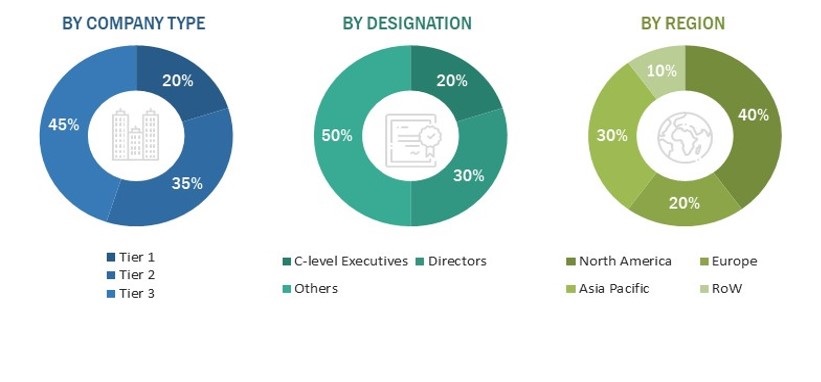
To know about the assumptions considered for the study, download the pdf brochure
Market Size Estimation
In the complete market engineering process, both top-down and bottom-up approaches were implemented, along with several data triangulation methods, to estimate and validate the size of the digital radar market and various other dependent submarkets. Key players in the market were identified through secondary research, and their market share in the respective regions was determined through primary and secondary research. This entire research methodology included the study of annual and financial reports of the top players, as well as interviews with experts (such as CEOs, VPs, directors, and marketing executives) for key insights (quantitative and qualitative).
All percentage shares, splits, and breakdowns were determined using secondary sources and verified through primary sources. All the possible parameters that affect the markets covered in this research study were accounted for, viewed in detail, verified through primary research, and analyzed to obtain the final quantitative and qualitative data. This data was consolidated and supplemented with detailed inputs and analysis from MarketsandMarkets and presented in this report.
Digital Radar Market: Bottom-Up Approach
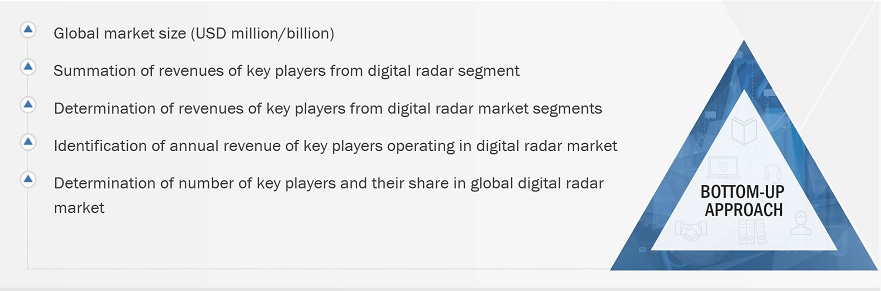
Digital Radar Market: Top-Down Approach

Data Triangulation
After arriving at the overall market size from the market size estimation process, as explained above, the total market has been split into several segments and subsegments. To complete the overall market engineering process and arrive at the exact statistics for all segments and subsegments, market breakdown and data triangulation procedures have been employed, wherever applicable. The data have been triangulated by studying various factors and trends from both the demand and supply sides. Along with this, the market has been validated using top-down and bottom-up approaches.
Market Definition
A digital radar is a radar system that uses digital technology to process and analyze the signals it receives. Instead of relying on analog circuits, digital radar converts the analog signals into digital data using analog-to-digital converters (ADCs). This digital data is then processed by digital signal processing (DSP) algorithms, which improve the accuracy, resolution, and reliability of the radar's measurements. Digital radars are capable of more precise detection and tracking of objects, better noise reduction, and enhanced performance in various environmental conditions compared to traditional analog radars.
Key Stakeholders
- Government and defense agencies
- Investors and financial institutions
- Industries such as automotive, aviation, and telecommunications
- Component manufacturers
- Raw material and manufacturing equipment suppliers
- Original equipment manufacturers (OEMs)
- Integrated device manufacturers (IDMs)
- Original design manufacturers (ODMs)
- Regulatory bodies
- Technology investors
- Research institutes and organizations
Report Objectives
- To define, describe, and forecast the digital radar market, in terms of value, by type, dimension, application, vertical, and region.
- To forecast the size of the market segments for four major regions—North America, Europe, Asia Pacific, and the Rest of the World (RoW).
- To provide detailed information regarding the major factors influencing the growth of the market (drivers, restraints, opportunities, and challenges)
- To offer an ecosystem analysis, case study analysis, patent analysis, technology analysis, pricing analysis, Porter’s Five Forces analysis, and regulations pertaining to the market.
- To give a detailed overview of the value chain of the digital radar market ecosystem
- To strategically analyze micromarkets with respect to individual growth trends, prospects, and contributions to the total market
- To strategically profile the key players and comprehensively analyze their market shares and core competencies
- To analyze the opportunities in the market for stakeholders and describe the competitive landscape of the market
- To study competitive developments such as collaborations, partnerships, product developments, and acquisitions in the market
- To understand the impact of the recession on the digital radar market
Available Customizations
With the given market data, MarketsandMarkets offers customizations according to the company’s specific needs. The following customization options are available for the report:
Company Information
- Detailed analysis and profiling of additional market players (up to 5)
Get the Full Digital Radar Market Report
Full forecast, segment splits, and company analysis for all Digital Radar Market.
Need a Tailored Report?
Customize this report to your needs
Get 10% FREE Customization
Customize This Report
