
Poland Europe Architectural Coatings Market (2026-2031)

The Poland Europe Architectural Coatings Market was valued at $1525.8 Million in 2026 and projected to reach to $1846.8 Million by 2031, representing a compound annual growth rate of CAGR 3.9%. Poland's architectural coatings market demonstrates resilient growth prospects, supported by sustained construction demand and renovation initiatives across residential and commercial sectors.


| Market Size in | USD 26.32 MN |
| Market Forecast in | |
| CAGR | |
| Forecast Period | |
| Units Considered | Value (USD MN) |
Poland Europe Architectural Coatings Market Trends and Insights
- The Polish market is expected to grow steadily, reaching USD 1,846.8 million by 2031, driven by ongoing construction activity, renovation projects, and increasing demand for sustainable coating solutions.
- Poland's growth trajectory reflects the country's expanding real estate sector and rising consumer preference for high-performance, environmentally compliant architectural finishes. The Polish architectural coatings market benefits from robust infrastructure development and EU-aligned regulatory standards that encourage adoption of low-VOC and eco-friendly products.
- Between 2026 and 2031, Poland is anticipated to maintain a compound annual growth rate (CAGR) of 3.9%, slightly below the European average, reflecting the market's maturity and competitive landscape.
- Poland's position as a manufacturing and distribution hub within Central Europe further supports market expansion, with both domestic and international players investing in production capacity and distribution networks..
Key Market Statistics
- CAGR (2026-2031) CAGR 3.9%
- Market Size, 2026 ~USD 1525.8 Million
- Forecast, 2031 ~USD 1846.8 Million
- Country Poland
Poland Europe Architectural Coatings Market Overview
Market Valuation Growth :
Poland's architectural coatings market is valued at USD 1,525.8 million in 2026 and is projected to reach USD 1,846.8 million by 2031, representing a steady compound annual growth rate of 3.9%.
Construction & Renovation Drivers :
Ongoing construction activity and residential renovation projects across Poland are primary growth catalysts, fueled by EU infrastructure investments and modernization of aging building stock in urban and suburban areas.
Sustainable Solutions Demand :
Polish consumers and builders increasingly prioritize eco-friendly and low-VOC coating solutions, aligning with EU environmental regulations and growing awareness of sustainable building practices in the region.
Regional Market Position :
Poland represents a significant segment within Europe's architectural coatings market, benefiting from its position as a Central European economic hub with expanding commercial and residential development sectors.
Poland Europe Architectural Coatings Market Dynamics
- The market's 3.9% CAGR reflects Poland's economic development trajectory and increasing investment in building infrastructure modernization.
- Government incentives for energy-efficient renovations and EU funding mechanisms continue to stimulate demand for high-performance coating products.
- The shift toward sustainable and environmentally compliant coatings presents significant opportunities for manufacturers offering innovative, low-emission solutions tailored to Polish market preferences and regulatory requirements..
Market Ecosystem

EUROPE ARCHITECTURAL COATING MARKET: COMMERCIAL USE CASES ACROSS INDUSTRIES
| COMPANY | USE CASE DESCRIPTION | BENEFITS |
|---|---|---|
 |
Develops interior & exterior decorative paints, façade coatings, and wood finishes under brands like Dulux and Sikkens for residential and commercial buildings | Enhances durability and weather resistance | Provides superior color retention | Improves application ease | Supports low-VOC sustainable formulations |
 |
Supplies architectural paints, primers, and specialty coatings for professional and DIY segments across Europe | Improves surface protection | Ensures consistent finish quality | Enhances stain resistance | Supports high-performance coating systems |
 |
Focuses on façade systems, interior wall paints, and energy-efficient coating solutions (Caparol brand) | Supports thermal insulation integration | Improves building protection | Enhances sustainability compliance | Ensures long-term performance |
 |
Provides decorative paints and exterior coatings tailored for harsh European climates | Enhances weather resistance | Prevents moisture damage | Improves longevity | Ensures color stability in exterior applications |
Logos and trademarks shown above are the property of their respective owners. Their use here is for informational and illustrative purposes only.
Related Ecosystem
Key Takeaways
- Poland's architectural coatings market is valued at USD 1,525.8 million in 2026 and is projected to grow to USD 1,846.8 million by 2031.
- Poland maintains a steady CAGR of 3.9% over the forecast period, reflecting stable demand from construction and renovation sectors.
- EU regulatory compliance and sustainability trends are driving Poland's shift toward low-VOC and eco-friendly coating formulations.
- Poland's role as a Central European manufacturing and distribution hub positions it as a strategic market for both regional and international coatings manufacturers.
Europe Architectural Coatings Market Report Scope
| Report Metric | Details |
|---|---|
| Base Year | 2026 |
| Fastest Growing Segment | FACADE 2 (Application) |
| Forecast Period | 2026–2031 |
| Growth Rate | CAGR of 4% from 2026 to 2031 |
| Largest Segment | WATER-BASED (Technology) |
| Market Size Base Year (Billions) | ~USD 20.95 (2026) |
| Revenue Forecast (Billions) | ~USD 25.49 (2031) |
| Segments Covered | Application, Technology, Substrate, End Use |
Poland Europe Architectural Coatings Market Report Segmentation
4 segment dimensions are covered across the global market.
By Application
- Facade 2
- Façade 1
- Interior Wall Paint
- Other Applications
- Trim, Lacquers, Varnish
- Wood Care
By Technology
- High Solid
- Other Technologies
- Solvent Based
- Solvent-Based
- Water Based
- Water-Based
By Substrate
- Metal
- Other Substrates
- Plastic & Composites
- Wood
By End Use
- Consumer
- Professional
POLAND: ARCHITECTURAL COATINGS MARKET, BY APPLICATION, 2026–2031
| Segment | 2026 | 2027 | 2028 | 2029 | 2030 | 2031 | CAGR (%) |
|---|---|---|---|---|---|---|---|
| FACADE 2 | 117.1 | 121.1 | 124.7 | 134.5 | 138.7 | 145.6 | 4.4 |
| FAÇADE 1 | 195.2 | 201.1 | 206.2 | 221.7 | 227.8 | 238.2 | 4.1 |
| INTERIOR WALL PAINT | 695.9 | 714.1 | 729.3 | 780.7 | 799.2 | 832.1 | 3.6 |
| OTHER APPLICATIONS | 76.6 | 78.8 | 80.6 | 86.5 | 88.8 | 92.7 | 3.9 |
| TRIM, LACQUERS, VARNISH | 294 | 302.8 | 310.3 | 333.3 | 342.4 | 357.7 | 4 |
| WOOD CARE | 147 | 151.7 | 155.8 | 167.6 | 172.5 | 180.6 | 4.2 |
| TOTAL | 1525.8 | 1569.6 | 1606.9 | 1724.3 | 1769.5 | 1846.8 | 3.9 |
Target Audience
- Coating Manufacturers & Suppliers : Manufacturers need Poland-specific market data to assess growth opportunities, benchmark competitive positioning, and develop localized product strategies for the expanding architectural coatings segment.
- Construction & Real Estate Companies : Builders and developers require market insights to understand coating demand trends, sustainability requirements, and cost projections for residential and commercial projects across Poland.
- Distributors & Retailers : Distribution partners need Poland market intelligence to optimize inventory management, identify high-demand product categories, and align supply chain strategies with regional growth forecasts.
- Investment & Private Equity Firms : Investors evaluating opportunities in Poland's coatings sector require detailed market sizing, growth trajectories, and competitive analysis to support M&A and capital allocation decisions.
- Market Consultants & Analysts : Research professionals and consultants need comprehensive Poland market data to support client advisory services, competitive benchmarking, and strategic planning initiatives in the coatings industry.
Key Companies in the Poland Europe Architectural Coatings Market
| Company | HQ | Ownership | Strongest segments |
|---|---|---|---|
| THE SHERWIN-WILLIAMS COMPANY | United States | Public Company | Architectural Paint & Coatings (Paint Stores Group),Consumer Brands (Retail, Private Label, DIY),Performance Coatings – Industrial & OEM, |
| AKZO NOBEL N.V. | Netherlands | Public Company | Decorative Paints (architectural, DIY, professional),Performance Coatings – Protective, Marine, and Oil & Gas,Performance Coatings – Automotive, Aerospace, and Transportation, |
| PPG INDUSTRIES, INC. | United States | Public Company | Global Architectural Coatings,Performance Coatings,Industrial Coatings, |
| STO SE & CO. KGAA | Germany | Public Company | External wall insulation systems (ETICS),Façade coatings and renders,Interior plasters, paints, and decorative coatings, |
| FLüGGER GROUP A/S | Denmark | Public Company | Decorative water-based paints and primers,Wood preservatives, stains, and exterior coatings,Wall coverings and wallpapers, |
| MAPEI SPA. | Italy | Private Company | Ceramic, stone, and related installation systems,Resilient, LVT, textile, and sports flooring systems,Waterproofing and building envelope solutions, |
| JOTUN | Norway | Private Company | Marine coatings,Protective coatings (incl. intumescent and high-temperature),Decorative paints, |
| HEMPEL A/S | Denmark | Private Company | Marine coatings,Protective / energy & infrastructure coatings,Decorative coatings, |
THE SHERWIN-WILLIAMS COMPANY
The Sherwin-Williams Company is a leading American paint and coatings manufacturer founded in 1866. With 64,249 employees, the company operates as a public corporation and serves residential, commercial, and industrial markets globally.
AKZO NOBEL N.V.
Akzo Nobel N.V. is a Dutch multinational paints and coatings company with roots dating back to 1646. The public company employs 31,100 people and operates across decorative paints, performance coatings, and specialty chemicals segments.
PPG INDUSTRIES, INC.
PPG Industries, Inc. is an American manufacturer of paints, coatings, and specialty materials founded in 1883. As a public company with 43,500 employees, PPG serves automotive, aerospace, industrial, and consumer markets worldwide.
STO SE & CO. KGAA
STO SE & CO. KGAA is a German building coating manufacturer established in 1955. The publicly traded company employs 5,147 people and specializes in facade systems, interior coatings, and building protection solutions.
FLüGGER GROUP A/S
Flügger Group A/S is a Danish paint and coating company with a heritage dating to 1783. The public company operates with 1,721 employees and focuses on decorative paints and industrial coatings for professional and consumer markets.
MAPEI SPA.
Mapei S.p.A. is an Italian manufacturer of adhesives, sealants, and chemical products for construction founded in 1937. The private company employs 13,252 people and serves the building and construction industry globally.
JOTUN
Jotun is a Norwegian paint and coatings manufacturer founded in 1926. The private company employs 10,833 people and produces protective coatings, decorative paints, and marine coatings for industrial and consumer markets.
HEMPEL A/S
Hempel A/S is a Danish coatings company established in 1915. With 7,115 employees, the private company specializes in protective and marine coatings for industrial applications and infrastructure protection.
Reasons to Buy this Report
- Market Size & Growth Data : Access precise valuation figures for Poland's architectural coatings market (USD 1,525.8M in 2026, USD 1,846.8M in 2031) with detailed CAGR analysis to inform investment and expansion decisions.
- Competitive Landscape Intelligence : Understand Poland-specific market dynamics, key players, and competitive positioning within Central Europe's coatings sector to identify partnership and acquisition opportunities.
- Demand Driver Analysis : Gain insights into construction activity, renovation trends, and sustainable coating adoption patterns unique to Poland to align product development and marketing strategies with local market needs.
- Regulatory & Sustainability Insights : Identify Poland-specific environmental regulations, EU compliance requirements, and consumer preferences for eco-friendly coatings to ensure product portfolio alignment and market readiness.
- Strategic Market Entry Planning : Leverage Poland-focused market data to develop targeted go-to-market strategies, distribution channel optimization, and pricing models for successful market penetration in this growing Central European economy.
Frequently asked questions
What is the current market size of architectural coatings in Poland?
Poland's architectural coatings market is estimated at USD 1,525.8 million in 2026, with verified data from KS table sources.
What is the projected market size for Poland's architectural coatings by 2031?
Poland's architectural coatings market is forecast to reach USD 1,846.8 million by 2031, representing growth of approximately USD 321 million over the five-year period.
What is the CAGR for Poland's architectural coatings market?
Poland's architectural coatings market is expected to grow at a compound annual growth rate (CAGR) of 3.9% between 2026 and 2031.
What factors are driving growth in Poland's architectural coatings market?
Growth in Poland is driven by expanding construction activity, residential and commercial renovation projects, EU regulatory compliance requirements, and increasing demand for sustainable, low-VOC coating solutions.
How does Poland's market growth compare to the broader European market?
Poland's CAGR of 3.9% is slightly below the European average of 4.0%, reflecting Poland's mature market position and competitive landscape within the region.
RESEARCH METHODOLOGY
The study involved four major activities in estimating the market size of the Europe architectural coatings market. Exhaustive secondary research was done to collect information on the market, the peer market, and the parent market. The next step was to validate these findings, assumptions, and sizing with industry experts across the value chain through primary research. Both top-down and bottom-up approaches were employed to estimate the complete market size. Thereafter, the market breakdown and data triangulation procedures were used to estimate the market size of the segments and subsegments.
Secondary Research
In the secondary research process, various secondary sources were referred to for identifying and collecting information for this study. These secondary sources included annual reports, press releases, investor presentations of companies, white papers, certified publications, trade directories, articles from recognized authors, gold standard and silver standard websites, and databases. Secondary research was used to obtain key information about the value chain of the industry, monetary chain of the market, the total pool of key Europe architectural coatings players, market classification, and segmentation according to industry trends to the bottom-most level, and regional markets. It was also used to obtain information about the key developments from a market-oriented perspective.
Primary Research
The Europe architectural coatings market comprises several stakeholders in the value chain. These include raw material suppliers, manufacturers, distributors and end users. Various primary sources from the supply and demand sides of the Europe architectural coatings market were interviewed to obtain qualitative and quantitative information. Primary interviewees from the demand side included key opinion leaders in end-use sectors. Primary sources from the supply side include manufacturers, associations, and institutions involved in the Europe architectural coatings industry.
Primary interviews were conducted to gather insights such as market statistics, data on revenue collected from the products and services, market breakdowns, market size estimations, market forecasting, and data triangulation.
Primary research also helped in understanding the various trends related to technology, substrate, application, end-use industry, and country. Demand-side stakeholders, such as CIOs, CTOs, and CSOs, were interviewed to understand the buyer’s perspective on the suppliers, products, component providers, and their current usage of Europe architectural coatings and future outlook of their business, which will affect the overall market.
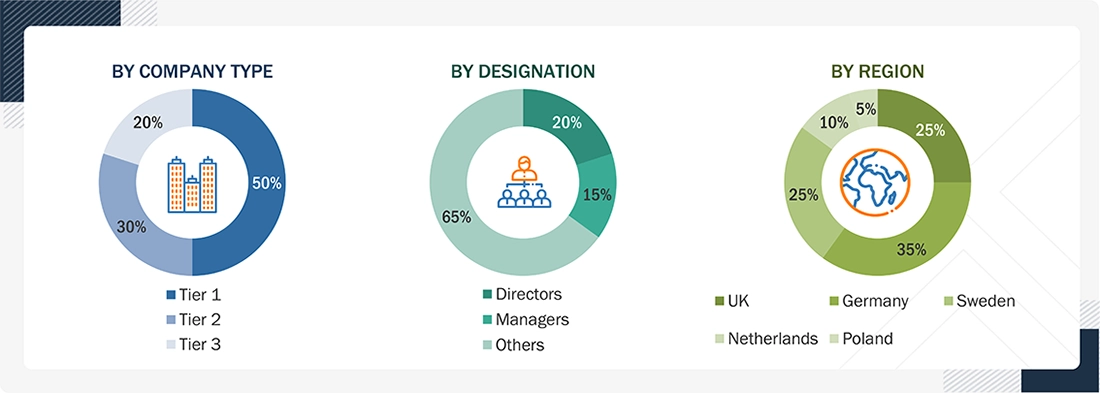
The breakdown of profiles of the primary interviewees is illustrated in the figure below:
Notes:
- Tier 1, Tier 2, and Tier 3 companies are classified based on their market revenue in 2025. The revenue is available in the public domain, product portfolios, and geographical presence.
- Other designations include sales representatives, production heads, and technicians.
To know about the assumptions considered for the study, download the pdf brochure
Maket Size Estimation
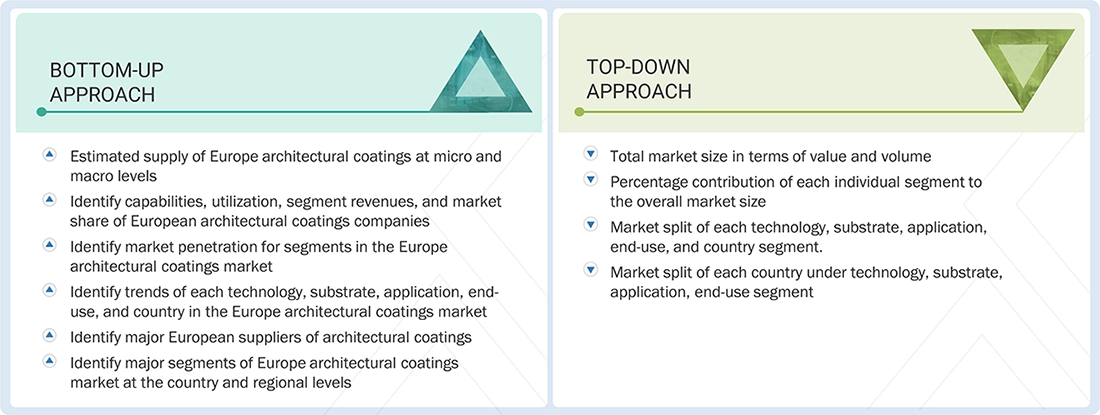
The top-down approach was used to estimate and validate the size of various submarkets for Europe architectural coatings for each region. The research methodology used to estimate the market size included the following steps:
- Key players in the industry were identified through extensive secondary research.
- The supply chain of the industry was determined through primary and secondary research.
- All percentage shares, splits, and breakdowns based on technology, substrate, application, end-use and by country were determined using secondary sources and verified through primary sources.
- All possible parameters that affect the markets covered in this research study were accounted for, viewed in extensive detail, verified through primary research, and analyzed to get the final quantitative and qualitative data. This data was consolidated and added with detailed inputs and analysis, and presented in this report.
Europe Architectural Coating Market : Top-Down and Bottom-Up Approach
Data Triangulation
After arriving at the total market size from the estimation process for Europe architectural coatings above, the overall market was split into several segments and sub-segments. To complete the overall market engineering process and arrive at the exact statistics for all the segments and sub-segments, the data triangulation and market breakdown procedures were employed, wherever applicable. The data was triangulated by studying various factors and trends from the demand and supply sides. Along with this, the market size has been validated by using both the top-down and bottom-up approaches and primary interviews. Hence, for every data segment, there have been three sources—top-down approach, the bottom-up approach, and expert interviews. The data was assumed correct when the values arrived from the three sources matched.
Market Definition
The Europe architectural coatings market consists of the production, distribution, and consumption of coatings that protect, insulate, enhance, and beautify the surfaces of structures through decoration. Examples of architectural coatings include water-borne coatings, solvent-borne coatings, sealers, and specialty coatings for the protection of walls, ceilings, and façades within residential and commercial buildings. In this industry, architectural coatings are prepared with essential ingredients such as resins, pigments, additives, and solvents. Architectural coatings are used in interior and exterior applications, including façade systems with coating products embedded in insulation boards in the structures. These types of coating products are applied to all aspects of housing markets, commercial real estate, and public infrastructure projects in Europe. The market includes players such as raw material providers, manufacturers, distribution channels, contractors, and end-users. The demand drivers in the European market include construction trends, EU regulations, renovations, energy efficiency, and innovations in environmentally-friendly architectural coatings.
Key Stakeholders
- Coatings Manufacturers
- Coatings Traders, Distributors, and Suppliers
- Raw Material Suppliers
- Government and Private Research Organizations
- Associations and Industrial Bodies
- R&D Institutions
- Environmental Support Agencies
Report Objectives
- To define, describe, and forecast the size of the Europe architectural coatings market, in terms of value and volume
- To provide detailed information regarding the major factors (Drivers, opportunities, restraints, and challenges) influencing the growth of the market
- To estimate and forecast the market size based on technology, substrate, application, end-use, and country
- To strategically analyze micromarkets with respect to individual growth trends, prospects, and their contribution to the overall market
- To analyze opportunities in the market for stakeholders and provide a competitive landscape of market leaders
- To track and analyze recent developments such as product launches, collaborations, contracts, acquisitions, and expansions in the market
- To strategically profile key market players and comprehensively analyze their core competencies
Available customizations:
Along with the given market data, MarketsandMarkets offers customizations according to the company’s specific needs. The following customization options are available for the report:
By Technology Analysis
- Market size for Europe architectural coatings in terms of value and volume
Tariff & Regulations
- Regulations and impact on Europe architectural coatings market
Company Information
- Detailed analysis and profiles of additional market players
Get the Full Europe Architectural Coatings Market Report
Full forecast, segment splits, and company analysis for all Europe Architectural Coatings Market.
- Germany Europe Architectural Coatings Market
- Italy Europe Architectural Coatings Market
- France Europe Architectural Coatings Market
- UK Europe Architectural Coatings Market
- Spain Europe Architectural Coatings Market
- Sweden Europe Architectural Coatings Market
- Netherlands Europe Architectural Coatings Market
- Romania Europe Architectural Coatings Market
Need a Tailored Report?
Customize this report to your needs
Get 10% FREE Customization
Customize This Report
