
Germany High-speed Data Converter Market (2023-2028)

The Germany High-speed Data Converter Market was valued at $211.9 Million in 2023 and projected to reach to $265.8 Million by 2028, representing a compound annual growth rate of CAGR 4.6%. Germany's high-speed data converter market is positioned for sustained growth through 2028, driven by accelerating demand from automotive electrification, industrial IoT deployments, and 5G telecommunications infrastructure expansion.


| Market Size in | USD 26.32 MN |
| Market Forecast in | |
| CAGR | |
| Forecast Period | |
| Units Considered | Value (USD MN) |
Germany High-speed Data Converter Market Trends and Insights
- Germany maintains a strategic position within Europe's semiconductor ecosystem, driven by robust demand from automotive, industrial automation, and telecommunications sectors.
- The country's strong engineering base and manufacturing capabilities support sustained adoption of advanced data conversion technologies across these verticals. Germany's market growth is underpinned by increasing digitalization initiatives and the transition toward Industry 4.0 standards across German manufacturing.
- High-speed data converters are critical components in 5G infrastructure deployment, automotive radar systems, and precision measurement applications-all areas where Germany holds significant competitive advantage.
- Between 2023 and 2028, Germany is expected to benefit from continued investment in semiconductor R&D and production capacity expansion, positioning the country as a key hub for high-speed converter innovation and deployment within the European market..
Key Market Statistics
- CAGR (2023-2028) CAGR 4.6%
- Market Size, 2023 ~USD 211.9 Million
- Forecast, 2028 ~USD 265.8 Million
- Country Germany
Germany High-speed Data Converter Market Overview
Market Valuation :
Germany's high-speed data converter market reached USD 211.9 million in 2023, with projected growth to USD 265.8 million by 2028, reflecting steady expansion in Europe's leading semiconductor hub.
Growth Trajectory :
The German market exhibits a CAGR of 4.6% through 2028, outpacing broader European trends and driven by industrial digitalization and automotive electrification initiatives across the country.
Key Demand Drivers :
Automotive, industrial automation, and telecommunications sectors fuel demand for high-speed data converters in Germany, supported by the country's manufacturing excellence and Industry 4.0 adoption.
Strategic Position :
Germany maintains a critical role in Europe's semiconductor supply chain, leveraging its engineering expertise and established OEM relationships to drive converter technology adoption and innovation.
Germany High-speed Data Converter Market Dynamics
- The country's commitment to Industry 4.0 and digital manufacturing creates significant opportunities for advanced converter technologies in precision measurement and signal processing applications. Key growth catalysts include increasing adoption of electric vehicles requiring sophisticated power management systems, expansion of industrial automation in manufacturing facilities, and telecommunications operators upgrading network infrastructure.
- Germany's strong engineering base and established semiconductor ecosystem provide competitive advantages for market participants, while regulatory support for digital transformation initiatives further strengthens long-term market prospects..
Market Ecosystem
Related Ecosystem
Electronics System And Components
- Sensors
- Temperature Sensors
- Pressure Sensors
- Actuators
- Image Sensors
- Lenovo
- Samsung
- Texas Instruments Incorporated
- HONEYWELL INTERNATIONAL INC.
- Teledyne Technologies Incorporated
Cns Systems
- C-Band
- Ka-Band
- Antennas
- Unmanned Ground Vehicles (UGV)
- Rotary Wing Aircraft
- L3Harris Technologies, Inc.
- Thales group
- HONEYWELL INTERNATIONAL INC.
- Northrop Grumman Corporation
- LOCKHEED MARTIN CORPORATION
Automotive Systems
- Light Commercial Vehicles (LCVs)
- Battery Electric Vehicle (BEV)
- Hybrid Electric Vehicle (HEV)
- Agricultural Tractors
- Fuel Cell Electric Vehicle (FCEV)
- BOSCH LIMITED
- DENSO Corporation
- Continental ag
- ZF FRIEDRICHSHAFEN AG
- TENNECO
Key Takeaways
- Germany's high-speed data converter market reached USD 211.9 million in 2023 with a projected value of USD 265.8 million by 2028.
- Germany's 4.6% CAGR reflects steady growth driven by automotive electrification, 5G rollout, and Industry 4.0 adoption.
- Germany's automotive and industrial sectors are primary demand drivers for high-speed data conversion technologies.
- Germany's semiconductor manufacturing infrastructure positions it as a critical European hub for data converter innovation and supply.
High-speed Data Converter Market Report Scope
| Report Metric | Details |
|---|---|
| Base Year | 2023 |
| Fastest Growing Segment | AUTOMOTIVE (Application) |
| Forecast Period | 2023-2028 |
| Growth Rate | CAGR of 6.4% from 2023 to 2028 |
| Largest Segment | ANALOG-TO-DIGITAL CONVERTER (Type) |
| Market Size Base Year (Billions) | ~USD 3.15 (2023) |
| Revenue Forecast (Billions) | ~USD 4.3 (2028) |
| Segments Covered | Type, Frequency Band, Application |
Germany High-speed Data Converter Market Report Segmentation
3 segment dimensions are covered across the global market.
By Type
- Analog-To-Digital Converter
- Digital-To-Analog Converter
By Frequency Band
- 125 Msps To 1 Gsps
- <125 Msps
- >1 Gsps
By Application
- Aerospace & Defense
- Automotive
- Communications
- Industrial
- Medical
- Test & Measurement
Target Audience
- Semiconductor Manufacturers : Evaluate Germany's market potential for high-speed data converter products, assess local demand from automotive and industrial sectors, and identify opportunities for manufacturing or distribution partnerships.
- Automotive OEMs & Suppliers : Understand converter technology requirements for electric vehicle platforms, power management systems, and advanced driver assistance systems (ADAS) specific to German automotive production standards.
- Industrial Automation Companies : Identify high-speed converter applications in German manufacturing facilities, Industry 4.0 implementations, and precision measurement systems to enhance product offerings and competitive positioning.
- Telecommunications Operators : Assess converter technology needs for 5G infrastructure deployment, network signal processing, and telecommunications equipment upgrades across Germany's expanding digital infrastructure.
- Investment & Strategy Consultants : Support M&A due diligence, market entry strategies, and investment decisions in Germany's semiconductor sector with comprehensive market sizing, growth forecasts, and competitive analysis.
Reasons to Buy this Report
- Localized Market Intelligence : Gain Germany-specific insights into market dynamics, competitive landscape, and growth opportunities tailored to the country's unique automotive, industrial, and telecom sectors.
- Strategic Investment Planning : Make informed decisions on market entry, expansion, or partnership strategies in Germany with detailed forecasts, CAGR analysis, and sector-specific demand projections through 2028.
- Competitive Benchmarking : Understand Germany's market position relative to global trends, identify local competitors, and assess opportunities to capture market share in Europe's largest semiconductor economy.
- Sector-Specific Opportunities : Access detailed analysis of high-speed converter demand across German automotive OEMs, industrial automation manufacturers, and telecom operators to identify targeted sales and partnership opportunities.
- Regulatory & Trend Alignment : Stay informed on Germany's Industry 4.0 initiatives, automotive electrification mandates, and digital transformation policies that directly influence high-speed converter adoption and technology requirements.
Frequently asked questions
What is the current market size of high-speed data converters in Germany?
Germany's high-speed data converter market was valued at USD 211.9 million in 2023 according to verified market data.
What is the projected market size for Germany by 2028?
Germany's high-speed data converter market is forecast to reach USD 265.8 million by 2028, growing at a CAGR of 4.6%.
Which industries drive demand for high-speed data converters in Germany?
Germany's primary demand drivers include automotive (radar and electrification), industrial automation (Industry 4.0), telecommunications (5G infrastructure), and precision measurement applications.
How does Germany's growth rate compare to global trends?
Germany's 4.6% CAGR is slightly lower than the global average of 6.4%, reflecting a more mature but stable market with consistent industrial demand.
What factors support growth in Germany's high-speed data converter market?
Germany's growth is supported by automotive electrification, 5G deployment, Industry 4.0 digitalization, and continued investment in semiconductor manufacturing and R&D capabilities.
RESEARCH METHODOLOGY
The study involved four major activities in estimating the current size of the high-speed data converter market—exhaustive secondary research collected information on the market and its peer and parent markets. The next step was to validate these findings, assumptions, and sizing with industry experts across the value chain through primary research. Both top-down and bottom-up approaches were employed to estimate the total market size. After that, market breakdown and data triangulation were used to estimate the market size of segments and subsegments.
Secondary Research
Various secondary sources have been referred to in the secondary research process for identifying and collecting information important for this study. These secondary sources include high-speed data converter technology journals and magazines, annual reports, press releases, investor presentations of companies, white papers, certified publications and articles from recognized authors, and directories and databases such as Factiva, Hoovers, and OneSource.
Primary Research
Various primary sources from both supply and demand sides have been interviewed in the primary research process to obtain qualitative and quantitative information important for this report. The primary sources from the supply side included industry experts such as CEOs, VPs, marketing directors, technology and innovation directors, and related executives from key companies and organizations operating in the high-speed data converter market. After complete market engineering (including calculations regarding market statistics, market breakdown, market size estimations, market forecasting, and data triangulation), extensive primary research was conducted to gather information as well as to verify and validate the critical numbers arrived at.
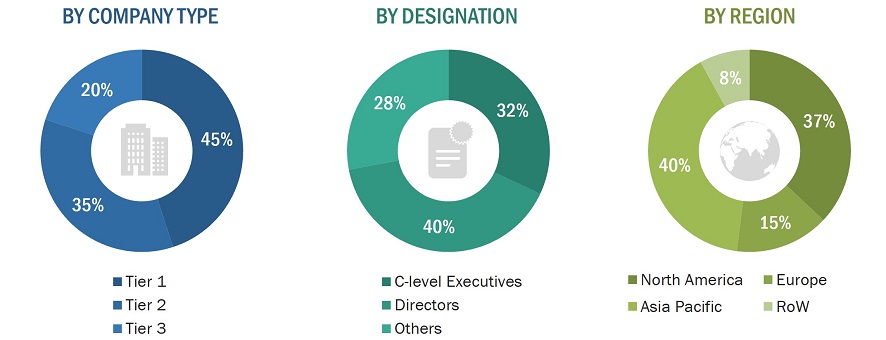
To know about the assumptions considered for the study, download the pdf brochure
Market Size Estimation
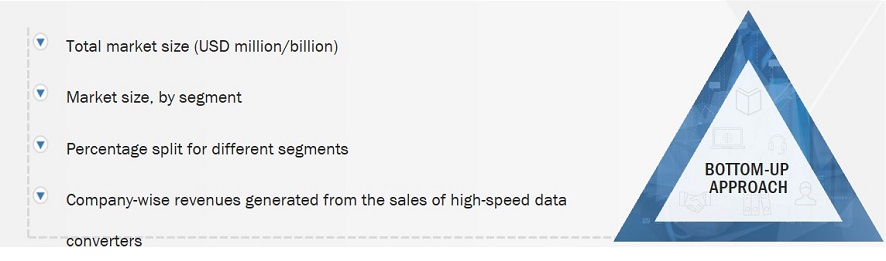
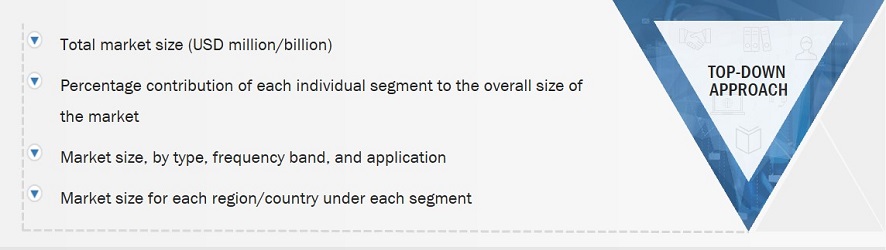
In the complete market estimation process, both top-down and bottom-up approaches have been implemented, along with several data triangulation methods, to estimate and validate the size of the high-speed data converter market and other dependent submarkets listed in this report.
- Extensive secondary research has identified key players in the industry and market.
- In terms of value, the industry’s supply chain and market size have been determined through primary and secondary research processes.
- All percentage shares, splits, and breakdowns have been determined using secondary sources and verified through primary sources.
High-Speed Data Converter Market: Bottom-Up Approach
High-Speed Data Converter Market: Top-Down Approach
Data Triangulation
After arriving at the overall market size from the estimation process explained above, the global market has been split into several segments and subsegments. Market breakdown and data triangulation procedures have been employed wherever applicable to complete the overall market engineering process and arrive at exact statistics for all segments and subsegments. The data has been triangulated by studying several factors and trends identified from both the demand and supply sides.
Market Definition
A high-speed data converter is an electronic circuit that converts a signal into a digital or an analog form based on the requirement of the application. It operates at a sampling rate of 10 MSPS to multi-GSPS. These types of converters are highly used for communications applications due to their ability to convert analog signals to a digital form, or vice versa, at high speed and resolution. High-speed data converters are of two types: analog-to-digital converter (ADC) and digital-to-analog converter (DAC).
Key Stakeholders
- Data Converter Manufacturers
- Integrated Device Manufacturers (IDMs)
- Data Converter IP Providers
- Communication Technology, Service, And Solution Providers
- Technology Investors
- Research Institutes and Organizations
Report Objectives
The following are the primary objectives of the study.
- To forecast the size of the high-speed data converter market based on type, application, frequency band, and region, in terms of value
- To describe and forecast the market for various segments across four main regions: North America, Asia Pacific, Europe, and Rest of the World (RoW), in terms of value
- To provide detailed information regarding drivers, restraints, opportunities, and challenges influencing the growth of the market
- To study the complete value chain and related industry segments and perform a value chain analysis of the high-speed data converter market landscape
- To strategically analyze the ecosystem, regulatory landscape, patent landscape, Porter’s five forces, import and export scenarios, trade landscape, and case studies pertaining to the market under study
- To strategically analyze micromarkets1 with respect to individual growth trends, prospects, and their contributions to the overall market
- To analyze opportunities in the market for the stakeholders by identifying high-growth segments in the market
- To strategically profile the key players and provide a detailed competitive landscape of the market
- To analyze strategic approaches adopted by the leading players in the high-speed data converter market, including product launches/developments and acquisitions
Available Customizations
With the given market data, MarketsandMarkets offers customizations according to a company’s specific needs. The following customization options are available for the report:
Company Information:
- Detailed analysis and profiling of additional market players (up to 5)
Get the Full High-speed Data Converter Market Report
Full forecast, segment splits, and company analysis for all High-speed Data Converter Market.
- US High-speed Data Converter Market
- Canada High-speed Data Converter Market
- Mexico High-speed Data Converter Market
- UK High-speed Data Converter Market
- France High-speed Data Converter Market
- Italy High-speed Data Converter Market
- Rest Of Europe High-speed Data Converter Market
- China High-speed Data Converter Market
- Japan High-speed Data Converter Market
- India High-speed Data Converter Market
- Rest Of Asia Pacific High-speed Data Converter Market
Need a Tailored Report?
Customize this report to your needs
Get 10% FREE Customization
Customize This Report
