
Asia Pacific Next Generation Emergency Response System Market (2023-2028)

The Asia Pacific Next Generation Emergency Response System Market was valued at $418.1 Million in 2023 and projected to reach to $678.2 Million by 2028, representing a compound annual growth rate of 10.2%. The Asia Pacific Next Generation Emergency Response System Market is positioned for sustained growth, expanding from $418.1 million in 2023 to $678.2 million by 2028.


| Market Size in | USD 26.32 MN |
| Market Forecast in | |
| CAGR | |
| Forecast Period | |
| Units Considered | Value (USD MN) |
Asia Pacific Next Generation Emergency Response System Market Trends and Insights
- Asia Pacific's market expansion is driven by rapid urbanization, increasing government investments in public safety infrastructure, and rising adoption of AI-powered and IoT-enabled emergency response technologies across the region.
- The region's growth rate of 10.2% CAGR significantly outpaces global trends, reflecting strong demand from emerging economies and developed nations alike. Asia Pacific's emergency response systems are increasingly integrating advanced technologies such as real-time data analytics, cloud computing, and mobile-first platforms to enhance response times and coordination.
- Key markets within Asia Pacific, including China, India, Japan, and Australia, are prioritizing digital transformation in their emergency services.
- Between 2023 and 2028, Asia Pacific is expected to capture substantial market share as regulatory frameworks strengthen and smart city initiatives accelerate across the region..
Key Market Statistics
- CAGR (2023-2028) 10.2% CAGR
- Market Size, 2023 ~USD 418.1 Million
- Forecast, 2028 ~USD 678.2 Million
- Geography Asia Pacific
Asia Pacific Next Generation Emergency Response System Market Overview
Rapid Market Expansion :
Asia Pacific's Next Generation Emergency Response System Market is growing at 10.2% CAGR, outpacing the global average of 7%, driven by accelerating digital transformation in public safety across the region.
Government Investment Surge :
Increasing government allocations toward public safety infrastructure and smart city initiatives across Asia Pacific nations are fueling adoption of advanced emergency response technologies and integrated command centers.
AI and IoT Integration :
Rising deployment of artificial intelligence and Internet of Things-enabled emergency response systems in Asia Pacific is enabling real-time threat detection, predictive analytics, and faster emergency dispatch capabilities.
Urbanization Catalyst :
Rapid urbanization across Asia Pacific cities is creating critical demand for scalable, intelligent emergency response infrastructure to manage growing population density and complex urban safety challenges.
Asia Pacific Next Generation Emergency Response System Market Dynamics
- This 10.2% CAGR reflects the region's commitment to modernizing emergency services through technology adoption.
- Key drivers include government investments in smart city infrastructure, increasing urbanization pressures, and growing recognition of AI and IoT capabilities in enhancing public safety outcomes. Looking ahead, Asia Pacific will likely emerge as a critical growth engine for the global market.
- Emerging economies in the region are prioritizing emergency response modernization, while developed markets like Japan and advanced economies are upgrading existing systems with next-generation capabilities.
- Strategic partnerships between technology providers and government agencies will accelerate market penetration and innovation across the region..
Market Ecosystem
Related Ecosystem
Application Security
- Cloud Security
- Security Analytics
- Network Testing
- Security Testing
- Web Application Security
- REDINGTON
- International Business Machines Corporation
- MICROSOFT CORPORATION
- Cisco Systems, Inc.
- PALO ALTO NETWORKS, INC
Cyber Security
- Cloud Security
- Biometric Systems
- Data Loss Prevention (DLP)
- Multi-Factor Authentication
- Security Analytics
- REDINGTON
- International Business Machines Corporation
- Cisco Systems, Inc.
- MITSUI BUSSAN SECURE DIRECTIONS INC
- MICROSOFT CORPORATION
Endpoint Security
- Cloud Security
- Security Analytics
- Multi-Factor Authentication
- Biometric Security and Authentication System
- Critical Communication Network
- REDINGTON
- International Business Machines Corporation
- MICROSOFT CORPORATION
- Cisco Systems, Inc.
- PALO ALTO NETWORKS, INC
Key Takeaways
- Asia Pacific's Next Generation Emergency Response System Market is valued at $418.1 million in 2023 and will reach $678.2 million by 2028, growing at a 10.2% CAGR.
- Asia Pacific's growth rate significantly exceeds global averages, driven by urbanization, government investment, and smart city initiatives across the region.
- Advanced technologies including AI, IoT, cloud computing, and real-time analytics are becoming standard in Asia Pacific emergency response systems.
- Key Asia Pacific markets such as China, India, Japan, and Australia are leading digital transformation in public safety and emergency services infrastructure.
Next Generation Emergency Response System Market Report Scope
| Report Metric | Details |
|---|---|
| Base Year | 2023 |
| Fastest Growing Segment | CRITICAL COMMUNICATION (Application) |
| Forecast Period | 2023-2028 |
| Growth Rate | CAGR of 7% from 2023 to 2028 |
| Largest Segment | SOLUTIONS (Component) |
| Market Size Base Year (Billions) | ~USD 2.35 (2023) |
| Revenue Forecast (Billions) | ~USD 3.3 (2028) |
| Segments Covered | Offering, Hardware, Software, Service, Professional Service, End User, Component, Solution, Vertical, Technology, Application |
Asia Pacific Next Generation Emergency Response System Market Report Segmentation
11 segment dimensions are covered across the global market.
By Offering
- Hardware
- Services
- Software
By Hardware
- Call Handling Systems
- Network Infrastructure Equipment
- Other Hardware
- Switching & Routing Equipment
By Software
- Call Management Software
- Location-Based Services Software
- Multimedia Support Software
- Other Software
- Text Messaging Software
By Service
- Managed Services
- Professional Services
By Professional Service
- Consulting Services
- Integration Services
- Training & Support Services
By End User
- Critical Infrastructure
- Emergency Medical Services
- Fire Departments
- First Responders
- Law Enforcement Agencies
- Other End Users
- Public Safety Answering Points
- Public Safety Answering Points (Psaps)
By Component
- Services
- Solutions
By Solution
- Backup And Recovery System
- Biometric Security And Authentication System
- C2/C4Isr System
- Critical Communication Network
- Cybersecurity
- Emergency And Disaster Management
- Public Address And General Alarm
- Scanning And Screening System
- Surveillance System
By Vertical
- Critical Infrastructure Security
- Emergency Services
- Homeland Security
- Other Verticals
- Transportation Systems
By Technology
- Cellular M2M
- Wi-Fi
By Application
- Critical Communication
- Location Guidance
- Remote Monitoring And Surveillance
Target Audience
- Government & Public Safety Agencies : Need comprehensive market data to justify emergency response system modernization budgets, evaluate technology vendors, and align procurement with regional smart city and public safety initiatives.
- Technology Solution Providers : Require detailed Asia Pacific market insights to develop region-specific products, identify high-growth country markets, and understand customer requirements for AI-powered and IoT-enabled emergency response systems.
- System Integrators & Consultants : Depend on market intelligence to advise clients on technology investments, competitive landscape, and implementation best practices for next-generation emergency response systems across Asia Pacific.
- Investment & Private Equity Firms : Seek market sizing, growth forecasts, and investment opportunity analysis for emergency response technology companies targeting Asia Pacific expansion and consolidation strategies.
- Telecommunications & Infrastructure Companies : Need market data to assess opportunities in providing connectivity, cloud infrastructure, and platform services supporting next-generation emergency response systems in Asia Pacific.
Countries within Asia Pacific - compare and drill down
| Country | 2025 size (native) |
|---|---|
| China | USD 236.1 Million |
| India | USD 111.4 Million |
| Japan | USD 126.6 Million |
| Rest Of Asia Pacific | USD 204.1 Million |
Country market size visualization
Reasons to Buy this Report
- Regional Growth Opportunity : Capture insights into Asia Pacific's fastest-growing emergency response market with 10.2% CAGR, significantly outpacing global growth and representing $260.1 million in incremental market value through 2028.
- Country-Level Market Intelligence : Access detailed market sizing and growth trajectories for key Asia Pacific markets including China ($236.1M), India ($111.4M), and Japan ($126.6M) to inform localized go-to-market strategies.
- Technology Adoption Trends : Understand AI and IoT adoption patterns specific to Asia Pacific emergency services, enabling product development and positioning aligned with regional technology preferences and regulatory requirements.
- Government Investment Landscape : Identify public safety funding initiatives and smart city programs across Asia Pacific nations to target procurement opportunities and establish partnerships with government agencies and integrators.
- Competitive Positioning : Benchmark your solutions against regional competitors and global players entering Asia Pacific, with actionable insights on market gaps, customer needs, and differentiation opportunities.
Frequently asked questions
What is the current market size of Next Generation Emergency Response Systems in Asia Pacific?
The Asia Pacific Next Generation Emergency Response System Market was valued at $418.1 million in 2023 and is projected to grow to $678.2 million by 2028.
What is the expected growth rate for Asia Pacific's emergency response system market?
Asia Pacific's Next Generation Emergency Response System Market is expected to grow at a compound annual growth rate (CAGR) of 10.2% from 2023 to 2028.
Which technologies are driving growth in Asia Pacific's emergency response systems?
Key technologies driving Asia Pacific's market growth include artificial intelligence, Internet of Things (IoT), cloud computing, real-time data analytics, and mobile-first platforms for enhanced emergency coordination.
Which countries in Asia Pacific are leading the emergency response system market?
Major markets in Asia Pacific include China, India, Japan, and Australia, all of which are prioritizing digital transformation and smart city initiatives in their emergency services infrastructure.
How does Asia Pacific's growth compare to the global market?
Asia Pacific's 10.2% CAGR significantly outpaces the global market growth rate of 7%, reflecting stronger demand and investment in emergency response modernization across the region.
RESEARCH METHODOLOGY
The study involved four major activities in estimating the current size of the global next generation emergency response system market. Exhaustive secondary research was done to collect information on the market, peer market, and parent market. The next step was to validate these findings, assumptions, and sizing with industry experts across the value chain through primary research. Both top-down and bottom-up approaches were employed to estimate the total market size of the next generation emergency response system. After that, the market breakup and data triangulation techniques were used to estimate the market size of segments and subsegments.
Secondary Research
In the secondary research process, various secondary sources, such as Bloomberg and BusinessWeek, have been referred to identify and collect information for this study. The secondary sources included annual reports, press releases, and investor presentations of companies; white papers; journals, such as Linux Journal and Container Journal, and articles from recognized authors, directories, and databases.
Primary Research
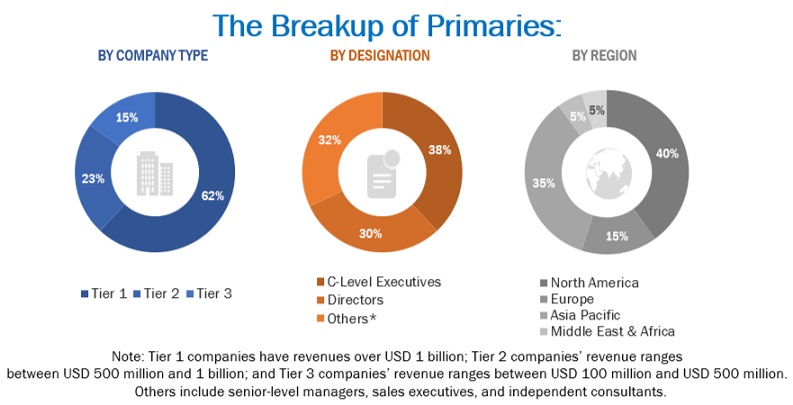
Various primary sources from both the supply and demand sides were interviewed to obtain qualitative and quantitative information for this report. The primary sources from the supply side included industry experts, such as Chief Executive Officers (CEOs), Chief Marketing Officers (CMO), Vice Presidents (VPs), Managing Directors (MDs), technology and innovation directors, and related key executives from various key companies and organizations operating in the next generation emergency response system market along with the associated service providers, and system integrators operating in the targeted regions. All possible parameters that affect the market covered in this research study have been accounted for, viewed in extensive detail, verified through primary research, and analyzed to get the final quantitative and qualitative data. Following is the breakup of primary respondents.
To know about the assumptions considered for the study, download the pdf brochure
|
Company Name |
Designation |
|
Avaya |
Senior Manager |
|
Convey 911 |
VP |
|
Cisco |
Business Executive |
Market Size Estimation
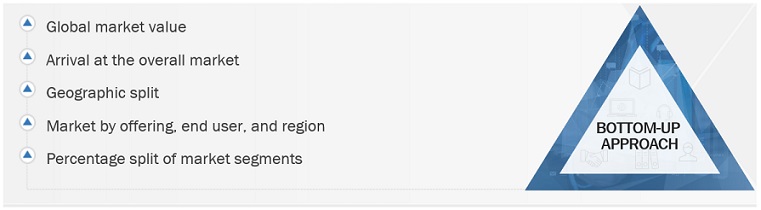
For making market estimates and forecasting the next generation emergency response system market, and other dependent submarkets, the top-down and bottom-up approaches were used. The bottom-up procedure was used to arrive at the overall market size of the global next generation emergency response system market using key companies’ revenue and their offerings in the market. The research methodology used to estimate the market size includes the following:
- The key players in the next generation emergency response system market have been identified through extensive secondary research.
- The market size, in terms of value, has been determined through primary and secondary research processes.
- All percentage shares, splits, and breakups have been determined using secondary sources and verified through primary sources.
Next generation emergency response system market Size: Bottom-Up Approach
To know about the assumptions considered for the study, Request for Free Sample Report
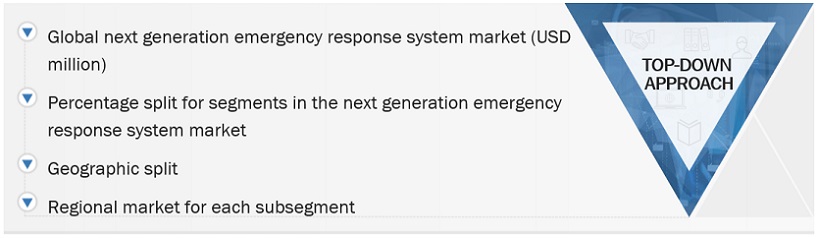
Next generation emergency response system market Size: Top-Down Approach
Data Triangulation
With data triangulation and validation through primary interviews, the exact value of the overall parent market size was determined and confirmed using this study. The overall market size was then used in the top-down procedure to estimate the size of other individual markets via percentage splits of the market segmentation.
Market Definition
The next generation emergency response systems market refers to the development, deployment, and maintenance of modernized emergency communication systems that enable faster response times, more accurate call routing, and better coordination during emergencies. These systems are designed to replace the aging analog-based infrastructure with a digital, internet protocol (IP)-based network that can handle a broader range of data, including voice, text, images, and videos.
Key Stakeholders
- Emergency service providers
- Technology providers
- Network operators
- Research and Development organizations
- Healthcare providers
- Law enforcement agencies
- Non-Governmental Organizations (NGOs)
- Technology consultants
- Governments agencies
- Insurance companies
- System integrators
- Telecommunications companies
Report Objectives
- To determine, segment, and forecast the global next generation emergency response system market based on offering, end user, and region in terms of value.
- To forecast the size of the market segments to five main regions: North America, Europe, Asia Pacific, Middle East & Africa, and Latin America.
- To provide detailed information about the major factors (drivers, opportunities, threats, and challenges) influencing the growth of the next generation emergency response system market.
- To study the complete value chain and related industry segments and perform a value chain analysis of the next generation emergency response system market landscape.
- To strategically analyze the macro and micro markets to individual growth trends, prospects, and contributions to the total next generation emergency response system market.
- To analyze the industry trends, patents, and innovations related to the next generation emergency response system market.
- To analyze the opportunities for stakeholders by identifying the high-growth segments of the next generation emergency response system market.
- To profile the key players in the market and comprehensively analyze their market share/ranking and core competencies.
- Track and analyze competitive developments, such as mergers and acquisitions, product launches and developments, partnerships, agreements, collaborations, business expansions, and Research and development (R&D) activities.
Available Customizations
With the given market data, MarketsandMarkets offers customizations as per the company’s specific needs. The following customization options are available for the report:
Company Information
- Detailed analysis and profiling of an additional two market players
Get the Full Next Generation Emergency Response System Market Report
Full forecast, segment splits, and company analysis for all Next Generation Emergency Response System Market.
- UK Next Generation Emergency Response System Market
- China Next Generation Emergency Response System Market
- US Next Generation Emergency Response System Market
- Canada Next Generation Emergency Response System Market
- France Next Generation Emergency Response System Market
- Germany Next Generation Emergency Response System Market
- Italy Next Generation Emergency Response System Market
- Rest Of Europe Next Generation Emergency Response System Market
- India Next Generation Emergency Response System Market
- Japan Next Generation Emergency Response System Market
- Rest Of Asia Pacific Next Generation Emergency Response System Market
- Brazil Next Generation Emergency Response System Market
- Mexico Next Generation Emergency Response System Market
- Rest Of Latin America Next Generation Emergency Response System Market
- GCC Next Generation Emergency Response System Market
- South Africa Next Generation Emergency Response System Market
Need a Tailored Report?
Customize this report to your needs
Get 10% FREE Customization
Customize This Report
