
South Africa Polyvinyl Alcohol Films Market (2026-2031)

The South Africa Polyvinyl Alcohol Films Market was valued at $6.3 Million in 2026 and projected to reach to $8.3 Million by 2031, representing a compound annual growth rate of 5.5%. South Africa's polyvinyl alcohol films market is positioned for steady growth through 2031, supported by increasing regulatory pressure for sustainable packaging and rising consumer awareness of environmental impact.


| Market Size in | USD 26.32 MN |
| Market Forecast in | |
| CAGR | |
| Forecast Period | |
| Units Considered | Value (USD MN) |
South Africa Polyvinyl Alcohol Films Market Trends and Insights
- This steady expansion reflects South Africa's increasing demand for sustainable packaging solutions and biodegradable film applications across food, pharmaceutical, and industrial sectors.
- South Africa's market growth is driven by regulatory pressures favoring eco-friendly materials and rising consumer awareness of environmental impact. The polyvinyl alcohol films market in South Africa is characterized by moderate but consistent expansion, supported by the country's manufacturing base and growing adoption of water-soluble film technologies.
- South Africa's position within the Middle East Africa region positions it as a key market for PVA film innovation and localized production.
- Between 2026 and 2031, South Africa is expected to see increased investment in sustainable packaging infrastructure, with PVA films gaining traction in detergent pods, agrochemical packaging, and medical applications..
Key Market Statistics
- CAGR (2026-2031) 5.5% CAGR
- Market Size, 2026 ~USD 6.3 Million
- Forecast, 2031 ~USD 8.3 Million
- Country South Africa
South Africa Polyvinyl Alcohol Films Market Overview
Market Size & Growth :
South Africa's polyvinyl alcohol films market is valued at USD 6.3 million in 2026, expanding to USD 8.3 million by 2031 at a CAGR of 5.5%, driven by regional demand for sustainable packaging alternatives.
Sustainability Focus :
South African manufacturers are increasingly adopting biodegradable PVA films to meet stringent environmental regulations and consumer preferences for eco-friendly packaging solutions across multiple industries.
Key Application Sectors :
Food packaging, pharmaceutical applications, and industrial uses represent the primary growth drivers in South Africa's PVA films market, with food sector leading due to shelf-life extension and contamination prevention needs.
Regional Market Dynamics :
South Africa's market growth lags the global CAGR of 7.1%, reflecting moderate industrialization rates and price sensitivity, but presents untapped opportunities in emerging pharmaceutical and specialty packaging segments.
South Africa Polyvinyl Alcohol Films Market Dynamics
- The pharmaceutical and food industries are primary catalysts, with manufacturers seeking cost-effective, biodegradable alternatives to conventional plastic films.
- Government initiatives promoting green manufacturing and circular economy principles are expected to accelerate adoption rates across the region. The market faces challenges including limited local production capacity, reliance on imports, and price competition from conventional plastics.
- However, strategic investments in manufacturing infrastructure and partnerships with global suppliers present significant opportunities.
- South Africa's position as a regional hub for FMCG and pharmaceutical distribution strengthens long-term market potential, with projected growth reaching USD 8.3 million by 2031..
Market Ecosystem
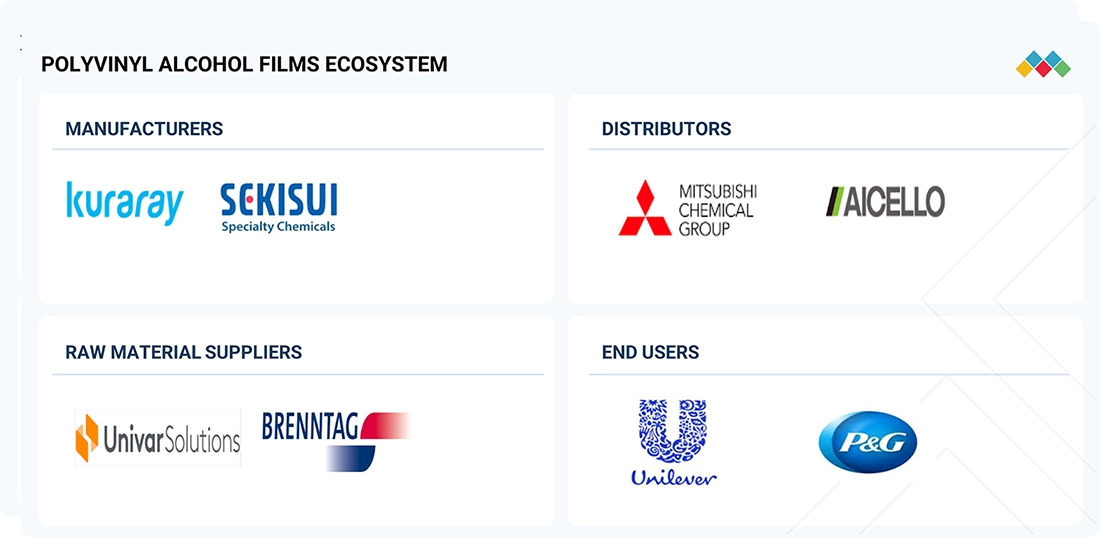
POLYVINYL ALCOHOL FILMS MARKET: COMMERCIAL USE CASES ACROSS INDUSTRIES
| COMPANY | USE CASE DESCRIPTION | BENEFITS |
|---|---|---|
 |
Polyvinyl alcohol films used in water-soluble detergent pods, agrochemical packaging, embroidery applications, and specialty industrial packaging solutions | Provides excellent water solubility, strong film strength, precise dosing capability, and supports sustainable packaging requirements |
 |
Polyvinyl alcohol films used in household detergents, healthcare packaging, pharmaceutical soluble films, and contamination-control applications | Offers rapid dissolution, hygienic packaging performance, improved handling safety, and reliable water-soluble packaging functionality |
 |
Polyvinyl alcohol films applied in specialty packaging, electronics, optical polarizer films, and advanced industrial applications | Enhances optical clarity, improves product stability, supports high-performance applications, and enables premium specialty film development |
 |
Polyvinyl alcohol films used in electronics display applications, specialty optical films, and advanced packaging technologies | Provides superior dimensional stability, high optical performance, enhanced durability, and supports advanced electronics manufacturing requirements |
Logos and trademarks shown above are the property of their respective owners. Their use here is for informational and illustrative purposes only.
Related Ecosystem
Ceramics And Glass
Green Bio Chemicals
Resins And Polymers
Key Takeaways
- South Africa's polyvinyl alcohol films market is valued at USD 6.3 million in 2026 and will reach USD 8.3 million by 2031.
- South Africa is experiencing a 5.5% CAGR, driven by demand for sustainable and biodegradable packaging solutions.
- South Africa's market is supported by regulatory frameworks promoting eco-friendly materials and water-soluble film adoption.
- South Africa's key applications include detergent pods, agrochemical packaging, pharmaceutical, and food packaging sectors.
Polyvinyl Alcohol Films Market Report Scope
| Report Metric | Details |
|---|---|
| Base Year | 2026 |
| Fastest Growing Segment | BIODEGRADABLE/COMPOSTABLE FILMS (Product Type) |
| Forecast Period | 2026–2031 |
| Growth Rate | CAGR of 7.1% from 2026 to 2031 |
| Largest Segment | WATER SOLUBLE FILMS (Product Type) |
| Market Size Base Year (Billions) | ~USD 0.72 (2026) |
| Revenue Forecast (Billions) | ~USD 1.01 (2031) |
| Segments Covered | Application, Material Grade, Product Type |
South Africa Polyvinyl Alcohol Films Market Report Segmentation
3 segment dimensions are covered across the global market.
By Application
- Agrochemicals
- Electronics
- Food Packaging
- Household Detergents
- Other Applications
- Pharmaceuticals & Healthcare
- Textile
By Material Grade
- Fully Hydrolyzed Films
- Partially Hydrolyzed Films
By Product Type
- Biodegradable/Compostable Films
- Embroidery/Textile Support Films
- Polarizer Films
- Specialty Functional Films
- Water Soluble Films
Target Audience
- PVA Film Manufacturers : Manufacturers need South Africa-specific market data to assess production capacity requirements, identify local demand patterns, and develop region-appropriate product portfolios for competitive positioning.
- Packaging Companies : Packaging solution providers require detailed insights into South African customer preferences, application trends, and regulatory requirements to develop compliant, market-ready PVA film offerings.
- Pharmaceutical & Food Producers : End-users in South Africa's pharmaceutical and food sectors need market intelligence to evaluate PVA film adoption feasibility, supplier availability, and cost-benefit analysis for sustainable packaging transitions.
- Distributors & Importers : Regional distributors require market forecasts and demand projections specific to South Africa to optimize inventory management, supplier negotiations, and sales strategy development.
- Investment & Strategy Consultants : Consultants advising clients on South African market expansion need localized data to support feasibility studies, business case development, and strategic recommendations for chemical materials sector investments.
Key Companies in the South Africa Polyvinyl Alcohol Films Market
| Company | HQ | Ownership | Strongest segments |
|---|---|---|---|
| OCI COMPANY LTD. | United States | Public Company | Nitrogen fertilizers (urea, UAN, CAN, ammonium sulphate, AN+S),Ammonia (anhydrous, renewable and lower-carbon),Methanol, |
| KURARAY CO., LTD. | Japan | Public Company | Vinyl Acetate (PVOH, PVB, EVOH resins and films),Isoprene and Thermoplastic Elastomers,Functional Materials (methacrylic, heat-resistant polyamide, activated carbon, membranes, CMP pads), |
| MITSUBISHI CHEMICAL GROUP CORPORATION | Japan | Public Company | Specialty Materials (battery, semiconductor, display, imaging, high-performance polymers, carbon fiber),MMA & Derivatives / PMMA,Basic Materials & Polymers (commodity polymers, petrochemicals, elastomers), |
| SEKISUI CHEMICAL CO., LTD. | Japan | Public Company | High performance plastics and industrial materials,Housing and residential services,Urban infrastructure and environmental products, |
| ARROW GREENTECH LTD. | India | Public Company | Water-soluble packaging films (detergents, agrochemicals, laundry bags, toilet blocks),Bio-compostable and other green products,Embroidery, mold release, and water transfer printing films, |
OCI COMPANY LTD.
OCI Company Ltd. is a United States-based public company founded in 2013 with 761 employees.
KURARAY CO., LTD.
Kuraray Co., Ltd. is a Japanese public company established in 1926 with 12,117 employees.
MITSUBISHI CHEMICAL GROUP CORPORATION
Mitsubishi Chemical Group Corporation is a Japanese public company founded in 1933 with 56,678 employees.
SEKISUI CHEMICAL CO., LTD.
Sekisui Chemical Co., Ltd. is a Japanese public company established in 1947 with 26,752 employees.
ARROW GREENTECH LTD.
Arrow Greentech Ltd. is an Indian public company founded in 1992 with 127 employees.
Reasons to Buy this Report
- Market Entry Strategy : Gain detailed insights into South Africa's specific market dynamics, regulatory environment, and competitive landscape to develop targeted market entry strategies and localization approaches for PVA film products.
- Investment Decision Support : Access comprehensive forecasts and growth projections specific to South Africa through 2031, enabling informed capital allocation decisions and ROI assessments for manufacturing or distribution ventures in the region.
- Competitive Intelligence : Understand South Africa's unique market structure, key players, and application segments to identify competitive advantages and differentiation opportunities in the regional PVA films landscape.
- Sector-Specific Opportunities : Identify high-growth application areas within South Africa's food, pharmaceutical, and industrial sectors with detailed demand analysis and customer requirements for targeted product development.
- Risk Mitigation : Evaluate South Africa-specific market challenges including import dependencies, pricing pressures, and regulatory requirements to develop comprehensive risk management and supply chain strategies.
Frequently asked questions
What is the current market size of polyvinyl alcohol films in South Africa?
South Africa's polyvinyl alcohol films market is estimated at USD 6.3 million in 2026.
What is the projected market size for polyvinyl alcohol films in South Africa by 2031?
South Africa's polyvinyl alcohol films market is projected to reach USD 8.3 million by 2031.
What is the CAGR for the polyvinyl alcohol films market in South Africa?
South Africa's polyvinyl alcohol films market is growing at a compound annual growth rate of 5.5% from 2026 to 2031.
What are the primary drivers of growth in South Africa's polyvinyl alcohol films market?
South Africa's market growth is driven by increasing demand for sustainable packaging, regulatory support for biodegradable materials, and expanding applications in detergent pods, pharmaceuticals, and agrochemicals.
Which industries are the largest consumers of polyvinyl alcohol films in South Africa?
South Africa's largest PVA film consumers include the detergent and cleaning products industry, pharmaceutical packaging, food packaging, and agrochemical sectors.
RESEARCH METHODOLOGY
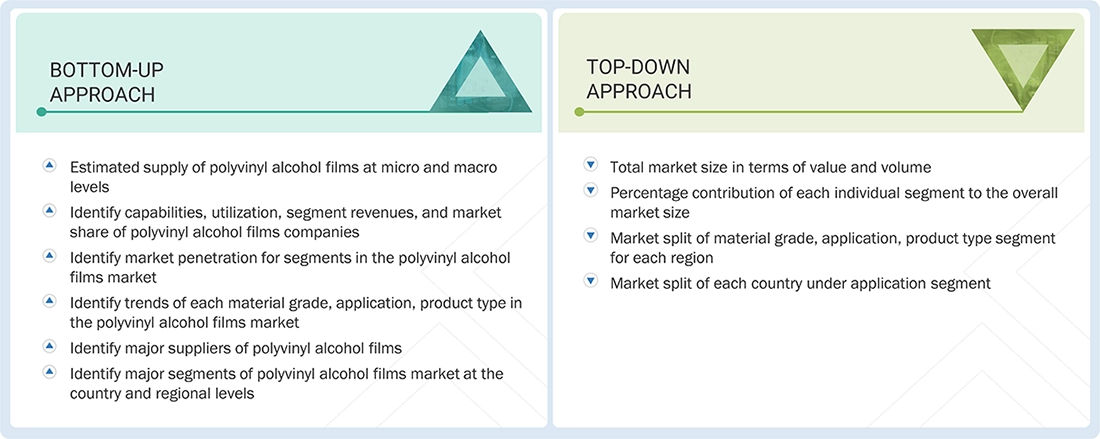
The study involved four major activities to estimate the size of the polyvinyl alcohol films market. Exhaustive secondary research was conducted to collect information on the market, the peer market, and the parent market. The next step was to validate these findings, assumptions, and sizing with industry experts across the value chain through primary research. Both top-down and bottom-up approaches were employed to estimate the total market size. Thereafter, market breakdown and data triangulation procedures were used to estimate the market size of the segments and subsegments.
Secondary Research
In the secondary research process, various secondary sources have been consulted to identify and collect information for this study. These secondary sources include annual reports, press releases, company investor presentations, white papers, certified publications, trade directories, articles by recognized authors, gold- and silver-standard websites, and databases.
Secondary research has been used to obtain key information about the value chain of the industry, monetary chain of the market, the total pool of key polyvinyl alcohol films players, market classification and segmentation according to industry trends to the bottom-most level, and regional markets. It was also used to obtain information about the key developments from a market-oriented perspective.
Primary Research
The polyvinyl alcohol films market comprises several stakeholders across the value chain, including raw material suppliers, manufacturers, distributors, and end users. Primary sources from both the supply and demand sides of the polyvinyl alcohol films market have been interviewed to gather qualitative and quantitative information. On the demand side, primary interviewees include key opinion leaders in application sectors. On the supply side, primary sources include manufacturers, associations, and institutions involved in the polyvinyl alcohol films industry.
Primary interviews were conducted to gather insights such as market statistics, revenue data for products and services, market breakdowns, market size estimates, market forecasts, and data triangulation. Primary research also helped in understanding the various trends related to material grade, application, product type, and region. Stakeholders from the demand side, such as CIOs, CTOs, and CSOs, were interviewed to understand the buyer’s perspective on suppliers, products, component providers, and their current usage of polyvinyl alcohol films, as well as the future outlook of their business, which will affect the overall market.
BREAKDOWN OF PRIMARY INTERVIEW PARTICIPANTS
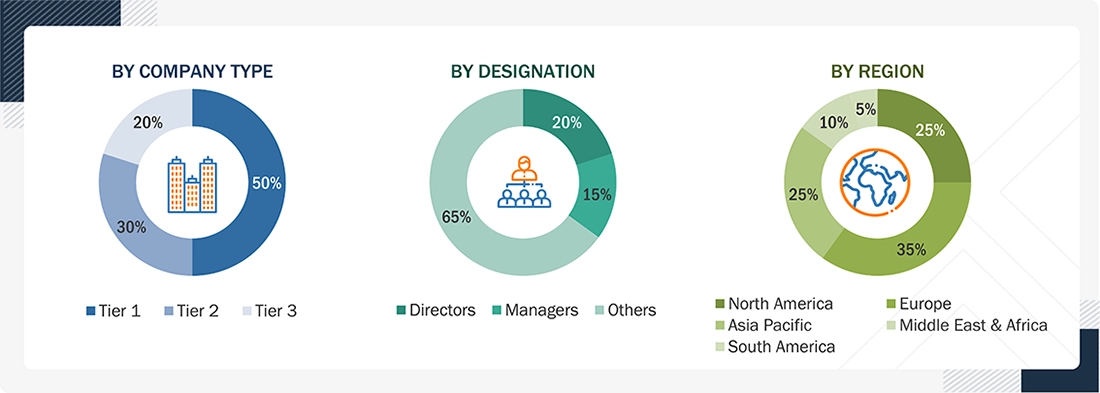
Note: Tier 1, Tier 2, and Tier 3 companies are classified based on their market revenue in 2025, available in the public domain, product portfolios, and geographical presence.
To know about the assumptions considered for the study, download the pdf brochure
Market Size Estimation
- The top-down approach was used to estimate and validate the size of various submarkets for polyvinyl alcohol films for each region. The research methodology used to estimate the market size included the following steps:
- The key players in the industry have been identified through extensive secondary research.
- The supply chain of the industry has been determined through primary and secondary research.
- The global market was then segmented into five major regions and validated by industry experts.
- All percentage shares, splits, and breakdowns based on material grade, application, product type, and regions were determined using secondary sources and verified through primary sources.
- All possible parameters that affect the markets covered in this research study were accounted for, viewed in extensive detail, verified through primary research, and analyzed to get the final quantitative and qualitative data. This data was consolidated and added with detailed inputs and analysis and presented in this report
Data Triangulation
After arriving at the total market size for polyvinyl alcohol films through the estimation process above, the overall market has been split into several segments and sub-segments. To complete the overall market engineering process and arrive at the exact statistics for all segments and sub-segments, data triangulation and market breakdown procedures have been employed wherever applicable. The data has been triangulated by studying various factors and trends from both the demand and supply sides. In addition, the market size has been validated using both the top-down and bottom-up approaches and primary interviews. Hence, for every data segment, there have been three sources—top-down approach, bottom-up approach, and expert interviews. The data was assumed correct when the values from the three sources matched.
Market Definition
Polyvinyl alcohol films are water-soluble, biodegradable, synthetic polymer-based films manufactured primarily from polyvinyl alcohol resin for packaging, industrial, healthcare, textile, and specialty applications. These films are valued for their excellent film-forming ability, chemical resistance, transparency, flexibility, and controlled dissolution properties. Polyvinyl alcohol films are widely used in detergent pod packaging, agrochemical dosing systems, pharmaceutical packaging, embroidery support films, and electronic polarizer applications. The market includes various grades and formulations designed for specific end-use requirements, including cold-water solubility, biodegradability, moisture resistance, and high-performance specialty functionality across consumer and industrial sectors worldwide.
Key Stakeholders
- Polyvinyl alcohol films manufacturers
- Polyvinyl alcohol films traders, distributors, and suppliers
- Raw material suppliers
- Government and private research organizations
- Associations and industrial bodies
- R&D institutions
- Environmental support agencies
Report Objectives
- To define, describe, and forecast the size of the polyvinyl alcohol films market, in terms of value and volume
- To provide detailed information regarding the major factors (drivers, opportunities, restraints, and challenges) influencing the growth of the market
- To estimate and forecast the market size based on material grade, application, product type, and region
- To forecast the size of the market with respect to major regions, namely, Europe, North America, Asia Pacific, Middle East & Africa, and South America, along with their key countries
- To strategically analyze micromarkets with respect to individual growth trends, prospects, and their contribution to the overall market
- To analyze opportunities in the market for stakeholders and provide a competitive landscape of market leaders
- To analyze recent developments such as product launches, collaborations, contracts, acquisitions, and expansions in the market
- To strategically profile key market players and comprehensively analyze their core competencies
Available customizations:
Along with the given market data, MarketsandMarkets offers customizations according to the company’s specific needs. The following customization options are available for the report:
Regional Analysis
- Further breakdown of a region with respect to a particular country or additional application
Company Information
- Detailed analysis and profiles of additional market players
Tariff & Regulations
- Regulations and impact on the polyvinyl alcohol films market
By Distribution channel Analysis
- Market size for polyvinyl alcohol films in terms of value and volume
Get the Full Polyvinyl Alcohol Films Market Report
Full forecast, segment splits, and company analysis for all Polyvinyl Alcohol Films Market.
- China Polyvinyl Alcohol Films Market
- Japan Polyvinyl Alcohol Films Market
- India Polyvinyl Alcohol Films Market
- South Korea Polyvinyl Alcohol Films Market
- US Polyvinyl Alcohol Films Market
- Canada Polyvinyl Alcohol Films Market
- Mexico Polyvinyl Alcohol Films Market
- Germany Polyvinyl Alcohol Films Market
- France Polyvinyl Alcohol Films Market
- Italy Polyvinyl Alcohol Films Market
- UK Polyvinyl Alcohol Films Market
- Spain Polyvinyl Alcohol Films Market
- Saudi Arabia Polyvinyl Alcohol Films Market
- UAE Polyvinyl Alcohol Films Market
- Brazil Polyvinyl Alcohol Films Market
- Argentina Polyvinyl Alcohol Films Market
- South America Polyvinyl Alcohol Films Market
- Rest Of Europe Polyvinyl Alcohol Films Market
Need a Tailored Report?
Customize this report to your needs
Get 10% FREE Customization
Customize This Report
