
GCC Countries Residual DNA Testing Market (2025-2030)

The GCC Countries Residual DNA Testing Market was valued at $2.04 Million in 2025 and projected to reach to $2.4 Million by 2030, representing a compound annual growth rate of 3.3%. The residual DNA testing market in GCC countries is poised for steady expansion as regional healthcare systems prioritize quality control and regulatory compliance.


| Market Size in | USD 26.32 MN |
| Market Forecast in | |
| CAGR | |
| Forecast Period | |
| Units Considered | Value (USD MN) |
GCC Countries Residual DNA Testing Market Trends and Insights
- In GCC Countries, residual DNA testing adoption remains in early stages compared to global markets, reflecting the region's developing healthcare infrastructure and emerging regulatory frameworks for molecular diagnostics.
- The GCC Countries market is characterized by increasing investment in healthcare modernization and growing awareness of contamination control in pharmaceutical and biotechnology manufacturing. GCC Countries are witnessing gradual integration of residual DNA testing protocols within quality assurance processes, driven by multinational pharmaceutical operations and stringent international compliance requirements.
- The forecast period through 2030 indicates steady growth in GCC Countries as local regulatory bodies align with global standards and healthcare institutions enhance their diagnostic capabilities.
- Market expansion in GCC Countries will be supported by rising pharmaceutical manufacturing activities and heightened focus on product safety and quality across the region..
Key Market Statistics
- CAGR (2025-2030) 3.3% CAGR
- Market Size, 2025 ~USD 2.04 Million
- Forecast, 2030 ~USD 2.4 Million
- Country GCC Countries
GCC Countries Residual DNA Testing Market Overview
Market Size & Growth :
The GCC residual DNA testing market is valued at USD 2.04 million in 2025, with projected growth to USD 2.40 million by 2030, representing a CAGR of 3.3% during the forecast period.
Early-Stage Adoption :
Residual DNA testing adoption in GCC countries remains in early developmental stages compared to global markets, presenting significant growth opportunities as healthcare infrastructure modernizes.
Regulatory Framework Development :
GCC countries are establishing emerging regulatory frameworks for residual DNA testing, creating a foundation for standardized implementation across pharmaceutical and biotechnology sectors.
Healthcare Infrastructure Growth :
Increasing investments in healthcare infrastructure across UAE, Saudi Arabia, and other GCC nations are driving demand for advanced testing methodologies and quality assurance protocols.
GCC Countries Residual DNA Testing Market Dynamics
- With a CAGR of 3.3%, the market reflects growing awareness among pharmaceutical manufacturers and contract research organizations about the importance of residual DNA detection in ensuring product safety and meeting international standards.
- Government initiatives to strengthen healthcare capabilities and attract biotech investments are expected to accelerate adoption rates.
- However, growth remains moderate compared to global markets due to limited awareness, developing regulatory infrastructure, and the region's reliance on imported testing technologies and expertise..
Market Ecosystem
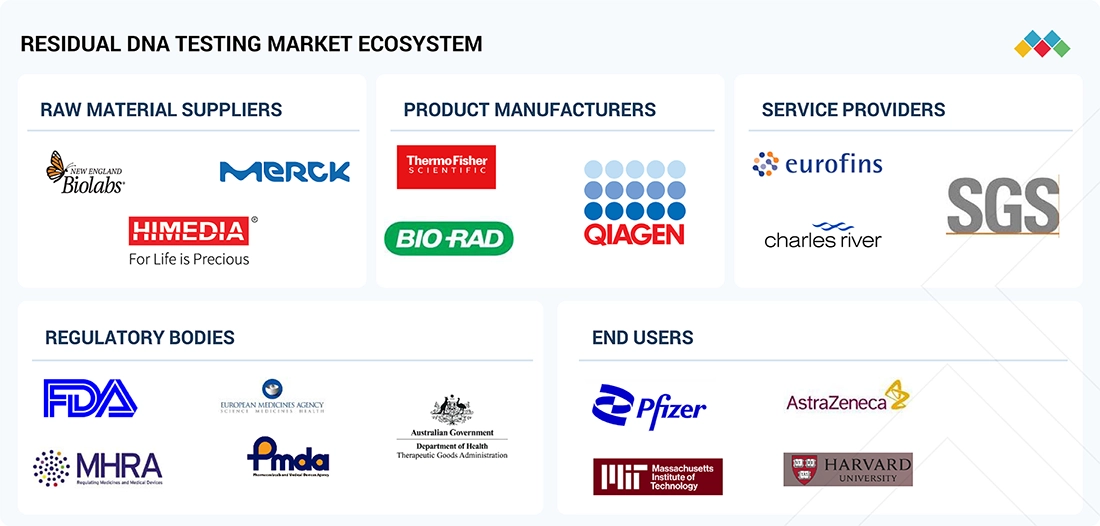
Residual DNA Testing Market: COMMERCIAL USE CASES ACROSS INDUSTRIES
| COMPANY | USE CASE DESCRIPTION | BENEFITS |
|---|---|---|
 |
Employed residual DNA testing in plasmid DNA manufacturing for gene therapies | Used quantitative PCR and process development to ensure minimal host cell DNA contamination in plasmid batches for clinical and commercial uses | Ensured regulatory compliance, improved plasmid purity and safety, increased client confidence, and supported scalable gene therapy manufacturing |
 |
Tested 28 batches of mRNA vaccines for residual host cell DNA using qPCR methods to quantify DNA fragments in final vaccine products | Wide assay portfolio; global lab network; scalable testing capacity for large biopharma clients |
Logos and trademarks shown above are the property of their respective owners. Their use here is for informational and illustrative purposes only.
Related Ecosystem
Biotechnology
- Reagents
- Polymerase Chain Reaction (PCR)
- Stem Cells
- Assay Kits
- Flow Cytometers
- Thermo Fisher Scientific Inc.
- Merck KGaA
- Danaher Corporation
- Agilent Technologies, Inc.
- Bio-Rad Laboratories, Inc.
Pharmaceuticals
- Bioreactors
- Analytical Testing
- Bioanalytical Testing Services
- Cell Counters
- Data Management Services
- Thermo Fisher Scientific Inc.
- Merck KGaA
- SANOFI
- Pfizer Inc.
- NOVARTIS
Key Takeaways
- GCC Countries residual DNA testing market valued at USD 2.04 million in 2025 with projected growth to USD 2.40 million by 2030.
- GCC Countries market grows at 3.3% CAGR, reflecting moderate adoption rates and emerging regulatory alignment with international standards.
- Pharmaceutical manufacturing expansion and quality assurance requirements are primary growth drivers for residual DNA testing in GCC Countries.
- GCC Countries healthcare modernization initiatives and multinational compliance demands will accelerate market penetration through 2030.
Residual DNA Testing Market Report Scope
| Report Metric | Details |
|---|---|
| Base Year | 2025 |
| Fastest Growing Segment | CELL & GENE THERAPY (Application) |
| Forecast Period | 2025–2030 |
| Growth Rate | CAGR of 16.4% from 2025 to 2030 |
| Largest Segment | POLYMERASE CHAIN REACTION (Technology) |
| Market Size Base Year (Billions) | ~USD 0.17 (2025) |
| Revenue Forecast (Billions) | ~USD 0.37 (2030) |
| Segments Covered | Offering, Type, Test Type, Technology, Application, End User |
GCC Countries Residual DNA Testing Market Report Segmentation
6 segment dimensions are covered across the global market.
By Offering
- Products
- Services
By Type
- Consumables
- Instruments & Software
By Test Type
- Bulk Lot Release Testing
- Final Product Release Testing
- Raw Material Testing
By Technology
- Dna Probe Hybridization
- Other Technologies
- Polymerase Chain Reaction
- Threshold Assays
By Application
- Cell & Gene Therapy
- Monoclonal Antibodies
- Other Applications
- Vaccines
By End User
- Academic & Research Institutes
- Cros & Cdmos
- Pharmaceutical & Biopharmaceutical Companies
- Pharmaceutical & Biotechnology Companies
Target Audience
- Pharmaceutical Manufacturers : Need market insights to establish quality assurance protocols and residual DNA testing capabilities aligned with GCC regulatory requirements and international standards.
- Contract Research Organizations (CROs) : Require regional market data to expand service offerings, identify client demand patterns, and position testing services in emerging GCC healthcare markets.
- Healthcare Regulatory Bodies : Utilize market intelligence to develop evidence-based regulatory frameworks, standards, and guidelines for residual DNA testing implementation across GCC nations.
- Biotech & Diagnostics Companies : Need competitive analysis and market opportunity assessment to guide product development, commercialization strategies, and regional expansion planning in GCC countries.
- Healthcare Investors & Consultants : Require accurate market forecasts and regional insights to evaluate investment opportunities, assess market viability, and provide strategic advisory services to healthcare stakeholders.
Key Companies in the GCC Countries Residual DNA Testing Market
| Company | HQ | Ownership | Strongest segments |
|---|---|---|---|
| THERMO FISHER SCIENTIFIC INC. | United States | Public Company | Consumables (assay kits, reagents, plastics),Instruments (PCR, qPCR, automation),Software & informatics, |
| CHARLES RIVER LABORATORIES | United States | Public Company | Consumables (assay reagents, kits within services),Instruments & Software (PCR and data platforms used in labs),Services – Raw Material Testing, |
| MERCK KGAA | United States | Public Company | Consumables (reagents, kits, assay components),Instruments,Software & Services (including CDMO/CRO testing support), |
| MARAVAI LIFESCIENCES | United States | Public Company | Consumables,Instrument & Software,Services, |
| EUROFINS SCIENTIFIC | Luxembourg | Public Company | Consumables,Instrument & Software,PCR-based Testing Services, |
| BIO-RAD LABORATORIES, INC. | United States | Public Company | Consumables,Instruments,Software & Informatics, |
| QIAGEN | Netherlands | Public Company | Consumables (sample prep, PCR, assays),Instruments (PCR, sample prep, QC),Software & Bioinformatics, |
| FUJIFILM CORPORATION | Japan | Public Company | Consumables (reagents, kits, media-linked components),Instruments & Software (PCR platforms, analytics, workflow tools),PCR-based Testing Services (CDMO-integrated), |
| SGS SOCIÉTÉ GéNéRALE DE SURVEILLANCE SA. | Switzerland | Public Company | Consumables-linked testing services,Instrument & software-enabled testing services,PCR-based residual DNA testing (all test types), |
| REVVITY | United States | Public Company | Consumables (reagents, assay kits, cartridges),Instruments,Software & Services, |
| INTERTEK GROUP PLC | United Kingdom | Public Company | Consumables,Instruments & Software,PCR-based Testing Services, |
| SARTORIUS AG | United States | Public Company | Consumables (filters, reagents, lab plastics linked to residual DNA workflows),Instruments (bioreactors, filtration systems, analytical platforms used in DNA-controlled processes),Software & data analytics (lab data, PAT, and QC integration), |
| LONZA | Switzerland | Public Company | Consumables,Instruments & Software,PCR-based Testing Services, |
THERMO FISHER SCIENTIFIC INC.
Thermo Fisher Scientific Inc. is a leading global provider of life sciences solutions, founded in 1956 and headquartered in the United States. With 125,000 employees, the company operates as a public corporation serving research, diagnostics, and bioproduction markets worldwide.
CHARLES RIVER LABORATORIES
Charles River Laboratories is a contract research organization founded in 1947, providing preclinical and clinical laboratory services to the pharmaceutical and biotechnology industries. The U.S.-based public company employs 19,000 people and supports drug development and safety testing globally.
MERCK KGAA
Merck KGaA is a diversified science and technology company founded in 1668, operating as a public company with 59,077 employees across the United States and globally. The company serves the pharmaceutical, life sciences, and performance materials sectors.
MARAVAI LIFESCIENCES
Maravai LifeSciences is a U.S.-based public company founded in 2014, specializing in critical reagents and services for the life sciences industry. With 416 employees, the company supports vaccine development, gene therapy, and molecular diagnostics.
EUROFINS SCIENTIFIC
Eurofins Scientific is a Luxembourg-based public company founded in 1987, operating a global network of laboratories with 65,694 employees. The company provides testing and analytical services across pharmaceutical, food, environmental, and consumer product sectors.
BIO-RAD LABORATORIES, INC.
Bio-Rad Laboratories, Inc. is a U.S. public company founded in 1952, manufacturing and distributing life science research and clinical diagnostics products. With 7,450 employees, the company serves research institutions, hospitals, and laboratories worldwide.
QIAGEN
QIAGEN is a Netherlands-based public company founded in 1984, specializing in sample and assay technologies for molecular diagnostics and life sciences research. The company employs 5,500 people and serves clinical, pharmaceutical, and academic markets globally.
FUJIFILM CORPORATION
Fujifilm Corporation is a Japanese multinational public company founded in 1934, with 73,526 employees operating across imaging, information, and life sciences divisions. The company provides diagnostic imaging, pharmaceutical, and biotechnology solutions worldwide.
SGS SOCIÉTÉ GéNéRALE DE SURVEILLANCE SA.
SGS Société Générale de Surveillance SA. is a Switzerland-based public company founded in 1878, employing 83,000 people in inspection, verification, testing, and certification services. The company serves industries including pharmaceuticals, food, and consumer goods globally.
REVVITY
Revvity is a U.S.-based public company founded in 1937, providing analytical instruments, software, and services for research and diagnostics. With 11,000 employees, the company supports life sciences, diagnostics, and environmental testing applications.
INTERTEK GROUP PLC
Intertek Group PLC is a United Kingdom-based public company founded in 1885, employing 45,425 people in testing, inspection, and certification services. The company serves industries including pharmaceuticals, chemicals, and consumer products across the globe.
SARTORIUS AG
Sartorius AG is a U.S.-based public company founded in 1870, manufacturing laboratory and bioprocess equipment with 14,242 employees. The company provides filtration, weighing, and bioanalytical solutions for pharmaceutical and life sciences applications.
LONZA
Lonza is a Switzerland-based public company founded in 1897, employing 20,000 people in pharmaceutical and biotechnology manufacturing and services. The company specializes in custom development and manufacturing, cell therapy, and specialty ingredients.
Reasons to Buy this Report
- Regional Market Penetration Strategy : Understand the unique characteristics of GCC market dynamics to develop targeted entry strategies and identify untapped opportunities in early-stage adoption phases.
- Competitive Landscape Intelligence : Gain insights into regional competitors, market players, and partnership opportunities specific to GCC countries' pharmaceutical and biotech sectors.
- Regulatory Compliance Roadmap : Access detailed information on emerging regulatory frameworks across GCC nations to ensure compliance and align product offerings with regional requirements.
- Investment Decision Support : Make informed investment decisions with accurate market sizing, growth projections, and risk assessments tailored specifically to GCC country markets.
- Stakeholder Engagement Planning : Identify key decision-makers, healthcare institutions, and regulatory bodies in GCC countries to develop effective stakeholder engagement and partnership strategies.
Frequently asked questions
What is the current market size of residual DNA testing in GCC Countries?
The residual DNA testing market in GCC Countries is estimated at USD 2.04 million in 2025.
What is the projected market size for residual DNA testing in GCC Countries by 2030?
GCC Countries residual DNA testing market is forecasted to reach USD 2.40 million by 2030.
What is the CAGR for residual DNA testing in GCC Countries?
The residual DNA testing market in GCC Countries is expected to grow at a CAGR of 3.3% from 2025 to 2030.
What factors are driving growth in the GCC Countries residual DNA testing market?
Growth in GCC Countries is driven by pharmaceutical manufacturing expansion, international compliance requirements, healthcare modernization, and increased focus on quality assurance and contamination control.
How does the GCC Countries market compare to global residual DNA testing trends?
GCC Countries market grows at 3.3% CAGR compared to the global CAGR of 16.4%, indicating slower but steady adoption as the region develops its regulatory frameworks and healthcare infrastructure.
RESEARCH METHODOLOGY
This research study extensively used secondary sources, directories, and databases to identify and collect valuable information to analyze the global residual DNA testing market. In-depth interviews were conducted with various primary respondents, including key industry participants, subject-matter experts (SMEs), C-level executives of key market players, and industry consultants, to obtain and verify critical qualitative & quantitative information and assess the market's growth prospects. The global market size estimated through secondary research was then triangulated with inputs from primary research to arrive at the final market size.
Secondary Research
Secondary research was used primarily to identify & collect information for the extensive, technical, market-oriented, and commercial study. The secondary sources used for this study include annual reports, SEC filings, investor presentations, World Health Organization (WHO), United States Food and Drug Administration (US FDA), National Center for Biotechnology Information (NCBI), Health Canada, European Medicines Agency (EMA), and Centers for Disease Control and Prevention (CDC). These sources also obtained key information about major players, market classification, and segmentation according to industry trends, regional/country-level markets, market developments, and technology perspectives.
Primary Research
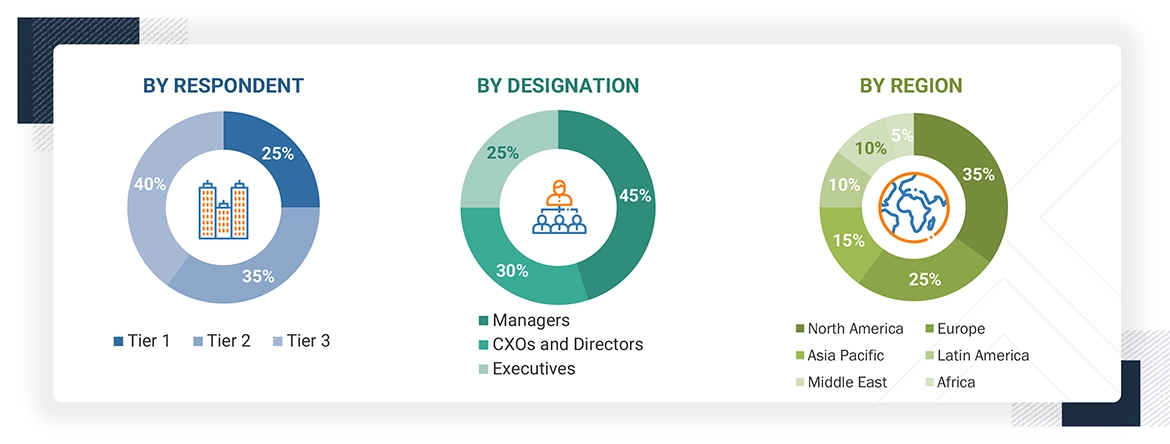
In-depth interviews were conducted with various primary respondents, including key industry participants, subject-matter experts (SMEs), C-level executives of key market players, and industry consultants, to obtain and verify the critical qualitative & quantitative information and assess the prospects of the market. Various primary sources from both the supply & demand sides of the market were interviewed to obtain qualitative and quantitative information.
The following is a breakdown of the primary respondents:
To know about the assumptions considered for the study, download the pdf brochure
Market Size Estimation
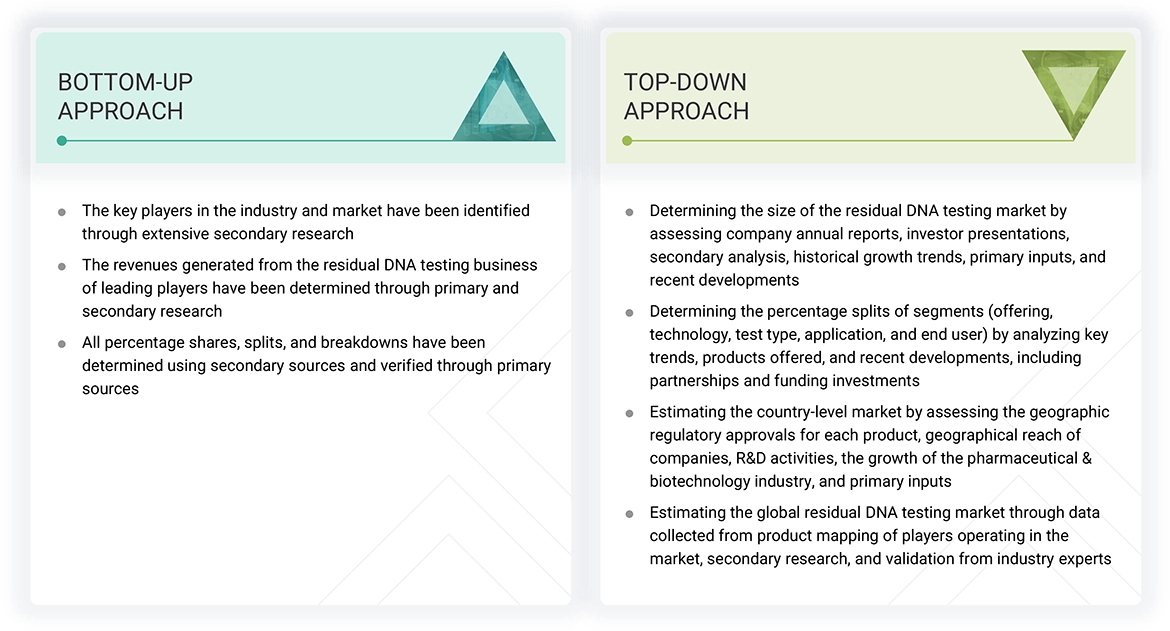
Both top-down and bottom-up approaches were used to estimate and validate the total size of the residual DNA testing market. These methods were also used extensively to estimate the size of various subsegments in the market. The research methodology used to estimate the market size includes the following:
Data Triangulation
The total market was split into several segments and subsegments after arriving at the overall market size from the estimation process. Where applicable, data triangulation and market breakdown procedures were employed to complete the overall market engineering process and arrive at the exact statistics for all segments and subsegments. The data was triangulated by studying various factors and trends from both the demand and supply sides.
Market Definition
Residual DNA testing involves the detection and quantification of DNA impurities from host cells present in biopharmaceutical products. This testing is a critical component in the quality assurance of biologics, as it assesses the levels of residual DNA that may remain in the final product, bulk intermediates, or raw materials post-purification. The market for residual DNA testing encompasses a diverse array of analytical tools and services tailored to meet stringent regulatory requirements. Compliance with guidelines established by the FDA, WHO, and GxP standards necessitates a thorough evaluation of host cell DNA to mitigate risks and ensure safety and efficacy in biologics. This regulatory landscape makes residual DNA testing a vital focus area in the development and manufacturing of biologic products, emphasizing the need for precision and reliability in these assessments.
Stakeholders
- Pharmaceutical & biotechnology companies
- Academic researchers and government research organizations
- Private research institutes
- Custom residual DNA testing service providers
- Contract development & manufacturing organizations (CDMOs)
- Life Science Companies
- Contract research organizations (CROs)
- Market research & consulting firms
- Venture capitalists
Report Objectives
- To define, describe, and forecast the global residual DNA testing market by offering, technology, test type, application, end user (product), end user (service), and region
- To provide detailed information regarding the major factors influencing the growth of the market (such as drivers, restraints, challenges, and opportunities)
- To strategically analyze micromarkets with respect to individual growth trends, prospects, and contributions to the overall residual DNA testing market
- To analyze opportunities in the market for stakeholders and provide details of the competitive landscape for market leaders
- To forecast the size of the market segments with respect to six regions: North America, Europe, the Asia Pacific, Latin America, the Middle East, and Africa
- To strategically profile the key players and comprehensively analyze their product portfolios, market positions, and core competencies
- Track and analyze competitive developments such as acquisitions, product launches, expansions, agreements, partnerships, and R&D activities in the residual DNA testing market.
- To analyze and provide funding & investment activities, brand/product comparative analysis, and vendor valuation & financial metrics of the residual DNA testing market.
Get the Full Residual DNA Testing Market Report
Full forecast, segment splits, and company analysis for all Residual DNA Testing Market.
- Canada Residual DNA Testing Market
- US Residual DNA Testing Market
- Germany Residual DNA Testing Market
- UK Residual DNA Testing Market
- France Residual DNA Testing Market
- Italy Residual DNA Testing Market
- Spain Residual DNA Testing Market
- China Residual DNA Testing Market
- Japan Residual DNA Testing Market
- India Residual DNA Testing Market
- South Korea Residual DNA Testing Market
- Australia Residual DNA Testing Market
- Brazil Residual DNA Testing Market
- Mexico Residual DNA Testing Market
- UAE Residual DNA Testing Market
- Rest Of Europe Residual DNA Testing Market
- Rest Of Asia Pacific Residual DNA Testing Market
- Rest Of Latin America Residual DNA Testing Market
- Rest Of GCC Countries Residual DNA Testing Market
- Saudi Arabia Residual DNA Testing Market
- Rest Of Middle East Residual DNA Testing Market
Need a Tailored Report?
Customize this report to your needs
Get 10% FREE Customization
Customize This Report
