
Rest Of Asia Pacific Road Marking Materials Market (2026-2031)

The Rest Of Asia Pacific Road Marking Materials Market was valued at $615.7 Million in 2026 and projected to reach to $826.9 Million by 2031, representing a compound annual growth rate of 6.1%. Rest Of Asia Pacific is positioned as a high-growth market for road marking materials, driven by unprecedented infrastructure development and urbanization across emerging economies.


| Market Size in | USD 26.32 MN |
| Market Forecast in | |
| CAGR | |
| Forecast Period | |
| Units Considered | Value (USD MN) |
Rest Of Asia Pacific Road Marking Materials Market Trends and Insights
- Rest Of Asia Pacific represents a critical growth corridor for road marking solutions, driven by rapid infrastructure development, urbanization, and increased road safety investments across emerging economies.
- The region's expanding transportation networks and government initiatives to modernize highway systems are fueling demand for durable, high-visibility marking materials. Rest Of Asia Pacific's market expansion reflects rising vehicle ownership, growing logistics sectors, and enhanced regulatory focus on road safety standards.
- Between 2026 and 2031, Rest Of Asia Pacific is expected to capture significant market share as countries invest in smart city projects and road infrastructure upgrades.
- The region's competitive landscape features both established manufacturers and emerging local players adapting products to regional climate conditions and regulatory requirements, positioning Rest Of Asia Pacific as a dynamic market with sustained growth potential..
Key Market Statistics
- CAGR (2026-2031) 6.1% CAGR
- Market Size, 2026 ~USD 615.7 Million
- Forecast, 2031 ~USD 826.9 Million
- Country Rest Of Asia Pacific
Rest Of Asia Pacific Road Marking Materials Market Overview
Market Valuation Growth :
Rest Of Asia Pacific road marking materials market valued at USD 615.7 million in 2026, expanding to USD 826.9 million by 2031, representing a robust 6.1% CAGR outpacing the global average of 5.1%.
Infrastructure Development Driver :
Rapid urbanization and massive infrastructure investments across emerging economies in Rest Of Asia Pacific are accelerating demand for advanced road marking solutions and safety compliance materials.
Regional Growth Acceleration :
Rest Of Asia Pacific demonstrates faster growth momentum compared to global benchmarks, driven by increasing road safety regulations, government spending on transportation networks, and rising vehicle ownership rates.
Emerging Market Opportunities :
Developing nations within Rest Of Asia Pacific present untapped potential for road marking material suppliers, with growing investments in highway expansion, smart city projects, and traffic management infrastructure.
Rest Of Asia Pacific Road Marking Materials Market Dynamics
- Government initiatives focused on road safety, coupled with increasing vehicle registrations and highway expansion projects, are creating sustained demand for innovative marking solutions including thermoplastic, paint-based, and reflective materials. The region's 6.1% CAGR significantly outpaces global growth, reflecting strong economic development and prioritization of transportation infrastructure.
- Market expansion will be supported by stricter safety regulations, smart city initiatives, and rising awareness of road safety standards.
- Key growth opportunities exist in tier-2 and tier-3 cities experiencing rapid motorization and infrastructure modernization..
Market Ecosystem
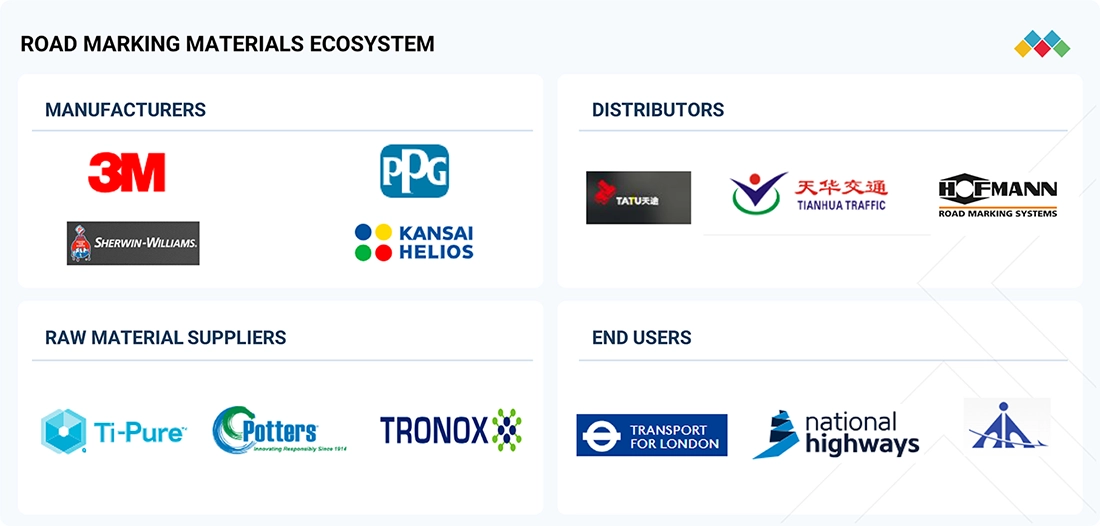
ROAD MARKING MATERIALS MARKET: COMMERCIAL USE CASES ACROSS INDUSTRIES
| COMPANY | USE CASE DESCRIPTION | BENEFITS |
|---|---|---|
 |
Supplies high-performance road marking paints, thermoplastic materials, and specialty traffic coatings for highways, urban roads, airports, parking facilities, and industrial infrastructure. Supports durable pavement marking solutions that enhance lane guidance, traffic management, and roadway safety while maintaining long-term performance under demanding environmental and traffic conditions. | Provides excellent durability, weather resistance, and color retention while maintaining high visibility throughout the service life of the marking. Supports rapid application and reduced maintenance requirements, improving operational efficiency and enhancing roadway safety for both day and night driving conditions. |
 |
Supplies advanced pavement marking coatings, traffic paints, and reflective road marking materials for highways, municipal roads, airports, and transportation infrastructure. Supports high-performance road marking systems designed to deliver reliable performance in high-traffic environments while meeting modern infrastructure and sustainability requirements | Delivers superior adhesion, abrasion resistance, and long-lasting reflectivity to improve lane visibility and traffic guidance. Enhances pavement marking durability, reduces maintenance frequency, and contributes to safer and more efficient transportation networks. |
 |
Manufactures thermoplastic road marking materials, cold plastic systems, glass beads, and intelligent road marking solutions for highways, city streets, pedestrian crossings, bicycle lanes, and airports. Supports integrated traffic management and road safety applications through durable, high-visibility pavement marking technologies. | Provides outstanding retro reflectivity, wear resistance, and long-term performance under heavy traffic conditions. Enhances driver guidance, improves road user safety in all lighting conditions, and reduces lifecycle maintenance costs through durable marking solutions. |
 |
Supplies pavement marking tapes, reflective materials, and advanced traffic safety solutions for highways, intersections, work zones, airports, and urban transportation infrastructure. Supports permanent and temporary road marking applications that require high visibility, durability, and consistent performance in demanding operating environments. | Delivers exceptional reflectivity in both wet and dry conditions while improving lane recognition and driver guidance. Enables faster installation with minimal traffic disruption and provides long-lasting performance that enhances roadway safety and reduces maintenance requirements. |
 |
Supplies thermoplastic, cold plastic, MMA, and decorative road marking materials for highways, pedestrian crossings, bicycle lanes, parking facilities, airports, and urban mobility projects. Supports sustainable transportation infrastructure by providing durable, high-performance road marking solutions for a wide range of pavement applications | Offers excellent wear resistance, UV stability, and long-term color retention while maintaining high visibility throughout the product lifecycle. Supports fast curing, improves road safety in diverse weather conditions, and enables durable, cost-effective, and sustainable pavement marking solution |
Logos and trademarks shown above are the property of their respective owners. Their use here is for informational and illustrative purposes only.
Related Ecosystem
Adhesives And Sealants
- Alkyd Resins
- Polyurethane Resin
- Epoxy Resin
- Polyester Resin
- Polyolefin
- 3M COMPANY
- HENKEL AG AND CO. KGAA
- H.B. Fuller Company
- Sika ag
- DOW CHEMICAL COMPANY
Key Takeaways
- Rest Of Asia Pacific road marking materials market will grow from USD 615.7M (2026) to USD 826.9M (2031), representing a 6.1% CAGR.
- Rest Of Asia Pacific's growth is driven by infrastructure modernization, urbanization, and increased government investment in road safety across emerging economies.
- Rest Of Asia Pacific's market benefits from rising vehicle ownership and expanding logistics networks requiring enhanced road visibility and safety standards.
- Rest Of Asia Pacific features a competitive mix of multinational and local manufacturers adapting solutions to regional climate and regulatory conditions.
Road Marking Materials Market Report Scope
| Report Metric | Details |
|---|---|
| Base Year | 2026 |
| Fastest Growing Segment | -COLD PLASTIC (Type) |
| Forecast Period | 2026-2031 |
| Growth Rate | CAGR of 5.1% from 2026 to 2031 |
| Largest Segment | ROAD & HIGHWAY MARKING (Application) |
| Market Size Base Year (Billions) | ~USD 7.31 (2026) |
| Revenue Forecast (Billions) | ~USD 9.38 (2031) |
| Segments Covered | Type, Application |
Rest Of Asia Pacific Road Marking Materials Market Report Segmentation
2 segment dimensions are covered across the global market.
By Type
- Paint-Based Markings
- Performance-Based Markings
- -Cold Plastic
- -Solvent-Based
- -Thermoplastic
- -Water-Based
By Application
- Airport Marking
- Antiskid Marking
- Factory Marking
- Other Applications
- Parking Lot Marking
- Road & Highway Marking
Target Audience
- Road Marking Material Manufacturers : Need regional market data to identify expansion opportunities, assess competitive dynamics, and develop localized product portfolios aligned with Rest Of Asia Pacific safety standards and infrastructure requirements.
- Infrastructure & Construction Companies : Require market insights to forecast material procurement needs, budget planning for highway projects, and supplier selection strategies across emerging economies in Rest Of Asia Pacific.
- Government & Transportation Agencies : Utilize market analysis for policy development, infrastructure investment planning, road safety program budgeting, and standardization initiatives specific to Rest Of Asia Pacific regions.
- Distributors & Supply Chain Partners : Need regional demand forecasts and market sizing to optimize inventory management, identify high-growth markets, and develop distribution strategies for road marking materials across Rest Of Asia Pacific.
- Investment & Strategy Consultants : Require comprehensive market data to advise clients on market entry strategies, M&A opportunities, and growth potential in Rest Of Asia Pacific's emerging road marking materials sector.
Reasons to Buy this Report
- Regional Growth Outperformance : Gain competitive intelligence on Rest Of Asia Pacific's 6.1% CAGR, which exceeds global benchmarks by 100 basis points, enabling strategic market entry and expansion planning in high-growth emerging economies.
- Infrastructure Investment Tracking : Access detailed insights into government-led infrastructure projects, highway expansion initiatives, and smart city developments driving road marking material demand across Rest Of Asia Pacific markets.
- Market Sizing & Forecasting : Leverage precise market valuations (USD 615.7M in 2026 to USD 826.9M in 2031) and segment-level forecasts to optimize production capacity, supply chain planning, and resource allocation decisions.
- Competitive Positioning Strategy : Identify emerging market opportunities in tier-2 and tier-3 cities with untapped potential, enabling first-mover advantages and localized product development strategies tailored to regional safety standards.
- Risk & Opportunity Assessment : Understand regulatory landscape, urbanization trends, and vehicle ownership patterns specific to Rest Of Asia Pacific to mitigate market entry risks and capitalize on high-growth corridors.
Frequently asked questions
What is the market size of road marking materials in Rest Of Asia Pacific?
Rest Of Asia Pacific's road marking materials market is valued at USD 615.7 million in 2026 and is forecast to reach USD 826.9 million by 2031.
What is the CAGR for Rest Of Asia Pacific road marking materials market?
Rest Of Asia Pacific's road marking materials market is expected to grow at a compound annual growth rate (CAGR) of 6.1% from 2026 to 2031.
What factors are driving growth in Rest Of Asia Pacific?
Rest Of Asia Pacific's market growth is driven by rapid infrastructure development, urbanization, increased road safety investments, rising vehicle ownership, and government modernization initiatives.
Which countries are included in Rest Of Asia Pacific?
Rest Of Asia Pacific encompasses emerging and developing economies in the Asia Pacific region outside of major markets, including countries across Southeast Asia, South Asia, and Oceania.
What types of road marking materials are used in Rest Of Asia Pacific?
Rest Of Asia Pacific utilizes thermoplastic, paint-based, epoxy, and polyurethane road marking materials, with selection based on climate conditions, traffic volume, and regulatory requirements.
RESEARCH METHODOLOGY
The study involved four major activities in estimating the current size of the road marking materials market. Exhaustive secondary research was done to collect information on the market, peer markets, and parent market. The next step was to validate these findings, assumptions, and sizing with the industry experts across the road marking materials value chain through primary research. Both top-down and bottom-up approaches were employed to estimate the complete market size. Thereafter, market breakdown and data triangulation were used to estimate the market size of segments and subsegments.
Secondary Research
Secondary sources for this research study include annual reports, press releases, and investor presentations of companies; white papers; certified publications; articles by recognized authors; gold- and silver-standard websites; road marking materials manufacturing companies; regulatory bodies; trade directories; and databases. The secondary research was mainly used to obtain key information about the industry's supply chain, the total pool of key players, market classification, and segmentation according to industry trends to the bottom-most level and regional markets. It has also been used to obtain information about key developments from a market-oriented perspective.
Primary Research
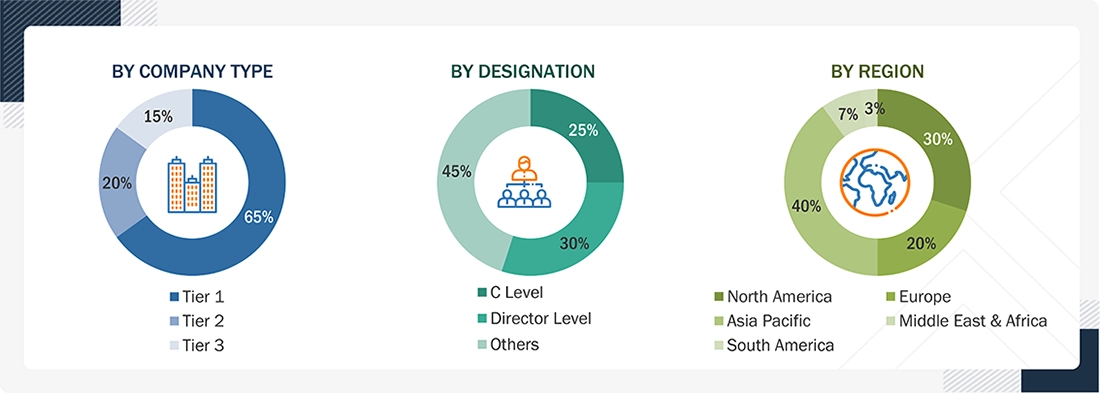
The road marking materials market comprises several stakeholders, such as raw material suppliers, technology support providers, data center plastic manufacturers, and regulatory organizations in the supply chain. Various primary sources from both the supply and demand sides of the market were interviewed to obtain qualitative and quantitative information. Primary sources from the supply side included industry experts such as Chief Executive Officers (CEOs), vice presidents, marketing directors, technology and innovation directors, and related key executives from various key companies and organizations operating in the road marking materials market. Primary sources from the demand side included directors, marketing heads, and purchase managers from various sourcing industries. The following is the breakdown of the primary respondents:
To know about the assumptions considered for the study, download the pdf brochure
Market Size Estimation
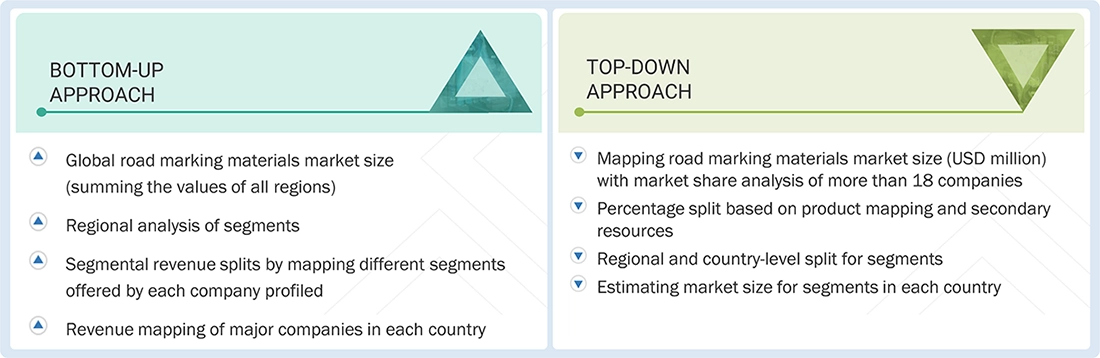
The top-down and bottom-up approaches have been employed to estimate and validate the total size of the road marking materials market. These approaches have also been used extensively to estimate the size of various dependent market subsegments. The research methodology used to estimate the market size included the following:
The following segments provide details about the overall market size estimation process employed in this study:
- Extensive primary and secondary research was done to identify the key players.
- The value chain and market size of the road marking materials market, in terms of value, were determined through primary and secondary research.
- All percentage shares, splits, and breakdowns were collected through secondary sources and verified through primary sources.
- All possible parameters that affect the market were covered in this research study and are viewed in extensive detail, verified through primary research, and analyzed to obtain the final quantitative and qualitative data.
- The study of reports, reviews, and newsletters of top market players, along with extensive interviews for opinions from key leaders, such as CEOs, directors, and marketing executives, is included in this research.
Road Marking Materials Market : Top-Down and Bottom-Up Approach
Data Triangulation
After arriving at the overall market size using the market size estimation processes as explained above, the market was split into several segments and sub-segments. To complete the overall market engineering process and arrive at the exact statistics of each market segment and subsegment, the data triangulation and market breakdown procedures were employed, wherever applicable. The data was triangulated by studying various factors and trends from both the demand and supply sides.
Market Definition
The global road marking materials market is gaining momentum as governments and infrastructure developers emphasize safer road networks, efficient traffic management, and improved roadway durability. The increasing requirement for high-performance marking solutions that provide better visibility, resistance to wear, and consistent performance under varying environmental conditions is encouraging the adoption of advanced materials and application technologies. Developments in thermoplastic, cold plastic, epoxy, and reflective marking systems are enabling longer-lasting solutions for diverse infrastructure applications, including highways, airports, parking facilities, and industrial areas. Additionally, the growing focus on sustainable construction practices and reduced maintenance requirements is driving innovation in eco-friendly formulations and advanced road marking technologies.
Key Stakeholders
- Road marking materials manufacturers, processors, and recycling technology providers
- Research institutions, standards organizations, and regulatory agencies such as ASTM, ISO, and others
- NGOs, governments, investment banks, venture capitalists, and private equity firms
Report Objectives
- To define, describe, and forecast the market size of road marking materials in terms of value
- To provide detailed information regarding the key factors, such as drivers, restraints, opportunities, and industry-specific challenges, influencing the growth of the road marking materials market
- To analyze and forecast the global road marking materials market on the basis of type, application, and region
- To analyze the opportunities in the market for stakeholders and provide details of a competitive landscape for market leaders
- To forecast the size of various market segments based on four major regions: North America, Asia Pacific, Europe, Middle East & Africa and South America along with their respective key countries
- To track and analyze the competitive developments, such as product launches, expansions, and others, in the market
- To strategically profile the key players and comprehensively analyze their market shares and core competencies
Available customizations:
With the given market data, MarketsandMarkets offers customizations according to the client-specific needs.
The following customization options are available for the report:
- Additional country-level analysis of the road marking materials market
- Profiling of additional market players (up to 5)
Product Analysis
- Product matrix, which provides a detailed comparison of each company's product portfolio.
Get the Full Road Marking Materials Market Report
Full forecast, segment splits, and company analysis for all Road Marking Materials Market.
- US Road Marking Materials Market
- Canada Road Marking Materials Market
- Mexico Road Marking Materials Market
- Germany Road Marking Materials Market
- France Road Marking Materials Market
- UK Road Marking Materials Market
- Russia Road Marking Materials Market
- Turkey Road Marking Materials Market
- China Road Marking Materials Market
- India Road Marking Materials Market
- Japan Road Marking Materials Market
- South Korea Road Marking Materials Market
- Brazil Road Marking Materials Market
- Argentina Road Marking Materials Market
- Rest Of Europe Road Marking Materials Market
- GCC Road Marking Materials Market
- -Rest Of GCC Road Marking Materials Market
- Rest Of South America Road Marking Materials Market
Need a Tailored Report?
Customize this report to your needs
Get 10% FREE Customization
Customize This Report
